






Abstract
A balanced ratio of ocean to land is believed to be essential for an Earth-like biosphere, and one may conjecture that plate-tectonics planets should be similar in geological properties. After all, the volume of continental crust evolves toward an equilibrium between production and erosion. If the interior thermal states of Earth-sized exoplanets are similar to those of Earth—a straightforward assumption due to the temperature dependence of mantle viscosity—one might expect a similar equilibrium between continental production and erosion to establish, and hence a similar land fraction. We show that this conjecture is not likely to be true. Positive feedback associated with the coupled mantle water—continental crust cycle may rather lead to a manifold of three possible planets, depending on their early history: a land planet, an ocean planet, and a balanced Earth-like planet. In addition, thermal blanketing of the interior by the continents enhances the sensitivity of continental growth to its history and, eventually, to initial conditions. Much of the blanketing effect is, however, compensated by mantle depletion in radioactive elements. A model of the long-term carbonate–silicate cycle shows the land and the ocean planets to differ by about 5 K in average surface temperature. A larger continental surface fraction results both in higher weathering rates and enhanced outgassing, partly compensating each other. Still, the land planet is expected to have a substantially dryer, colder, and harsher climate possibly with extended cold deserts in comparison with the ocean planet and with the present-day Earth. Using a model of balancing water availability and nutrients from continental crust weathering, we find the bioproductivity and the biomass of both the land and ocean planets to be reduced by a third to half of those of Earth. The biosphere on these planets might not be substantial enough to produce a supply of free oxygen.
1. Introduction
In the absence of observable unique biomarkers, the search for life beyond the solar system focuses on the search for habitable planets (e.g., Segura and Kaltenegger, 2010). The concept of the circumstellar habitable zone (CHZ) around a host star has long been established (Hart, 1979; Huggett, 1995) and developed further (see e.g., Cockell et al., 2016 and Ramirez, 2018 for reviews). The CHZ is defined as the zone of orbits in which a planet would have surface temperatures that allow the presence of liquid water, thus recognizing the importance of water for life as we know it (e.g., Brack et al., 2010). The boundaries of the habitable zone not only depend on the luminosity of the star but also on the atmosphere pressure at the surface of the planet and on atmospheric chemistry, i.e., on the concentration of the atmosphere greenhouse gases, carbon dioxide (CO2) and methane (e.g., Lammer et al., 2009).
More recent discussions of planetary habitability go beyond stellar luminosity and atmosphere chemistry to include other planetary properties such as the ratio between land- and water-covered surface areas, diversity of geologic provinces, magnetic fields, and processes such as plate tectonics that drive the planetary engine and its evolution (e.g., Heller and Armstrong, 2014; Lingam and Loeb, 2018, 2019, 2021; Glaser et al., 2020; Schulze-Makuch et al., 2020).
Having both emerged continents and oceans on the Earth is an outcome of plate tectonics. About 40% of Earth's surface is covered with continental crust, of which 87% is emerged; 13% of the area is continental shelf area and covered by water. Emerged land provides easy access to solar energy, and weathering of continental crust rock provides essential nutrients for the biosphere. As a result, most of the biomass is found on continents and their shelves, while the deep ocean biomass is much lower (e.g., Behrenfeld and Falkowski, 1997; Gray, 1997; Kallmeyer et al., 2012), even though the net primary production (NPP) from oceans is similar to that from land (Field et al., 1998).
The importance of a suitable balance between land- and ocean-covered surface areas for life as-we-know-it has recently been emphasized by Lingam and Loeb (2019, 2021) and Glaser et al. (2020). The required balance is a consequence of the need for water on the one hand and nutrients such as phosphorus and nitrogen on the other. On a land-dominated planet with minimal water, the biological productivity should be low due to water limitations. Ocean-dominated planets could be stymied by the lack of nutrients. If phosphorous is the productivity limiting nutrient (e.g., Kamerlin et al., 2013), then the increased weatherability of subaerial continental rock by slightly acidic rainwater gives land surfaces an edge over the ocean floors. The buildup of free oxygen in the atmosphere for more advanced life is likewise favored by continental crust weathering that produces the sediments in which organic carbon is buried and removed from oxidization.
Lingam and Loeb (2019, 2021) discussed a simple parameterization of the NPP and the biomass as functions of the land–ocean surface ratio. They found both functions to be maximized at the present-day Earth ratio and to decrease by an order of magnitude as one goes to land-dominated (1–2σ) or ocean-dominated worlds. We note that the Earth-like land–ocean ratio would tend to maximize the extent of continental shelf areas where life will profit from solar insolation and the riverine entry of dissolved nutrients. Lingam and Loeb (2019, 2021) also found that oxygen can build up in worlds that have a water coverage between roughly 25% and 85%. Thus, planets with a balance of landmasses and oceans might be potentially conducive to hosting rich biospheres. In addition to the land–ocean distribution, the surface temperature will matter for the bioproductivity, as has been emphasized recently by Heller and Armstrong (2014), Lingam and Loeb (2018), and Schulze-Makuch et al. (2020).
It is well established that the concentration of CO2 in Earth's atmosphere is buffered by the long-term carbonate–silicate cycle (e.g., Kasting et al., 1993), thereby stabilizing the atmosphere temperature and clement conditions. Negative feedback in the cycle causes the atmospheric CO2 to attain an equilibrium between carbon outgassing and recycling (e.g., Isson et al., 2020; Lehmer et al., 2020). Plate tectonics is a central element of the modern cycle, exchanging CO2 between the atmosphere and the mantle reservoirs through volcanism and subduction, and the rate of outgassing is a function of the interior properties of the planet. The surface temperature is buffered as the rate of removal of CO2 from the atmosphere through rain and weathering of continental crust—the latter a product of plate tectonics—increases with increasing temperature (e.g., Walker et al., 1981; Kasting et al., 1993; Foley, 2015).
Weathering of continental crust results in carbon fixation, and its rate depends on the continental surface area and the topography. Water is the main agent for transporting CO2 from the atmosphere to the surface and for transporting weathering products, including nutrients from the continents to the oceans and eventually to the subduction zones, where CO2 is then returned to the mantle. Similar to CO2, water is cycled by plate tectonics through the mantle, and mantle outgassing may have been a major source of the present ocean mass (e.g., Elkins-Tanton, 2011). The oceans provide the single most important thermal reservoir for buffering the surface temperature (e.g., Bindoff et al., 2007; Cheng et al., 2019; von Schuckmann et al., 2020), and they provide a sink for atmospheric CO2 on short timescales (e.g., Pierrehumbert, 2010).
The operation of plate tectonics, as is the case on present-day Earth, is vital to the long-term carbon cycle outlined above. Venus may have had surface recycling (e.g., Crameri, 2017), but its hypsometric curve is unimodal (e.g., Rosenblatt et al., 1994). While there are units that resemble terrestrial rifts and ridges such as Beta Regio, there is no clear indication of subduction zones and continental crust, although Ishtar Terra as a high elevation physiographic province resembles a terrestrial continent (Ivanov and Head, 2011). Rather, it seems more likely that Venus has a continuous lithosphere. While Venus may be debated (Davaille et al., 2017), the smaller planets Mars and Mercury are widely agreed to have continuous outer shells termed stagnant-lid lithospheres. Planetary mantle convection modeling finds stagnant lids to form naturally as a consequence of a temperature-dependent rheology of mantle rock (e.g., Stein and Hansen, 2008), while subduction and plate-like behavior require additional strain-related mechanisms for which water may be important (e.g., Bercovici, 2003).
Uncertainties in estimates of the interior properties of exoplanets have significant effects on assessments of their habitability (e.g., Seales and Lenardic, 2020). For example, uncertainties in the concentrations of heat producing elements will naturally affect estimates of the outgassing rates and the evolution of the surface temperature (e.g., O'Neill et al., 2020; Oosterloo et al., 2021; Unterborn et al., 2022). It has even been suggested that there may be feedback between the surface temperature and the tectonic regime (plate tectonics vs. stagnant lid) that could result in irreversible bifurcation between the two modes (Weller et al., 2015; Weller and Lenardic, 2018).
Another key uncertainty in exoplanet evolution is the initial mantle temperature. Theoretical considerations and simple thermal history models suggest that differences in the initial mantle temperature should become insignificant after ∼1 Gyr of evolution due to the temperature dependence of mantle viscosity (e.g., Tozer, 1967), at least for planets less massive or as massive as the Earth (Kruijver et al., 2021). Therefore, one might conclude that the climate at 4.5 Gyr should be largely independent of the initial mantle temperature. This conjecture, however, neglects feedback associated with the growth of continental crust, which we explore in this article.
Even for Earth-sized planets with plate tectonics, it is not given that the surface would have a balanced ocean-to-land coverage similar to that of Earth. Höning and Spohn (2016) and Höning et al. (2019a) argued that—depending on initial conditions—the evolution of a plate tectonic Earth-like planet would rather result in a planet mostly covered by continents or mostly covered by oceans (Fig. 1). In their analysis, the continental crust and the water cycles are feedback cycles with either one or three fixed points depending on whether negative feedback or positive feedback dominates, respectively. Of the three fixed points, two would be stable (pertaining to the continent and the ocean planet) and one conditionally stable (the Earth). These differences in the outcome of planetary evolution are likely to be mirrored in the climate and possibly biomass. The present climate of such a planet would retain a memory of the planet's very early evolution since the equilibrium between CO2 outgassing and silicate weathering would depend on the fraction of emerged continents and on the thermal state of the planet's interior. Their rates of change in turn would depend on the properties of the coupled continent–water system.
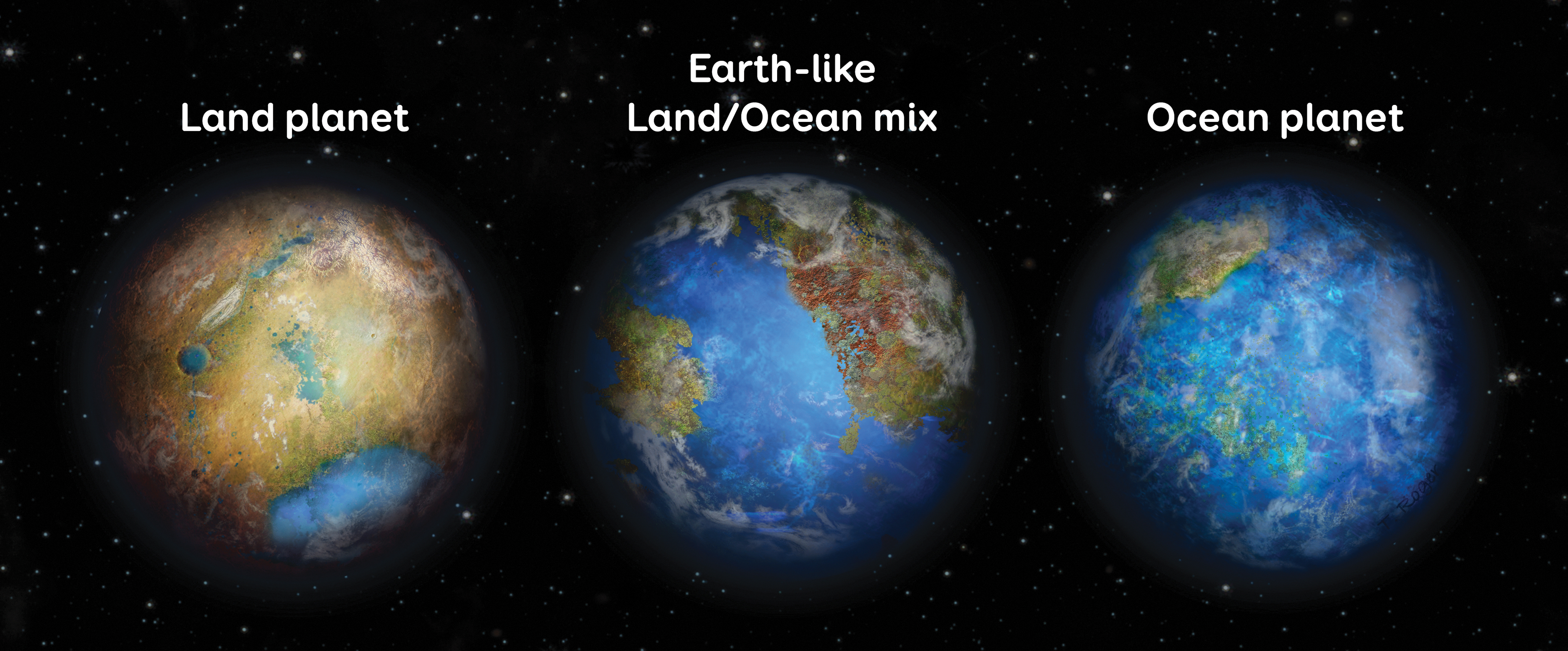
Graphical illustration of the Land Planet, Earth-like land/continent mix, and Ocean Planet. Credit: Europlanet 2024 RI/T. Roger.
The dependence of the strengths of positive and negative feedback on details of continental growth mechanisms complicates an extensive analysis of evolution pathways of (exo)planets (Höning and Spohn, 2016). Therefore, in the present article, we parameterize feedback using four dimensionless quantities. We show evolution pathways that depend on the assumed values of these quantities and then comprehensively discuss reasonable parameter choices and evolution scenarios. We extend our earlier models by analyzing the effects of insulating continents delaying mantle cooling and the opposing effect of a depletion of mantle radioactive isotopes with continental growth. Furthermore, we calculate average surface temperatures for the model planets using a model of the carbonate–silicate cycle and estimate the NPP and biomass following Lingam and Loeb (2021). We present our models in a three-dimensional (3D) phase space spanned by continental coverage, mantle water concentration, and mantle temperature as variables.
In the following section, we begin by discussing plate tectonics from the point of view of complex nonlinear system theory. We then discuss fixed points of the system and their stability depending on dimensionless parameters that describe the strengths of positive and negative feedback. Coupling the model to a thermal evolution model of the mantle, we show how fixed points evolve with time and steer the evolution of the planet and its habitability (Section 3). This section is followed by a discussion and conclusions.
2. Mantle Thermochemical Evolution and Continental Growth as a Nonlinear System
Plate tectonics and its role in geology have been described in many publications (e.g., Sleep, 2015). In a nutshell, the Earth's surface is covered by seven major plates that move horizontally across the surface driven by solid-state convection in the mantle. The plates consist of oceanic crust and lithosphere and continental crust and lithosphere. Oceanic crust is produced by pressure release partial melting of mantle rock underneath mid-oceanic ridges and is returned to the mantle in subduction zones. The subduction zones are the places where modern plate tectonics produces continental crust by partially melting oceanic crust, subducted sediments, and mantle rock in the presence of subducted water reducing their solidus temperature (e.g., Campbell and Taylor, 1983).
Continents, despite their longevity in comparison with oceanic crust, are continuously weathered and eroded, and the resulting sediments are transported to subduction zones by surface water flow. In addition, continental crust is eroded through friction between the continental keel and the subducting slab. The rates of subduction and crust production are closely linked to the rate of mantle flow, which is governed by the rheology of mantle rock. On the scale of mantle flow, the rheology can be parameterized by an effective viscosity. The latter depends nonlinearly on mantle temperature and on the concentration of water and—to a lesser extent—of CO2 in mantle rock. In addition, the mantle viscosity is a function of pressure, which should be considered for planets more massive than 2–3 Earth masses (e.g., Kruijver et al., 2021). Since we restrict our analysis to Earth-mass planets, we neglect this dependence here.
Sediments play important roles in subduction zone processes, and in this article, they play a decisive role: The erosion rate of the continents is proportional to their area and thus provides negative feedback limiting their growth. As carriers of water, however, sediments contribute to water transport (Hacker, 2008; Deschamps et al., 2013) in subduction zones and provide positive feedback increasing the continental growth rate. Moreover, Sobolev and Brown (2019) argued that sediments are essential for keeping plate tectonics running by lubricating the subducting plate.
While mid-oceanic ridges are the most prominent source regions of mantle water entering the oceans and the atmosphere, subduction zones are the major sink regions for surface water. Today, about 1.8 · 1012 kg of water enter subduction zones each year mainly in hydrous minerals in sediments and hydrated basaltic crust (Jarrard, 2003). Significant, but difficult to constrain (e.g., Höning et al., 2014), quantities of the subducted water are expelled at shallow depth, the remaining water—partly stored in serpentinites and other hydrous minerals—reaches the source region of continental crust rock where hydrous minerals break down and release water that is consumed upon melting. The remainder of the water is subducted deeper into the mantle where it is eventually incorporated into nominally anhydrous minerals (Bell and Rossman, 1992). Consequently, mantle viscosity is reduced (Hirth and Kohlstedt, 2003) and the rate of mantle convection flow increased. The water is transported in the convection flow toward mid-oceanic ridges where part of it is outgassed into the atmosphere and oceans.
Feedback associated with the growth of continental crust can also originate from its thermal properties. The continental heat flow per unit area of about 70 mW/m2 is known to be significantly smaller than the oceanic heat flow of about 105 mW/m2 (e.g., Jaupart et al., 2015). Moreover, the basal heat flow per unit area from the mantle into stable continental crust is only about 15 mW/m2. These observations suggest that the continents act as thermal blankets of the mantle reducing the heat flow and the mantle cooling rate and diverting heat flow from subcontinental to suboceanic areas. The growth of continents diverting heat flow to oceanic areas can cause immediate positive feedback (Höning et al., 2019a). However, even a reduction of the overall cooling rate introduces a sensitivity of the continental growth rate to its history.
An opposing effect to thermal blanketing of continental crust is the redistribution of heat sources during crustal growth, which may provide negative feedback. Radiogenic elements, because of their large ionic radii and their valence states, are enriched in melts that produce continental crust. The concentration of heat sources in present-day continental crust is debated, however. Estimates are based on measured heat flow values and concentrations in mantle and crustal rock (e.g., Jaupart et al., 2016). Uncertainties are due to uncertainties in the ratio between surface heat flow and mantle radiogenic heat production (Urey ratio) and the density of heat sources in the lower mantle. However, it is estimated that the modern continental crust contains between 25% and 40% of the total planetary inventory of heat sources (Dye, 2012; Jaupart et al., 2015, 2016). The transfer of heat sources from the mantle to the growing continental crust effectively cools the mantle (e.g., Spohn, 1991) and provides negative feedback by slowing down mantle convection and, thus, the production rate of new continental crust.
The above description of plate tectonics suggests that the continental crust volume, the mantle water concentration, and mantle temperature are linked through nonlinear feedback cycles, as illustrated in Fig. 2. An increase in mantle water concentration (blue) leads to a reduction of the mantle viscosity and, thereby, to an increase in the convection speed. The increased subduction rate will increase the mantle water concentration establishing positive feedback. The latter may be balanced by negative feedback associated with mantle water outgassing. The water cycle is linked to the continental crust cycle (green) through the water subduction rate. An increase in continental coverage increases the weathering and erosion rates and—assuming that the increased sedimentary volume will be subducted and contribute to water subduction—to increased rates of mantle water regassing and continental crust production. This feedback may be balanced by continental loss through erosion. The thermal evolution of the mantle (red) is linked to the mantle water cycle through mantle viscosity and to the continental cycle through thermal blanketing and mantle depletion of radiogenic elements. The role of sediments in water subduction and the insulating effect of continents determine the strength of positive feedback in the coupled system.
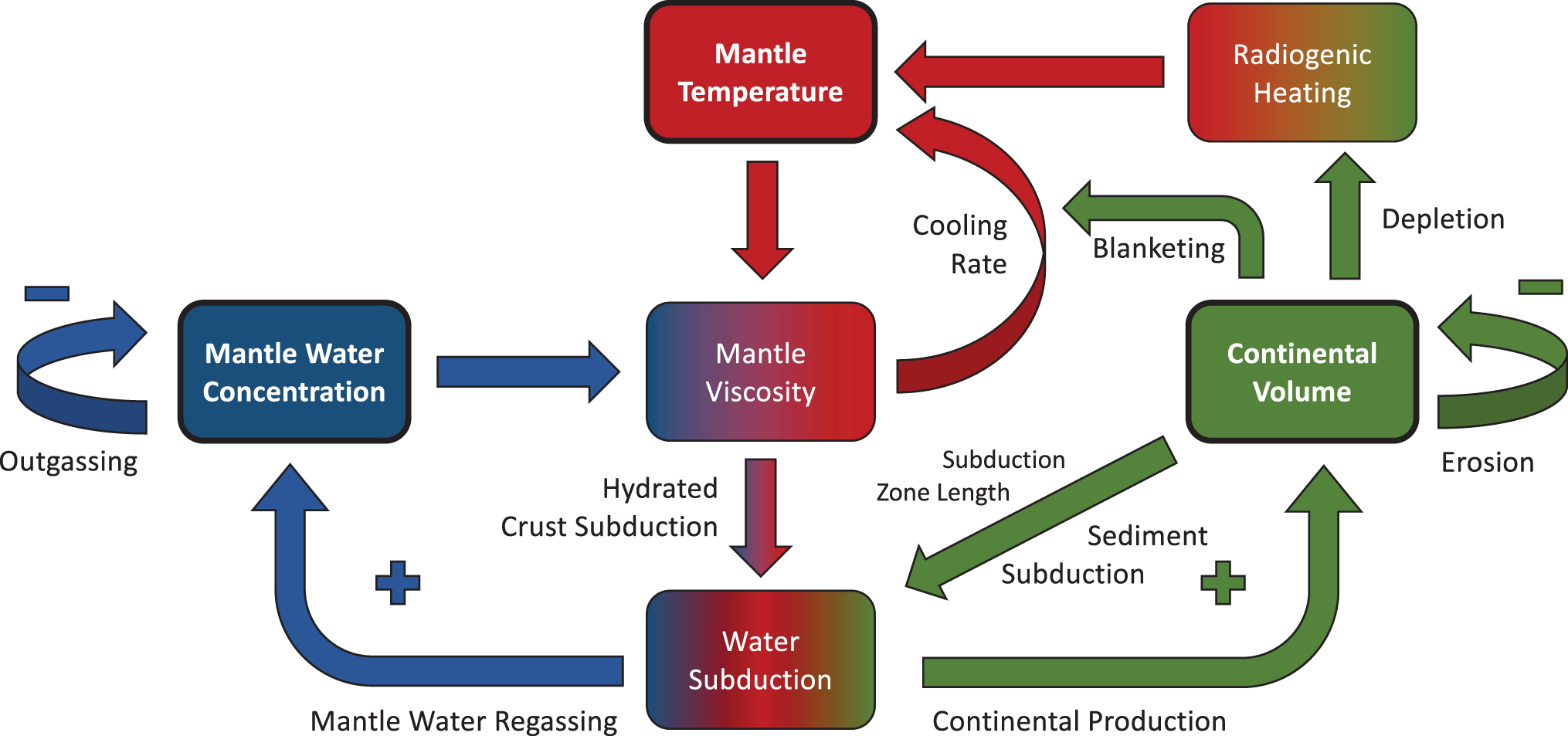
Graphical illustration of the feedback cycles linking continental coverage (green, compare Eq. 1), mantle water concentration (blue, compare Eq. 2), and mantle temperature (red, compare Eq. 3). The evolution of the former two is coupled through the subduction of water. Positive feedback—indicated by “+” signs—results from the subduction of water reducing the mantle viscosity and increasing the plate speed and the crust production rate. Increasing the continental coverage results in an increased production rate of sediments feeding additional water and rock into the melt zone from which continental crust originates. Water outgassing, surface erosion, and cooling dampen the positive feedback and are indicated by “−” signs. Continental crust growth feeds back further on the mantle temperature through thermal blanketing and transfer of radiogenic elements from the mantle to the crust.
The mantle temperature is subject to the negative feedback provided by the temperature dependence of the mantle viscosity and known as the Tozer (1967) principle. Accordingly, an increase in mantle temperature will decrease the viscosity, which will result in an increased convection and mantle cooling rate—all else being equal. There is no intrinsic positive feedback mechanism that could lead to runaway heating as long as the mantle heat source density decreases with time, but continental crust growth and the mantle water budget can feedback onto the evolution of the mantle temperature. Increased water degassing of the mantle will increase the mantle viscosity and result in reduced mantle cooling—with effects on crust growth and the water budget. Likewise, an increase in continental surface area can reduce the surface heat flow and the cooling rate—with possible readjustments of the convection system that may lead to adjustments of the plate speed. However, only in an extreme case of thermal blanketing can continental growth result in temporary mantle heating, as we show further below.
Mathematically, the nonlinear feedback system can be described by the following set of differential equations. In writing Equations 1 and 2, we follow Höning and Spohn (2016), but we simplify their equations while keeping the most important feedback terms. We complement these equations by an energy balance equation that includes the effects of continents (Eq. 3).
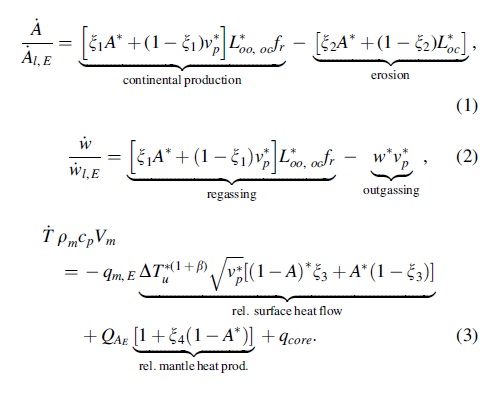
A, w, and T are the state variables of the system. A is the continental surface fraction (combined surface area of the continents divided by the surface area of the planet), w is the mantle water concentration, and T the mantle temperature;
We generally use the asterisk to denote variables scaled to present-day Earth values and the index E to denote the latter.
The depletion of mantle heat sources due to continental crust growth is modeled by the term
Parameters ξi That Control the Feedback in the Coupled System
These parameters are defined for the present-day Earth and kept constant throughout evolution. We explore wide ranges of values of ξi since these carry large uncertainties.
Equation 1 calculates the growth rate of continental crust area from a balance of continental crust production and loss through erosion. One part of the growth is directly proportional to the continental surface area. This part is a consequence of the effect of sediments on continental crust production and provides positive feedback as illustrated in Fig. 2. Its relative weight is given by the dimensionless factor ξ 1, which may take values between 0 and 1. A second contribution to the growth rate is proportional to the plate speed, which depends on the water concentration in the mantle and the mantle temperature, thereby coupling Equation 1 to Equations 2 and 3. Its relative contribution is given by (1 − ξ 1). Loss by erosion is composed of a surface erosion part depending on the continental surface area and provides negative feedback to the system. The remaining part of continental erosion is related to the friction in subduction zones (subduction erosion) and depends on the total length of ocean–continent subduction zones. It should be noted that the latter part is a function of the continental surface area.
The term describing mantle water regassing (first term on the RHS of Eq. 2) mirrors the production term in Equation 1, as both are related to the subduction of water. The regassing term altogether provides nonlinear positive feedback to the rate of change of mantle water concentration through the dependence of the plate speed on the latter (compare Fig. 2). Mantle water outgassing described by the second term on the RHS of Equation 2 is directly proportional to
Equations 1 and 2 are coupled to the energy equation (Eq. 3) through the plate speed. The latter equation balances the surface heat flow with the heat production rate in the mantle by radiogenic decay and the heat flow from the core to calculate the rate of change of mantle internal energy. The surface heat flow is coupled to the water balance through the nonlinear dependence of the mantle convection speed on the water concentration (Supplementary Appendix SC) and is calculated in terms of the present-day mantle heat flow
ξ 3 is defined as the present-day ratio between the oceanic heat flow and the mantle heat flow. It is a measure of the efficiency of the thermal blanketing of the mantle by continental crust. We discuss a case of perfectly insulating continents, for which ξ 3 = 1, as well as a case for which ξ 3 = 0.85, and for which the percentage of mantle heat flow passing through continental crust is about 15% (Jaupart et al., 2016). Neglecting continental insulation altogether requires setting ξ 3 = 0.6, which equals the share of the surface area of oceanic crust. A detailed derivation is given in Supplementary Appendix SD. Other parameter values pertaining to the present-day Earth are collected in Supplementary Tables SF1–SF3 in the Supplementary Appendix SF.
3. Results
The state variables A, w, and T span a phase space—a space in which all possible states of the system are represented by unique combinations of the state variables—in which solutions can be discussed. Equilibrium conditions within the phase space are described by
We begin by introducing the continent–water system in a phase plane evaluated at a representative present-day mantle temperature (Section 3.1). Following this, we discuss how the phase planes and the state variables evolve with temperature in 3D phase space in Section 3.2. In addition, we show time histories of selected quantities. Implications for the long-term carbon cycle are presented in Section 3.3, and the effect of thermal blanketing on the system is shown in Section 3.4.
3.1. Phase planes at constant present-day mantle temperature, fixed points, and stability
Figure 3 presents phase planes spanned by A and w at a constant representative present-day mantle temperature of 1750 K for various combinations of values of ξi and fr . The exact choice of the value of the present-day temperature is not critical and does not affect our results in any significant way because the mantle viscosity is scaled accordingly to reach this temperature at 4.5 Gyr. While values of ξi parameterize the strength of the feedback, fr describes the ratio between the present-day Earth gain rates (continental production and mantle water regassing) and loss rates (continental erosion and mantle water outgassing) and therefore shifts the fixed points in the phase plane.
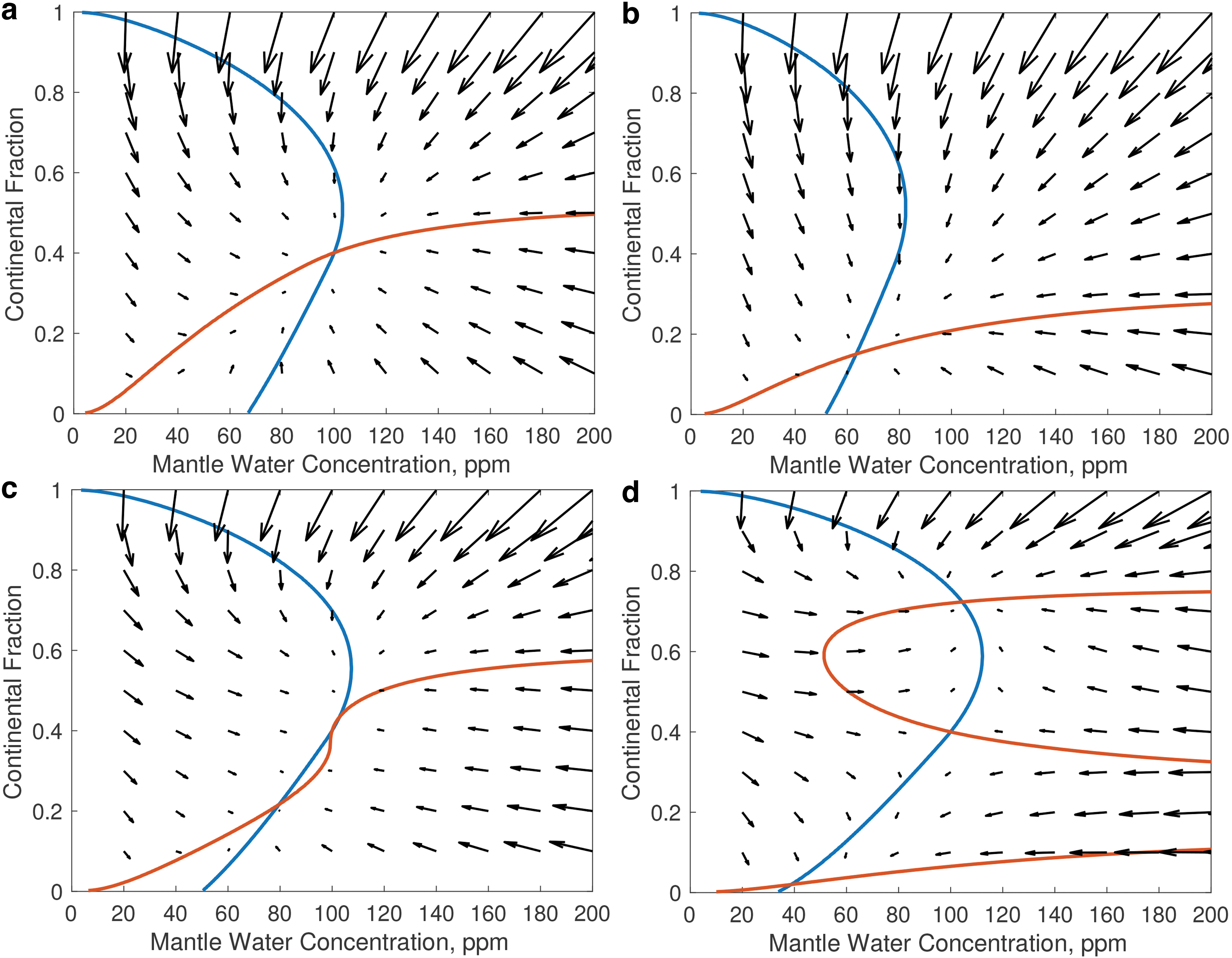
Phase planes defined by the mantle water concentration and continental coverage at the present-day mantle temperature. Shown are local arrows pointing into the directions dA/dw of evolution of A and w. In addition, graphs of the integrals of
Figure 3 displays local arrows pointing into the directions dA/dw of evolution of A and w and graphs of the integrals of
At around 50% continental surface area, the curve bends over as continents begin to dominate on the surface. For geometrical reasons, the ocean–continent subduction zones and the ocean–ocean subduction zones will shrink in length, while the length of continent–continent collision zones without subduction will increase. This will reduce the potential to subduct water. The mantle water consumption rate will then decrease with increasing A and will need to be balanced, for
The maximum of
At ξ
1 ≥ ξ
2, the integral
The graphs of the integrals of
3.2. Mantle cooling without thermal blanketing
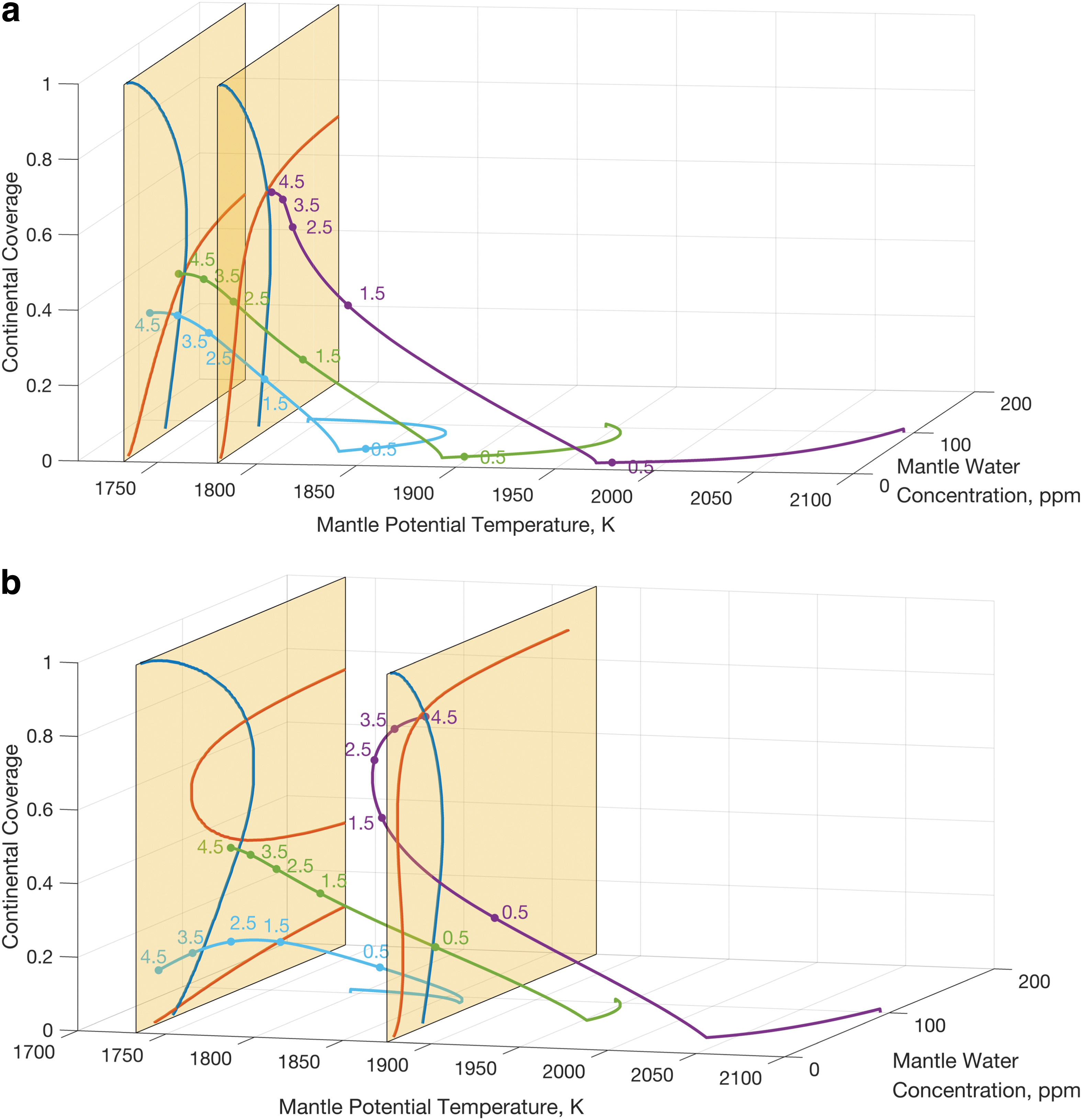
In the following, we present numerical solutions to Equations 1–3 in the A-, w-, T-phase space (Fig. 4). We also show phase planes at the present-day mantle temperature and at 1850 K, respectively, with graphs of the integrals of
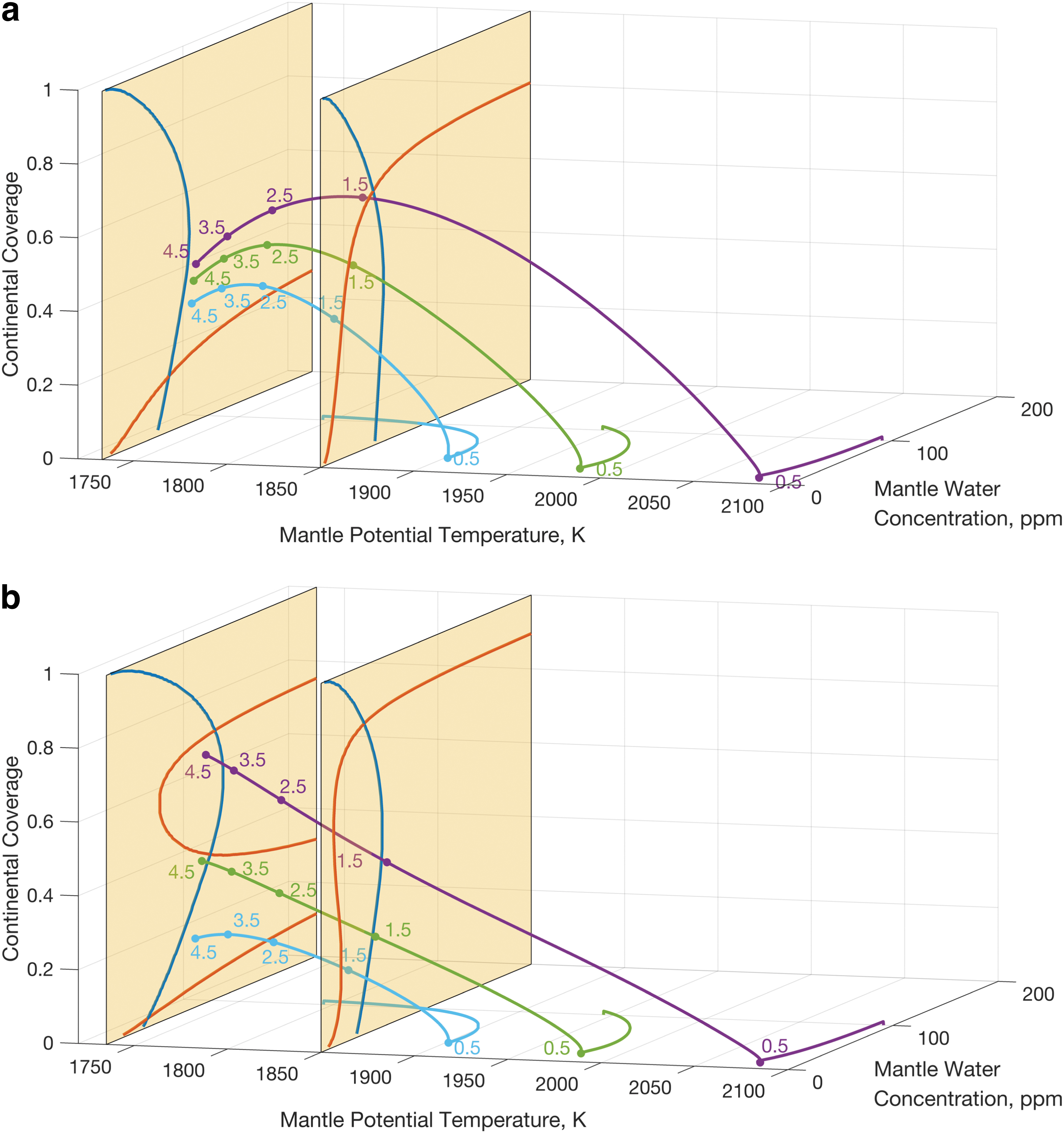
Evolution models without thermal blanketing and continental crust enrichment in radiogenic elements. Shown are trajectories in the A-, w-, T-phase space along with A-, w-phase planes at constant mantle temperatures of 1850 K and 1733 K. The latter temperature is the present-day mantle temperature in all models shown here. Time in units of Gyr is marked by dots and labeled. The model shown in
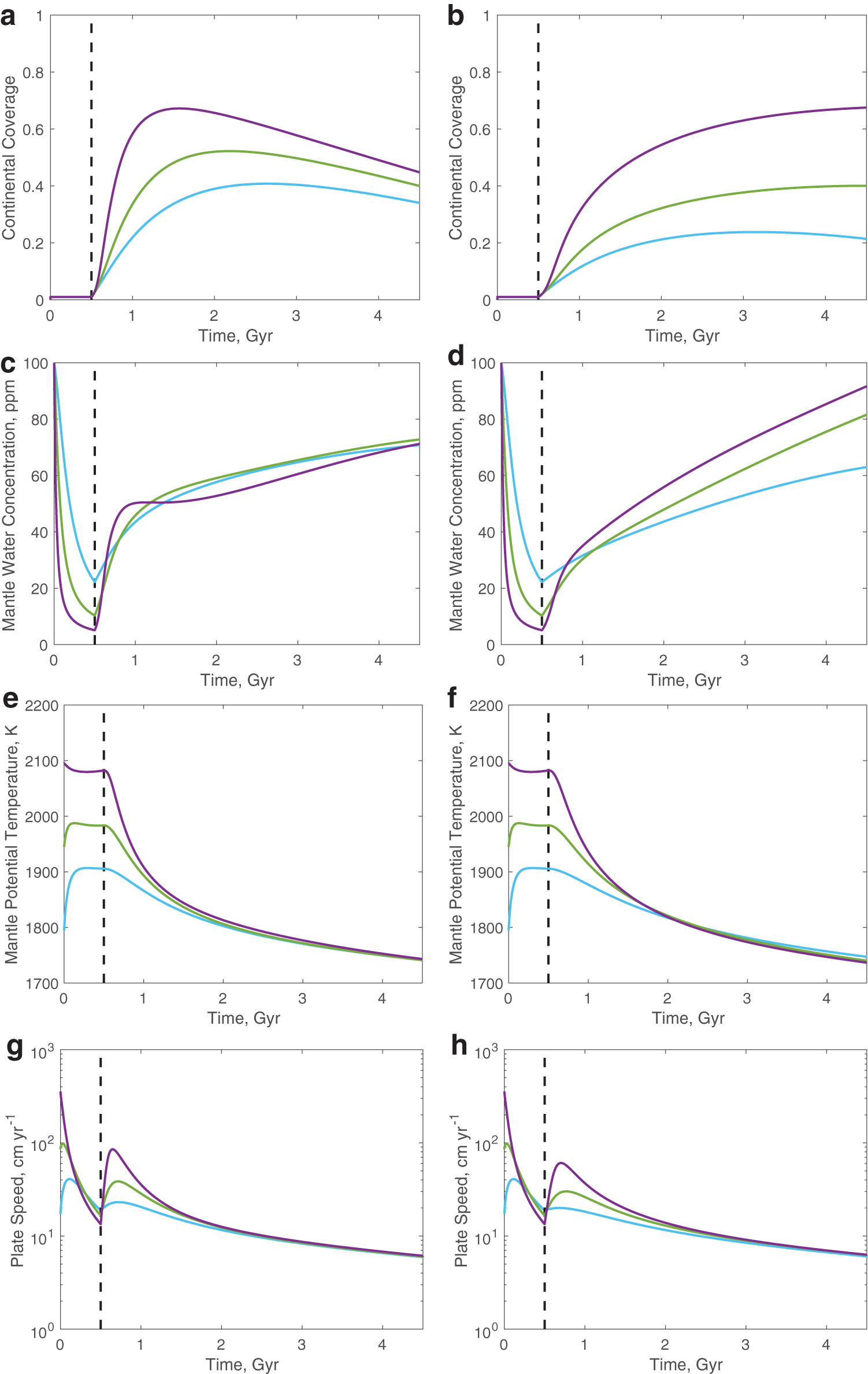
Continental coverage, mantle water concentration, temperature and plate speed over time (top to bottom) for the models of Fig. 4. Left: Negative feedback dominating, ξ 1 < ξ 2. Right: Positive feedback dominating, ξ 1 > ξ 2.
Model calculations are started at t = 0 by integrating Equations 2 and 3 with a given initial temperature
We present three models in each panel of Fig. 4 that differ by the chosen initial mantle temperature, color coded cyan, green, and purple. The initial mantle temperature for the models belonging to the green curves (1945 K) in both panels was chosen such that a continental coverage of 40% as on present-day Earth results after 4.5 Gyr. For the models belonging to the purple curves, a 150 K higher initial temperature was chosen; for the models belonging to the cyan curves the initial temperature was chosen 150 K lower. Otherwise, the models have the same parameter values. We note that at given values of ξ
1, ξ
2, and
Figure 4 shows how the number of fixed points and their locations in the phase planes change with temperature. The phase planes at 1850 K (t ≈ 1.5 Ga) in the top and bottom panels resemble each other by both showing a single fixed point. This can be understood as resulting from the strong temperature dependence of the viscosity and, hence, the flow speed
All models in Figs. 4 and 5 begin with rapid degassing of water accompanied by an adjustment of the mantle temperature depending on the chosen value of T 0 even before continents start to grow. This adjustment to initial conditions is well known from thermal evolution models (e.g., Breuer and Moore, 2015). The mantle then cools and temperatures converge until differences become insignificant after about 2 Gyr of evolution, although the models with ξ 1 > ξ 2 cool a bit slower reaching 1880 K about 200 Myr later. The plate speed shown in the bottom panels of Fig. 5 evolves similarly; after adjustment to initial conditions, differences become small after about 2 Gyr of evolution. Again, the models with ξ 1 > ξ 2 evolve less rapidly with a similar delay as for the mantle temperature.
Differences between models with dominating positive versus negative feedback, respectively, are more significant for the mantle water concentration and, even more so, for the surface coverage by continental crust. With negative feedback dominating, ξ 1 < ξ 2, the mantle water concentration adjusts rapidly to initial conditions and increases steadily after a little more than 1 Gyr, almost independent of the choice of initial mantle temperature to reach a present-day value of about 70 ppm, the equilibrium value being about 65 ppm. For positive feedback dominating, ξ 1 > ξ 2, the initial adjustment of the variables to their initial conditions at times smaller than 0.5 Gyr corresponds to the one in the model with dominating negative feedback. However, beyond 0.5 Gyr, the evolution paths diverge with greater and widening differences in mantle water concentrations and continental coverage. This is caused by the emergence of the three fixed points and the evolution paths tending toward them.
Figures 4 and 5 illustrate how positive feedback causes the present-day value of continental coverage to depend on its early evolution. Although mantle temperature values converge after a few billion years of evolution and differences in initial conditions disappear as predicted by the Tozer (1967) principle, differences in the early growth history of continental crust get emphasized if the feedback is positive as well as differences in the net mantle regassing rate persist. If negative feedback dominates, however, both continental coverage and mantle water concentration tend to converge toward their single equilibrium fixed point values. It should be noted that these equilibrium values evolve on their own with time or temperature while the state variables follow suit, although with some delay in time.
It should further be noted that the continental surface area is predicted to shrink if negative feedback dominates, while it is predicted to grow slightly or keep its level for the past 2 Gyr if positive feedback dominates. Moreover, we find a large surface coverage by continents to imply a wet mantle, while a small coverage is related to a comparatively dry mantle. This is due to the fact that both gain rates—continental production and mantle water regassing—depending on the same physical parameters that control the transport of water in subduction zones. Because we neglect the loss of water due to atmospheric escape, the complement of the mantle water is to be found at the surface as ocean water.
3.3. Implications for the long-term carbon cycle
The surface area of continental crust that emerged above sea level has a direct impact on the climate because the rates of erosion and silicate weathering increase with increasing land area (e.g., Foley, 2015; Graham and Pierrehumbert, 2020; Levenson, 2021). A planet with a larger area of emerged continents will thus have a lower concentration of CO2 in its atmosphere (all other factors being the same) and a lower surface temperature compared with a planet with a smaller land area. For details of the calculation of the CO2 degassing rate, partial pressure, and the surface temperature, see Supplementary Appendix SE. In Fig. 6, we plot the CO2 degassing rate, partial pressure, and surface temperature as functions of time for the models with dominating negative (left panels) and positive (right panels) feedback, shown in Figs. 4 and 5.
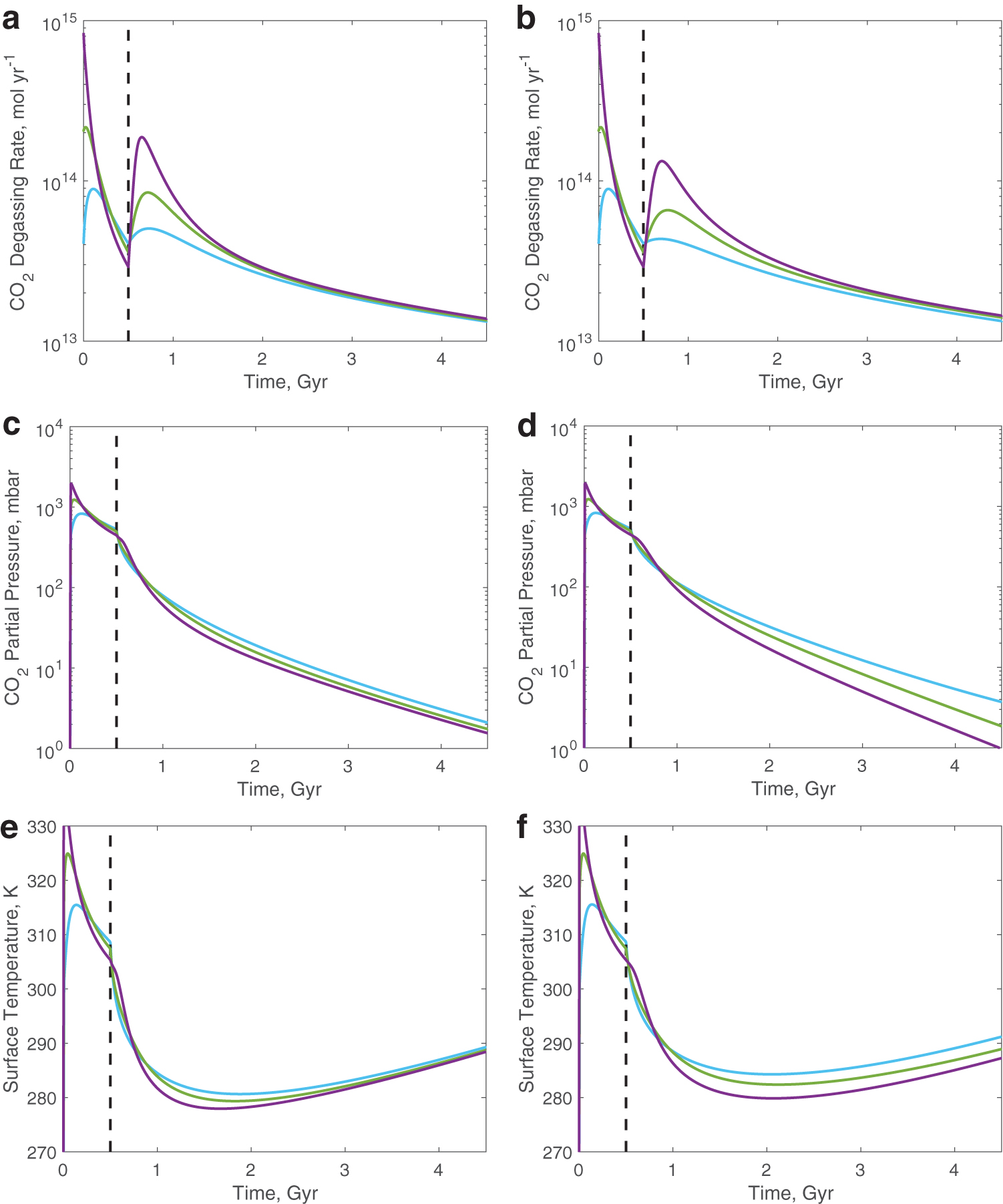
While differences in the degassing rate decrease with time and are negligible after 4.5 Gyr, the partial pressure of CO2 is lower for the model starting with 150 K higher initial mantle temperature, in particular, if positive feedback dominates. Also, vice versa for the model starting with the lower initial temperature. This observation is consistent with the differences in continental surface area. All in all, with dominating positive feedback, differences in the surface temperature by about 5 K result after 4.5 Gyr even though all other parameter values are the same.
3.4. Cooling with thermal blanketing and mantle depletion in radiogenic elements
Thermal blanketing of the mantle by the continental crust and the depletion of the mantle in radiogenic heat sources transferred to the crust can provide additional feedback between the crust growth rate and its surface area. In Fig. 7, we plot results for models with the same parameter values as in Fig. 4, but account for thermal blanketing by setting ξ
3 = 0.85 and ξ
4 = 1/4 in Equation 3. The onset time
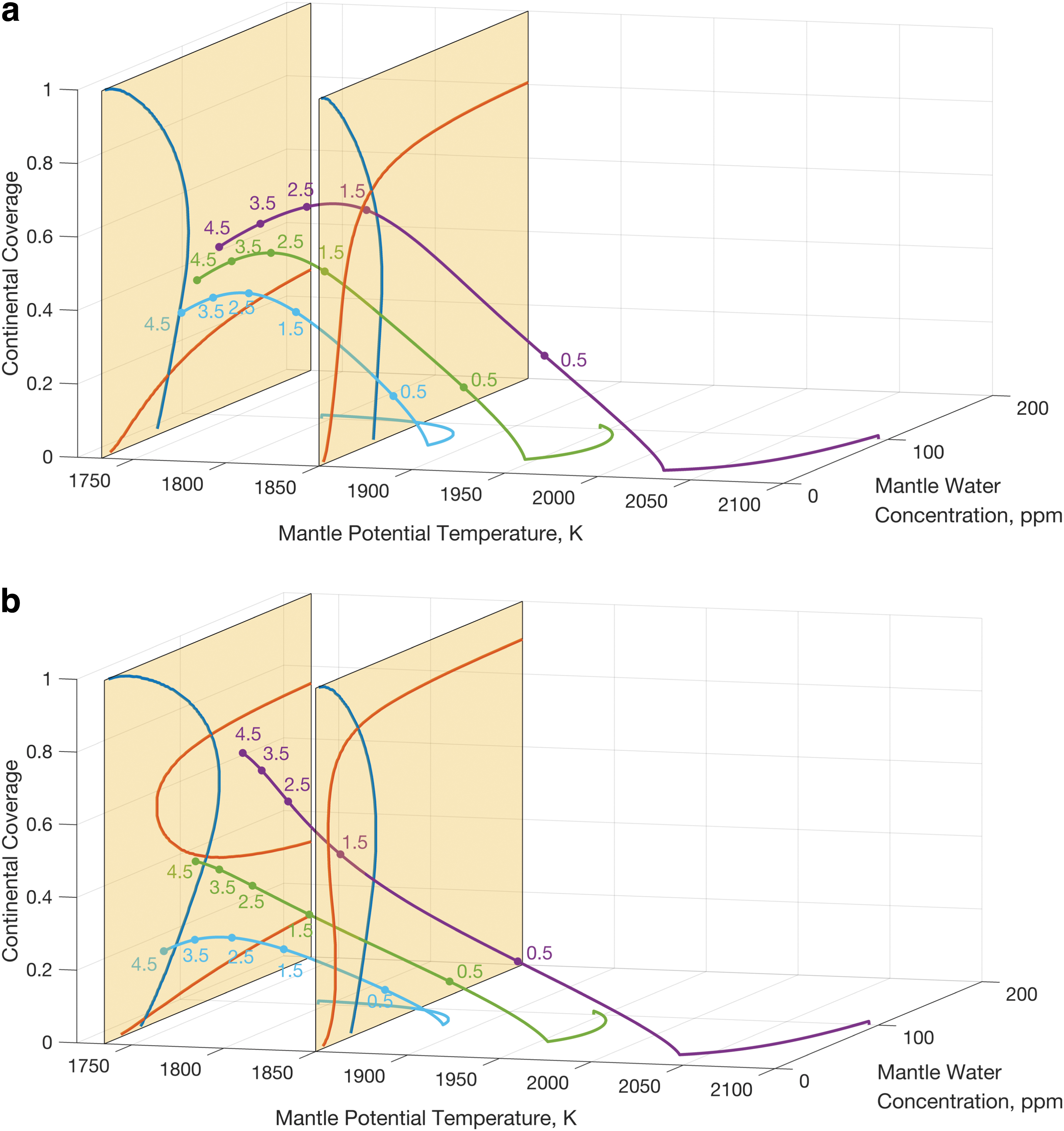
Same as Fig. 4 but with continents that are enriched in radiogenic elements and that thermally blanket the mantle.
A comparison between Figs. 4 and 7 and between Figs. 5 and 8 shows the same general behavior with the models converging toward the single fixed point when negative feedback dominates. For dominant positive feedback, the models diverge and tend toward three distinct fixed points. There is a larger spread between the continental growth curves for models, that include thermal blanketing, though, 0.4 ± 0.1 versus 0.4 ± 0.05 dimensionless units for negative feedback and—somewhat more asymmetric—
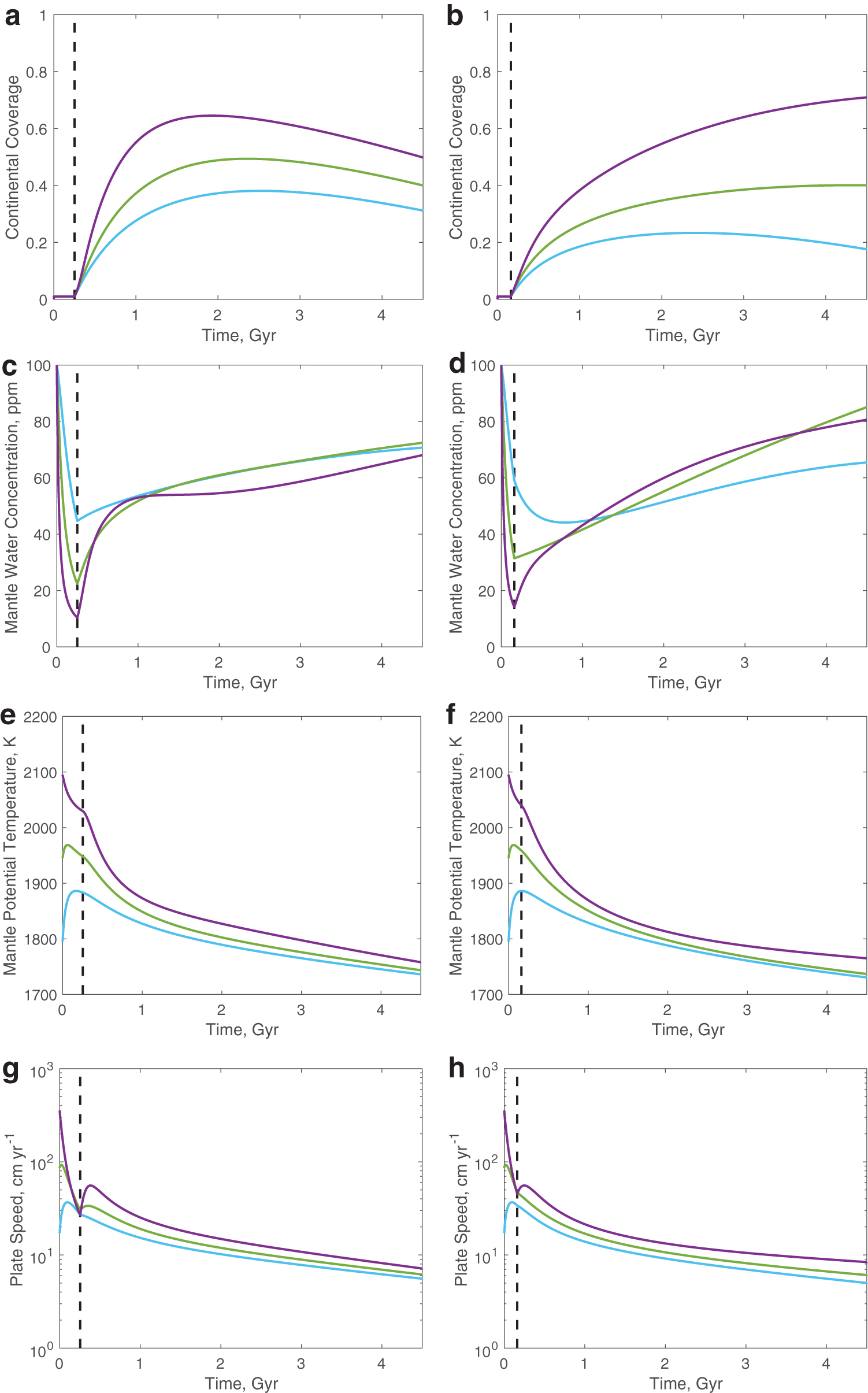
Continental coverage, mantle water content, temperature and plate speed over time (top to bottom) for the models of Fig. 7. Left: Negative feedback predominating. Right: Positive feedback predominating.
The evolution of the mantle water content is also found to depend on thermal blanketing as can be particularly well seen when comparing the respective panels in Figs. 5 and 8. For positive feedback and blanketing, the model with the largest continental coverage (purple) ends with less mantle water than in the case when blanketing is ignored. It even ends with less mantle water in Fig. 8 (right column) than the Earth-like model with a present-day continental coverage of 0.4. This can be understood if the mantle temperature is considered, which shows the most prominent differences. Models with no thermal blanketing and heat source differentiation have temperatures converging with time, independent of the choice of the initial temperature. With blanketing and mantle heat source depletion, mantle temperatures tend to converge initially, but then tend to diverge with the growth of continents. In particular, the model with dominating positive feedback and with a present-day continental coverage of >0.6 (purple) shows the cooling rate to decrease after about 2.5 Gyr and the mantle temperature to start to level off. This explains why the net water gain rate in that model decreases after about that time. Still, the model has a present-day hotter and wetter mantle when compared with the purple model for dominating negative feedback (left column). The difference can be attributed to the larger contribution to water subduction by sediments, which explains why the difference in plate speed and continental coverage is particularly pronounced for the purple models. The plate speed, finally, evolves largely in parallel with the mantle temperature as expected. The effect of continental insulation, which tends to reduce cooling, exceeds that of the depletion of mantle radiogenic elements in this model, which tends to enhance cooling.
Interestingly, for the case of dominating negative feedback (Fig. 8 left), large continents (purple curve) result in comparatively hot and dry mantles, with opposing effects on viscosity and plate speed. For dominating positive feedback (Fig. 8 right), sediments from the comparatively large continents contribute to water subduction such that a hot and wet mantle results, both increasing the plate speed. This feeds back to continental growth such that the difference in continental coverage at 4.5 Gyr becomes particularly pronounced.
Figure 9 shows results pertaining to the long-term carbon cycle for the models that include thermally insulating continents. As in previous figures, panels on the left are for models with predominating negative feedback, and those on the right are for models with predominating positive feedback. A larger surface fraction of insulating continents keeps the mantle warmer and, therefore, results in somewhat larger degassing rates, but also in a larger weatherability and rate of CO2 removal. The differences in the CO2 partial pressure and surface temperature between the models remain small and are even a bit smaller than for models neglecting thermal blanketing altogether.
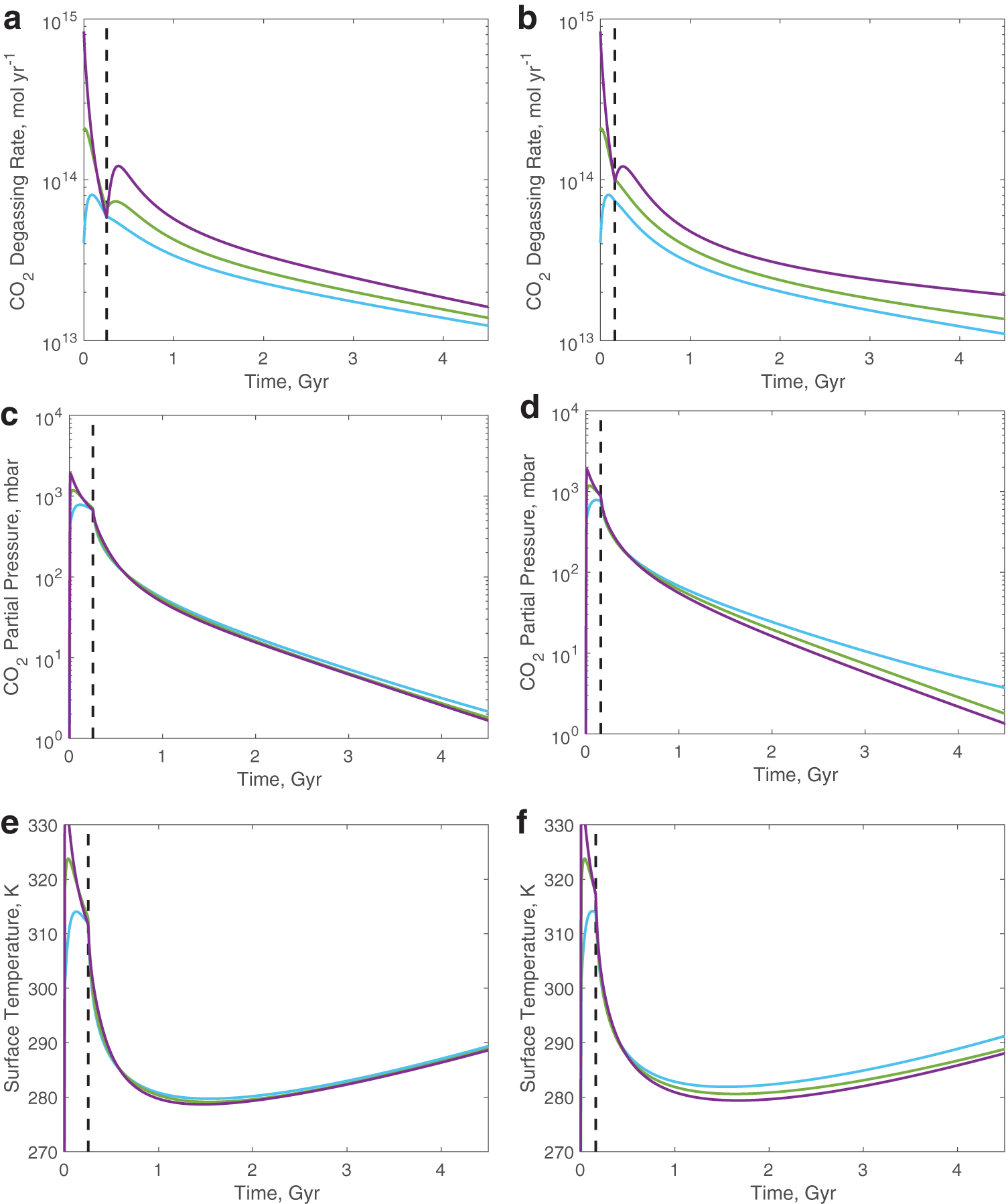
Same as in Fig. 6, but for models with thermal blanketing and mantle depletion of radiogenic elements upon continental crust growth and ξ 3 = 0.85 and ξ 4 = 1/4. Left panels: Negative feedback predominating. Right panels: Positive feedback predominating.
4. Discussion
In this article, we modeled three main geologic processes as a nonlinear coupled dynamical system: growth of continental crust, exchange of water between the reservoirs on and above the surface (oceans, atmosphere) and in the mantle, and cooling by mantle convection. These processes are linked through mantle convection and plate tectonics with the following: - subduction zone-related melting and volcanism and continental erosion governing the growth of the continents (Eq. 1), - mantle water degassing through volcanism and regassing through subduction governing the water budget (Eq. 2), and - heat transfer through mantle convection governing the thermal evolution (Eq. 3).
The rates of these processes depend nonlinearly on mantle temperature and water concentration through the mantle viscosity (compare Supplementary Eq. C6) and plate speed
The conceptual nature of our study motivated us to simplify our model beyond the level of abstraction of our previous work (e.g., Höning and Spohn, 2016; Höning et al., 2019a) by reducing the number of free parameters to four, ξ 1, … , ξ 4, with 0 ≤ ξ 1, … , ξ 4 ≤ 1. We still use the present-day Earth as a reference and present-day observables as scales. In the following, we discuss our finding that the spread of continental coverage on Earth-like planets is determined by the respective strengths of positive and negative feedback in continental growth (ξ 1 vs. ξ 2, Section 4.1) and by the relationship between thermal blanketing and depletion of radioactive isotopes upon growth of the continental crust (ξ 3 vs. ξ 4, Section 4.2). Uncertainty in these parameter values represents the main uncertainty in the model.
Our discussion aims to provide a better qualitative understanding of the feedback processes; we admit to lacking data for a detailed understanding of quantitative differences. Finally, we discuss the habitability of the model planets and their bioproductivity that result from the various possible evolution pathways in Section 4.3.
4.1. The feedback parameters ξ 1 and ξ 2 and their implications for continental growth
The parameters ξ 1 and ξ 2 can be regarded as slide rulers in Equations 1 and 2 to weigh between feedback terms. We have chosen combinations of ξ 1 = 1/3 and ξ 2 = 2/3, ξ 1 = ξ 2 = 0.5, and ξ 1 = 2/3 and ξ 2 = 1/3 to demonstrate in Figs. 3–9 how the properties of the system vary with these choices. Note that ξ 1 and ξ 2 do not have to add up to 1, although they do in our parameter choices. The parameter ξ 1 weighs between the importance of the continental surface area and plate speed (i.e., convection speed), respectively, for both the production rate of continental crust and the mantle water degassing rate of the present-day Earth.
The value of ξ
1 becomes particularly important late in the evolution, when the mantle has cooled down sufficiently such that
Höning and Spohn (2016) discussed how continental erosion, subduction of sediments, and continental rock formation are related. The ability of hydrous sediments to contribute to water transport with the subducting plate is well established (Hacker, 2008; Deschamps et al., 2012, 2013) but difficult to quantify. In addition, as described by Höning et al. (2014), low permeability sediments can seal the hydrated crust, thereby reducing the rate of shallow dewatering upon subduction. Stern (2011), Sobolev and Brown (2019), and Chen et al. (2022) argued that accumulation of sediments in subduction zones is crucial to lubricate the subducting plate, which would effectively introduce another positive feedback to the system. Sobolev and Brown (2019) even suggested that the persistence of plate tectonics requires a sufficient thickness of the sedimentary layer and that an extended period of reduced surface erosion and sediment subduction might have resulted in reduced tectonic activity on Earth between 0.75 and 1.75 billion years before present.
It may be argued that positive feedback may also originate from the variation of
The parameter ξ 2 weighs between surface erosion and subduction erosion, the latter depending on the length of the ocean–continent subduction zones. A major share (≈1/3) of the global continental erosion rate has been associated with subduction erosion (Stern, 2011). In addition, significant shares of the loss of continental surface area have been attributed to continental collision and lower crust delamination, leaving less than a third for surface erosion (Stern, 2011). It thus seems reasonable to assume that ξ 2 < 0.5. We note that the rate of subduction erosion may depend on the rate of friction between the subducting slab and the continental keel in addition to its dependence on the length of the subduction zone. Sediments may reduce friction by lubricating the slab (Stern, 2011), thereby reducing the rate of subduction erosion for increasing continental coverage. This would effectively introduce another positive feedback to the system that is not considered here, however.
The length of the ocean–continent subduction zones
Our results show how strong negative feedback would lead to an evolution largely independent of the starting conditions and the early history of the planet, which would imply a single stable present-day value of the continental surface area. For strong positive feedback, however, the outcome of the evolution may be quite different depending on starting conditions and the early history. For exoplanets, this suggests that Earth-like planets covered largely by land (i.e., land planets) are possible as well as planets covered mostly by oceans (i.e., ocean planets) (Fig. 1). Höning and Spohn (2016) found that the land planet should be the most likely outcome, followed by cases that end as ocean planets. Only a small percentage end as planets with a balanced Earth-like share of land and ocean surfaces.
Earth's further evolution can be discussed using the present-day phase planes shown in Figs. 4 and 7. It will depend on the location of the state variable A relative to the fixed point. For values of A close to, but larger than, the continental coverage at the unstable fixed point, A will increase with time at a small rate beyond its present-day value. While A is growing, the mantle water concentration will increase. With the water budget conserved, this will be accompanied by decreasing surface water reservoir and increasing area of emerged land. This would be beneficial for the biosphere allowing for more silicate weathering, provision of nutrients, and partly compensating for an increasing solar luminosity. Eventually, the unstable fixed point will overtake the trajectory and net continental growth will cease. Additional calculations have shown that the upper stable fixed point will move toward smaller values of A together with the unstable fixed point moving toward larger values of A. The two fixed points will eventually merge and then disappear with further cooling, while the continental area will slowly decrease with time, being far away from, but evolving toward, the remaining lower stable fixed point.
An extreme case in which continental production and erosion would be entirely independent of the surface area can be studied by setting ξ 1 = 0 and ξ 2 = 0. The continent production rate will then depend only on the mantle convection rate and the erosion only on the total length of ocean–continent subduction zones. In addition, we neglect thermal blanketing (as in Fig. 4) and show the results in Fig. 10. Without positive or negative feedback, differences in early continental growth resulting from differences in initial conditions are mostly retained throughout the evolution without being damped or amplified with time as they would be with feedback. Continental coverage at 4.5 Gyr is found to attain similar values to those with dominating positive feedback (compare Fig. 5, right panel), though. Mantle water concentrations for the ocean and Earth-like planet are similar to the values found for negative feedback, but the land planet (purple curve) of the extreme model has a comparatively dry mantle. This implies a comparatively larger surface water mass and more flooded continental crust and can be explained as a consequence of ignoring the contribution of sediments to water subduction. The concentrations of atmospheric CO2 and the spread of surface temperatures are similar to the scenario with dominating positive feedback explored above.
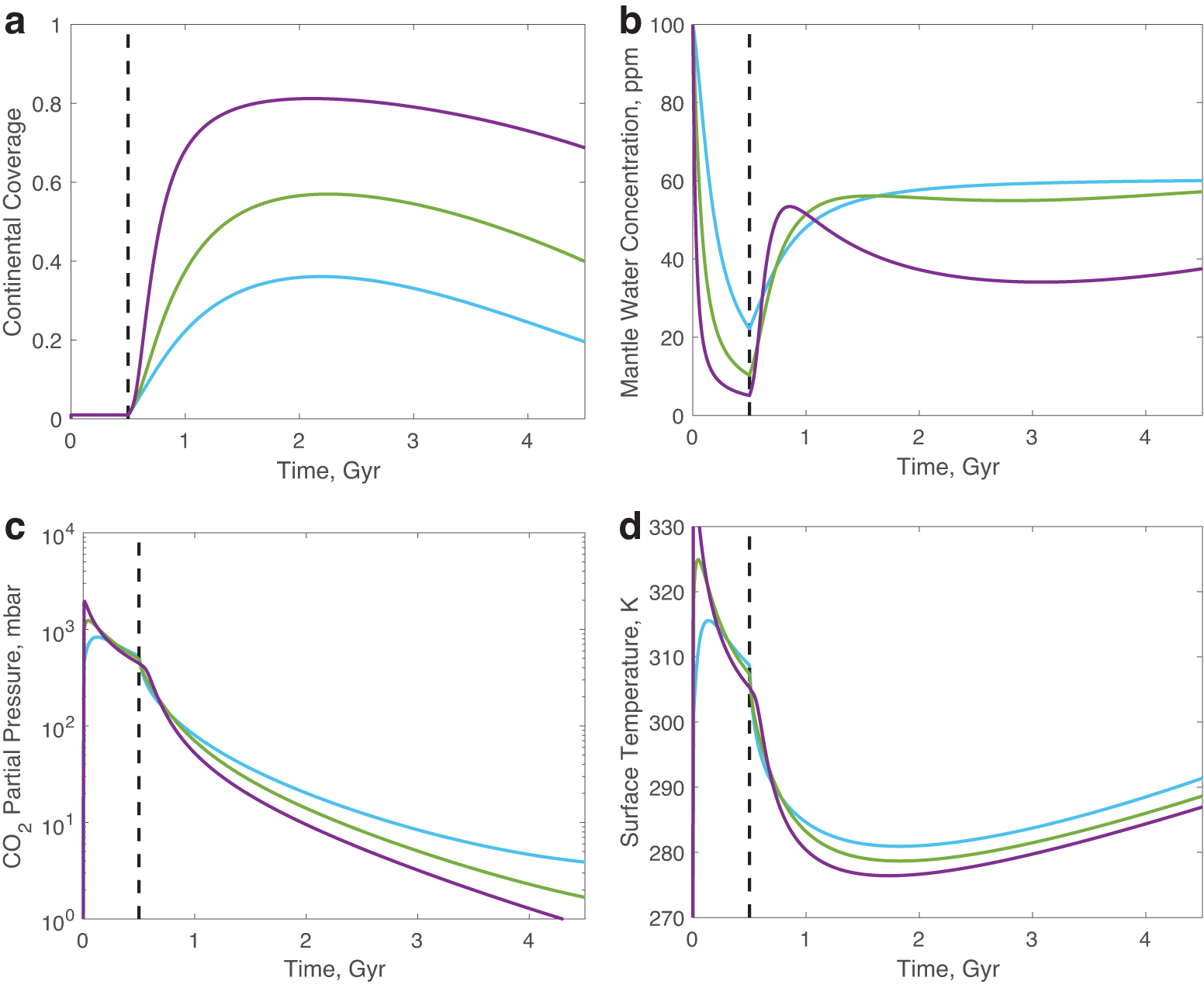
Model scenario that neglects any direct dependence of continental production and erosion on continental area (ξ
1 = 0, ξ
2 = 0). In order for the green curve to reach continental coverage of 0.4 at 4.5 Gyr, we set
It is interesting to note that, for planets around M dwarfs, Tian and Ida (2015) predicted a similar bimodal distribution of emerged land area, with most planets either having their surface entirely covered with water or with significantly less surface water than the Earth. Their analysis, however, was based on a combination of planet formation and water escape models, not explicitly modeling continental growth.
The small positive net growth rate of the continents since the Archean (e.g., Armstrong, 1991; Dhuime et al., 2017; Rosas and Korenaga, 2018; Korenaga, 2021) provides a strong argument for positive feedback in Earth's continental growth history: Positive feedback can sustain a small net growth rate over an extended period of time even in the presence of a slowly decreasing mantle temperature as in the right columns of Figs. 5 and 8. In that case, the unstable fixed point will be evolving slowly toward larger continental coverage, and A, being located slightly above this fixed point, will follow suit. We note that equilibrium is not expected to be attained as mantle heat production decreases with time and planets necessarily cool, as has already been discussed by Schubert et al. (1979). With negative feedback prevailing, the continental production rate will decrease with decreasing mantle temperature. As a result, the continental surface area will decrease with time as in the left columns of Figs. 5 and 8. An overall decrease of the continental surface over the past 2 Gyr as predicted by the negative feedback model is not observed, however! Negative feedback evolution trajectories reaching a continental coverage of 0.4 after 4.5 Gyr require a present-day ratio between the rate of continental production and that of continental erosion of
The continents may have grown in the Archean by mechanisms that differ from those of modern plate tectonics (e.g., Condie and Kröner, 2013). Our analysis would still be applicable, because the bifurcation appears only at post-Archean mantle temperatures and plate speeds. The onset time
4.2. Thermal blanketing and mantle depletion through crust growth: effects of ξ 3 and ξ 4
Thermal blanketing by continental crust can have two effects that may both act at the same time: Blanketing can result in an overall reduction of the surface heat flow and the cooling rate. Also, it can result in a redirection of mantle heat flow away from the continents to the oceanic areas. Using stability analysis, Höning et al. (2019a) showed that thermal blanketing can lead to runaway continental growth (see also Lenardic et al., 2005 for related findings). The analysis, however, was based on the assumption of a steady-state mantle and a constant Urey ratio. It also did not include the redistribution of radiogenic elements between the mantle and the crust. In their analysis, blanketing caused the heat flow from the mantle to be diverted from the subcontinental to the suboceanic areas, resulting in an increasing suboceanic heat flow, plate speed, and, finally, continental growth rate. Their result can be considered an extreme case but suggests that positive feedback between thermal blanketing and continental growth is, in principle, possible.
In the present model, we consider thermal blanketing in the presence of mantle cooling and the decay of radiogenic elements. In addition, we consider the transfer of heat producing elements from the mantle to the crust as a consequence of melting and crust growth. The cooling and the decrease in time of the mantle heating rate will reduce the self-reinforcement of continental growth through thermal blanketing. We do not consider any possible redirection of mantle flow away from the subcontinental areas to suboceanic areas. Instead, we use ξ
3 as a slide ruler to distribute the present-day mantle heat flow
For the present-day Earth, the oceanic heat flow per unit area is on average 105.4 mW/m2, while the average continental heat flow is 70.9 mW/m2 and the total average surface heat flow per unit area is 91.6 mW/m2 (Davies and Davies, 2010). Jaupart et al. (2015) gave a somewhat smaller value for the continental heat flow of 65 mW/m2, while earlier work resulted in about 60 mW/m2 (e.g., Williams and von Herzen, 1974). The total heat flow values, accounting for uncertainties, are 31–32, 14–15, and 45–47 TW, respectively. The continental heat flow includes a significant contribution from radiogenic elements in the crust.
Jaupart et al. (2015, 2016) gave values for the basal continental heat flow—mostly in stable continental shield areas—from the mantle of 15 ± 3 mW/m2, equivalent to 2.4–3.7 TW. Subtracting the latter values from the continental heat flow gives 11–12.3 TW. However, this value is much too large to be explained by the continental heat production for which Jaupart et al. (2015, 2016) gave 6–7 TW, the remainder of 3–4 TW to be attributed to continental margins where the heat flow can be significantly higher than in stable continental areas (e.g., Springer and Förster, 1998). Altogether, this suggests a global present-day heat flow from the mantle of ≈38 TW, so that values for ξ 3 between 0.8 and 0.85 should be reasonably characterizing the heat flow ratios on the present-day Earth.
To calculate a consistent value of ξ 4, the share of the heat sources in the present-day continental crust (compare Supplementary Eq. C3), we use the observed continental heat flow and subtract the above estimate of the mantle heat flow through the continents including continental margins of 6–7 TW to obtain 7–8 TW. Unfortunately, the mantle heat production rate is much more uncertain. Dye (2012) cited estimates between 11 and 24 TW for the bulk silicate Earth (mantle + crust) as resulting from cosmochemical studies. Using a mantle heat flow estimate of 36 TW and estimates from convection modeling of 30–50% being attributable to radiogenic heating (Dye, 2012, the so-called Urey ratio), they arrive at 19–27 TW, again for the bulk silicate Earth. Note that we do not adopt the case of 80% radiogenic heating as we find that the Urey ratio predicted from constant viscosity mantle models is unrealistic. Jaupart et al. (2015) compiled mantle and crust heat production rates from the literature and from their own interpretations of global heat flow data and arrived at a representative value of 11 ± 6 TW for the mantle heating rate. This value can be considered a lower limit as it assumes that the (depleted) mid-ocean ridge basalt (MORB) source extends through the whole mantle. Thus, values for ξ 4 between 0.25 and 0.4 should be reasonable to assume.
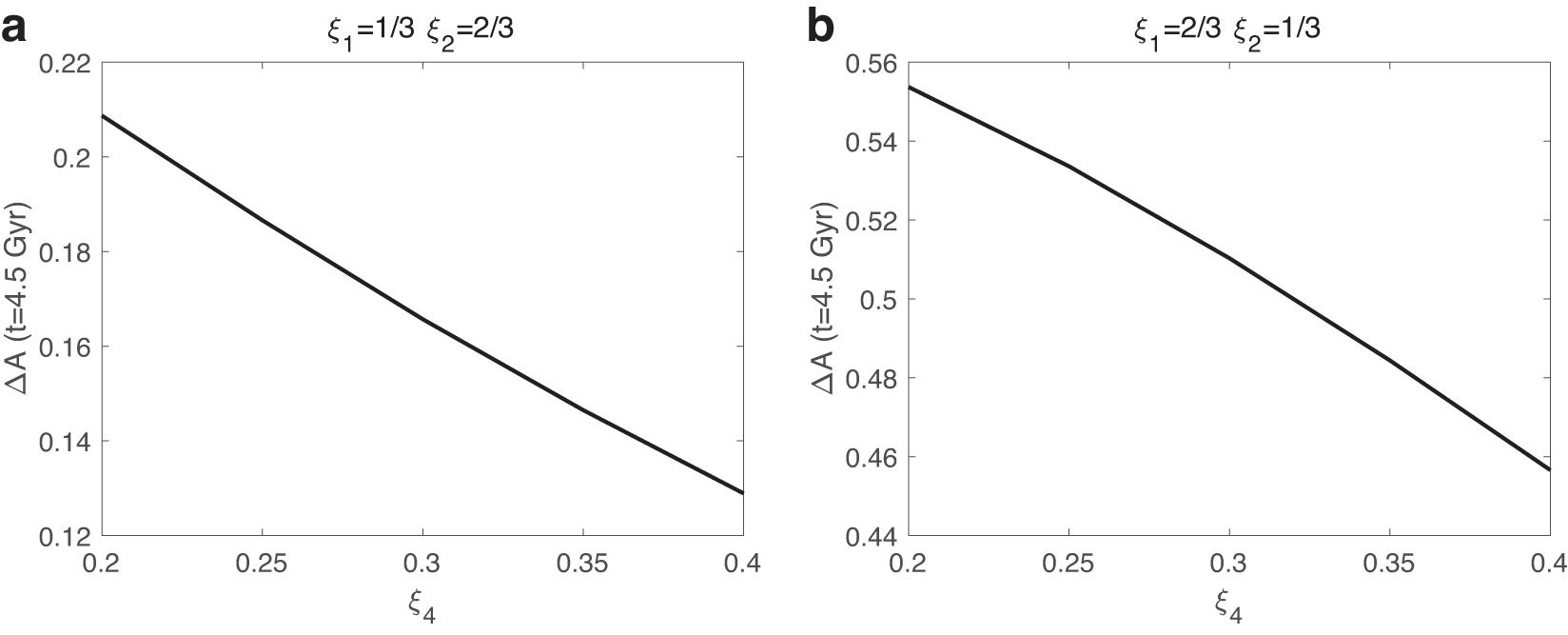
In Fig. 7, we used a combination of values for ξ 3 and ξ 4 within our range of estimates that maximizes the effect of thermal blanketing. For values of ξ 4 > 0.25, depletion of heat sources works increasingly against the effect of thermal blanketing such that for ξ 3 = 0.8 and ξ 4 = 0.4, the results are close to those neglecting blanketing as in Figs. 4 and 5. In Fig. 11, we show the difference of the continental surface fraction at 4.5 Gyr resulting from models with a difference in the initial mantle temperature of 300 K (i.e., between the light blue and purple curves in Figs. 4 and 7) for dominating negative (left) and positive (right) feedback. As expected, the spread in continental surface area at 4.5 Gyr decreases with increasing ξ 4, but the spread can be twice as large for cases with dominating negative feedback and ξ 4 = 0.25.
Long-term heating of the mantle can only be obtained if the thermal blanketing is made extreme. In Fig. 12, we show a case with ξ 3 = 1 implying perfectly insulating continents. Here, with dominating positive feedback for a high initial mantle temperature, we obtain heating even though the depletion of radiogenic elements in continental crust is taken into account with ξ 4 = 0.25. All in all, we conclude that the reduction of cooling by thermal blanketing underneath the growing continental crust is partly, potentially largely, compensated by the effective cooling of the mantle associated with the transfer of radiogenic elements from the mantle to the crust.
An extreme case of thermal blanketing with ξ
3 = 1 and ξ
4 = 1/4.
4.3. CO2 outgassing, weathering, surface temperature, and bioproductivity
Coupling the continental erosion rate and the plate speed to a model of the long-term carbon cycle (Supplementary Appendix SE), we find that the large spread in continental surface coverage between our models results in differences of surface temperatures of not more than about 5 K. The reason for this rather small difference is the opposing effects of increasing continental coverage on the atmospheric CO2 concentration. On the one hand, the weatherability and thereby the CO2 sink increase with increasing continental coverage. On the other hand, the mantle remains hotter with larger, insulating continents, which causes an enhanced outgassing rate of CO2.
Note that our ocean planet is a shallow water world with an ocean depth of about 4 km for which the carbonate silicate cycle is still operative (e.g., Höning et al., 2019b; Hayworth and Foley, 2020), even though the negative feedback associated with silicate weathering would be weaker. It should not be confused with a deep ocean water world with 10–1000 Earth ocean masses for which the carbonate–silicate cycle might not work at all due to the formation of high-pressure ice layers and potentially limited magmatic degassing (e.g., Noack et al., 2016; Kite and Ford, 2018; Krissansen-Totton et al., 2021).
A 5 K surface temperature difference is considerably smaller than the excursions of the Earth's mean surface temperature over the Phanerozoic (e.g., Scotese, 2021) and might be assumed to be of limited significance for the general discussion of exoplanet habitability. However, Lingam and Loeb (2018) and Schulze-Makuch et al. (2020) argued that a 5 K higher surface temperature would significantly increase the habitability of an Earth-like world. In combination with the differences in land and water surfaces, it could have an impact on climatic zones. Earth climate modeling suggests that the temperature difference on land surfaces, near the equator, may be twice as large (Nazarenko et al., 2022). Furthermore, the polar ice sheets will shrink with increasing temperature. In contrast, the lower surface temperature of the land planet would allow for substantial polar ice caps. These differences should be reflected in the sea level, which would also differ on account of the nonlinear thermal expansion of seawater (e.g., Widlansky et al., 2020).
In addition, there may be dry cold deserts in the interiors of large continents. For the present-day Earth, 40% of the surface is continental crust, but a quarter of it (10% of the Earth's surface) is covered with water in shelf areas, leaving 30% land surface. Our ocean planet has a continental surface of about 20%, but given the warmer climate predicted, a significant part of it may be covered by water, leaving perhaps only 10% of land surface. On the contrary, the land planet with about 70% continental surface area could have a land surface twice that of Earth. All in all, we expect the ocean planet to be comparatively warm and wet and the land planet comparatively dry and cold. Future work with comprehensive Earth System and Global Circulation Models is needed to better understand the impact of land area on the climate of Earth-like planets together with a varying CO2 concentration in the atmosphere.
We can estimate the combined effects of the land–ocean distribution and the surface temperature on the bioproductivity and the biomass by using the models of Lingam and Loeb (2019) for the effect of the ratio of land-to-ocean surfaces and of Lingam and Loeb (2018) for the surface temperature. While the former model weighs the land and ocean areas based on their differing specific bioproductivities, the latter model considers the temperature effect on the metabolic rate being governed by an activation energy. We again scale to the present Earth and find the land planet to have an NPP of about 43% of Earth's, corrected down from 50% when accounting for the about 1.7 K lower surface temperature.
The model with thermal blanketing would have a slightly larger productivity of 47% of Earth's due to the smaller surface temperature correction. The larger land area will lead to a predicted biomass of 67% of Earth's, corrected down from 76%, obtained when the temperature effect is neglected. The ocean planet has an NPP of 60% of Earth's, up from 49% when accounting for the higher surface temperature. It has a biomass of 53% of Earth's, up from 43%, again accounting for the higher surface temperature. The indirect effects of thermal blanketing are too small to be relevant for this model. Further using Lingam and Loeb (2019), the land and the ocean planets would be predicted to both have only a marginal capability of building up O2 for advanced life-forms in their atmospheres.
Undoubtedly, the biosphere on worlds with different land fractions would adapt to their environment, and a balanced ratio of ocean-to-land accompanied by large continental shelves is certainly beneficial for an Earth-like biosphere (e.g., Kallmeyer et al., 2012; Höning and Spohn, 2016; Lingam and Loeb, 2019; Stevenson and Wallace, 2021). Vice versa, life on Earth coevolved with the environment, shaping the atmosphere and oceans (Grenfell et al., 2010; Lenton et al., 2014; Algeo et al., 2016). The emergence of pelagic calcifiers in the deep oceans has been argued to have played a role in the stability of Earth's climate (Ridgwell et al., 2003), and the colonization of land by plants enhancing continental weathering has presumably been crucial in keeping our planet's biosphere flourishing in the long term (Berner, 1998; Schwartzman, 2017). In combination, life on land and in the oceans has been shown to help stabilize Earth's climate on timescales >100 kyr, with land plants dominating on timescales >1 Myr and marine calcifiers being predominantly important on shorter timescales (Höning, 2020). This relative importance of life on land and in the oceans is a direct result of Earth's balanced ratio of oceans-to-land. On planets with a larger continental coverage, however, land plants would become increasingly important for climate stability, whereas the role of marine calcifiers would become minor (Höning, 2020).
5. Conclusions
In this article, we assessed the coupled evolution of continental growth, mantle water cycling, and thermal evolution of Earth-like planets. We explored how differences in initial mantle temperature and the strength of positive and negative feedback would impact their continental growth curves and water budgets. We coupled the model to a model of the carbonate–silicate cycle through the plate speed and the continental surface area to assess the habitability and the bioproductivity of these planets. Our results can be summarized as follows:
Positive feedback in the coupled continent–water cycle may lead to the emergence of multiple fixed points and to substantially differing land and ocean coverage, with an Earth-like distribution of land and ocean surfaces being the least likely. The average depth of the oceans would be similar, around 4 km, because differences in the ocean surface will be compensated by differences in the distribution of water between the mantle and the surface reservoirs. The final continental coverage and the environment of the planet will depend on the initial conditions, on the initial mantle temperature and the onset time of plate tectonics. If early mechanisms of continental growth differ from plate tectonics, then other differences in initial conditions may still matter. An evolution largely independent of the early conditions is possible only if negative feedback mechanisms prevail.
Positive feedback is mostly provided by the role of sediments in continental growth. The rate of sediment subduction will increase with the continental surface area, and the additional water transported will enhance the continental growth rate. In addition, sediments lubricate the subducting plate and facilitate efficient subduction. Thermal blanketing of the mantle by continents may retard mantle cooling, keep an enhanced continental production rate, and may cause an even larger difference in final continental coverage. However, the effect of thermal blanketing is partly, potentially largely, balanced by the removal of heat sources from the mantle going along with crust growth and with an enrichment of radiogenic elements in the continental crust.
The carbonate–silicate cycle is coupled to the evolution of the interior through the carbon outgassing rate depending on the plate speed and continental growth through the weathering rate increasing with the continental surface area. We found differences in the mean global surface temperature between the land planet and the ocean planet of up to ∼5 K. The climate of all three planets as well as their biospheres may have evolved quite differently, however. The warmer ocean planet's potentially higher specific bioactivity may be limited by the smaller availability of critical nutrients from weathering its smaller land surface. The cooler land planet may have a smaller specific bioactivity further reduced by the limited availability of water, but its bioactivity would be spread over a larger area. By using the scalings of Lingam and Loeb (2018, 2019), we find the bioproductivity and the potential biomass on these planets reduced by a third to half of Earth's. It is questionable whether a biosphere on these planets would be substantial enough to produce more oxygen than is consumed by geologic activity.
Main model uncertainties are related to quantifying the role of sediments in continental production and to estimating the depletion of radiogenic elements by continental crust production. Future work on these issues is required to improve understanding the complexities of our own planet and the prediction of the continental fraction on Earth-like exoplanets.
Footnotes
Acknowledgments

Author Disclosure Statement
The authors declare that they have no conflict of interest.
Funding Information
Part of this research was done during a visitor scientist's stay of D.H. at ISSI. Support by ISSI is gratefully acknowledged.
Supplementary Material
Supplementary Appendix SA
Supplementary Appendix SB
Supplementary Appendix SC
Supplementary Appendix SD
Supplementary Appendix SE
Supplementary Appendix SF
Abbreviations Used
Associate Editor: Jack Mustard
References
Supplementary Material
Please find the following supplemental material available below.
For Open Access articles published under a Creative Commons License, all supplemental material carries the same license as the article it is associated with.
For non-Open Access articles published, all supplemental material carries a non-exclusive license, and permission requests for re-use of supplemental material or any part of supplemental material shall be sent directly to the copyright owner as specified in the copyright notice associated with the article.
