






Abstract
The regolith breccia Northwest Africa (NWA) 7034 and paired samples are unique meteorite representatives of the martian crust. They are water rich, lithologically varied, and preserve the oldest martian zircon grains yet discovered that formed ca. 4500–4300 Ma. The meteorite thus provides us with an invaluable record of the crustal and environmental conditions on early Mars. Resetting of some radioisotopic chronometers occurred in response to a major thermal disturbance event ca. 1500–1400 Ma, likely caused by an impactor that brecciated and redeposited NWA 7034 near the surface in an ejecta blanket. Lithologies comprising NWA 7034 were then aqueously altered by a long-lasting impact-induced hydrothermal system, before being excavated and ejected by a subsequent impact at ca. 5–15 Ma. This review compiles chronological and petrological information into an overarching geochronological summary for NWA 7034 and paired samples. We then provide a synopsis for the volatile (H2O, C) inventory and hydrothermal alteration history of NWA 7034. From this geochronological history and volatile inventory, we interpret and assess two potential periods of martian habitability: (1) an early window of pre-Noachian planetary habitability, and (2) impact-derived hydrothermal systems that allowed intermittent habitable crater environments well into the Amazonian.
Introduction
The meteorite Northwest Africa (NWA) 7034, colloquially known as “Black Beauty” (Agee et al., 2013; Yin et al., 2014; Smith et al., 2020), was found in Morocco in 2011 and is paired with 18 additional stones (Meteoritical Bulletin Database, 2021), including NWA 7475, NWA 7533, NWA 8114, and NWA 11522. All are polymict breccias whose martian origin has been proved via their oxygen isotope composition (Agee et al., 2013; Nemchin et al., 2014) and the trapped atmospheric noble gases they host (Cartwright et al., 2014). NWA 7034 was initially described as a monomict basaltic breccia (Agee et al., 2013), but its classification was later rectified to a polymict breccia (Humayun et al., 2013; Santos et al., 2015; Wittmann et al. 2015). However, the term “martian regolith breccia” has also grown in popularity, given that NWA 7034 is presently the only known meteorite sample representative of Mars's near-surface crust (Humayun et al., 2013; Davidson et al., 2020). Wittmann et al. (2015) suggested Gratteri crater (17.7°S/160.1°W, 6.9 km diameter, formed ca. 5 Ma in the martian southern highlands; Quantin et al., 2016) as the best fit for a source locality based on age and lithological constraints. Here, NWA 7034 and paired stones are referred to as breccias, although we caution that this term does not fully describe the sedimentological processes recorded in these stones.
NWA 7034, and by extension its numerous pairings (referred collectively herein as “NWA 7034”), provides the only opportunity to apply Earth-based laboratory techniques to the martian regolith material. These meteorites have allowed researchers to assess early crust formation, hydrothermal alteration, and habitability on Mars, as well as how they have changed over time. NWA 7034 samples some of the earliest crust on Mars; dating of zircon and baddeleyite grains has revealed that most igneous clasts in NWA 7034 crystallized from melts at ca. 4450–4300 Ma (Humayun et al., 2013; Yin et al., 2014; McCubbin et al., 2016a; Bouvier et al., 2018). These old clasts thus provide temporal constraints on the martian crust's early formation and reworking (Armytage et al., 2018), the existence of a global magnetic field (Gattacceca et al., 2014), and early atmospheric loss (Nemchin et al., 2014) on Mars.
Increasingly, new research on NWA 7034 is uncovering a complex sedimentological and hydrothermal history (Liu et al., 2016; McCubbin et al., 2016b; Hewins et al., 2017; MacArthur et al., 2019; Davidson et al., 2020; Lorand et al., 2020).
The purpose of this review is twofold. First, we aim to compile a temporal and petrological summary of NWA 7034 and the components it hosts, creating a reference timeline. In the context of martian habitability, we then use this tool to analyze research into postimpact hydrothermal alteration and the ancient paleoenvironment recorded in NWA 7034. This is a timely review given the successful landing of the NASA Perseverance rover in March 2021, which will (1) investigate martian surface lithologies with a primary science goal to determine whether life ever existed on Mars, and (2) cache surface samples that will eventually be returned to the Earth.
Radiometric Dating of NWA 7034 and Paired Stones
The different radioisotopic systems used on NWA 7034 and its components (Fig. 1) record a complex history of dates that can be organized into four major groups. These are widely interpreted as comprising the following: a bimodal age distribution for the oldest zircon grains with peaks at ca. 4450 Ma and ca. 4300 Ma (Yin et al., 2014; Bouvier et al., 2018); a thermal “disturbance event” dated at ca. 1500–1400 Ma (Humayun et al., 2013; Tartèse et al., 2014; Yin et al., 2014; Hu et al., 2019; Lindsay et al., 2021); and excavation/ejection from Mars ca. 5–15 Ma (Cartwright et al., 2014). A comprehensive summary of dating methods and their applications to NWA 7034 is provided by Hu et al. (2019).
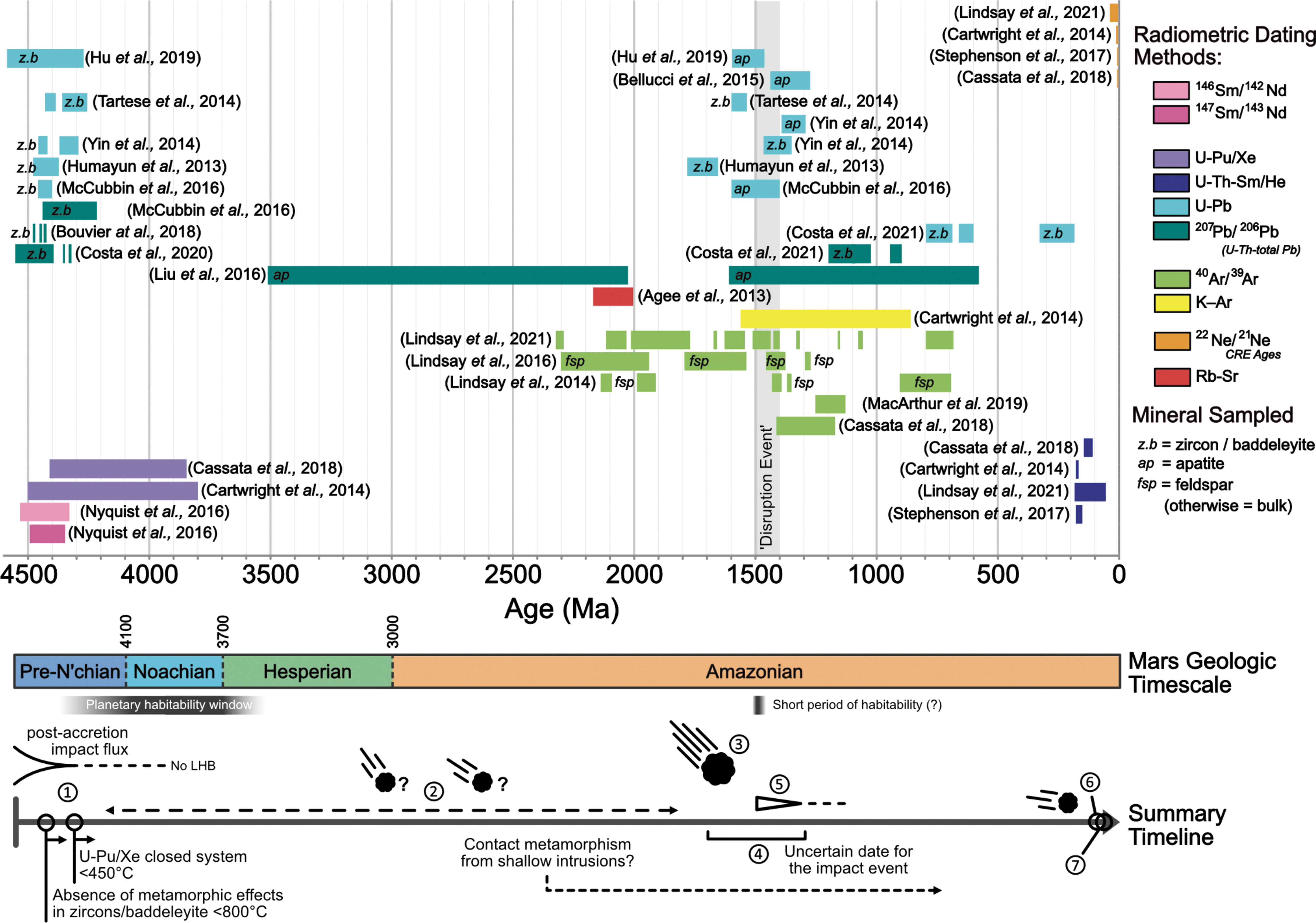
A synopsis of reported dates for bulk rock fragments, clasts, and individual minerals in NWA 7034 and paired meteorites. Colored rectangles represent a dating method, with the upper/lower bounds representing either a 2σ measurement uncertainty or the published range. A summary time line of major events is depicted with label numbers correlating to the geochronological summary in the text, based upon Moser et al. (2019). Possible habitability windows are indicated above the time line. CRE, cosmic ray exposure; NWA, Northwest Africa. Color graphics are available online.
U-Pb dating of zircon and baddeleyite preserved within both the matrix and igneous clasts (Humayun et al., 2013; Yin et al., 2014) suggests that the source material crystallized in a relatively short period of time between ca. 4450 and 4300 Ma, and may represent the earliest phase of magmatism on Mars (Tartèse et al., 2014; Yin et al., 2014; McCubbin et al., 2016a; Bouvier et al., 2018; Costa et al., 2020). Most nonmetamict matrix zircons yielded U-Pb dates of ca. 4.4 Ga. This is consistent with zircon dates from magmatic clasts, suggesting that the matrix primarily comprises broken up grains derived from magmatic clasts akin to those observed in NWA 7034 (e.g., Hu et al., 2019).
The earliest U-Pb dates (Fig. 1) are roughly consistent with Sm-Nd dates from both matrix and clast mineral separates (ca. 4420 Ma), as well as whole rock U-Xe ages (ca. 4270 Ma) (Nyquist et al., 2016; Cassata et al., 2018). Lead loss in radiation-damaged amorphous zircon domains records younger perturbation events between 1700 and 1300 Ma, in agreement with resetting of the U-Pb chronometric system in apatite at ca. 1500–1350 Ma (Yin et al., 2014; Bellucci et al., 2015; Hu et al., 2019), as well as complete resetting of the K-Ar systematics between ca. 1700 and 800 Ma (Cartwright et al., 2014; Cassata et al., 2018; MacArthur et al., 2019; Lindsay et al., 2021). This ca. 900 Myr range of dates (Fig. 1) has been widely attributed to disruption from an impact-derived heating event that lithified NWA 7034 (Lorand et al., 2015; McCubbin et al., 2016a).
Alternatively, it has been suggested that the radioisotopic system disturbances record periods of heterogeneous contact metamorphism between ca. 1500 and 1200 Ma followed by lithification at ca. 225 Ma (Cassata et al., 2018), or a simultaneous contact metamorphic and lithification event at ∼1400 Ma (Lindsay et al., 2021). Costa et al. (2020) identified a detrital zircon grain dated at ca. 300 Ma (Fig. 1) that supports a more recent consolidation date but is otherwise difficult to integrate into the broader chronology recorded in NWA 7034. Overall, the textural, petrological, and alteration assemblage in NWA 7034 best supports a single impact-driven lithification event at ca. 1500 Ma (Wittmann et al., 2015; MacArthur et al., 2019), rather than a two-stage history of metamorphism followed by lithification. However, the possibility of early lithification at ca. 4300 Ma also stands (Humayun et al., 2016), and highlights the difficulty in reconciling such a range of disrupted radioisotopic systems into a straightforward chronology.
Deciphering the more recent thermal history of NWA 7034 is also challenging. Various lithologies in NWA 7034 yield U–Th(–Sm)/4He dates ranging between ca. 190 and 50 Ma (Cartwright et al., 2014; Stephenson et al., 2017; Cassata et al., 2018; Lindsay et al., 2021). Based on abundances of cosmogenic 3He and 38Ar measured in NWA 7034, Cartwright et al. (2014) estimated a cosmic ray exposure (CRE) age of ca. 5 Ma. Stephenson et al. (2017) calculated a similar CRE age of ∼5 Ma using 3He and 21Ne abundances in paired stones NWA 7906 and NWA 7907.
However, further cosmogenic noble gas abundance measurements yielded slightly older CRE ages between ca. 8 and 15 Ma (Cassata et al., 2018; Lindsay et al., 2021). This range of estimates between 5 and 15 Ma reflects the range of assumptions required for calculating CRE ages, which include the possibility of diffusive loss of some noble gases and parameters related to the exposure history of the meteorites during their transport to Earth (e.g., meteoroid size and shielding conditions).
NWA 7034 is a polymict breccia comprising sedimentary, igneous crystalline, and porphyry clasts embedded in a clast-supported, thermally annealed granoblastic matrix (Fig. 2). The groundmass is primarily composed of submicron-sized (average 0.2–0.3 μm) plagioclase and pyroxene, with fewer magnetite, ilmenite, and chlorapatite grains, as well as possible surface dust components (Muttik et al., 2014a; Wittmann et al., 2015; Hewins et al., 2017).
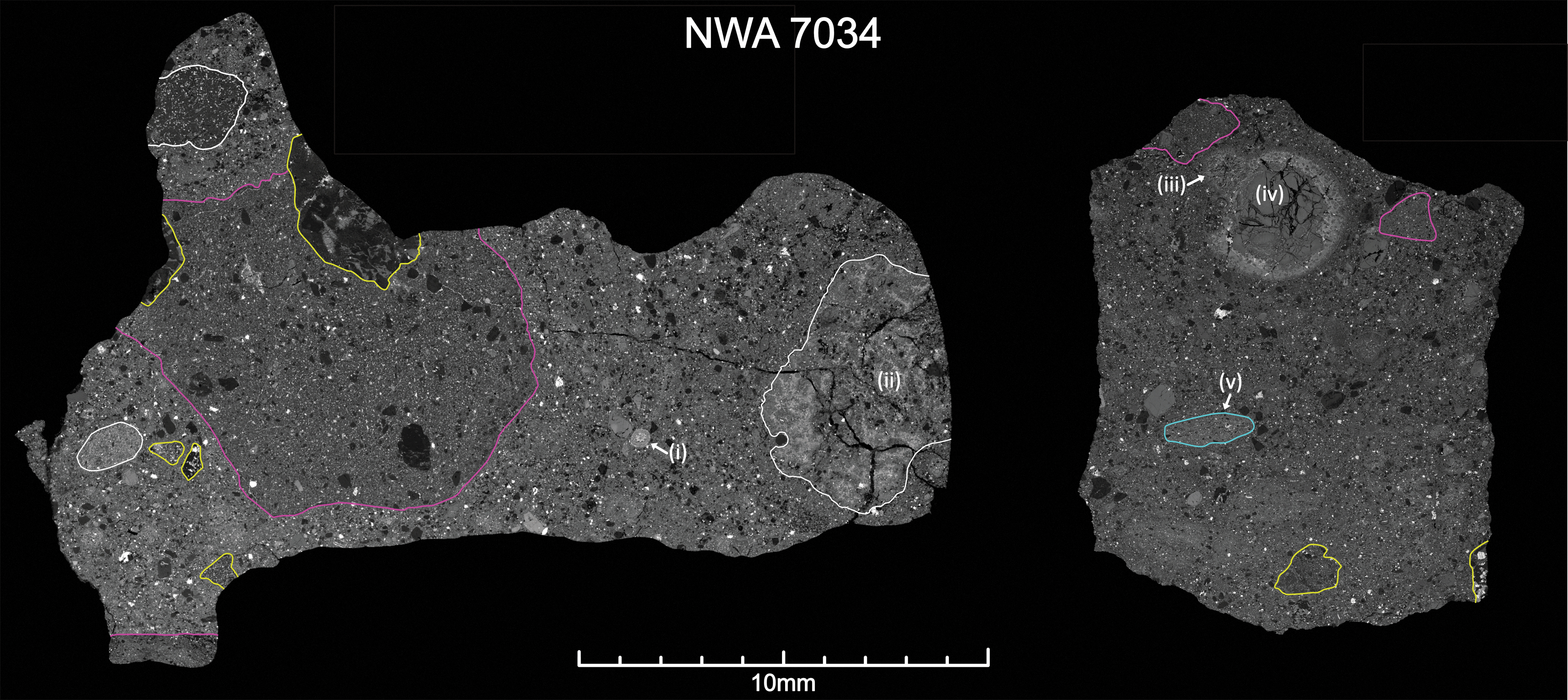
Back-scattered electron images of two polished sections of NWA 7034 showing lithological components. Clasts >1 mm are outlined with contour colors as follows: purple = proto-breccia; yellow = polymineralic igneous clast; white = vitrophyre; and blue = siltstone. The heterogenous conglomerate hosts some interesting clasts, including: (i) a lapilli clast featuring concentric laminae around a central subrounded mineral grain; (ii) an amoeboid-shaped impact melt with carbonate-filled fractures; (iii) a vitrophyre spherule featuring septarian fracturing; (iv) an intensely fractured plagioclase grain with an accreted, partially melted, iron-rich rim. Note that the spherule (iii) has sintered onto the side of the grain. Fractures are partially filled by calcite; (v) a siltstone clast recognizable via a paler coloration and relict planar lamination. See McCubbin et al. (2016a) for scanning electron microscopy analytical details. Color graphics are available online.
The breccia is a heterogeneous mix of geochemically varied lithic clasts, which may have originated as chaotic atmospherically deposited material from an impact plume, as supported by the following: high bulk concentrations of Ni and Ir (Humayun et al., 2013; Goderis et al., 2016); the presence of amoeboid, glassy interstitial melt (Fig. 2); and sintered accretionary lapilli (Nyquist et al., 2016; MacArthur et al., 2019). For this reason, NWA 7034 is commonly referred to as a “regolith breccia”—a rock composed of consolidated clastic impact debris that features matrix melt and melt particles (Stöffler and Grieve, 2007). Table 1 gives a succinct overview of the types of clasts found in NWA 7034.
The igneous clasts in NWA 7034 define an evolved alkaline trend (Fig. 3) and are characterized by a near absence of olivine (Agee et al., 2013; Humayun et al., 2013; Wittmann et al., 2015). Santos et al. (2015) provided a summary of NWA 7034 igneous clasts grouped by their chemical compositions, while Hewins et al. (2017) classified NWA 7034 clasts based on mineralogy, making cross-correlation difficult. Table 1 relates the various lithological classifications used in the main petrology articles, based upon MacArthur et al. (2019).
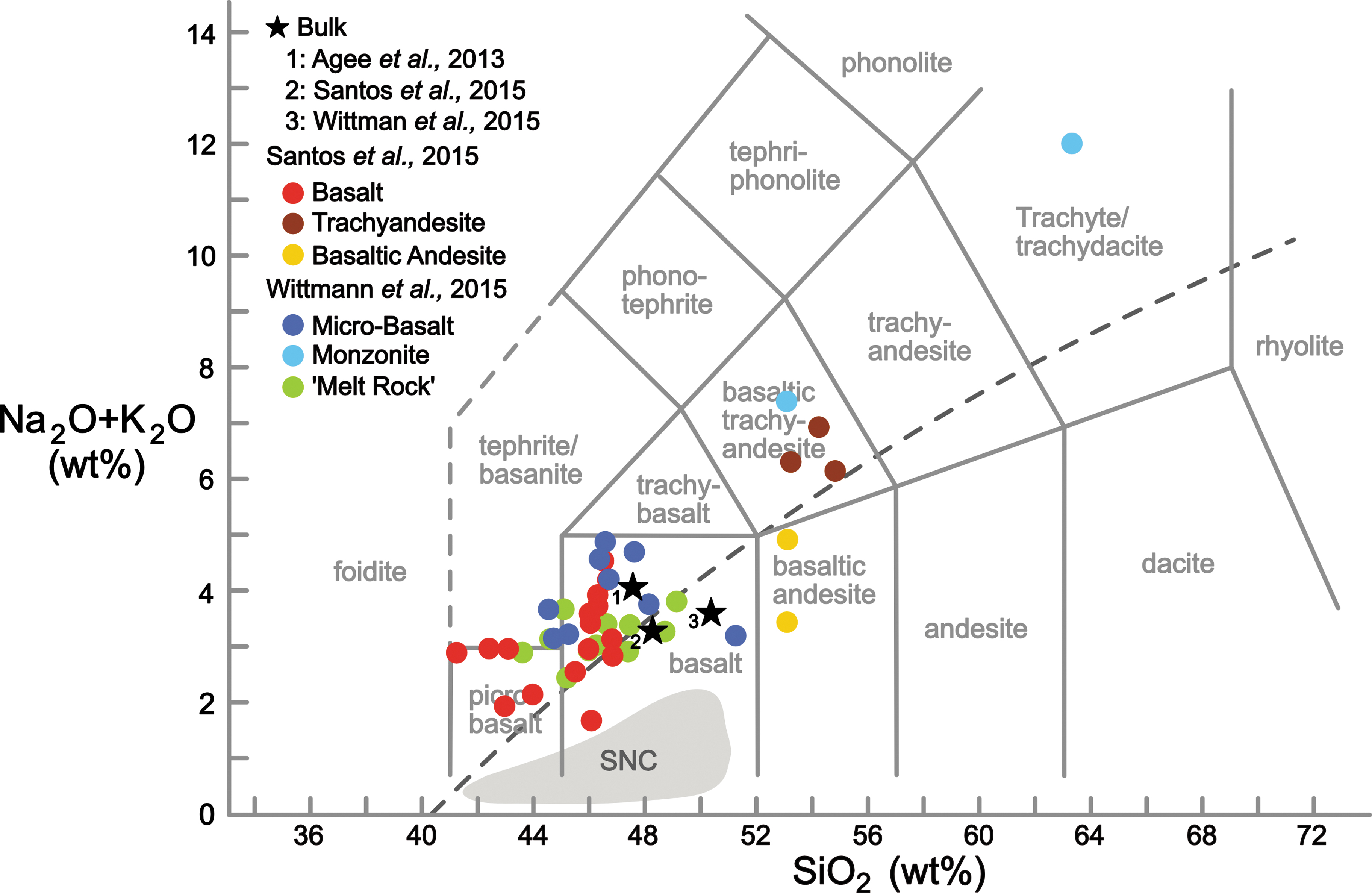
TAS diagram for NWA 7034 and paired meteorites showing their bulk composition and that of various individual clast types. Data are derived predominantly from Santos et al. (2015) and Wittmann et al. (2015). The SNC field is based upon Agee et al. (2013). SNC, Shergottite/Nakhlite/Chassignite; TAS, Total alkali versus silica. Color graphics are available online.
Lithological studies on paired stones suggest the ubiquitous presence of “proto-breccia” clasts, defined as fragments of previously lithified martian regolith preserved as polymict sedimentary clasts (Santos et al., 2015; McCubbin et al., 2016a). Proto-breccia clasts differ from the bulk breccia as they contain a greater proportion of Fe–Ti oxides and a larger matrix grain size (Wittmann et al., 2015; McCubbin et al., 2016a) (Fig. 2).
X-ray microtomography (μCT) analysis coupled with scanning electron microscope imaging reveals concentric Fe-enriched matrix components and well-rounded entrapped grains (Jacobs et al., 2016), suggesting that proto-breccia clasts entrained already brecciated (proto-)proto-breccia components. Concentric, rounded conglomerate clasts suggest that dynamic, likely aqueous, fluidized sedimentological transport occurred on the martian surface >1700 Ma (Jacobs et al., 2016). McCubbin et al. (2016a) interpreted proto-breccia clasts in NWA 7034 as “siltstones,” which differ from genuine laminated siltstones first recorded in NWA 7475 that feature size-sorting and subrounded mineral grains (Wittmann et al., 2015) (Table 1).
Cassata et al. (2018) discussed in detail the chronology of the geological events preserved within NWA 7034 and paired breccias. However, their interpretations—that the ca. 1500 Ma disturbance event was a period of igneous metamorphism followed by final lithification of the breccia at ca. 225 Ma—have not reached a broad consensus (e.g., Lindsay et al., 2021). MacArthur et al. (2019) proposed a five-step summary of thermal events that affected NWA 7034, which is more representative of the literature as a whole and includes a detailed overview of the postlithification alteration. Reconstructing a complete history for these specimens is difficult, not only because NWA 7034 is an aggregation of different igneous and sedimentary clasts that each have different formation histories, but also because the ca. 1500 Ma disturbance event has reset all but the most resistant radioisotope systems.
Here we present a brief overview of the major geological events recorded in NWA 7034 as compiled across the breadth of relevant literature, summarized by a timeline in Fig. 1: Crustal building and early alkaline volcanism: Magmatic crystallization ages of the source terrains for all dated igneous materials range between ca. 4450 and 4200 Ma, as identified by U-Pb dating of zircon and baddeleyite, bulk U–Pu/Xe dating, and Sm/Nd dating of matrix and igneous clasts (Fig. 1), with the possibility of at least two peaks of igneous activity during this interval (Cartwright et al., 2014; Tartèse et al., 2014; Yin et al., 2014; McCubbin et al., 2016a; Costa et al., 2020). The oldest igneous materials in NWA 7034 include a variety of evolved alkaline clasts hypothesized to sample multiple, lithologically diverse sources (Humayun et al., 2013; Santos et al., 2015) (Table 1). Exsolution in pyroxene displays a range of cooling rates and thus source depths for these igneous clasts (Leroux et al., 2016). Elevated siderophile element abundances in bulk rock fragments indicate the incorporation of Pt-rich impactor material into source melts (Goderis et al., 2016), and high Δ17O values in some zircon grains are suggestive of regolith assimilation and crustal reworking (Nemchin et al., 2014) (Δ17O represents the “oxygen isotope anomaly,” i.e., the offset from the terrestrial fractionation line [TFL], which is described by the relationship Δ17O = δ17O – 0.528 × δ18O; unaltered martian igneous samples are characterized by a constant Δ17O offset of ca. +0.32‰, which defines the martian fractionation line [MFL]; Franchi et al., 1999). Detailed micro- and nanostructural observations of 4.48–4.43 Gyr-old zircon and baddeleyite show that they are characterized by low-grade (<10 GPa and <450°C) shock and thermal metamorphic conditions, which suggest that no thermal anomaly resulting from a “Late Heavy Bombardment” (LHB) affected zircon grains in NWA 7034 after they crystallized. Any such LHB impact event, which would have been potentially cataclysmic for putative martian life, thus likely occurred before ca. 4.43 Ga (Moser et al., 2019) (Fig. 1). Sedimentological processes and surface reworking: The NWA 7034 regolith breccia is an aggregate of volcanic and plutonic igneous clasts that have been excavated and mixed during impact gardening. The occurrences of impact events before the ca. 1500–1400 Ma disruption event are preserved in proto-breccia clast textures that feature coarser granoblastic matrix and internal Fe-oxides veins, indicative of earlier heating and hydrothermal events (McCubbin et al., 2016a). The observation that fluid-rock alteration of chlorapatite grains is constrained to a subset of the lithic clasts implies that previously separate populations of grains were transported to the site of lithification (Santos et al., 2015; Wittmann et al., 2015; Liu et al., 2016). Mn-oxide weathering products observed in some breccia clasts, but not in the matrix, require the existence of continuous, long-duration, aqueous environments before the final lithification of NWA 7034, if we assume the same martian atmospheric oxygen concentration as today (Liu et al., 2021). Jacobs et al. (2016) used μCT to reveal internal well-rounded grains and entrained poorly layered material, providing further evidence for sedimentary transport. As such, NWA 7034 records a complex array of sedimentological features indicative of a dynamic surface modified by both impacts and long-lived fluidized transport. The lithifying impact event: Between ∼1500–1400 Ma (Fig. 1), a siderophile-rich impactor may have caused the brecciation and melting of target rocks (Hewins et al., 2017), mixing material within a hot impact plume that sintered accreted lapilli clasts during a process analogous to a pyroclastic base-surge event (Wittmann et al., 2015; Goderis et al., 2016; MacArthur et al., 2019). Material was then rained-out to form a chaotic, hot ejecta blanket deposit (McCubbin et al., 2016a). This “disturbance event” at ca. 1500 Ma is recorded as a (partial) radioisotopic resetting event with a bulk temperature excursion below 900°C, to avoid disrupting the Sm-Nd and old zircon/baddeleyite U-Pb isotopic systems, and destroying pyroxene exsolution textures (McCubbin et al., 2016a; MacArthur et al., 2019). Although thermal metamorphism following impact events can last up to several million years (Váci and Agee, 2020), Lindsay et al. (2021) applied thermal diffusion parameters to suggest that the temperature excursion lasted <50 Myr as not to cause excessive 40Ar loss. High-temperature oxidizing conditions immediately postimpact: NWA 7034 was subsequently assembled and buried >5 m deep in a hot impact blanket that sustained high temperatures of at least 700°C for weeks to years, long enough to partially melt and devitrify feldspars (MacArthur et al., 2019). Lindsay et al. (2021) proposed that interactions with K-rich fluids were necessary to modify K/Ar ratios and thus the ages of some shocked feldspar grains, which likely occurred at this time. Pyroxene experienced a high-temperature shock oxidation that decomposed grains into magnetite and silica, a process that occurs at a temperature of 700–1000°C (Leroux et al., 2016; MacArthur et al., 2019). Peak temperatures immediately postimpact annealed the interstitial groundmass to form a granoblastic matrix. Postimpact hydrothermal alteration: Following the burial and fusing of NWA 7034, crustal heating from the impact initiated a hydrothermal system. Large volumes of melt in the regolith breccia may have acted as a major heat source, potentially maintaining hydrothermal water circulation for hundreds of thousands of years (Abramov and Kring, 2005; Osinski et al., 2013). Evidence for the interaction of the breccia with hot fluids is seen in feldspar veins cross-cutting formerly oxidized clasts, indicating temperatures of >500°C (MacArthur et al., 2019). Hyalophane veins are also present within large spherules (Hewins et al., 2017). Pyrite-pyroxene intergrowths and Ni-rich pyrite mineralization record the interaction of sulfur-rich fluids with the host lithology at 400–500°C (Lorand et al., 2015). Continued cooling of NWA 7034 in the lithified ejecta blanket resulted in the precipitation of secondary alteration minerals such as maghemite in a retrograde mineral succession (Gattacceca et al., 2014; Wittmann et al., 2015; McCubbin et al., 2016a). Metasomatized chlorapatite preserves the isotopic signature of hydrothermal water as H excursions (Hu et al., 2019; Davidson et al., 2020; Smith et al., 2020) (Fig. 4). Excavation and ejection: Approximately 5 to 15 Ma, an impactor excavated the shallowly buried NWA 7034 parent body and ejected it from Mars to land on Earth. This impactor likely intersected Mars at an inclined oblique angle, such that NWA 7034 experienced minimal shock effects—probably undergoing the (theoretical) minimum pressure of 10 GPa required to eject it from Mars. This pressure is associated with temperature excursions as small as 10°C (Artemieva and Ivanov, 2004; Fritz et al., 2005). However, shock pressures were enough to form twins in pyroxene (Leroux et al., 2016) and evidence for minor Pb-loss may exist in the near-origin intercept of discordia curves from some metamict zircon grains (Tartèse et al., 2014). Terrestrial alteration: Terrestrial weathering may be recorded through the H isotope composition of Fe oxyhydroxides, including goethite, formed from the alteration of pyrite (Lorand et al., 2015; Hewins et al., 2017). The terrestrial-like D/H ratios measured in goethite are not a definite proof that they formed via weathering on Earth, however, as martian fluids with Earth-like D/H ratios could have interacted with NWA 7034 and triggered goethite formation. Both Lorand et al. (2015) and Hewins et al. (2017) suggested that alteration of pyrite hosted in shock fractures necessitates that the later alteration occurs after the lithifying impact event 1500–1400 Ma. Calcite veins are ubiquitous and crosscut all components of the breccia (Hewins et al., 2017).
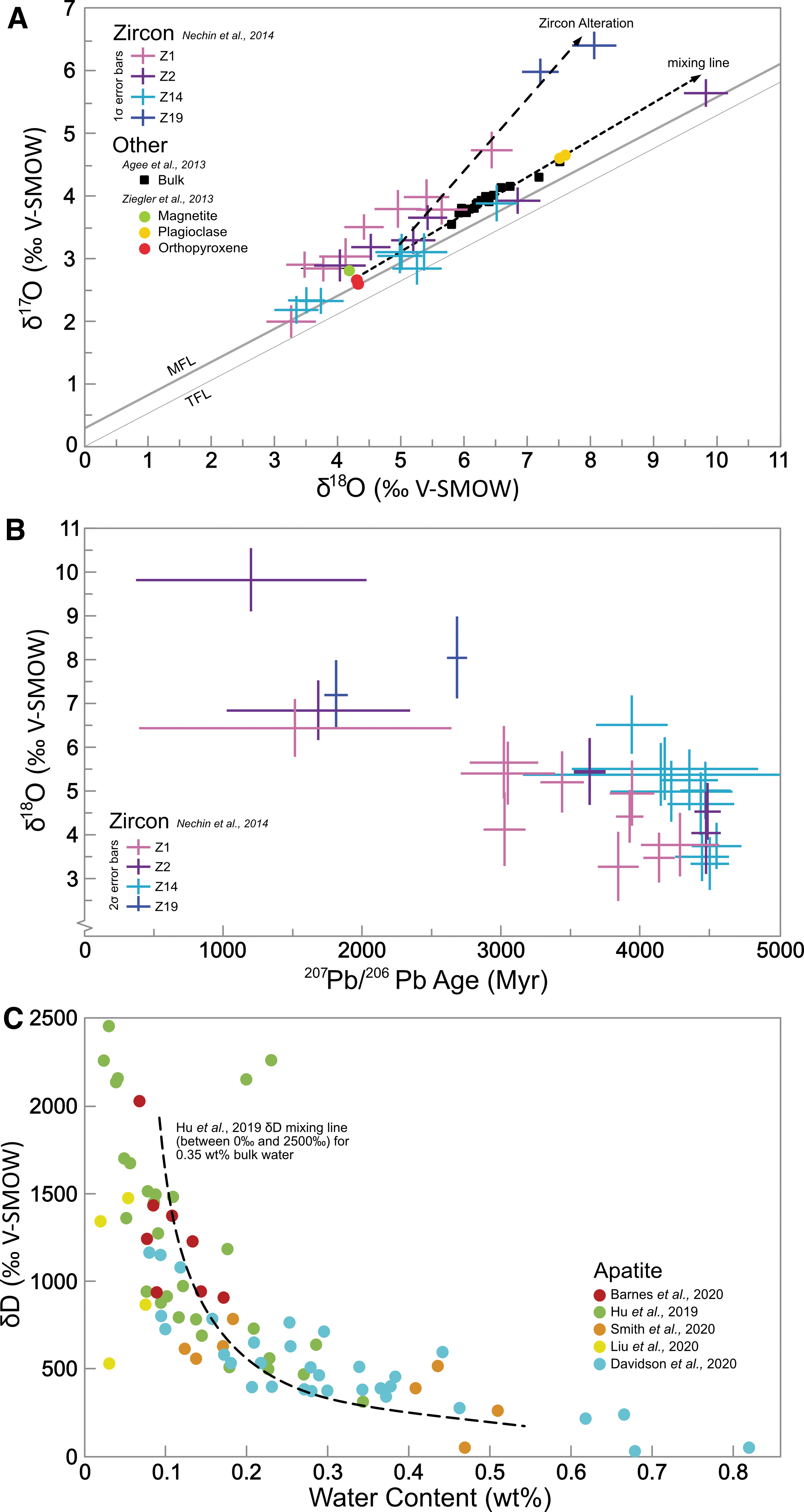
Summary of O and H isotope data in NWA 7034:
Water inventory, isotopic composition, and origins
Liquid water is necessary for Earth-like life, acting as a solvent for biochemical reactions (Pohorille and Pratt, 2012). Significant volumes of water are known to have existed on Mars in the geological past, potentially with a neutral chemistry, representing possible habitable environments for life (Grotzinger et al., 2014). The bulk H2O abundance in NWA 7034 was initially measured at 6000 μg/g, which is at least an order of magnitude higher than in Shergottite/Nakhlite/Chassignite (SNC) martian meteorites (Agee et al., 2013), and significantly higher than the estimated bulk martian crust H2O abundance of ca. 1410 μg/g (McCubbin et al., 2016b). NWA 7034 may thus provide important insights into the availability of subsurface water on Mars through time.
Stepwise heating measurements carried out by Muttik et al. (2014b) showed that 65% of the meteoritic H2O was released by 300°C. They further postulated that half of the bulk water (2800–3400 μg/g) was stored in Fe oxyhydroxides, with the remainder split between phyllosilicates predominantly (1900–3800 μg/g) and apatite (ca. 150 μg/g). Some of the oxyhydroxide minerals, such as goethite, may be terrestrial in origin (Lorand et al., 2015; Hewins et al., 2017), and so, it is possible that the bulk water inventory of NWA 7034 includes a mixture of martian and terrestrial waters. Water released from NWA 7034 is characterized by a bulk δD value of 46‰ ± 9‰, with 55–65% H2O released between 50°C and 200°C characterized by δD values around −100‰, and 35–45% H2O released >300°C having δD values of ca. 200–300‰ (Agee et al., 2013).
Extracted water is also characterized by a bulk Δ17O value of 0.33‰ ± 0.01‰, which is lower than the bulk rock NWA 7034 Δ17O value of 0.58‰ ± 0.05‰ (Agee et al., 2013). This could suggest that about half of the NWA 7034 water inventory that is released during heating at temperatures up to ∼200°C is terrestrial water (with δD of ca. −100‰ and Δ17O value of 0‰), while water released above ∼200–300°C is of martian origin (with δD of ca. 200–300‰ and Δ17O value of ca. 0.6‰, similar to the bulk rock Δ17O). However, this scenario is not consistent with the oxygen isotope composition measured for water released from NWA 7034 by step-heating, which yielded the Δ17O value of ∼0.3‰ for H2O released up to 400°C (Agee et al., 2013). These two lines of evidence would be reconciled if terrestrial alteration affected water H isotope composition without affecting its O isotope composition (Agee et al., 2013).
The O isotope composition of zircon in NWA 7533 also depicts a complex history of regolith assimilation and late interaction with fluids; zircon δ18O values range between ca. 3% and 10‰, and are characterized by Δ17O values between ca. 0.3‰ and 2.2‰ that deviate significantly from the MFL (Fig. 4A) (Nemchin et al., 2014). Nemchin et al. (2014) interpreted these results as indicating that zircon crystallized ∼4.4 Gyr-ago from melts that assimilated 17O-enriched regolith material, and that metamict zircon domains were later altered by low-temperature surface fluids during the ∼1.5 Ga disturbance event, as shown by the relationship between decreasing 207Pb/206Pb dates and increasing δ18O values (Fig. 4B).
Hydrogen isotopes in martian meteorites may preserve evidence for as many as four reservoirs: one atmospheric, one crustal, and two distinct mantle reservoirs (Barnes et al., 2020). A number of recent studies into chlorapatite H isotope compositions in NWA 7034 (Hu et al., 2019; Barnes et al., 2020; Davidson et al., 2020; Smith et al., 2020) reveal a continuous negative logarithmic correlation between (1) low δD and high-water content (ca. 50‰, > ca. 5000 μg/g H2O) and (2) high δD and low water content (ca. 2000‰, ca. 300 μg/g H2O) (Fig. 4C).
This trend has been interpreted as representing a D-rich crustal water reservoir that buffered apatite H isotope composition during the 1.5 Ga disturbance event, which was later disturbed by interactions with D-poor fluids after the breccia lithification (Hu et al., 2019; Smith et al., 2020). This mixing is also seen as δD zoning in some metasomatic apatite grains, which preserve signatures of D-rich crustal waters in their cores coupled with evidence for interaction with D-poor fluids at their rims. These fluids could have been derived from degassing of late magmatic intrusions (Hu et al., 2019).
Hydrogen and oxygen isotope characteristics of bulk NWA 7034 samples and accessory minerals such as zircon and apatite reveal a complex history of interactions with crustal and/or surface fluids, notably around 1.5 Ga. Mixing of mantle-derived and near-surface fluids is likely to create redox potentials capable of being utilized by life (Grenthe et al., 1992; Mottl et al., 2007). For example, it has already been suggested that martian subsurface groundwaters may have been habitable for sulfate-reducing bacteria (Tarnas et al., 2021).
Carbon inventory, isotopic composition, and origins
The term “organic carbon” refers to compounds that may be produced biogenically or abiogenically and are useful for life. Earth-like life requires carbon for metabolism and growth. Thus, understanding how bioessential carbon compounds may be synthesized biotically or abiotically on Mars is an important pursuit of astrobiology. When extraterrestrial carbon shares similar characteristics to terrestrial kerogens (e.g., similar Raman spectra), the term macromolecular carbon (MMC) is used to avoid making inferences about its origin (Steele et al., 2016).
For NWA 7034, Agee et al. (2013) reported a high bulk carbon content of 2080 ± 80 μg/g associated with a δ13C value of −3.0‰ ± 0.2‰ in an untreated sample. Analysis of an acid-washed sample yielded a much lower C abundance of 310 ± 10 μg/g with a δ13C value of −21.6‰ ± 0.2‰, indicating that ∼80–90% of the untreated sample bulk C content originated from carbonate veinlets formed through terrestrial weathering.
High-temperature release yielded 22 ± 10 μg/g magmatic C with a δ13C value of −23.4‰ ± 0.7‰ (Agee et al., 2013), which is consistent with magmatic C abundances and isotope compositions determined in SNC meteorites (e.g., Grady & Wright, 2003; Steele et al., 2012, 2016). Suga et al. (2019) measured a bulk C abundance of 400 ± 10 μg/g in a powdered sample of NWA 7034, which is consistent with the bulk C abundance obtained by Agee et al. (2013) from their acid-washed sample.
Scanning transmission X-ray microscopy (STXM) and C-, N-, and O-near edge X-ray absorption fine structure were applied to a bulk crushed sample of NWA 7034 by Suga et al. (2019) who identified two populations of N-poor (below their STXM detection limit) and N-rich carbonaceous materials in the sample. The existence of differing δ13C isotopic ratios—that is, in N-poor MMC (δ13C = 9.6‰ ± 8.1‰), N-rich MMC (δ13C = 28.0‰ ± 11.9‰) (Suga et al., 2019), and bulk acid-washed sample (δ13C = −21.6‰ ± 0.2‰) (Agee et al., 2013)—suggests the existence of at least two end-member carbon isotope reservoirs.
The intermediate δ13C value obtained for the N-poor MMC could potentially correspond to mixing between a 13C-poor and a 13C-rich reservoir. Carbon isotope compositions of martian carbon typically range from low δ13C values (δ13C = −20‰ to −30‰) for magmatic carbon to elevated δ13C values (δ13C = +25‰ to +50‰) for atmospheric/surface reservoirs (Carr et al., 1985; Wright et al., 1992; Grady & Wright, 2003; Steele et al., 2012, 2016; Hu et al., 2015). Therefore, the range of δ13C values measured in different components of NWA 7034 suggests that its carbonaceous material may preserve evidence for interactions between surface- and mantle-derived C.
This is similar to the water inventory of NWA 7034, which likely comprises at least two sources: an ancient magmatic source altered by later, near-surface hydrothermal activity. Fluid/rock interaction during hydrothermal activity is a possible trigger for the formation of MMC by the electrochemical reduction of aqueous CO2, as proposed by Steele et al. (2018) to explain the formation of abiotic indigenous MMC in a study on Nakhla and Tissint.
Raman spectroscopy has been applied to NWA 7034 samples to identify MMC (Agee et al., 2013; Suga et al., 2019). A single scan by Agee et al. (2013; supplementary data) reveals a carbonaceous inclusion within a pyroxene grain. Their identified association of MMC with apatite and magnetite is promising, given this is a common diagenetic mineral relationship resulting from oxidation of MMC (e.g., via sulfate reduction), resulting in the precipitation of apatite and hydrogen sulfides (Papineau et al., 2017).
Suga et al. (2019) noted fine calcite embedded in MMC from a powdered bulk sample, further suggesting carbon oxidation. Diagenetic decarboxylation reactions (which result in the degradation of organic material to CO2) often cause the precipitation of carbonates and can be driven by both abiotic and biotic processes (Sheik et al., 2020). A thorough inventory of the phases hosting carbon in NWA 7034, their mineralogical context (which could provide clues regarding post-depositional oxidation and/or alteration), and a comprehensive characterization of the organic compounds themselves (e.g., chemistry, C isotope composition) will be crucial to further the investigation of the organic geochemistry record preserved in NWA 7034.
Habitable paleoenvironments
Hunting for traces of life on Mars has first involved assessing paleoenvironment habitability, before searching for biosignature preservation within these past environments (Grotzinger, 2014). Generally, “habitable” has referred to an environment (ranging from locality- to planetary-scales) that has the potential to sustain life (Westall et al., 2015; Cockell et al., 2016) while being shielded from potential harmful physical conditions (Dartnell et al., 2007). Just because a habitable paleoenvironment existed does not mean it was ever inhabited (Cockell et al., 2012). However, contextual features evidencing past conditions suitable for life help define targets for later astrobiological exploration.
Martian meteorites are an important source of evidence in this search and dating paleoenvironment indicators—largely the presence of water—to reconstruct windows of martian habitability has already been achieved with Allan Hills (ALH) 84001 (Treiman, 2021). The martian regolith breccia NWA 7034 records at least two potential habitable environments: (1) an early period of planetary habitability soon after the formation of Mars; and (2) ephemeral habitable crater localities created from impacts and associated hydrothermal activity.
The Noachian (4.1–3.7 Ga) is the favored period of martian history for habitability, during which models suggest that transient wet conditions and an active hydrological cycle were present (Andrews-Hanna and Lewis, 2011; Wordsworth et al., 2013), promoting lateral connectivity between habitable environments (Westall et al., 2015). Little is known for the pre-Noachian, although NWA 7034 provides us with crucial information on pre-Noachian conditions on Mars. The oldest zircon grains (ca. 4450 Ma) in NWA 7034 show an unexpected O isotope mass-independent fractionation indicative of the assimilation of 17O-enriched regolith materials into the igneous melt (Fig. 4A). This suggests that interactions between the martian regolith and an atmosphere/hydrosphere occurred within ca. 150 Ma of Mars formation (Nemchin et al., 2014).
Such a scenario is consistent with evidence for mineral crystallization under oxidizing conditions at oxygen fugacity above the quartz/fayalite/magnetite buffer (Lorand et al., 2015; Hewins et al., 2017), which implies that volcanic outgassing during this early period resulted in an H2O- and CO2-enriched secondary atmosphere, much like that of early Earth (Trail et al., 2011). Evidence of fluid transport of proto-breccia grains in NWA 7034 (Jacobs et al., 2016) indicates that an unknown amount of flowing liquid water existed at some point between 4300 and 1500 Ma, and may have resulted in sedimentary siltstone preserved as rare clasts within NWA 7034 (Wittmann et al., 2015; Hewins et al., 2017). This is promising evidence for watery environments on a young Mars.
The existence of 17O-enriched surface reservoir also implies atmospheric loss (to allow for photochemical fractionation) within 120 Myr of Mars's formation (Nemchin et al., 2014) and that crustal reworking occurred remarkably early on in the planet's history to incorporate this material, with hydrated crust present by ca. 4440 Ma (Hewins et al., 2017). Atmospheric loss favors an early, possibly pre-Noachian period of planetary habitability. Although Noachian and pre-Noachian surface conditions may have been suitable for life, any MMC preserved in NWA 7034 from this time likely underwent oxidation during the 1.5 Ga disruption event impact (Leroux et al., 2016; MacArthur et al., 2019), which would have either destroyed organics, or altered and remobilized them.
It has been speculated that any life that could have initially developed on Mars would have been chemotrophic—that is, its dominant energy source was from the oxidation of inorganic, rock-forming materials (Summons et al., 2011). During planetary desiccation after the Noachian, cellular life may have followed water to survive underground (Schulze-Makuch et al., 2005; Chivian et al., 2008). Impacts would have provided energy input, creating transient wet surface conditions and long-lasting hydrothermal systems (Osinski et al., 2013) evidenced in NWA 7034 by aqueous alteration of precursor clasts in the regolith breccia (Nemchin et al., 2014; Lorand et al., 2015; McCubbin et al., 2016a; Hu et al., 2019; MacArthur et al., 2019; Smith et al., 2020).
Models suggest that such environments would have been habitable for life (Abramov and Kring, 2005; Schwenzer and Kring, 2009; Ramkissoon et al., 2020). NWA 7034 preserves clear H and O isotope evidence for the complex mixing of crustal, magmatic, and surface reservoirs that likely provided redox contrasts known to be ideal environments for chemotrophic life (Falkowski, 2001). Milojevic et al. (2021) showed that the thermoacidophile Archaea Metallosphaera sedula is capable of chemolithoautotrophic growth on a sample of NWA 7034, oxidizing reduced sulfur from pyrite-rich domains as its main energy source.
This proof-of-concept demonstrates that this martian breccia can support subsurface life in a hydrothermal environment. Negative δ34S values (as low as −5.8‰) attributed to the precipitation of sulfides in NWA 7533 (Lorand et al., 2020) indicate that suitable chemistry for chemotrophic life was present during the time of metasomatism. In this context, the regolith breccia NWA 7034 is extremely valuable because it was excavated from several meters deep (estimated >5 m) (MacArthur et al., 2019), where potential life-forms would have been shielded from harmful solar and galactic radiations (Kminek and Bada, 2006; Dartnell et al., 2007).
Footnotes
Acknowledgments
We thank the two anonymous reviewers whose insightful comments and suggestions greatly improved this article, and the UK Science and Technology Facilities Council for financial support.
Author Disclosure Statement
No competing financial interests exist.
Funding Information
This work was supported by the UK Science and Technology Facilities Council through a PhD studentship to A.G. (ST/V506886/1) and a fellowship to R.T. (ST/P005225/1).
Associate Editor: Lewis Dartnell