






Abstract
The Tanpopo experiment was the first Japanese astrobiology mission on board the International Space Station. It included exposure experiments of microbes and organic compounds as well as a capture experiment of hypervelocity impacting microparticles. We deployed three Exposure Panels, each consisting of 20 Exposure Units that contained microbes, organic compounds, an alanine UV dosimeter or an ionizing radiation dosimeter. The three Exposure Panels were situated on the zenith face of the Exposed Experiment Handrail Attachment Mechanism (ExHAM) that was pointing in zenith direction toward space, which was attached on a handrail of the Japanese Experiment Module (Kibo) Exposed Facility (JEM-EF) outside the International Space Station. The three Exposure Panels were one by one retrieved and returned to the ground after approximately 1, 2, and 3 years of exposure to the space environment. Capture Panels, each of which contained one or two blocks of amorphous silica aerogel, were exposed to collect hypervelocity impact microparticles. Possible captured particles may include micrometeoroids, human-made orbital debris, and natural terrestrial particles. Each year, Capture Panels containing from 11 to 12 aerogel blocks were attached to the three faces of the ExHAM (pointing to zenith, ram, and port); they remained in place for about 1 year and were then returned to the laboratory. This process was repeated three times, in total, during 2015–2018. Additional exposure of a Capture Panel facing ram was conducted between 2018 and 2019. Once the aerogel blocks were returned to the laboratory, they were encapsulated in dedicated transparent plastic cases and optically inspected by a specially designed microscopic system. Once located and recorded, hypervelocity impact signatures were excavated one by one and distributed for further detailed analyses. The apparatus, operation, and environmental factors of all the Tanpopo experiments are summarized in this article.
1. Introduction
The Tanpopo experiment, named after “dandelion” in Japanese, was the first Japanese astrobiology mission on board the International Space Station. There were two objectives of this experiment (see an accompanying article for further detail: Yamagishi et al., 2021). The first was to partially investigate the panspermia hypothesis, which proposes interplanetary transfer of microbes between planets (Arrhenius, 1908; Horneck et al., 2002; Kawaguchi et al., 2013, 2020). The other was to gain supporting evidence for the chemical evolution of life. It is believed that organic compounds must have been abundant on Earth prior to the origin of life. Organic compounds produced in space might have been transferred to Earth via comets, asteroids, and their fragments such as meteorites and micrometeorites (Elsila et al., 2009). To test these hypotheses, several space exposure experiments outside the International Space Station were proposed and collectively referred to as Tanpopo.
To investigate the panspermia hypothesis, terrestrial, extremophilic microbes were exposed in low Earth orbit (LEO) to estimate their survival time in outer space. The possibility of organic compounds produced in space successfully being transferred to Earth via micrometeorites was also tested, and organic compounds were exposed in space to estimate denaturation. Another experiment was designed to capture intact microparticles and to estimate the average density of microbes at the cruising altitude of the International Space Station (ISS). If no microbes were captured, the density of microbes would be lower than the detection limit of our particle-capture method. Hypervelocity impacting microparticles were captured intact and are being analyzed to determine if any organic molecules are present. These objectives are reviewed in an accompanying article (Yamagishi et al., 2021).
To estimate the survival of microbes and denaturation of organic compounds, we designed original Exposure Panels (EPs). An EP consists of 20 Exposure Units (EUs), each containing selected microbes or organic compounds for space exposure. Some of the EUs were used to estimate ultraviolet (UV) radiation dose and ionizing radiation dose. We also designed original Capture Panels (CPs), each of which contains one or two aerogel blocks approximately 100 × 100 × 20 mm size for intact capture of hypervelocity impacting microparticles. These apparatuses used in the Tanpopo experiments are explained in the following sections, and the environmental conditions of space exposure are also summarized below.
2. Apparatus
2.1. Exposure Panels
An Exposure Panel (EP) consisted of an assembly of Exposure Units (EUs) and was used for the exposure experiments in Tanpopo. EPs were mounted on the Exposed Experiment Handrail Attachment Mechanism (ExHAM). ExHAM is a universal platform for up to 20 EPs, each with a dimension of 100 × 100 × 19.5 (thickness) mm. ExHAM was placed on the Exposed Facility (EF) of Japanese Experiment Module (JEM) “Kibo” of the International Space Station (ISS). Figure 1a shows the ExHAM attached to the EF-JEM-ISS handrail, and Fig. 1b shows the EPs attached to the ExHAM.
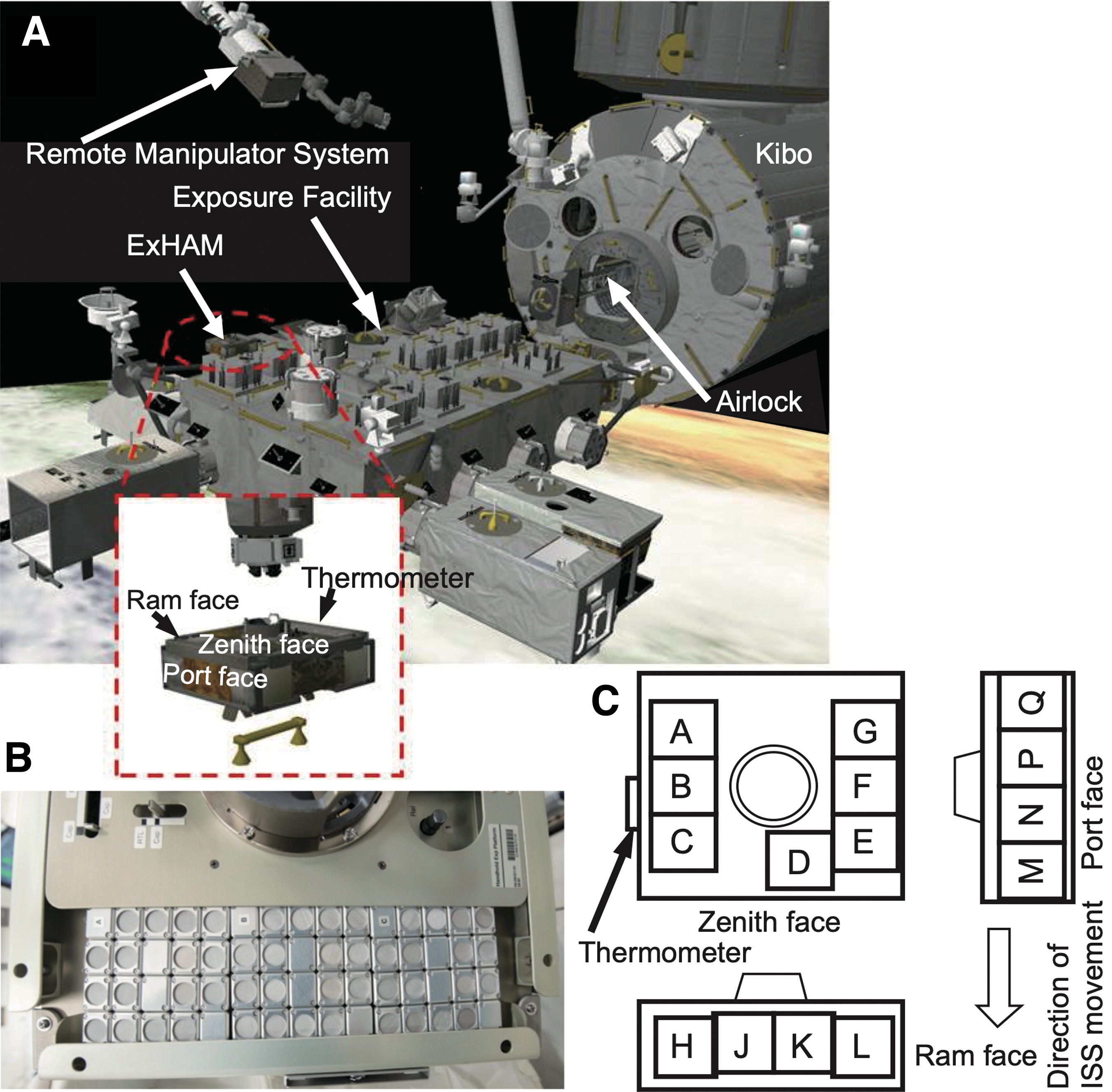
(
Operation Dates of ExHAMs and Tanpopo Panels
We employed two ExHAMs, ExHAM #1 and #2. Each ExHAM was operated independently. EP-A, EP-B, and EP-C were attached on ExHAM #1 and started exposure on 2015.05.26. Designation of EPs, A, B, and C, corresponds to the position indicated in Fig. 1C. After about 1, 2, and 3 years of exposure, one of the EPs was detached and returned to ISAS every year. A set of CPs were attached on either ExHAM #1 or #2 and detached after about 1 year of exposure. CP1 or CP2 contains one or two aerogel blocks, respectively (Fig. 5). The designation of CPs from D to Q corresponds the position indicated in Fig. 1C. ISAS: Institute of Space and Astronautical Science.
2.2. Exposure Panels in detail
A Tanpopo EP is shown in Fig. 2. One EP contains 20 EUs. Microbes, organic compounds, and dosimeters for exposure experiments were enclosed in each of these EUs. The dimension of an EP is 100 × 100 × 19.5 mm, and each EU is 25 × 20 × 11.5 mm. Each EU can be handled independently, and each user can manage the pre-experimental preparation and post-experimental analysis of the sample using each EU. Figure 2 shows the placement of the EUs in the EP. Among the 20 EUs, 8 EUs were assigned to microbes (EU A1–A6, B1, and C1), 4 EUs to organic compounds (D1, D2, E1, and E2), 4 EUs to UV dosimeters (F1, F2, G1, and G2), and 4 EUs to ionizing radiation dosimeters (H1–H4).
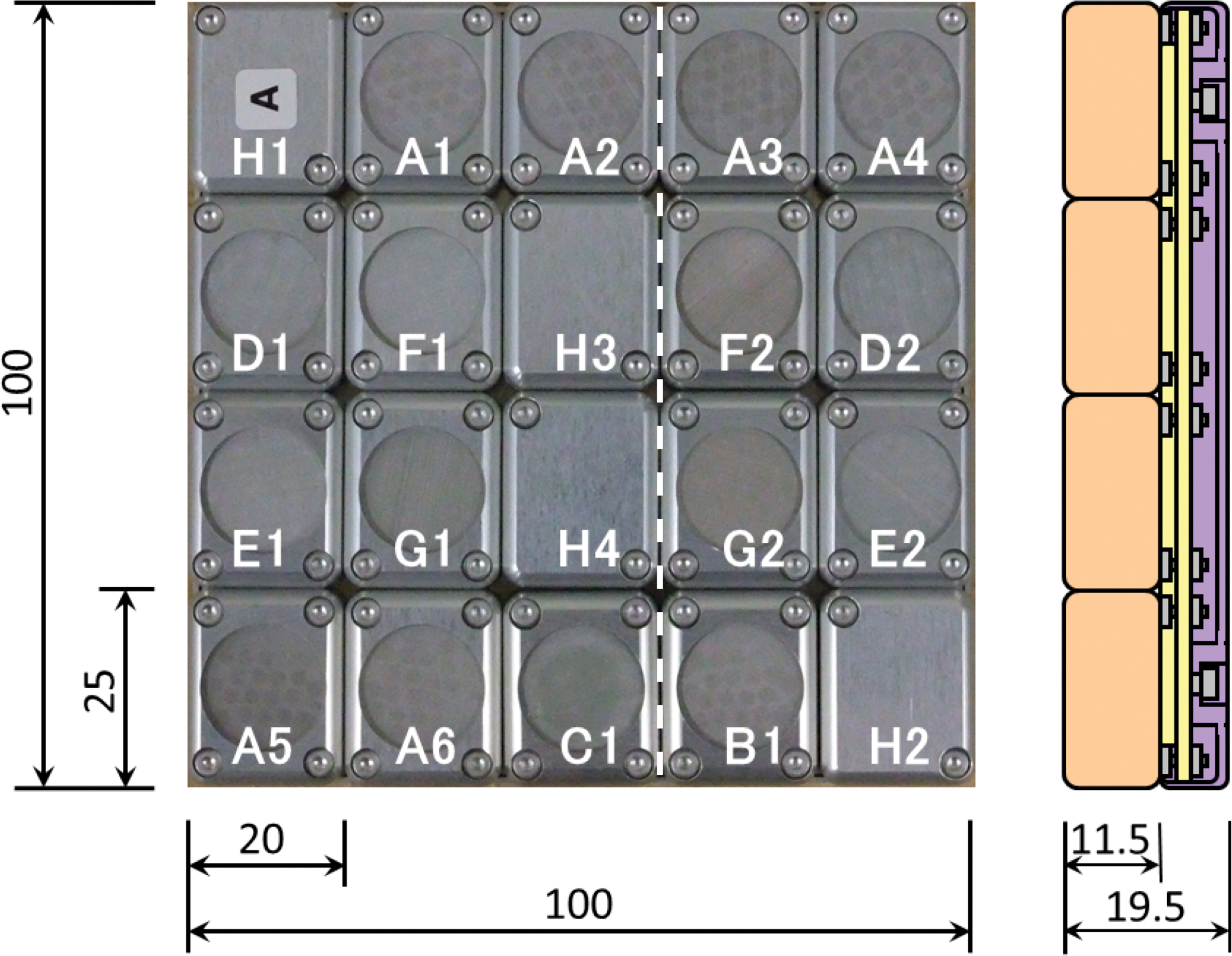
One Exposure Panel (EP) consists of 20 Exposure Units (EUs). Microbes, organic compounds, and dosimeters for exposure experiments were placed in these EUs. Dimension of an EP is 100 × 100 × 19.5 mm, and each EU is 25 × 20 × 11.5 mm (pale orange in cross section at the dashed line of the top view). Yellow parts represent the attachment plates to fix the EUs on the basement plate shown in purple. Microbes were placed in EUs A1–A6, B1, and C1. Organic compounds were placed in EUs D1, D2, E1, and E2. UV dosimeters were placed in EUs F1, F2, G1, and G2. Ionization radiation dosimeters were placed in EUs H1–H4, which do not have windows. Color images are available online.
A cross section of a typical EU is shown in Fig. 3. The frame of the EU is made of aluminum. There is a sample plate (18 mm in diameter) at the center, the structure of which can be modified to any shape, and various samples can be placed in the wells with desired shape on a sample plate. For example, by dividing this sample plate into upper and bottom parts, the bottom plate can be used for a dark control sample, while the upper plate can be used for samples exposed to sunlight. There is a window to prevent the sample from scattering into outer space and from polluting the surrounding environment. The diameter of the window opening is 16 mm, with a thickness of 2 mm. By changing this window material, the wavelength range of sunlight irradiation can be attuned. In the Tanpopo experiments, two types of windows were used: MgF2 in the wavelength range from 110 nm and above and quartz in the wavelength range from 170 nm and above. A metal mesh is placed at the top of the window to prevent scattering of accidentally broken windows. The mesh is made of stainless steel SUS316 with 350 mesh and an aperture ratio of 34.7%. There is a gas-permeable filter underneath the sample so that it is exposed to the vacuum of the space environment, allowing the air inside the EU to escape during space exposure. The filter is made of stainless steel SUS316 with a filtration limit of 0.3 μm. The O-ring is made of Kalrez with an inner diameter of 16 mm and a thickness of 1 mm.
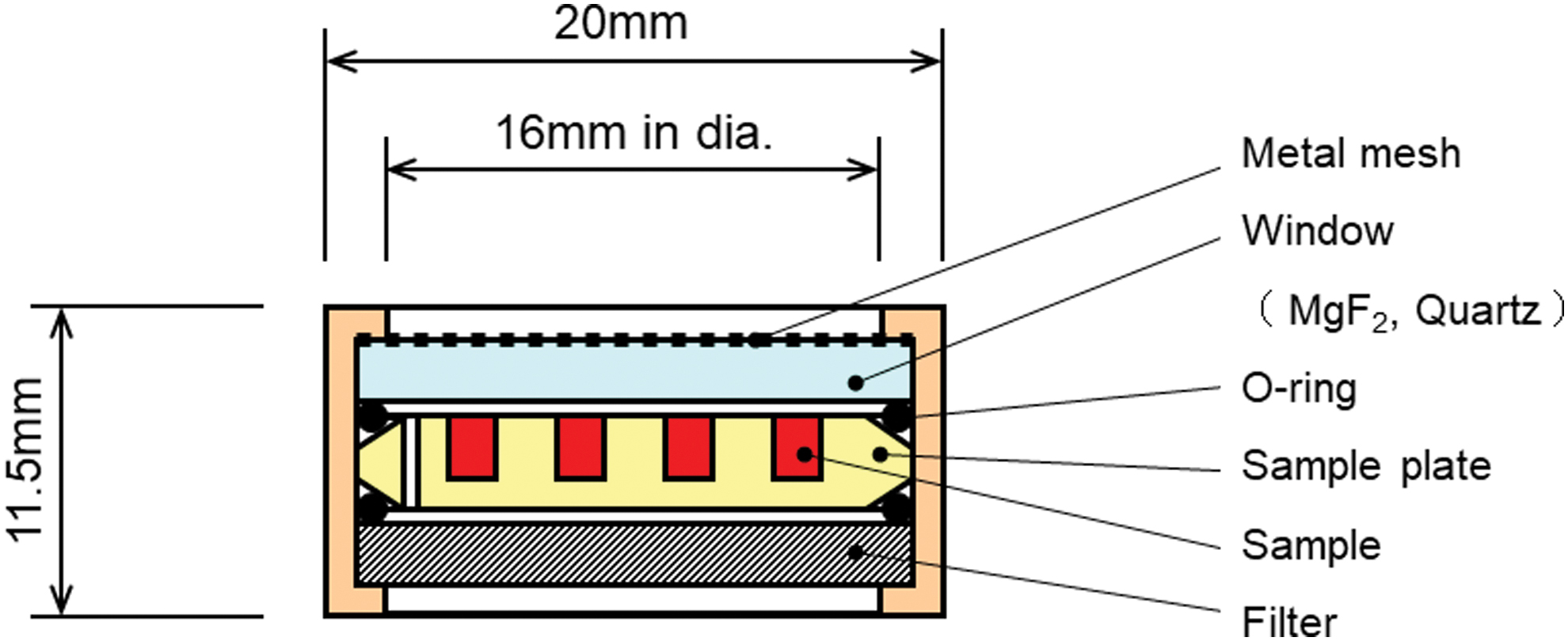
A cross section of an exposure unit. There is a sample plate (18 mm in diameter) at the center, which can be designed with wells of any shape to hold various samples. The diameter of the window opening is 16 mm. The thickness of the window is 2.0 mm. There is a filter underneath the sample plate, allowing the air to escape from inside during space exposure. The EUs without windows, H1–H4 (Fig. 2), had no metal mesh, no window, no filter but the top surface of 2 mm thick aluminum. H3 and H4 had SUS and lead plates, respectively, to achieve higher shielding density underneath the aluminum top surface. Color images are available online.
It was necessary to record the highest temperature that the EP would experience for microbial exposure experiments. However, ExHAM has no power source. The estimated temperature of the exposed area based on thermal model calculations was too low for the use of chemical batteries. Therefore, a bimetal mechanical thermometer that does not require a power supply was developed and attached to an EP as shown in Fig. 4.
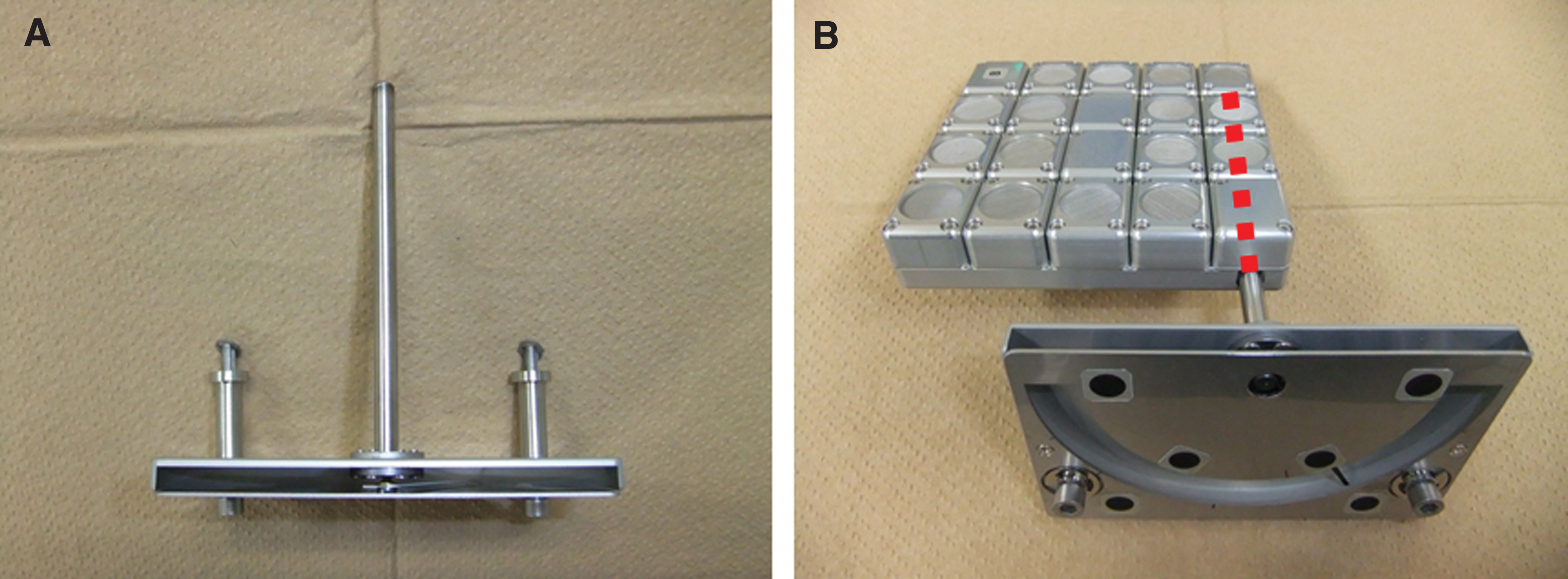
Exposure Panel (EP) equipped with a bimetal thermometer. The thermometer body (
2.3. Capture Panels
Meteoroid observation and collection have been conducted to study their parent bodies in planetary science, and several types of analyses have been conducted on meteoroids. Cosmic spherules have been found in Antarctic ice cores. Stratospheric interstellar dust particles have been captured by aircrafts. Meteoroid impacts have been noted on the surface of Earth-orbiting spacecraft and planetary probes. Analysis of impact signals of these particles has provided information on their origin and the parental bodies. However, collection of intact and uncontaminated micrometeoroids is desired.
Measurement and modeling of human-made debris flux is also important for evaluating the failure risk of LEO spacecraft. Relatively large debris can be monitored by ground observation, but smaller debris is detected and analyzed on the surface of retrieved parts of spacecraft. Retrieved spacecraft parts have been analyzed in the following missions: LDEF (84–90, NASA/ESA) (Mackay et al., 1993; Miao and Stark, 2001), EURECA (92–93, ESA) (Drolshagen et al., 1996), HST (89–93, NASA/ESA) (Drolshagen et al., 1995; Kearsley et al., 2005), SFU (95–96, JAXA) (Yano, 1994, 1998, 1999; Yano et al., 1994, 1997, 2000; Yano and Kitazawa, 1998; Burchell et al., 1999; Kitazawa et al., 1999) and STS (92–11, NASA) (Hyde et al., 2015). Passive particle collection apparatuses have also been deployed and analyzed: Euro-Mir (96–97, ESA) (Maag et al., 1997; Mandeville et al., 2000), ODC (97–98, NASA) (Hörz et al., 1999), MPAC&SEED (02–05 and 09–10, JAXA) (Kitazawa et al., 2009; Noguchi et al., 2009; Waki and Kimoto, 2013). However, the number of debris is changing, and continuous monitoring is needed.
The key technology developed for Tanpopo was the capture of intact particles with aerogel. The aerogel is amorphous SiO2 with low bulk density (below 0.03 g/cm3) and is optically transparent and thus most suitable for hypervelocity particle capture experiments. The aerogel is also an excellent thermal insulator: the thermal conductivity is about 0.017 W/mK. Accordingly, aerogel is suitable for use in space, and this premise has been supported by the use of aerogel tiles for EURECA, Euro-Mir, ODC, MPAC & SEED, Stardust, and so on.
For example, aerogel was used in the Stardust project (Brownlee et al., 2006; Zolensky et al., 2006) that captured and returned intact cometary and interstellar dust for analysis. The spacecraft was launched in 1999, and interstellar dust was collected in 2002. Cometary particles were collected from the Comet Wild-2 coma during the flyby in 2004, and the samples were returned on January 2006. Hypervelocity particles at 6.1 km/s were successfully captured and led to the detection of amino acid glycine (Elsila et al., 2009).
Japanese aerogel was also used in ISS-MPAC&SEED. In the mission, sampling devices (SM/MPAC&SEED) were launched in 2001 on the Russian Service Module of the ISS in LEO at about 400 km above the surface of Earth. Sampling devices were retrieved sequentially in 2002, 2004, and 2005. Another sampling device (JEM/MPAC&SEED) was launched in 2009 and placed on the JEM. This device was retrieved in 2010. However, the sampling devices were exposed only on the ram and wake faces of the ISS. It is known that the type of particles collected depend on the exposure face relative to the direction of ISS movement. The ram side, pointing in the flight direction of the ISS, has the highest possibility of capturing debris of human-made origin. The zenith face is the most suitable for collecting interplanetary dust particles. It is also useful to test the side direction of the ISS, port and/or starboard side, to capture both human-made debris and interplanetary dust particles.
One of the Tanpopo teams has already tested the possibility of collecting hypervelocity meteoroids by aerogel. CM2 Murchison powder was accelerated to 6.2 km/s by a two-stage light-gas gun and targeted on aerogel (Noguchi et al., 2007). The track of the particle in the aerogel was inspected, and the particle was found at the tip of the track. A thin section of the particle was inspected by an electron microscope. The peripheral area of the particle consisted of amorphous nodules that are typical of melting phenomena. However, crystal structures were retained at the central part representing the original mineral structure of the Murchison powder. These results showed that it is possible to capture hypervelocity meteoroids partially intact. Another target of the capture experiment is for particles originating from Earth. Particles containing microbes may also be captured by the aerogel. To test this, clay particles containing microbes were accelerated by two-stage light-gas gun and impacted on aerogel. Microscopic inspection showed that the DNA could be visualized in the aerogel track after an impact of 4 km/s on the aerogel (Kawaguchi et al., 2014).
The aerogel blocks were contained in an aluminum case on the CPs, which were attached on three faces of ExHAM (zenith, ram, port), which was attached on the ISS-JEM Exposed Facility. After about 1 year of exposure in LEO, the CPs were detached from the ExHAM and returned to the ground.
2.4. Capture Panels in detail
Each CP contained a silica aerogel block in an aluminum container to capture hypervelocity impacting microparticles. CPs were attached to the ExHAM, which were installed on the handrail of the ISS exposure area.
Two types of CPs were designed and used (Fig. 5): Type-1 stores one silica aerogel block, and Type-2 stores two silica aerogel blocks. The Type-1 CP is 100 × 100 × 20 mm and less than 0.2 kg. The Type-2 CP is 100 × 200 × 20 mm and less than 0.4 kg. CPs were made of aluminum alloy (A-7075) and were anodized to a thickness of 3 μm. The front face of a CP is a coarse mesh to hold the aerogel while preserving its strength and leaving maximal area for capturing particles. The size of each window of the mesh is 19 × 19 mm (Fig. 5).
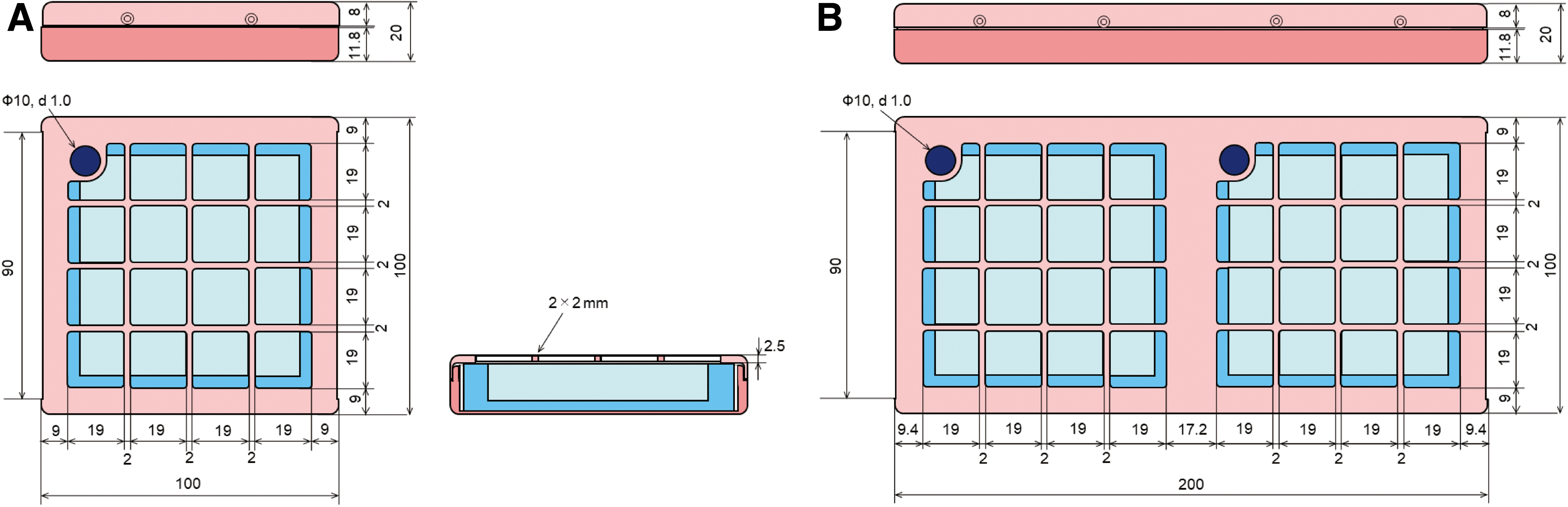
Side view, top view, and cross section of CP Type-1 (
A carbon nanotube forest was attached in a shallow well of 10 mm diameter and 1 mm depth as a witness plate (Fig. 5). The carbon nanotube forest is carbon nanotube populations that self-assemble into vertically oriented arrays during the growth of carbon nanotubes. The top of the carbon nanotube forest absorbs particles by atomic force. Carbon nanotube forests were used to count the number of particles that collided with the surface of CPs at low velocity.
Our ability to capture particles and retain intact composition was required to achieve the objectives of the mission, as described in an accompanying article (Yamagishi et al., 2021). Silica aerogel blocks were used to capture particles. Silica aerogel block has a double-layered structure: a 0.03 g/cm3 base layer provides mechanical strength to support the 0.01 g/cm3 layer inside (Figs. 5 and 6) (Tabata et al., 2014). The aerogel block's primary layer was designed to have a density of 0.01 g/cm3 and was positioned on the space-exposed surface side. The surface layer with a thickness of 10 mm at maximum was expected to capture particles as intact as possible by employing the aerogel with the lowest density available by our current stable production technology. However, the low-density aerogel is fragile and needs protection from vibration. The second layer having a density of 0.03 g/cm3 was formed as a base under the 0.01 g/cm3 layer. More specifically, as shown in Fig. 5, the base layer was formed as an open-topped box shape, allowing fill of the inside of the box with the lower-density layer (a box-framing structure). The robust base layer with a bottom thickness of 7 mm helped mechanically support the fragile, lower-density surface layer over the orbital operation period, including rocket launch. The two aerogel densities were clearly distinguished at the boundary, which facilitates ground-based hypervelocity impact simulation studies (e.g., Okudaira et al., 2004; Ogata et al., 2013; Kawaguchi et al., 2014; Kebukawa et al., 2019). Each density layer was chemically combined during the sol–gel synthesis process, forming a single aerogel block with a large area of approximately 90 × 90 mm. The double-layer but monolithic aerogel block enabled it to be securely installed into an aluminum container, the CP.
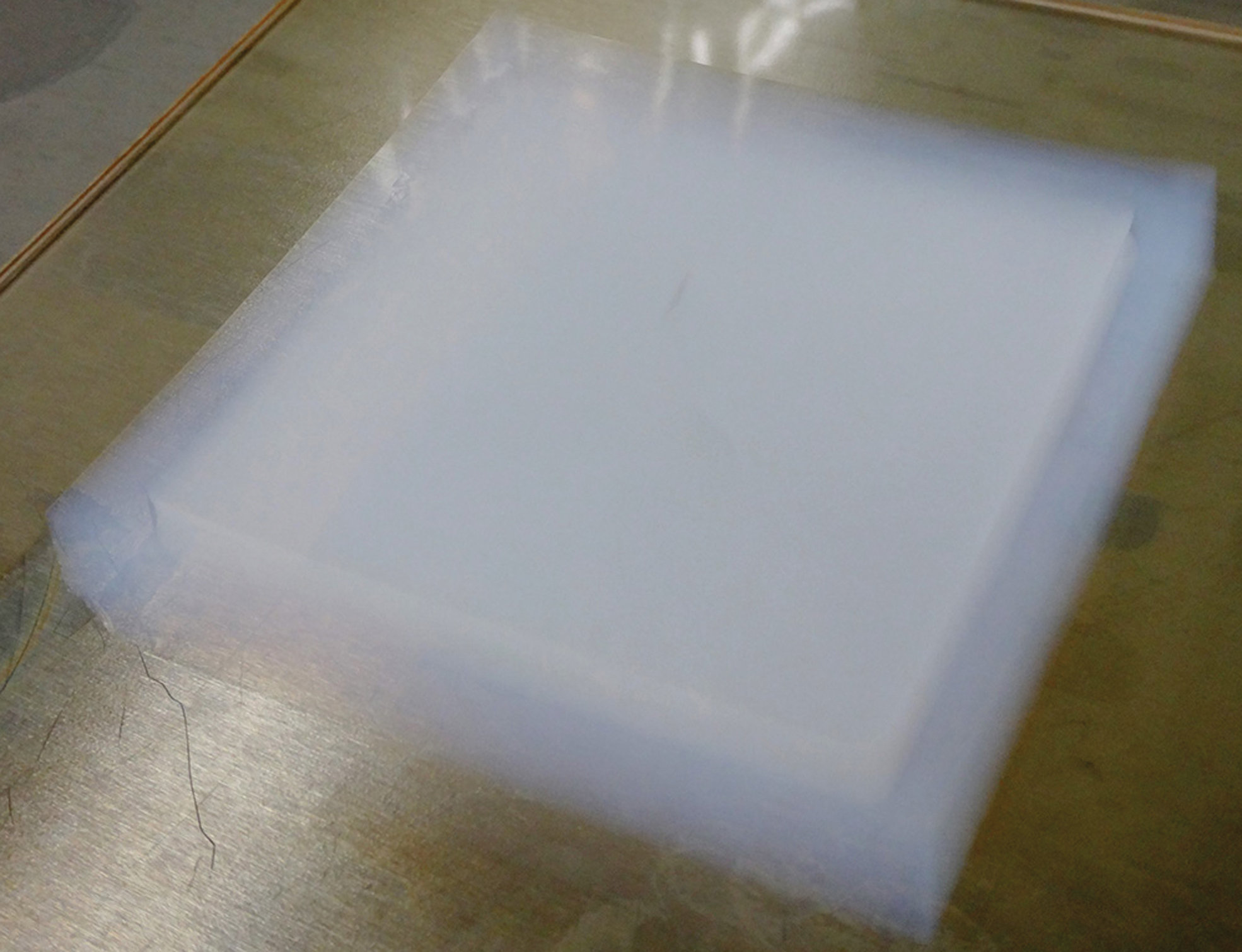
Box-framing aerogel tile with approximate dimensions of 87 × 87 × 17 mm (reproduced from Tabata et al., 2016). Silica aerogel block has a double-layered structure: a 0.03 g/cm3 base layer provides mechanical strength to support the 0.01 g/cm3 layer inside. Color images are available online.
We also modified ultralow-density double-layer silica aerogel blocks to give hydrophobic properties. The hydrophobic aerogel is more resistant to environmental moisture than hydrophilic aerogel (Perego, 2008) during storage.
Aerogel blocks were synthesized by using chemicals and media with the highest purity available (Tabata et al., 2016). All the equipment was cleaned with care and high purity water. The aerogels were manufactured in a clean environment (ISO Class 6). All possible contamination was evaluated, and the number of microbes were under detection limits (Tabata et al., 2011). A total of 36 selected among 60 aerogel blocks produced were installed in the CPs by using sterilized tools in a clean environment.
Performance of the aerogel was confirmed based on the recovery of all the aerogel blocks returned from space without any serious destruction that may prevent observation of high-velocity impact tracks.
The front face of the CP aluminum alloy was used to monitor the particles by counting the craters. SUS (stainless steel) protective covers were used to protect CPs by preventing damage to and contamination of the silica aerogel and lid surface before and after exposure of the CP to the space environment.
3. In-Orbit Operations
3.1. Operation of the Exposure Panels
In February 2015, EUs prepared by users were assembled into three EPs. Three reference panels (RPs) were assembled as an onboard control. Ground control samples were also prepared at the same time by respective users.
On 14 April 2015 (UTC: 2015, 4.15 JST, Table 1), EPs with other space experimental samples were launched by the SpaceX CRS-6 from the John F. Kennedy Space Center. The three EPs were mounted on the top of ExHAM placed on the table of the airlock inside the JEM by Scott Kelly, a NASA astronaut. ExHAM was transferred from inside the JEM through an airlock. In EXPOSE-R, the windows, mainly inside vented compartments, were contaminated with a transmission-decreasing layer (Rabbow et al., 2015). We anticipated possible similar transmission-decreasing layer formation caused by reaction of the gas released from the biological and organic samples. To avoid the possible effect of gas released from the sample to the window, EPs were exposed to space vacuum for 12 days in an airlock of the JEM to allow the gas release from the samples to be exhausted. ExHAM was attached to the EF-JEM-ISS on 26 May 2015 (UTC) by remote control and a remote manipulator system operated by robotic arm specialists from the Japan Aerospace Exploration Agency (JAXA) Tsukuba center. RPs were stored in an ISS pressurized storage area (ISS storage room JPM1O2_c2) as an ISS cabin control. The three EPs were then recovered to the ground after 1, 2, and 3 years of exposure. After 384 days of exposure, the ExHAM was retrieved into the ISS by a robotic arm on 13 June 2016 (UTC) for the first-year EP recovery. The first-year EP was detached from the ExHAM and packed in a plastic bag with desiccant blocks. The first-year EP and RP were returned to Earth, landing in the Pacific Ocean, via SpaceX CRS-9 on 27 August 2016 (UTC) and were returned to us in September 2016.
The ExHAM was returned to the same position on the EF-JEM-ISS by a robotic arm. After a total of 769 days of exposure, excluding the days during the operation inside the JEM and the airlock, the second-year EP was detached from the ExHAM and stored in the ISS pressurized area. The second-year EP and RP were returned to Earth via SpaceX CRS-12 on 17 September 2017 (UTC) and returned to us in October 2017.
The ExHAM was returned to the same position on the EF-JEM-ISS by a robotic arm. After a total of 1126 days of exposure, excluding the days during the operation inside the JEM and the airlock, the third-year EP was detached from the ExHAM and stored in the ISS pressurized area. The third-year EP and RP were returned to Earth via SpaceX CRS-15 on 2 August 2018 (UTC) and returned to us in August 2018. In summary, the exposure periods for the three EPs were 384 days, 769 days, and 1126 days, respectively, excluding the days during the operation inside the JEM and the airlock. At the same time, the RPs were also recovered to the ground one by one.
3.2. Operation of the Capture Panels
Capture Panels were basically on the same schedule as the EPs described in the previous section with some differences. On 14 April 2015 (UTC: 2015, 4.15 JST, Table 1), CPs with other space experimental samples were launched by the SpaceX CRS-6 from John F. Kennedy Space Center. The CPs containing eight aerogel blocks (Table 1) were mounted on the ExHAM on the three faces, zenith, ram, and port, as indicated in Fig. 1C. The ExHAM was attached to the EF-JEM-ISS by a robotic arm remotely operated by robotic arm specialists from the JAXA Tsukuba center on 26 May 2015 (UTC). The remaining CPs were stored in an ISS pressurized storage area (ISS storage room JPM1O2_c2) for the following operation. After 384 days of exposure, the ExHAM was retrieved into the ISS by a robotic arm remotely operated by robotic arm specialists from the JAXA Tsukuba center on 13 June 2016 (UTC) for the first-year CP recovery. The first-year CPs were detached from the ExHAM, and each CP was packed in a plastic bag with desiccant blocks. The first-year CPs were returned to Earth, landing in the Pacific Ocean, via SpaceX CRS-9 on 27 August 2016 (UTC) and were returned to us in September 2016.
The second year set of CPs containing 12 aerogel blocks (Table 1) were attached on ExHAM, and it was returned to the same position on the EF-JEM-ISS by a robotic arm. After 385 days of exposure, the second-year CPs were detached from the ExHAM and stored in the ISS pressurized area. The second-year CPs were returned to Earth via SpaceX CRS-12 on 17 September 2017 (UTC) and returned to us in October 2017.
The third-year set of CPs containing 12 aerogel blocks (Table 1) were attached on ExHAM, and it was attached to the same position on the EF-JEM-ISS by a robotic arm. After 357 days of exposure, the third-year CPs were detached from the ExHAM and stored in the ISS pressurized area. The third-year CPs were returned to Earth via SpaceX CRS-15 on 2 August 2018 (UTC) and returned to us in August 2018.
The fourth-year CP containing one aerogel block (Table 1) was attached on ExHAM, and it was attached to the same position on the EF-JEM-ISS by a robotic arm. After 377 days of exposure, the fourth-year CP was detached from the ExHAM and stored in the ISS pressurized area. The fourth-year CP was returned to Earth via SpaceX CRS-18 on 28 August 2019 (UTC) and returned to us in September 2019.
To accommodate other ExHAM users, CPs containing three aerogel blocks (Table 1) were exposed on ExHAM #2. The exposure started on 12 November 2015. After 484 days of exposure, the CP was detached from the ExHAM and stored in the ISS pressurized area. The CP was returned to Earth via SpaceX CRS-10 on 19 March 2017 (UTC) and returned to us in April 2017.
Upon return to ISAS, the CPs were stored in an electric desiccator with moisture less than 1%. Each aerogel block was transferred from the CP to transparent plastic cases made of acrylamide, which were stored in the electric desiccator with moisture less than 1%. The operations were done in an extremely clean area (ISO Class 1) between a pair of flow air cleaners (KOACH T 500-F, Ikari inc., Tokyo) in an ISO Class 4 clean room (Fig. 7A). The surface of the aerogel in the plastic case (Fig. 7B) was imaged by a microscope (VH-5000, Keyence, Osaka) with a magnification of 100. A total of 2500 images were integrated into 1, and was carefully checked for possible signatures of hypervelocity impact with size larger than 0.1 mm. Each signature was reimaged with a magnification of 245. By taking images while changing the focal depth, we could obtain 3-dimentional images of the signatures. By evaluating the 3-dimentional images of the signature, we could identify more than 300 tracks of possible hypervelocity impacts.
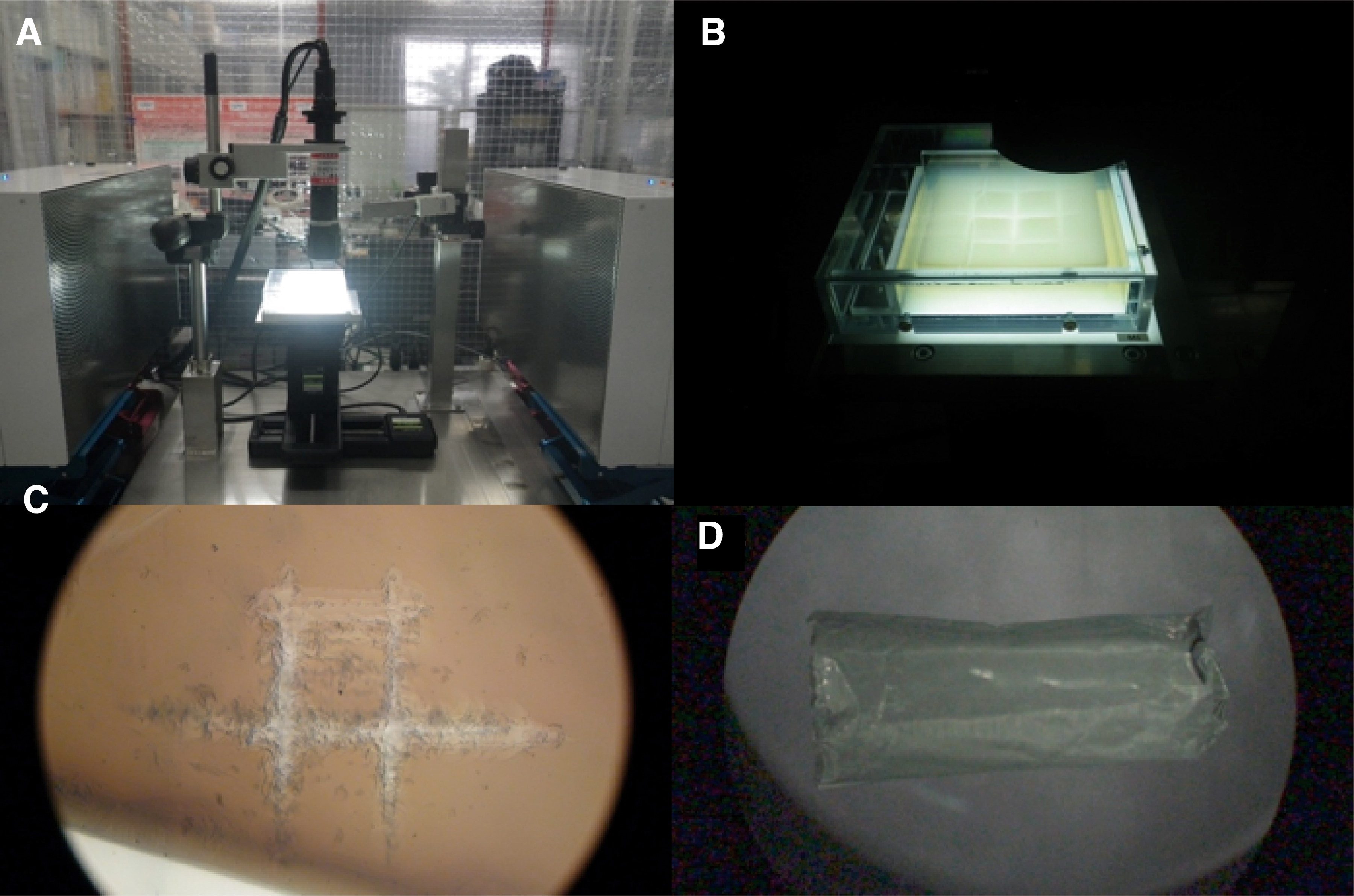
Aerogel handling. (
Aerogel around each impact track was scraped from the aerogel by using CLOXS system arranged and operated as described previously (Sasaki et al., 2019). All of the following operations were done in an extreme clean area (ISO Class 1) made between a pair of flow air cleaners (KOACH T 500-F, Ikari inc., Tokyo) in an ISO Class 4 clean room. A glass needle was automatically operated by an electric drive (DMA 1510 with DM system, Narushige, Tokyo) attached to the manipulator (MN-4, Narushige, Tokyo). The electric drive was controlled by a computer. Holes were punctured by a glass needle around the track (Sasaki et al., 2019), three faces at 90 degrees to the surface of the aerogel block and one face tilted at 50 degrees against the surface of the aerogel. Thus, the track was surrounded by four faces, each made of a series of punctured holes (Fig. 7C). The sandwich-shaped aerogel block made by the punctured faces was scraped by a thin razor blade (Fig. 7D) and stored in an appropriate small container for further analysis.
4. Summary of the Environmental Factors in Space
Environmental conditions were reported previously and cited in Table 2 (Kawaguchi et al., 2020). UV flux, radiation dose, and temperature were measured on EPs. We estimated the UV flux with an alanine film dosimeter as described previously (Yamagishi et al., 2018; Kawaguchi et al., 2020). Alanine film was formed by vacuum sublimation technique on an MgF2 plate, coated with hexatriacontane to prevent alanine film from possible sublimation in space vacuum, and mounted on Exposure Units. After 1, 2, and 3 years of exposure in the space environment, degradation of alanine was evaluated by infrared absorbance measurement at wavenumber 1307 per centimeter. We determined UV absorption dose between 120 and 203 nm with a calibration curve that was obtained by measuring the alanine degradation versus 172 nm UV irradiation dose using an Xe2 excimer lamp (Kawaguchi et al., 2020). The UV dose is listed in Table 2. UV dose under the MgF2 window is equivalent to between 44 and 63 ESD/year, where 1 ESD (equivalent solar day) represents the quantity of solar light received during one full day in the interplanetary space in Earth orbit, and the UV dose under the quartz window was between 41 and 58 ESD/year (Kawaguchi et al., 2020).
Three-Year Environmental Measurement Results in the Tanpopo Experiment (Kawaguchi et al. 2020)
UV fluence was estimated.
Ionizing radiation was measured with the dosimeters in the reference (Kawaguchi et al., 2020).
Maximum and minimum temperatures were measured as in the references (Yamagishi et al., 2018; Hashimoto et al., 2019).
Outside pressure estimated in Rabbow et al. (2015).
Sample plates were set on the upper side of the exposure unit; the plates were irradiated with UV.
Sample plates were set under the upper plates; UV was completely blocked by the upper plates.
The ground control was stored in a desiccator in an incubator at Tokyo University of Pharmacy and Life Sciences.
Total mission average UV-fluence values were calculated by “Redshift” in EXPOSE missions (Rabbow et al., 2012, 2015, 2017), which are summarized and compared with the values from Tanpopo in Table 3. The total UV doses were monitored with passive alanine film dosimeters developed in Tanpopo (Yamagishi et al., 2018; Kawaguchi et al., 2020). The alanine passive UV dosimeters were positioned at the same location as biological and chemical samples in Tanpopo (Yamagishi et al., 2018), just beneath the windows of EUs. The UV dose estimated in the Tanpopo mission was a few times lower than the doses estimated in the EXPOSE missions (Table 3). The shading effect of mesh in front of Tanpopo EU window may responsible for the lower UV doses in Tanpopo, which has an aperture ratio of 34.7%. The method used to estimate the UV dose may be another factor resulting in the different UV dose values. The shadows of the solar panels of the ISS or many other factors may also influence greatly and differently the achievable UV doses on EXPOSE-E, EXPOSE-R, EXPOSE-R2, and Tanpopo, which were in different locations (Table 3).
Comparison of Space Exposure Experiments on the ISS
EuTEF: European Technology Exposure Facility. URM-D: Universal Workplace D, JEM-EF: Japanese Experiment Module Exposed Facility.
Sizes are indicated as width × length × height in millimeters.
Exposure duration periods for EPs of first, second, and third recovery, respectively.
Daily doses were calculated from the total doses and the exposure duration periods.
Ionizing radiation dose with very thin (few micrometer) shielding.
Daily ionizing radiation dose during the period from May 2015 to June 2016.
For ionizing radiation, aluminum oxide–based optically stimulated luminescence dosimeters (Yamagishi et al., 2018) and silver-activated phosphate glass-based radiophotoluminescence dosimeters were used to measure radiation dosimetry outside and inside the ISS (Yamagishi et al., 2018; Kawaguchi et al., 2020). Total absorbed doses during the 3-year mission were 712 ± 15 mGy (SD) in space and 253 ± 2 mGy (SD) in the pressurized area of the ISS. The annual dose rates were 232 ± 5 mGy/year (SD) and 83 ± 1 mGy/year (SD) in space and the pressurized area of the ISS, respectively. The shielding density in front of the dosimeters that were placed in the Exposure Units placed outside and inside the ISS was approximately 0.55 g/cm2, which is approximately the same as that of the window placed in front of the microbe and organic compound samples. Inside the ISS, there is additional shielding provided by the structure of the ISS and the surrounding materials in the storage. The higher shielding inside is reflected in the dose values: the values in space are approximately three times higher than in the ISS pressurized area. The slightly higher dose (0.71 mGy/day) was recorded during the first period from May 2015 to June 2016, compared with the average for the 3 years (0.63 mGy/day), which may be related to the highly intense solar event of >10 MeV protons that occurred in the period from May 2015 to June 2016 as well as the location of a particular EU (Kodaira et al., 2021). The detailed results are reported in this issue (Kodaira et al., 2021).
The daily dose (0.63 mGy/day) in Tanpopo was higher than the doses recorded in EXPOSE-E and EXPOSE-R (0.32–0.47 mGy/day, Table 3); the passive dosimeters were located in close neighborhood of the test samples in EXPOSE-E and EXPOSE-R (Rabbow et al., 2012, 2015). The dosimeters in Tanpopo were shielded by 2 mm thick aluminum, providing a shielding density of 0.55 g/cm2. The dosimeters on EXPOSE-E and EXPOSE-R were placed behind 8 mm thick windows made of MgF2 or quartz (see Table 3), providing shielding densities of 2.52 or 2.12 g/cm2, respectively. This explains why the daily radiation dose in Tanpopo was significantly higher than in EXPOSE. The much higher daily dose (2.13 mGy/day) with very thin shield was reported in EXPOSE-R2 (Rabbow et al., 2017). The higher dose reported in EXPOSE-R2 is related to the thin shield in front of the dosimeter. The different doses reported in different missions may be mainly related to the different shields in front of the dosimeter.
Temperature was monitored by a mechanical thermometer (Fig. 4, Yamagishi et al., 2018; Kawaguchi et al., 2020). At a given time and orbital position of the ISS, the thermometer indicator was video-imaged by the extravehicular video camera attached to the EF-JEM and controlled from the ground. The EP temperature was estimated by analyzing the image of the pointer of this thermometer recorded with a JEM outboard camera. Throughout the 3 years of the Tanpopo exposure experiment, the thermometer was recorded by camera in 15 operations each for about 6 h. The temperature of the ISS is thought to be related to the Sun beta angle, which is the angle between the orbital plane of the ISS and the direction of the Sun. The maximum and minimum temperature estimated in each operation are shown in Fig. 8 as a function of the Sun beta angle. From the results obtained in 15 operations, the maximum temperature was 29 ± 5°C when the Sun beta angle was -15 degrees, and the minimum temperature was -42 ± 5°C when the Sun beta angle was -75 degrees. At a position of low absolute beta angle, the sunlight illuminates at a high angle, which is responsible for the higher temperature relative to orbit positions with larger absolute beta angle.
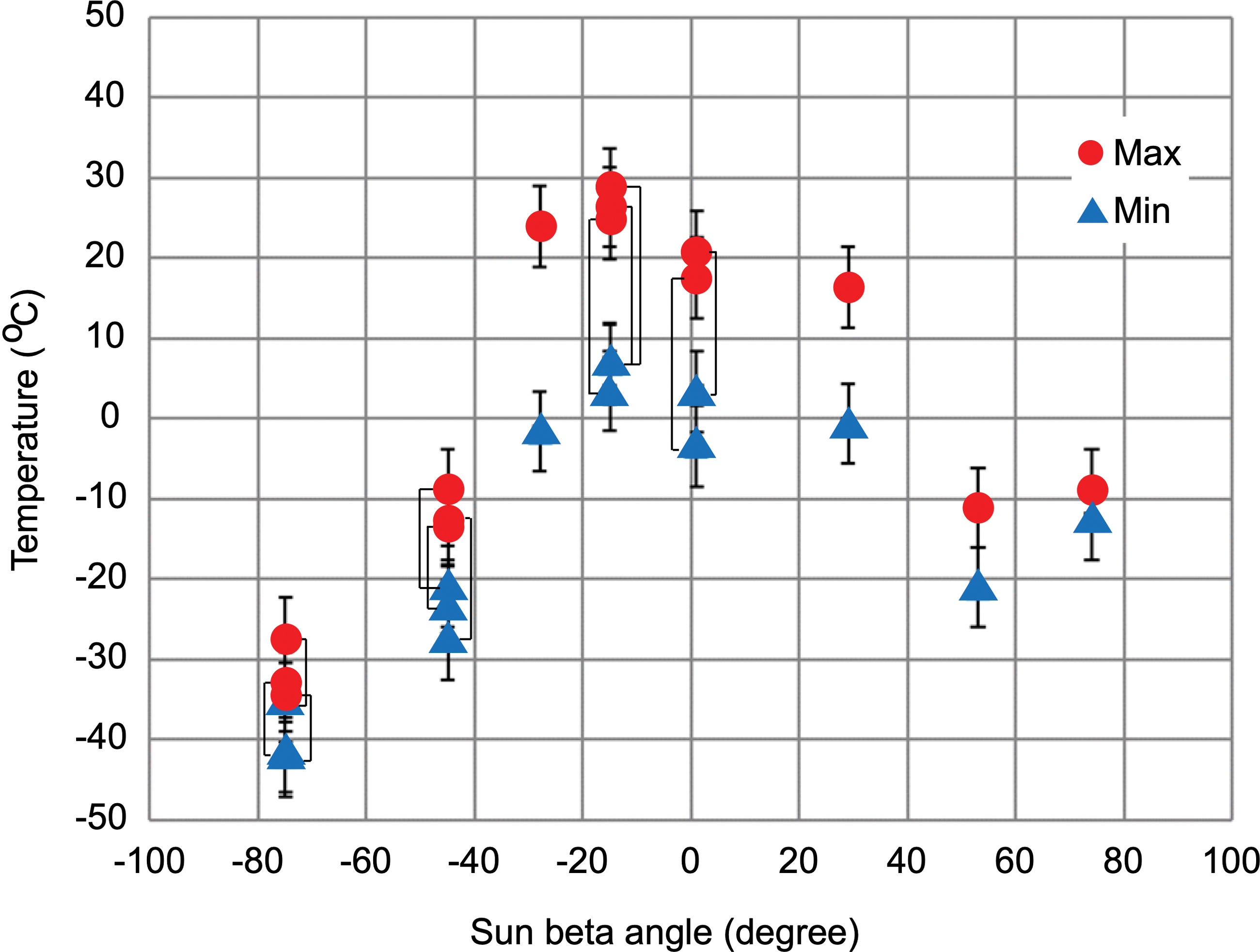
The temperature of the ISS is thought to be related to the Sun beta angle, which is the angle between the orbital plane of the ISS and the direction of the Sun (Hashimoto et al., 2019). The pair of the min and max values for each video session was connected by a line. The accuracy of the temperature was ±5°C, resulting from the accuracy of the estimation of the pointer position based on the video movies. Color images are available online.
5. Conclusion
In the Tanpopo experiments, two types of apparatus, EPs and CPs, were used for exposure and particle capture experiments, respectively. Each EP consisted of 20 EUs, each of which harbored microbes, organic compounds, UV dosimeters or ionizing radiation dosimeters. Three EPs were attached to the zenith-pointing side of ExHAM. Each EP was exposed for 1, 2, or 3 years. Accordingly, it was possible to estimate the time course of the survival of microbes and decomposition of organic compounds. By obtaining the slope and Y intersection of the time course, it became possible to separate the effect of the space exposure (slope) from the effect suffered before and after the space exposure (Y intersection) on the samples (Kawaguchi et al., 2020).
Two types of CPs were used to capture hypervelocity particles: Type-1 and Type-2. Each Type-1 CP contained one aerogel block, and each Type-2 CP contained two aerogel blocks. CPs were exposed for about 1 year before returning to the ground.
All the operations were done as planned: transfer of EPs and CPs from JAXA to NASA, launch, storage in the ISS, attachment to ExHAM, deployment and retrieval of ExHAM, detachment and storage of EPs and CPs, capsule return and transfer of EPs and CPs to JAXA through NASA and to the investigators' laboratory. All the EPs and CPs were returned to the laboratory without failure. Surface color of space-exposed and returned EPs was changed slightly; however, there was no clear damage to the structure of the EPs that were exposed for 1, 2, or 3 years in space. The structure of CPs was not changed, either. One or two cracks were found on some of the aerogel blocks returned to the ground. However, the cracks did not significantly interfere with the surface inspection of the aerogel blocks.
Aerogel blocks were transferred to transparent plastic cases and inspected by a microscope. After an extensive image analysis, aerogel sections surrounding hypervelocity impact tracks were scraped from the aerogel block and were delivered for further analyses.
European scientists conducted a series of space exposure experiments including EXPOSE (reviewed in Cottin et al., 2017). They exposed biological and organic samples to the space environment. EXPOSE is a multifunctional device that can retain gas introduced inside, has a sophisticated structure with a lid in EXPOSE-E (which was deleted in EXPOSE-R and EXPOSE-R2), and can measure temperature electrically.
The Tanpopo EPs do not have the same functions as EXPOSE, but they were attached to ExHAM, which was placed on the table of the airlock in the JEM pressurized area. ExHAM can be transferred from inside to outside the JEM through an airlock. ExHAM can be safely operated by robotic arm specialists from the ground, JAXA Tsukuba center, by remote control and a remote manipulator system (robotic arm) to transfer it from the table of the airlock and attach it to a handrail, while manned extravehicular activity is required to install and remove EXPOSE.
The most distinctive feature of the Tanpopo experiments was that the exposure experiments were conducted in the same environment on the ISS for periods of 1, 2, and 3 years, by installing three equivalent EPs on the zenith face of ExHAM and detaching one of them each year. By simplifying and downsizing the EP, it was possible to easily attach and detach the EPs from the ExHAM.
The following mission of Tanpopo, Tanpopo 2 was designed to conduct the exposure experiment of a cyanobacterial species and several types of organic compounds in the space environment. Exposure of Tanpopo 2 samples started in August 2019. After about 1 year of exposure of the samples, they were returned to the laboratory in January 2021. The initial analysis of the Tanpopo 2 samples has started.
Tanpopo 3 was designed to space expose the Deinococcus radiodurans cells grown with and without extra manganese, as well as testing the UV wavelength dependence on the survival of a cyanobacterial species. Exposure of Tanpopo 3 samples started in October 2020. The Tanpopo 3 samples will be returned to Earth after about 1 year of exposure. We are on the way to designing the next exposure experiment, Tanpopo 4, with the special interest of developing and utilizing a new type of Exposure Unit that can be pressurized so liquid samples can be used for exposure experiments.
The largest weakness of ExHAM is that there is no power supply and signal transmission. However, IVA-replaceable Small Exposed Experiment Platform (i-SEEP) with power and signal transmission is currently under development in JAXA. In addition, the Exposed Experiment Handrail Attachment Mechanism for Deep Space Gateway (ExHAM-G) has also been proposed.
Footnotes
Acknowledgments
We are grateful to JAXA and NASA for the excellent support during the space exposure experiment.
Authorship Confirmation Statement
A.Y., H.H., H.Y., E.I., M.T., M.H., and K.O. wrote the paper.
Funding Statement
The work was financially supported by JSPS KAKENHI Grant-in-Aid for Scientific Research (B) 16H04823. This work was also supported by the Astrobiology Center of National Institutes of Natural Sciences (AB282002, AB292002, AB302005, AB312006, AB022002, and AB032001).
Authors' Disclosure Statement
The authors declare that the research was conducted in the absence of any commercial or financial relationships that could be construed as a potential conflict of interest.
Abbreviations Used
Associate Editor: Petra Rettberg