






Abstract
To ensure that scientific investments in space exploration are not compromised by terrestrial contamination of celestial bodies, special care needs to be taken to preserve planetary conditions for future astrobiological exploration. Significant effort has been made and is being taken to address planetary protection in the context of inner Solar System exploration. In particular for missions to Mars, detailed internationally accepted guidelines have been established. For missions to the icy moons in the outer Solar System, Europa and Enceladus, the planetary protection requirements are so far based on a probabilistic approach and a conservative estimate of poorly known parameters. One objective of the European Commission-funded project, Planetary Protection of Outer Solar System, was to assess the existing planetary protection approach, to identify inherent knowledge gaps, and to recommend scientific investigations necessary to update the requirements for missions to the icy moons.
1. Preface
Planetary protection is aimed to control contamination between Earth and other bodies in the context of space exploration missions. To ensure that scientific investment in space exploration is not compromised by terrestrial contamination, special care needs to be taken by all actors and stakeholders. Committee on Space Research (COSPAR)'s current recommendations are mainly focused on requirements for space missions to Mars. The requirements for missions to the outer Solar System are currently based on quantitative probability of contamination constraints—similar to requirements applicable for missions to Mars several decades ago before easier to implement quantitative bioburden control requirements have been issued.
With increasing evidence for the presence of liquid water in the outer Solar System, the accepted number of potentially habitable environments has increased, and, in consequence, the issue of contaminating other moons and planets is becoming more important and relevant. There are several ongoing missions to planets and small bodies beyond Mars. Space agencies are currently planning missions of astrobiological interest to promising targets such as Ganymede, Enceladus, and Europa. Therefore, updating the COSPAR Planetary Protection Policy is timely and of the utmost importance.
In March 2016, the project “Planetary Protection of the Outer Solar System” (PPOSS) funded by the European Commission's H2020 Programme was kicked off. This project was intended to provide an international platform and forum where various communities (
The identification of scientific challenges and the assessment of scientific planetary protection requirements are the major focus of the PPOSS project. For this purpose, the PPOSS consortium (Appendix 1) gathered two study groups of international and multidisciplinary experts (see Appendix 2 for the composition of the study groups) to evaluate the current COSPAR Planetary Protection Policy and associated requirements, and to provide new insights and advice. Two different workshops were organized between January and April 2017 in Cologne and Florence, respectively. The discussions and outcome of these workshops as well as additional information, comments, and suggestions obtained from further experts through e-mail exchange and during the 42nd COSPAR Assembly in Pasadena, CA, USA in July 2018 were used as direct inputs into the formulation of the recommendations contained in the present report.
2. Introduction to Planetary Protection
From the dawn of space exploration, the international scientific community raised concerns regarding potential lunar and planetary contamination. Indeed, the need to protect celestial bodies was among the earliest space-related policies to be drafted (Tennen, 2004). Planetary protection is an international endeavor to preserve the capability to study planets and moons of astrobiological interest as they exist in their natural state. The contamination with Earth organisms and organic molecules that could be misinterpreted as biosignatures would compromise life detection missions (forward contamination). Moreover, Earth's biosphere needs to be protected from potential harmful extraterrestrial matter carried by a spacecraft returning from an interplanetary mission (backward contamination).
Maintaining and promulgating the COSPAR planetary protection policy and the associated requirements at an international level are under the mandate of COSPAR. In the past, COSPAR's Planetary Protection Policy was mainly focused on planets close to the Sun, in particular Mars, and on their protection from biological contamination. Although the requirements for Mars and the guidelines as to how these may be implemented are based on decades of experience, the necessary measures to study chemical evolution and the potential origin of life in the outer bodies of the Solar System, particularly at Europa and Enceladus, are less developed. Current guidelines are based on conservative estimates of poorly known parameters (Kminek
To date, the COSPAR Planetary Protection Policy has identified five categories of planetary protection requirements depending on the type of mission, the target body, and the types of scientific investigations involved. For category I missions, no planetary protection measures are necessary, but for category II to V missions, the planetary protection requirements become increasingly stringent depending on the scientific focus of a particular mission and on the astrobiological relevance of their individual mission target. The COSPAR Planetary Protection Policy lists category specifications for individual target bodies and mission types and assigns different categories to individual icy moon and other outer Solar System bodies in the appendix (Kminek
Planetary Protection Categories for Icy Moons and Other Solar System Bodies
The mission-specific assignment of these bodies to Category II must be supported by an analysis of the “remote” potential for contamination of the liquid water environments that may exist beneath their surfaces (a probability of introducing a single viable terrestrial organism of <1 × 10⁻⁴), addressing both the existence of such environments and the prospects of accessing them.
TBD, to be determined.
2.1. Planetary protection requirements for Europa and Enceladus
In addition to the general assignment of target mission types to planetary protection categories, the COSPAR Planetary Protection policy states in its appendix “that requirements for Europa and Enceladus flybys, orbiters and landers, including bioburden reduction, shall be applied in order to reduce the probability of inadvertent contamination of an europan ocean to less than 1 × 10⁻⁴ per mission.” These requirements, based on the Coleman–Sagan formulation of contamination risk, will be refined in future years, but the calculation of this probability should include a conservative estimate of poorly known parameters, and address the following factors, at a minimum: Bioburden at launch Cruise survival for contaminating organisms Organism survival in the radiation environment adjacent to Europa or Enceladus Probability of landing on Europa or Enceladus The mechanisms and timescales of transport to the europan or enceladian subsurface liquid water environment Organism survival and proliferation before, during, and after subsurface transfer.
Missions to Enceladus are not explicitly mentioned here, but the same requirements can be assumed to be relevant for Enceladus.
2.2. Planetary protection requirements for small Solar System bodies
Small Solar System objects are a very heterogeneous class of objects. Therefore, general planetary protection requirements for those that are not discussed elsewhere in the COSPAR Planetary Protection Policy cannot be formulated but have to be addressed on a case-by-case basis to assign a planetary protection mission category. For Earth return missions, the decision between category V restricted or unrestricted Earth return has to be based on the answers to the six questions formulated in the policy (Table 2). For containment procedures to be required (“Restricted Earth return”), an answer of “no” or “uncertain” needs to be returned to all six questions.
COSPAR Planetary Protection Policy Questions for the Categorization of Sample Return Missions from Small Solar System Bodies
COSPAR, Committee on Space Research.
2.3. Knowledge gaps
Our knowledge about the environmental conditions, chemical composition, and geological and mineralogical processes of the mission targets in the outer Solar System is often very limited. Some of the information necessary for the COSPAR Planetary Protection implementation measures for icy moons and other outer Solar System bodies can only be obtained by future space missions and research projects. The duration of such research activities as well as the associated issues of planning uncertainties in terms of schedule, cost, and acceptance go beyond the scope of a single space project. Mission planners and project experts need more detailed guidance on how to comply with these requirements. The implementation has to be based on traceable, testable, and measurable parameters at comparable levels of confidence.
2.4. Previous alternative suggestion for PPOSS bodies
An alternative approach to the current COSPAR Planetary Protection Policy was suggested by the Committee on Planetary Protection Standards for Icy Bodies in the outer Solar System in 2012 in the report “The Assessment of Planetary Requirements for Spacecraft Missions to Icy Solar System Bodies” (Sogin
Suggested Binary Decision Tree for Icy Solar System Bodies from the Committee on Planetary Protection Standards for Icy Bodies in the Outer Solar System
2.5. Different planetary protection challenges for Mars and icy moon missions
In the past, astrobiological exploration in our Solar System has focused mainly on the planet Mars with potential modern habitable areas to be defined as “special regions.” These special regions are areas that may accommodate conditions allowing the survival and replication of terrestrial microorganisms (Rettberg
The icy moons in our Solar System are another target of great interest for astrobiology. For some of these icy moons, there is direct evidence for the existence of an ocean underneath the surface, for others there is only indirect evidence. The Cassini mission detected a hydrothermally driven plume from Enceladus (Spencer and Nimmo, 2013; McKay
Numerous flyby and lander missions are being planned to search for life on the moons and the potential of either contaminating indigenous biota or creating false positives in life detection experiments is enhanced by the presence of water. False positive results are generated when a potential terrestrial signal is detected that can be confused with an extraterrestrial signal from biological materials. On Mars, organic compounds are likely to be scarce and the major challenge is their detection. Nonbiological organic compounds can originate from meteoric or cometary material or through synthesis in hydrothermal systems. These organic carbon species can thereafter be transformed through chemical processes that are not very well understood (Mahaffy
To summarize, there are significant differences between Mars and the icy moons, the former is dry and organic matter-poor, whereas the latter are potentially wet and organic matter rich. Contamination on Mars can be expected to comprise local isolated events, even if a transfer of contaminating agents can occur, for example, by dust storms, whereas contamination of subsurface oceans on icy moons can potentially become global. Therefore, planetary protection requirements and contamination prevention measures have to take this into account.
3. Icy Moons
Moons in the outer Solar System—especially Jupiter's moon Europa and Saturn's moon Enceladus—are promising targets for finding complex organic chemistry and possibly life due to the presence of liquid water under their icy shells. The inner part of the icy moons is presumably formed by a similar rocky core of silicate or metallic rocks—however, the interior structure may vary. The assumed subsurface oceans of the icy moons require an energy source for keeping the water in the liquid state. Unlike Earth's oceans, which are heated from above by sunlight, the subsurface oceans of outer Solar System bodies would be heated from below by the rocky core, and possibly from within by tidal friction (Tyler, 2008). The ice sheet at the surface can form a stagnant or mobile lid allowing convection to a certain degree. The ocean may have a direct contact to the rocky core or to an additional high-pressure ice phase at the bottom. The latter would inhibit the utilization of minerals by life forms.
Common to these icy moons are the low temperatures at the surface and in the subsurface ocean, as well as the negligible atmospheric pressure (with the exception of Titan), resulting in surface conditions far from equilibrium with liquid water. At the surface, water in the form of ice sublimates into vacuum. In some cases, cryovolcanism, as well as geysers, has been observed. The mechanisms and extent of vertical material transport from the subsurface to the surface are controlled by gravity, heat flow, and ice thickness. Vertical transport in the ice shell can be based on top–down or bottom–up processes. Examples for the former are impact gardening, radiation damage, ion implantation, tensile surface fractures, and burial. Bottom–up process can be induced by melting, convection, or fluid-filled cracks. To date, it is not clear whether material exchange in both directions takes place or whether there is an area between the surface and the subsurface, which is not mixed at all.
The temperature of the water in contact with the base of the ice shell is limited to <0°C. Any excess energy would induce melting of the ice until a new equilibrium is reached. Heat deposition from below or within, combined with cooling from the top, leads to convective motions within the ocean that will rapidly mix and homogenize the temperature of the ocean to be in equilibrium with the ice shell (Vance and Goodman, 2009). Only if the ocean has a very low salinity and a thin ice shell, the thermal expansion minimum of water can result in the creation of a cold liquid at the top, which would allow for significant (still <4°C) excursions >0°C in the bulk ocean water (Melosh
3.1. Europa and Enceladus
Europa is the smallest of the four Galilean moons of Jupiter with a size similar to Earth's moon. It has a young dynamic water ice surface. Beneath the ice, a liquid salty ocean is assumed based on magnetometer measurements and the surface characteristics imaged by remote sensing from the Galileo spacecraft (Khurana
Enceladus is the sixth largest moon of Saturn with a diameter of about 500 km and an average surface temperature of about 75 K with ∼33 K at the north pole and 145 K at the south pole. The surface has a high albedo and is characterized by several regions of cratered terrain, regions of smooth terrain, and lanes of ridged terrain. In addition, extensive linear cracks and scarps were observed as well as impact craters. A subsurface ocean is assumed to exist beneath the ice layer. Water-rich plumes are emitted near the south pole where the ice thickness is estimated to be ∼10 km, indicating local current endogenic geological activities. The ice shell in the equatorial region was modeled to be >30 km (Hsu
3.2. The radiation environment in the outer Solar System
The space radiation environment in the outer Solar System is composed of solar particles, mainly electrons, protons, and alpha particles, as well as galactic cosmic rays, which consist nearly exclusively of ions from protons up to uranium. Solar particle events cannot be forecasted, but have the highest probability around solar activity maxima. The Mars Science Laboratory Radiation Assessment Detector (RAD) instrument (Hassler
Some information is available inside the jovian system, it has been summarized in Paranicas
For the radiation environment of Enceladus, less data are available. However, lower radiation dose rates are expected within the orbit of Enceladus than Europa because the energy and flux of the saturnian magnetospheric electrons are significantly lower than those of jovian magnetospheric electrons.
In addition to ionizing radiation, solar UV radiation is also an important factor in the outer Solar System. The distance between the jovian system and the Sun is 5.2 AU (the distance from Earth to the Sun), leading to a calculated UV irradiance of ∼3.7% of that in low Earth orbit. Although life on Earth is protected by the ozone layer from UV wavelengths shorter than 295 nm, the extremely thin or nonexisting atmospheres of the icy moons are no barrier for those wavelengths. In space and on any celestial body without a significantly UV-absorbing atmosphere, this short wavelength UV radiation reaches the surface. On Mars, wavelengths as low as 200 nm are transmitted through the CO2 dominated atmosphere of 600–1000 Pa pressure. Owing to their low gravity, the icy moons cannot hold UV filtering atmospheres: Europa's atmosphere is mainly constituted of O2 with pressures <10−6 Pa, similar to those of Ganymede and Callisto; Enceladus' trace atmosphere consists mainly of water vapor. Thus, without atmospheric attenuation, the jovian and saturnian systems, which are 5.2 and 9.6 times farther away from the Sun than Earth, experience an irradiance of 3.7% and 1.1% of that measured outside Earth's ozone layer.
4. Life As We Know It
Even if there is no generally accepted unambiguous definition of life, all life forms on Earth, the only inhabited planet we know, are characterized by certain properties. Organisms are composed of cells, maintain homeostasis, and perform metabolic reactions by exploiting thermodynamic disequilibria for gaining energy from redox reactions. They use compounds from the environment for building up their biomass. They are able to respond to stimuli, adapt to changing environmental conditions, and reproduce and undergo Darwinian evolution. Furthermore, all organisms depend on water as a solvent, for stabilizing the structure of complex molecules and as a partner in biochemical reactions.
Prokaryotic and eukaryotic microorganisms dominate life on Earth with respect to the number of individuals, diversity, and biomass. They are ubiquitous and present in almost all places on Earth, even in “extreme environments,” for example, permafrost, glacier ice, hot and cold deserts, salt evaporates, hydrothermal vents, the deep subsurface, hot springs, deep-sea brines, and alkaline and acidic lakes. Microorganisms living in such environments are also known as extremophiles, whereas some are even polyextremophilic, that is, adapted to two or more extreme parameters (Harrison
Such environments are called extreme from a human point of view but might not be extreme for the organisms living there. Indeed, such microorganisms do not only survive in such extreme conditions but also require these conditions for metabolism and replication. However, it should be kept in mind that organisms are adapted to their specific habitat, that is, organisms thriving at one end of the parameter range will not grow at the other end. For example, organisms living at very high salt concentrations will not grow at low salt concentrations and those living at high pH values are not able to live at low pH values. Our knowledge about the physiological responses of extremophiles to multiple stressors and their ability to replicate under these conditions is very limited (Harrison
Microorganisms are ubiquitous and can live in extreme environments.
Organisms are adapted to their specific habitat.
The limits for survival are broader than for replication.
The availability of liquid water is central for life, allowing it to persist and to multiply. Microorganisms that prevail in environments with low water activity are either xerophilic organisms, which have been mostly isolated from preserved food and arid environments, or halophilic, isolated from natural or artificially created hypersaline sites, where water availability is usually limited by high NaCl concentrations. Xerophiles isolated from high sugar content food are often eukaryotes. Some filamentous fungi can still germinate at values as low as 0.650–0.605
Vacuum as experienced in space is devoid of any available water. Low pressure of 10−3 to 10−7 Pa renders active life and metabolism impossible. Nevertheless, a long-term space mission proved that, in an inactive anhydrous state, some microorganisms can survive up to 6 years, and probably longer. In particular, spore formers like bacilli are resistant against the low-pressure vacuum, but also vegetative cells of some species adapted to environments that repeatedly dried in their natural environment can survive space vacuum exposure on space missions or simulated in the laboratory for several months (Table 5) (Billi
Examples for Bacterial Survival in Space Vacuum
EURECA, European Retrievable Carriere; LDEF, Long Duration Exposure Facility.
In contrast, barophiles or piezophiles are able to survive high pressures. Barophilic organisms have been isolated from deep subsurface areas or oceans. For example, in the laboratory,
For microbial life to exist, it also needs an energy source. On Earth, primary production is driven by photosynthesis where energy is gained from the Sun; however, in subsurface environments, where there is no sunlight, primary production is driven by chemotrophs, which gain energy from chemical compounds (Madigan
On Earth, the magnetic field effectively shields life from galactic cosmic radiation and heavy ions. In space, and on the icy moon's surface (Paranicas
Examples of very radiation-resistant organisms are the mesophilic bacterium
The effect of HZE particles on life was investigated on ground utilizing heavy ion accelerators and a variety of microorganisms. Cross sections of the investigated endpoints exhibited a similar dependence on energy as measured in space experiments. For light ions with
The present-day atmosphere of Earth contains about 21% oxygen and a stratospheric ozone layer that absorbs the solar UV radiation with wavelengths <290 nm. However, on the early Earth, when life evolved, the UV climate was different. The atmosphere was anoxic and energy-rich deleterious short wavelength UV radiation could penetrate the atmosphere due to the lack of an ozone layer. In contrast to the penetrating ionizing radiation, UV radiation is only harmful for microorganisms that are not shaded, hence protected, by spacecraft or planetary material or even other microorganisms. Interestingly, the survival of the radiation-resistant
Combinations of environmental parameters may act as multiple stressors, adding up to an increase of the total effect. The survivability of high radiation and desiccation resistance bacteria has been attributed not only to effective enzymatic DNA repair mechanisms but also to the protection of proteins from oxidative damage induced by desiccation (Fredrickson
5. Parameters Influencing the Survival of Earth Organisms with the Potential to Contaminate Icy Moons
For the planetary protection of icy moons, the only relevant organisms are those with the potential to contaminate the subsurface oceans and replicate (“problematic species”) (Box 6). This requires that Earth microorganisms are able to survive different steps over a long period of time under challenging conditions. First, the microorganisms have to enter the clean rooms used for assembly, integration, and testing of space hardware. These are microorganisms that are either associated with humans, originating from the facilities' environment, or brought in with hardware and ground support equipment. For microorganisms, spacecraft assembly clean rooms represent an extreme oligotrophic environment with constant moderate temperature, controlled air circulation, and relatively low and constant humidity. Clean rooms are subjected to strict cleaning regimes with antimicrobial and sporocidal agents (such as ECSS-Q-ST-70-01C; Venkateswaran
Clean rooms used for assembly, integration, and testing of spacecraft with planetary protection requirements are biologically monitored on a regular basis. The bioburden and biodiversity in clean rooms are determined following standard procedures and assays (ECSS-Q-ST-70-55C, 2008), in addition to the obligatory bioburden measurements of the spacecraft hardware itself. After rigorous cleaning and bioburden reduction steps, the few microorganisms that remain on the spacecraft hardware alive in a dried form have to survive the transport to the launch site, the integration in the launch vehicle, the launch itself, and the long-term space travel to the final destination in the outer Solar System.
Space travel will take years depending on the mission target and the specific mission schedule. For example, the Juice mission is planned to launch in June 2022 and to arrive in the Jupiter system after 7.6 years in January 2030 (ESA,
Whereas most microorganisms can survive low temperatures in a metabolically inactive state, the extremely desiccating conditions induced by exposure to space vacuum inactivate many microorganisms, but not all, for example, spores can survive. After landing, the small percentage of microorganisms that survived until that stage also have to survive on the surface and near surface (
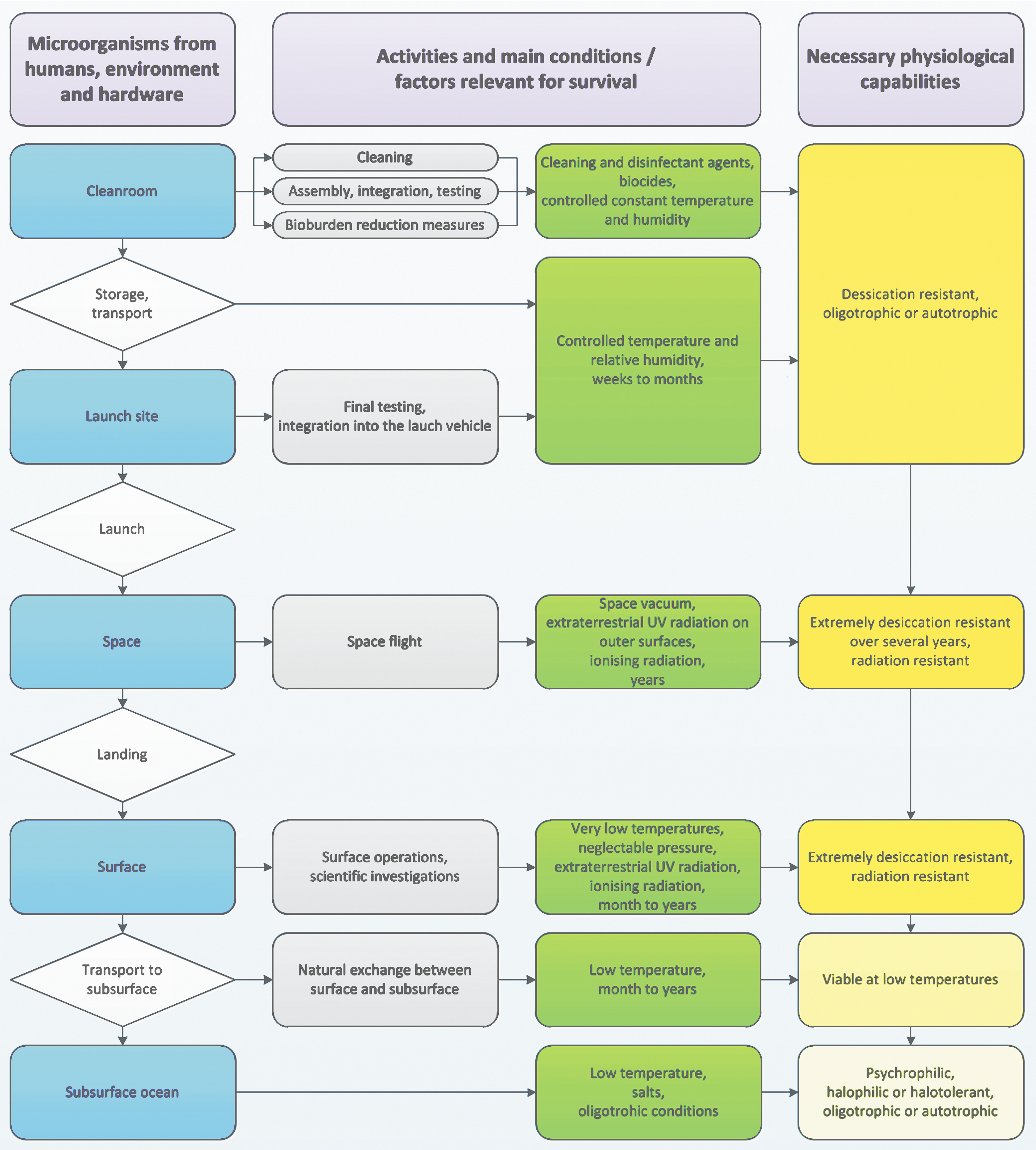
Microbial characteristics of relevant microorganisms for future missions to the outer Solar System.
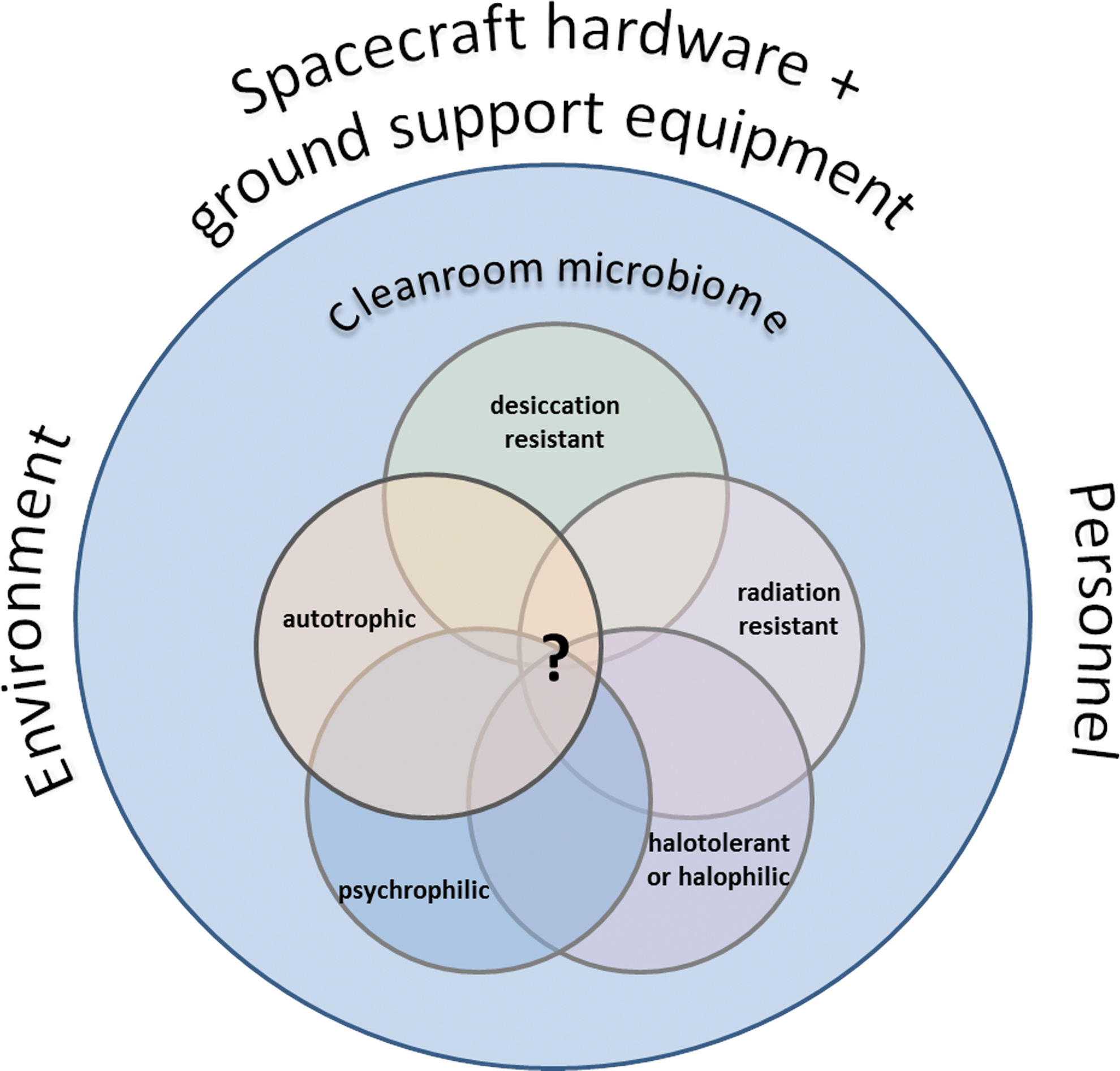
Relevant organisms with the potential to contaminate icy moons (“problematic species”) as a so far unknown subpopulation of the overall clean room microbiome.
6. The Present-Day Planetary Protection Approach for Bioburden Determination
The bioburden limits specified in the COSPAR requirements for different mission type/target combinations are based on results from standardized cultivation assays. In two comparable standards, the detailed procedures for sampling and microbiological analysis of space hardware are described (ECSS-Q-ST-70-55C, 2008; NASA-HDBK-6022, 2010). The sampling technique employed both sterile swabs and wipes moistened with distilled water. Swabs are used for sampling small surfaces up to 25 cm2. Wipes are used preferentially on larger areas up to 1 m2. The microbiological assay procedure features the sonication of the sample with sterile distilled water or rinse solution, followed by an aerobic incubation on nutrient agar (Tryptic Soy agar [TSA] or Reasoner's 2A agar [R2A]) for 3 days at 32°C. Spore assays are performed by exposing the sample to 80°C for 15 min (Pasteurization step), followed by plating on TSA or R2A agar plates and incubation as already described. The number of colonies (colony-forming units [CFUs]) visible with the naked eye after incubation is used to calculate the overall bioburden of the hardware. An exemplary scheme of a standard planetary protection swab assay is shown in Fig. 3 (ECSS-Q-ST-70-55C). Wipe assays are performed in an analogous way.
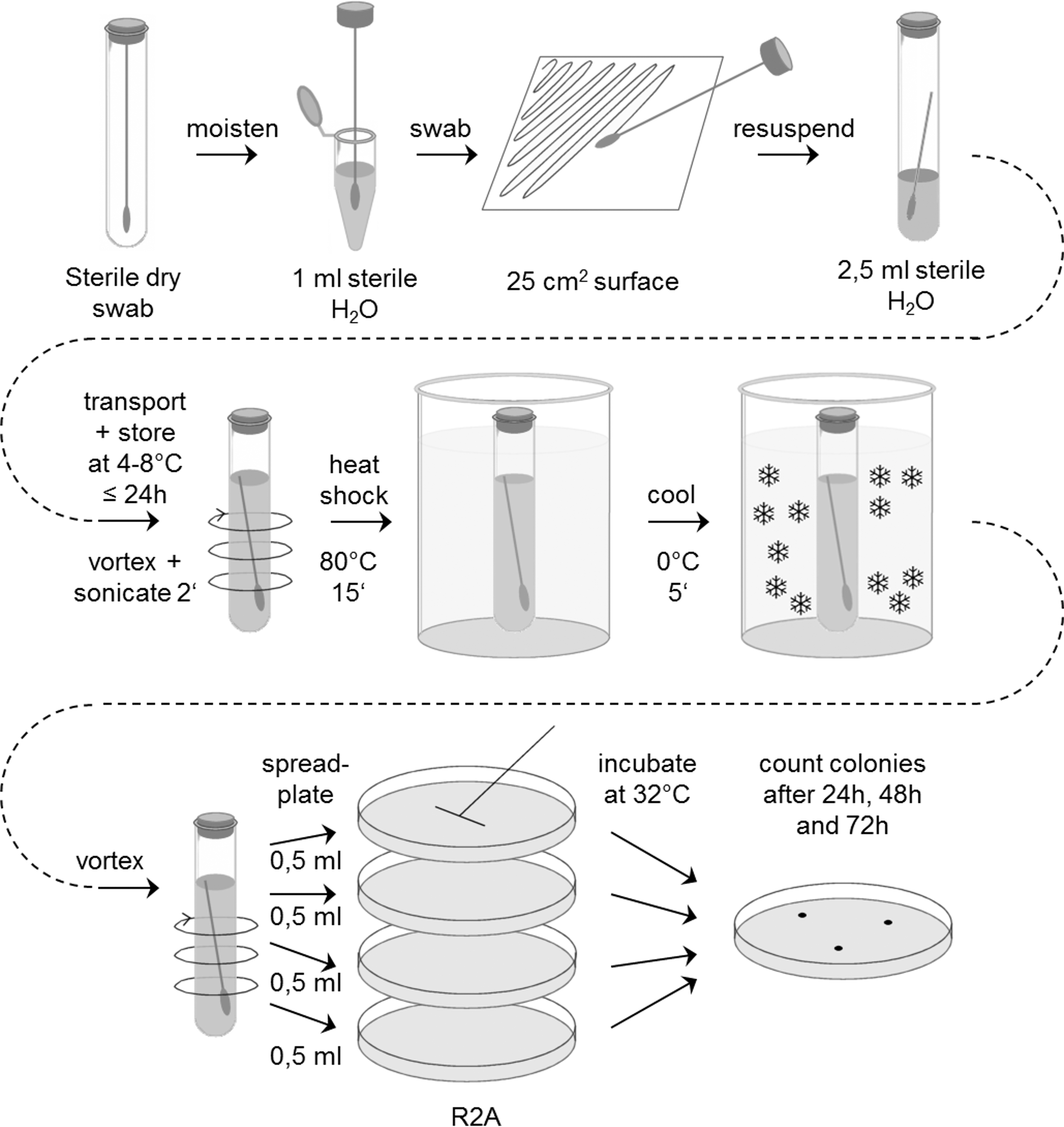
The ESA bioburden standard assay for swabs (ECSS-Q-ST-70-55C).
With this assay, only mesophilic aerobic spores and bacteria that are able to survive a heat treatment for 15 min at 80°C and that can grow on the specified nutrient medium and conditions are determined. Most of them belong to the genus
7. The Spacecraft Assembly Clean Room Microbiome
The investigation of the microorganisms in clean rooms and on spacecraft started in the 1960s (for a summary of the history of planetary protection, see Meltzer, 2011). One of the first studies on the microbiome associated with spacecraft hardware was conducted by Puleo
Before the rise of molecular techniques, clean rooms and space hardware were routinely investigated by culture-dependent methods already described. These methods were employed to calculate the bioburden and investigate the diversity of the Apollo spacecrafts (Puleo
With the increase in molecular techniques, researchers were able to elucidate the microbiome of a clean room with greater detail. The first study was presented by La Duc
Although improved sequencing methods increased our understanding of the diversity associated with these environments, one cannot differentiate between living organisms or just the presence of the 16S rDNA signature from dead organisms. To address this issue, several studies employed propidium monoazide (PMA), a pre-PCR dye that is able to discriminate live and dead cells (Vaishampayan
Several studies have characterized and described isolates from clean room environments and spacecraft, and currently there are nine newly described species and one novel genus:
High Efficiency Particulate Air filtration, humidity and temperature control, partial overpressure (in ISO class 5 clean rooms), frequent cleaning, limited number of persons working at the same time in a clean room, and strict garment changing protocols—all these clean room maintenance procedures have strong impact on the abundance, viability, and diversity of microorganisms therein (Moissl-Eichinger
The comparison of the microbiome data from different clean rooms in different countries and climate zones using the available published data is difficult, because different analysis methods have been employed. To be truly able to compare the biodiversity of spacecraft assembly facilities and space hardware, all investigations need to follow the same protocol, including the record of metadata with a clear description of the sequencing platforms, bioinformatics tools, and data bases used for analysis. Owing to rapid technological developments in this area, these protocols have to be updated on a regular basis. Reduced sequencing costs, high throughput methods, and powerful new analytical tools, which have been developed in the past few years, enable the investigation of microbial communities in great detail. However, each step from sample collection, storage, DNA extraction, sequencing, and computational and statistical methods for data analysis can induce bias and influence the interpretation of the obtained data as summarized in a recent review from Hugerth and Andersson (2017).
In addition, it is mandatory to establish and maintain an international quality controlled data repository for microbiome data from spacecraft assembly clean rooms and spacecraft. The data base format has to be flexible to allow the implementation of future optimized protocols and handle the enormously increasing data volume.
In all investigated spacecraft assembly clean rooms, the microbial community was found to be very diverse. Microorganisms belonging to genera with extremotolerant members were found in all clean rooms both with cultivation assays and with molecular methods (La Duc
8. Bioburden Reduction by Sterilization
As already mentioned, the only microorganisms that are problematic for icy moons are those that can reach the subsurface oceans and replicate there. One aspect already addressed in “The Assessment of Planetary Requirements for Spacecraft Missions to Icy Solar System Bodies” (Sogin
9. Mid- and Long-Term Research Activities for the Identification of Relevant Species
9.1. Cultivation and stress tests
Today, the capability of microorganisms to withstand the deleterious environmental factors during a mission to the outer Solar System can only be determined with cultivable organisms, by performing stress tests. Depending on the species, the necessary cultivation time can be long, and take up to weeks and months, before results are available. This is especially the case for psychrophiles, organisms growing at low temperatures (−20°C to +15°C; Pulschen
To identify microbial species that are problematic for icy moons, a systematic overview of typical microbial clean room inhabitants is necessary.
Systematically compile the available published data about the extremotolerance of clean room isolates with a focus on desiccation and radiation resistance, halophilic, oligotrophic (autotrophic), psychrophilic, (facultative) anaerobic growth.
Investigate the desiccation and radiation resistance of representative spacecraft assembly clean room isolates, starting with organisms that are already available in culture collections.
Collect new isolates representing a wide range of metabolisms from clean rooms and investigate in the same way as in (b) to get a broader basis for a first estimation of the abundance of problematic species.
Obtain additional new insights into the molecular and cellular stress response mechanisms of potentially problematic species from isolates from recent Earth analog environments for icy moons such as polar regions, subglacial lakes, and deep sea or terrestrial brines. Perform laboratory experiments under subsurface icy moon conditions to assess their potential for survival and replication.
Table 6 gives a preliminary list of bacteria to be investigated. All of them are publicly available from culture collections, for example, the ESA Microbial Collection at the German Collection of Microorganisms and Cell Cultures (DSMZ;
Preliminary List of Bacteria to be Investigated
Type strain.
ATCC, American Type Culture Collection; DSMZ, Deutsche Sammlung von Mikroorganismen und Zellkulturen.
The spacecraft assembly clean room isolates listed in Table 6A and B have been detected with the actual planetary protection standard assays that do not aim primarily at the identification and quantification of species relevant for icy moons. Some of these strains, namely any spore formers, might turn out to be problematic for icy moons. The list also includes taxa that have been shown to be active in icy moon analog environments (Table 6C), although they have not yet been isolated from clean rooms. Their inclusion is meant to further expand the physiological variability and better represent the total microbial diversity.
Based on the results to be expected from these investigations, a threshold for desiccation and radiation resistance of clean room microorganisms has to be defined, which allows the distinction of problematic species from nonproblematic species for icy moons.
9.2. Proposed test organisms
9.2.1. Spacecraft assembly clean room isolates
9.2.1.1. Bacillus pumilus
The Gram-positive aerobic rod-shaped endospore-forming bacteria of the genus
9.2.1.2. Paenibacillus phoenicis
This novel Gram-positive motile endospore-forming aerobic bacterium was isolated from the NASA Phoenix lander assembly clean room that exhibits 100% 16S rRNA gene sequence similarity to two strains isolated from a deep subsurface environment (Bernadini
9.2.1.3. Micrococcus luteus
9.2.1.4. Staphylococcus aureus
9.2.1.5. Staphylococcus epidermidis
Similar to
9.2.1.6. Clostridium perfringens
9.2.1.7. Brevundimonas ssp.
The genus
9.2.1.8. Acinetobacter gyllenbergii 2P01AA
Gram-negative gammaproteobacteria of the genus
9.2.2. Examples of species relevant for icy moons
9.2.2.1. Halomonas halodenitrificans
Gram-negative coccus, 0.5 μm in diameter, occurring singly or in pairs. Sodium chloride is necessary for growth and the organism dies at or <2.2%. The coccus grows optimally in medium containing between 4.4% and 8.8% sodium chloride; above 8.8%, the length of the lag phase increases and the rate of growth decreases; however, growth is observed up to 24% (Robinson and Gibbons, 1952). The strains grow under aerobic or facultatively anaerobic conditions.
9.2.2.2. Halorubrum lacusprofundi
This strain was isolated from deep lake, Antarctica, and first described by Franzmann
9.2.2.3. Halanaerobium sehlinense
This strictly anaerobic extremely halophilic Gram-positive rod-shaped bacterium was isolated from the hypersaline (20% NaCl) surface sediments of Sehline Sebkha in Tunisia (Abdeljabbar
9.2.2.4. Bacillus alcalophilus subsp. halodurans
9.2.2.5. Acidothiobacillus ferrooxidans
9.2.2.6. Planococcus halocryophilus
This aerobic Gram-positive motile coccoid bacterial strain was isolated from permafrost active-layer soil collected from the Canadian High Arctic (Mykytczuk
9.2.2.7. Methanogenium frigidum
9.2.2.8. Psychromonas antarcticus
This Gram-negative rod- to oval-shaped aero-tolerant anaerobic bacterium was isolated from an anaerobic enrichment inoculated with sediment taken from below the cyanobacterial mat of a high-salinity pond near Bratina Island on the McMurdo Ice Shelf, Antarctica (Mountfort
None of these problematic species has been investigated on their desiccation and radiation resistance in detail. It is, therefore, unclear at the moment whether they could survive a spaceflight to an icy moon and whether they could proliferate in the icy moons' subsurface oceans.
9.3. Functional genomics
(Gene-resolved) metagenomics (Zhang
The usefulness of the identification and quantification of indicator sequences/genes from metagenome data with respect to physiological capabilities pointing to problematic species should be tested by direct comparison with cultivation and stress test data obtained from comparable spacecraft assembly clean room samples. First steps to identify candidate genes/sequences responsible for the unusual resistance of some
However, this type of basic investigations takes time and requires research projects that are not coupled to specific space missions with tight schedules.
10. Short-term Research Activities for the Development of New Planetary Protection Assays for the Next Icy Moons Missions
As already mentioned due to time constraints, cultivation assays for all potentially problematic species are not suitable for routine clean room monitoring and planetary protection bioburden measurements during assembly, integration, and testing activities.
For near future missions to the outer Solar System, there is a need for new fast assays whose results are indicative for problematic species and take into account the most challenging environmental factors (
One first practical approach for the final assay could be the concentration of microorganisms from clean room and spacecraft samples on membrane filters, followed by a desiccation step under controlled conditions and an irradiation step with ionizing radiation (duration of desiccation and dose of radiation to be defined). As already described, space radiation, consisting of sparsely and densely ionizing radiation, is very complex and cannot be reproduced on Earth. Therefore, the use of X-rays as a proxy for space radiation is recommended, even if the induced cell damages are not totally identical to those resulting from the absorbance of HZE particles or the exposure to space radiation. An example of a possible assay for swab samples is shown in Fig. 4.
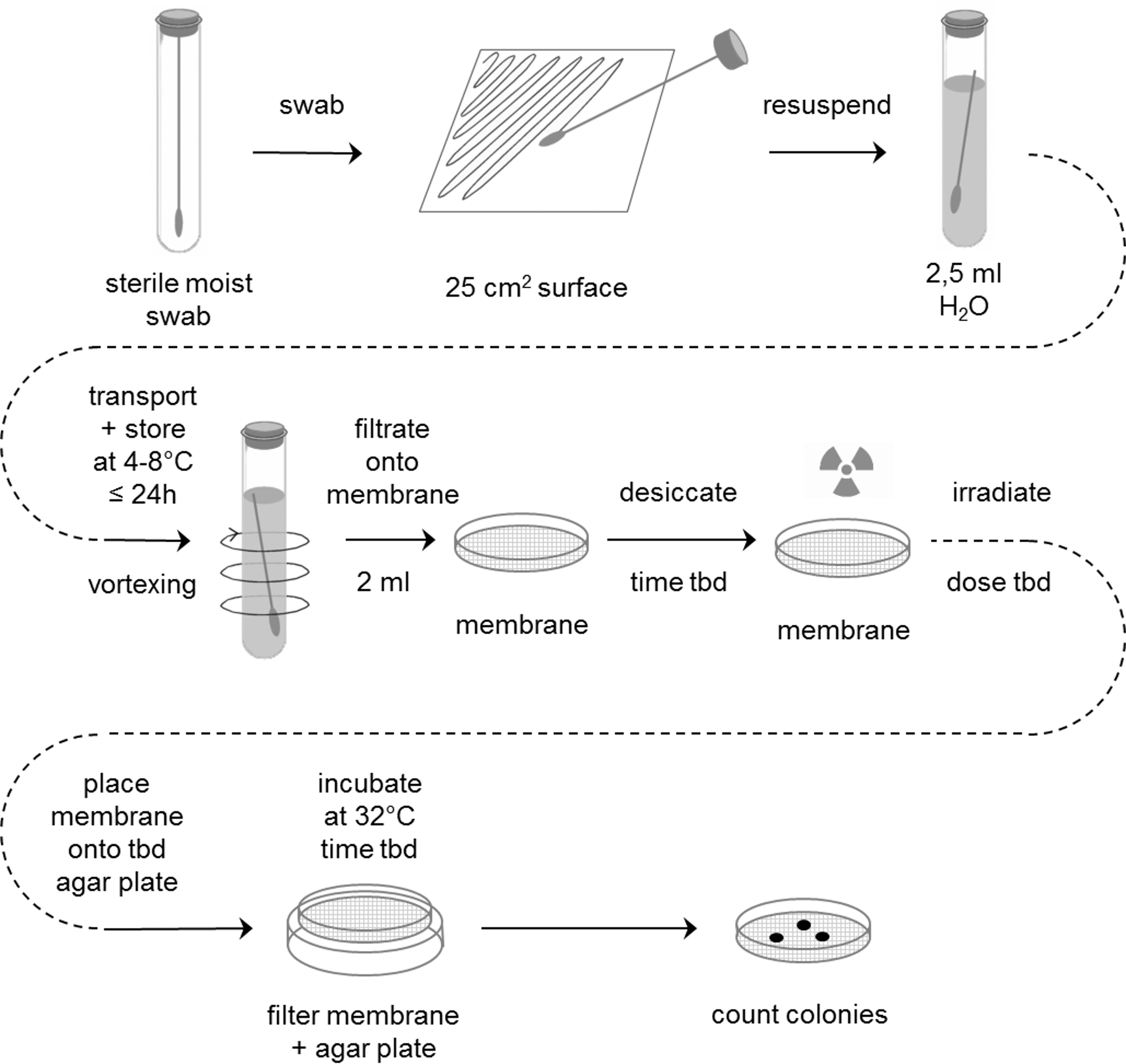
Suggested new standard assay for problematic species.
11. Summary
To define new planetary protection bioburden assays relevant for icy moons, systematic investigations should aim to (i) identify potential problematic species for icy moons in clean rooms by applying a combination of cultivation-dependent and cultivation-independent methods, (ii) develop/optimize methods for the discrimination between dead and alive microorganisms, (iii) determine the resistance of representative clean room contaminants to simulated mission parameters (
Footnotes
Author Disclosure Statement
No competing financial interests exist.
Associate Editor: Christopher McKay
Abbreviations Used
*
The statements are numbered in the order they appear in the text. They summarize general findings as well as opinions of the PPOSS team as the basis of the recommendations given in this report.
†
Recommendations are numbered to facilitate referencing. The order does not indicate the importance or timeframe.