




Abstract
Introduction:
The ongoing COVID-19 pandemic has presented numerous challenges to education at all levels, but has been particularly challenging for professional schools and other educational sectors that require intensive hands-on training. Those institutions have had to deploy and continuously adapt new learning strategies in response to an ever-changing pandemic landscape over the past two years, while at the same time meeting the rigorous proficiency standards for their students.
Methods:
This communication describes how two professional schools at Oregon State University, the College of Pharmacy and the Carlson College of Veterinary Medicine, pivoted in response to the COVID-19 pandemic to ensure continuity in student training. The adaptations included technological solutions, physical distancing, barriers, reduced group size and scheduling changes in the curriculum, and enhanced personal protective equipment.
Results:
The available evidence suggest that the biosafety measures implemented to reduce the risk of COVID-19 in the hands-on educational setting appear to have been effective in preventing transmission during classroom and experiential learning activities. Professional licensing exam scores for the students of both colleges remain as high as pre-pandemic values, suggesting that the implemented changes in instruction did not have a detrimental impact on student learning. The scores will need to be monitored for several more years before firm conclusions can be drawn.
Discussion:
Both colleges implemented creative solutions to the delivery of hands-on pedagogy that sought to balance risk of infection and the necessity to master critical skills that can only be acquired by active learning.
Introduction
The onset of the COVID-19 pandemic brought widespread disruptions in the workforce, 1 travel, healthcare, 2 commerce and supply chains, education,3–5 and many other aspects of normal prepandemic activities. While all of higher education in the United States experienced disruptions, none was more profound than the training of students whose learning requires participation in hands-on learning, particularly graduate students in the sciences and professional students. Other articles have focused on the disruptions of academic research.6–8 This communication addresses the impact and changes necessitated by the COVID-19 pandemic on the training of professional students in programs for doctorate degrees in pharmacy and veterinary medicine at the Oregon State University.
Education and training of professional students in pharmacy and veterinary medicine are overseen by accrediting bodies—American Council for Pharmacy Education for the Doctor of Pharmacy (PharmD) and American Veterinary Medical Association for the Doctor of Veterinary Medicine (DVM) degrees. Both accrediting agencies have significant requirements for hands-on instruction.
For the DVM degree, the criteria for curriculum include the following:
“The curriculum must provide instruction in both the theory and practice of medicine and surgery applicable to a broad range of species. The instruction must include principles and hands-on experiences in physical and laboratory diagnostic methods and interpretation (including diagnostic imaging, diagnostic pathology, and necropsy), disease prevention, biosecurity, therapeutic intervention (including surgery and dentistry), and patient management and care (including intensive care, emergency medicine and isolation procedures) involving clinical diseases of individual animals and populations. Instruction should emphasize problem solving that results in making and applying medical judgments.”
9
The PharmD degree accrediting organization requires that the curriculum “incorporates Introductory Pharmacy Practice Experience (IPPE), and inculcates habits of self-directed lifelong learning to prepare students for Advanced Pharmacy Practice Experience (APPE).” The IPPE is a minimum of 150 h balanced between community and institutional practices, while the APPE component builds on the IPPE to prepare practice-ready students:
“APPE ensures that students have multiple opportunities to perform patient-centered care and other activities in a variety of settings. Experiences are in-depth, structured, and comprehensive in the aggregate, and carefully coordinated with other components of the PharmD curriculum. Collectively, APPE hones the practice skills, professional judgment, behaviors, attitudes and values, confidence, and sense of personal and professional responsibility required for each student to practice independently and collaboratively in an interprofessional, team-based care environment.”
Required APPEs occur in four practice settings: (1) community pharmacy; (2) ambulatory patient care; (3) hospital/health system pharmacy; and (4) inpatient general medicine patient care. A total of 160 h are required in each of the above practice settings over a period of not less than 36 weeks. 10
The challenge to both the College of Pharmacy and the Carlson College of Veterinary Medicine (CCVM) at Oregon State University was to meet the requirements and expectations of their respective accreditation organizations and their professional students, while at the same time minimizing the potential for transmission of COVID-19 disease in the educational setting for students, faculty, and staff, and do so against the background of an ever-changing epidemiological picture.11,12 This required significant discipline, effort, and flexibility on the part of administrators, faculty mentors, students, and outside training partners.
Oregon State University operates on the academic quarter system. When the pandemic arrived in Oregon in early 2020, the winter term was nearly over and spring break was looming. There was concern among university officials that students would disperse for the spring break, mingling with students from other geographic areas, and return bringing a surge of COVID-19 cases to the university and surrounding community. The university administration made the decision to teach the spring term, beginning in early April, online only, with no in-person instruction. Initially it was assumed that within a few months class schedules could return to normal; however, the majority of university undergraduate and graduate classes continued to be held online until the fall of 2021.
The exceptions to online-only instruction included certain professional instructional activities in the Colleges of Pharmacy and Veterinary Medicine as described in this communication, as well as research training of graduate students, with limitations on occupancy and physical distancing.
Both the CCVM and the College of Pharmacy have active research programs and graduate students working toward MS and PhD degrees. These students were impacted early on, similar to all students at the Oregon State University. The onset of the pandemic disrupted critical research experiments, particularly for graduate students close to their final defense, and also for new graduate students who had not yet fully developed laboratory research skills and relied on mentoring by more experienced investigators. For the former, defenses were often delayed or held online, while for the latter, the mentoring process was often delayed. While critical research in progress was never fully shut down in either college, laboratory space occupancy rules were implemented and many laboratories scheduled research activities to minimize transmission potential. In general, most research laboratories have adequate ventilation systems and biomedical researchers are proficient in the proper use of personal protective equipment and other risk mitigation practices.
In addition to graduate students, both colleges encourage professional students to work in research laboratories, often with stipends made available by funds within the respective colleges. Similar to all students in science-based fields, learning to work in a research laboratory is beneficial for professional students and enhances professional growth.13,14 PharmD and DVM students benefit through exposure to the research methods that lead to innovations and life-saving products critical to these professions. These programs were also disrupted by the pandemic, and many students were unable to participate in the opportunity to gain hands-on exposure to research. The research that continued was mainly limited to the analysis of existing data and bioinformatics. A small number of veterinary medicine students working in the outside environment were able to continue with those projects.
Methods
The sections below provide a description of the methods that the two professional colleges of Oregon State University implemented to minimize the risk of COVID-19 transmission in the educational setting for students and faculty, while meeting the rigorous demands of training required in these disciplines.
College of Pharmacy
The Oregon State University College of Pharmacy, in collaboration with the Oregon Health and Science University, offers a 4-year PharmD professional degree. There are ∼330 students enrolled in this program, ∼80 students per class.
PharmD Lecture Course Content
At the beginning of the 2020 spring term, until the spring term of 2021, all lecture classes were held online. Instructors were given only 1 week to adapt in-person teaching to online format. The software used was Zoom™ for lectures and Canvas™ for quizzes, assignments, examinations, and all other instructional components of the courses. For four terms, all examinations were computer based. Students had limited oversight and examinations were given initially without proctors. As the pandemic continued into the academic year 2021, instructors and some university-supplied assistants monitored behavior by requiring students to turn on their computer cameras during examinations. In addition, pharmacy professional students sign a statement of integrity and were largely held to honor the system for assignments and examinations.
In the fall of 2021, lecture courses were transitioned back to in-person format, with the added feature that all class lectures were recorded so that students isolating at home or those students with underlying health conditions could participate online as needed. After transitioning back to in-person lecture formats, examinations were held in person for the most part, with the occasional makeup examination for those students who were isolating at home.
Faculty who were uncomfortable with in-person lectures during the Delta and Omicron surges were given the option of holding classes online within a limited scope, but most courses were taught in-person.
PharmD Laboratory Courses
The College of Pharmacy teaches PharmD students for the first 2 years on the Corvallis campus of Oregon State University, where they learn various skills in laboratory courses. These skills include but are not limited to administration of immunizations, dispensing medicine, chemical compounding, taking blood pressure readings, and the skills required to conduct patient physical assessments, and require hands-on activities in which the students must participate.
When the pandemic arrived, the university officials moved all courses to online beginning in the spring term of 2020. For most of the university, in-person instruction did not resume until the fall of 2021. College of Pharmacy rearranged the curriculum to postpone the hands-on skills courses for professional students beginning in spring 2020. By March of 2021, College of Pharmacy leadership had to decide how to meet the needs of PharmD students for learning those skills that require in-person instruction within the time frame of the 4-year curriculum. A decision was made to bring students back for these in-person courses. By that time, nearly 90% of the students had been fully vaccinated, having qualified for early vaccination as healthcare providers.
Classes for hands-on laboratory skills resumed in the spring term of 2021 with several changes implemented:
Group sizes of students participating at the same time were reduced according to occupancy thresholds established by the university's space planning and pandemic response teams. The pharmacy building is an older structure, which is naturally drafty, but to increase fresh air, windows were opened during in-person instructional activities. Students and faculty wore face coverings over the nose and mouth. Physical distancing was maintained at 6 feet to the extent possible. For those tasks that required a closer contact between individuals, duration was limited to 15 min, and gloves used if touching was required. Plexiglass barriers were installed for use in some hands-on courses, such as chemical compounding. Desks, chairs, light switches, door knobs, and other high touch appears were disinfected by wipe down after every class session.
Some additional courses were modified. Students learn to counsel patients in person, but the pandemic prompted a change to learning these skills utilizing actors and telemedicine technology. This change was very successful, and will be retained as a change to the curriculum postpandemic.
Not all the students were able to return to the campus in the spring 2021 term for various reasons, so a special week-long hands-on skills session was scheduled for the summer of 2021 to accommodate those students.
Experiential Training of PharmD Students
Beginning midway through the 1st year of their training, PharmD students begin rotations to obtain hands-on training in the community, health system, and other pharmacy practice sites. In the spring of 2020, no external sites were accepting students for these rotations due to concerns about COVID-19 transmission in the workplace. Many pharmacies are crowded spaces where work is conducted in inherently close quarters, and personal protective equipment availability was very limited at the time. This situation posed a special problem for advanced students and had the potential to delay graduation.
A partial solution was arranged using a combination of TeleMed™ technology innovative methods in various pharmacy settings. Some sites allowed for virtual interactions and remote access for oversight of pharmaceutical dispensing, and provision of drug information and counseling. Health systems and pharmacies in the area accommodated the need for experiential training for advanced students by allowing them to be involved in these new procedures for delivery of pharmaceutical care.
As the pandemic progressed, personal protective equipment became more readily available to healthcare personnel, and workplaces began to modify their environments with Plexiglass dividers and procedural changes to maximize physical distancing of workers. These changes let more sites open up to student experiential learning. By the winter quarter of 2021, students were fully placed in collaborating off-campus pharmacy practice sites.
In November of 2020, applications to the United States Food and Drug Administration (FDA) for emergency use authorizations for the first COVID-19 vaccines were filed, and by mid-December, the FDA had completed their review. The availability and deployment of vaccines in early 2021 produced a sudden demand in pharmacies and mass vaccination sites for PharmD students, who learn to administer and record vaccines in their 1st year of training. This situation provided multiple opportunities for PharmD students to gain proficiency in vaccination administration.
College of Veterinary Medicine
Oregon State University's CCVM includes two academic departments—Clinical Sciences and Biomedical Sciences, the Oregon Veterinary Diagnostic Laboratory, and the Veterinary Teaching Hospital, along with supporting infrastructure. Similar to the university, the CCVM mission includes service, research, and teaching. The teaching mission is focused on training DVM students, but the college also supports clinical training for interns and residents in a variety of disciplines, as well as MS and PhD research graduate students.
The DVM degree is a 4-year curriculum, with a current enrollment at CCVM of ∼300 students, 75 per class. Lecture courses are interspersed in the first 3 years of the curriculum, but much of the DVM training involves in-person, hands-on instruction. Hands-on training begins in the 1st year, which includes gross anatomy, microscopic anatomy, clinical skills, and immunology laboratory. The 2nd year continue hands-on fundamental science instruction, including virology, bacteriology, and mycology, parasitology laboratories; also in the 2nd year are more clinically oriented courses with laboratories, including pathology, diagnostic imaging, toxicology, surgery, and anesthesia. Third-year laboratory courses include medicine, theriogenology, and surgery. Third-year students also begin rotations in the clinics of the Veterinary Teaching Hospital. The 4th year curriculum consists of clinical rotation blocks in the Veterinary Teaching Hospital, which is entirely hands-on training and in-person rounds.
The abrupt appearance of the COVID-19 pandemic introduced a dramatic and significant impact on the training of DVM students and required immediate changes to the instructional methods within the constraints of university and Oregon Health Authority requirements. These changes, described below, included scheduling, space occupancy restrictions, and additional hygiene measures. Out of necessity, the restrictions in the Veterinary Teaching Hospital had some flexibility built in to accommodate emergency procedures and emerging information about the virus or local conditions during pandemic surges.
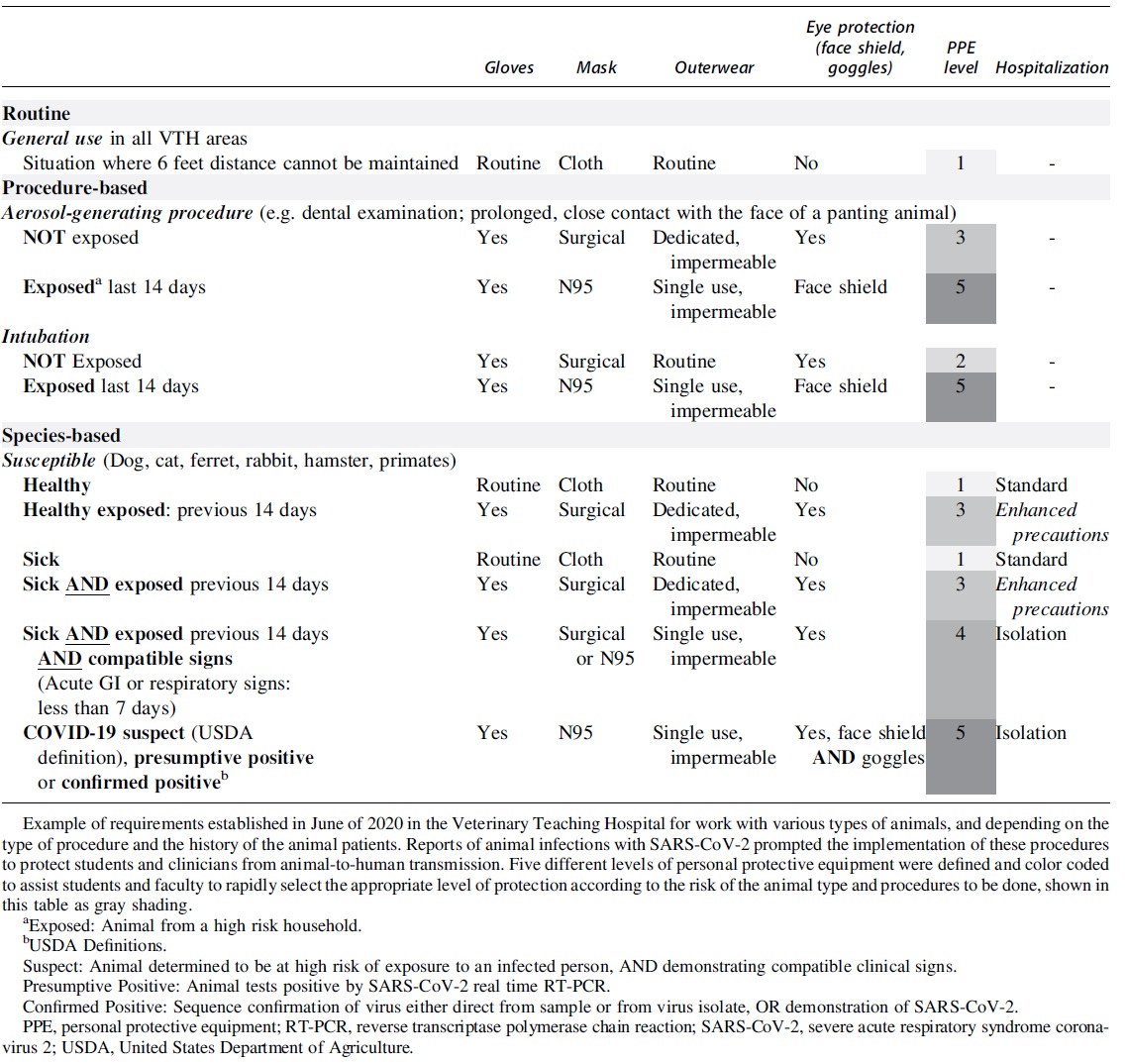
The severe acute respiratory syndrome coronavirus 2 (SARS-CoV-2) virus most likely appeared as a result of a closely related virus circulating in bats, undergoing changes that allowed it to infect and spread in humans, possibly through an intermediate animal species.15,16 Early on in the pandemic, reports began to appear of the virus infecting and causing illness in various species of animals. 17 Initially, reports of domestic cats, then dogs, ferrets, hamsters, mink, deer, livestock animals, and others. The ease with which SARS-CoV-2 infects some animals—particularly domestic cats, ferrets 18 and hamsters 19 —poses a potential risk since these animals are likely to become patients in the Veterinary Teaching Hospital. This risk of animal-to-human transmission added a further complication to the safety of students in the clinics. In response, in June of 2020, with the return of 4th year clinical rotation students, personal protective equipment requirements for the clinics were established (Table 1) to minimize risks associated with potential animal-to-human transmission.
Oregon State University Veterinary Teaching Hospital - COVID-19 personal protective equipment requirements—small animal
Microbiology Laboratories
Laboratory courses in the DVM curriculum for microbiology include bacteriology, mycology, virology, parasitology, and immunology. When the pandemic arrived in March of 2020, instructors were informed just before the end of winter term to prepare for online instruction. The university decided to transition to remote learning only, with no in-person instruction, in late march. The spring term was to begin in early April, and there were concerns about students returning from spring break causing a surge of cases in the community.
Of the microbiology laboratory courses, immunology was impacted the most by this abrupt transition. The immunology laboratory is normally taught during the spring term, but was forced to pivot to video instruction demonstrating the techniques normally taught as hands-on exercises. By the following year, with vaccination rates among students >90%, the immunology laboratory could again be taught in person, but with smaller group sizes and consolidation of the number of 3-h laboratory sessions from five to three.
The bacteriology and virology laboratories are taught during the fall term. While the rest of the university was still holding classes only remotely, the CCVM in-person laboratory classes were reconvened in the fall of 2020, with significant modifications implemented.
These modifications included increasing the number of sections of each laboratory from two to three per day, and reducing the number of students per section from 36 to 24 students to allow for greater physical distancing. Seating at laboratory tables was reduced by half and arranged in an alternating pattern such that students were not directly across from each other. At this time, vaccines were not yet available and it was still not clear that the SARS-CoV-2 virus is an obligate airborne pathogen, and so, precautions to minimize forms of contact transmission were implemented. For instance, each table of four students did not share supplies such as inoculating loops and microscope slides with other groups to minimize the potential for spread within the laboratory by contact.
Procedural changes were implemented to facilitate physical distancing to the recommended six feet, such as directional entry to and exit from the laboratory through different doors. At the beginning of class, students entered the laboratory in small groups of 6 to allow for adequate distancing during entry procedures that include donning laboratory coats, handwashing, followed by donning of clean face masks and eye protection, and finally disinfection of bench surfaces and chairs. Face coverings worn in the laboratory by students were replaced with new disposable surgical masks upon entry, which were discarded at the end of laboratory sessions as students exited the laboratory.
Throughout the pandemic, the CCVM policy has been that students who were isolating at home due to exposure or illness, or who have underlying medical conditions that predispose them to greater illness, were not required to attend in-person laboratory courses. Courses and laboratories were live streamed to accommodate those students who were not in attendance. Procedures implemented during the pandemic early on required students who had contact with an infected individual or were themselves experiencing signs of illness to stay home for 2 weeks, and then to test negative before returning to the campus. As the pandemic went on and new information and guidance from the Centers for Disease Control and Prevention (CDC) and Oregon Health Authority evolved, the isolation times have decreased. At the time of this writing a 5-day waiting period is considered sufficient by the CDC, and in response, university policies have changed accordingly.
Clinical Courses and Rotations in the Veterinary Teaching Hospital
Fundamental changes in the way the veterinary teaching hospital interacted with both clients and patients were implemented early on in the pandemic. Changes to the procedures were made as new information became available and the surges due to sequential viral variants came and went. Standard operating procedures were implemented to address client access to the building, personal protective equipment required based on species and the risk of exposure of the animals, the types of procedures that could be done, and the types of facial coverings that were acceptable.
Early on in the pandemic, during the spring 2020 term, the 4th year clinical rotation students were sent home and participated in virtual training and online rounds. During this period, both the large animal clinic and small animal services at the veterinary teaching hospital were limited to life-threatening emergencies or procedures that could not be performed elsewhere in the area, such as implanting pacemakers, certain surgical procedures, or other specialized procedures requiring sophisticated equipment not available in most private veterinary clinics. Staffing changes were made such that there were three cohorts of staff and clinical faculty that did not overlap in the building to minimize the potential for person-to-person transmission. Procedures requiring close contact between workers, such as surgeries or necropsies, were generally conducted using N95 respiratory protection.
Interfacing with client/owners in the veterinary teaching hospital underwent a fundamental transition. Before the pandemic, the clients were allowed to accompany the patients during some procedures, or could wait in the clinic waiting rooms. With the onset of the pandemic, clients were no longer allowed in the building. The one exception was that one client was allowed to be present during euthanasia, unless the euthanasia was performed outdoors. Standard operating procedures were implemented for personal protective equipment and patient handoff, which occurred in the parking lots outside the building. Awnings were set up to provide shelter from inclement weather, and clients generally waited in their vehicles or returned later to receive their animals after postprocedure discharge.
Due to the essential nature of hands-on patient care instruction for veterinary medical students, it was essential for students to return from online-only learning to the teaching hospital clinics as soon as possible. Aside from the laboratories discussed above, the 3rd and 4th year professional students returned to in-person instruction first. Graduate courses returned to in-person instruction first for smaller classes, while larger classes continued to be taught online. In June of 2021, the veterinary teaching hospital returned to full staff (with vaccination mandatory under university rules), although some training of students continued online, such as rounds. Generally throughout the pandemic, students were only in the building during treatment or follow-up of patients, and then left.
A summary of the major safety measures implemented in response to the COVID-19 pandemic for both colleges is presented in Table 2.
Summary of major COVID-19 pandemic modifications in hands-on training for Doctor of Pharmacy and Doctor of Veterinary Medicine students implemented to minimize the potential for exposure to SARS-CoV-2 during educational activities
These and other modifications are described more fully in the Methods section.
DVM, Doctor of Veterinary Medicine; PharmD, Doctor of Pharmacy.
Results
It is too early to know if, on balance, the instructional changes implemented during the pandemic will have a negative impact on student learning that could filter into their professional careers. The percentage of students that passed the North American Veterinary Licensing Examination in 2021 remains high, indicating that the changes did not significantly impact the learning of key objectives for DVM students (L. Jin, pers. comm.).
Similarly, Oregon State University College of Pharmacy students performed well on the North American Pharmacist Licensure Examination® Pharmacy School National Board Examination in 2020, and the 2021 results reported thus far appear similar. The 4- and 5-year graduation rates remain unchanged. 20 The passage rates will need to be monitored for several more years as the pandemic cohorts of students move through their training before any firm conclusions can be drawn, but initial findings are encouraging and suggest that the pandemic has not had a detrimental effect on student learning. However, published surveys of medical students found that the COVID-19 pandemic has added to students' anxiety about their ability to acquire appropriate skills. 21
The students and faculty in both colleges were eligible to receive vaccination for COVID-19 in early 2021 along with other medical professionals before the vaccines became available to the general public. The available information suggests that vaccination rates were very high among the students, in excess of 95%. This is not surprising for a demographic that is training to enter the medical professions.
As for whether the biosafety measures implemented were effective, data are somewhat limited due to the constraints on the gathering and reporting of COVID-19 cases among students imposed by Family Educational Rights and Privacy Act (FERPA) legislation and associated regulations (20 U.S.C. § 1232g; 34 C.F.R. Part 99), as well as university rules for student privacy. However, both colleges had a critical need to report COVID-19 cases among students, and required reporting for students with illness and also conducted in-house contact tracing. In the College of Pharmacy, this tracking was necessary for the external experiential learning partners. There was no documented instruction-associated transmission until after the time period described in this communication; in late winter of 2022, the Omicron surge did result in several breakthrough infections that were traced to educational activities.
In the CCVM, it was necessary to report student cases and conduct contact tracing for the safety of clients and animal patients as well as other students and faculty. There were no cases of COVID-19 until April of 2021, when two employees in the same hospital unit tested positive. It is not clear if these individuals contracted the infection in the Veterinary Teaching Hospital, because they also socialized together outside of work. As for students, there were no documented cases until the Omicron surge, where some breakthrough infections did occur. Students who did develop and self-report COVID-19 illness triggered a notification system to close contacts, which was consistent with the public health exemptions in FERPA regulations [34 C.F.R. §§ 99.31(a)(10) and 99.36]. 22
Whether any of the cases of COVID-19 among students were contracted due to exposures that occurred during their educational activities is unclear, in part, due to the absence of effective contact tracing in the local community, but it seems likely that some transmission may have occurred in the educational setting.
Discussion
Against a backdrop of an ever-changing pandemic, the two professional colleges at Oregon State University rapidly adapted instruction for their doctoral professional students to comply with university and state public health rules, while still meeting the requirements of accrediting bodies that oversee the degree programs. There were many challenges that had to be overcome, but there was minimal loss of continuity for some components of the curriculum that were facilitated by new technologies, in particular software delivery platforms such as Zoom and Canvas. For other components of the curriculum, particularly those that require hands-on experience, more complex solutions were required.
Both colleges implemented creative solutions to the delivery of hands-on pedagogy that sought to create a balance between risk of infection (for students and faculty) and the necessity to master critical skills. Those solutions included a combination of changes, including barriers such as personal protective equipment and shields, scheduling to reduce classroom crowding, standard operating procedures for interfacing with patients and clients, and technologies such as TeleMed.
Professional schools are rigorous and student interactions are an important component to the training. Some students learn best by participating in problem-based learning in a group setting. The online experience of group learning activities is different than the in-person experience, and some active learners may have struggled. In addition, the camaraderie of daily in-person interaction with fellow students is an important part of the professional student experience. During the early part of the pandemic, students missed out on this important component of their learning; this is particularly true for students who matriculated in the fall of 2020, and did not meet their classmates in person for several terms. These aspects have not been fully evaluated to date, but should be.
The COVID-19 pandemic has required flexibility on the part of professional school students, faculty, and external partners. At the time of this communication, much of the instruction at the Oregon State University professional schools has returned to some version of instruction before the pandemic. Some of the changes implemented by both colleges in professional student instruction as noted were found to be improvements in the delivery of instruction and will be retained. These include technological implementations such as TeleMed patient counseling for PharmD students and remote rounds for DVM students.
Footnotes
Acknowledgments
The authors wish to thank the instructors and administrators who provided information and insights into the professional student training described in this communication, especially Dr. Ling Jin.
Authors' Contributions
M.P.: Conceptualization (lead); and writing—original draft, and review and editing (equal). K.O.: Conceptualization; writing—review and editing (equal); and resources. L.B.: Resources; writing—review and editing (equal). H.d.M.: Resources; and visualization. T.M.F.: Resources; and writing—review and editing (equal).
Authors' Disclosure Statement
The authors do not have any conflicts of interest with the content of this communication.
Funding Information
No funding was obtained for this publication.