






Abstract
Objectives:
To recommend (1) the adoption of optimal terminology for referring to services in the United States that incorporate horses and other equines to benefit people, and (2) the discontinuation of especially problematic terminology.
Design:
A diverse multidisciplinary consortium of individuals, including representatives of relevant national organizations, participated in an inclusive, systematic, and comprehensive 2-year consensus-building process.
Results:
Twelve specific types of services were identified that relate to one of three broad areas of professional work: therapy, learning, or horsemanship. Related to the area of therapy, five distinct types of therapies were identified: counseling, occupational therapy, physical therapy, psychotherapy, and speech-language pathology. Therapy-first language is recommended that foregrounds the exact therapy (e.g., physical therapy) and adds precise equine-related descriptors as warranted (e.g., physical therapy using equine movement). Related to the area of learning, three distinct types of nontherapy services were identified. The recommended terminology for referring to these services is equine-assisted learning in education, equine-assisted learning in organizations, and equine-assisted learning in personal development. Related to the area of horsemanship, four distinct types of nontherapy services were identified. The recommended terminology for referring to these services is adaptive equestrian sports, adaptive riding or therapeutic riding, driving, and interactive vaulting. The plural term, equine-assisted services, is recommended as a concise shorthand for easily referencing multiple services that differ from each other, yet share the horse as a common thread. Terms recommended for discontinuation include equine therapy, equine-assisted activities and therapies, equine-assisted therapy, equestrian therapy, hippotherapist, hippotherapy clinic (program), horse therapy, horseback riding therapy, and therapy riding. The consensus-building process culminated in extensive but not unanimous endorsements of all terminology recommendations.
Conclusions:
Terminology recommended for adoption clearly describes and distinguishes 12 distinct types of services. Terminology recommended for discontinuation was found to be ambiguous, misleading, no longer useful, or to have adversely affected stakeholders. It is hoped that all recommendations will prove useful and serve to enhance the professionalism and viability of specific identified services. It is also hoped that improved precision and clarity in terminology for naming specific services will advance their future scientific development and reliable measurement of effectiveness. Not all terminology-related challenges were resolved, however, and new challenges will likely arise as services continue to evolve and diversify. Significant impacts, if any, of the terminology recommendations herein merit ongoing monitoring and the question of optimal terminology merits revisiting in the foreseeable future.
Introduction
Human services that incorporate horses have greatly diversified and expanded over the past 30 years. Thus, it is well-documented that many different types of services that incorporate horses (or other equines) have been provided to people, from toddlers through older adults, with an extensive array of disabilities, health issues, and other major life challenges. 1 –4
Among the many services that incorporate horses, different types of professional therapies may aim to improve physical, cognitive, and social-emotional functioning (e.g., occupational therapy, 5 psychotherapy 6 ). Different types of experiential learning may aim to complement various approaches to educational programming, personal development, or organizational performance for specific groups (e.g., equine-assisted learning for personal development of youth at risk for school or social failure 7 or youth who are overweight or obese 8 ). Different types of adaptive approaches to riding and other horsemanship activities may aim to enhance the participation and well-being of people with diverse abilities (e.g., therapeutic riding, 9 adaptive equestrian sports 10 ). These various services may complement, or offer alternatives to, more traditional approaches that are insufficient, partially effective, or unsuitable to address the unique needs of an individual or group.
As human services that incorporate horses have diversified and expanded, uses of unclear and imprecise terms for naming and describing these services have also become widespread. In turn, unclear and imprecise terminology has generated many serious problems involving stakeholders. Stakeholders include providers of services; consumers of services and their advocates; people and groups who administer, regulate, fund, insure, or research services; and members of the public and media. Among others, problems that adversely involve these stakeholders include confusion and inadequate protection of consumers, reimbursement obstacles, misinformed policies, and barriers to scientific advancement.
Especially concerning is terminology that may confuse, mislead, or fail to protect consumers. For example, three widely used terms—equine therapy, equestrian therapy, and horseback riding therapy—have been applied inconsistently, defined differently, and also used synonymously. 11 –13 Each of these terms furthermore erroneously implies that the mere inclusion of equines is sufficient to constitute a legitimate therapy. This implication may not only mislead consumers, it may also divert consumers from obtaining the exact service that could best meet their needs. Another widely used term, equine-assisted activities and therapies (EAAT), has been misrepresented as a single form of therapy that is simply called EAAT. 14 In actuality, no health profession, practice standards, nor licensure regulations are known to exist for any single form of therapy called equine therapy, equestrian therapy, horseback riding therapy, or EAAT. Yet, widespread adoption of such terms has created obstacles for reimbursement of legitimate therapies and influenced the development of misinformed policies.
Scientific progress is also impeded when the same imprecise and unclear term is used to name different services that are guided by different assumptions and concepts. Conversely, precision and clarity in terminology and concepts are essential if an innovative intervention is to be scientifically developed and its effectiveness reliably measured. 15
Consider, for instance, that 78 studies show that the widely used term of hippotherapy has been defined in at least 60 different ways, and applied to diverse treatment tools with different presumed mechanisms of action (e.g., equine movement vs. relationship-building activities with horses). 3 Across this body of research, providers have also been represented as possessing different areas of expertise (e.g., riding specialists, therapeutic riding instructors, occupational therapists, physical therapists, speech-language therapists). Thus, imprecise and ambiguous uses of hippotherapy have likely masked the existence of a number of distinct types of services that are provided by differently qualified individuals, thereby erecting barriers to the respective clear identification, elucidation, and scientific development of these distinct services.
To our knowledge, published scholarship on human services that incorporate horses is yet to address the problems of ambiguous, imprecise, and confusing terminology or propose comprehensive solutions. This consensus document therefore aims to mitigate the confusion by reporting findings from an innovative, inclusive, and systematic consensus-building process. This process culminated in recommendations to (1) adopt optimal terminology for naming and describing diverse human services that incorporate horses and other equines in the United States, and (2) discontinue uses of specific problematic terms.
Design of the Consensus-Building Process
The consensus-building process was initiated in 2018, unfolded over 2 years, and followed six steps (Fig. 1). During step one, the Professional Association of Therapeutic Horsemanship International (PATH Intl.) obtained funding from the Bob Woodruff Foundation to support the consensus-building process and convened a working group of five leaders (authors Wood, Alm, Benjamin, Thomas, Kane). This working group designed the remaining consensus-building process.
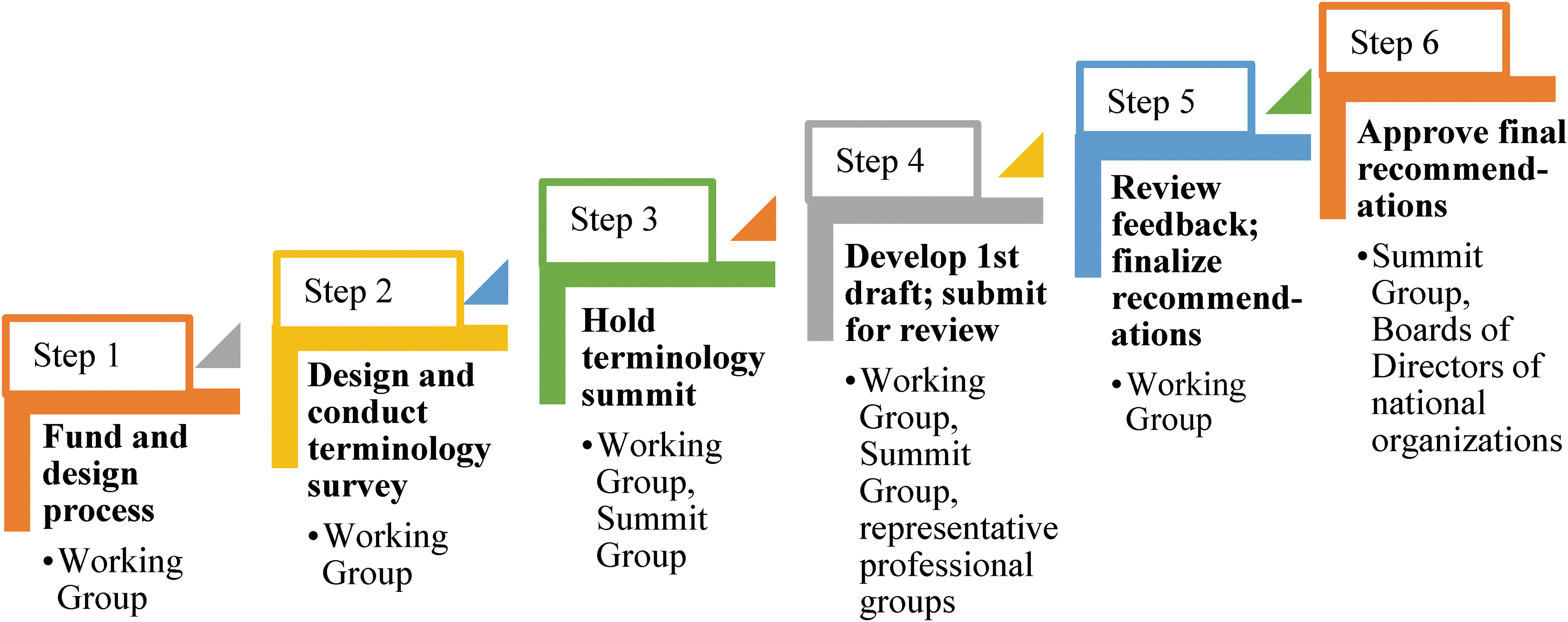
Six steps of the consensus-building process.
During step two, the working group developed and distributed a survey to ascertain how stakeholders perceived the relative usefulness of prominently used terms. To develop this survey, the working group first assembled a comprehensive list of commonly used terms from websites of relevant national organizations and relevant literature (Supplementary Data S1). Using over 45 search criteria related to equine- and animal-assisted services and interventions, nine databases were searched (CAB Abstracts [EBSCO], CINAHL, PsycINFO [EBSCO], PubMed [NCBI], Social Sciences Abstracts [EBSCO], Social Services Abstracts [ProQuest], Social Work Abstracts [EBSCO], SPORTDiscus [EBSCO], and Web of Science [Thomson Reuters]). Titles and abstracts, and in some cases, texts, of 158 books and peer-reviewed journal articles identified through the search were then examined to identify terms. All identified terms from websites and the literature were entered into an Excel database to compare and contrast their respective frequencies of use. Members of the working group divided this work, and ultimately reached consensus on the most commonly used terms.
Informed by the compiled list of commonly used terms, the working group developed the survey in collaboration with experts in survey research. All working group members approved the final survey for online distribution in the United States through the following organizations: American Hippotherapy Association, Inc. (AHA, Inc.), Equine Experiential Education Association (E3A), Equine Assisted Growth and Learning Association (EAGALA), Equus Foundation, and PATH Intl.
Online surveys were also distributed to ∼500 recipients of services, their parents, or caregivers. In total, ∼16,156 surveys were distributed and 1,745 completed and useable surveys were returned, yielding a response rate of 10.8%. Supplementary Data S2 presents research questions, data analytic methods, and key findings.
During step three, and guided by survey findings, the working group planned a professionally facilitated two-and-a-half-day terminology summit. Members of the working group plus 10 other individuals participated in the summit, and were called the summit group. Members of this group possessed extensive experiences and perspectives and included official representatives of the:
AHA, Inc.,
Bob Woodruff Foundation,
Certification Board for Equine Interaction Professionals (CBEIP),
EAGALA,
E3A,
PATH Intl., and
United States Department of Veterans Affairs.
By the summit's conclusion, the group produced an initial framework of recommendations.
Steps four through six involved development, multiple reviews and revisions, and approvals of all terminology recommendations. During step four, and guided by the initial framework, the working group developed a first draft of recommendations. Other summit attendees approved this draft as suitable for further review by leaders and board members of the aforementioned organizations. During step five, the working group considered all received reviews and finalized terminology recommendations accordingly. During step six, the working group submitted final recommendations to other summit attendees for their approval or disapproval, and the Boards of Directors of eight relevant national organizations, including the following:
AHA, Inc.,
American Horse Council (AHC),
Certified Horsemanship Association (CHA),
CBEIP,
EAGALA,
E3A,
Horses and Humans Research Foundation (HHRF), and
PATH Intl.
The individuals representing the boards of directors of these organizations were asked to approve or disapprove those recommendations that were germane to their respective organization's mission and members.
Results
Optimal terminology recommended for adoption
As illustrated in Figure 2, the consensus-building process culminated in the identification of 12 specific services that relate to three broad areas of professional work: therapy, learning, and horsemanship. Because these broad areas are not subsumed under the same industry or line of work, professionals affiliated with each area undergo the specific education and training, earn the specific certifications, and acquire the specific professional licenses that are relevant to their particular area and discipline. From this large universe of professionals, a small subset pursues specialized trainings that enhance their abilities to bring horses together with people with diverse needs. Professionals in this subset still maintain alliances with, and have accountability to, their particular discipline's practice standards. The consensus-building process culminated in the recommendation of an optimal unifying term for referring to multiple services, and in recommendations of optimal terms for referring to 12 distinct types of services.
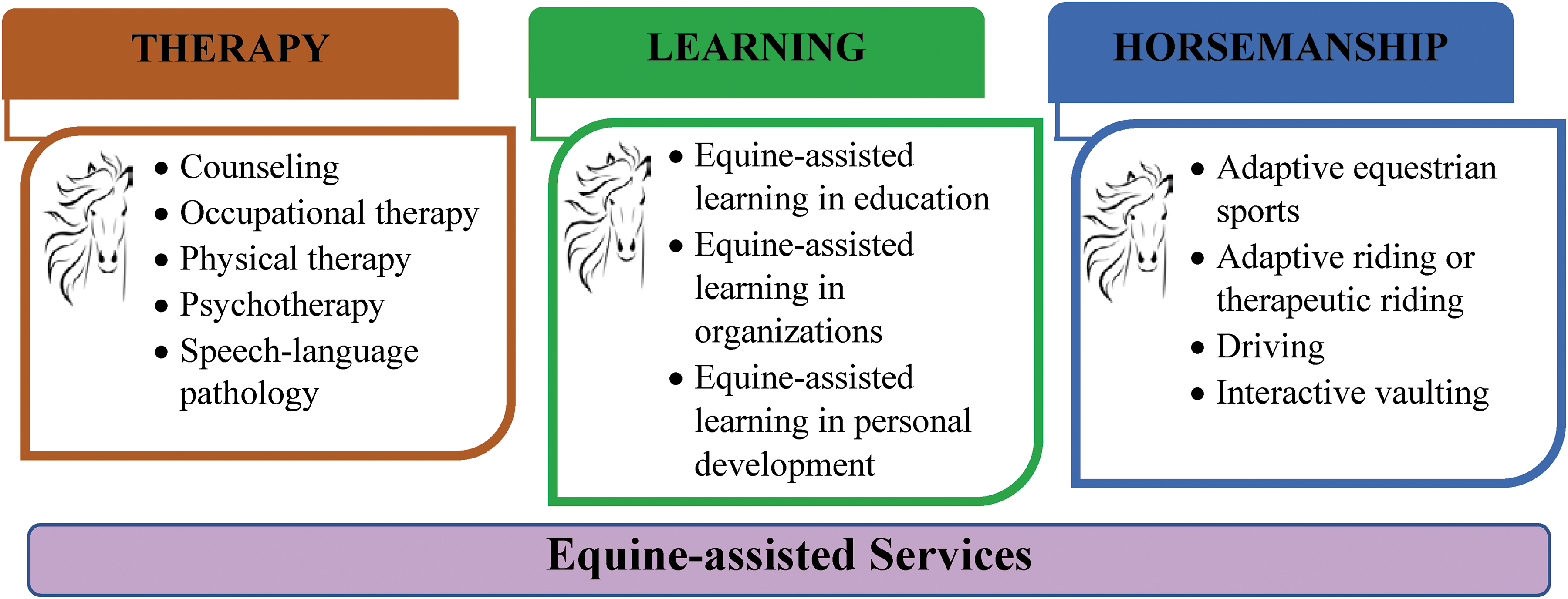
Recommended terminology for 12 distinct types of services and for multiple services.
Recommended optimal unifying term: equine-assisted services
Equine-assisted services (EAS) is recommended as an optimal unifying term to refer to multiple services in which professionals incorporate horses and other equines to benefit people (Fig. 2). Services refer to work done for, or on behalf of others. Unifying is defined in a manner that identifies the common thread that 12 otherwise different types of services share. Most contributors to the consensus-building process believed that this concise shorthand term was necessary both to refer to multiple services that incorporate horses and other equines, and to help diverse professionals who provide varied services collaborate, discuss, and resolve common issues. Furthermore, in the absence of recommending EAS, uses of alternative terms that have shown to be problematic would have continued usage. Optimal thus refers to the succinctness and accuracy of EAS, which was deemed superior to other terms.
Lastly, EAS is intentionally plural because its function is to serve as an efficient shorthand for referring to at least two or more services. Although any one distinct service constitutes a type of EAS, clarity and precision would require that this service be named and marketed, not as an equine-assisted service, but rather by using the most appropriate optimal terminology next presented (e.g., physical therapy, equine-assisted learning for organizations, driving).
Recommended optimal terminology for distinct services
Therapy
Related to the broad area of therapy, licensed therapy professionals may incorporate horses in five distinct therapies: counseling, occupational therapy, physical therapy, psychotherapy, and speech-language pathology (Fig. 2). These licensed therapy professionals work within the scope of practice of their particular discipline. Best practice also dictates that these professionals obtain specialized training focused on incorporating interactions with horses, equine movement, or the equine environment into the individualized plans of care of those receiving therapy. These professionals incorporate horses within treatments or interventions to help address individualized goals, and improve overall function, health, and wellness. Depending on their particular therapy or approach, licensed therapy professionals may work with equine professionals or other assistants for risk management and other purposes.
Therapy-first language is recommended to refer to any one of the above-identified therapies. Such terminology always precisely identifies the exact therapy (e.g., physical therapy, psychotherapy). Equine-related descriptors that more precisely describe the therapy can then be added as appropriate in various contexts (e.g., physical therapy using equine movement, psychotherapy incorporating horses, occupational therapy in an equine environment).
Therapy-first language is recommended for several reasons. This language foregrounds the licensed therapy professionals who determine how best to implement particular therapies, while also acknowledging the potential of the horse to enhance therapeutic outcomes. After completing discipline-specific evaluations of patients or clients, these professionals develop optimal treatment plans for achieving established goals, and specify tools, strategies, or interventions that will be of greatest benefit, including how best to incorporate the horse. Therapy-first language accurately reflects that licensed therapy professionals have many different treatment options available to them given their respective disciplines, the incorporation of horses being just one.
Learning
Related to the broad area of learning, specially trained or certified professionals may incorporate horses in three distinct nontherapy services: equine-assisted learning in education, equine-assisted learning in organizations, and equine-assisted learning in personal development (Fig. 2). Whether as individuals or in teams, these professionals should possess appropriate training, experience, and skill in facilitating the particular content of equine-assisted learning. These professionals should also demonstrate extensive knowledge of horse behavior and handling, human/horse relationships, and design of experiential learning activities involving horses. Qualified professionals leverage experiential learning activities involving interactions with horses, mounted and unmounted activities, and the equine environment.
Equine-assisted learning in education engages people of all ages in learning processes that focus on academic skills, character development, and the promotion of relevant life skills such as problem-solving and critical thinking skills. Professionals providing these services should have extensive knowledge, training, or certifications related to learning theory and teaching methodology. To address the needs of groups of students, these professionals may develop contracts with schools or school systems, and integrate specific educational strategies. Specific educational strategies may support individual education plans and academic remediation.
Equine-assisted learning in organizations assists members of corporations, organizations, and other workgroups build effective teams and leaders that enhance work dynamics and performance at multiple organizational levels. Professionals providing this service should have extensive knowledge, training, or certifications related to organizational theory, team building, strategic planning, or leadership development. To address the needs of clients, these professionals may also integrate various approaches or strategies (e.g., executive coaching, team-building, or group retreats) within their services.
Equine-assisted learning in personal development assists individuals and groups discover new ways to face life challenges and opportunities by developing skills in effective problem-solving, decision-making, critical and creative thinking, and communication. Professionals providing these services should have extensive knowledge, training, or certifications in facilitation, coaching, and teaching; they should also clearly understand how their services differ from psychotherapy and counseling. To address the needs of clients, these professionals may integrate various approaches or strategies (e.g., personal coaching, wellness-related activities), within their services.
Horsemanship
Related to the broad area of horsemanship, equine professionals may offer four distinct nontherapy services that are adapted from traditional equine disciplines of horseback riding, driving, and vaulting. These include adaptive equestrian sport, adaptive riding or therapeutic riding, driving, and interactive vaulting (Fig. 2). Equine professionals with specialized training or certifications provide these services to individuals and groups with diverse needs. These professionals should demonstrate extensive competencies in adapting equipment, the equine environment, and teaching techniques to match the abilities and needs of participants who experience restricted participation in life situations. Qualified instructors develop lesson plans that may involve riding, driving, vaulting, or ground-based activities (e.g., grooming, handling, leading, observing). These activities may help participants attain individualized horsemanship skills, and allow for the naturally healthful benefits of riding and other horsemanship activities to occur.
Adaptive equestrian sport prepares people with diverse needs to participate in events and competitions in equine disciplines such as driving, dressage, reining, and Western or English riding. Coaches and trainers should have extensive knowledge and expertise related to their specific equine disciplines, including training and competition requirements, possible adaptations for athletes with diverse needs, and representative organizations. Benefits of adaptive equestrian sport may include motivation and opportunities to excel as competitive athletes, physical fitness, self-confidence, and social inclusion.
The terms adaptive riding and therapeutic riding may both be used to name and describe services that focus on skillfully adapting riding and making natural healthful benefits of riding and horses accessible to individuals and groups with diverse needs. Instructors who provide therapeutic riding or adaptive riding should have extensive expertise in riding instruction across the continuum of horsemanship skills, from groundwork to riding. Potential benefits may include physical fitness and improved cognitive, emotional, social, or behavioral skills.
Driving teaches individuals with diverse needs how to safely participate in driving activities with horses. Driving instructors must possess the knowledge and expertise specific to techniques of safe driving and its instruction. Driving with horses can occur with many types of vehicles such as carriages, sleighs, or wagons, which can be adapted as needed. Naturally healthful benefits of driving may include improved physical fitness or cognitive, emotional, social, or behavioral skills.
Interactive vaulting engages individuals and groups with diverse needs in movements and gymnastic positions around and on horses and vaulting barrels. Vaulting instructors should possess extensive knowledge and expertise pertaining to the principles of vaulting and its techniques. Naturally healthful benefits of interactive vaulting may include improved physical fitness, social skills and communication, problem-solving, and teamwork.
Problematic terminology recommended for discontinuation
The consensus-building process culminated in recommendations that specific terms be retired from widespread usage owing to their problematic impacts. Terms recommended for discontinuation include equine therapy, equine-assisted activities and therapies, equine-assisted therapy, equestrian therapy, hippotherapist, hippotherapy clinic or program, horse therapy, horseback riding therapy, and therapy riding. The terminology survey and summit were instrumental in identifying these terms as not useful, or as having adversely affected stakeholders.
Specific adverse impacts of terms recommended for discontinuation were identified.
When providers described their service using terms that lack clarity and transparency (e.g., equine therapy, equestrian therapy), consumers had difficulty identifying and accessing the service that could best meet their needs and ensure their safety. When payers established inaccurate payment codes and requirements based on misinterpretations of terms such as hippotherapy, licensed therapy professionals experienced funding barriers, denials, and requests for repayment of legitimate therapies. When journalists used sound bites such as horse therapy in stories, they obscured the distinct nature and value of particular services from the public's view. When researchers applied generic terms such as equine-assisted therapy to label any service that incorporated horses, they amplified pervasive terminology-related inconsistencies in the literature. Most importantly, no profession, academic degree, professional license, or state regulation was known to exist that supported the above-named therapies as legitimate stand-alone therapies. Altogether, terms recommended for discontinuation were found to be potentially legally indefensible for providers and to have misled other stakeholders.
The term, equine-assisted activities and therapies, or EAAT as often abbreviated, is dated because it does not recognize specific services that are related to the broad area of learning. Its separation of activities from therapies erroneously implies that licensed therapy professionals never use activities as treatment tools. The term had also been erroneously used or interpreted to mean that all services are the same. The conjunction, and, has been recently dropped to yield equine-assisted activities therapy. This modified term erroneously suggests that equine-assisted activities alone comprise a legitimate therapy.
With respect to hippotherapist, hippotherapy program, and hippotherapy clinic, members of the summit group clarified that hippotherapy in the United States refers not to a stand-alone therapy, rather to uses of equine movement as a specific treatment tool by occupational therapy, physical therapy, or speech-language therapy professionals as part of their overall treatment plans. Prescriptions and referrals are accordingly made to occupational therapy, physical therapy, or speech-language pathology, but not hippotherapy. Likewise, recognized licensed therapy professionals include occupational therapy, physical therapy, or speech-language therapy professionals, but not hippotherapists. Hence, whereas therapy clinics enable access to treatment within which equine movement is used, these spaces are not hippotherapy clinics, nor are hippotherapy programs offered in them.
Endorsements
All terminology recommendations were endorsed by a large majority of the summit group (12 of 14 with one abstention), in addition to the Boards of Directors of AHC, CHA, E3A, HHRF, and PATH Intl. Due to concerns about professional and reimbursement ramifications for licensed therapy professionals, AHA, Inc.'s Board of Directors disapproved of associating therapies with other EAS related to the broad areas of learning and horsemanship, yet noted that other recommendations offered a tremendous step forward. Votes of the Boards of Directors of EAGALA and CBEIP were still pending at the time of this article's publication. Altogether, then, recommendations were extensively but not unanimously endorsed.
Discussion
A multidisciplinary consortium of service providers, service recipients and advocates, leaders of organizations, researchers, funders, and members of the public contributed to a 2-year long consensus-building process. This systematic process culminated in extensive endorsements of recommendations, both to adopt and discontinue specific terminology for describing services that incorporate horses to benefit people. The most important recommendation was this: that stakeholders adopt terminology that precisely and accurately identifies distinct types of services. Also, terminology must be adopted that meaningfully distinguishes different services. Use of such terminology may confer many benefits and prevent or mitigate future terminology-related problems.
When licensed therapy professionals adopt therapy-first language, accurate representations of their profession and transparent communication with clients and insurance providers regarding reimbursable services can occur. When other professionals precisely name services (e.g., equine-assisted learning in organizations, interactive vaulting), consumer awareness and protection may be promoted. When consumers accurately name and share their experiences of such specific services, they educate others who may benefit.
Moreover, when researchers precisely and accurately name a service under study, its exact nature is best clarified and its scientific foundation can best be progressively built. 15 To illustrate, consider that youth with autism spectrum disorder have been found to benefit from therapeutic riding, 16,17 and also from occupational therapy in an equine environment. 18,19 The studies of these distinct types of EAS reveal important differences in their respective theories of change, qualifications of providers, implementations, and measured outcomes. If researchers had disregarded these differences and failed to name the services precisely and accurately, neither service could advance scientifically. Consumers also could not compare and contrast supporting evidence. Thus, precision and clarity in concepts and terminology are essential for the future development of interventions and reliable measurements of their effectiveness.
With respect to preventing or mitigating future terminology-related challenges, contributors to the consensus-building process confirmed through their own experiences many terminology-related problems. Terms recommended for discontinuation have ambiguous meanings and were subject to misinterpretations. This elicited confusion and therefore adversely affected stakeholders. Persistence of problematic terminology was also found to have masked and negated vital distinctions among the 12 distinct types of services and the three broad areas of work to which each relates (Fig. 2). Conversely, the recommended preventative or mitigating strategy is to distinguish among services by adopting terminology that precisely and accurately names each service distinctly.
Another preventative or mitigating strategy is to employ the recommended unifying term, EAS, in accord with its proposed definition, intended function, and other recommendations. Reducing this plural term to name a single service, an equine-assisted service, would fail to describe that single service accurately, and fail to align with the given definition of EAS. Representing EAS as a singular homogenous service would also violate this term's intended shorthand function, which is to reference two or more services that share the horse as a common thread yet also are distinct. Given their many distinctions, generalizations regarding all EAS should be rendered very cautiously, particularly in research (e.g., systematic reviews, meta-analyses) and in marketing and fundraising initiatives.
Ongoing questions and challenges
There was disagreement during the consensus-building process concerning whether the modifier, equine-assisted, should be applied to describe particular therapies. Licensed therapy professionals, who opposed using equine-assisted to define therapy, argued that terms such as equine-assisted psychotherapy erroneously imply a different stand-alone therapy from that of psychotherapy itself. These professionals endorsed therapy-first language because it clearly communicates to funders, consumers, and other stakeholders that the skillful integration of the qualities of the horse or equine environments within individualized plans of care benefits patients and clients. Other licensed therapy professionals reported, however, that the use of terms such as equine-assisted psychotherapy had not been problematic.
Other contributors to the consensus-building process noted that the modifier, equine-assisted, was universally recognized and aligned with widespread uses of animal-assisted. For these reasons, the recommendations reflect that the modifier, equine-assisted, was strongly preferred over other modifiers such as equine-facilitated and equine-guided. Likewise, applying equine-assisted to define the three services that relate to the area of learning was strongly endorsed.
Adaptive riding and therapeutic riding were questioned as terms that best described services in which riding was adapted, and the benefits of riding and horses were made accessible to persons with diverse needs. The historic use of therapeutic riding to label any service that incorporated horses was rejected, as was the use of the adjective, therapeutic, to imply that therapeutic riding is a type of therapy. Yet, therapeutic riding was also viewed as a highly recognizable term, one used nationally and internationally since mid-twentieth century. Adaptive riding has been more recently used and aligns with terminology in adaptive recreation and sports. The adjective, adaptive, also succinctly conveys that riding is adapted for the person with diverse needs. Ultimately, valid preferences for either therapeutic riding or adaptive riding were recognized.
Conclusion
This is a living document. The authors thus encourage critical evaluations of all recommendations herein, plus ongoing monitoring of evidence of any related benefits or adverse impacts. They also expect that new terminology-related challenges will arise as other therapy and nontherapy services that incorporate horses to benefit people become increasingly more prevalent and diversified over time. For these reasons, they propose that the question of optimal terminology be revisited in the foreseeable future.
For now, it is the hope that recommendations in this consensus document prove useful and relevant for some time. These recommendations may help more people speak and write specifically, accurately, and consistently about the diversity of services that incorporate horses to benefit people, and the growing use of consistent terminology may also serve to better educate and protect consumers. More than just a list of recommendations, the recommendations themselves capture significant shifts in how such services have come to be understood and may now be best represented. Mostly, the authors hope that widespread adoption of optimal terminology will help to sustain services that are preserving an invaluable role of the horse in society, while simultaneously seeking to benefit people and enrich their lives.
Footnotes
Authors' Contributions
W.W., the corresponding author, primarily wrote the article and affirms that all coauthors reviewed and approved the article before submission. K.A. obtained funding to support the consensus-development process. W.W., K.A., J.B., L.T., D.A., L.P., and M.K. were leaders of the consensus-building process as core members of the working group; they also each contributed substantively to article development.
Acknowledgments
The authors thank these members of the summit group for their extensive contributions and thoughtful reviews of the recommendations in this article: Emily Bader, Program Officer, Bob Woodruff Foundation; Dr. Octavia Brown, Professor of Equine Studies, Centenary University; Dr. Nina Ekholm Fry, Director of Equine Programs, University of Denver; Analisa Enoch; Department of Veterans Affairs; Dr. Margaret Harrell, Chief Program Officer, Bob Woodruff Foundation; Miyako Kinoshita, MS, Farm Education Program Manager, Green Chimneys Farm and Wildlife Center and Sam and Myra Ross Institute; Martin Pearce, parent of a participant; Lynn Klimas Petr, Founder and Executive Director, Shangri-la Therapeutic Academy of Riding; Dr. Jennifer Nagrath, Assistant Director of Research and Development, McCormick Research Institute; and Laurie Schick MPT, American Hippotherapy Association, Inc. They also gratefully acknowledge Dr. Ken Minkoff and Dr. Chris Cline for their expert professional facilitation of the terminology summit.
Author Disclosure Statement
No competing financial interests exist.
Funding Information
The authors gratefully acknowledge the Bob Woodruff Foundation, which funded the consensus-development process. They also gratefully acknowledge Dr. Margaret Harrel, Chief Program Officer, and Emily Bader, Program Officer, from the Bob Woodruff Foundation, for their helpful support throughout the consensus-building process.
Supplementary Material
Supplementary Data S1
Supplementary Data S2
References
Supplementary Material
Please find the following supplemental material available below.
For Open Access articles published under a Creative Commons License, all supplemental material carries the same license as the article it is associated with.
For non-Open Access articles published, all supplemental material carries a non-exclusive license, and permission requests for re-use of supplemental material or any part of supplemental material shall be sent directly to the copyright owner as specified in the copyright notice associated with the article.
