






Abstract
Objectives:
In Part 1 of the review of physicochemical research performed on homeopathic preparations the authors identified relevant publications of sufficient reporting quality for further in-depth analysis. In this article, the authors analyze these publications to identify any empirical evidence for specific physicochemical properties of homeopathic preparations and to identify most promising experimental techniques for future studies.
Methods:
After an update of the literature search up to 2018, the authors analyzed all publications in terms of individual experiments. They extracted information regarding methodological criteria such as blinding, randomization, statistics, controls, sample preparation, and replications, as well as regarding experimental design and measurement methods applied. Scores were developed to identify experimental techniques with most reliable outcomes.
Results:
The publications analyzed described 203 experiments. Less than 25% used blinding and/or randomization, and about one third used adequate controls to identify specific effects of homeopathic preparations. The most promising techniques used so far are nuclear magnetic resonance (NMR) relaxation, optical spectroscopy, and electrical impedance measurements. In these three areas, several sets of replicated high-quality experiments provide evidence for specific physicochemical properties of homeopathic preparations.
Conclusions:
The authors uncovered a number of promising experimental techniques that warrant replication to assess the reported physicochemical properties of homeopathic preparations compared with controls. They further discuss a range of experimental aspects that highlight the many factors that need to be taken into consideration when performing basic research into homeopathic potentization. For future experiments, the authors generally recommend using succussed (vigorously shaken) controls, or comparing different homeopathic preparations with each other to reliably identify any specific physicochemical properties.
Introduction
Homeopathy is a very popular complementary medicine worldwide. 1 Scientific interest into therapeutic efficacy of homeopathic remedies is reflected in the growing number of studies and meta-analyses in clinical research. 2 However, specific efficacy and the mode of action of homeopathic remedies—especially in high dilution—is still the subject of scientific debate.
A major challenge of homeopathic basic research is to decode any physicochemical mode of action. The aim of this review project was to contribute to this effort through a systematic literature search and a thorough evaluation of the state of research in this field.
In Part 1 of this review the authors presented the methodology of the literature search and a bibliometric classification of the publications that were found. 3 In the present, second article, the authors report on a methodological analysis of the investigations in the different physicochemical research areas. The authors focus on criteria such as blinding, randomization, use of statistics, controls, independent sample preparation, and replicated experiments. The aim was to identify any empirical evidence for specific physicochemical properties of homeopathic preparations, and to identify most promising experimental techniques for future studies. In the forthcoming Part 3 of this review, a qualitative in-depth analysis of the research field will be performed to get clues about possible hypotheses for the physicochemical mode of action.
Materials and Methods
In Part 1 of this review the authors described how they performed the literature search and the procedure by which they assigned to each publication a Manuscript Information Score (MIS) as a proxy for the reporting quality of the article. 3 A total of 183 publications on physicochemical experiments in homeopathy were retrieved; 122 of these had an MIS ≥5 and were thus considered to be of sufficient quality to be included in this part of the review. On closer inspection seven of these publications were found not to be relevant to this review and were excluded (six because of duplications 4 –9 and one because it was not standard homeopathy 10 ).
The authors performed an update of the literature search to cover all publications up to December 2018. The same search criteria and methods as previously were used. 3 The update uncovered 19 publications, reporting on 32 experiments. In this part of the review the authors analyzed these 134 publications in terms of the 203 experiments they describe. 9,11 –143 The definition of an experiment was taken as an intellectually conceivable unit with uniform measurement methods and a homogenous set of samples. Thus, the authors split publications into multiple experiments when different measurements procedures and/or differing sample preparation methods had been applied. An experiment could be described in several publications and quite often a publication would contain several relevant experiments.
Detailed information for each experiment was extracted from the publications (see Box 1).
All data were independently extracted by two authors and compared. Conflicts were resolved through discussion. The detailed data extraction sheet is available as Supplementary Data. Two authors worked on each of the 11 research areas. Because of the search criteria excluding nonhomeopathy-specific articles, some work potentially relevant to the mode of action of homeopathic dilutions were not included (see Limitations section).
To quantitatively compare any empirical evidence for specific effects of homeopathic preparations for the 11 research areas, we constructed a methodological score—the Methodological and Frequency of Investigation (MFI) score—by taking the average of 5 quality criteria (randomization, blinding, statistics, use of succussed controls, and use of multiple independent production lots) and weighing it by the number of studies in that research area.
General information
Authors, year of publication, title of publication, research area (one of 11 predefined categories), and type of Publication (journal, book, etc.) were the general information.
Homeopathic preparations
Homeopathic preparations included potentized substances (Latin or chemical names), method of potentization (multiple tube vs. single tube, hand vs. machine, succussion vs. vortex vs. sonication), potency levels and dilution ratio, Substance of potency vessel, composition of potentization medium, production of potencies (self-made, off the shelf, and specific external production), and physical modifications.
Controls
Types of controls (unsuccussed medium, dilution without succussion, succussed medium, potentized medium, none, and other).
Bias prevention and statistics
Number of independent homeopathic and control sample production lots; blinding, randomization, statistics (none, descriptive, inferential).
Techniques and results
Measurement technique in more detail, summary of results, results reported by authors (evidence or no evidence for empirical differences between homeopathic preparations and controls).
Results
Formal overview
The 134 publications analyzed reported on a total of 203 experiments (Fig. 1). The majority of experiments (72%) reported findings in line with the notion that homeopathic preparations are different from the controls used (Table 1).
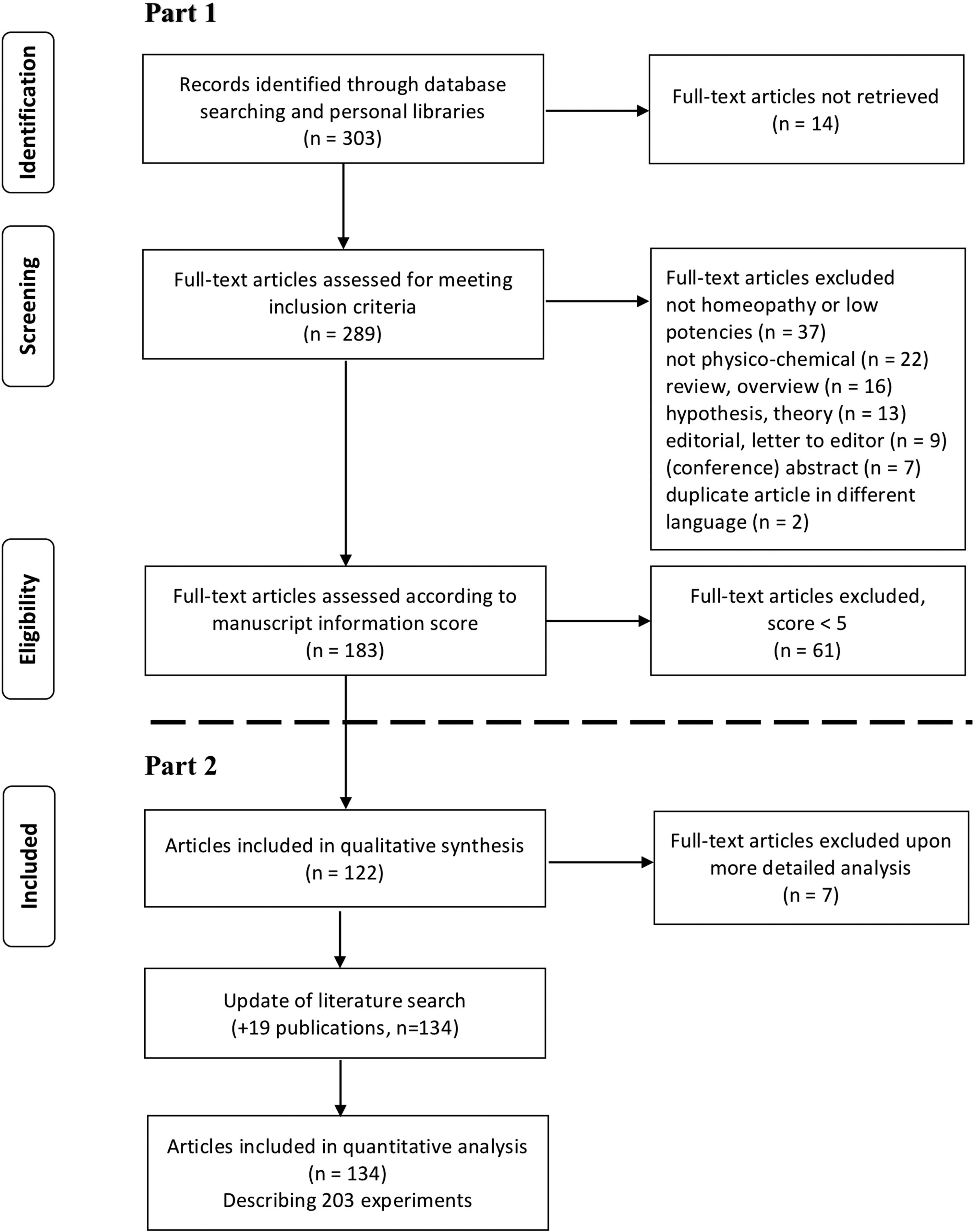
PRISMA flow diagram describing the process of paper inclusion through Part 1 and Part 2 of the review to arrive at the 203 experiments being described. PRISMA, Preferred Reporting Items for Systematic Reviews and Meta-Analyses.
Physicochemical Experiments Reporting Differences Between Homeopathic Preparations and Controls
Most experiments used plain (unsuccussed) potentizing medium as control, whereas less than one third used potentized medium (Table 2); 23% of experiments used more than one control. Twenty-three percent of experiments reported blinding and 21% reported randomization. Only 15% of the experiments reported measurements of multiple independent sample production lots. Most of the experiments (59%) did not report the use of statistics to analyze the data, whereas 28% reported use of inferential statistics.
Controls, Bias Prevention and Statistics Used in Physicochemical Experiments
Types of controls used in experiments, and information on whether sample blinding and randomization was used, whether experiments used independent production lots (i.e., how many times the homeopathic preparations were produced from the original substance) and whether statistics were used and what type.
Experiments often used several controls.
Table 3 reports on specific aspects of the sample production. Two thirds of the experiments used the multiple-tube method for potentization. Nearly half of the experiments declared use of some form of potentizing machine. The majority of experiments used succussion as potentization method. About two thirds of the preparations investigated were prepared by the researchers in their own laboratory. Experiments most often investigated samples both above and below the theoretical limit where nothing would be left of the original substance (12c/24x, roughly corresponding to the inverse of Avogadro's number). Although the assumption is generally that the effects of homeopathy are the result of as yet unknown water characteristic, only 24% of experiments used ultrapure water as the medium for the dilution/succussion process. Most experiments (35%) used ethanol at different concentrations. Of interest, 20% of experiments used specifically prepared water-based mediums such as solutions of sodium bicarbonate, silicic acid, sodium chloride, and lithium chloride.
Homeopathic Sample Preparation
Methods that were employed in the production of the samples: potentizing method (multiple- or single-vessel method), succussion method (hand, machine), production location (in-house or outsourced), and dilution level (below or above the inverse Avogadro number, i.e., whether any of the original substance could be expected to remain in the sample).
A total of 192 different substances were investigated. The most used potentized substance was Natrium muriaticum (sodium chloride), followed by 2.4-dichlorophenoxyacetic acid, Arnica montana, sulfur, Nux vomica, and Silicea (Table 4).
Substances Potentized Most Used in Experiments
Usage in number of experiments.
The most frequently used measurement techniques were electrical impedance, spectroscopy followed by nuclear magnetic resonance (NMR) (Table 5). From the breakdown per method we see that blinding and randomization was used most often in NMR, although still less than half of the experiments used them. Use of inferential statistics was generally low except for NMR where they were used often (77%). In terms of the use of succussed controls, these were used less than half of the time except for NMR (63%). The use of independent production lots was generally very low except for NMR (33%) and chromatography (100%). According to the methodological score applied (MFI score, see Materials and Methods section), NMR comes out as the method with the most reliable empirical evidence for specific properties of homeopathic preparations (MFI score of 15.8), followed by spectroscopy techniques (MFI score of 10.2), analytical methods (6.2), and electrical impedance (MFI score of 6.0).
Experimental Methods Used
Ordered by MFI score (see the Materials and Methods section). Count, number of experiments per method. Blinding, randomization, inferential statistics, succussed controls, and independent production lots, frequency of use. Differences between homeopathic preparations and controls as reported in publication: frequency.
The low level of reported differences in the Analytical Methods group is because of the fact that many experiments used analytical methods to control sample purity, not as a technique to compare samples.
MFI, Methodological and Frequency of Investigation.
If we look at the best experiments, defined as those that used blinding, randomization, and inferential statistics, we find overall 24 experiments, of which 79% reported differences between homeopathic preparations and controls (Table 6). Of those, 10 fulfilled a further two methodological criteria (use of succussed controls and use of independent lot production), 80% of which reported differences between homeopathic preparations and controls.
High-Quality Experiments
Number of experiments fulfilling three quality criteria (blinding, randomization, and inferential statistics) along with percentage of experiments reporting differences, number of experiments fulfilling an additional two quality criteria (succussed controls and independent series production) along with corresponding percentages of experiments reporting differences.
NMR, nuclear magnetic resonance.
Replications
For the purposes of this review, we define a replication as an experiment that used the same investigative technique to measure the same physicochemical properties of homeopathic potencies made of the same substances. Note that this is different from a reproduction where the same instrument and potencies would have to be used, along with the same statistical analysis, experiment protocol, and materials.
We extracted the replication data for all research techniques. The data tables summarizing these replications for each of the 11 experimental methods are given in the Supplementary Tables S1, S2, S3, S4, S5, S6, S7, S8, S9, S10, S11. A synthesis of the replication data is given in Table 7. To score the different replications, we defined the Experimental Replication (ER) score as the number of replications times the average methodological score of these replications times the percentage of experiments reporting differences. This score enables to determine which replications have most reliably reported differences between homeopathic preparations and controls and should therefore be replicated further to confirm (or not) their results.
Replicated Experiments
Number of replications of a given experiment, showing average methodological (MFI) score of experiments within a replication, how often differences between homeopathic preparations and controls were reported and associated ER score. Replications with ER score ≥5 sorted according to ER score.
ER, Experimental replication; GDV, gas discharge visualization; MFI, Methodological and Frequency of Investigation; NMR, nuclear magnetic resonance; UV, ultraviolet.
We see that the seven replications investigating T1 and T2 NMR relaxation times of potentized silica have high methodological scores and that all seven experiments reported differences between homeopathic preparations and controls, leading to a high ER score of 31.0. Similarly, NMR relaxation time investigations of potentized histamine have a high score of 17.0 with 5/5 replications reporting differences.
In spectroscopy, we have two sets of ultraviolet (UV) measurements (Cuprum sulfuricum, sulfur potencies) with high ER scores. In electrical impedance, the two replications of the REDEM experiments (black box measurements) stand out as having high methodological scores, and both replication lines reported differences between homeopathic preparations and controls leading to a decent ER. We also see the three studies of thermoluminescence using homeopathic preparations of Lithium muriaticum.
Discussion
Appropriate controls for potentized preparations
A major question that came up during this review is how to define the most appropriate controls for homeopathic preparations in physicochemical measurements. We can distinguish two main classes of controls: (1) plain (unsuccussed) solvent or diluted (but not succussed) homeopathic samples and (2) potentized or succussed (vigorously shaken) solvent. It is quite evident that succussion of a fluid in ambient air leads to a number of effects such as formation of air bubbles of different size with differential lifetimes, increased dissolution of air components (N2, O2, CO2) in the fluid, increased dissolution of potentization vessel wall material (Si, B, Na, K etc.), and maybe cavitation effects. 144 These processes may lead to further consequences such as increased oxidative processes (because of O2 dissolution), changes in pH (because of CO2 dissolution and acid formation), changes in nuclear magnetic relaxation (O2 as relaxation agent), increased silica-hydrogel formation (because of increased Si dissolution), radical formation (because of cavitation), and potentially other effects.
When investigating the hypothesis that potentization of a given material leads to remedies with specific effects, it is evident that any such specific effects have to be different from pure succussion effects that are unspecific in the sense that they are not related to the substance potentized. From this point of view, only succussed or potentized controls are valid controls for demonstrating any evidence for specific (remedy-related) properties of potentized preparations.
Considering the hypothesis that succussion leads to some information transfer of the substance potentized to the potentization medium, the question arises what happens when pure medium is potentized as control sample (e.g., potentized water). One could speculate that the potentization process is amplifying some random information. This would lead to a situation where samples with specific information (homeopathic preparations) would be compared with samples with random information (potentized water as control). In this sense potentized medium (and by extension succussed medium too) might not to be the best controls possible as they could introduce a random element.
On the contrary, one can argue that it would not be wise to compare homeopathic preparations with each other in case the measurement method used is not able to distinguish the putative homeopathic structures. Because the nature of the homeopathic structures is not known yet, it cannot be decided at present if a given measurement method is able or not to distinguish the presumed structures.
We therefore recommend in future investigations the use of two types of controls: (1) potentized solvent and (2) other homeopathic preparation(s). The use of several homeopathic samples increases the probability to identify different structures. Furthermore, if possible, we recommend the additional use of (3) unsuccussed and (4) succussed control samples that would allow determining the effect of pure succussion. A study of the effect of succussion on the observed physicochemical activities would be a welcome endeavor as it is currently lacking, in particular investigating the effect of the number of succussions would be very interesting. Such a study would complement the work by Betti et al., which used wheat germination assays and the droplet evaporation method to explore this topic, showing a sigmoidal type behavior as a function of the number of succussions. 145
As mentioned previously, certain experimental methods might be more suitable to investigating the presence/absence of such structures rather than distinguishing between such structures. The issue here is in conceiving appropriate controls that would not suffer from confounding factors such as gas dissolution for example. Such an approach is being pioneered by the group of Prof. Elia in their conductivity measurement experiments; they used trace analytics methods to levels of sodium in their samples and are thereby able to calculate the theoretical conductivity of the sample (sodium being the most relevant element for conductivity in their setup) to obtain the so-called “excess conductivity” as the difference between the measured conductivity and the theoretical prediction. This technique is interesting as in principle it probes directly for the presence of structures with unexplained properties (here in terms of conductivity). However, the technique does not currently control for other elements and gases originating from the succussion process that could also play a role.
Bias prevention and statistics
Most of the studies neither used blinding nor randomization. This is not entirely unusual in physicochemical research where one usually does not expect experimenter effects. Most of conventional research does not invoke blinding on such experiments for that very reason. Giving the history and heated debate surrounding homeopathy, we recommend implementing blinding and randomization protocols in future investigations to ensure that experimenters do not have any effect on the results.
Rather worrying is the lack of use of proper statistical tools. Part of the problem here is that many of the studies are quite dated and statistical tools were often not used at that time. Another effect is that many experiments such as in spectroscopy have been rather descriptive and therefore did not use statistical tools. Now, again given the controversy in the field, there is a great need for proper statistical methods to be implemented, so as to quantify the degree of uncertainty in the results and to avoid Type I and Type II errors.
We recommend the implementation of systematic negative control (SNC) experiments on a regular basis. SNC experiments are full experiments with identical design and evaluation as experiments with homeopathic preparations, but all samples are either from the same source material (e.g., plain potentization medium) or consist of potentized medium, prepared analogously as the homeopathic samples. 146 Depending on the design of the experiments, systematic positive control (SPC) experiments may also be a valid approach, consisting of the same sample (either a positive control or a homeopathic preparation), independently prepared in the number of samples assessed in the “true” experiments. SNC and SPC experiments are excellent scientific tools to evaluate the stability of a given experimental system, to identify any systematic error, and to assess applicability of statistical models. In this review, only one investigation implemented SNC experiments. 97
Another aspect that needs to be addressed in the future is the inherent variability present in physicochemical studies of homeopathic remedies. It is quite clear that there is a high degree of variability in the experimental measurements, 139 which cannot be solely attributed to instrumental error and are because of the high variability inherent in water itself. 147 SNC and SPC experiments are well suited to address these issues. In addition, adapted statistical models may be necessary to address variability in itself.
Most promising techniques
Looking at the results gathered in this review a number of experiments emerge as deserving further replication and exploration. First of all, NMR relaxation studies of potentized silica and histamine preparations have shown the most methodological rigor and the most promising results, demonstrating the ability to distinguish between potentized silica or histamine, and potentized controls. Of interest, potentized sulfur seems to be harder to distinguish from corresponding controls.
Based on the available data, UV spectroscopy seems to be the second most interesting technique. With this experimental approach only, a formal meta-analysis over three independent experimental series yielded statistically significant differences between potencies of copper sulfate and succussed medium.
Thermoluminescence on potentized lithium chloride seems to be the third promising technique, although it requires quite sophisticated and expensive equipment.
In contrast, both NMR relaxation and UV spectroscopy can be performed with desktop instruments, and can additionally be equipped with autosamplers to allow a high number of samples to be measured. From a pragmatic point of view, these two methods therefore seem to be most promising to be recommended for further replication studies.
Of interest, two unconventional experimental methods (so-called REDEM spectroscopy and gas discharge visualization) also seem to have a potential to distinguish between potentized preparations (silver nitrate, gold, sodium chloride) and controls. The disadvantage of these approaches is that the exact measurement process is only partially understood, and cannot be scientifically interpreted in a straightforward way.
Limitations
The search criteria defined homeopathic preparations as having undergone succussion steps, as such a number of publications from the field of water research and of high-dilutions research were not included. In particular the work of Pollack on “Exclusion Zone” (EZ) water, which is often cited as a possible line of enquiry for explaining homeopathy, did not fulfill the criteria and was not retained (for a overview of this field, the reader is referred to the book by Pollack: “The Fourth Phase of Water” 148 ). Similarly, the work of Konovalov and Ryzhkina on structures terms “Nanoassociates” at ultralow dilutions, did not meet the criteria and was not retained (for more details the reader is referred to the review of the field by Konovalov and Ryzhkina 149 ). It is quite clear that the homeopathic remedy production process with iterative dilution and succussion steps raises fundamental questions in the realm of physics and chemistry that go far beyond the field of homeopathy research. A review on water structures and water/ethanol structures and on physicochemical effects of succussion would be a very valuable complementary approach for homeopathic basic research.
Conclusions
We reviewed 134 publications describing 203 experiments in the area of physicochemical research into homeopathically potentized preparations, which we analyzed in detail with the aim of extracting relevant information about what has been learned in the field and which experiments to undertake in the future.
To conclude, the most promising techniques used so far are NMR relaxation, optical spectroscopy, and electrical impedance measurements. In these three areas, several sets of replicated high-quality experiments provide evidence for specific physicochemical properties of homeopathic preparations.
For future experiments, we recommend using succussed controls, or comparing different homeopathic preparations with each other to reliably identify any specific physicochemical properties. We also recommend the use of systematic positive and negative control experiments as a way of measuring the inherent variability in an experimental setup.
Further in-depth analysis of the experiments published is warranted to extract hypotheses regarding a possible mode of action of potentized remedies; such an analysis will be published as Part 3 of this review.
Footnotes
Author Disclosure Statement
S.W. was an employee of Hevert-Arzneimittel GmbH & Co. KG, Germany; however, none of the publications included in this review used Hevert products. All other authors have no competing financial interests.
Supplementary Material
Supplementary Data
Supplementary Table S1
Supplementary Table S2
Supplementary Table S3
Supplementary Table S4
Supplementary Table S5
Supplementary Table S6
Supplementary Table S7
Supplementary Table S8
Supplementary Table S9
Supplementary Table S10
Supplementary Table S11
References
Supplementary Material
Please find the following supplemental material available below.
For Open Access articles published under a Creative Commons License, all supplemental material carries the same license as the article it is associated with.
For non-Open Access articles published, all supplemental material carries a non-exclusive license, and permission requests for re-use of supplemental material or any part of supplemental material shall be sent directly to the copyright owner as specified in the copyright notice associated with the article.
