





Abstract

For the 40th anniversary of the Australian and New Zealand Journal of Psychiatry it was felt that some reminiscing was appropriate. One obvious idea was to present the 10 most important articles published by the journal since it began in 1966. All things considered, it was felt the fairest way to measure the impact of individual articles was by how often they had been cited by researchers.
In 2005, the journal used citation data provided by the Web of Science to identify the ‘Top 10 articles published for the years 1966–2006’ (http://www.isiknowledge.com). A general search using ‘Australian “and” New Zealand Journal of Psychiatry’ in ‘Source title’ was conducted on 27 September 2005 and the results were then sorted by ‘times cited’ to give the top 10 articles. The dates searched automatically by the Web of Science were 1955–2005. The results along with the number of citations are presented in Table 1.
The 10 most-cited articles
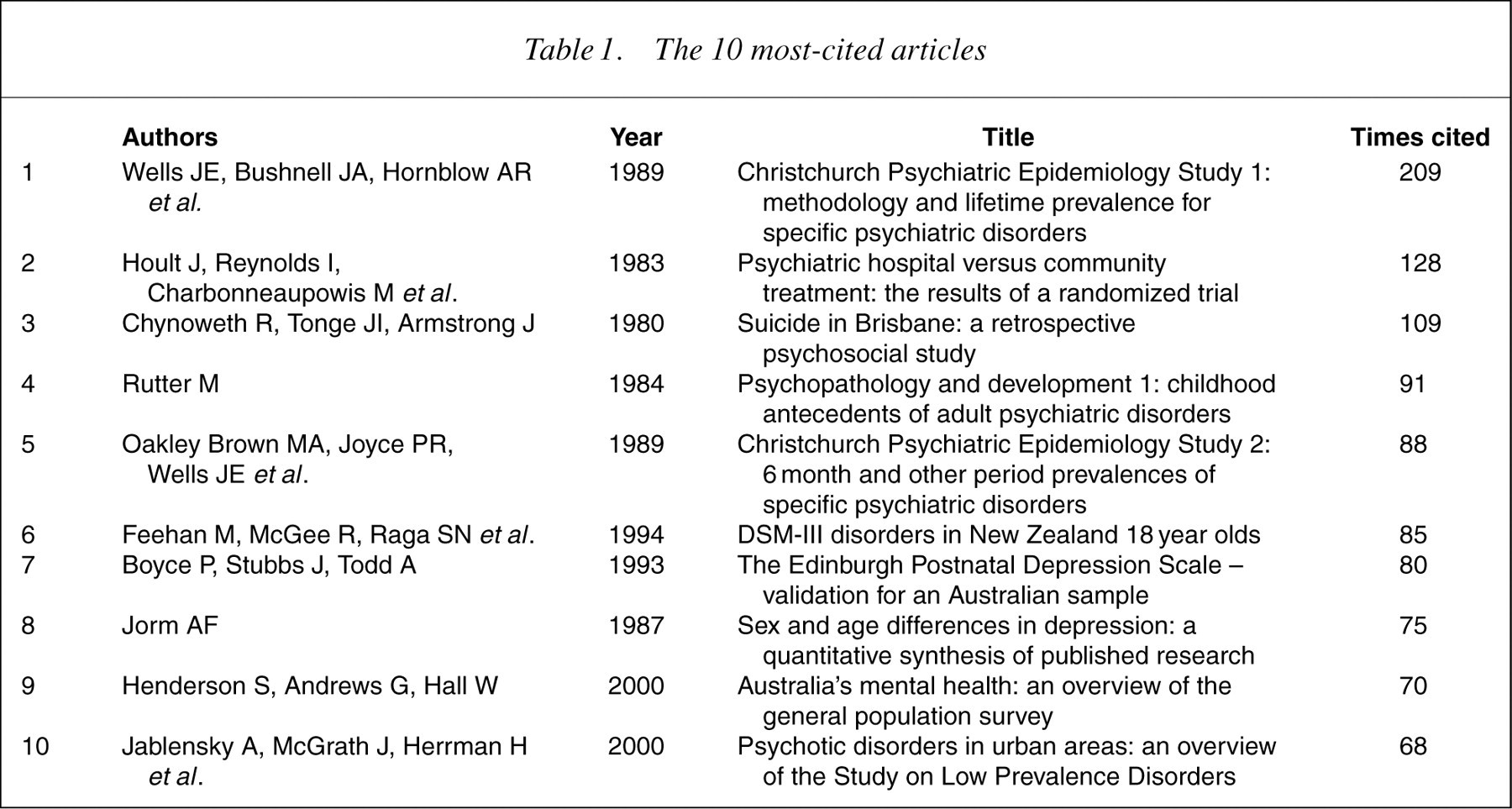
The results suggest that publishing a survey of prevalence of psychiatric disorders is the most likely way to be well cited in the Australian and New Zealand Journal of Psychiatry. Half the papers are epidemiological surveys. Two are from the Christchurch Psychiatric Epidemiology Study, two are from the Australian National Survey of Mental Health and Wellbeing and one from the Dunedin Multidisciplinary Health and Development Study.
The other five articles are an assortment of reviews, validation of scales and one randomized treatment trial. It is of interest that a similar exercise conducted by the Medical Journal of Australia in 2004 reported that a psychiatric publication was also their most cited. This was John Cade's 1949 study on ‘Lithium salts in the treatment of psychotic excitement’ [1]. It had been cited 888 times [2].
The Australian and New Zealand Journal of Psychiatry's 10 most-cited articles present some attempts to understand more about psychiatry. It is to be hoped that the next 40 years will see more articles that systematically evaluate treatments of psychiatric illness as well as those that quantify its characteristics and epidemiology. The journal particularly welcomes studies that attempt to do this. Many of the authors cited are also clinicians. This reminds us of what Cade said in his presidential address to the 17th Annual Congress of the Australian and New Zealand College of Psychiatrists in 1970. ‘Almost everyone can and should do research both because almost everyone has a unique observational opportunity at some time… and also because the intellectual discipline or technical training that it imposes is an essential prerequisite to expertise in a professional field’ [3]. It is vital that clinical psychiatrists continue to actively take part in research.