





Abstract
When John Cade was born in 1912, in the small Victorian country town of Murtoa, his future professional field was also in its infancy, if indeed it had been truly born at all. There were of course large lunatic asylums occupying prime real estate in Melbourne and grand sites in the country, but these functioned primarily as custodial institutions rather than as hospitals offering treatment, for in general there was no effective therapy for the major mental illnesses. But living many of his younger years within the grounds of these impressive institutions, since his father was for many years medical superintendent at several of these hospitals (Beechworth, Sunbury, Mont Park), was to have a major bearing on his later deep understanding of the needs of the mentally ill.
John Cade was still a small boy when his father, David, left for World War I, for Gallipoli and later France, returning in 1919 a Colonel with a DSO (Distinguished Service Order) but with severe physical and mental exhaustion referred to at the time as ‘war weariness’. During the war, the family (John's mother, Ellen, John himself, and his two younger brothers, David and Frank) had lived in the peaceful Dandenongs, and the main memory of that time was that his mother bought from a door-to-door salesman a block of land at St Leonards which turned out to be underwater. After the war, the family returned to Murtoa, but his war-weary father became increasingly exhausted treating the large number of his patients in the influenza pandemic of the time. He, therefore, sold his general practice and gratefully accepted a position with the Mental Hygiene Department, in which he worked in three of the major mental hospitals over the next 25 years.
John was educated at Scotch College, at its then new Hawthorn site, where school mates included later medical colleagues (Sir) Jock Frew and (Sir) Benjamin Rank, the former whose nose he broke at boxing. His certificate with first class honours for intermediate class (form VII in the nomenclature of the day) was signed by the redoubtable W.S. Littlejohn in 1926, and he matriculated in 1928.
He studied medicine at Melbourne University, graduating at the age of 21 years with honours in all subjects. When his Uncle Fred, a general practitioner in Narrabri, died in 1931 and left a legacy to each of his three nephews, it was typical of John that he used his to reimburse his father for his university fees. These were frugal times, and since his family lived in the country during his education, he stayed with his cousin in their old family home situated on the remains of its original 6.5 acres in Orrong Road, Toorak, paying 5 guineas per week for board.
He became a House Officer at St Vincent's Hospital and later at the Royal Children's Hospital, when he developed bilateral pneumococcal pneumonia. He was fortunate to survive, and one of his special nurses during this illness was Jean Charles, whom he married in 1937. They were too poor to buy an engagement ring or to have guests at their wedding. Their two eldest boys were born in 1938 (John) and 1940 (David).
Like his father a generation earlier, he left his wife and small boys to serve in an overseas Field Ambulance in a global military conflict. He sailed from Australia in 1941 on the Queen Mary to return not so grandly on the SS Largs Bay 4 years later. Initially, he wrote to his family from Malaya, but the Japanese advance and the fall of Singapore was so fast that they were all promptly ‘put in the bag’. The rest of the war was spent as a prisoner in Changi Camp.
He had a remarkable memory. His task was to listen to the nightly BBC broadcast on the hidden radio in Changi, and when it was too dangerous to carry written reports he committed the entire news to memory and repeated it verbatim to his audience of fellow POWs.
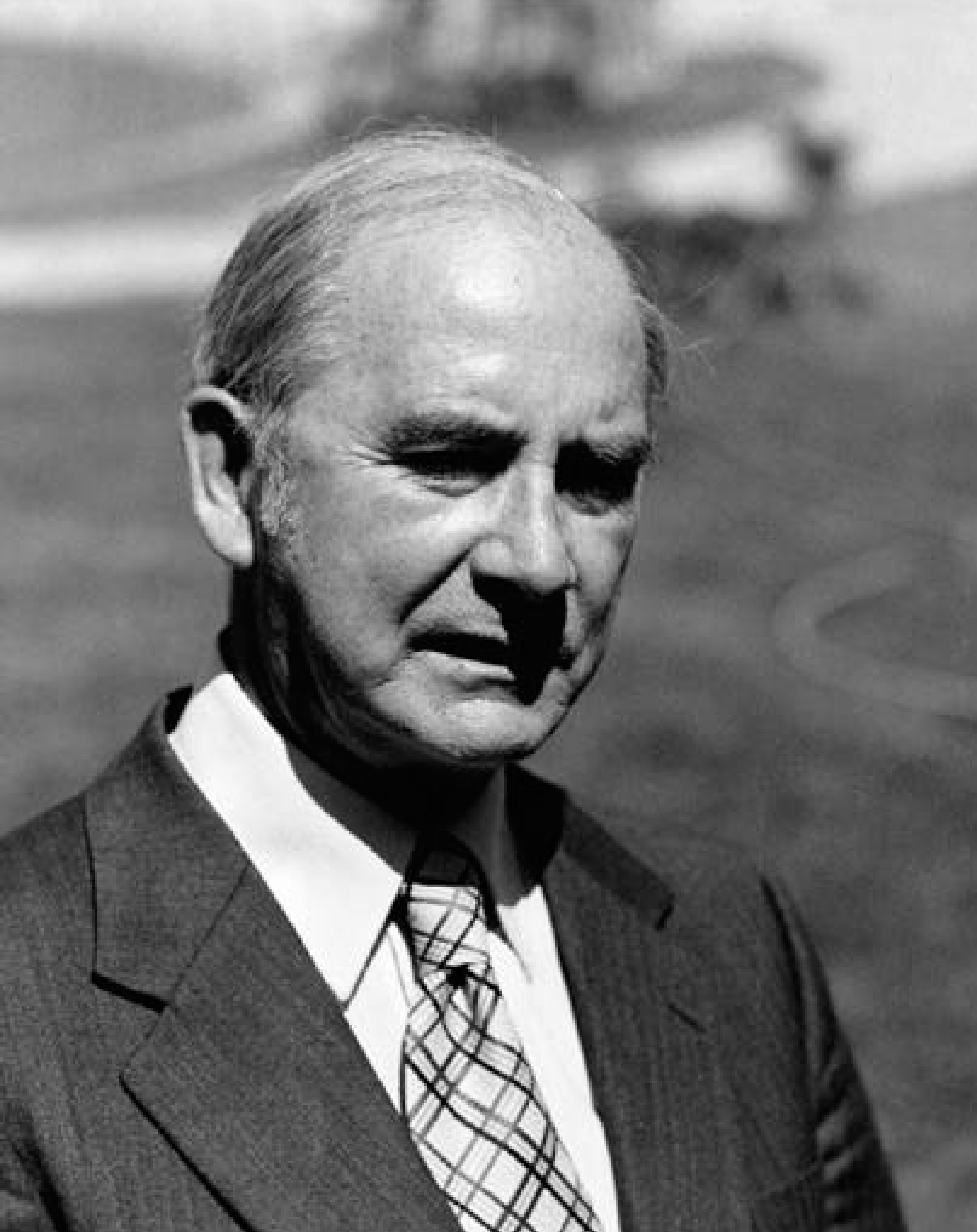
John Cade, 1970
Like many others, he never spoke about these horrific times until very many years later, although he retained a strong and continuing relationship with his Field Ambulance colleagues who affectionately called him the Mad Major. His feelings towards war and his war-time mates is beautifully illustrated by his address at their annual ceremony at the Shrine of Remembrance many years later, when he said:
This year is the fortieth of the comradeship that we have been privileged to share. It is a very precious bond that binds the living and the dead and today we pay homage to those who have gone before us and whom all of us must follow in God's good time. We remember all those fine men who died but particularly those whose memory lives on in our hearts. It is said that it is a holy and wholesome thought to pray for the dead. Why should it be wholesome? I have thought about that and I think I know part of the answer. We remember their virtues: their courage, their fortitude, their generosity, their wisdom, their loyalty: and remembering we emulate; and are better people for it. One gallant comrade, and you all know who that was, was recommended for a posthumous V.C. which was never awarded. As we think of him and the two brave men who died with him, the flickering flame of our own courage burns just that much brighter and stronger. As we think of the wisdom and loyalty of our only commander so our own is just a little magnified. Let us then enter this shrine and pay our loving homage and remembrance to our departed comrades.
Interestingly, he refused to join the RSLbecause he felt it glorified war. Indeed, he bore no resentment to the Japanese, but rather felt great warmth for Asians, many of whom he considered to have suffered even more than he and other Australians had.
On his return from the war, he was a walking skeleton of about 40 kg and typical of so many surviving POWs. After recuperation in Heidelberg Hospital, he came home and his two small sons, now aged 5 and 7 years, were somewhat startled to find a skinny sallow man saying ‘boo’ and smiling from behind the kitchen door when they came home from school.
After the war, he returned to medical practice at Bundoora Repatriation Mental Hospital, to his beloved ex-diggers, where he sought to care for their physical and spiritual as well as medical and psychiatric wellbeing. It was here that his post-war children were born, in 1947 (Mary), 1948 (Peter) and 1950 (Richard). Mary died when she was 1 day old due to an obstetric complication and this was perhaps his life's greatest tragedy, with lasting memories of carrying the tiny coffin in his hands at her small funeral.
His theory at this time of the possible aetiology of manic-depressive illness and his discovery of lithium for its treatment are well known. Family memories of this event are of guinea pigs lying contentedly on their backs in an empty ward pharmacy, of manic urine in the family fridge, of his own ingestion of lithium to his wife's dismay, and of the grubby little man who was the first to be cured of his mania by lithium.
A mark of his simplicity and modesty was that this extraordinary discovery was not fully appreciated by his own family and indeed by many others until overseas awards flowed some 20 and more years later. On one of these occasions, we well remember his leaving for New York to receive the prestigious Kittay Award, at the time the world's most valuable prize in psychiatry, carrying no luggage other than his briefcase with little more than a toothbrush and a clean shirt. He was later to be invited to be a Distinguished Fellow of the American College of Psychiatrists, but he was especially proud to have been President of his own Australian College. He was also proud to have been one of the early recipients of the newly created Australian Awards, and he always liked to wear his small lapel badge of Officer of the Order of Australia (AO).
But his discovery of lithium was no fluke. He had an intelligent and inquisitive mind, with broad interests particularly in the natural world. His boys well remember his curiosity over animal paw prints and dung in the bush.
One day when driving through the Black Forest to Woodend, he suddenly announced that he thought there were elephants up ahead in the forest. Of course, all schoolboys know that elephants do not inhabit Australian forests. But no sooner had his prediction been ridiculed than there at the side of the road were three elephants. As it happened, the circus was on tour and he had seen a pile of dung on the side of the road too large to be from any other animal.
More esoterically, he was for years convinced that the thylacine or Tasmanian Tiger was not extinct but actually still roaming in remote parts of the Victorian bush, particularly his beloved Otways near Kennett River. His sons were not impressed with this postulate, until one day it was announced that Brigitte Bardot was to visit Australia in her capacity as protectress of endangered species, and here might be a chance for them to meet the decade's ultimate ‘sex kitten’. Alas, her visit did not eventuate.
Of more immediate relevance to the smaller members of the family, his love of nature took the form of frequent trips for the grandchildren to the Zoo, where elephants and lions and butterflies and icecreams became happily intermingled.
Together with his love of the natural world was a boyish sense of humour, with a particular penchant for limericks, malapropisms and pithy yarns. A welwritten book was always welcome, especially if it related to history, but his culture did not extend far into music. This was not one of his long suits, as he would say, and his tastes ran primarily to such pieces as the melodious but relatively unsubtle 1812 Overture and Capriccio Italien by Tchaikovsky. Nor did culinary art excite him. Even at the finest restaurant, he always preferred a dozen plain oysters with a glass of beer, followed by a fillet steak with a bottle of Seppelts Moyston claret.
It is sometimes said that the left-handed are the more creative and indeed John Cade was one of those natural left-handers who had been forced to become a righthander at school, at least for writing. For all his later life, he had a left hand/right hand dilemma, in that he could play tennis or golf with either hand and the direction to turn left or right caused palpable seconds of uncertainty and deliberation, especially when driving. Despite his variable handedness, he could play a round of nine holes of golf after an absence of many years and, armed with only a 5 iron and putter, return a score in the low 40s, although this would be scoffed at by his younger brother, David, a scratch golfer with a handicap at his best of ++2. His sons were never able to beat him at golf or even tennis, at least until after the first set and then only when he was much older.
To those closest to him, whether family, friends or colleagues, he was best known professionally as a clinician, a teacher and a humanitarian rather than a researcher. For treating patients, teaching both under graduates and postgraduates, and caring for others were his life's work, and intellectual curiosity and its fruits were integral to these activities rather than a field in its own right. It was moving to hear him on the event to mark his retirement publicly thank his many patients for all they had taught him and clearly this is what underpinned his professional life. He had spent the last 25 years of his professional life as the busy Superintendent of the Royal Park Psychiatric Hospital, where he was also Dean of the Clinical School.
But John Cade was not perfect. Although he was a kind, tolerant and deeply Christian gentleman, he was an addicted and stubborn smoker despite his family's pleadings. Doubtless this habit was irrevocably entrenched during wartime and it was to be eventually fatal.
During his last months when he was dying from inoperable and metastatic carcinoma of the oesophagus, he was always calm and dignified, despite advanced cachexia, intractable nausea and repeated hospitalisation. His request at this time to me was for the simplest box in which to be buried in the country at Yan Yean near his parents and for donations to the overseas Missions instead of any flowers at his funeral. He died only 3 years after his retirement, alas at an age when many more years of happy life might normally have been expected.
Long after his death and without diminish over the years, we, his family, increasingly appreciate the national treasure we had in our midst but did not really know in that way. But no doubt he would not have wanted it otherwise.
Footnotes
Acknowledgements
This paper is derived from personal memory. Its content has been confirmed by the collective memory of John Cade's immediate family, the individual members of whom are thanked for their comments and suggestions.