



Abstract
Proterozoic limestone in a north British terrane contains a newly recognised occurrence of Nb-REE minerals. The mineralized Loch Shin Limestone is in the Lewisian Complex of the Northern Highlands of Scotland, intruded by alkaline plutons above a Caledonian (∼0.43 Ga) subduction zone. The mineral assemblage includes columbite, calcium niobate minerals, and niobian rutile and also includes W- and Sn-bearing phases. The interval between limestone deposition and mineralization was over a billion years. Other limestones in the Lewisian Complex that were not affected by alkaline plutons are not mineralized by Nb. The occurrence indicates that there may be exploration potential for Nb in limestones mineralized by hydrothermal activity above subduction zones with alkaline intrusions.
Introduction
Niobium (Nb) has been identified as a critical element, required to support future technology, including steels and alloys (Linnen et al. 2014; Mackay and Simandl 2014; Simandl et al. 2018). Niobium is mostly sourced from Brazil, but geopolitical considerations make it desirable to identify resources from diverse regions. Most Nb mineralization is associated with carbonatites, representing alkaline fluids of magmatic affinity (Elliott et al. 2018). Some smaller Nb deposits occur in metamorphosed sedimentary carbonates, i.e. marbles (e.g. Drábek et al. 1999; Franchini et al. 2005), and some Nb-bearing marbles are interpreted as extrusive carbonatites (e.g. Høy and Kwong 1986). The giant Nb-REE deposit at Bayan Obo, China, is of much argued origin, in which the balance of importance between carbonatite and sedimentary carbonate is debated. The predominant view is that carbonatites were essential, but mineralization was modified by intrusion into a Proterozoic marble-bearing succession on the North China Craton (Smith et al. 2015; Fan et al. 2016). Some authors also propose modification by a consequent flux of hydrothermal fluid through the marble at Bayan Obo (Ling et al. 2013; Lai et al. 2016; Deng et al. 2017).
Exploration for Nb deposits focuses on carbonatites (Mackay and Simandl 2014). An alternative strategy would investigate marble-bearing successions penetrated by alkaline subduction fluids. This study examined an outcrop of Proterozoic marble in the Northern Highlands terrane of northern Britain, in a region intruded by alkaline and other plutons above a Caledonian subduction zone. The marble, previously unremarkable, was found to contain diverse Nb mineralization, which emphasizes the potential of limestones mineralized by hydrothermal activity for exploration.
Geological setting
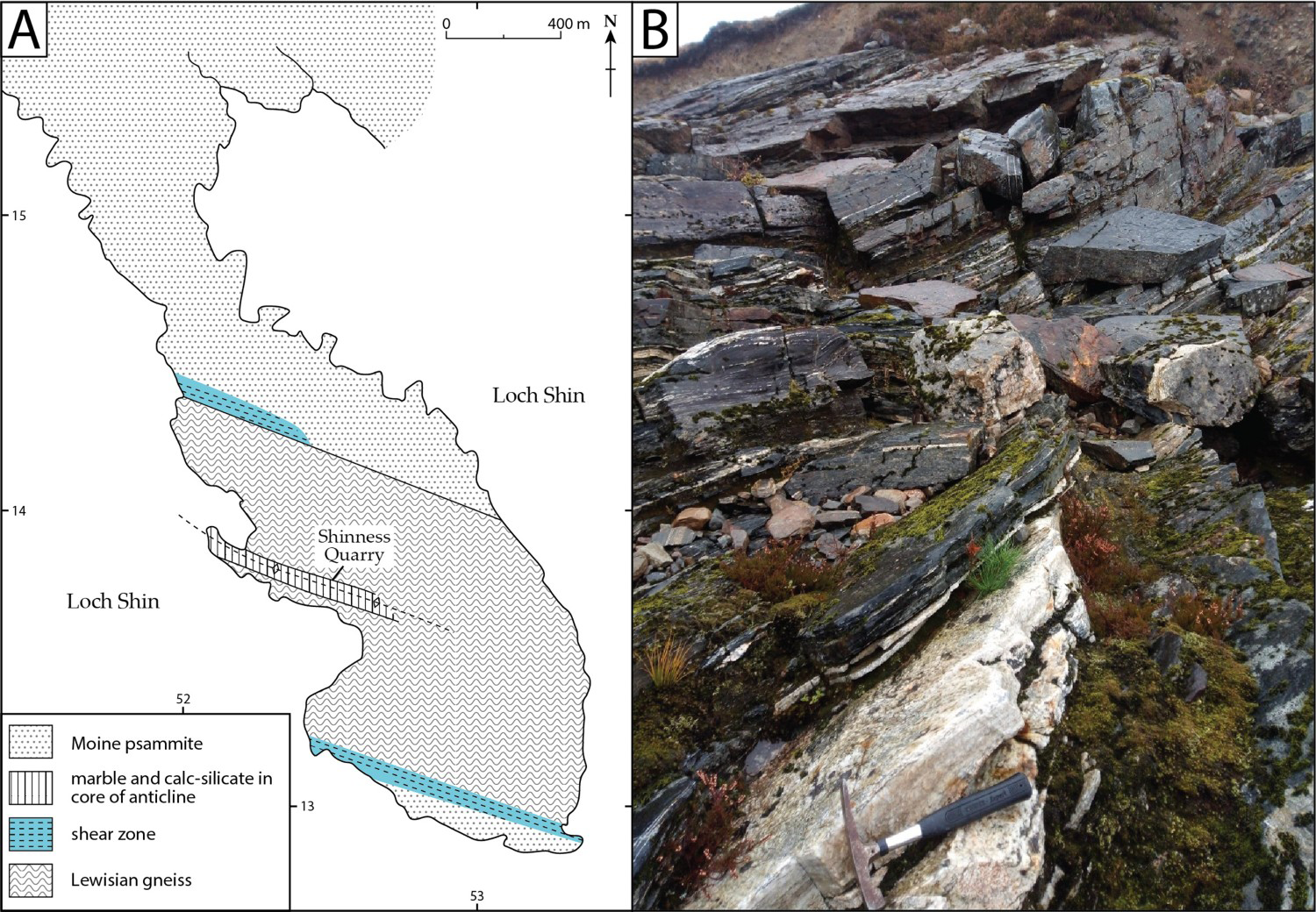
Marble occurs on the east shore of Loch Shin (National Grid Reference NC 521 139), as a supracrustal component of the Lewisian Complex (Figure 1), which at Loch Shin forms an inlier within Neoproterozoic Moinian metasediments in the Northern Highlands terrane (Read et al. 1926; Crampton 1956; Winchester and Lambert 1970; Rock and Waterhouse 1986; Rock 1987; Soper 2009; Strachan et al. 2010). The Lewisian Complex is predominantly Archean, of igneous origin, but includes numerous supracrustal successions, of Palaeoproterozoic age. The limestone at Loch Shin is undated, but other marbles in Lewisian supracrustal assemblages date to ∼1.9 Ga, in accretionary subduction-related complexes (Park et al. 2001; Whitehouse and Bridgwater 2001; Storey 2008). The supracrustal rocks include marbles whose sedimentary origin is evident from associated beds of mudrock and ironstone, entrained grains of quartz and mica, and carbon isotope data. The marble at Loch Shin is part of a ∼ 1 km wide metasedimentary package, separated from Moinian metasediments to the north and south by shear zones represented by ‘tectonic schist’ (Soper 2009). About 7 m of marble was worked in 2 quarries, where it occurred as lensoid intermixtures of relatively pure limestone and skarn-like calc-silicate rocks (Read et al. 1926; Robertson et al. 1949). The marble, and accompanying calc-silicate rocks, occupy the core of an anticline, succeeded on both sides by amphibolitic gneisses (Figure 2). Current exposure is limited to a quarry (National Grid Reference NC 525137) and shore section (NC 521139). Hand specimens consist of granoblastic carbonate (calcite, dolomite) with centimetre-scale lenses of mixed carbonates, feldspars (orthoclase, albite), quartz, muscovite, tremolite, diopside, phlogopite, epidote and chlorite (Read et al. 1926; Winchester and Lambert 1970; Strachan et al. 2010). Some rock is predominantly feldspar.
Map of northern Scotland, after Walters et al. (2013), showing location of Loch Shin mineralized marble, and alkaline plutons above Caledonian subduction zone. (#A) Map of southern part of Loch Shin, showing location of marble within Lewisian supracrustal metasediments, all separated by Moinian metasediments to north and south by shear zones (after Soper 2009). (B) Field view of marble (white) below amphibolitic gneisses in Lewisian section on shore of Loch Shin.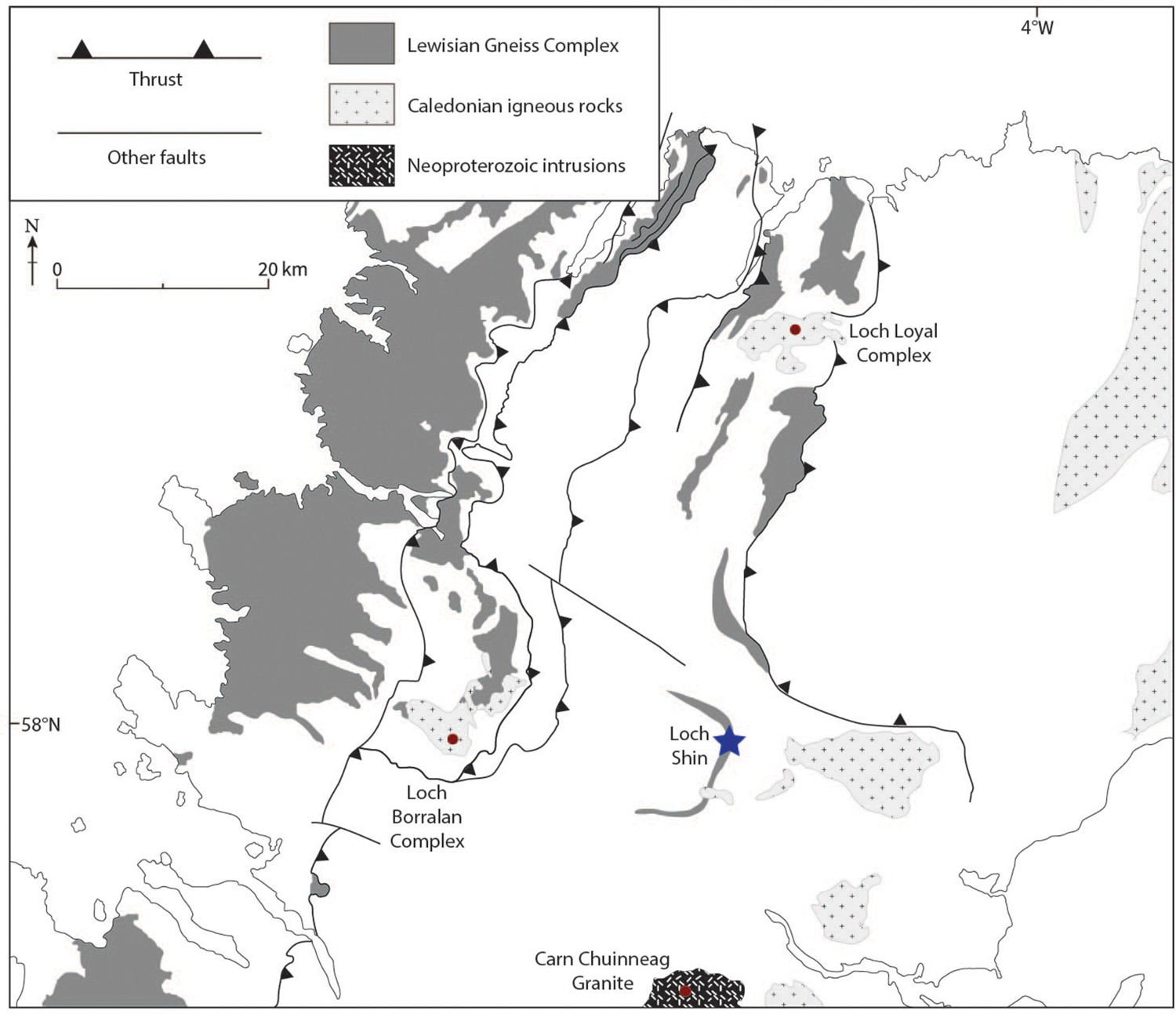
The Lewisian and Moinian rocks are tectonically inter-sliced (Peacock 1975; Soper 2009) and intruded by numerous granitoid plutons above the subduction zone on the Laurentian margin of the Iapetus Ocean (Oliver et al. 2008). The plutons include two alkaline complexes, at Loch Loyal (426 Ma) and Loch Borralan (429 Ma) in the Northern Highlands terrane (Goodenough et al. 2011). Carbonatite occurs in the Loch Borralan Complex (Young et al. 1994). The terrane also includes plutons dated to the end-Neoproterozoic, which possibly relate to an early stage of Iapetus history. The early plutons include the Carn Chuinneag granite (594 Ma), which was mineralized with the tin (Sn) ore cassiterite (Gallagher et al. 1971). Vein mineralization at the southern end of Loch Shin, in Lewisian, Moinian and Caledonian granitic rocks (within a few kilometres to the south of the marble locality: Figure 1), includes the tungsten (W) ore scheelite, Sn-rich galena and fluorite (Gallagher 1970; Gallagher and Smith 1976).
Analytical methods
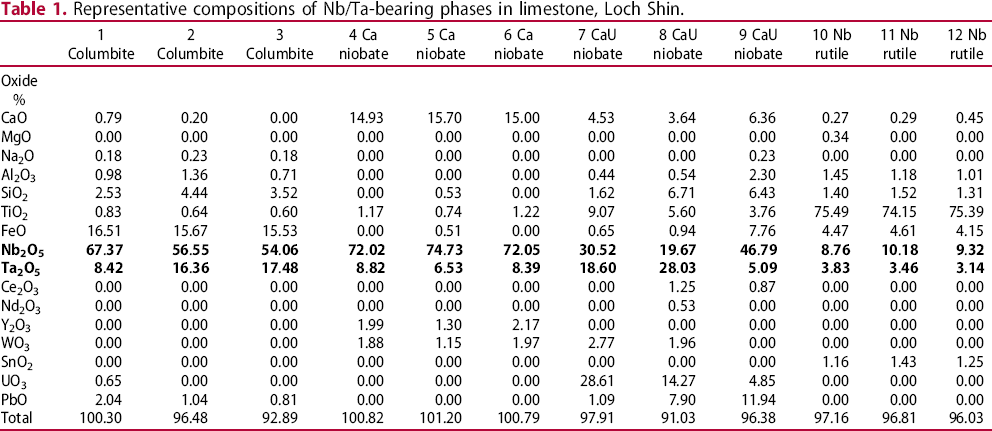
Representative compositions of Nb/Ta-bearing phases in limestone, Loch Shin.
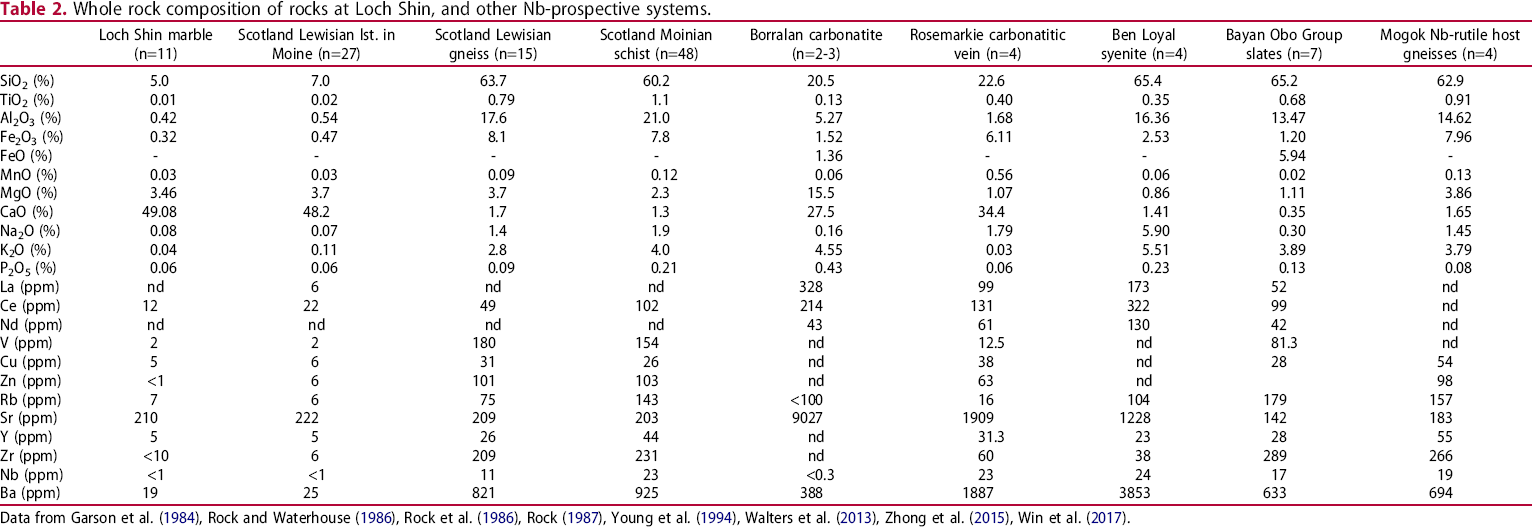
Whole rock composition of rocks at Loch Shin, and other Nb-prospective systems.
Results
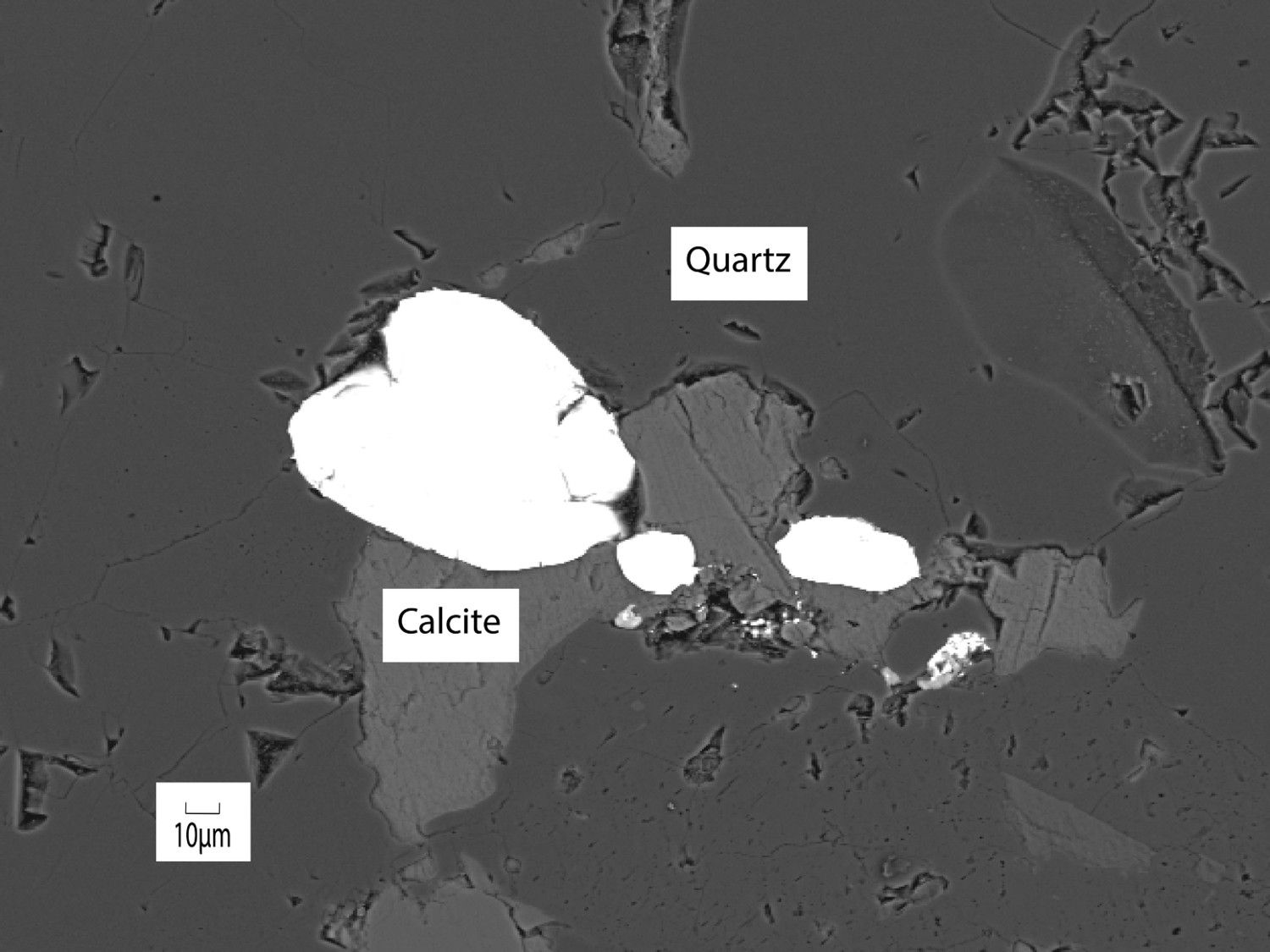
Mineralization occurs in bedded limestone, not containing any conspicuous veining. The limestone is substantially replaced by crystallites of feldspar, muscovite and chlorite up to several millimetres size. Nb-bearing mineral phases up to 40 micrometres size (Figures 3–4) are distributed sparsely through the limestone. These phases occur particularly in limestone replaced by muscovite, chlorite and albite. The Nb minerals occur both between and within crystals of these silicates (Figure 3). Less commonly, the phases are associated with quartz and calcite (Figure 4). They are not recorded in association with skarn minerals (diopside, tremolite, epidote) which occur in parts of the limestone. Several Nb-bearing mineral phases can be distinguished:
Columbite (FeNb2O6) Calcium niobate phases with general formula (Ca, Y,X) (Nb, Ta,Ti)2O6, most referable to fersmite. Calcium niobate with a consistent enrichment in yttrium (Y) and tungsten (W). Niobate phases of variably mixed (Nb, Ta), REE and (U, Th) composition. Niobian rutile (Ti, Nb,Ta, Fe)O2, commonly tin-bearing up to 2% SnO2 (Ti, Nb,Ta, Sn,Fe)O2.
Backscattered electron micrographs showing niobium-bearing mineral phases in muscovite and chlorite in marble, Loch Shin. (A) Niobian rutile (bright) in mixed laths of muscovite and chlorite, and calcite (etched); (B) Niobian rutile (bright) and calcium niobate (bright grey) in muscovite and chlorite. Rutile contains traces of tin; (C) Several crystals of niobate phase rich in Ta, U and Ti (bright) with satellite crystals of pyrite (bright grey), in host of calcite, muscovite and chlorite; (D) Calcium niobate (bright) crystal within muscovite. Backscattered electron micrograph showing calcium niobate phases (bright) in calcite and quartz in marble, Loch Shin. Largest grain is 40 micrometres size. Smaller grains are brighter due to greater proportion of Ta.
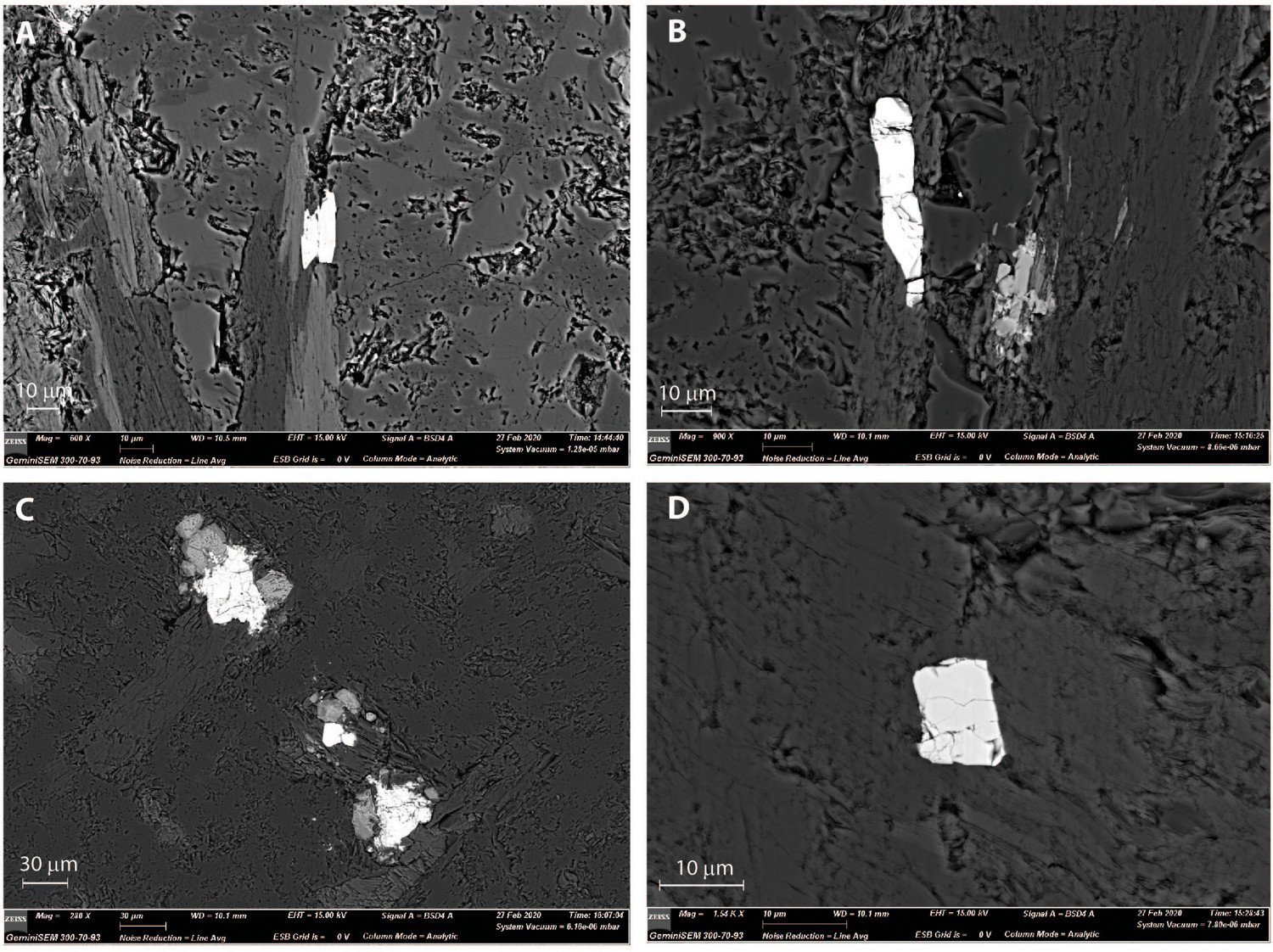
Each of these phases has been recorded in multiple examples, in several distinct samples of the marble. They occur as isolated crystals rather than clusters. Mapping shows that Si substitutes for Ti to varying degrees in Ti-bearing phases, and that U and/or W substitute in many Nb-bearing phases. REE-bearing phases contain Y, Ce and Nd. Pb commonly occurs in/near U-bearing phases. Examples of the main phases are given in Table 1. Tantalum is a consistent component of the Nb minerals, but is especially abundant in the U-bearing phases. No preferred paragenetic sequence between the phases is evident.
The columbite contains up to 67% Nb2O5. The mean Nb/Fe atomic ratio from three analyses is 2.01, consistent with the formula FeNb2O6. The calcium niobate phase contains up to 75% Nb2O5. The mean (Nb, Ta,Ti)/(Ca, Y,W) atomic ratio from three analyses is 1.99, consistent with the formula (Ca, Y,X)/(Nb, Ta,Ti)2O6. The Nb-rutile typically contains about 10% Nb2O5 and 2 to 4% Ta2O5.
The limestone is also mineralized by phlogopite, apatite, zircon, sphene, allanite, pyrite, pyrrhotite, sphalerite and uraninite. Studies by us of other marbles in supracrustal successions in the Lewisian Complex, but not associated with Caledonian plutons (e.g. Loch Maree, Iona, Tiree, South Harris; see Rock 1987) show that they contain these other mineral phases but do not include Nb-Ta mineralization.
A further distinctive mineral in the limestone at Loch Shin is strontianite, recorded at the same locality, in the collections of the National Museum of Scotland.
Discussion
Mineralogy
The range of Nb minerals at Loch Shin includes several phases that commonly occur in Nb ore deposits (Mackay and Simandl 2014; Mitchell 2015), including columbite, varieties of calcium niobate including fersmite, and niobian rutile (Table 1). Each of these phases is similarly among the principal ore minerals found at Bayan Obo (Chao et al. 1997). The known occurrences at Loch Shin are, however, microscopic rather than ores. The accompanying elements at Loch Shin, i.e. U, Th, Sn, W, Ti, Si and REE, are all commonly encountered in Nb-bearing phases, especially in phases with formula AB2O6. Nb-Ta mineralization commonly accompanies Sn-W mineralization elsewhere, particularly in plutons localized by subduction zones (e.g. Neiva 2008; Melcher et al. 2015), and the Sn is enriched within niobian rutile as at Loch Shin (Hassan 1994; Zack et al. 2002). U- and Th-bearing phases are recorded with Nb and Ta in several AB2O6 minerals, and, as observed at Loch Shin, Ta is relatively abundant in U-bearing phases (Guastoni et al. 2019). REE are components of several Nb minerals, and the world's largest REE deposit at Bayan Obo is also a major Nb resource (Smith et al. 2015). Silicon occurs as a minor component of Nb minerals, including silicates and titanosilicates (e.g. Mitchell 2015) and commonly occurs in secondary Nb minerals (e.g. Abd El-Naby 2008). The assemblage of Nb minerals at Loch Shin is therefore a typical example of Nb mineralogy. The museum record of strontianite is also consistent with Nb mineralization, in which it is commonly included (e.g. (Torro et al. 2012; Chebotarev et al. 2017; Kozlov et al. 2018).
Setting
The marbles in the Lewisian inliers are dated at ∼1.9 Ga where possible, and carbonatites of ∼1.9 Ga age occur to the east in Finland (Nykänen et al. 1997), Ukraine (Ponomarenko et al. 2013), Central Asia (Lv et al. 2020) and Russia (Prokopyev et al. 2019) and to the west in Canada where it is Nb-mineralized (Mitchell and Smith 2013; Nadeau et al. 2015). The mineralized Bayan Obo rocks also include 1.9 Ga carbonatite (Wu et al. 2018). Combined, these occurrences define a peak in carbonatite intrusion at the time (Rukhlov and Bell 2010). The Lewisian supracrustal rocks in other inliers were mineralized by contemporary VMS deposition (Jones et al. 1987) and banded iron formations (Whetton and Myers 1949; Coats et al. 1997). However, the mineralization in the Loch Shin marble appears to relate to the chemistry of the Caledonian plutons that intruded the region surrounding Loch Shin. In particular, the alkaline complexes at Loch Borralan and Loch Loyal, both 30 km distant, are both notably enriched in REE (Walters et al. 2013; Abdulkadir et al. 2020). The occurrence of Caledonian carbonatite at Loch Borralan is significant, as other examples of Nb-mineralized marbles have been fertilized by subduction-related carbonatitic fluids (e.g. Franchini et al. 2005; Ling et al. 2013). Carbonatite does not, however, outcrop at the surface at Loch Shin. The slightly older Carn Chuinneag granite is mineralized by Sn, as is veinrock in Caledonian granite at the southern end of Loch Shin, which could have contributed to the Sn within minerals in the marble at Loch Shin. The Caledonian granite is also mineralized by W, which is represented in the Loch Shin marble. The occurrence of both Sn and W in the Caledonian granite is consistent with their co-occurrence with Nb in the Loch Shin marble, and lack of preferred paragenesis between them. Notably, Sn/W mineralization does not occur at Bayan Obo. In summary, the mineralogy of Nb-Ta mineralization at Loch Shin reflects the chemistry of fluids associated with Caledonian subduction in the Northern Highlands terrane. The chemistry of subduction-related alkaline and calc-alkaline intrusions in the Northern Highlands in turn reflects contamination from Archean-Proterozoic metasediments (Fowler et al. 2008). Loch Shin is situated on a major NW-SE fault with a multi-stage history which penetrated the deep crust (Watson 1984; Holdsworth et al. 2015), and would have helped to focus mineralizing fluids.
Skarn minerals, including tremolite, diopside and epidote, occur in the marble at Loch Shin. Skarn minerals could be related to carbonatites (Elliott et al. 2018), but they occur in many of the other Lewisian limestone inliers in northern Scotland (Rock 1987) where they are not proximal to known carbonatites. These minerals do not exhibit close affinity to the Nb-bearing minerals at Loch Shin. It is not, therefore, possible to state that skarn indicates carbonatite influence in this case.
The supra-subduction setting of the marble in a terrain intruded by alkaline rocks, and alteration of the marble to feldspar-rich rocks, suggests that the marble may be fenitized. Many examples of Nb mineralization, including mineralized limestones, are associated with fenitization (Elliott et al. 2018), and fenitization is recorded at Bayan Obo (Wang et al. 2018). Fenitization does occur in Northern Highlands of Scotland, cutting Moinian and Devonian rocks (Tanner and Tobisch 1972; Garson et al. 1984) and attributed to latest Caledonian magmatism. Fenitized rocks at Rosemarkie, north of Inverness, contain carbonate interpreted as a carbonatite vein (Garson et al. 1984). These rocks are not known to be Nb-mineralized, but they add to the evidence for late orogenic alkaline fluids in the region and the possibility that further mineralization does occur. These occurrences, together with the Nb mineralization at Loch Shin, suggest that the carbonatites should be investigated further for evidence of mineralization.
Exploration
The reported whole rock contents for limestone at Loch Shin (Rock and Waterhouse 1986) and in Lewisian limestone inliers in the Moinian more generally (Rock 1987) are unexceptional at <1 ppm Nb. These values sare lower than the regional mean values for Lewisian and Moinian country rocks of 11 and 23 ppm Nb respectively (Rock et al. 1986), and the Ben Loyal syenite at 24 ppm Nb (Walters et al. 2013). The two carbonatites at Loch Borralan and Rosemarkie are also unexceptional at <0.3 and 23 ppm Nb respectively (Garson et al. 1984; Young et al. 1994). However, the mean values for country rocks to Nb mineralization at Bayan Obo and Myanmar also show no Nb anomalies at 17 and 19 ppm Nb respectively (Zhong et al. 2015; Win et al. 2017), so such data does not appear to be an indicator of Nb mineralization. The geological setting, as discussed below, is a more promising guide in this case.
The separation of host and Caledonian subduction at Loch Shin by a billion years or more excludes any direct genetic connection between them, i.e. the limestone was not part of the depositional system during subduction. Typically, limestones become mineralized within 100 million years of deposition. However, the limestone at Loch Shin had been metamorphosed to marble, intermixed with silica and feldspar, before mineralization. The residence in Palaeoproterozoic limestones reflects the widespread survival of metasediments from this time. The preservation potential of Palaeoproterozoic successions was high due to prolonged assembly and stasis of the Nuna supercontinent (Condie 2014), and they occur globally, but particularly in the current northern hemisphere from Canada to northern China. The subduction zones which triggered mineralization were especially active and numerous in the Ordovician-Silurian (Khain and Seslavinsky 1996), and sourced widespread arc volcanic rocks, again across the northern hemisphere from Canada to China. The combination is therefore disproportionately represented, and more likely to be encountered.
The area of investigation, in Britain, includes several regions of Caledonian plutons related to Ordovician-Devonian subduction on either side of the Iapetus Ocean, and several marble-bearing successions of proven/assumed early Proterozoic age. The overlap between the two, and also where some plutons have a distinctly alkaline character, is in the region of the Northern Highlands terrane including Loch Shin. Marbles from other successions in northern Britain, which are not associated with Caledonian plutons, do not contain Nb mineralization. However, another Caledonian pluton in northern Britain, at Glen Gairn, contains mixed Nb-W mineralization in a vein cutting granite (Tindle and Webb 1989; Smith et al. 2019). The limited database suggests that the host limestone at Loch Shin was a positive control on the location of Nb mineralization, but was not essential to it. Nevertheless, where limestone is available in the pathway of subduction-derived fluids, it may be an alternative to carbonatites to host Nb mineralization.
The Nb mineralization adds to the range of mineralization inferred to be related to Caledonian subduction in the Northern Highlands of northern Britain, including uranium (Simpson et al. 1979), platinum group elements (Prichard and Lord 1988), gold (Crummy et al. 1997), and molybdenum (Gallagher and Smith 1976; Conliffe et al. 2010).
Conclusions
Proterozoic limestone on the Laurentian margin in northern Scotland is mineralized by a range of Nb-Ta phases. The significance of the occurrence is:
Mineralization is coincident with the distribution of alkaline plutons, including carbonatite, above a subduction zone. In addition to Nb-Ta, the mineralization has a signature of W-Sn that reflects the chemistry of intruding plutons. There is exploration potential in limestones above subduction zones with appropriate mineralizing geochemistry.
Footnotes
Acknowledgements
Skilled technical support was provided by J. Johnston and J. Bowie. We are very grateful to three reviewers whose comments helped to focus the manuscript. Conceptualization, J.P.; Formal Analysis, J.S., E.H. and J.P.; Investigation, R.M., E.H., J.S. and J.P.; Data Curation, J.S.; Writing, Review & Editing, J.P., E.H. and R.M.; Project Administration, J.P.; Funding Acquisition, J.P.
Disclosure statement
No potential conflict of interest was reported by the author(s).