



Abstract
The raw materials sector is undergoing significant structural changes. Skills required by emerging technologies and ever more challenging mineral deposits are changing quicker than todays’ workforce can update them. Education mainly focusses on “classical” raw materials related topics (geology, mining and mineral processing), whereas there are deficiencies in emerging and non-technical skills like communication and management. There is a strong need for both sides to understand the necessities and constraints of the respective other partner in this business. This paper generates a knowledge base for future analysis of raw materials education, identifying currently taught skills and the structure of higher education. A definition of skills, knowledge and teaching areas is presented, leading to a comprehensive “skills catalogue”. It builds the basis for an inventory of raw materials education worldwide.
Introduction – skills shortages in raw material industries in the twenty-first century
Mineral resources and mineral raw materials industries are facing skills shortages in many countries. This problem has been recognised as one of the significant challenges facing the sector (Ernst & Young 2016, 2018, 2019). They ranked skills shortages as the overall number 1 risk faced by the global mining industry, and the future of workforce as number 2 risk for 2020. At the same time, the global demand for raw materials is increasing, the value chains based on mineral raw materials are becoming increasingly complex, and concerns on the security and sustainability of supply of some raw materials are boosting research on recycling and substitution of critical raw materials. On top of this changing environment, the extractive and recycling industry's technological advances, cyclicity and demographics are snowballing skills’ shortages.
Technological advances
An increasing number of modern mining operations are highly automated, and equipment operators have largely replaced hands-on miners. Today's mining companies are looking for graduates and technical specialists with not only mining knowledge but also the ability to use sophisticated technology and computing techniques, operating in challenging environments. The same is happening in the recycling sector. As industrial societies began to demand increasing varieties of raw materials to build up sophisticated equipment and devices, recycling of metals and minerals became much more complex. In the last 30 years, recycling took a leap forward, from basic scrap collection into a mix of operations supported by materials engineering and inverse manufacturing, fostered by the principles of the circular economy and eco-design.
This is in line with a recent analysis made by Ernst and Young (2019) that revealed the following impacts of technological developments on the workforce across the minerals value chain:
Robotics and automation through drones, autonomous vehicles and remote-controlled operational systems will redesign traditional occupations such as drill operators, surveyors and field geologists, and increase demand for remote vehicle operators and geologists with greater skills in contemporary data and digital technologies; There will be increasing demand for data and digital literacy skills across all phases of the minerals value chain that will redesign most occupations as the human-to-machine interface evolves and becomes more prevalent. These skills can be expected to increase in demand into the future and play an important role in enhancing decision-making and optimising everyday work; Cloud computing, information sharing and big data continue to change the nature of work and enable integrated operating centres so more work can be performed remotely and more flexibly. This trend will accelerate within the sector and increasingly take employees away from hazardous on-site events.
With increasing technological innovation, one can expect more blind disruptors- those things that will hit society (and the minerals value chain) unexpectedly, with an immediate impact.
Cyclicity
Cyclicity in commodity prices provokes an inconsistent supply and demand for skills. Mining is a high capital investment industry, extremely sensitive to economic cycles and primarily governed by the international commodities market. Regardless of location, all mines are competing on the cost of production and efficiency of the project capital. Demand and supply can change rapidly and, as a result, job security and long-term viability of individual mines is always an issue. Cyclicity in commodity prices also affects recycling operations and metals processing, and the industry has therefore recently seen rapid increases and decreases in the number of people it employs.
Cyclicity results in skills shortages and demographic gaps followed by retrenchments and over-capacity on a recurring basis (Jeffrey et al. 2019). This is mainly caused by the time required for training and education, creating a lag in trained staff becoming available to the raw materials sector. In the start of an upturn, staff are not available, but the sector becomes attractive for new entrants who start relevant education and training programmes. Unfortunately, 2–5 years later as they emerge, the peak has passed, and these new graduates find it difficult to find jobs in a declining market. The cyclicity in the sector has caused endemic skills shortages and then oversupply that lags the commodity cycles and results in elevated costs and loss of experience from the sector.
Demographics
Company retrenchment in many countries in the 2012–2017 commodities downturn caused a ‘demographic gap’ in the raw materials sector, worsened by lack of recruitment during the 1980s and 1990s in similar downturns. In addition, increasing global competition for talent and migration are challenging the sectors ability to retain local talent and attracting talent from elsewhere. This is a real issue in mining and recycling, that is becoming critical in Europe (Jeffrey et al. 2019), as senior staff retire and there are few mid-career staff available to replace them.
Miners, metal producers and recyclers need global talent to cope with the above-mentioned tendencies affecting the supply of resources (Summa 2008; American Geological Institute (AGI) 2012), that is well-trained professionals in the raw materials sector (geologists, mining engineers, metallurgical specialists, materials engineers, managers for mining facilities, managers for recycling plants, foremen, drillers, etc.). This calls for a better alignment between the sector specificities, its needs, and the functioning forms of education, validation and certification of knowledge, skills and competencies.
The same is happening on the secondary raw materials or recycling sector. As industrial societies began to demand increasing quantities of raw materials to build up sophisticated equipment and devices, recycling of metals and minerals became much more complex. In the last 30 years, recycling took a huge leap forward, from basic scrap collection into a mix of operations supported by reverse engineering and materials engineering, under the framework of circular economy.
Alongside policy development, the EU has been financing research projects (e.g. Cobalt; Euro Ages) to evaluate the EU education and training offer in the raw materials sector. The Bologna process has also served to define the education which will result in the needed skills for professionals (Tuning project. http://www.unideusto.org/tuningeu/). These projects provided a detailed overview of mining education and training in Europe, and have led to the conclusion that most geoscience education and training programmes in Europe are not focused towards mineral exploration or extractive industries, nor responding to the demand of recycling-related study programmes. According with data collected, despite the international dimension of geoscience, vocational and technical training on raw materials in Europe is carried out traditionally at national levels, in national languages and mostly in the mining regions. This indifference towards mining is confirmed by the decline in the numbers of both starting and graduating students of mining engineering in Europe (Society of Mining Professors (SOMP) 2015). In addition, the decline of undergraduate programmes on primary and secondary raw materials in Europe (and in North America) corresponds to a shift to Asia, South and Central America (IIED 2019).
It is also relevant to highlight some outcomes from the Raw Materials Scoreboard (European Innovation Partnership on Raw Materials and European Commission 2016). The 2016 report includes a chapter on knowledge and skills that concludes:
Talent shortage is recognised to be a significant problem in the raw materials sector. The mining industry (considering exploration, mining and processing) suffers from an ageing work force, and young graduates are often attracted to other sectors. There are indicators that the number of educational programmes relevant to raw materials is in decline.
In order to having a long-lasting view and outlook on the training offered in the raw materials sector, in a specific professional area, it is of vital interest to analyse the current state of the art, trends and available offers. Specifically, it is important to develop common metrics and reference points for future quality assurance and recognition of training. When dealing with a truly internationally operating industry, like the raw materials industry, it will be very important to develop a comprehensive competency model for employment across the primary and secondary raw materials sector and across all continents and national borders.
As a starting point, it is necessary to carefully assess and describe the existing training/education programmes. This can in the future be built on by combining the results of the exercise with future needs and industrial developments.
The aim of this paper is to provide an overview of the status of the technical and vocational training offered for raw materials professionals including, but not limited to, geology, mining, processing, recycling, health, safety and environment on a worldwide basis. It includes the development of a mapping methodology (e.g. desk and online research, surveys, interviews with programme leaders) and the definition of a skills list for the raw materials sector. It also includes the definition of a coherent system of skills used by the raw materials sector and will report on the skills identified as the critical skills for raw materials education.
Skills catalogue
The objective of this catalogue is to build a hierarchical logical structure, from the training domain (where the skills are acquired) to the professional domain (where the skills are applied). Thus, the mining sector was scanned globally, identifying all the potential jobs domains generally needed in mining operations, disregarding the specific profession that practices them (usually several professionals develop the same functions). From the job descriptions profiles found, the skills needed to perform such jobs have been described in detail.
This system can then be used to locate specific subjects available in the different training centres or programmes that can provide such skills or learning outcomes. This way, the evaluation works on both ways, from the job domain, or from the knowledge domain, and potential users will be able to define precisely their needs and training requirements.
The skills catalogue presented here is focused focused on the exploration, exploitation and processing stages of the mining and recycling industries. The skills catalogue is based on the skills needed for the industry on a graduate and postgraduate level. The focus is not on technician skills (e.g. drillers, supervisors) but on learning outcomes above the degree level.
Definitions
In order to understand the logic structure of the catalogue, at first the different terms employed in the training and professional domains must be defined in this context, so that a common understanding is provided when using a particular word.
Mining and extractive industry
Mining is defined from a global perspective, as the techniques associated with minerals extraction from the ground and the processes to obtain a substance of economic value. In this context, the skills catalogue includes ore dressing, metallurgy and recycling. The concept ‘mining’ includes all kind of mineral and rock extraction (underground and open pit), dredging, metals, salts (from drilling and sea), quarries and pits for aggregates.
Skills
There is a clear need to understand the differences between skills and competencies. Therefore, the European multilingual classification of Skills, Competencies, Qualifications and Occupations (ESCO) establishes ‘essential skills and competencies’ (EMPL 2018a).
E.g. the definition of skill from the Cambridge Dictionary (Cambridge Dictionary 2019), states that a skill is ‘an ability to do an activity or job well, especially because you have practised it’. Skill is thus, an ability usually acquired by practise. This definition is very relevant as links the knowledge gained with the practical use of such knowledge.
The Collins dictionary (Collins Online Dictionary 2019) establishes two types of nouns:
Countable nouns: ‘A skill is a type of work or activity which requires special training and knowledge.’
Uncountable noun: ‘A skill is the knowledge and ability that you to do something well.’
This is probably the reason why according to ESCO there is no distinction between skills and competencies (EMPL 2018b). The ESCO skills pillar distinguishes between the skills/competencies concept and the knowledge concept. This is done by indicating skill types.
Competencies
Weinert (2001) defines competencies as the ‘necessary prerequisites for meeting complex demands’. In a more generalised approach they can be considered as ‘things’ that an individual must demonstrate, to be effective in a job, role, function, task, or duty. These ‘things’ include job-relevant behaviour (what a person says or does that results in good or poor performance), motivation (how a person feels about a job, organisation, or geographic location), and technical knowledge/skills (what a person knows/demonstrates regarding facts, technologies, a profession, procedures, a job, an organisation, etc.). Competencies are identified through the study of jobs and roles. Competence is then, the ability to do something successfully or efficiently.
Knowledge: In this context knowledge is the facts, information, and skills acquired through experience or education; the theoretical or practical understanding of a subject.
Capacities: Also in this context, the capacities of a subject for something, is his/her ability to do it.
Subject: A branch of knowledge studied or taught in a school, college, university or professional training that provides a certain knowledge.
Course: A prescribed number of instruction periods or classes in a particular field of study.
Programme: Significant long-term training activity which comprises of a series of courses, and usually has a flexible time and cost budget.
Qualification: A pass of an examination or an official completion of a course, especially one conferring status as a recognised practitioner of a profession or activity. An official record showing that a subject has finished a training course or has the necessary skills, etc. An ability, characteristic, or experience that makes a subject suitable for a particular job or activity:
Learning outcomes
Learning outcomes are statements that describe the knowledge or skills students (or trainees) should acquire by the end of a specific assignment, class, course, or programme, and help students understand why that knowledge and those skills will be useful to them (Centre for Teaching Support & Innovation 2019). They focus on the context and potential applications of knowledge and skills, help students connect learning in various contexts, and help guide assessment and evaluation. Good learning outcomes emphasise the application and integration of knowledge. Instead of focusing on coverage of material, learning outcomes articulate how students will be able to employ the material, both in the context of the class and more broadly. Learning outcomes are thus statements of what a learner is expected to know, understand and/or be able to demonstrate after completion of a process of learning.
Profession: A paid occupation, especially one that involves prolonged training and a formal qualification.
Scoping
It is important to consider here the scope of the list of skills. The professions whose skills are defined, which definition or type of training and professional skills are addressed, etc. We have to define the degree of detail in which the whole exercise will be performed.
For the mining skills catalogue we do not exclude the graduate skills. The Australian MEA framework (Mining Education Australia MEA 2015) which has been used as the basis of the skills catalogue is for undergraduate level education. However, the major aim of this paper is to build up a catalogue of training centres focused on post graduate university education. In a later stage it can be discussed to include the training performed by private companies and institutions (such as geological surveys) if such training is available to any potential student.
Regarding the university training this paper evaluates the two professions more closely related to mineral raw materials, which are mainly geologists and mining engineers. Other areas might be subject for future research but would have been too extensive for the scope of the presented study.
The T-shaped professionals
There is a new kind of skilled professional named ‘T shaped’ which is now been demanded in twenty-first century organisations. The concept, which is also applied in the Raw Materials sector, is being introduced by T-Dore Consortium (2017): ‘T-shaped professionals are characterized by their deep disciplinary knowledge in at least one substance area and capability to cross the boundaries between disciplines.’ Although the concept of T-shaped managers was first introduced by Hansen and Oetinger (2001) in opposition to the I shape professionals (see also tsummit.org). T-shaped professionals are already in high demand for their ability to innovate, build relationships, advance research and strengthen their organisations.
This kind of T-shaped champion must fulfil some requirements, such as being capable of new systemic innovations in areas of waste reduction, recycling, material efficiency and residue utilisation. However, it provides also a deep understanding of the raw materials system and value chain, in particular a holistic understanding of the raw materials value chain. It is essential to highlight that the importance of these requirements is shared by academia, research and industry, but currently many graduates are educated to be productive in one field. This report indicates that employers are placing increasing importance on skills that go beyond a single discipline. Some barriers to the development of this kind of T-shaped champions have been identified:
Researchers receive a strong focus on technical excellence but very little in so called ‘soft’ skills like e.g. social interaction, community relations and leadership Lack of practical training and co-operation with companies Lack of improvement of employability skills in technical universities. Sometimes universities are creating non employable graduates Few policies support collaboration between universities, research centres and industry.
New skills and sustainability of the catalogue
Over the last 150 years, mining skills have not undergone major structural changes except in their contents. Those changes have only dealt with training in technical skills but often not quite in transversal or humanistic competencies. Many classical mining schools reoriented their studies towards management and civil engineering after the European mining crisis in the 1970s.
Regarding new subjects and teaching changes, it is worth mentioning some important milestones at the end of the twentieth century:
Introduction of the environmental concepts. Environmental impact studies and specific regulations for the closure of mines from the 1980s. Initially there was a lot of reluctance and it was difficult to introduce these concepts in the industrial sectors. However the inclusion of environmental aspects in the business plan of companies and as a skill is already a consolidated reality; Computing, new technologies and the internet. Since the 1990s these are indispensable skills in technical studies and these are fully consolidated; Advances in robotics and automation. An emerging skill that usually learnt at the workplace. Social aspect in mining and industry, licensing and public awareness. Many mining projects in Europe (in particular) having passed all the technical, legal and environmental filters, are being blocked by social disconformity. It can be said, without a doubt, that the social license to operate (and everything related to NIMBY – not in my backyard) is the Achilles heel of the extractive industry in Europe and many countries of the world; thus it has become a very relevant emerging skill.
Methodology
Starting point for the catalogue
It is important to make this skills catalogue as simple as possible so it can be practical to be used as a search engine and a global database. The simplicity of the catalogue is a compromise between minimalism in the programming of menus and subsequent surveys, but at the same time in covering the disciplines that are named in very different ways in different places of the world.
Graduated professions in mining and related job description.
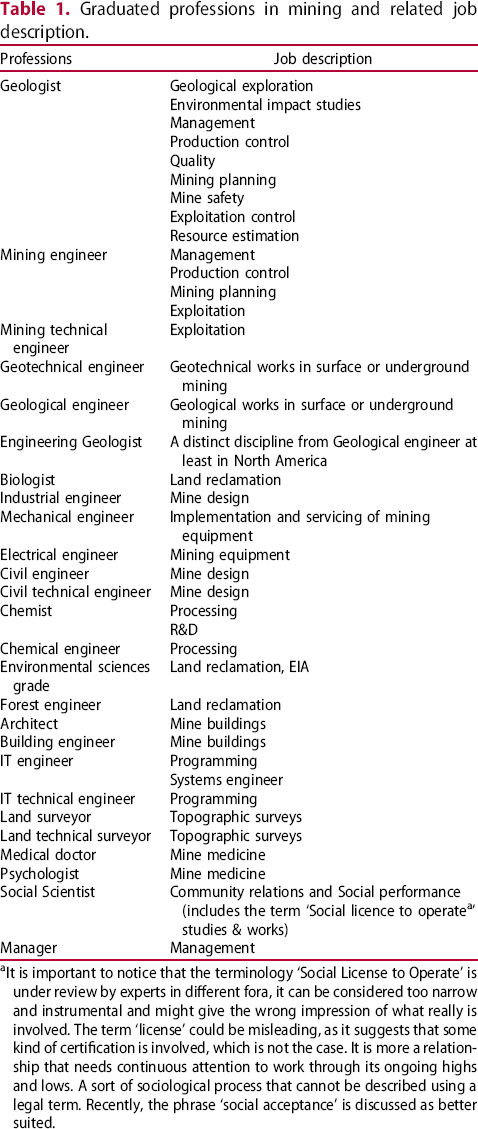
aIt is important to notice that the terminology ‘Social License to Operate’ is under review by experts in different fora, it can be considered too narrow and instrumental and might give the wrong impression of what really is involved. The term ‘license’ could be misleading, as it suggests that some kind of certification is involved, which is not the case. It is more a relationship that needs continuous attention to work through its ongoing highs and lows. A sort of sociological process that cannot be described using a legal term. Recently, the phrase ‘social acceptance’ is discussed as better suited.
The starting point, presented in this paper, focusses on the two professions most linked to the world of mining, that is the ‘classical’ geologist and mining engineer (in some countries considered civil engineer of mines), as well as engineering geologist and geological engineer. The skills may be later completed at a later stage with other related professions.
One of the most comprehensive documents regarding skills in the mining sector (extractive industries) is Mining Education Australia MEA (2015). We have used this document as basis, and added other professions and jobs such as geologists and the list of skills of ESCO of geologists and mining engineers. The latter presents some limitations which have been completed with a desktop search of skills for ‘mining engineer’.
Professions vs. careers in mining and geology (modified from ThingLink).
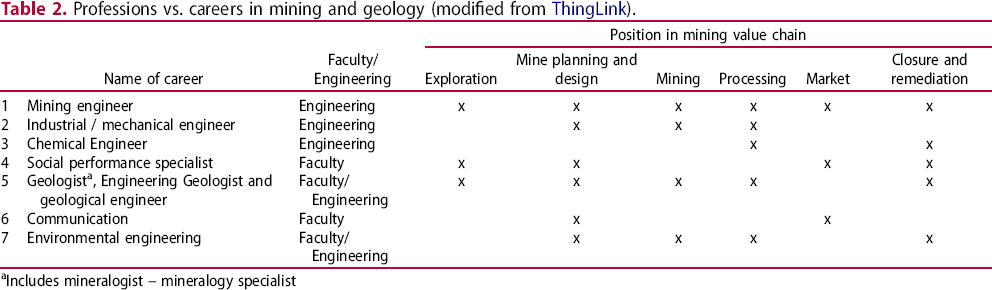
aIncludes mineralogist – mineralogy specialist
The skills and questionnaire approach
The skills catalogue developed in this study defines two levels: skills and knowledge. Although these two terms might be quite confusing since the only difference seems to be that skills are associated with practising and knowledge with experience. Skills are often assigned to the mining job area while knowledge to the learning outcomes. The exhaustive table of skills includes both and keeps the ‘academic domain’ of subjects for a potential further questionnaire in the future. This discrimination might be less encyclopaedically supported, but it is used as a working template for the survey, being a compromise between completeness and ease of filling in the data.
The survey has been designed with a tree-like structure which contains a first choice of the main professions; then the education programme is directed to and followed by, the mining job areas covered by the graduates of the profession (Figure 1). The mining job areas are subdivided in sub-areas addressing the job area in more detail. Subsequently the survey supplies a broad selection of learning outcomes to tick which provide the basis of professional practice. The survey strictly accords to the skills-catalogue reducing individual denotations and classifications by the respondents as far as possible; this reduces the effect of distorted assessment while transforming the reply of the respondents into entries of a database.
From profession to careers scheme, through skills and subjects.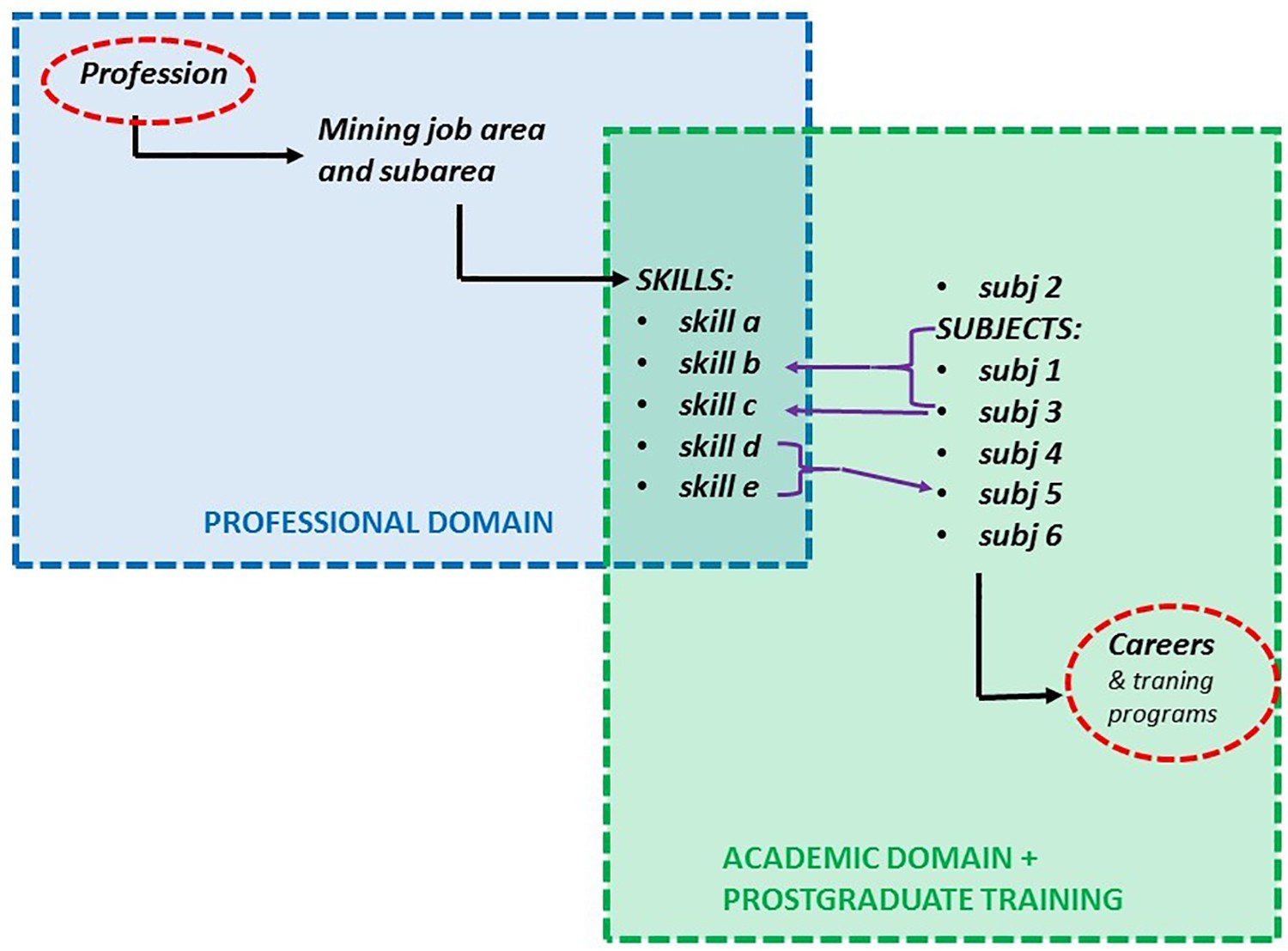
In the questionnaire in the level of knowledge and learning outcomes tick boxes are opened indicating whether it covers that particular subject (Figure 2). Therefore, it was important to reach a consensus on which are the subjects that will be included in each knowledge. The entries of the Skills/Knowledge and learning outcomes can be formulated as topics of the academic programme. In the questionnaire, only specific knowledge and subjects are included. Core subjects such as chemistry, technical drawing, programming, etc., are not included.
Skills catalogue and questionary scheme – example.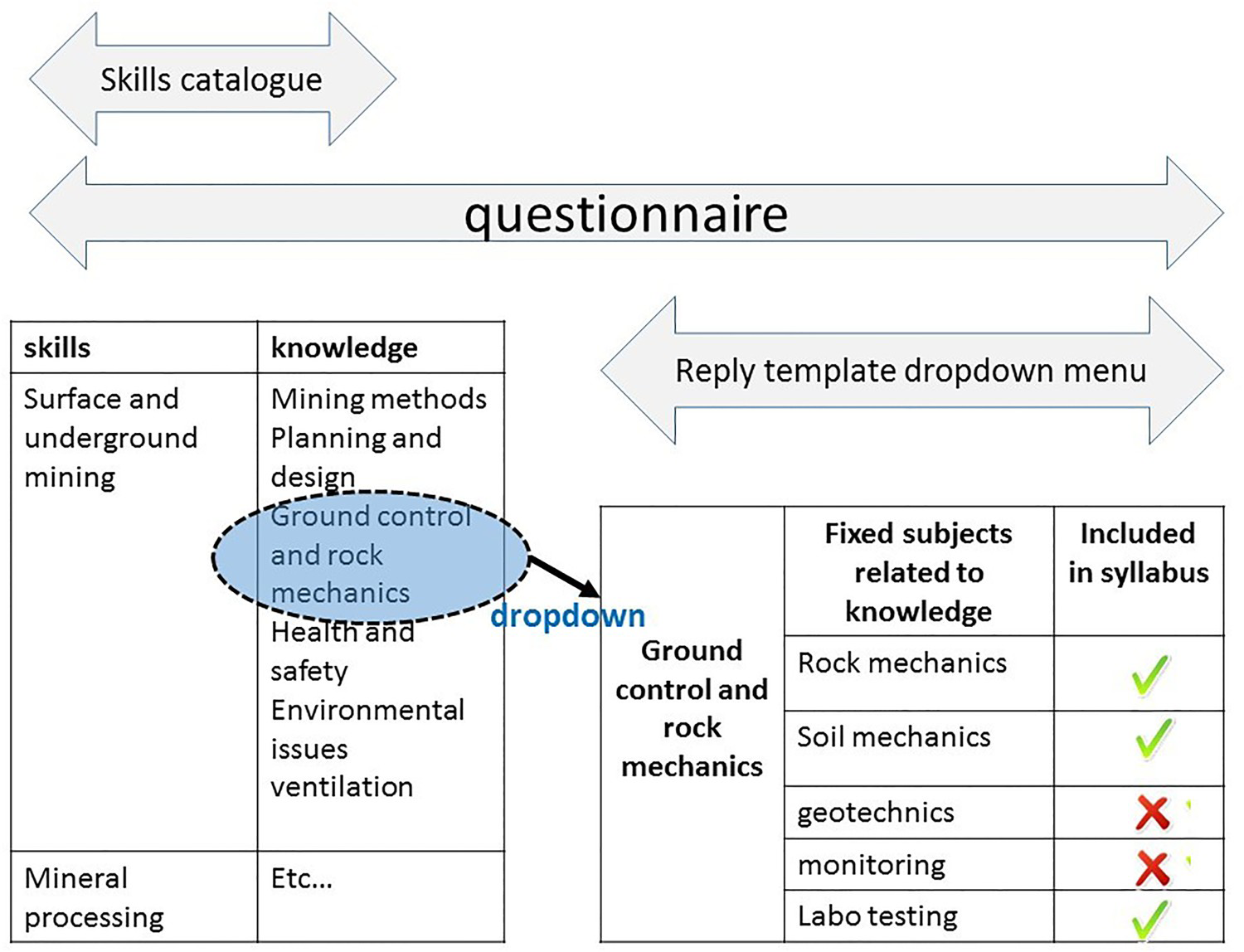
The skills catalogue is intimately linked to a questionnaire subsequently used for acquiring the data from relevant stakeholders. The main problem faced was that the skills catalogue should be well aligned with the questionnaire to be filled. It should be comprehensive enough to have all the skills required but also easy to fill in. Finally, this condensed skills catalogue was implemented in an online-survey tool (with an English and a Spanish version). The survey was designed in a way that it could be completed in 15–20 min. The survey was then distributed via personal contacts to different educators, email distribution lists of suitable professional bodies (e.g. Society of Mining Professors, European Federation of Geologists and others),, and shared via social media platforms.
Results and discussion
Response rate and quality of data
All in all the survey attracted 233 different responses, representing 193 unique institutions from 92 countries worldwide (Figure 3). Please note that this only includes full answers (until the last page of the questionnaire) and that only partly filled questionnaires are not considered here. From the total amount of 442 starters of the survey, 192 did not proceed further than page one of four, 16 stopped at page two, only one stopped at page three and 233 completed the entire survey. We estimate that the total worldwide amount of institutions teaching raw materials related topics is between 600 and 1000. Hence, this survey covered roughly 20% of all institutions, in the worst-case scenario, making it quite comprehensive and unique.
Representation of the continent-wise distribution of respondents to the survey. Note that some institutions (mainly Russian) are represented twice (in Europe and in Asia).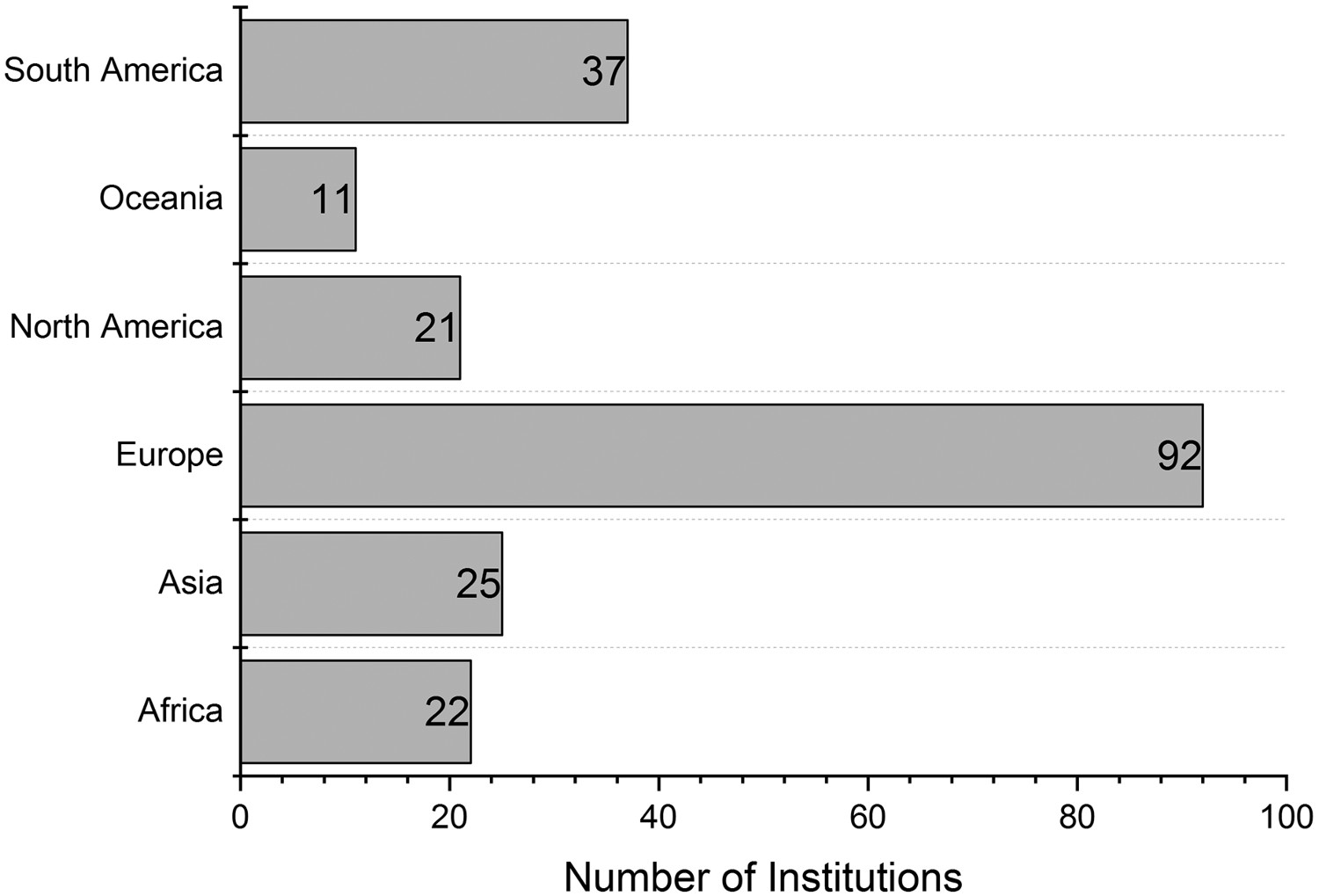
However, several black spots can easily be identified. Despite the fact that the mining industry is stronger in Australia, China, North and South America, European institutions are leading in our survey (92 institutions). Although Australia and South America are widely covered, there is a massive gap in Northern America. Unfortunately, only few US and even fewer Canadian or Chinese institutions have responded to this survey.
The survey asked for a series of demographic data from the recipients, ranging from name to job position and email address. This information helped to identify potential problems with the data, e.g. estimating how trustworthy the results are, and allowed to ask follow-up questions to respondents. In this context, e.g. the answer of a professor has a higher ranking than that of a student. It could theoretically happen that even two professors of the same institution provide different answers because they understand the questions or the curricula differently. In case of doubt, this can only be solved with personal contacts. In the present survey, double-listings of institutions happened exclusively in order to distinguish between different programmes so no programme is listed twice. All personally sensitive information was deleted. Hence, the results provide a high degree of completeness and are believed to be trustworthy. The associated dataset can found in Hartlieb et al. (2020).
First insights into raw materials education worldwide
Teaching areas and skills
The survey reveals that the teaching areas of Geology, Exploration and Resources has, by far, the widest coverage amongst the represented institutions, followed by Mining Methods, Mining Geomechanics, and Mineral Production (176, 132, 115, and 100 respective answers or 92, 69, 60 and 54% of the represented institutions). On the other side of the spectrum, only 42 of these institutions deal with the social impact of raw materials related activities and only 55 teach business management (22 and 29%, respectively; Figure 4).
Statistical analysis of the different teaching areas. Geology, Exploration and Resources is taught at 176 institutions, whereas Social performance is only taught at 42.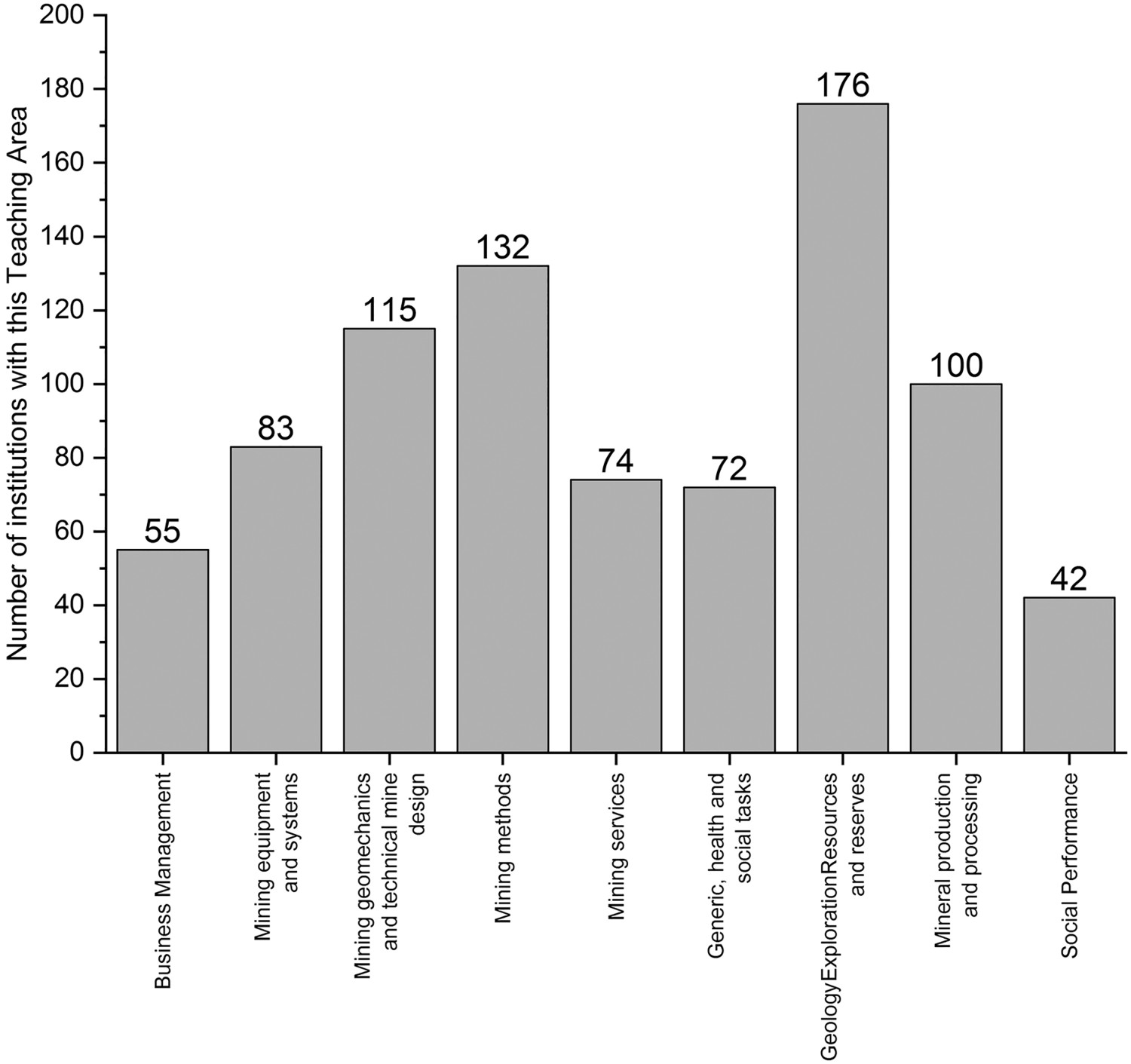
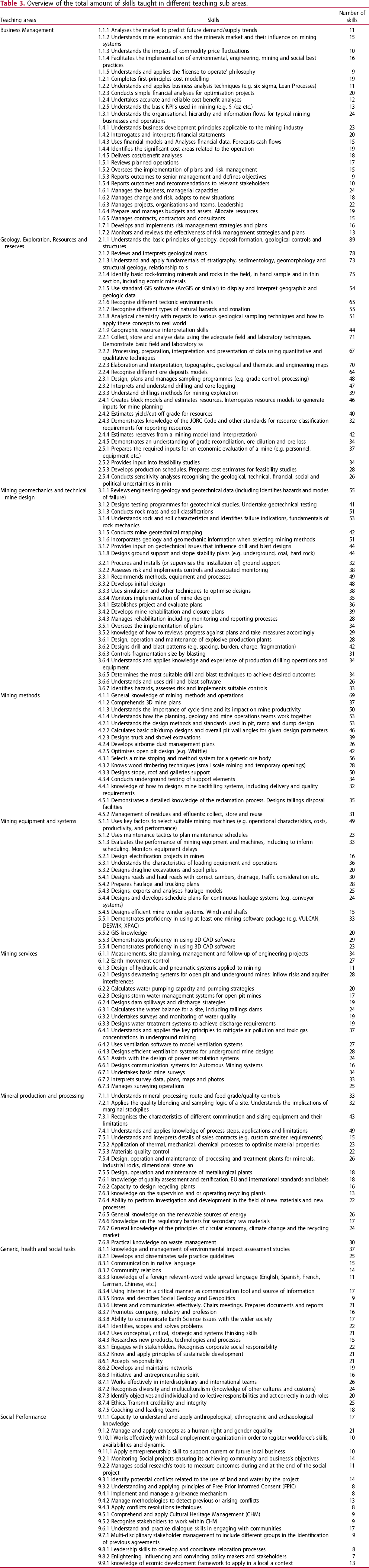
Overview of the total amount of skills taught in different teaching sub areas.
Language
Language is probably the most important factor in acquiring the skills listed above. Be it as primary or secondary (sometimes-tertiary) language. Many programmes offer parts of their courses in the mother tongue (mainly the basics) and the courses that are more advanced or specific programmes in a foreign language. It is apparent that English is by far the most common teaching language in world, followed by Spanish (Figure 5). In total 122 institutions state that they are at least partly teaching in English. What's interesting about this is the fact that although 71 name English as their primary teaching language, only 40 of the respective institutions are in an English native speaking country. Others range from Finland to Belgium and from Colombia to Japan. Fifty-nine institutions teach in Spanish. Some languages like Italian, Danish or Korean are only used as secondary language.
Teaching language by abundance (primary, secondary and and tertiary langauge).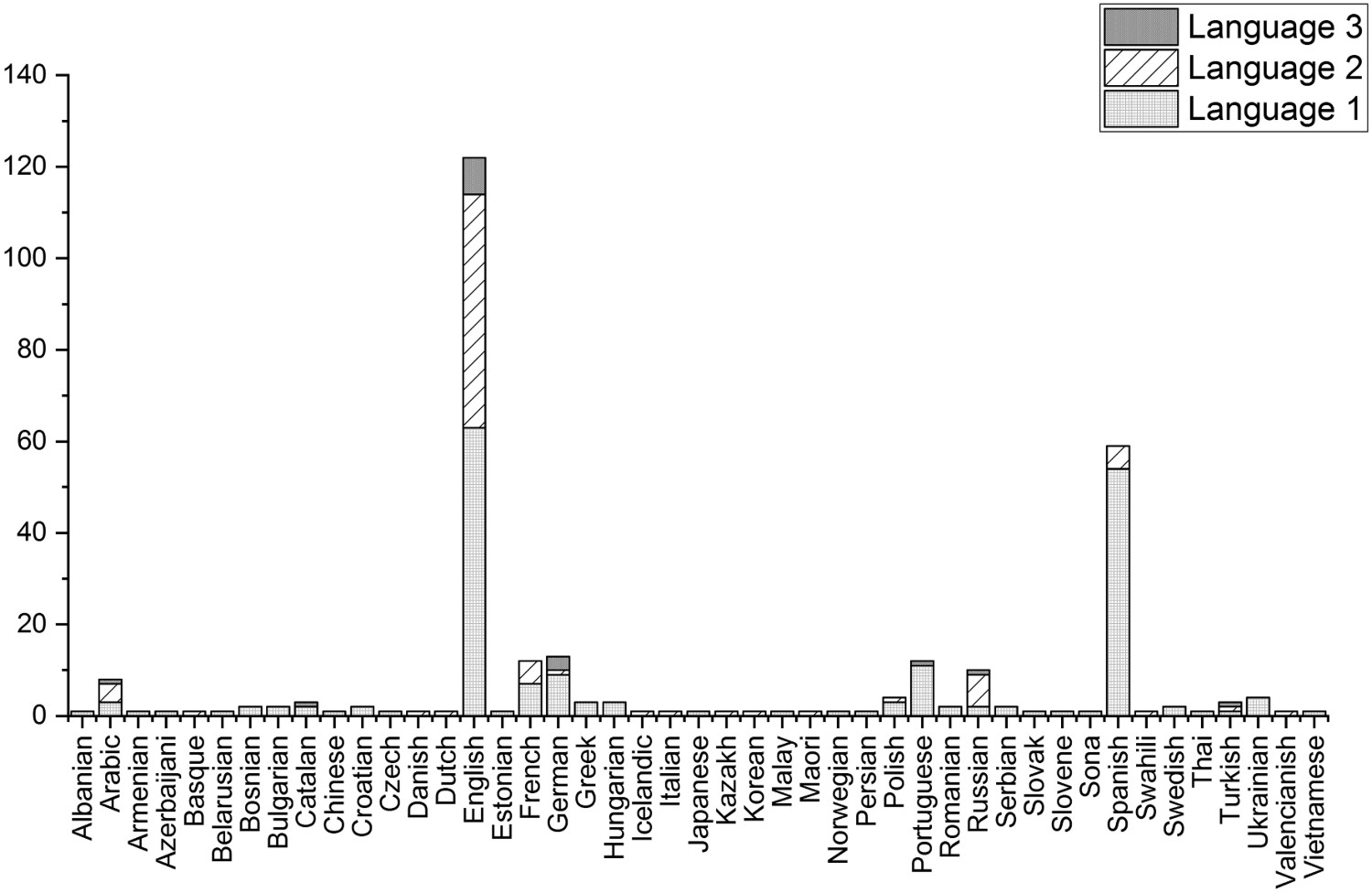
Conclusions
This paper presents a new concept for assessing raw materials education and comparing the results worldwide. Rather than analysing the individual curricula and listing the subjects taught at different institutions, an approach was chosen to identify the skills and knowledge that students acquire because of their studies. This leads to a much better understanding of the capacities of the students, which will be the future workforce of the industry. Furthermore, this makes individual study programmes comparable on a global basis.
A skills catalogue has been developed for the raw materials sector, mainly dealing with skills necessary for identifying and extracting primary resources but also for dealing with secondary raw materials. The catalogue is organised in a cascade of three different levels of hierarchy: Job areas, Job sub areas and Skills. All in all the catalogue represents 315 individual skills organised in nine job areas: ‘Business Management’, ‘Geology, Exploration, Resources and Reserves’, ‘Mining geomechanics and technical mine design’, ‘Mining Methods’, ‘Mining Equipment and Systems’, ‘Mining Services’, ‘Mineral Production and Processing’, ‘Social performance’ and ‘Recycling and secondary mineral raw materials. Circular Economy’.
A shortened version of this skills catalogue was transferred into an online questionnaire and distributed to raw materials educators worldwide. The survey has provided good coverage of 199 individual institutions from 92 countries. Amongst the main results we conclude that most of the ‘soft skills’ in business management and social aspects around raw materials education seem to be fairly underrepresented compared to technical skills.
The results of this study provide the basis for future considerations on raw materials education. It will be important to assess the future needs of the mining industry and bridge the gaps that are apparent from the present study.
Footnotes
Acknowledgements
This project has received funding from the European Union's Horizon 2020 research and innovation programme under Grant Agreement No 776642. The authors furthermore wish to thank all the people who responded to our survey and provided this unique dataset.
Disclosure statement
No potential conflict of interest was reported by the author(s).