



Abstract
Blockchain technology, best known as the decentralised transactional ledger of Internet currencies such as Bitcoin, could provide possibilities for tracking the origin of timber products. As such, it could ease the complex job of timber procurement officers in companies that seek to purchase timber products from trustworthy origins. This study explores how trust among purchasers in suppliers of sustainable timber can be increased and the roles that blockchain technology could play as a factor influencing purchasing decisions. The study examines the attributes influencing purchaser trust in timber products, revealing that the country of origin is the strongest predictor of purchaser trust, followed by the price level for the timber product, the presence of a certification scheme, and the duration of the relationship with the supplier. Blockchain technology also had a significant effect on purchaser trust and could become an important factor for generating trust in timber products during international trade.
Keywords
Introduction
Statement of the problem
It is important for companies to undertake due diligence when purchasing timber products (Leipold 2017). According to Interpol (2017), illegal logging accounts for 50%–90% of all forestry activities in tropical forests. One of the most solid assessments of illegal timber logging shows that the majority of exploitation, corruption and illegal timber trade in forestry administrations and customs services occurs in Africa, Latin America, the Asia Pacific and Russia (Seneca Creek Associates, LLC & Wood Resources International, LLC 2004). In response to these concerns, environmental organisations and timber trading companies developed (inter)national standards to encourage the purchase of wood from certified sustainable forests (Ozanne and Vlosky 1997); however, certification and legality documents can easily be forged, affecting the implementation and impact of these standards (Leipold 2017).
Blockchain technology provides new opportunities for the procurement of trustworthy timber. Blockchain technology was originally created to record the transfer of Bitcoins, an Internet currency that resides outside governmental control (Grinberg 2011). A blockchain can be seen as a decentralised ledger comprising a chronological chain of data ‘blocks’, which are encrypted pieces of information consisting of valid network activity. (Abeyratne and Monfared 2016). This results in an immutable history of network activities shared among a distributed network. In addition to recording Bitcoin transactions, blockchain technology can be applied to tracing physical assets, which allows for a record of ownership for each asset (Abeyratne and Monfared 2016). As such, it has been suggested as a method for recording and tracking the ownership of environmental products such as timber (Greenspan and Zehavi 2016).
By eliminating the need for intermediation and by providing an immutable history of activities within the timber supply chain, blockchain could provide trust among purchasers of timber trading companies by providing supply chain reports. The conceptual study from Ge et al. (2017) provides a method for tracking physical products. When applied to timber, this would provide an open record of transactions, where anyone can query the blockchain to validate the legitimacy of the sustainability of the timber.
Principles of blockchain technology
Over the past seven years, there has been a high increase in interest in blockchain technology. This technology is still in an early phase of development, but it has great potential for commercial and social applications. The central function is to achieve a consistent and integer database that is distributed and decentralised (Abeyratne and Monfared 2016).
Blockchain technology emerged from a technology that was created for the use of Bitcoin. Bitcoin is a currency that is outside of governmental control which operates only on the internet (Grinberg 2011). All the blocks in a blockchain contain transactions and their corresponding records. These records can be transformed into hashes allowing a document of records to be transformed into a ‘hashed’ summary. By hashing, derived from the French word ‘hasher’ which means ‘chopping into pieces’, the information consisting of letters and digits of any length is transformed into a ‘hash’ of a fixed length, by using a hashing function. In Bitcoin, all information is for example transformed into a total of 64 digits. A sequence of hashes can be applied to create a ‘block’ in the blockchain. Each block contains a ‘hash’ of the former block in the header, which starts from an ‘introductory’ block. As a result, each continuous hash depends on the hash of the former blocks (Ge et al. 2017), ensuring that the data on new blocks, and thus hashes, has not been tampered with when they are added to the blockchain.
The technology facilitates in creating a distributed database that can be applied for creating a record of transactions from ‘one person to another’ (Ge et al. 2017). This is because the blockchain is distributed over all computers that partake in the system. Individuals can ‘write’ on the blockchain, however, to know which person performed this writing, each operation will be signed using a public–private key (Ge et al. 2017).
The blockchain technology may provide a ‘ledger’ (a distributed database) for the documentation of financial transactions, such as bitcoin. Interestingly for the wood industry, the same technology could also be applied for recording non-financial transactions (Ge et al. 2017). An interesting development is the application of blockchain technology for tracking physical assets, which allows for a record of ownership for each asset (Abeyratne and Monfared 2016).
The conceptual study from Ge et al. (2017) provided grapes with a digital certificate, after which they could be tracked in the supply chain via blockchain technology. For the use-case in the study from Ge et al. (2017), certifiers could issue a certificate to the farm, after which the farm could issue certificates to the grapes it produces. These grapes would then receive a unique bar code, and afterwards the grapes were sold to international resellers and eventually to the end-customer. When the grapes change owner, this is recorded in the blockchain. All the parties that are involved in the supply chain are able to verify whether the certificate is valid, by querying the blockchain. When an auditor would discover that the farm is using any kind of unauthorised pesticide, the auditor can revoke any certificate that has been issued to the farm by the certifier. This will also be recorded on the blockchain, where after anyone querying the blockchain is able to see this (Ge et al. 2017).
While lack of scalability has been named as a remaining challenge for implementing blockchain technology (de Meijer 2020), this seems to be more of a problem for Bitcoin (and other cryptocurrencies) than for non-financial applications of blockchain technology. For example, there were 197,794 bitcoin transactions on June 13th of 2021 (Blockchain.com 2021). Additionally, it can take twenty minutes on average for a bitcoin transaction to be processed (Garrison 2021). A unit (bundle) of wood will typically be traded fewer times than currencies like bitcoin for the simple reason that they stop being traded once they are used. This makes the lack of scalability less of a problem for a commodity product, such as wood.
The fact that wood has user value while currencies only have trade value, therefore suggests that the role of blockchain technology in the wood industry is contingent on other trade aspects, like buyer–supplier relationships and certification. To identify the full potential of blockchain technology for tracking physical assets, buyer–supplier relationships may therefore be studied together with corresponding transaction aspects that affect a purchaser's trust.
Literature background
Existing research into sustainable timber has mostly focussed on sustainable forest management, illegal logging in the global wood market, and consumer trust in third-party forest certification (e.g. Kozak et al. 2004; Van Kooten et al. 2005; Bisschop 2012). Despite their importance in the timber system, professional timber purchasers tend to be overlooked as the focus of studies. Although purchasing managers may be instructed to procure timber products from origins with sustainable practices, it may be difficult for them to assess the precise sustainability status or trace the origin of the products for sale. Managers are usually not perfectly informed, meaning their decisions are heavily influenced by trust. According to the business literature, trust is one of the most important factors in the relationship between buyer and supplier (Lindgreen 2003; Akman and Yörür 2012). Because trust in a trading partner reduces the perceived risk of a transaction (Hofstede et al. 2010), it is an important driver of (re-) purchasing and the future development of a business relationship (Palmatier et al. 2009).
The literature has identified several factors that purchasing managers may use to assess the trustworthiness of timber products. A host of studies have pointed at forest certification systems as a means of assessing unknown timber sources that may be prone to illegal logging and deforestation (e.g. Cashore et al. 2004; Cubbage et al. 2007). The Forest Stewardship Council (FSC) and the Programme for Endorsement of Forest Certification (PEFC) are the two main forestry certification systems. The standards, prescriptions and criteria of forest certification systems must be aligned with the definitions of sustainable and legal forest management to be deemed trustworthy (Van Kooten et al. 2005); thus, a certification body has the explicit role of assuring the sustainable and legal production of timber, allowing for transparency and traceability within the supply chain. As a result, a purchaser is encouraged to trust a supplier's products when they carry a certificate from an approved certification body (Claro and Claro 2004). On the Dutch timber trading market, for example, sawn tropical, European and American timber with a certificate of sustainable forest management is priced 10–30% higher than uncertified tropical hardwood (Oldenburger et al. 2015). This finding corroborates research indicating that consumers are also willing to pay higher prices for wood products that are verified as originating from legal sources (Kozak et al. 2004).
Certification system audits are currently often stored on paper, which can result in fraud and inefficiency. Despite the positive contribution of certified tropical timber to the sustainability of this industry, supplier and certification procedures in tropical countries are still sometimes distrusted and perceived as having poor sustainable forestry practices (Kozak et al. 2004). Similar problems have also led to a lack of trust in the certification procedures for the agri-food production chain, among other industries (Ge et al. 2017). By providing an immutable history of activities within the timber supply chain, a blockchain could enhance trust among the purchasers of traded timber by providing supply chain reports. In that respect, Ge et al. (2017) provide a method for tracking physical products, which, when applied to timber, would provide an open record of transactions enabling anyone to query the blockchain to validate the sustainable origin of the timber.
According to the marketing literature, however, purchasers may also use three other ‘cues’ that influence their trust (and thus reduce the potential effect of blockchain technology). First, they may use price to evaluate the quality of a product when there is a lack of information about the intrinsic attributes of a product (Zeithaml 1988; Rao and Monroe 1989). A price that is too low creates distrust about the attributes that the buyer is searching for (such as sustainability). In daily life, the purchase of wine is a common example, with buyers often believing that more expensive wine will taste better.
Second, parties that have frequently transacted in the past can place a higher level of reliance on the decisions of their trusted party (Ring and Van de Ven 1992). This narrow-scope trust depends on the past experiences that the purchaser had with a salesperson for a company (Greyson et al. 2008). If a purchaser trusts a supplier, they will believe that the other party acts according to normally accepted ethical standards, without acting in a self-serving manner. Most importantly, the purchaser trusts that the supplier will accurately disclose relevant information and will not change the supply specifications (Smeltzer 1997). For the timber industry in the EU, this usually means that the supplier is expected to provide timber in coherence with the EU Timber Regulation (Jonsson et al. 2015).
Broad-scope trust refers to the trust a purchaser has in the business context in which a set of organisations and individuals operate (Greyson et al. 2008), referring to a purchaser's trust in the wider social and institutional system of a country rather than a particular company within that country (Zucker 1986). The broad-scope trust of a purchaser may also be influenced by the belief that third parties would reveal any information about companies that would break their trust (Milgrom et al. 1990). More specifically, this can be defined as system trust and encompasses trust in the functioning of bureaucratic safeguards among other factors (Lewis and Weigert 1985). Trust in a supplier and its products can therefore be influenced by external factors, such as national integrity and legal structure (Fukuyama 1995).
Aside from its direct effects, broad-scope trust may also interact with narrow-scope trust regarding particular suppliers. It has been confirmed that narrow-scope trust reduces complexity and uncertainty within business; however, it is more likely that this will arise when it is legitimated by broad-scope trust (Greyson et al. 2008). Applied to the context of cross-border relations, the country in which the supplier is based could be an important aspect regulating the independent variable experience with supplier and its effect on purchaser trust.
Aim and hypotheses
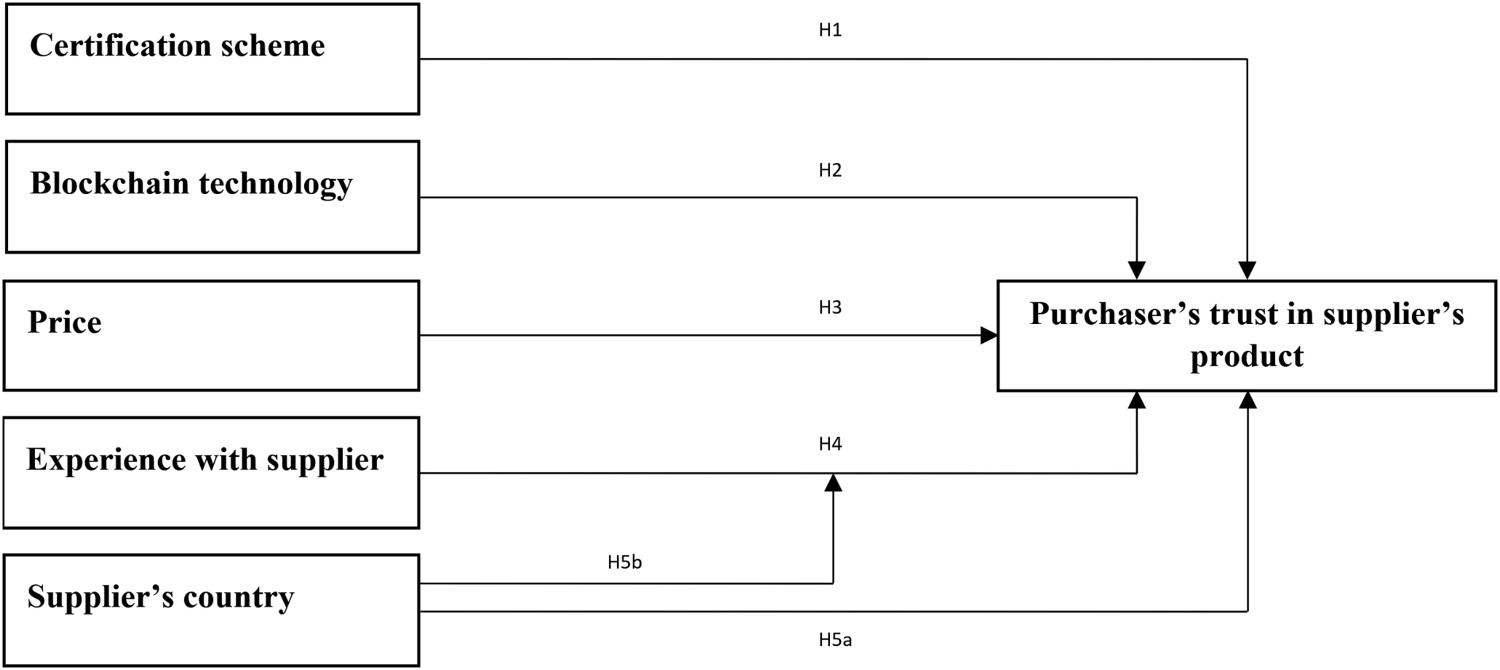
This study aims to investigate what affects purchaser trust and whether blockchain technology, applied for tracking timber, can increase the trust of timber purchasers in timber products. We therefore use the purchaser's trust in the supplier's timber product as the dependent variable in our study (see Figure 1 for the conceptual framework). Based on the literature discussed above, we will test the following hypotheses:
(1) A supplier's product with a trustworthy third-party certificate will have a positive effect on purchaser trust;
(2) a blockchain chain-of-custody certificate will have a positive effect on purchaser trust;
(3) the price of the supplier's product will have a negative effect on purchaser trust if it is lower than the current market price;
(4) a longer trading relationship with a supplier will have a positive effect on purchaser trust;
(5a) a supplier from a country with a solid legal structure will have a positive effect on purchaser trust in the timber product; and
(5b) the correlation between the trading relationship and the purchaser's trust in the supplier's product will be stronger if the supplier comes from a country with a solid legal structure. Conceptual framework of this study. H1–5 represents the explored hypotheses.
This article brings blockchain technology to the attention of the wood research community. It also develops and tests a conceptual framework that examines blockchain technology among other factors believed to determine purchaser trust in timber products, examining the relative importance of these factors and their potential interactions.
Materials and methods
To test the hypotheses, a quantitative survey was conducted using a conjoint design. Conjoint analysis is a market research technique originally created for the development of new products and services. The technique divides a product into different attributes each holding different levels. The analysis of the data from the respondents then allows to assess the relative importance of the attributes and to assess their preferences for attribute levels. Before the survey, telephone interviews were conducted with eight Dutch timber purchasers to identify whether the aspects affecting purchaser trust found in the literature corresponded to their experiences. The interview questions explored the countries from which they imported timber and the aspects that influenced their trust in the legitimacy of the supplier's timber products. The outcomes provided additional insights used to complete the design of the quantitative study.
Conjoint analysis
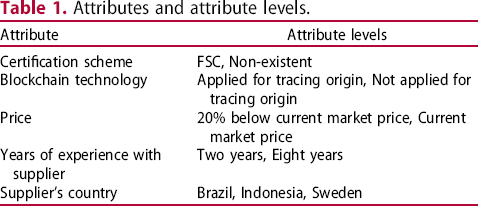
Attributes and attribute levels.
Certification scheme
The degree to which a certificate will signal trust largely depends on the extent to which the purchaser perceives this certificate as trustworthy (Jiang et al. 2008). The FSC is one of the main forestry certification systems used in the Dutch timber industry (Oldenburger et al. 2015), and was well known among interviewees. ‘FSC’ and a ‘non-existent’ certificate were therefore used as the attribute levels for the certification scheme to measure the effect of a trustworthy certification scheme (FSC) on purchaser trust.
Blockchain technology
Blockchain technology can remove risk by delivering a consistent and complete database (Bogart and Rice 2015; Ge et al. 2017). When applied to tracking timber, blockchain technology provides an open record of transactions, enabling anyone to query the blockchain and identify the origin of the product. The attribute levels for the blockchain therefore consisted of ‘applied for tracing origin’ and ‘not applied for tracing origin’.
Price
The price of a product is a search attribute and can communicate product information before a purchase (Zeithaml 1988). The procedures for the legal production of wood products result in a price increase of 10%–30% relative to illegal methods (Oldenburger et al. 2015). It was therefore analysed whether an extreme price difference of –20% compared to the current market price would influence purchaser trust in the legitimacy of the wood product using the attribute levels ‘current market price’ and ‘20% below current market price’.
Years of experience with the supplier
Parties that have frequently transacted place a higher level of reliance on the decisions made by the trusted party (Ring and Van de Ven 1992). This narrow-scope trust depends on the purchaser's experience with a company (Greyson et al. 2008). Qualitative interviews verified that a higher reliance can be placed on the supplier after eight years of experience with them. The attribute levels were therefore set to a low experience with the supplier (two years) or a high experience with the supplier (eight years).
Supplier's country
The supplying firm's country can lead them to be perceived as more or less competent, affecting their trustworthiness in the eyes of the purchaser. The attribute levels were developed by consulting Bisschop's (2012) estimates on illegal logging by country as well as the results of the explorative interviews. The attribute levels therefore consisted of countries with a relatively high risk of illegal logging and exports (Brazil and Indonesia) and one with a low risk of illegal logging and exports (Sweden).
Analysis
The full-profile method was used to analyse the data, as is recommended when the number of attributes is lower than seven (Green et al. 2001). The profiles showed all the attributes, but with different attribute levels. Therefore, the profiles displayed different purchasing situations Since the study contains five attributes, with levels ranging from two to three, this would result in 48 possible scenarios when employing a full-factorial design (2 × 2 × 2 × 2 × 3). The scenarios were divided into two blocks using the statistics package SAS with an optimised D-efficiency (100) and no duplications between choice sets. Each block was distributed to 50% of the respondents, resulting into 24 scenarios for each respondent.
Questionnaire development and sampling procedure
The questionnaire began with an introduction explaining the goals of this study. After the introduction, the main scenario was shown, explaining that the respondent has to rate 24 scenarios with different attributes and attribute levels. Afterward, the participant received an explanation of blockchain technology and how this could be implemented within the timber trade. The participants were then asked to rate the trustworthiness of the 24 purchasing situations using a nine-point Likert scale.
Data were collected between 4 and 18 December 2018. A total of 93 timber purchasers of 89 different companies based in the Netherlands and Belgium were asked to participate. The response rate was 55.9%, with 52 timber purchasers completing the survey. Of the respondents, 86.5% were male, and over 60% were between 30 and 60 years old. A total of 31% worked in a company with 5–20 employees, while 39% were employed by a company with 20–50 employees. A total of 44% of the companies imported timber products from Sweden, 44% from Brazil and 35% from Indonesia (the three most popular countries, according the respondents). About 43 respondents were Dutch while 9 were Belgian.
Results and discussion
Results
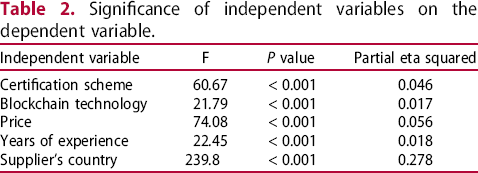
Significance of independent variables on the dependent variable.
Mean attribute levels and linear regression results assessing the factors influencing a ‘purchaser's trust in the legitimacy of the supplier's product’.
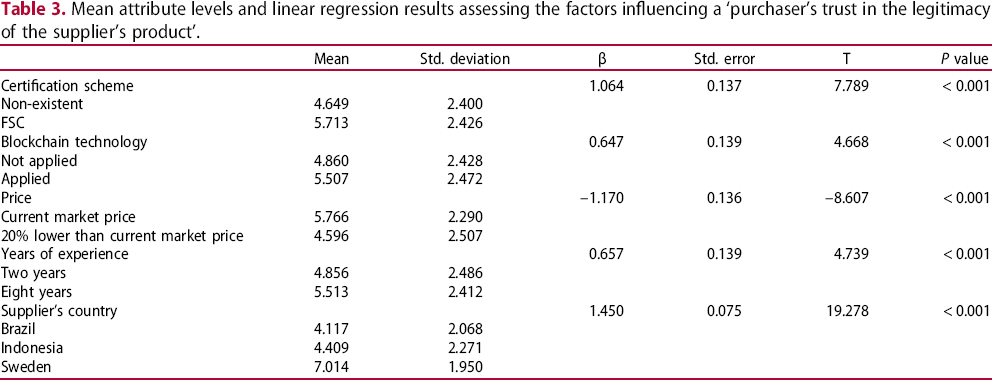
H1 stated that a supplier's product with a trustworthy third-party certificate would have a positive influence on the purchaser's trust. As can be seen in Table 2, the presence of a trustworthy certification scheme has a significant effect on trust (F(1, 1246) = 60.667, p < 0.01, η2 = 0.046). The results displayed in Table 3 suggest that the presence of a trustworthy third-party certificate increases the mean purchaser trust in the legitimacy of a supplier's product by β = 1.064 (s.e. 0.137, p < 0.01).
H2 stated that if the price of a supplier's product is lower than the current market price, this would have a negative influence on purchaser trust. Price was indeed found to have a significant effect on purchaser trust (F(1, 1246) = 74.080, p < 0.01, η2 = 0.056), with a price 20% below the current market price decreasing the mean purchaser trust by β = –1.170 (s.e. 0.136, p < 0.01).
H3 stated that the application of blockchain applied to track the origin of a supplier's timber product would have a positive influence on the purchaser's trust in the legitimacy of the supplier's product. Blockchain technology had a significant effect on purchaser trust (F(1, 1246) = 21.790, p < 0.01, η2 = 0.017); providing the supplier's product with blockchain technology increased the purchaser's trust in the legitimacy of the product by β = 0.647 (s.e. 0.139, p < 0.01).
H4 stated that a longer trading relationship between purchaser and supplier would increase purchaser trust. The hypothesis was also supported because ‘years of experience’ had a significant direct effect on trust (F(1, 1246) = 22.45, p < 0.01, η2 = 0.018). A relationship of eight versus two years increased the mean purchaser trust by β = 0.657 (s.e. 0.139, p < 0.01).
Pairwise comparison effect of ‘supplier's country’ on ‘purchaser's trust in the legitimacy of the supplier's product’.
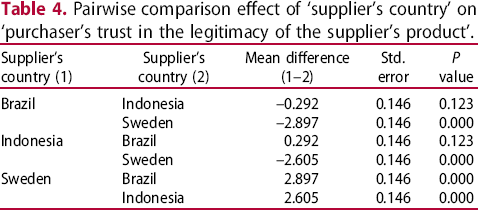
H5b stated that the relationship between ‘years of experience’ and ‘purchaser's trust in the legitimacy of the supplier's product’ would be moderated by the country in which the supplier operates. This hypothesis was not supported, because the interaction between ‘years of experience’ and ‘supplier's country’ was found not to be significant (F(2, 1242) = 1.980, p > .05). We also tested other interactions of potential interest and found a significant interaction between ‘certification scheme’ and ‘blockchain technology’ (F(1,1244) = 5.207, p < .05). The mean purchaser trust therefore increases both when blockchain technology has been applied to products with a ‘non-existent’ certificate (m = 4.82, s.d. = 2.41) and in particular for suppliers whose products carry an ‘FSC’ certificate (m = 6.19, s.d. = 2.34).
Discussion
This research aimed to explore how trust among purchasers of certified and sustainable timber is influenced by various supplier attributes. Congruently, we aimed to discover the potential of blockchain technology in tracking timber and how this might increase purchaser trust in suppliers and their products. Our results supported all the predicted effects in the model, except for H5b (the correlation between the trading relationship and the purchaser's trust in the supplier's product will be stronger if the supplier comes from a country with a solid legal structure). One explanation for this lack of support may be that ‘broad-scope trust’, in this case, the supplier's country, is too dominant a factor and influences purchaser trust independently of the years of experience with the supplier, thus potentially explaining the inconsistency of this result with findings of prior studies (Greyson et al. 2008). Additionally, we found that blockchain technology positively moderates the effect of a certification scheme on the purchaser's trust. The application of blockchain technology would therefore reinforce the use of certification.
In terms of effect sizes, the country in which the supplier is based had the strongest effect on purchaser trust, followed by the price, the presence of a certification scheme, the years of experience, and the use of blockchain technology. As a new and relatively unknown factor, it is not surprising that blockchain has the smallest effect on purchaser trust in comparison with the other investigated factors. Despite this, the results showed that blockchain technology seems to have a stronger effect when combined with certification.
Conclusion
Over the past 20 years, timber trading practices have increasingly focussed on certified legal timber (Van der Heyden et al. 2018). This is important for suppliers because timber purchaser trust is strongly affected by the reputation of the country of origin. Producers in countries such as Brazil and Indonesia, with high estimated levels of illegal logging and inadequate laws (Bisschop 2012), should therefore take additional steps if they want to sell their legal timber products as a trustworthy product. Trustworthy certification increases the trust perception of purchasers; therefore, it is important to increase the areas covered by this certification, particularly in parts of the world where it is still rarely used, such as South America, Africa, Asia, and Oceania (Kraxner et al. 2017). Local small-forest holders can obtain a competitive advantage in Dutch and Belgian markets if they obtain certification. Companies selling sustainable timber products should also be careful not to set their prices too low in comparison to the average market price because purchasers use price as a signal to assess whether sustainability claims are realistic. Finally, new technologies could help to improve the trustworthiness of timber products. The application of blockchain technology was found to improve trust on its own but was particularly advantageous when used in combination with certification.
If applied as in the conceptual study by Ge et al. (2017), third-party certifying companies could issue a certificate of sustainable timber production to the owner of a forest parcel. This certificate can be registered on the blockchain, where the forest owner can issue a code to the harvested timber that is connected to this certificate. Since this code is embedded in the timber, it will always be traceable to its origin and original certificate, no matter how often it switches from the owner. This allows parties within the supply chain to verify the validity of a certificate. Additionally, every time the timber switches from the owner, it can be registered on the blockchain as well to improve traceability. Parties within the supply chain can verify if the certificate is indeed valid. When a certifying company identifies that the forest owner is involved with illegal harvesting practices, he could withdraw the certificate, which would be registered on the blockchain as well.
However, it would be necessary to develop a method to apply blockchain technology for tracking a timber product. Conceptual studies from Vlam et al. (2018) currently focuses on using wood DNA as a tool to independently verify claimed geographic origin of timber. Investigating potential methods for using the DNA code as a tool to access the blockchain seems to be highly interesting since the code of DNA is unalterable. If this conceptual study discovers that DNA has the potential to track the origin of timber, it would be very interesting to investigate potential methods to merge this technique with blockchain technology and sustainable forest certificates.
On behalf of all authors, the corresponding author states that there is no conflict of interest.
Footnotes
Disclosure statement
No potential conflict of interest was reported by the author(s).