




Abstract
A multicycle Wilhelmy plate method was applied to study the water and octane sorption behaviour of small Norway spruce veneers. Dry heart- and sapwood samples of varying density were investigated. The results showed a correlation between the porosity and the sorption of octane for all samples, i.e. a higher wood porosity resulted in higher octane sorption. However, no difference in octane sorption was found between heart- and sapwood samples of similar density. The water sorption behaviour was difficult to interpret, probably due to the influence of surface-active wood extractives. It is suggested that the presence of such extractives, particularly in the sapwood samples, increases the sorption of water due to a significant decrease in its apparent surface tension. Hence, the results indicate that the liquid water sorption of spruce heart- and sapwood is strongly influenced by variations in the extractives content rather than by the micromorphology.
Introduction
The in-service performance of coated wood products in outdoor applications is related to several parameters. The properties of the actual coating system are crucial, of course, but other complex material properties related to the wood substrate also play a central role. The substrate properties may also influence the ability of a coating to be absorbed and anchored into the substrate. However, performance studies of coated wood for outdoor applications (De Meijer 2002; Gobakken and Vestøl 2012; Grüll et al. 2014) have mainly involved accelerated or in-field weathering tests of the complete system including both the substrate and coating layers. Fewer studies have explored the liquid penetrability (liquid sorption and porosity) properties of wood substrates. Therefore, one primary motive for this study is to investigate key properties and information related to the liquid sorption characteristics of the wood substrate.
Many studies have pointed out that different parts of a tree have different liquid water sorption properties and permeability (Bailey and Preston 1970; Palin and Petty 1981; Metsä-Kortelainen et al. 2006; Sivertsen and Vestøl 2010; Engelund et al. 2013). Heartwood, in comparison to sapwood, is considered to have a lower water sorption rate. Norway spruce is commonly used in Sweden in outdoor applications, both coated and uncoated. Several studies have been conducted regarding the liquid water sorption properties of Norway spruce heart- and sapwood. A lower liquid permeability and sorption properties for the heartwood compared to the sapwood region have been observed in the longitudinal (Sandberg 2009; Fredriksson and Lindgren 2014), radial (Bergström and Blom 2006) and tangential (Sivertsen and Vestøl 2010) directions. The lower liquid sorption of heartwood has been explained with parameters like the irreversible nature of pit aspiration during heartwood formation (Thomas and Kringstad 1971) and the amount and type of extractives deposited in the wood structure (Hillis 1987; Flynn 1995).
Pit openings are considered as the main pathway for the flow of liquids between tracheids in conifer wood (Petty 1972). Aspiration of the bordered pits in Norway spruce occurs not only during the process of heartwood formation but also during the drying process. The drying process has been suggested as one of the main causes for the low permeability of spruce sapwood (Liese and Bauch 1967). For example, Phillips (1933) observed that spruce sapwood showed a dramatic increase in pit aspiration when the fibre saturation point was approached during drying. The same study also showed a higher aspiration rate in earlywood than in latewood. Additionally, a gradual decrease in the permeability of sapwood was demonstrated with higher drying temperature or faster drying rate (Comstock and Côté 1968). The mechanism of aspiration was found to be related to the surface tension of the liquid (Liese and Bauch 1967) and the rigidity of the pit membrane (Petty 1970). It is, however, unclear if there are any differences in pit aspiration and therefore morphologic permeability between dried spruce heart- and sapwood.
Main extractive components in Norway spruce [mg per g dry wood].
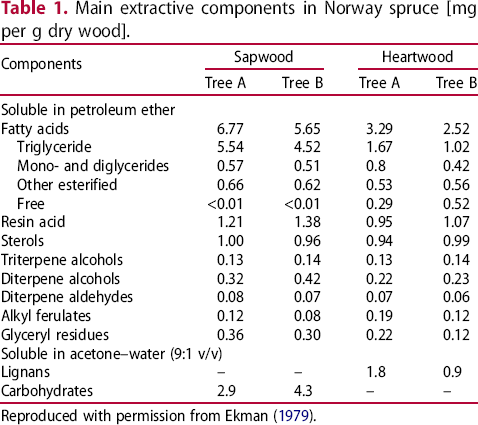
Reproduced with permission from Ekman (1979).
Most studies on water sorption related to coated wood (Derbyshire and Miller 1997; Ahola et al. 1999; De Meijer and Militz 2000; De Meijer 2002; Sivertsen and Flæte 2012) have involved larger wood panel samples, representing the average sample behaviour over relatively long evaluation times. Obviously, experiments with smaller wood veneers samples enable faster and more specific information regarding the liquid sorption dynamics of wood. The objective of this study was, therefore, to apply a recently developed multicycle Wilhelmy plate method (Sedighi Moghaddam et al. 2013) to study the liquid sorption behaviour of relatively small Norway spruce veneers during a sequence of wetting cycles in water and octane. The aim is to increase the understanding of parameters that influence liquid sorption of Norway spruce. An effort was also made to study the liquid sorption behaviour specifically of heart- and sapwood veneer samples with different densities.
Material and methods
Wood samples
Average values of the density, growth ring, liquid sorption and swelling characteristics of the spruce samples and the number of replicates for each average value.
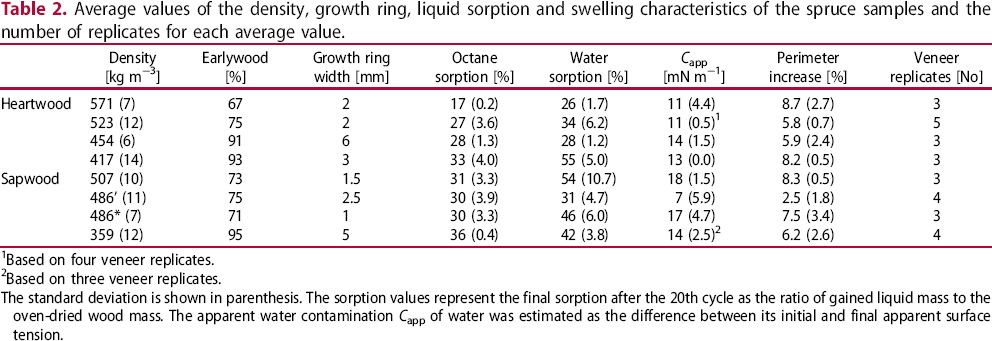
1Based on four veneer replicates.
2Based on three veneer replicates.
The standard deviation is shown in parenthesis. The sorption values represent the final sorption after the 20th cycle as the ratio of gained liquid mass to the oven-dried wood mass. The apparent water contamination Capp of water was estimated as the difference between its initial and final apparent surface tension.
The multicycle Wilhelmy plate method
The Wilhelmy plate method (Wilhelmy 1863) involves detecting the force F acting on a small plate when immersed in a liquid. The detected force can be related to the wetting force between the liquid and the plate as well as to the buoyancy force. For porous and hygroscopic materials such as wood, a force due to liquid sorption must also be considered. The basic equation for the Wilhelmy plate method applied to small wood veneers samples is according to Equation 1 (Wålinder and Johansson 2001):

 is the force due to wicking and sorption of the liquid at time t, ρ the probe liquid density, A is the cross-sectional area of the plate,
 is the immersion depth and
 is the gravitational acceleration constant (9.8 m s−2). This method enables the study of wettability, dynamic liquid sorption and swelling behaviour of wood veneers during a cycle of immersion and withdrawal in a liquid.
A multicycle procedure (Sedighi Moghaddam et al. 2013) was used to study the sorption dynamics through multiple immersion and withdrawal cycles. The sorption value is the percentage ratio of absorbed liquid mass to the oven dry wood mass. The liquid sorption of the veneer after n cycles is calculated according to Equation 2 (Sedighi Moghaddam et al. 2013):

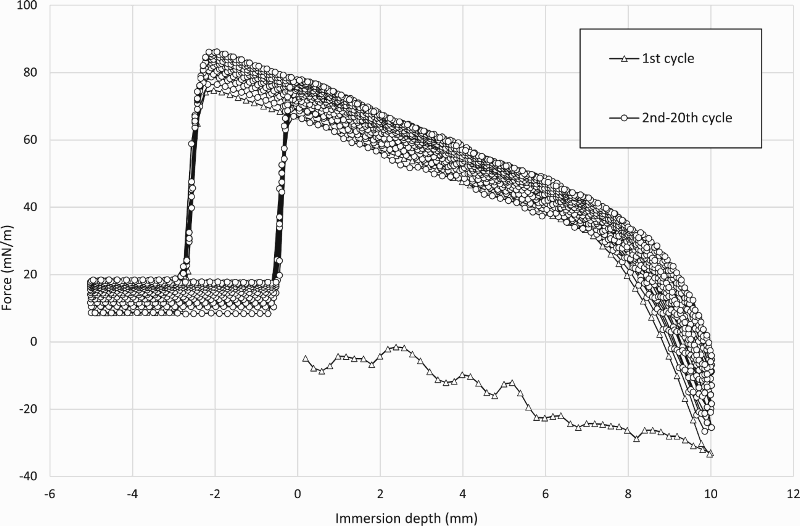
The force during the measurements was detected by a Sigma 70 tensiometer from KSV Instruments. The probe liquid used was Ultrapure (Milli-Q) water (resistivity > 18 MΩ cm) and synthetic n-octane (≥99%) from Alfa Aesar. The surface tension was measured to be γ(water) = 72.4 ± 0.1 mN m−1 and γ(octane) = 21.3 ± 0.1 mN m−1. A platinum plate was used to measure the surface tension, and the values are based on four replicates. The tested veneer was initially dried for 1 h at 103°C in a ventilated oven, then quickly cooled to room temperature within 1–2 min and immersed and withdrawn for 20 cycles in water. See Figure 1 for a typical multicycle Wilhelmy plate test of a wood veneer in water where the first immersion cycle clearly differs from the following cycles due to the changed surface energy from dry to the wetted surface. After 20 cycles in water, the veneer was directly immersed and withdrawn for two cycles in n-octane to determine its wet perimeter. Next, the veneer was dried again for 1 h at 103°C and finally immersed for another 10 cycles in octane to obtain the octane sorption value. The test velocity was 12 mm min−1, and the immersion depth was 10 mm. The lab area conditions were as follows: 22–23°C and 35% ± 5% RH. Octane is a non-polar liquid, which enables a sorption measurement without interference from cell wall substance sorption and hence no swelling. The low surface tension of octane also supports the spontaneous wetting-out (zero contact angle) of the wood substrate, which enables an in situ measurement of the sample perimeter according to Equation 3, a paraphrase of Equation 1 with h = 0 and θ = 0 is shown as follows:
A typical graphic illustration of a multicycle Wilhelmy plate test of a wood veneer in water. The curves demonstrate the measured force (F) as a function of the immersion depth (h) during 20 cycles of immersion and withdrawal. As one can see, the measured force for the first cycle is very different than the following cycles due to the initial unwetted surface. The values are from the sapwood group, ρ = 486’ (replicate S11).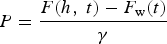
Results and discussion
In addition to previously mentioned wood characteristic parameters, Table 2 presents a summary of the results from the multicycle Wilhelmy plate experiments, including sorption values, Capp values and perimeter increase values. Figure 2 illustrates the final octane sorption values at the end of the 20th cycle for all samples plotted as a function of their density. A regression analysis showed a significant linear correlation (σ = 0.000, R = 0.769, R2 = 0.592), i.e. increased octane sorption (increased permeability) with decreased density (increased porosity), that was independent if the veneers were made of either heart- or sapwood. The correlation is probably due to larger voids with decreased density, which enhances capillary octane sorption. The corresponding water sorption values were however scattered with no correlation found. Heart- and sapwood samples with close densities had in relation to each other either a higher or lower water sorption in a random manner.
Final octane sorption after 10 cycles of immersions versus density of the oven-dried veneer replicates. The sorption values are the ratio of gained octane mass to the oven-dried wood mass.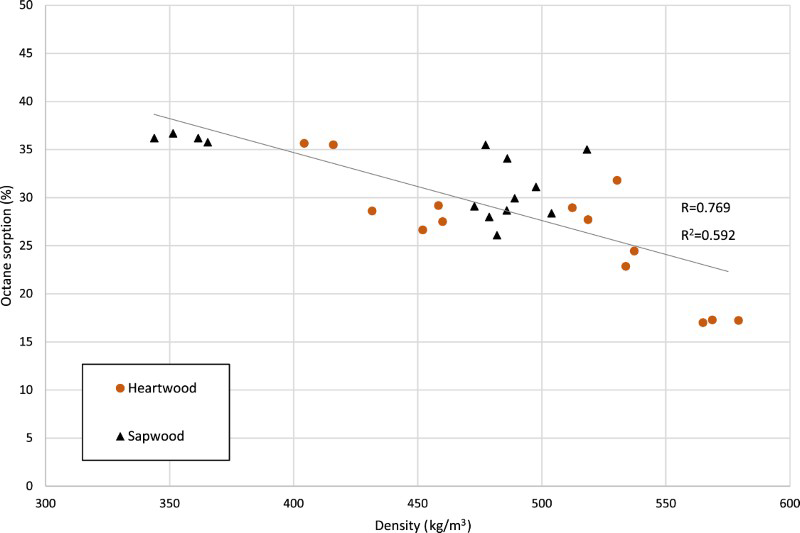
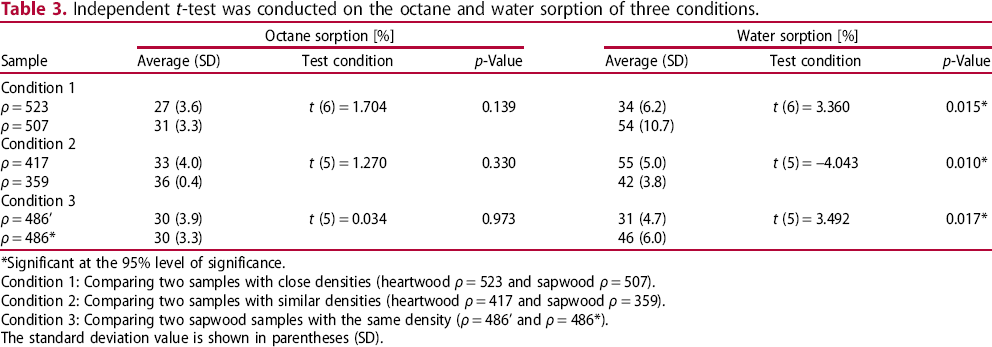
Independent t-test was conducted on the octane and water sorption of three conditions.
*Significant at the 95% level of significance.
Condition 1: Comparing two samples with close densities (heartwood ρ = 523 and sapwood ρ = 507).
Condition 2: Comparing two samples with similar densities (heartwood ρ = 417 and sapwood ρ = 359).
Condition 3: Comparing two sapwood samples with the same density (ρ = 486’ and ρ = 486*).
The standard deviation value is shown in parentheses (SD).
Returning to Table 2 and the presented Capp values, the sapwood sample with the highest water sorption (sample ρ = 507) also had the highest Capp value. It should also be noted that between two sapwood samples with a similar density, the sample denoted 486’ had a distinct lower water sorption than the sample denoted 486*, where the former also had a distinct lower Capp value. However, some of the Capp values are based on a very few replicates and the values should be more of a guideline. Figure 3 further illustrates the dynamics of the liquid sorption for the same samples. As can be seen, the octane curves indicate similar sorption behaviour for both samples, whereas the water curves indicate faster and higher water sorption for the sample denoted 486*, supporting the observations discussed earlier. The independent t-test in Table 3: condition 3 also showed a significant difference in water sorption but no significant difference in octane sorption between the samples.
Mean value of water and octane sorption versus immersion cycles for two sapwood samples with the same density ρ = 486 kg m−3. The error bars represent the standard deviation of the value. The sorption values are the ratio of gained liquid mass to the oven-dried wood mass.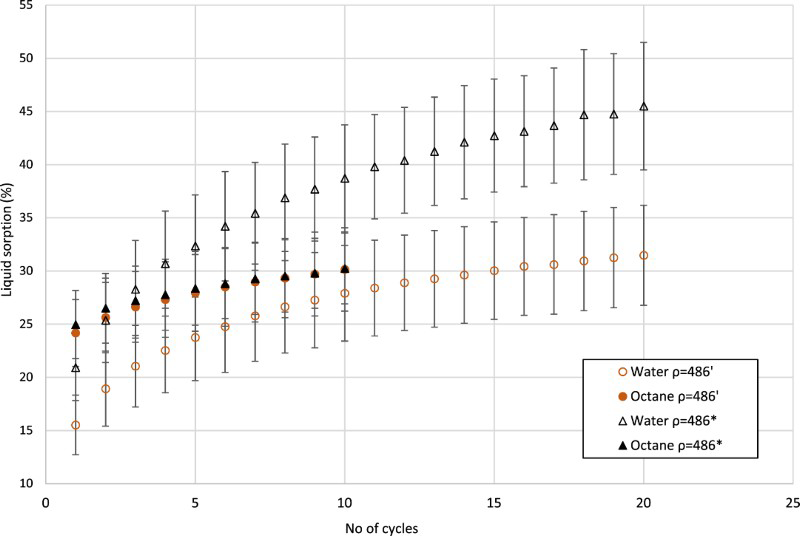
The Capp value can be seen as an indirect measurement of the contamination effect of water by the wood extractives. This phenomenon was first noted by Wålinder and Johansson (2001) who observed a lowered surface tension of the probe liquids in wettability studies of wood, as an effect of extractives contamination. Consequently, the pattern of Capp values in this study, in combination with the corresponding water sorption, suggests that wood extractives might have a more pronounced role in the context of the water sorption properties of wood than previously considered. The presence of wood extractives, particularly in the sapwood samples, is very likely the cause of the increase in water sorption due to a significant decrease in its apparent surface tension. Results that support this theory can be found in a recently published paper by Källbom et al. (2017) who found lower water sorption in extracted samples than in unextracted ones. As indicated in Table 1, Ekman (1979) found that spruce sapwood contained (opposite to heartwood) extractives of water-soluble carbohydrates, i.e. mainly fructose, glucose and sucrose, and also, essentially a higher amount of triglycerides. Triglycerides belong to an amphiphilic group of molecules with both hydrophobic and hydrophilic parts. Amphiphiles are also surface active and are known to decrease the surface tension of a liquid by segregation at the air–water interface (Hamley 2000). Therefore, the higher amount of triglycerides in spruce sapwood in addition to the presence of sugars might be a possible cause of the lowered apparent surface tension observed in this study. Figure 4 further supports that extractives in sapwood (possibly amphiphiles) might be the main cause of the variation in water sorption of those samples. Figure 4 illustrates the water sorption values versus Capp values for the heart- and sapwood veneer replicates. As one can see, a brief linear correlation was present among the sapwood samples connecting the higher water sorption values with higher Capp values, while no correlation was found among the heartwood samples.
Final water sorption values after 20 cycles of immersions versus the Capp value of the veneer replicates. The apparent contamination value (Capp) is the difference between the initial surface tension and the lower apparent surface tension of water in the final 20th cycle.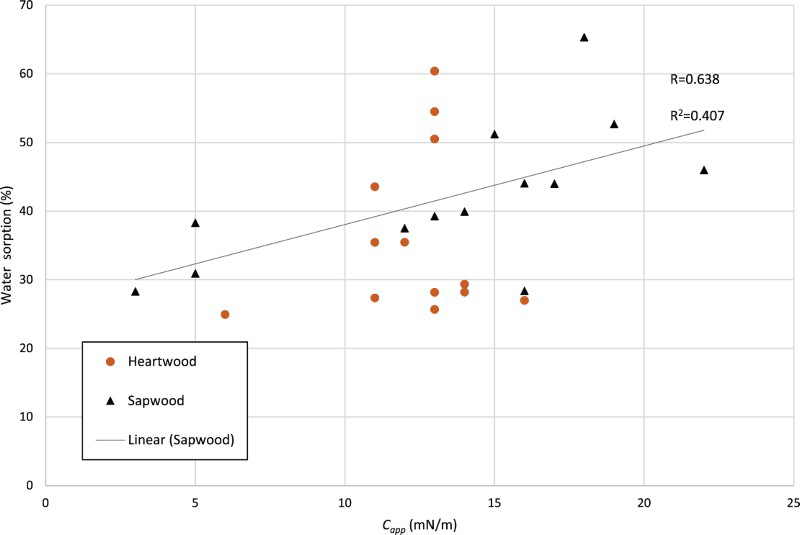
Table 2 also presents the ratio of earlywood (approximately 70% and 90%) in the samples. No significant difference in liquid sorption was observed between the two ratios of earlywood. However, a lower liquid sorption is expected in samples with a higher portion of earlywood regions due to a more frequent pit aspiration in earlywood compared to latewood, as shown by other researchers (Phillips 1933; Liese and Bauch 1967; Petty 1972). A possible inference from the overall sample density is one explanation for this unexpected result. The swelling (perimeter increase) values presented in Table 2 seem to be related to the water sorption and the density, as well as the Capp value, in a quite complex manner.
The path of the fluid flow and micromorphology of spruce have been extensively studied in the past (Phillips 1933; Liese and Bauch 1967; Petty 1972; Flynn 1995; Olsson et al. 2001). These studies show that the low fluid sorption of spruce is mainly caused by physical attributes related to the piceoid type of the pits that easily aspirate in combination with a smaller volume of ray tracheids supporting radial liquid transport (Olsson et al. 2001). This study adds additional knowledge through the specific water and octane sorption measurements by the multicycle Wilhelmy plate method. The measurements indicate that a similar micromorphology in the spruce heart- and sapwood samples, manifested by their similar octane sorption behaviour, still demonstrate different water sorption behaviours. Additionally, the variation in water sorption is attributed to the variable presence of wood extractives. It is suggested that this new knowledge regarding the liquid sorption characteristics of spruce should be considered in the development of coating formulas and further studies on the liquid dynamics in spruce.
Conclusion
The results showed a linear correlation between spruce porosity and the sorption of octane. Higher wood porosity resulted in higher octane sorption and permeability. Similar octane sorption was indicated between the heart- and sapwood samples with a similar density, which implies that spruce heart- and sapwood have a similar micromorphology.
The sorption behaviour of water is, however, more difficult to interpret. The presence of surface-active wood extractives, particularly in the sapwood samples, is a very probable reason for the increase in the sorption of water due to a significant decrease in its apparent surface tension during the multicycle experiments. Hence, the commonly observed differences in water sorption between spruce heart- and sapwood are likely caused by a difference in the extractive content rather than differences in the micromorphology.
Finally, the multicycle Wilhelmy plate method using small dimension wood veneers seems to be a valuable complementary method to understand further the liquid sorption characteristics of wood, especially by using both a swelling and high-surface tension probe liquid (such as water) in combination with a non-swelling and low surface tension probe liquid (such as octane).
Footnotes
Acknowledgements
The authors acknowledge financial support from The Bridge, a multidisciplinary research and education collaboration between Linnaeus University and IKEA as well as from the Swedish Research Council Formas (project EnWoBio 2014-172). This experiment has also been possible thanks to Swedish Infrastructure of Ecosystem Science (SITES), in this case at Asa field research station.
Disclosure statement
No potential conflict of interest was reported by the authors.
