



Abstract
Abstract dialectical frameworks (ADFs) constitute a recent and powerful generalisation of Dung's argumentation frameworks (AFs), where the relationship between the arguments can be specified via Boolean formulas. Recent results have shown that this enhancement comes with the price of higher complexity compared to AFs. In fact, acceptance problems in the world of ADFs can be hard even for the third level of the polynomial hierarchy. In order to implement reasoning problems on ADFs, systems for quantified Boolean formulas (QBFs) thus are suitable engines to be employed. In this paper we give complexity sensitive QBF encodings of ADF problems generalising recent work on QBFs for AF labellings. Our encodings provide a uniform and modular way of translating reasoning in ADFs to QBFs, that can be used as the basis for novel systems for ADF reasoning.
Introduction
Since its invention by Dung (1995), abstract argumentation constitutes one of the main research branches for computational models of argument. Hereby, the conflict resolution between arguments is done by abstracting away from the arguments' contents, yielding a simple yet powerful framework for reasoning used as a core model in many argumentation tasks and applications. Although very general, Dung's argumentation frameworks (AFs) do not directly support modelling more complex interactions between arguments. For this and similar issues, several extensions of AFs have been proposed to date (e.g. those presented by Baroni, Cerutti, Giacomin, Guida, 2011; Bench-Capon, 2003; Cayrol & Lagasquie-Schiex, 2005; Brewka, Polberg, & Woltran, 2014 provide a survey of this line of research), one of the most general being that of abstract dialectical frameworks (ADFs) by Brewka and Woltran (2010). In this last framework, acceptance conditions in the form of arbitrary Boolean formulas are associated to every argument. Proper generalisations of Dung's semantics have been given by Brewka, Ellmauthaler, Strass, Wallner, and Woltran (2013).
Various reasoning tasks can be defined on abstract argumentation frameworks, some of the central ones being those that evaluate the ‘acceptability’ of an argument with respect to a given framework and semantics. Already for AFs, most of the reasoning tasks have been shown to suffer from high computational complexity (see e.g. the work by Dunne & Bench-Capon, 2002). For ADFs, the complexity of many of the main reasoning tasks with respect to the generalised semantics jump up one level of the polynomial hierarchy (as has been shown by Strass & Wallner, 2014; Wallner, 2014), resulting in some of the reasoning tasks even being on the third level of the polynomial hierarchy.
One successful approach for implementing problems of high computational complexity is to employ a so-called reduction approach (Charwat, Dvořák, Gaggl, Wallner, & Woltran, 2015). Hereby the underlying idea is to exploit existing efficient software which has originally been developed for other purposes. To this end, one has to formalise the reasoning problems within other formalisms like, for instance, propositional logic, thus directly benefiting from the high level of sophistication today's systems for SAT (satisfiability in propositional logic) have reached (Franco & Martin, 2009).
In this work we follow this idea and present translations of the main reasoning tasks
defined for ADFs into the satisfiability problem of quantified Boolean formulas (QBFs). QBFs
are an extension of propositional logic, allowing for quantification over propositional
atoms (Büning Bubeck, 2009). Its associated
satisfiability problem (QSAT) is complete for PSPACE while types of QBFs classified
according to the structure of quantification provide us with complete problems for each
level of the polynomial hierarchy. These results indicate that reasoning problems for ADFs
can be efficiently transformed into QSAT problems with a certain quantifier structure.
Employing the framework of QBFs thus allows for a
uniform translation of ADF reasoning tasks into one widely studied formal
language; complexity sensitive encodings, that is,
encodings to a subclass of QBFs whose complexity matches the complexity of the encoded
reasoning task; and utilisation of ever more efficient
solvers for QSAT (see, e.g. the results presented by Lonsing & Seidl, 2013).
Providing reductions to QSAT is increasingly seen as a promising approach to tackle computational problems in the polynomial hierarchy. Planning (see the work by Ferraris & Giunchiglia, 2000; Rintanen, 1999) and formal methods for determining correctness of software systems (as shown by Benedetti & Mangassarian, 2008; Bryant, Lahiri, & Seshia, 2003; Giunchiglia, Narizzano, & Tacchella, 2007; Ling, Singh, & Brown, 2005; Mneimneh & Sakallah, 2003) are notable examples of areas where QSAT solvers have found their way into practice. Moreover, reductions of many reasoning problems in different areas including knowledge representation and reasoning (reductions of autoepistemic, default logic, disjunctive logic programming, and circumscription problems into QSAT are given by Egly, Eiter, Tompits, & Woltran, 2000 for example) into QSAT have also been proposed in the literature. Giunchiglia, Marin, and Narizzano (2009) list several more examples of reductions of computational problems to QSAT.
Our work specifically continues the line of of study that has been initiated for Dung style AFs by Egly and Woltran (2006) and Arieli and Caminada (2013). In both of these works, reductions of the problems of evaluating Dung style AFs into the setting of quantified Boolean logic are given. The more recent work by Arieli and Caminada in particular, which is based on a so called ‘labelling approach’ (Caminada & Gabbay, 2009) to defining the semantics of AFs presents some parallels with the approach followed by Brewka et al. (2013) and Strass (2013), respectively, to define the semantics for ADFs. Thus this work has been particularly influential for the approach we follow to give encodings for the reasoning problems defined for ADFs.
Summarising, in this article we provide complexity sensitive encodings of all the main reasoning problems defined for ADFs (evaluation, credulous acceptance, skeptical acceptance and verification) with respect to the most prominent semantics (two valued models, admissible, complete, preferred, grounded and stable) in the context of QBFs. Further, we present the formal framework required to prove that our encodings are correct as well as detailed proofs. This article extends the work of Diller, Wallner, and Woltran (2014) and Diller (2014) by three novel contributions: (1) we additionally consider the reasoning task of verifying a given candidate solution, (2) we expanded all proofs, and (3) we present here complexity sensitive encodings also for the grounded and stable semantics.
Background
Quantified Boolean formulas
We recall the necessary background of Boolean logic and QBFs: for further details see also the survey of the theory of QBFs by Büning & Bubeck (2009).
Quantified Boolean logic is an extension to propositional logic. The basis of
propositional logic is a set of propositional variables
A propositional variable p in a QBF ϕ is free if it
does not occur within the scope of a quantifier; otherwise it is bound. If
ϕ contains no free variable, then ϕ is said to be
closed; otherwise it is open. Further we will write
An interpretation
We extend the evaluation function
Given two interpretations
We will often use the simplified notation
The following lemma and corollary are straightforward consequences of the semantics of QBFs that we make often use of for proving the correctness of the encodings we present in this work.
Let ψ be a QBF, and P a set of propositional
variables. If
Let ψ be a closed QBF, and P a set of propositional
variables. If
One final use of brackets as notational device we introduce for QBFs is
Let
Normal forms of (quantified) formulas play an important role for theoretical and
practical purposes. A well-known normal form for QBFs is the prenex normal form (PNF). A
QBF ϕ is in PNF if ϕ is of the form
We assume familiarity with the complexity classes
A language is in the complexity class
An abstract dialectical framework (ADF) is a directed graph whose vertices represent
statements which can be accepted or not. The links represent dependencies: the status of a
node s only depends on the status of its parents (denoted
An ADF is a tuple S is a set of statements
We represent the acceptance conditions C as a collection
We consider ADF semantics as defined by Brewka et al. (2013). A semantics σ assigns to an ADF
D a collection of two or three valued interpretations, denoted by
The interpretations map statements to truth values. We use
A three valued interpretation v is two valued if all statements are
mapped to either true or false. For a three valued interpretation v, we
say that a two valued interpretation w extends v iff
For an ADF
Let in
in
in
in
No other
elements except those stipulated by the items above are in
For any ADF one has that all preferred interpretations are complete and all complete
interpretations are admissible. Brewka et al. (2013) have also shown that the operator
The
Let
In Figure 1 we see an example ADF
ADF
example.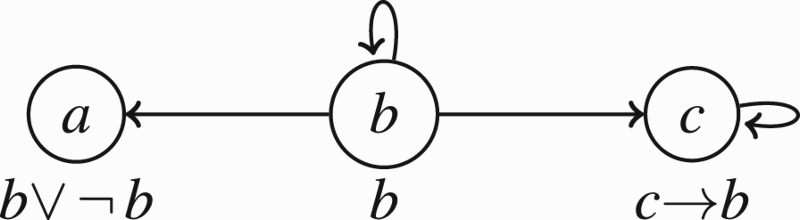
All admissible interpretations of the ADF from Figure 1.
Note: Right-most column shows further semantics the interpretations belong to.
Complexity results for semantics of ADFs.
Continuing Example 2.7 we can see that a is skeptically accepted
w.r.t. preferred semantics in the ADF D. (i.e.
In this section we present the encodings of reasoning tasks for ADFs into QBFs. After
dealing with some preliminaries for our encodings, we develop for each semantics
This method for providing encodings has the advantage of being general in the sense that
the encodings of the reasoning tasks we provide at the end of Section 3.2 for some semantics σ remain correct if the
defining encoding function
As indicated above, we begin with some preliminaries. To express constraints on the values
to which an interpretation on ADFs can map statements, in our encodings we make use of
variables that stand for the statements of an ADF. Since the definitions of semantics of
ADFs often refer to several interpretations (e.g. the extensions of a given interpretation)
to express such definitions in the language of quantified Boolean logic we in fact need to
use several disjoint sets of propositional variables standing for statements to implicitly
refer to these different interpretations in our encodings. We generate such sets by using
priming (with
Let S be a set of statements. Then
The
The purpose of introducing the notation
To encode expressions about two valued interpretations on a set of statements
S as QBFs we use a variable set copy of S. To refer to
three valued interpretations inside QBFs on the other hand we follow the procedure that has
already been used by Arieli and Caminada (2013)
to encode expressions about (three valued) labellings for AFs. Specifically, we assume that
for every set
Let
The intended meaning of
ADF semantics are based on three or two truth values. Since there are four possible truth
value assignments for a statement s via
Let
We now formally define the correspondence we require of the models of the QBFs returned by
a defining encoding
Let S be a set of statements and
The following lemma is a straightforward consequence of Definition 3.4 we make often use of in the proofs of correctness of the encodings we provide in this work.
Let S be a set of statements, Assume that Assume
that Assume
that Assume
that
Let
We are finally in a position to provide the formal definition of a defining encoding
function
Let If If If If
When encoding the reasoning tasks associated to ADFs as QBFs we make repeated use of some
simple modules. In the first place, given a variable set copy
Let
A two valued valuation
In order to encode the definitions of ADF semantics as QBFs we often need to express that
Let S be a set of statements, Let
Let
v and
Let Let v and
Note that the reason Lemma 3.8 is split into two items instead of being written using an
‘if and only if’ is that, given a set S of statements and variable set
copies
The formula below
Let S be a set of statements, Let
Let
v and
The proof is similar to that of Lemma 3.8.
Having covered the preliminaries, in this section we set out to provide the encodings of ADF reasoning to QSAT. As already explained, we do so by first giving defining encoding functions for each of the semantics we consider in this work. To give a defining encoding function for admissible semantics of ADFs we slightly reformulate the definition of admissible interpretations.
Let
Let v be a three valued interpretation such that
Assume now that
This leads us to the defining encoding function for admissible semantics of ADFs, which essentially encodes evaluation of ADFs with respect to the admissible semantics by recasting the condition expressed in Proposition 3.10 in the language of QBFs.
Given an ADF
Coherence of
In order to prove soundness assume that
To prove completeness, assume
The following is the encoding for the ADF
Any interpretation mapping the free variables
The following proposition gives the defining encoding for the complete semantics. The
first conjunct of
Given an ADF
Note first that for a three valued valuation v and an ADF
Coherence follows directly from Proposition 3.11 and the fact that for any two valued
interpretation
Using again the encoding for admissibility we encode preferred semantics in the next
proposition. The defining encoding function returns a QBF that specifies that the result
should correspond to an admissible interpretation v and for any
admissible interpretation
Given an ADF
Coherence of
In order to prove soundness assume that
To prove completeness, assume
The following is the encoding for the ADF
To give the defining encoding function for the grounded semantics we use a similar
technique as for the preferred semantic. Instead of the module for admissible
interpretations we use complete semantics and require that the result is information
minimal. A three valued interpretation v is preferred for an ADF
D if for all
Given an ADF
Having established the encodings for the three valued semantics on ADFs we now proceed to the remaining two valued semantics. We begin with two valued models.
Given an ADF
Let
We provide the defining encoding for the stable semantics in Proposition 3.23. The
encoding function maps every ADF
Let S be a set of statements. Then
Let
When it is clear from the context to which ADF D we are referring we
will more often than not drop the D from the notation
Let v and
Let
We prove by induction on
The base case (
Before proving the inductive step note first that Observation A:
A second fact that will be of use in the proof of the inductive step is Observation B: if v and
This is because if there exists some
Assume now (induction hypothesis) that
To prove that
Before finally giving the defining encoding for the stable semantics we generalise the
notation
Let ϕ be a QBF and
In the defining encoding for the stable semantics given in Proposition 3.23, any priming
applied to the modified acceptance conditions
Given an ADF
Let
To prove completeness, let
The following is a part of the encoding for the ADF
Having the defining encoding function for a semantics σ, encodings for the reasoning tasks we consider with respect to σ can be given in a generic manner as is condensed in Proposition 3.25.
Let
Assume first that Assume now that Assume first that Assume now that Assume first that Assume now that
Many of the encodings shown above are adequate w.r.t. their complexity (see Table 2 for the complexity of the reasoning tasks) 1
We refer to the appendix for rewritings of all encodings (of
non-trivial reasoning tasks) in such a manner that their structure reflects the
complexity of the associated reasoning problems, that is, the encodings are
transformed to PNF or, when they correspond to
For the remaining queries our encodings do not result in QBFs with a prefix type matching
the complexity of the corresponding decision problem on ADFs. The reason for this is that
the encodings for the grounded semantics, if translated to PNF, have a higher prefix type
(third level) than the complexity of the corresponding decision problems would suggest.
The encodings for the stable semantics in turn depend on the defining encoding function
for the grounded semantics and are, hence, not adequate w.r.t. the complexity either. We
give complexity sensitive encodings of all the reasoning tasks w.r.t. the grounded and
stable semantics in Section 3.3, which
requires us to deviate from the methodology we followed in this section. These are also a
bit more involved than the more ‘natural’ encodings of these reasoning tasks given in this
section, requiring more propositional variables per statement in the ADF. Finally since
As already indicated, in this section we provide alternatives to those encodings from Section 3.2 which are not in a fragment of QSAT which matches the complexity of the reasoning task.
We consider first credulous and skeptical acceptance of statements with respect to the grounded semantics. One way of arriving at adequate encodings for these decision problems is by making use of a characterisation of grounded interpretations given by Strass Wallner (2014), for the statement of which we make use of the following definition:
Let For each
For
each For
each
The above mentioned characterisation of grounded interpretations is expressed in the following proposition by Strass and Wallner (2014):
Let D be an ADF. Then v is the grounded
interpretation of D if and only if v is the
This characterisation leads to an alternative way of defining the encoding function for the grounded semantics as is expressed in the next proposition.
Given an ADF
Then
Given an ADF
The proof can be fashioned after the proofs regarding defining encoding functions in Section 3.2 by using Lemmas 2.1, 3.5, 3.7, 3.8 and 3.9 in addition to Proposition 3.27.
For and ADF
Let
Assume first that v is the grounded interpretation of
D,
That
Given an ADF
The proof can be fashioned after the proofs regarding defining encoding functions in Section 3.2 by using Lemmas 2.1, 3.5, 3.7 and 3.9 as well as Corollary 2.2.
Then the following proposition gives adequate encodings w.r.t. their complexity for
Given an ADF
This proposition follows directly from Proposition 3.30 and Corollary 3.29.
When converted to PNF the encodings which are returned by the function
Corollary 3.29 can also be used to provide an alternative defining encoding function for
the stable semantics as is expressed in Proposition 3.32. Given an ADF D,
the encodings returned by this defining encoding function are based on the fact that
verifying whether a two valued interpretation v is equal
to the grounded interpretation
Given an ADF
The proof is similar to that of Proposition 3.23, using Propositions 3.17 and 3.30, Corollary 3.29 as well as Lemmas 2.3, 3.5 and 3.21.
Applying Proposition 3.25 using this alternative characterisation of the defining
encoding function for the stable semantics gives complexity adequate encodings for
verification (encodings of prefix type
We have presented encodings of several reasoning tasks defined on ADFs into the language of QBFs in a manner that is ‘adequate’ with respect to the complexity of the reasoning tasks. This allows for taking advantage of recent developments for QBF solvers and thereby tackling the high complexity of reasoning problems for ADFs.
An initial feasibility study of our encodings was conducted in Diller et al. (2014), comparing a prototype system
Thus, future work will focus mainly on tuning of the encodings and implementation to improve performance. In particular, it may be that QBF solvers are struggling to efficiently deal with the signed variables in our encodings, a concept we have borrowed from Arieli and Caminada (2013); this issue needs further investigation. Another point on our agenda is to specialise our encodings for ‘less complex’ ADFs (e.g. bipolar ADFs). Also, additional complexity in the structure of the encodings due to the Tseitin transformation that is required to transform the encodings to the prenex conjunctive normal form (PCNF) required by most QSAT solvers may be avoided by using a QSAT solver that does not require the input to be in PCNF. Finally we plan to investigate algorithms using recent advances in incremental QBF solving (Lonsing & Egly, 2014). Incremental algorithms can, for example, compute a preferred interpretation by incrementally computing admissible interpretations with increasing information until an information maximal interpretation is found. For AFs such an incremental approach has already been carried out and implementations based on incremental SAT showed a good performance (Cerutti, Dunne, Giacomin, & Vallati, 2013; Cerutti, Giacomin, Vallati, & Zanella, 2014; Dvořák, Järvisalo, Wallner, & Woltran, 2014). By utilising incremental QBF solving one can generalise the algorithms developed for AFs to ADFs and potentially inherit the good performance of this approach.
Footnotes
Disclosure statement
No potential conflict of interest was reported by the authors.
Funding
This research has been supported by the Austrian Science Fund (FWF) through projects I1102, W1255-N23 and S11403-N23.
Appendix. Summary of encodings
In this section we list those encodings we have provided in our work that are adequate
with respect to the complexity of the reasoning tasks. We present them in such a manner
that they reflect the complexity of the reasoning tasks, that is, they are either in PNF
or mirror the structure of the SAT UNSAT problem which is prototypical for the complexity
class
In order to avoid excessive priming in the presentation of the encodings below we will
often use alternative ‘base sets’ to the one given in Definition 3.1 (namely
S) to generate the variable set copies of a set of statements
S. Specifically, we will also consider sets