The Metis research project aims at supporting maritime safety and security by
facilitating continuous monitoring of vessels in national coastal waters and prevention of
phenomena, such as vessel collisions, environmental hazard, or detection of malicious
intents, such as smuggling. Surveillance systems such as Metis typically comprise
a number of heterogeneous information sources and information aggregators. Among the main
problems of their deployment lies their scalability with respect to a
potentially large number of monitored entities. One of the solutions to the problem is
continuous and timely adaptation and reconfiguration of the system according to the
changing environment it operates in. At any given timepoint, the system should use only a
minimal set of information sources and aggregators needed to facilitate effective and
early detection of indicators of interest. Here, we describe the Metis system
prototype and introduce a theoretical framework for modelling scalable
information-aggregation systems. We model information-aggregation systems as networks of
inter-dependent reasoning agents, each representing a mechanism for
justification/refutation of a conclusion derived by the agent. The proposed continuous
reconfiguration algorithm relies on standard results from abstract argumentation and
corresponds to computation of a grounded extension of the argumentation framework
associated with the system. Finally, we demonstrate the flexibility of the presented
framework by extending the proposed algorithm to adapt to context-dependent changes in
information sources availability, as well as shifts in system's focus according to its
context.
The Metis project (Hendriks & van de Laar, 2013; TNO Embedded Systems Innovation, 2013) studies techniques supporting development of large-scale dependable systems
of systems which aggregate multiple sources of information, analyse them, compute risk
factors and deliver assessments to system operators. Systems-of-systems are large-scale
integrated systems that are heterogeneous and independently operable on their own, but are
networked together for a common goal (Jamshidi, 2008). Here, we introduce the Metis project's prototype application,
which applies the developed concepts to the domain of maritime security and aims to provide
advanced situation awareness capabilities for monitoring maritime traffic in national
coastal waters. Our focus here is on supporting continuous reconfiguration,
that is, efficient adaptation to changes in its environment.
The Metis system is a large-scale surveillance system operating in a mixed
physical and software environment. It comprises a number of cooperative agents serving as
information sources and aggregators. Typically, these would be either situated physical
agents, such as cameras, satellites or human patrols, or software components interfacing
various public, or proprietary databases, web resources, etc.
In the implemented prototype scenario similar to the one implemented and demonstrated to
industrial partners of the project in spring and autumn 2013, Metis aims at
detection of ships suspected of smuggling illegal contraband during their approach to the
port under surveillance. For every vessel in the zone of its interest, the system accesses
the various information sources and subsequently processes the extracted information so as
to finally identify vessels which require operator's attention. The available sources
provide information about the ships, including their identifications, crew, ports-of-call,
various physical characteristics, possibly even digest of news articles reporting on events
involving the vessel, or the crew. Quite often, such information would yield inconsistent,
or even contradictory information, which needs to be cross-validated and processed in order
to infer the most likely values. The resulting information is aggregated by a hierarchy of
information aggregators so that the system is ultimately able to determine whether a
particular vessel should be considered a smuggling suspect, or it is able to justify that it
is innocuous given the available information. In the prototype scenario, the individual
aggregators are represented by various information-fusion components operating over a shared
data warehouse, but could also include external agents, such as human experts.
Metis should be deployable both on land and on board of independently operating
ships. As a consequence, querying individual information sources and subsequent information
aggregation could incur non-negligible financial and computational costs. While accessing a
publicly available Internet resource via a fixed broadband connection can be relatively
cheap, the bandwidth of satellite communication links used on board of maritime vessels is
limited and data transfers incur external costs too. Similarly, accessing proprietary
industrial databases, or utilisation of physical agents, such as aerial drones, or imaging
satellites can incur rather significant costs to the system's operation. Hence, using all
available information sources and information-fusion components is not always feasible. The
problem of configuration and dynamic reconfiguration according to the current system's needs
can be thus formulated as follows:
Which information sources and aggregators should be active over time so as to
facilitate an early detection of malicious intents in the most efficient
manner?
To answer this question, we will use tools and methods derived from argumentation
theory. Abstract argumentation theory (Dung, 1995) studies logical reasoning solely in terms of interrelationships of
arguments, abstract entities representing inference mechanisms, not unlike opaque
information aggregators of the Metis system. As a consequence, the argumentative
approach provides a solid basis for modelling information-processing systems in terms of
interrelated arguments which support, or attack each other.
Here, we propose an approach to (re-)configuration of large-scale information-aggregation
systems by modelling the interactions between the individual components in terms of
anargumentation framework. This paper builds upon and significantly
extends the results presented in Novák and Witteveen (2013). After introducing the basic concepts (Section 2) and a preliminary analysis of evolutions of
information-aggregation systems, in Section 4, we
present the problems of configuration and reconfiguration of information-aggregation systems
to account for changes in their environments. Subsequently, in Section 5, we show that suitable system configurations correspond to the
concept of grounded extensions of an associated argumentation framework and provide an
algorithm for continuous reconfiguration of information-processing systems with respect to
the changes in their environment. The solution concept viewed through the optics of abstract
argumentation is closely related to standard results in logic programming, so the
relationship opens the door for further study of reconfiguration in relation to standard
results in logic programming. Finally, in Section 6,
we extend the reconfiguration algorithm to account for context-dependent availability of
information sources in the system and dynamic changes in system's focus according to
context-dependent query specification. The results introduced in Section 6 comprise a major advancement over the results presented in Novák
and Witteveen (2013). A discussion of on-going
and future work along the presented line of research concludes the paper.
Throughout the discourse, in a series of example expositions indicated under the
headingMetis x.y, we describe the relevant parts of the Metis system
and identify a class of relevant solution concepts. These expositions present simplified
example fragments of the delivered prototype and are aimed at supporting the discourse as a
running example.
In the prototype scenario, Metis should continuously monitor vessels in the
coastal waters in the Dutch Exclusive Economic Zone, source information about them and
process it, so as to finally identify vessels which are suspect of smuggling. Upon
detection of a suspicion, the system should notify the user, a Netherlands Coastguard
officer, who then decides on the following course of action. Such can include for instance
sending a coastguard boat patrol to check the situation, engage additional, possibly
costly, information sources like a satellite high-resolution video feed, or a human
expert, or can even alert and engage police, or other entities concerned with public
security. To put the scenario in perspective, note that the monitored area covers more
than 63,000 km2 and typically contains around
3–4000 vessels at any given moment in time.
To illustrate the functionality of Metis, in the system exposure we consider the
following simplified fragment of the prototype scenario. Information sources available to
the system comprise a local copy of IHS Fairplay (IHS, 2013) database and web-portals of MyShip.com (MyShip, 2013), MarineTraffic.com (Maltenoz Limited, 2013) and its Ports of Call database storing the harbours the
ship visited in the recent past. There are also two physical sensors: a receiver for
Automatic Identification System (AIS) (IEC, 2007; IMO, 1974) messages, the
vessels transmit themselves, and radar providing kinematic signatures of vessel tracks.
Besides cross-validation and probabilistic inference over the received data, the
individual information-processing components also derive meta-information about quality,
certainty and trust of the aggregated information.
Information-aggregation systems
An instance of a multi-agent surveillance system such as Metis comprises a set
ofinformation-processing agents and a shared database.
Information source agents operate in a dynamic
environment and feed a shared data store which is further
processed by a set of information-aggregator agents. The system's objective
is to determine the truth value of a set of distinguished indicators,
information elements corresponding to some non-trivially observable properties of the
monitored entities, such as whether a vessel is a smuggling suspect.
We model an abstract information-aggregation system as a tuple comprising a finite set of information-processing
agents and a database schema, respectively. A shared data store of the system is represented
by a 3-valued database schema comprising a
finite set of propositional variables over the domain representing true,
false, and unknown valuations, respectively.
In practice, could include an
arbitrary number of distinct crisp valuations as far as remains finite. The actual Metis
system exposure indeed assumes such an extended domain of the database schema.
Without loss of generality, we do not distinguish between different interpretations of the
unknown value ∅: no information and
value existent, but unknown Klein (2001). A database snapshot (database) of the schema at a given timepoint is a ground
interpretation of variables of .
That is, each variable of takes a truth value from
the domain . Let
denote the valuation of a variable
x in D and
be a database snapshot with all variables valued as unknown.
The information-processing agents of the system are modelled as function objects
over interpretations of the schema , formally
for each
. Usually, an information-processing agent is not
interested in the complete set of D-valuations to transform it to a new set
of D-valuations: only a part of the database variables and their values are
of its interest and dependent upon their values will be used to change the value of some
other variables. Therefore, we assume that there is a specific subset of input values that
is considered by agent A, denoted by and a specific set of
variables (possibly) updated by A, denoted by . Using
and
, we can consider an
agent A as a function mapping partial interpretations into partial
interpretations. Formally: Let
D be an arbitrary snapshot of
and let and
denote value
assignments to variables of and
, respectively. Then,
A maps the snapshot D to a snapshot
as follows:
;
for every
,
.
That means that only the
bindings of the variables in might have been
changed by an information-processing agent A. We model a special type of
information-processing agents, information sources, as standard agents, however, with an
empty set of input variables
and a non-empty set of output variables . We denote the set of all
information-source agents within a system by .
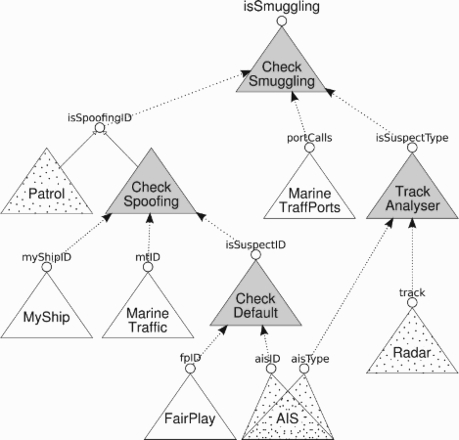
In the prototype scenario (Figure 1),
Metis features seven information-source agents (white), including three
physical sensors (dotted) and four non-trivial information-aggregation agents (grey).
Metis system
interdependencies.
The system contains a CheckDefault aggregator agent. This agent
consults the local physical AIS sensor and cross-validates the self-transmitted vessel
identity with those listed in the IHS FairPlay database. The identity of
a ship is the value of a variable , the outcome
of checking an IHS FairPlay database is stored in the variable
. So, . If there is a mismatch, the aggregator will set
the variable to true, if
there is a match, this variable is set to false. So, .
In a similar fashion, upon failure to match the identities of the vessel, the system
performs a deeper check of the vessel's identity (CheckSpoofing) in
order to determine whether it does not actively spoof it. If that is indeed the case, the
system escalates to the highest-level information-aggregator
CheckSmuggling consulting the most extensive set of information
sources and aggregators and performing the deepest analysis of the vessel's background so
as to assess its potential involvement in smuggling. The
TrackAnalyser processor matches the vessel's kinematic track
signature from the Radar sensor to the vessel type retrieved from
AIS. Should the vessel turn out to be a suspect smuggler
according to the Metis's analysis, the valuation of
isSmuggling information element is communicated to the system
operator via a GUI warning. Note that all the involved agents assume a domain of the
underlying database extended with enumerations of possible identities, etc., and can also
produce unknown valuation ∅ for each of their output
variables.
Configurations and database evolution
A set of information-processing agents of a system gives rise to the notion of system
configuration. Formally, a configuration of a
system is a set of information-processing agents
active in in a given point
in time. From now on, unless explicitly stated otherwise, we consider only non-trivial
configurations . Notation for input and output
variables of an agent naturally extends to configurations, that is and
. The notion of an
update of a database snapshot given a configuration of agents can be easily defined as
follows:
Let be a configuration of a system
and D a database snapshot of
the schema Then,
the database
is said to be an update of D by C,
denoted by iff
Every change in
w.r.t. D can be attributed to an information-processing agent, that
is for each such that there exists an
agent with
and
.
An update does
not change the database snapshot only if no agent is able to make a change, that is
only if for every
agent
If , we also say that the update
was co-induced by the agent A.
Note that here we give priority to an agent in a configuration that is able to change the
current database snapshot. Moreover, each variable x modified in the update
w.r.t. its original value in D, is a result of a (single) computation of
some agent A in the configuration C. This does not imply
that an update is the result of at most one
information-processing agent , it only implies that
there is no interference between agents in C during an update.
Instead of referring to configurations of agents, we might also refer to an update
of D by means of a partial database . The information in this
partial database should override existing
information in D only if the information in is known, that is the
value of a variable x in is either ⊤ or ⊥:
Let D be a database and be a partial database.
We say that
is an update of D by a partial database denoted by iff whenever is defined, we have
and
otherwise.
Given a configuration C of agents and an update of D, it might be that agents in
C might be used to update
too, resulting in a new update . This gives rise to the notion of an
evolution of a system
under a configuration :
Let be a system,
be a database snapshot and a configuration. An
evolution of a system
under a configuration from
is an infinite sequence of database snapshots such that each is an update of
by
C, for all .
The evolution is called a
C-evolution of from
on.
In general, given a configuration C and an initial snapshot
,
there might be many different evolutions starting from
,
depending upon the agents active at every update of the current snapshot. So, an evolution
of a system can be considered a non-deterministic process. Among these evolutions, there are
special evolutions that interest us: these are the evolutions that from some point
k on do not change. Such evolutions we deem stable
(Table 1):
Metis system
agents.
Agent
in
out
AIS
∅
aisID∗,
aisType′
FairPlay
∅
fpID∗
MyShip
∅
myShipID†
MarineTraffic
∅
mtID†
MarineTraffPorts
∅
portCalls‡
Radar
∅
track′
Patrol
∅
isSpoofingID‡
TrackAnalyser
marked ′
vesselType‡
CheckDefault
marked ∗
isSuspectID†
CheckSpoofing
marked †
isSpoofingID‡
checkSmuggling
marked ‡
isSmuggling
Let be a
C-evolution of . We say that is
stable if there exists a constant such
that
is an initial
segment of
for
all possible C-evolutions
such that for
that is
and share the same
initial segment we have
for all
The state is also known as the
stable state in the evolution .
Stable evolutions can also be identified with their finite initial segment
. There is an easy
characterisation of stable evolutions using the definition of a database update:
Let be a
C-evolution. Then, is stable iff there
exists some finite k such that .
The only-if direction is trivial, so assume that . Then, for all
we have . This means that for
any C-evolution
starting from we have
. Hence, for every
evolution
sharing with
, we have
. Hence,
is stable.
The evolution of a system strongly depends on both the nature of the active configuration
and the particular order in which the agents of the configuration work over the database.
So, even if C-evolutions from a given snapshot
turn out to be stable, it might be that there are several distinct stable states reached by
these C-evolutions from the same initial snapshot .
In general, this is not what we want: given any initial situation, we want to draw a
definite set of conclusions from it. Therefore, we would like to characterise
C-evolutions from a certain initial snapshot that not only are stable,
but at their points of stability turn out to reach the same stable state, whatever initial
snapshot we take. The following definition articulates this intuition formally:
Let be a configuration of a system
. We say that C is
normal iff
for every database
snapshot
all C-evolutions of from
stabilise and
all the stable states achieved by these
stable C-evolutions from
are identical.
More formally, a configuration C of agents is normal if for every initial
database snapshot
and every evolution starting from
,
there exists a finite constant such that
and for all
, . The unique
stable state reached by such a normal configuration C from an initial
snapshot
is denoted by .
Clearly, not all configurations of any information-aggregation system are normal. To see
this, consider the following example:
A solution to a configuration problem does not always exist. For instance, consider three
agents ,
and .
Suppose that
is an information-source agent where .
is able to set x to ⊤.
and
are information-processing agents, where and . It holds that while
Let
be a
configuration. Let
be the snapshot after
provides a crisp value to x. Then, there exists no stable
C-evolution starting with
as the updates from
oscillate between x, y being true and
x, y being false. Hence, the configuration
is not a normal
configuration.
As we already pointed out, the precise operational semantics of application of a
configuration to an information-system's database snapshot remains abstract. In particular,
the configuration execution model is not precisely defined in terms of ordering of the
individual agents, as well as in terms of possible effects concurrent execution might have
on the underlying database. Since our study relates to design of information-aggregation
systems which lend themselves to an analytical insight, the following questions are central
and of natural interest to guide design of information-aggregation systems with a more
transparent system evolution semantics:
What are the conditions which need to be imposed on information-aggregation
systems and their underlying databases, so that existence of non-trivial normal
configurations is guaranteed?
More specifically, ignoring the restrictions imposable on database snapshots, we are
interested in the question:
What are the properties of information-aggregation systems which guarantee that
regardless of the database snapshot of the system, there exists a non-trivial normal
configuration?
Tackling the aforementioned questions in their generality is beyond the scope of this
paper. Instead, to give a baseline for our further analysis in the later text, we introduce
a constrained class of information-aggregation systems with a property that they always
enjoy normality. More specifically, these systems have the property that given an arbitrary
configuration C of information-aggregation agents, whenever the
information-source agents have ‘produced’ an initial database snapshot
,
any C-evolution from
will result in the same stable state. We delve into the details and rationale of such
configurations in the later text.
We say that an information-aggregation system is simple and
stratified iff
there exists a
stratification of that is a
partitioning of into a sequence
of
strata (layers), where and
for all
and
S is simple in
that for every every variable there is at most one agent
such that
.
As it turns out, these conditions are sufficient to guarantee normality of
configurations:
Let be a simple and stratified system. Then every
configuration C of information-processing agents in S is
normal w.r.t. any initial database
produced by the information-source agents .
The proof follows by induction over the number k of layers in the
stratification of . Let . Then,
the only agents we have are information-source agents. So by assumption, every
configuration comprising only information-source agents is stable as it cannot update the
database any more, since their outputs are already reflected in it. Hence, given any
initial database snapshot ,
,
proving that every such configuration is normal.
Assume the induction hypothesis to hold for any stratification with
. Let S be a system with
layers
in its stratification, let C be an arbitrary configuration of agents and
be an initial database snapshot. Let ,
where contains all agents in
C that occur in the layers 1 up to k and
contains all agents in the ()th layer.
By induction hypothesis, we know that is normal since it
reduces to a configuration in a simple and stratified system with
k layers. Hence,
is well defined. Now, let and consider an arbitrary
-evolution
starting with .
First, we show that .
We can divide
into two disjoint parts ,
where and .
Note that, by simplicity of S, all parts are disjoint. Now,
the effect of any agent
is restricted to a possible modification of only, without
affecting .
In particular, for any agent
its effect on
is limited to which will be changed to
. Therefore, after at most
m updates, the cumulative effect of all updates by agents
A in the configuration
equals and any
applied to
will result in
again. Since, given ,
is uniquely defined, any
evolution is normal w.r.t. the
initial database
reaching the unique stable state .
Second, we show that
is the unique stable state any C-evolution will evolve to
starting from an initial snapshot .
To prove this, we define
to be that part of the state
that contains only bindings for variables1
Without loss of generality we may assume that for all
variables it holds that there
exists an agent such that
.
in the layers
0 up to j, that is variables occurring in for any agent
. For
,
is the unique stable state any C-evolution will evolve to.
Assume that for , any C-evolution will
evolve to the unique state .
Then for any C-evolution evolves to
.
But then we must have ,
implying that .
Now assume that there is another stable state
reachable by a C-evolution
from .
By induction hypothesis, we have .
But then we must have ,
contradiction. Therefore,
is the unique state every C-evolution from
will evolve to. Therefore, any C is normal w.r.t. any initial database
snapshot .
While simple stratified systems represent a rather constrained and narrow class of
information-aggregation systems, they are still a very useful subclass of systems. For
instance, most deployed sensor networks fall into this class of systems due to their
uni-directional flow of information and relative simplicity of information-fusion
mechanisms.
Metis is a security-related information-aggregation system. Such
knowledge-intensive systems are designed by encoding human expert knowledge into the
structure of the system. In practice, however, we observe that domain experts tend to
articulate their knowledge in terms of hierarchically structured information flows and
cascading inference and filtering processes. This provides an intuitive justification for
the stratified design of such systems. Complementarily, the requirement of
simplicity of a system as expressed in the aforementioned definition
embodies the intuition that the easiest way to resolve conflicts is by doing so explicitly.
That is, in the case there might be a conflict between two operating aggregators over a
valuation of some variable, this should be resolved already in the design phase by
explicitly splitting the computation of the two aggregators into two separate variables and
designing an independent third aggregator capable to resolve such conflicts either by fusing
their outcomes, deciding which of them takes precedence, or otherwise. More formally,
whenever
for two distinct agents ,
we can rename x in
to ,
similarly rename x to
in
and introduce a new agent with
and
.
then embodies the
fusion of
and
into a single variable without a possibility of a conflict over x in
S.
In the remainder of this paper, we flesh out the above-introduced intuitions about systems'
evolutions and design requirements which need to be imposed on them in order to facilitate
‘well-behaved’ information aggregation. In particular, we discuss the issues stemming from
embedding of information-aggregation systems in environments which might have their own
dynamics. An example of such might be a mixed physical and IT infrastructure-related context
our Metis prototype system operates in. Subsequently, we introduce and apply optics
of abstract argumentation on the functionality of such information-processing systems. Along
the way, we re-introduce the framework of information-processing systems as laid out
earlier, this time in terms of argumentation frameworks. We demonstrate that the parallels
between the two are useful as they allow us to relate the information-aggregation processes
to reasoning, inference and conflict-resolution mechanisms of argumentation approaches. As a
side effect, we lift the constraint of system's simplicity introduced in Definition 3.8 and
show how we can arrive to sound conclusions of the information-aggregation processes in
systems such as Metis. Furthermore, as we will show, argumentation optics allows us
to straightforwardly capture the notion of justification of a system's conclusion regarding
a variable of interest, a query.
Configuration and reconfiguration problems
In this section, we formulate the problems of configuration and reconfiguration of
information-aggregation systems. Before that, however, we introduce and illustrate the
concept of an environment such a system is to be embedded in. The notion of environment
provides a connection of the system to the ground reality, the source of data the system
processes and upon which it infers its conclusions.
System and its environment
An information-aggregation system, such as Metis, is situated in a dynamic
environment which changes over time. It reads values from it, monitors it and derives
non-trivial information on the basis of the collected evidence. We model an environment as
a database schema over crisp truth values
.
A system can be embedded in an environment
when the two database schemas coincide in
exactly the variables produced by the information-source agents of
. That is, each variable
of an agent
with
is included in the environment too, that is and we denote
. A variable in a database
snapshot D of reflects the state of the environment E iff
implies
. We say that the system
is embedded in
E iff computations of all the information-source agents reflect the
state of the environment. That is, for all with
all variables from in the snapshot
reflect
E.
The dynamics of the environment is captured by its evolution over time modelled as a
(possibly infinite) sequence of database snapshots. To
ensure correspondence between an evolution of the environment
and an evolution of a system
embedded in, we require that there exists a sequence of
indices ,
such that the variables from in
with
reflect the environment state
for
. That
is, at every such a distinguished timepoint, the system is embedded in the current state
of the environment.
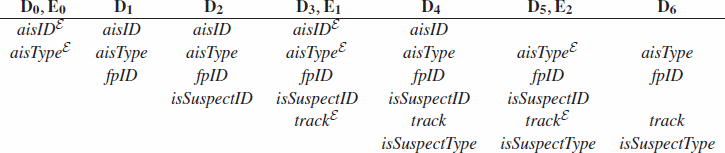
A configuration capable to produce the system evolution depicted in Figure 2 could include the agents
AIS, FairPlay,
CheckDefault, Radar and
TrackAnalyser agents executed subsequently in that order up to
the database snapshot .
That is, is produced by
execution of AIS, by execution of
FairPlay, by
CheckDefault, by
Radar and by
TrackAnalyser. Subsequently, is produced by a
re-execution of AIS, which produces an unknown valuation
∅ for the variable which leads to
derivation of ∅ also for the
variable when finally is produced by
re-execution of CheckDefault. The environment of the system
evolves in a sequence
and its changes are reflected in the evolution of the system's database snapshots.
Assuming that all the not-mentioned variables in the environment do not change, the
system is embedded in it exactly at points marked by the environment updates.
An example evolution of the Metis system database.
Only variables valued ⊤ are listed. The variables marked are read from the corresponding
environment update.
Configuration problem
Assessments of a surveillance information-aggregation systems such as Metis
could have real-world repercussions. For instance, after deriving that a vessel could be a
smuggling suspect, a warning would be indicated to the operator, who might then consider
contacting the vessel, possibly even sending a patrol to the location. Such actions,
however, need to be justified in the operational scenario. As a
consequence, any crisp conclusion computed by the system must be explainable and
defensible by inspecting the structure of inferences from basic evidence in the
environment. In turn, we are interested in system configurations, which can either crisply
answer distinguished queries, such as suspicion of smuggling, or, if that is not possible,
the operator needs to be sure that there is no such configuration given the current state
of the environment and the system's implementation. In the following, we implicitly assume
that the system is embedded in an environment state reflected in its current (initial)
database snapshot.
Given a tuple
with being an information-aggregation system,
a query variable and
D being an initial snapshot of the
information-aggregation system configuration problem is to find a
normal configuration C, a solution to , such that all evolutions of
rooted in
D stabilise in a snapshot and C
satisfies the following:
that is C contains at
least one agent capable to
derive φ. We also require that the resulting query
solution is a crisp valuation computed by the
configuration C;
for each variable
also and
and finally
there is no configuration
with
satisfying Equations (1) and (2), such that
Condition (1) of the aforementioned definition stipulates that the solution configuration
indeed provides a valuation of the query. Condition (2) formalises the intuition that the
query solution can be traced back to the evidence from the environment and computations of
a series of crisp variable valuations by the individual agents of the system, that is a
justification for the query solution. Finally, condition (3) ensures that there is no
doubt about the computed query solution. In that sense, C is a minimal
sufficient support of the query answer.
Definition 4.2 is agnostic of the structure of the underlying system. As a consequence,
as we already pointed out in the previous section, in general, a solution to a
configuration problem does not always exist.
Reconfiguration problem
Through information-source agents, a dynamic environment serves as the main driver of
change within the system. Situating the configuration problem into a changing environment,
repeated configuration becomes a means for continuous adaptation of the system to the
updates coming from its environment.
Given a tuple where
is an evolution of an
environment is an information-aggregation system embedded
in and
is a query variable,
theinformation-aggregation reconfiguration problem is a search for a
sequence of configurations such that each is a solution to
the configuration problem for where and
We say that a sequence of configurations is a weak
solution to iff is a solution to
if it exists and can be
arbitrary otherwise.
Informally, a reconfiguration problem solution is a sequence of configurations producing
a database evolution reflecting the changes of the system's environment. The sequence of
configurations in a weak solution to the reconfiguration problem captures the intuition
that the system tries its best to compute a query solution upon each environment update,
which, however, does not always exist.
Consider the Metis prototype scenario introduced in the previous expositions.
An example configuration problem could be . As stated, there is no solution to
. This would only
exist if all the information-source agents provide a reading of their output variables.
Then, the solution would comprise all the agents of the system.
Solving configuration and reconfiguration problems using argumentation theory
The individual agents of an information-aggregation system perform inference over
valuations of their input variables, premises, and thus provide support to the output
variables, conclusions. In effect, they can be treated as blackbox modules embodying a
support for their output variables, or can produce an output in conflict with outputs of
other agents within the system. Thus, their interrelationships embody the flow of
information within the system in terms of mutual support of conflict.
Dung's theory of abstract argumentation (Dung, 1995) is a formal model revolving around analysis of mutual support and the
structure of conflicts between abstract arguments in favour, or against some conclusion.
Hence, the framework of abstract argumentation provides a natural model of computation of
information-aggregation systems. Here, we propose an approach to solving (re-)configuration
problems rooted in sceptical semantics of argumentation. The terminology introduced in the
later text is adapted from Dung (1995).
Let be a system and D be a database
snapshot of . We construct a
configuration argumentation framework associated with over
as follows:
Arguments correspond to
information-processing agents and embody a set of interrelations among
variables of the schema . The
input variables provide the
basis for inferring the conclusions of the
argument . We say that an
argument is valid w.r.t. a database snapshot D iff
and for all
variables we have .
Informally, a valid argument is supported by a given database snapshot in that the
input/output characteristics of the internal computation of the agent is truthfully
reflected in the database. From now on, we will use the notions of an argument and
an agent interchangeably according to the context.
We
say that a valid argument attacks another argument denoted , on a variable
w.r.t. a given database snapshot D iff and
. That is, the agent A
derives a crisp valuation for x which disagrees with the one
derived by the agent .
We also say that A is a counter-argument to
,
or that A is controversial. Finally, an argument
attacks a set of
arguments iff there exists
attacked by
A.
Note that the attack relation is defined only for valid arguments supporting their
conclusions by crisp valuation of their input. The conclusion, however, does not necessarily
need to be crisp itself. Also, the attack relation is not symmetric in that a valid argument
supporting a crisp conclusion can attack an argument providing unknown valuation to the same
conclusion, but not vice versa.
In the case of the example system depicted in Figure 1, an attack in a particular argumentation framework associated with a
Metis system in some state might arise in the case the agents
Patrol and CheckSpoofing produce two
different crisp valuations for the variable . This situation could realistically
arise in the case when for instance the information provided by AIS
and FairPlay agents cannot be cross-validated by that retrieved
from other external databases (MyShip
orMarineTraffic) and thus CheckSpoofing
agent concludes that the ship might be spoofing its identity. At the same time, a
coastguard patrol boat or a UAV sent to inspect the ship would actually confirm the
identity of the vessel to be that retrieved from AIS.
Consider a fixed argumentation framework associated with a system
over a database D. A
configuration C is said to be conflict-free if there are
no agents such that A attacks
B w.r.t. A valid argument
(agent) is acceptable to
C iff for each in the case
attacks A, then there exists another argument
in C, such that
is attacked by
all w.r.t. the database snapshot D.
In security-related information-aggregation systems, such as Metis, any computed
assessments need to be justified in order to preserve presumption of innocence of the
monitored entities. That is, the resulting crisp valuation must be traceable to and
justifiable by the evidence coming from the environment. Reasoning of such a system is
sceptical in that only conclusions which the system is sure about can be inferred, given the
environment evidence and the system's design. The notion of a grounded extension of an
argumentation framework based on a fix-point semantics captures this intuition. Besides
being capable to articulate their conclusions to its users, these should also be susceptible
for providing insights for the structural explanations, justifications, of the conclusions.
The notion of grounded extension provides a basis for our analysis.
A grounded extension of an argumentation framework
denoted is the least fix-point of its
characteristic function defined as
is
admissible, that is all arguments in are also
acceptable to over
D, and complete, that is all agents which are
acceptable to also belong to
it.
A grounded extension of always exists and
is monotonous with
respect to set inclusion. In general, an argumentation framework can have multiple grounded
extensions, a property undesirable to security-related systems, where assessments should be
unambiguous. Dung (1995) shows that argumentation
frameworks without infinite chains of arguments , such that for each
i,
attacks , have a unique
grounded extension. A way to ensure that property, consistent with our earlier observations
about systems such as Metis, is to consider only stratified systems. That is those,
for which there exists a stratification, a decomposition into a sequence of strata (layers)
as defined in
Definition 3.8. Furthermore, we say that is
the most compact stratification of iff all agents
belong to the lowest possible layer of .
Formally, for all stratifications
of , implies
with.
The following proposition establishes the correspondence between solutions to configuration
problems for stratified systems and grounded extensions of their configuration argumentation
frameworks.
is a solution of a configuration problem
with a stratified system
if and only if C is also
the grounded extension of (i.e. an argumentation framework associated with
over the database with
.
If C is a
solution of , by definition we have
that (i) C is normal, (ii) each argument within C is
valid and (iii) . As a consequence,
the computation of follows in system's layers
(strata) from the information sources to ever higher ones exactly copying the inductive
argument presented in the proof of Proposition 3.9. Note that there is no execution of the
involved agents, their output only needs to be checked against the database snapshot
, which, however, is already
a result of their execution. Since C is a solution to
, the computation must also include
computation of a valuation for the query variable.
We need to show that
is (i) normal, (ii)
, (iii) all input variables
of agents in C are crisply valued and (iv) there is no larger
configuration
producing a different valuation for φ than C does.
The proof of C's normality
follows the inductive argument laid down in the proof of Proposition 3.9. Thanks to
the insight that there is always a unique grounded extension of a stratified
argumentation framework, we have that the computation of forms a stable
evolution of from
D onwards, moreover, all possible evaluations of agents from the
individual layers must lead to the same
outcome;
holds by
assumption;
all inputs to all arguments in
C are indeed crisply valued thanks to the requirement of an
argument to be valid and non-controversial in order to be considered acceptable to
; and
finally
is a fix-point of
, hence it is
also the maximal set of conflict-free arguments in .
Proposition 5.5 can be applied to static databases only. Note that execution of agents
considered for acceptance to a candidate solution does not modify the database fragment
computed in previous iterations, which also remains stable in further computation. In turn,
a naive configuration algorithm utilising Proposition 5.5 would iteratively proceed in three
steps following the inductive argument presented in the proof of Proposition 3.9. In every
ith iteration, it would (i) execute all the agents from stratum
of the most compact
stratification of , (ii) select the
non-controversial ones and finally (iii) add them to the candidate solution. To ensure
non-validity of arguments from higher strata that utilise controversial inputs derived in
this iteration, these should be set to ∅.
The naive algorithm, while correctly computing a solution to a given configuration problem,
is rather inefficient in terms of the overall run-time cost. It targets computation of a
grounded extension of the whole framework, instead of only answering the query of the given
configuration problem. First, in the initial iteration the algorithm considers and executes
all information-source agents. Besides that it also potentially executes
information-processing agents, which do not contribute to answering the query. In both
cases, it thus incurs unnecessary run-time cost. In fact, only arguments relevant to
derivation of the configuration problem query need to be considered.
Let be a stratified system and
be a query. The agents relevant
to φ include . Given a set of agents C
relevant to φ, all the agents computing the input for those in
C are relevant to φ too, that is
. The set of all agents relevant to
φ is the (unique) fix-point of denoted
.
The following proposition formalises the intuition.
Let and
be
as in Proposition 5.5. Then
is also a solution to .
Observe that since C is a solution to , every fragment which still satisfies
and the condition that for each variable ,
also
with must also be a solution to
. From the definition of
and the fact that C is a normal configuration the two conditions are
satisfied in .
Finally, since C is already a solution to , by definition no agent from
attacks the valuation of , hence
also satisfies the condition (3) of Definition 4.2.
Finally, the naive algorithm does not terminate early enough but rather computes the
grounded extension to its full extent, despite the fact that in the course of its
computation it might turn out that the query is (i) either already derived in a justified
manner, or that (ii) its computation is hopeless. The former is relatively easy to detect.
After all the agents relevant to φ were considered for inclusion to the
candidate solution, further computation will consider only irrelevant arguments as implied
by the proof of Proposition 5.6. To detect the latter case, we need to closely inspect the
current candidate solution with respect to the interdependencies among the agents of the
system. Given a configuration C, let's define as the fix-point of the
operator . is complementary to
in that given a
configuration C, it collects all agents dependent solely on the output of
C and thus works bottom-up along the system's strata, while
worked top-down from
the query down to the relevant information source in the system's bottom layer.
Consequently, contains C, together with all the
arguments which can be still eventually considered for accepting to the candidate solution
in future iterations of . In the case
ceases to hold during computation, the algorithm can terminate, since none of the arguments
capable to compute the query solution can be added to C in the future. A
straightforward corollary of this line of reasoning is the following proposition, which
formalises the relationship between the operator and the structure of the grounded
extension.
Let and
be as in Proposition 5.5.
We have
if and only if for every
.
Finally, the naive algorithm considers arguments for accepting the candidate solution in
sets, subsets of the system's layers. Considering arguments for acceptance one by one would
facilitate even earlier detection of hopeless computations and thus further reduction of
run-time costs. It could even consider arguments across strata, however, in that case, in
line with the sceptical inference strategy, the accepted arguments can only use input
variables which are a part of the already stabilised fragment of the database. An
alternative definition of (safe) acceptability of an argument A to a
conflict-free configuration C is when all its input variables are (i)
crisply valued, (ii) already derived by C and (iii) there are no arguments
outside of C which can potentially threat the valuations of its input
variables. More formally, we require (i), (ii) there is no
with
, and (iii)
there is no , such that . Evaluation of this
alternative definition of acceptability does not require execution of the agent
A and thus can be used in the context of an evolving database, as is the
case inMetis.
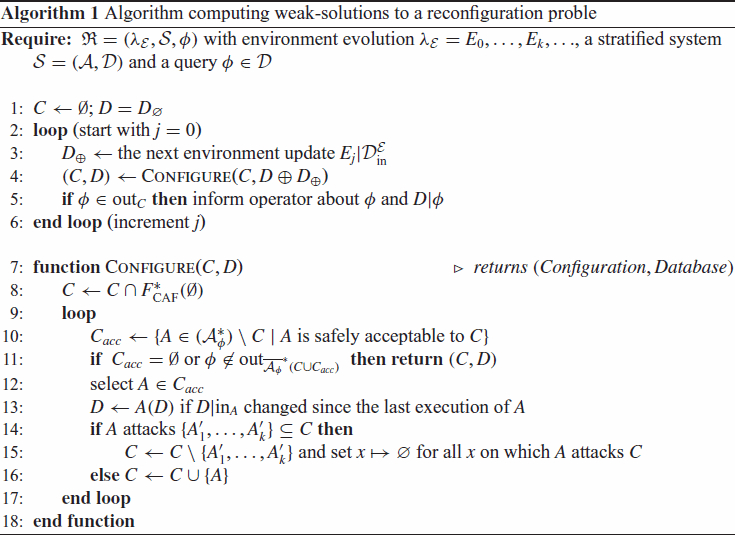
Algorithm 1 provides a pseudocode for continuous reconfiguration of information-aggregation
systems based on the aforementioned principles. Upon every environment update, in a step
j, the algorithm tries to compute the minimal solution to the current
configuration problem. Either it succeeds and informs the operator about the query solution,
or detects that a solution cannot be computed and proceeds. Function Configure
computes the grounded extension of the current configuration problem
restricted to the arguments
relevant to φ and considers potentially acceptable arguments individually
one by one.
Given a configuration, without executing the agents, the algorithm strips
C of all arguments which might need reconsideration (line 8), due to the
last environment update (line 4), or because they depend on such arguments. Starting from an
empty candidate solution C, in every iteration, the algorithm first
identifies among the arguments relevant to φ (Proposition 5.6) those
potentially acceptable to C (line 10). Before considering their execution,
it checks whether a solution can still be computed and should this not be the case, it
terminates the procedure. To detect the condition, it exploits the principles presented in
Proposition 5.7. Furthermore, the algorithm selects a potentially acceptable
information-processing agent A (line 12) and executes it (line 13). In the
case A does not attack the current candidate solution C
(line 14), it is accepted to C (line 16). Otherwise, the arguments attacked
by A were previously accepted to C prematurely and thus
need to be removed. We also need to set the variables on which they disagree to
∅ so as to ensure that all agents dependent on
controversial valuations will be deemed non-valid in the future iterations (line 8). To
further reduce the run-time costs incurred by the algorithm, we assume that each agent keeps
track of changes to its input, so the algorithm executes it only in the case its
re-execution is really needed (line 13).
For simplicity, we do not specify the particular strategy in which the potentially
acceptable arguments are selected from (line 12). One
possible heuristic strategy could be to pick the arguments which can result in a conflict
with other arguments first. This would lead to an early detection of hopelessness of the
computation of a solution to the given configuration problem. Another strategy could be to
select the arguments in a greedy manner according to estimation of the run-time costs
incurred by executing the argument agent.
Consider the example configuration problem . In subsequent iterations, Algorithm 1 could
execute the agents as follows. The + superscript represents agents accepted to the
candidate solution: AIS+,
FairPlay+,
MyShip,
CheckDefault+,MarineTraffic+,
etc. However, already after execution of MyShip, it would detect
hopelessness of further computation and would terminate. The valuation of
is vital to computation of the query
solution.
Let us conclude the section with a brief remark on explanations, or justifications, which
can be extracted from grounded extension of configuration argumentation frameworks as
solutions to configuration problems. As articulated in Algorithm 1, provided a system infers
a solution to a given configuration problem, it should inform the operator about its query
answer. One of the benefits of exploiting the argumentation optics on system reconfiguration
is that the grounded extension reduced to only relevant arguments directly also provides a
notion of justification of the system's conclusions. In particular, it only includes the
arguments supporting the query answer, while excluding all the irrelevant ones. Given a
stratified system, the query answer can thus be justified by a tree of crisp valuations of
the database's variables connected by the information-processing agents providing the
relationships between them. Assuming that from the perspective of its user, a coastguard
officer in the case of Metis, the system is designed intuitively and the
information-aggregation agents embody a relatively encapsulated and single-purpose
computation procedure, ideally, these relationships will be comprehensible and plausible
explanations of the query answer for the system's user. In effect, instead of focusing on
the conflict-resolution strengths of Dung's abstract argumentation approach, we exploit the
mutual support relationships we enforced by requiring argument validity as a precursor for
acceptability to the grounded extension.
Context-dependent information sources and queries
Information-source agents of a system provide an interface to the system's environment.
Algorithm 1 presented in the previous section assumed that all information sources are
constantly available. While this assumption is plausible for automatic sources such as
physical sensors (e.g. a thermometer or a radar), other information sources might not be
always available and can be only utilised depending on the system's context. As a
consequence of the need to handle also such information sources with context-dependent
availability, the system should be able to regularly retrieve the currently available
information sources and perform its computation over these sources only.
Since Metis should be deployable also on board a seagoing ship, access to
information sources such as coastguard patrol rapports or unmanned aircraft is reasonable
only with the explicit approval of a human officer and also only in the range of
utilisation of such a sensor, such as close to major harbours. Also, some sensors, such as
stationary cameras, are typically available at harbour entrances, but not on arbitrary
locations along the coastline.
The main purpose of information-processing systems is to perform continuous surveillance of
their environment and attempt to infer valuation of a distinguished indicator, a query.
However, queries of the system can also be a subject to change over time as the system's
focus shifts according to the particular context of the monitored entities. To account for
such dynamic changes of the information-processing system's focus, the system needs to be
able to accept changes in its currently relevant query and perform computations relevant to
the actual query in a timely manner.
In the specific example of Metis, a seagoing ship continuously moves in the zone
of under system's surveillance. While detection of smuggling intent of a given ship might
be highly relevant while the vessel is approaching a major harbour, near a protected
natural habitat, the system might focus rather on its cargo and kinematic behaviour in
order to detect whether it might pose a hazard to the environment, or whether it might be
involved in malicious activities, such as dumping garbage or chemical waste to the
sea.
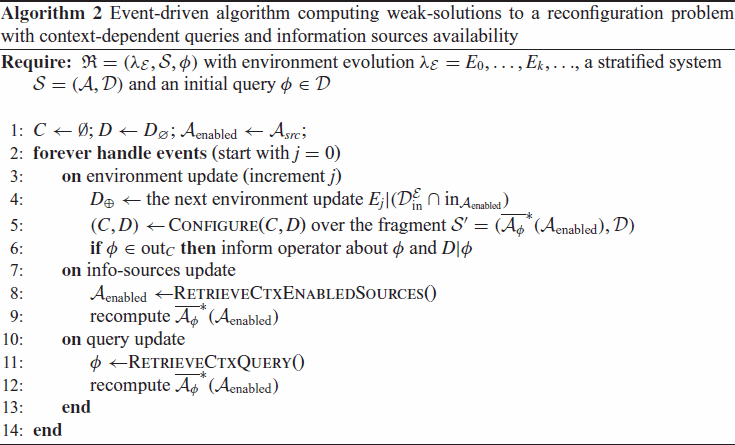
Algorithm 2 reformulates and extends Algorithm 1 to facilitate continuous reconfiguration
of information-aggregation systems with information sources with context-dependent
availability, as well as with dynamic, context-dependent queries. We expose Algorithm 2 as
an event-driven algorithm sequentially reacting to three main types of events which can
occur. Most importantly, upon an update of the system's environment (line 3), the algorithm
effectively reconfigures the system by first retrieving the environment database update and
subsequently invoking the function Configure from Algorithm 1, thus updating the
system's configuration. If necessary, the algorithm informs the system user about the
computed answer to the currently relevant query. Note that the configuration function is,
however, always invoked only on the currently relevant fragment of the
original system relevant to the currently
enabled information sources and the
currently relevant query φ. The fragment is precisely defined as
. That is, all the
information-processing agents depending on the currently enabled information sources and at
the same time relevant to the actual query.
Upon detecting a contextual change in either the currently available information sources
(line 7) or the currently relevant query (line 10), the algorithm retrieves the set of
enabled information sources or the query, and subsequently recomputes the currently relevant
fragment of the system
.
Finally, observe that the retrieval of an environment update
(line 4) is restricted only to the currently available information sources and as a result,
the system ignores the changes of the environment which it cannot observe.
Discussion and final remarks
Earlier, we presented an approach for modelling information-processing systems geared
towards continuous surveillance of a mixed physical and software environments largely
inspired by Dung's approach to argumentation Dung (1995). We also demonstrated the usefulness of modelling such systems in terms of
arguments and analysing their interrelationships with respect to potential conflicts between
outputs of their computations. The conceptual formal framework provides a sound and flexible
basis for a rigorous formulation of (re-)configuration problems and their various extensions
are also demonstrated in Section 6, where we present
an approach to handle not only the dynamics of an environment, but also that of the system
itself, as dictated by its changing context. We argue that sceptical semantics of
argumentation frameworks is a natural fit for modelling systems such as Metis and
our approach paves the way for further study of their properties, as well as development of
algorithms for their continuous adaptation on the solid basis of the existing body of
research in argumentation theory and logic programming.
In our future work, we intend to explore these relationships, specifically to study further
extensions of reconfiguration problems, including optimisation of run-time costs with
respect to explicit costs incurred by the system computation, or reconfiguration with
respect to ageing information in the system's database. In the argumentation-relevant
terminology, this means studying extensions of abstract argumentation to include notions of
a cost of an argument and its inclusion in an extension, or time-dependent strength of
argument's attacks, etc. Further inspirations stemming from the dynamic nature of such
systems also invite to study links between their evolution and standard results from
theories of evolving knowledge bases (e.g. Leite, 2003), logic programme updates, belief revision, etc. In particular, among other
challenges, we are also interested in dynamic run-time changes of the system's structure, in
other words dynamic changes of the underlying configuration argumentation framework. We also
aim at studying extensions and applications of the presented approach towards lifting
structural constraints imposed on systems, such as stratification and inclusion of cyclic,
or more involved dependencies among information-aggregation agents.
Throughout this paper we have introduced example fragments inspired by the actual
implementation of Metis demonstrators delivered to the Metis project's
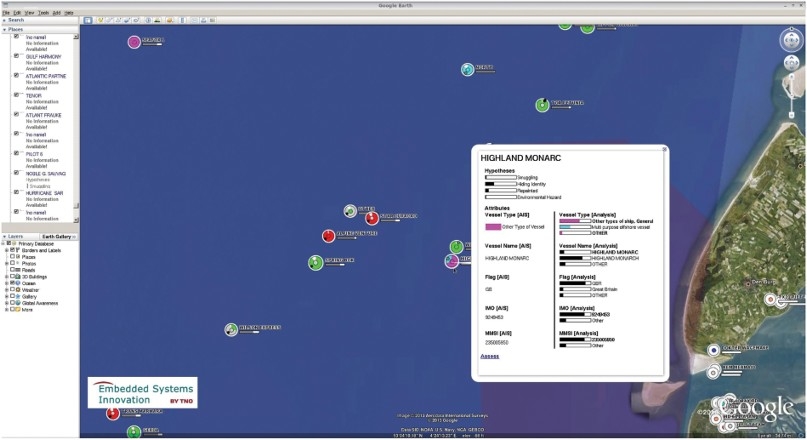
industrial partners in spring and autumn 2013. Figure 3 provides a screenshot of the operator's view in the prototype. It shows several
vessels (circular glyphs) in a selected monitored coastal area with indication of the most
likely values of their selected attributes. The pop-up inspection window shows the
likelihoods of the vessel satisfying the target indicators, such as suspicion of a smuggling
intent, or environmental hazard as discussed throughout this paper. An extended account of
the Metis system functionality as of 2014 and AI-related technologies employed in
its implementation can be found in Velikova et al. (2014).
No potential conflict of interest was reported by the authors.
Funding
This work was supported by the Dutch national programme COMMIT. The
research was carried out as a part of the Metis project under the responsibility of
the TNO-Embedded Systems Innovation, with Thales Nederland B.V. as the carrying industrial
partner.
References
1.
Dung, P. M.
(1995). On the acceptability of arguments and its
fundamental role in nonmonotonic reasoning, logic programming and n-person
games. Artificial Intelligence,
77(2), 321–357. doi:
10.1016/0004-3702(94)00041-X
2.
Hendriks, T., &
van de Laar,
P. (2013). METIS:
Dependable cooperative systems for public safety. Procedia
Computer Science, 16, 542–551.
doi: 10.1016/j.procs.2013.01.057
3.
IEC. (2007). International
standard IEC 62320-1: Maritime navigation and radiocommunication equipment and systems
– Automatic Identification System (AIS) – Part 1: AIS Base Stations.
International Electrotechnical Commission, February.
Jamshidi, M.
(2008). System of systems engineering – New challenges for
the 21st century. Aerospace and Electronic Systems Magazine,
IEEE, 23(5),
4–19. doi: 10.1109/MAES.2008.4523909
7.
Klein, H.-J.
(2001). Null values in relational databases and sure information
answers. In L. E. Bertossi, G. O. H. Katona, K.-D. Schewe, & B. Thalheim (Eds.),
Semantics in databases (pp. 119–138). Lecture Notes in Computer
Science, Vol. 2582. Springer.
8.
Leite, J. A.
(2003). Evolving knowledge bases. Frontiers in
Artificial Intelligence and Applications, Vol. 81.
IOS Press.
MyShip.com 2013. MyShip.com – Mates, ships, agencies. Retrieved from http://myship.com/
11.
Novák, P., &
Witteveen,
C. (2013, September 16–18).
Reconfiguration of large-scale surveillance systems. In J. Leite, T. C. Son, P.
Torroni, L. van der Torre & S. Woltran (Eds.), Computational Logic in
Multi-Agent Systems, 14th International Workshop, CLIMA XIV, Corunna, Spain,
Proceedings, Lecture Notes in Artificial Intelligence (Vol. 8143, pp. 1–17).
Berlin: Springer-Verlag.
Velikova, M.,
Novák,
P., Huijbrechts, B.,
Laarhuis,
J., Hoeksma, J., &
Michels,
S. (2014, August 18–22).
An integrated reconfigurable system for maritime situational awareness. In T.
Schaub, G. Friedrich & B. O'Sullivan (Eds.), ECAI 2014 – 21st European
Conference on Artificial Intelligence, Prague, Czech Republic –
Including Prestigious Applications of Intelligent Systems (PAIS 2014).
Frontiers in Artificial Intelligence and Applications (Vol. 263. pp. 1197–1202).
Amsterdam: IOS Press.