In the current paper, we re-examine the concept of strong admissibility, as was originally introduced by Baroni and Giacomin. We examine the formal properties of strong admissibility, both in its extension-based and in its labelling-based form, and analyse the computational complexity of the relevant decision problems. Moreover, we show that strong admissibility plays a vital role in discussion-based proof procedures for grounded semantics. In particular it allows one to compare the performance of alternative dialectical proof procedures for grounded semantics, and obtain some remarkable differences between the Standard Grounded Game and the Grounded Discussion Game.
Admissibility is generally seen as one of the cornerstones of abstract argumentation theory [19], as it is the basis of various argumentation semantics [1]. Not only does admissibility appeal to common intuitions [5], it is also one of the key requirements for obtaining a consistent outcome of instantiated argumentation formalisms [13,22,25].
Slightly less well-known is the principle of strong admissibility, which was originally introduced in [3]. The original aim of strong admissibility was to characterise the unique properties of the grounded extension. It turns out, however, that the concept is also useful for comparing the characteristics of the different dialectical proof procedures that have been stated in the literature. In particular, the Standard Grounded Game [21,26] and the Grounded Discussion Game [11] prove membership of the grounded extension essentially by constructing a strongly admissible labelling where the argument in question is labelled . However, as we will see, the Grounded Discussion Game is able to do so in a more efficient way, requiring a number of steps that is linearly related to the /-size of the strongly admissible labelling,1
With the /-size of a labelling , we mean .
whereas the Standard Grounded Game can require a number of steps that is exponentially related to the /-size of the strongly admissible labelling.
The remaining part of the current paper is structured as follows. First, in Section 2 we briefly summarise some of the key concepts of abstract argumentation theory, both in its extension and in its labelling based form. In Section 3, we then discuss the extension based version of strong admissibility and examine its formal properties. In Section 4 we introduce the labelling based version of strong admissibility and show how it relates to its extension based version. In Section 5 we examine the computational complexity of some of the decision problems related to strong admissibility. In Section 6 we then re-examine the Standard Grounded Game, and the Grounded Persuasion Game, and show that strong admissibility plays a vital role in describing the relative efficiency of these games. In Section 7 we then round off with a discussion of our results and some open research issues.2
This paper is an extended and thoroughly revised version of work that was presented at COMMA 2014 [10] and TAFA 2015 [11]. In particular, we have rewritten some of the previously unpublished proofs (of Theorem 1, Theorem 2, Theorem 3, Theorem 6 and Theorem 7) to take advantage of a new technical result (Lemma 2). Moreover, we have added results on computational complexity (Section 5) and we have decided to include the Grounded Discussion Game [11] instead of the outdated Grounded Discussion Game [18].
Formal preliminaries
In the current section, we briefly restate some of the key concepts of abstract argumentation theory, in both its extension based and labelling based form.
An argumentation framework is a pair where is a finite set of entities, called arguments, whose internal structure can be left unspecified, and a binary relation on . For any we say that A attacks B iff .
Let be an argumentation framework, and . We define as , as , as , and as . is said to be conflict-free iff . is said to defend A iff . The characteristic function is defined as .
Let be an argumentation framework. is said to be:
an admissible set iff is conflict-free and
a complete extension iff is conflict-free and
a grounded extension iff is the smallest (w.r.t. ⊆) complete extension
a preferred extension iff is a maximal (w.r.t. ⊆) complete extension
If is a conflict-free set, then its down-admissible set (written as ) is defined as the (unique) biggest (w.r.t. ⊆) admissible subset of .3
The well-definedness of the down-admissible set follows from [16], where this concept is defined in its labellings form, together with the equivalence between extensions and labellings [15].
The above definitions essentially follow the extension based approach of [19].4
In [19] a preferred extension is defined as a maximal admissible set, instead of as a maximal complete extension, but it can be shown that these are equivalent.
It is also possible to define the key argumentation concepts in terms of argument labellings [8 ,15].
Let be an argumentation framework. An argument labelling is a partial function . An argument labelling is called an admissible labelling iff is a total function and for each it holds that:
if then for each B that attacks A it holds that
if then there exists a B that attacks A such that
is called a complete labelling iff it is an admissible labelling and for each it also holds that:
if then there is a B that attacks A such that , and for each B that attacks A such that it holds that
As a labelling is essentially a function, we sometimes write it as a set of pairs. Also, if is a labelling, we write for , for and for . As a labelling is also a partition of the arguments into sets of -labelled arguments, -labelled arguments and -labelled arguments, we sometimes write it as a triplet .
Let and be argument labellings of argumentation framework . We say that iff and . is defined as . is defined as .
We say that is a sublabelling of (or alternatively, that is a superlabelling of ) iff . If is a total labelling (i.e. a total function), then its down-admissible labelling [16] (written as ) is defined as the (unique) biggest (w.r.t. ⊑) admissible sublabelling of .
Let be a complete labelling of argumentation framework . is said to be
a grounded labelling iff is the (unique) smallest (w.r.t. ⊑) complete labelling
a preferred labelling iff is a maximal (w.r.t. ⊑) complete labelling
Given an argumentation framework we define two functions and (to translate a conflict-free set of arguments to an argument labelling, and to translate an argument labelling to a set of arguments, respectively) such that and . It has been proven [15] that if is an admissible set (resp. a complete, grounded or preferred extension) then is an admissible labelling (resp. a complete, grounded or preferred labelling), and that if is an admissible labelling (resp. a complete, grounded or preferred labelling) then is an admissible set (resp. a complete, grounded or preferred extension). Moreover, when the domain and range of and are restricted to complete extensions and complete labellings they become injective functions and each other’s reverses, which implies that the complete extensions (resp. the grounded extension and the preferred extensions) and the complete labellings (resp. the grounded labelling and the preferred labellings) are one-to-one related [15].
Strongly admissible sets
The concept of strong admissibility was first introduced by Baroni and Giacomin [3], using the notion of strong defence.
Let be an argumentation framework, and be a set of arguments. A is strongly defended by iff each attacker of A is attacked by some such that C is strongly defended by .
Baroni and Giacomin say that a set satisfies the strong admissibility property iff it strongly defends each of its arguments [3]. However, it is also possible to define strong admissibility without having to refer to strong defence.
Let be an argumentation framework. is strongly admissible iff every is defended by some which in its turn is again strongly admissible.
To illustrate the concept of strong admissibility, consider the argumentation framework of Fig. 1. Here, the strongly admissible sets are ∅, , , , , , , , and , the latter also being the grounded extension. As an example, the set is strongly admissible as A is defended by ∅, C is defended by and F is defended by , each of which is a strongly admissible subset of not containing the argument it defends. Please notice that although the set defends argument C in , it is in its turn not strongly admissible (unlike ). Hence the requirement in Definition 8 for to be a subset of . We also observe that although is an admissible set, it is not a strongly admissible set, since no subset of defends H.
An example of an argumentation framework.
It can be proved that a set is strongly admissible (in the sense of Definition 8) iff it strongly defends each of its arguments (in the sense of Definition 7). In order to do so, we need the following two lemmas.
Letandsuch thatand. If A is strongly defended bythen A is also strongly defended by.
By induction over the number of arguments in . Let .
basis
For it holds that , which together with and implies that . From it trivially holds that if A is strongly defended by then A is also strongly defended by .
step
Suppose the lemma holds for some . We now prove it also holds for . Let A be strongly defended by . We need to prove that A is also strongly defended by with . According to Definition 7 this would be the case if each attacker of A is attacked by some such that C is strongly defended by . The fact that A is strongly defended by means that each attacker of A is attacked by some . From the fact that it follows that so . We now need to prove that C is strongly defended by . From the fact that we can apply the induction hypothesis to obtain that if C is strongly defended by (which it is) C is also strongly defended by . □
Let. Letand(). For eachit holds that
is strongly admissible
strongly defends each of its arguments
Proof by induction over i.
basis
For it holds that because .
step
Suppose that for some it holds that . From the fact that F is a monotonic function, it follows that , from which it follows that . That is, .
Proof by induction over i.
basis
For it holds that which is trivially strongly admissible.
step
Suppose that for each it holds that each () is strongly admissible. We now prove that is also strongly admissible. Let . That is, . Let j be the smallest number such that (this implies that and ). The fact that means that , so A is defended by . From point 1 above, it follows that , which together with the fact that implies that . This, together with the fact that is strongly admissible (induction hypothesis), means the conditions of Definition 8 (take for ) are satisfied.
Proof by induction over i.
basis
For it holds that which trivially strongly defends each of its arguments.
step
Suppose that for some it holds that each () strongly defends each of its arguments. We now prove that also strongly defends each of its arguments. Let . Let j be the smallest number such that (this implies that and ). From it follows that , so each attacker B of A is attacked by some such that C is strongly defended by (induction hypothesis). From point 1 above, it follows that , which together with implies that . So from the fact that each attacker B of A is attacked by some such that C is strongly defended by , it follows that each attacker B of A is attacked by some (as ) such that C is strongly defended by (Lemma 1, together with ). □
Letand let() be as in Lemma
2
.is strongly admissible iff.
“⇒”:
Suppose is strongly admissible. We need to show that
. This follows directly from the definition of and .
. Let . Suppose towards a contradiction that .
This means there is an such that . The fact that is strongly admissible implies that is defended by some which in its turn is again strongly admissible. Can it be the case that ? If so, there must be an i such that . But as defends , it would follow that , which together with the fact that implies that , so so . Contradiction. So .
This means there is an such that . The fact that is strongly admissible implies that is defended by some which in its turn is again strongly admissible. Can it be the case that ? If so, there must be an i such that . But as defends , it would follow that which together with the fact that implies that , so so . Contradiction. So .
Using similar reasoning as in the above two paragraphs, we observe that there exists a sequence and a sequence where
for each (because )
for each
(because is finite, and we lose at least one argument when going from to as shown in point 2a)
From 2b and 2d it follows that . Contradiction. Therefore .
“⇐”:
Suppose . Lemma 2 states that each () is strongly admissible. Therefore is also strongly admissible. As it directly follows that is strongly admissible. □
Letand let() be as in Lemma
2
.strongly defends each of its arguments iff.
“⇒”:
Suppose strongly defends each of its arguments. We need to show that
. This follows directly from the definition of and .
. Suppose towards a contradiction that . This means there is an such that . As strongly defends each of its arguments, strongly defends .
The fact that strongly defends means that each attacker of is attacked by some such that is strongly defended by . If each such were an element of (so of some ) then would be defended by , so , so . Therefore, for at least one .
The fact that strongly defends means that each attacker of is attacked by some such that is strongly defended by . If each such were an element of (so of some ) then would be defended by , so , so . Therefore, for at least one .
Using similar reasoning as in the above two paragraphs, one can identify an infinite sequence of different arguments such that for each () it holds that . However, since contains only a finite number of arguments, this cannot be the case. Contradiction.
“⇐”:
Suppose that . Lemma 2 states that each () strongly defends each of its arguments. Therefore strongly defends each of its arguments. As it directly follows that strongly defends each of its arguments. □
Letbe an argumentation framework and.is a strongly admissible set (in the sense of Definition
8
) iff eachis strongly defended by(in the sense of Definition
7
).
This follows directly from Theorem 1 and Theorem 2. □
Now that the equivalence between the two ways of defining strongly admissible sets has been proven, the next step is to examine some of the formal properties of strong admissibility. We start with conflict-freeness and admissibility.
Letbe an argumentation framework and letbe a strongly admissible set. It holds that:
is conflict-free
is admissible
Conflict-freeness follows from [3, Proposition 51], together with Theorem 3. Admissibility follows from conflict-freeness, together with the fact that every strongly admissible set defends each of its arguments. □
Baroni and Giacomin prove that the grounded extension is the unique biggest (w.r.t. ⊆) strongly admissible set [3].5
Hence, each strongly admissible set is an admissible set that is contained in the grounded extension. The converse, however, does not hold. For instance, in Fig. 1, is an admissible set that is contained in the grounded extension, but it is not a strongly admissible set.
However, it can additionally be proved that the strongly admissible sets form a lattice, of which the grounded extension is the top element and the empty set is the bottom element. To do so, we need two lemmas.
Ifandare strongly admissible sets, thenis also a strongly admissible set.
Let and be strongly admissible sets. Let . If then A is defended by some which in its turn is strongly admissible. If then A is defended by some which in its turn is strongly admissible. In both cases, we have that A is defended by some which in its turn is strongly admissible. Therefore, is a strongly admissible set in the sense of Definition 8. □
Each admissible set has a unique biggest (w.r.t. ⊆) strongly admissible subset.
We first observe that each admissible set has at least one strongly admissible subset: the empty set. As we consider only finite argumentation frameworks, this implies that there exists at least one maximal (w.r.t. ⊆) strongly admissible subset of . We now proceed to show that this maximal strongly admissible subset is unique. Let and be maximal strongly admissible subsets of . Now consider . From Lemma 3 it follows that this is again a strongly admissible set. From the fact that and are maximal strongly admissible subsets, it follows that if then , and that if then , so we obtain that and so . □
If is an admissible set, we write for its biggest (w.r.t. ⊆) strongly admissible subset.
It turns out that the strongly admissible sets of an argumentation framework form a lattice.6
We recall that a lattice is a partial order such that each two elements have both a greatest lower bound and a least upper bound. For an ordering to be a semi-lattice only one of these two conditions needs to be met.
Letbe an argumentation framework. The strongly admissible sets of this framework form a lattice (w.r.t. ⊆).
We need to prove that each two strongly admissible sets have a supremum (a least upper bound) and a infimum (a greatest lower bound).
supremum
Let and be two strongly admissible sets. From Lemma 3 it follows that is again a strongly admissible set. Since, by definition, and , it follows that is an upper bound. Moreover, it is also a least upper bound, since any proper subset of will not be a superset of and .
infimum
Let and be two strongly admissible sets. Let be . From the fact that is conflict-free, it follows that it has a (unique) biggest admissible subset, which we will refer to as . From Lemma 4 it follows that has a (unique) biggest strongly admissible subset, which we will refer to as . We now prove that is an infimum of and .
lower bound
From the fact that it follows that and .
greatest lower bound
Let be a strongly admissible admissible set such that and . Then, by definition, . Since is admissible, it follows that (since is the biggest admissible subset of ). Since is a strongly admissible subset of it follows that (since is the biggest strongly admissible subset of ). □
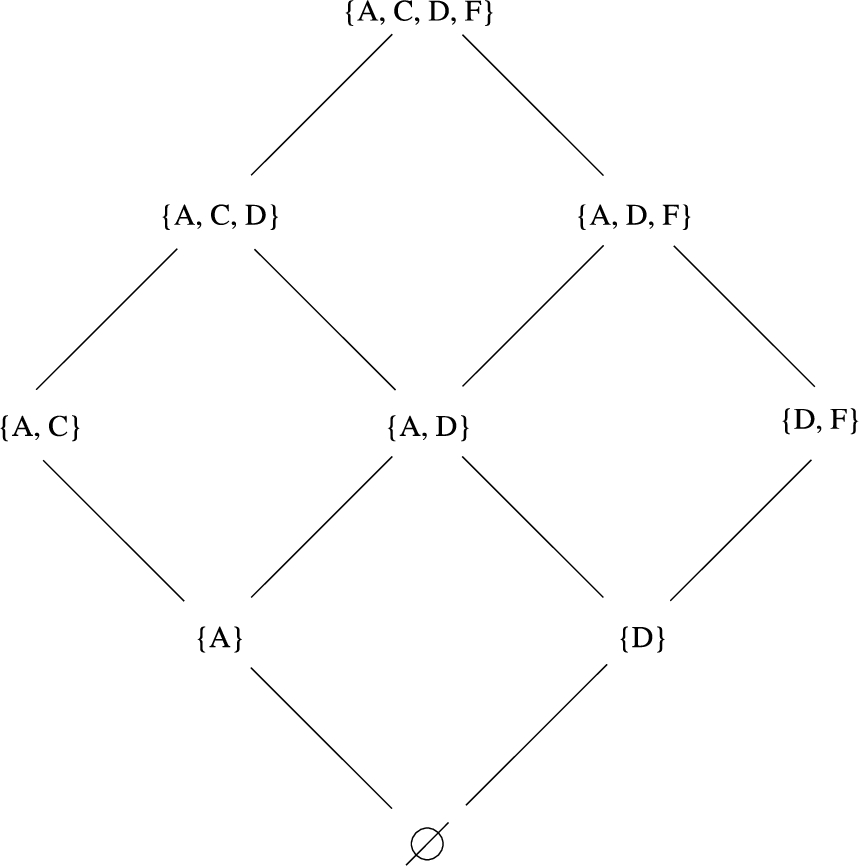
The strongly admissible sets of the argumentation framework of Fig. 1.
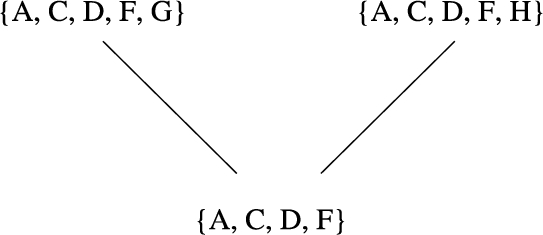
The complete extensions of the argumentation framework of Fig. 1.
In essence, if and are strongly admissible sets, then is their supremum, and is their infimum. By forming a lattice, with the empty set as its bottom element and the grounded extension as its top element, the strongly admissible sets differ from the admissible sets, which form a semi-lattice with the empty set as its bottom element, and the preferred extensions as its top elements [19]. It also distinguishes the strongly admissible sets from the complete extensions, which form a semi-lattice with the grounded extension as its bottom element and the preferred extensions as its top elements [19].
As an example, a Hasse diagram of the strongly admissible sets of the argumentation framerwork of Fig. 1 is shown in Fig. 2. Notice that (as specified by Theorem 5) the strongly admissible sets form a lattice with the empty set as its bottom element and the grounded extension as its top element. A Hasse diagram of the complete extensions of the argumentation framework of Fig. 1 is shown in Fig. 3. Notice that (as indicated in [19]) the complete extensions form a semi-lattice with the grounded extension as its bottom element and the preferred extensions as its top elements.
Strongly admissible labellings
Argument labellings [8,15] have become a popular approach for purposes such as argumentation algorithms [9,21,23], argument-based judgment aggregation [16,17] and issues of measuring distance of opinion [6]. In the current section, we develop a labelling account of strong admissibility, which will subsequently be used to analyse some of the existing discussion games for grounded semantics.
To define a strongly admissible labelling, we first have to introduce the concept of a min–max numbering.7
The intuition behind the min–max number of an argument is that of the game-theoretic length of the path (consisting of alternately and labelled arguments) from the argument back to an unattacked ancestor argument. The player selecting the labelled arguments aims to make the path as short as possible whereas the player selecting the labelled arguments aims to make the path as long as possible.
Let be an admissible labelling of argumentation framework . A min–max numbering is a total function such that for each it holds that:
if then (with defined as 0)
if then (with defined as ∞)
To illustrate the concept of a min–max numbering, consider again the argumentation framework of Fig. 1. Here, the admissible labelling has min–max numbering , and the admissible labelling has min–max numbering .
Every admissible labelling has a unique min–max numbering.
Let be an admissible labelling, and let . Now consider the sequence as defined in Lemma 2. For each we define as
For each we define as
We first prove that is a correct min–max numbering. For this, we need to prove the following two properties from Definition 9:
if then
Let such that . We distinguish two cases:
In that case, , where i is the lowest number such that . We first observe that (otherwise ). In case it holds that , so A is defended by ∅ so A does not have any attackers, so , which is indeed equal to for . In the remaining part of this proof we will therefore focus on the case where . In that case so A is defended by , which means that each B that attacks A is attacked by some , so attacks B. As B is labelled (as is an admissible labelling) from the fact that attacks B it follows that each labelled attacker of A has a min–max number of at most . However, the fact that (as i is the lowest number such that ) implies that there exists at least one labelled attacker of A with min–max number of exactly . Therefore so A is numbered correctly.
In that case, . From the fact that it follows that for any , which means that . As , it follows that for any . This means that there exists a B that attacks A and is not attacked by (for any i). So B is not attacked by . It also holds that B is labelled , as is an admissible labelling. Hence, B is numbered ∞. Therefore so A is numbered correctly.
if then
Let such that . We distinguish two cases:
attacks A
In that case, , where i is the lowest number such that attacks A. We first observe that (otherwise so which would not be able to attack A). The fact that attacks A means that there is some that attacks A such that (as because ). From this, it follows that the min–max number of B is at most . The fact that does not attack A (as i is the lowest number such that attacks A) means there is no that attacks A such that . Therefore, it follows that no labelled attacker of A can have a min–max number of or lower, which together with the fact that the min–max number of any labelled argument has to be odd means that any labelled attacker of A has to be at least . This implies that the min–max number of B is precisely . We have therefore obtained that there is at least one labelled attacker of A that is numbered , and that every labelled attacker of A is numbered at least . Therefore, so A is numbered correctly.
does not attack A
In that case, . From the fact that does not attack A it follows that for each attacker B of A it holds that . This implies that each labelled attacker B of A has a min–max number of ∞. Also, A has at least one such labelled attacker (as is an admissible labelling). Therefore so A is numbered correctly.
Now that we have proved that each admissible labelling has a min–max numbering, the next thing to prove is that this min–max numbering is unique. Let and be two min–max numberings of the same admissible labelling . We now prove, by strong induction over , that for each , iff .
basis
“⇒”: Let . This can only be the case if A is labelled and does not have any attackers. This means that is also 1.
“⇐”: Similar to “⇒”.
step
Suppose that for each it holds that iff .
“⇒”: Let . We distinguish two cases:
. In that case, so . This implies that for each labelled attacker B of A, it holds that is at most i. Hence, we can apply the induction hypothesis and infer that . Therefore, .
. In that case so . This means there is at least one labelled B that attacks A such that . From the induction hypothesis we infer that . Furthermore, for each the induction hypothesis tells us that iff . Therefore, from the fact that no labelled attacker of A is numbered less than i by it follows that also no labelled attacker of A is numbered less than i by . Therefore, .
“⇐”: Similar to “⇒”.
From the thus proved fact that for each , iff , together with the fact that each min–max number has to be in it follows that also iff . Hence, we have that for each , , so . □
Using the concept of a min–max numbering, we can proceed to define the concept of a strongly admissible labelling.
A strongly admissible labelling is an admissible labelling whose min–max numbering yields natural numbers only (so no argument is numbered ∞).
From Definition 10 it directly follows that every strongly admissible labelling is also an admissible labelling. Also, there exists a clear connection between strongly admissible labellings and strongly admissible sets, as one can be converted into the other.
Letbe an argumentation framework.
for every strongly admissible set, it holds thatis a strongly admissible labelling
for every strongly admissible labelling, it holds thatis a strongly admissible set
Let be a strongly admissible set. This means that . The procedure specified in the proof of Theorem 6 makes sure that every argument in () is numbered with a natural number (note: each such argument is labelled ). As it follows that each argument in (that is, each labelled argument) is numbered with a natural number. It then follows (from Definition 9) that also each labelled argument is numbered with a natural number. This means that no argument is numbered ∞, thus satisfying the condition of Definition 10.
Let be a strongly admissible labelling. This means that each or labelled argument is numbered with a natural number. As the min–max number of can be constructed using the procedure explained in the proof of Theorem 6, the fact that each labelled argument A is assigned a natural number means that for each there is an i such that . This means that . This, together with the fact that for each , implies that which means that is a strongly admissible set. □
Please notice that strongly admissible labellings and strongly admissible sets are not one-to-one related; instead, they are many-to-one related. As an example, in the argumentation framework of Fig. 1 the strongly admissible set is related to two strongly admissible labellings: and .
The fact that strongly admissible sets and strongly admissibe labellings are not one-to-one related unfortunately means that some of the results for strongly admissible sets (for instance Theorem 5) do not automatically carry over to strongly admissible labellings. Instead, they need to be proved separately.
Ifandare strongly admissible labellings, thenis also a strongly admissible labelling.
Let and . From Theorem 7 it then follows that and are strongly admissible sets, hence (Lemma 3) is also a strongly admissible set. Let . From Theorem 7 it follows that is a strongly admissible labelling. Let be the min–max numbering of this strongly admissible labelling. How does compare with ? We start with making the following thee observations.
is an admissible labelling.
This is because is a strongly admissible labelling.
is an admissible labelling.
From the fact that is a strongly admissible set, it follows that is conflict-free, so and do not attack each other. This implies that and , which means that . That is, we obtain that and that . Hence, each argument that is labelled by has all its attackers labelled by (this folows from the fact that and are admissible labellings) and each argument that is labelled by has an attacker that is labelled by (which again follows from the fact that and are admissible labellings). This means that is an admissible labelling.
.
In the previous point, it was observed that . As we have that (as ) and (as ) it holds that (as as observed in the previous point). As (as ) we obtain that .
We define the min–max numbering of such that for each . We now prove that is a correct min–max numbering. For this, we need to show two things:
if then
As and are both admissible labellings, it holds that all attackers of an labelled argument are labelled . This implies that argument A, which is labelled by and is therefore also labelled by (as ) has the same labelled attackers in both and . As the labelled attackers of A are numbered the same by as by we have that . This, together with the fact that (as is a correct min–max numbering) and the fact that implies that .
if then
As it holds that the labelled argument A has the same labelled attackers in both and . As the labelled attackers of A are numbered the same by as by we have that . This, together with the fact that (as is a correct min–max numbering) and the fact that implies that .
Hence, we have established that is a correct min–max numbering of , one that numbers each argument that is labelled or by the same as . As does not number any argument with ∞ (as is a strongly admissible labelling) it follows that also does not number any argument with ∞. Hence, is a strongly admissible labelling. □
Each admissible labellinghas a unique biggest (w.r.t. ⊑) strongly admissible sublabelling.
Similar to the proof of Lemma 4, but with , and replaced by , and , with ⊆ and ∩ replaced by ⊑ and ⊓ and Lemma 3 replaced by Lemma 5. □
If is an admissible labelling, then we write for its biggest (w.r.t. ⊑) strongly admissible sublabelling.
Letbe an argumentation framework. The strongly admissible labellings of this framework form a lattice (w.r.t. ⊑).
Similar to the proof of Theorem 5, with , , , , and replaced by , , , , and , ⊆, ∪ and ∩ replaced by ⊑, ⊔ and ⊓, and Lemma 4 replaced by Lemma 6. ⊆ replaced by ⊑, ∪ replaced by ⊔ and ∩ replaced by ⊓. □
Computational complexity
Regarding the issue of computational complexity, one can distinguish the standard decision problems of credulous acceptance, sceptical acceptance and verification.
The formal statement of these decision problems (which are defined for any extension based argumentation semantics σ) is presented in Table 1. In this, we use σ to described an arbitrary semantics, e.g. any of the cases given in Definition 3, although our principal interest will be the case of σ being the class of strongly-admissible sets; for the set of all subsets of arguments within a framework that satisfy the criteria given by σ, e.g. is the set of all admissible sets in the framework .
Decision problems in argumentation semantics
Problem
Instance
Question
Formal statement
ca
,
Is x credulously accepted?
and ?
sa
,
Is x sceptically accepted?
?
ver
Does S satisfy the criteria of σ?
?
The credulous acceptance problem for strong admissibility reduces to deciding if the given argument, x, is in the grounded extension, as the grounded extension is the (unique) biggest (w.r.t. ⊆) strongly admissible set [3]. Hence, the credulous acceptance problem of strong admissibility is of polynomial complexity.
As for sceptical acceptance, the issue is to determine whether a particular argument is in every strongly admissible set. However, as the empty set is always strongly admissible, this decision problem is trivial as the answer is always negative.
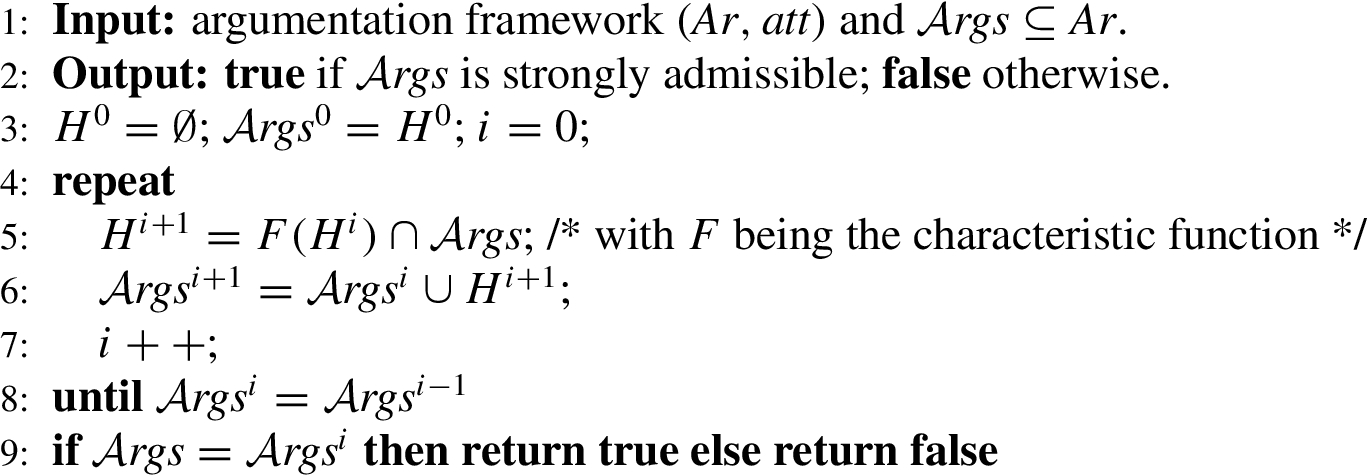
The verification problem is more interesting in that it is not simply a matter of testing if S is a subset of the grounded extension, i.e. although S being such a subset is a necessary condition for strong-admissibility it is not a sufficient condition. In determining if a set S is strongly admissible one could use Algorithm 1.
Verification of as a strongly admissible set
The correctness of Algorithm 1 follows from Theorem 1 and Lemma 2. To see this, notice that the algorithm accumulates a subset of (in ) stopping when there is no change to the existing subset (i.e. that forming ) and using the final set to compare with the candidate subset . The set(s) are formed by the adding the intersection of the characteristic function of with the set, , being tested. This set, starts () from the empty set. Overall the process of computing successive subsets and the concomitant changes to mimics exactly the stages applied in the proof of Theorem 1 using the result of Lemma 2 as support.
As we only consider finite argumentation frameworks, the algorithm is guaranteed to terminate.
The maximal number of loop iterations is of the order because at each iteration there will be at least one argument added (this must be the case for otherwise we would have resulting in the loop terminating at line 8) until the loop terminates. As for the set operations of union and intersection, it holds that and each require the order of operations, provided that appropriate data structures are being used. For the above algorithm, this would be , so no more than for each loop iteration. As there are no more than loop iterations, this implies the maximal number of steps for doing the set operations is in the order of .
As for determining the number of operations of the F-operator, the easiest way to do this is to consider the total number of operations, throughout all loop iterations. Calculating can be done basically by removing the arguments of from the argumentation framework (together with the attacks from and to ) and then examining which arguments have no attackers (this is one standard approach used in computing the grounded extension). Point 1 of Lemma 2 implies that this can be done in an iterative way when it comes to calculating each . As no more than edges can be removed from the graph, there can be at most edges relevant to any . Note that the maximum number of attacks that could be present in any framework satisfies , so it holds that the number of operations is at most for computing the outcome of the characteristic functions. This, together with the number of operations required for computing the union and intersection (which is also ) means the total number of required operations is in the order of , so of polynomial complexity.
As an aside, please notice that in order to simplify the above discussion, we have formulated Algorithm 1 in a way that is closely aligned to Lemma 2 and Theorem 1. However, it can be observed that for every i it holds that (this is because of point 1 of Lemma 2). Hence, it would be possible to do away with in the above algorithm, and only use instead. We observe that this does not affect the overall complexity of the algorithm, which remains in the order of .
Strong admissibility and argument games
Now that some of the formal properties of strong admissibility have been examined, the next step is to study some of its applications. In particular, it turns out that strong admissibility is one of the corner stones of the discussion games for grounded semantics.
The standard grounded game
As far as we are know, the Standard Grounded Game [7,21,26] was the first dialectical proof procedure to determine whether a particular argument is in the grounded extension.
A discussion in the Standard Grounded Game is a finite sequence () of arguments (sometimes called moves), of which the odd moves are called P-moves (Proponent moves) and the even moves are called O-moves (Opponent moves), such that:
every O-move is an attacker of the preceding P-move (that is, every where i is even and attacks )
every P-move except the first one is an attacker of the preceding O-move (that is, every where i is odd and attacks )
P-moves are not repeated (that is, for every odd it holds that if then )
A discussion is called terminated iff there is no such that is a discussion. A terminated discussion is said to be won by the player making the last move.
An argument tree is a tree of which each node () is labelled with an argument (). The level of a node is the number of nodes in the path to the root.
A winning strategy of the Standard Grounded Game for argument A is an argument tree, where the root is labelled with A, such that
for each path from the root () to a leaf node () it holds that the arguments on this path form a terminated discussion won by P
for each node at odd level it holds that and the number of children of is equal to the number of attackers of
each node of even level has precisely one child , and attacks
The soundness and completeness of the Standard Grounded Game depends on the presence of a winning strategy. That is, an argument A is in the grounded extension iff there exists a winning strategy for A. Interesting enough, it turns out that such a winning strategy defines a strongly admissible set containing A.
The set of all proponent moves in a winning strategy of the Standard Grounded Game is strongly admissible.
We prove this by induction over the depth (i) of the winning strategy game tree.
basis
. In that case, the winning strategy consists of a single argument (say, A). This means that A has no attackers. Hence, is a strongly admissible set.
step
Suppose that every winning strategy of depth less or equal than i has its proponent moves constituting a strongly admissible set. We need to prove that also every winning strategy of depth has its proponent moves constituting a strongly admissible set. Let be a winning strategy of depth . Let A be the argument at the root of the tree. Let be the subtrees whose roots are at distance 2 of the root of . The induction hypothesis states that for each of these subtrees (), their set of proponent moves constitutes a strongly admissible set. Therefore (by Lemma 3) the set is strongly admissible. Also, (this is because the proponent is not allowed to repeat his moves). Let B be an arbitrary argument in (the set of all proponent moves in the winning strategy). We distinguish two cases:
. Then, since is a strongly admissible set, there exists an that defends B and is itself strongly admissible. Since , it also holds that .
. Then (the root of the tree ). The structure of the tree is such that B is defended by the roots of . So B is defended by the strongly admissible set . Also , so , therefore satisfying Definition 8. □
It can also be observed that a winning strategy defines a strongly admissible labelling.
Letbe the set of proponent moves andbe the set of opponent moves of a particular winning strategy given an argumentation framework. It holds thatis a strongly admissible labelling.
Given that is strongly admissible (Theorem 9) it then follows from Theorem 7 that is a strongly admissible labelling. Now consider . Notice that , otherwise would not be an admissible set. Also, from the structure of a winning strategy (with the Opponent playing all possible attackers of each Proponent move as its children) it follows that . Hence, . has the same min–max numbering as (minus the arguments that are no longer in , since , as ). This is because the -labelled arguments in do not influence the min–max numbers of the -labelled arguments in . It then follows that the min–max numbers of the -labelled arguments in also stay the same. Hence, the min–max numbering of is essentially a restricted version (with a smaller domain) of the min–max numbering of . So from the fact that is a strongly admissible labelling (not yielding ∞) it directly follows that is a strongly admissible labelling (not yielding ∞). □
Hence, given a winning strategy of the Standard Grounded Game, the set of all proponent moves and the set of all opponent moves essentially define a strongly admissible labelling.
The grounded discussion game
Like the Standard Grounded Game, the Grounded Discussion Game [11] is a proof procedure to determine whether a particular argument is a member of the grounded extension. The game has two players (proponent and opponent) and is based on four different moves, each of which has an argument as a parameter.
(“A has to be the case”)
With this move, the proponent claims that argument A has to be labelled by every complete labelling (and hence also has to be labelled by the grounded labelling).
(“B can be the case, or at least cannot be ruled out”)
With this move, the opponent claims that argument B does not have to be labelled by every complete labelling. That is, the opponent claims there exists at least one complete labelling where B is labelled or , and that B is therefore not labelled by the grounded labelling.
(“Fair enough, I agree that A has to be the case”)
With this move, the opponent indicates that he now agrees with the proponent (who previously did a move) that A has to be the case (labelled by every complete labelling, including the grounded labelling).
(“Fair enough, I give up that B can be the case”)
With this move, the opponent indicates that he no longer beliefs that argument B can be or . That is, the opponent acknowledges that B has to be labelled by every complete labelling, including the grounded labelling.
One of the key ideas of the discussion game is that the proponent has burden of proof. He has to establish the acceptance of the main argument. The opponent merely has to cast sufficient doubts. Also, the proponent has to make sure that the discussion does not go around in circles.
The game starts with the proponent uttering a statement. After each statement (either the first one or a subsequent one) the opponent utters a sequence of one or more , and statements, after which the proponent again utters an statement, etc. In the argumentation framework of Fig. 1 the discussion could go as follows.
In the above discussion, C is called the main argument (the argument the discussion starts with). The discussion ends with the main argument being conceded by the opponent, which means the proponent wins the discussion.
As an example of a discussion that is lost by the proponent, it can be illustrative to examine what happens if, still in the argumentation framework of Fig. 1, the proponent claims that B has to be the case.
After the second move, the discussion is terminated, as the proponent cannot move anymore, since A does not have any attackers. This brings us to the precise preconditions of the discussion moves.
This is either the first move, or the previous move was , where A attacks B, and no or move is applicable.
A is an attacker of the last statement that is not yet conceded, the directly preceding move was not a statement, argument A has not yet been retracted, and no or move is applicable.
There has been a statement in the past, of which every attacker has been retracted, and has not yet been moved.
There has been a statement in the past, of which there exists an attacker that has been conceded, and has not yet been moved.
Apart from the preconditions mentioned above, all four statements also have the additional precondition that no - repeats have occurred. That is, there should be no argument for which has been uttered more than once, has been uttered more than once, or both and have been uttered. In the first and second case, the discussion is going around in circles (which the proponent has to prevent, since he has burden of proof). In the third case, the proponent has been contradicting himself, as his statements are not conflict-free. In each of these three cases, the discussion comes to an end with no move being applicable anymore.
The above conditions are made formal in the following definition.
Let be an argumentation framework. A grounded discussion is a sequence of discussion moves constructed by applying the following principles.
BASIS ()
If then is a grounded discussion.
STEP ()
If () is a grounded discussion without - repeats,8
A move is applicable iff the discussion contains a move and for every attacker A of B the discussion contains a move , and the discussion does not already contain a move . A move is applicable iff the discussion contains a move and there is an attacker A of B such that the discussion contains a move , and the discussion does not already contain a move .
and and B is an attacker of A then is also a grounded discussion.
STEP ()
If () is a grounded discussion without - repeats, and no or move is applicable, and is not a move, and there is a move () such that the discussion does not contain , and for each move () the discussion contains a move , and B is an attacker of A such that the discussion does not contain a move , then is a grounded discussion.
STEP ()
If () is a grounded discussion without - repeats, and is applicable then is a grounded discussion.
STEP ()
If () is a grounded discussion without - repeats, and is applicable then is a grounded discussion.
It can be observed that the preconditions of the moves are such that a proponent move () can never be applicable at the same moment as an opponent move (, or ). That is, proponent and opponent essentially take turns in which each proponent turn consists of a single statement, and every opponent turn consists of a sequence of , and moves.
A grounded discussion is called terminated iff there exists no move such that is a grounded discussion. A terminated grounded discussion (with being for some ) is won by the proponent iff the discussion contains , otherwise it is won by the opponent.
To illustrate why the discussion has to be terminated after the occurrence of a - repeat, consider the following discussion in the argumentation framework of Fig. 1.
After the third move, an - repeat occurs and the discussion is terminated (opponent wins). Hence, termination after a - repeat is necessary to prevent the discussion from going on perpetually.
It has been proved [11,12] that the Grounded Discussion Game is a sound and complete proof procedure for determining whether an argument is in the grounded extension. More specifically,
(soundness)
if a discussion for a particular argument has been won by the proponent, then the argument is in the grounded extension, and
(completeness)
if an argument is in the grounded extension, then the proponent is able to win the game for the argument (that is, the proponent has a winning strategy)
As for the first point (soundness) it can be observed that if one would label the arguments of moves , the arguments of moves and all other arguments , the result is a strongly admissible labelling at each state of the discussion game. If this game is ultimately won by the proponent, then the main argument has been d. Hence, the result is a strongly admissible labelling where the main argument is labelled . This means the main argument is in the grounded extension.
As for the second point (completeness) it can be observed that the grounded labelling, together with its associated min–max numbering, serves as a roadmap that allows the proponent to win the game. In essence, the proponent does this by using only labelled arguments to select the moves, and to select the labelled argument with a lowest min–max number whenever there is a choice. We refer to [11,12] for details.
The Standard Grounded Game (SGG) vs. the Grounded Discussion Game (GDG)
So far, we have seen that both the SGG and the GPG show membership of the grounded extension essentially by building a strongly admissible labelling where the argument in question is labelled .10
Similarly, it can be observed that for instance the credulous preferred game [14,27] shows membership of a preferred extension essentially by building an admissible labelling around the argument in question.
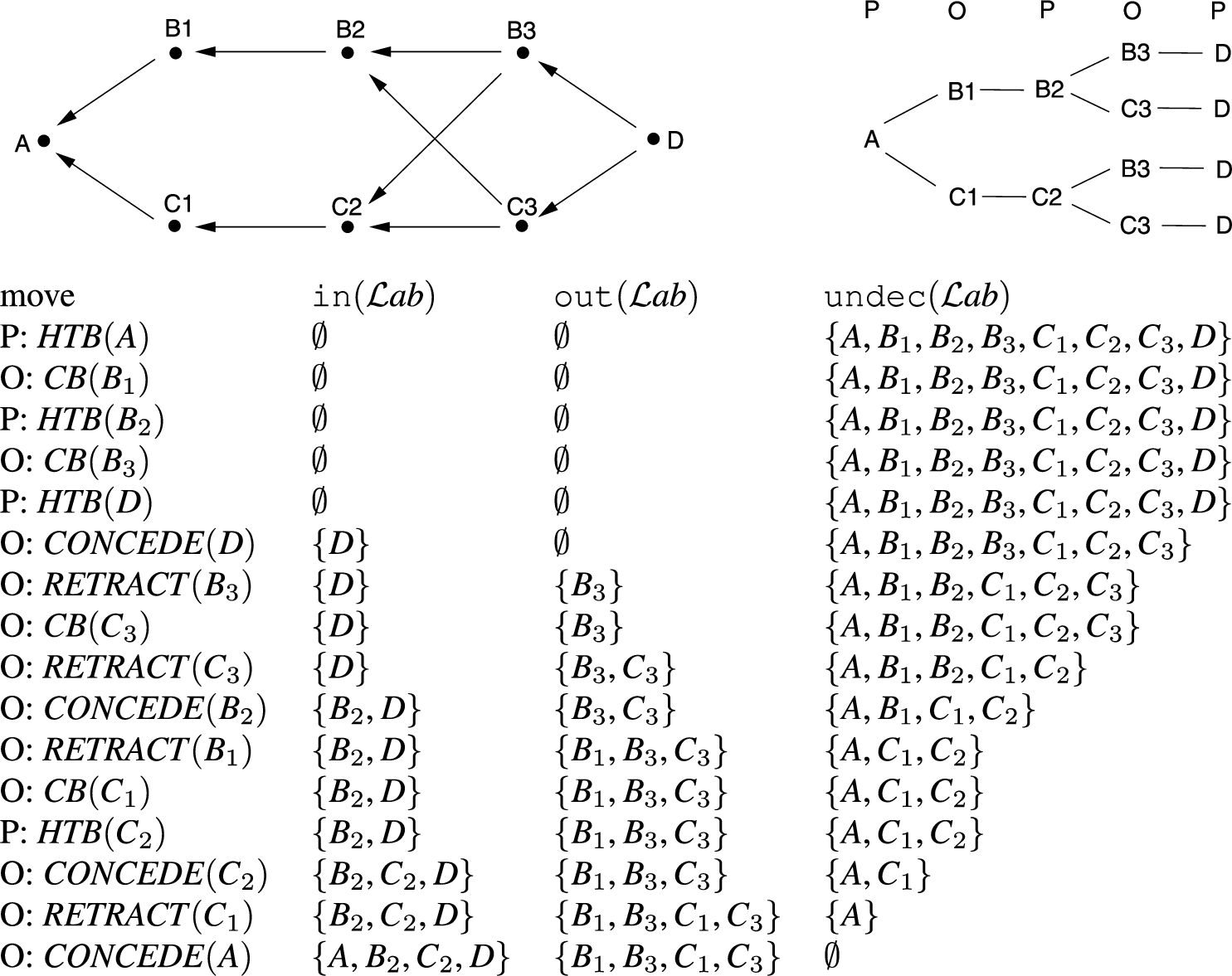
This raises the question of how many steps each of these games requires for doing so. Consider the argumentation framework of Fig. 4 (top left). The winning strategy of the SGG is in the same figure (top right). Now consider what would happen if one would start to extend the argumentation framework by duplicating the middle part. That is, suppose we have arguments and (with n being an odd number), as well as arguments A and D. Suppose that for every attacks , and attacks , and that for each even attacks , and attacks , and that and attack A, and that D attacks and . In that case, the branches in the SGG winning strategy would split at every O-move. So for (as is the case in Fig. 4) the number of branches is four, for it is eight, etc. In general, the number of branches in the SGG winning strategy is , with the number of nodes in the SGG winning strategy being . Hence, the number of steps needed in a winning strategy of the SGG can be exponential in relation to the /-size11
We recall that with the /-size of a labelling we mean .
of the strongly admissible labelling that the SGG winning strategy is constructing.12
We thank Mikołaj Podlaszewski for this example.
The Standard Grounded Game (SGG) versus the Grounded Discussion Game (GDG).
As for the Grounded Discussion Game, the situation is different. It can be proven [11,12] that the proponent always has a strategy for the game that results in the total number of moves being where the strongly admissible labelling that is built up during the discussion game. This labelling is such that consists of all arguments that have been subject to a move and consists of all arguments that have been subject to a move. An example of a game that results from such a strategy is provided in Fig. 4.
Overall, we observe that both the Standard Grounded Game and the Grounded Discussion Game prove that an argument is in the grounded extension by building a strongly admissible labelling around it. However, where the Standard Grounded Game can require a number of moves that is exponential in relation to the /-size of the strongly admissible labelling, the Grounded Discussion game requires a number of moves that is always linear in relation to the /-size of the strongly admissible labelling.
Discussion and future research
In the current paper, we have re-examined the concept of strong admissibility, from both theoretical and practical perspectives. From theoretical perspective, we have observed that the strongly admissible sets form a lattice with the empty set as bottom element and the grounded extension as top element. Also, we have developed the concept of a strongly admissible labelling, and shown how it relates to the concept of a strongly admissible set. From practical perspective, we have examined how strongly admissible labellings lie at the basis of both the Standard Grounded Game [21] and the Grounded Discussion Game [11,12]. Although both essentially construct a strongly admissible labelling around the argument in question, the Grounded Discussion Game does so using a linear number of steps, whereas the Standard Grounded Game can require an exponential number of steps.
An alternative definition of a strongly admissible set is given by Baumann et al. [4]. Basically, the idea is that a set of is strongly admissible iff there are finitely many and pairwise disjoint sets such that (1) , (2) , and (3) defends (). Baumann et al. [4] prove that their definition is equivalent with Definition 8 of the current paper (which first appeared in [10]). One particular issue with their definition is that they do not specify how to actually obtain the sequence . However, we observe that it is fairly easy to convert the sequence as specified in Lemma 2 to a corresponding sequence . This can be done by first identifying n to be the lowest number such that (which implies that for each ) and then taking and ().
The idea of numbering arguments (such as is done in a min–max numbering) can be traced back to the work of Pollock [24], who gives an iterative procedure (basically for computing the grounded extension, as is explained by Dung [19]) in which arguments become and at different levels during the algorithm [24, Algorithm 2]. It has to be mentioned, however, that Pollock’s algorithm (the ideas of which have also been applied in [2]) computes the entire grounded extension (in a way that is similar to what is done in [21]) and is not applicable to the concept of a strongly admissible set (or labelling) in general.
One of the things to be examined in the future is how the concept of strong admissibility can be useful in identifying the shortest discussion that shows an argument (A) is in the grounded extension. For instance, we conjecture that for each minimal (w.r.t. ⊑) strongly admissible labelling that labels A, there exists a discussion under the Grounded Persuasion Game for argument A that builds precisely this labelling. However, there can be more than one such labelling. For argument F in Fig. 1, for instance, both and are minimal (w.r.t. ⊑) strongly admissible labellings that label F, but the /-size of the second labelling is smaller than that of the first labelling, thus yielding a shorter discussion. How to precisely obtain such a strongly admissible labelling with minimal size is a topic for further investigation.
Finally there are a number of questions that would merit further consideration with respect to complexity issues. For example, although the canonical decision problems (credulous and sceptical acceptance, verification) for the strong admissibility semantics are tractable having polynomial-time sequential algorithms, it seems unlikely that verification would have efficient parallel algorithms. The notion of “efficient parallel algorithm” being one that can be realised using a logarithmic depth Boolean combinational circuit. A formal demonstration that such is indeed the case would be achieved by showing the verification problem to be p-complete. In view of the supporting technical detail that would be required in exploring this question we have not pursued it in the current article.
A question of some considerable interest whose status is far from clear concerns the following: given two argumentation frameworks and (that is with identical arguments but not necessarily identical attacks), do their strongly admissible sets coincide? That is, is the case that ? Alternatively we could examine if . It is worth noting that the “equivalence by set equality” is only one such definition, but there are alternatives: we could also ask about the existence of a relabelling of arguments so that the two frameworks become identical. It is worth noting two further aspects of this question: firstly, unlike previously studied and superficially similar problems, e.g. coincidence of stable and preferred semantics from [20] the question involves more than a single framework (although given an appropriate semantics, σ, the question may also be non-trivial: while some instances, e.g. preferred semantics, reduce to known cases since if and only if others are less so). A second point is the how much “obvious” necessary conditions can be exploited, e.g. “in order for to hold the number of unattacked arguments in each must be equal” (otherwise there will be different single argument strongly admissible sets in the two). While conditions such as these suggest a natural way of progressing from single to two to k argument set comparisons, there is potentially an exponential increase in the number of sets being compared as the process continues. Such further algorithmic and complexity issues are the topic of continuing work.
Footnotes
Acknowledgements
We would like to thank Ringo Baumann and the anonymous reviewers for their useful comments.
References
1.
P.Baroni, M.W.A.Caminada and M.Giacomin, An introduction to argumentation semantics, Knowledge Engineering Review26(4) (2011), 365–410. doi:10.1017/S0269888911000166.
2.
P.Baroni and M.Giacomin, Self-stabilizing defeat status computation: Dealing with conflict management in multi-agent systems, Artificial Intellligence165 (2005), 187–259. doi:10.1016/j.artint.2005.02.003.
3.
P.Baroni and M.Giacomin, On principle-based evaluation of extension-based argumentation semantics, Artificial Intelligence171(10–15) (2007), 675–700. doi:10.1016/j.artint.2007.04.004.
4.
R.Baumann, T.Linsbichler and S.Woltran, Verifiability of argumentation semantics, in: Computational Models of Argument; Proceedings of COMMA 2016, P.Baroni, T.F.Gordon, T.Scheffler and M.Stede, eds, 2016, pp. 83–94.
5.
T.J.M.Bench-Capon, Dilemmas and paradoxes: Cycles in argumentation frameworks, Journal of Logic and Computation (2014).
6.
R.Booth, M.W.A.Caminada, M.Podlaszewski and I.Rahwan, Quantifying disagreement in argument-based reasoning, in: Proceedings of the 11th International Conference on Autonomous Agents and Multiagent Systems, 2012.
7.
M.W.A.Caminada, For the sake of the Argument. Explorations into argument-based reasoning, PhD thesis, Vrije Universiteit Amsterdam, 2004.
8.
M.W.A.Caminada, On the issue of reinstatement in argumentation, in: Logics in Artificial Intelligence; 10th European Conference, JELIA 2006, M.Fischer, W.van der Hoek, B.Konev and A.Lisitsa, eds, LNAI, Vol. 4160, Springer, 2006, pp. 111–123.
9.
M.W.A.Caminada, An algorithm for computing semi-stable semantics, in: Proceedings of the 9th European Conference on Symbolic and Quantitalive Approaches to Reasoning with Uncertainty (ECSQARU 2007), Springer Lecture Notes in AI, Springer Verlag, Berlin, 2007, pp. 222–234. doi:10.1007/978-3-540-75256-1_22.
10.
M.W.A.Caminada, Strong admissibility revisited, in: Computational Models of Argument, Proceedings of COMMA 2014, S.Parsons, N.Oren, C.Reed and F.Cerutti, eds, IOS Press, 2014, pp. 197–208.
11.
M.W.A.Caminada, A discussion game for grounded semantics, in: Theory and Applications of Formal Argumentation (Proceedings TAFA 2015), E.Black, S.Modgil and N.Oren, eds, Springer, 2015, pp. 59–73. doi:10.1007/978-3-319-28460-6_4.
12.
M.W.A.Caminada, A Discussion Protocol for Grounded Semantics (proofs), Technical Report, University of Aberdeen, 2015.
13.
M.W.A.Caminada and L.Amgoud, On the evaluation of argumentation formalisms, Artificial Intelligence171(5–6) (2007), 286–310. doi:10.1016/j.artint.2007.02.003.
14.
M.W.A.Caminada, W.Dvořák and S.Vesic, Preferred semantics as Socratic discussion, Journal of Logic and Computation26 (2014), 1257–1292. doi:10.1093/logcom/exu005.
15.
M.W.A.Caminada and D.M.Gabbay, A logical account of formal argumentation, Studia Logica93(2–3) (2009), 109–145, Special issue: New ideas in argumentation theory. doi:10.1007/s11225-009-9218-x.
16.
M.W.A.Caminada and G.Pigozzi, On judgment aggregation in abstract argumentation, Autonomous Agents and Multi-Agent Systems22(1) (2011), 64–102. doi:10.1007/s10458-009-9116-7.
17.
M.W.A.Caminada, G.Pigozzi and M.Podlaszewski, Manipulation in group argument evaluation, in: Proceedings of the Twenty-Second International Joint Conference on Artificial Intelligence, T.Walsh, ed., 2011, pp. 121–126.
18.
M.W.A.Caminada and M.Podlaszewski, Grounded semantics as persuasion dialogue, in: Computational Models of Argument – Proceedings of COMMA 2012, B.Verheij, S.Szeider and S.Woltran, eds, 2012, pp. 478–485.
19.
P.M.Dung, On the acceptability of arguments and its fundamental role in nonmonotonic reasoning, logic programming and n-person games, Artificial Intelligence77 (1995), 321–357. doi:10.1016/0004-3702(94)00041-X.
20.
P.E.Dunne and T.J.M.Bench-Capon, Coherence in finite argument systems, Artificial Intelligence141(1–2) (2002), 187–203. doi:10.1016/S0004-3702(02)00261-8.
21.
S.Modgil and M.W.A.Caminada, Proof theories and algorithms for abstract argumentation frameworks, in: Argumentation in Artificial Intelligence, I.Rahwan and G.R.Simari, eds, Springer, 2009, pp. 105–129. doi:10.1007/978-0-387-98197-0_6.
22.
S.Modgil and H.Prakken, A general account of argumentation with preferences, Artificial Intellligence195 (2013), 361–397. doi:10.1016/j.artint.2012.10.008.
23.
S.Nofal, K.Atkinson and P.E.Dunne, Algorithms for decision problems in argumentation systems under preferred semantics, Artificial Intelligence207 (2014), 23–51. doi:10.1016/j.artint.2013.11.001.
24.
J.L.Pollock, How to reason defeasibly, Artificial Intelligence57 (1992), 1–42. doi:10.1016/0004-3702(92)90103-5.
25.
H.Prakken, An abstract framework for argumentation with structured arguments, Argument and Computation1(2) (2010), 93–124. doi:10.1080/19462160903564592.
26.
H.Prakken and G.Sartor, Argument-based extended logic programming with defeasible priorities, Journal of Applied Non-Classical Logics7 (1997), 25–75. doi:10.1080/11663081.1997.10510900.
27.
G.A.W.Vreeswijk and H.Prakken, Credulous and sceptical argument games for preferred semantics, in: Proceedings of the 7th European Workshop on Logic for Artificial Intelligence (JELIA-00), Springer Lecture Notes in AI, Springer Verlag, Berlin, 2000, pp. 239–253. doi:10.1007/3-540-40006-0_17.