




Abstract
An abstract framework for structured arguments is presented, which instantiates Dung's (‘On the Acceptability of Arguments and its Fundamental Role in Nonmonotonic Reasoning, Logic Programming, and n-Person Games’, Artificial Intelligence, 77, 321–357) abstract argumentation frameworks. Arguments are defined as inference trees formed by applying two kinds of inference rules: strict and defeasible rules. This naturally leads to three ways of attacking an argument: attacking a premise, attacking a conclusion and attacking an inference. To resolve such attacks, preferences may be used, which leads to three corresponding kinds of defeat: undermining, rebutting and undercutting defeats. The nature of the inference rules, the structure of the logical language on which they operate and the origin of the preferences are, apart from some basic assumptions, left unspecified. The resulting framework integrates work of Pollock, Vreeswijk and others on the structure of arguments and the nature of defeat and extends it in several respects. Various rationality postulates are proved to be satisfied by the framework, and several existing approaches are proved to be a special case of the framework, including assumption-based argumentation and DefLog.
Introduction
In 1995, Phan Minh Dung introduced an abstract formalism for argumentation-based inference (Dung 1995), which assumes as input nothing else but a set (of arguments) ordered by a binary relation (of attack). Although he thus fully abstracted from the structure of arguments and the nature of the attack relation, he was still able to develop an extremely interesting theory. His article was a breakthrough in three ways: it provided a general and intuitive semantics for the consequence notions of argumentation logics (and for non-monotonic logics in general); it made a precise comparison possible between different systems (by translating them into his abstract format) and it made a general study of formal properties of systems possible, which are inherited by instantiations of his framework. In consequence, Dung's work has given an enormous boost to research in computational argumentation. Yet it has also been criticised for not specifying the structure of arguments and the nature of the attack relation, which makes it less suitable for modelling specific argumentation problems. I believe that such criticism fails to appreciate the nature of Dung's formalism. It is best seen not as a formalism for directly representing argumentation-based inference problems but as a tool for analysing particular argumentation systems and for developing a meta-theory of such systems. As such it has been very successful: differences between particular systems can be characterised in terms of some simple notions, and formal results established for the framework are inherited by its instantiations. This was already illustrated by Dung (1995) with reconstructions of Pollock's (1987) system, various logic-programming semantics and Reiter's (1980) default logic in his formalism.
Nevertheless, it is true that when actual argumentation-based inference has to be modelled, Dung's framework is by itself usually too abstract and instead an instantiated version of his approach should be used. However, here too abstraction is still possible and worthwhile. The aim of this paper is to instantiate Dung's abstract approach with a general account of the structure of arguments and the nature of the defeat relation.1
For reasons explained in Section 3, this paper will rename Dung's attack relations to ‘defeat’ relations and reserve the term ‘attack’ for something else.
The choice for tree-structured arguments based on two types of inference rules arguably is very natural both in light of logic and argumentation theory and when looking at argumentation as it occurs in human thinking and dialogue. The notion of arguments as trees of inferences is very common in standard logic and in argumentation theory and is the basis of many software tools for argument visualisation. Moreover, in actual argumentation, humans often express their arguments as claims supported with one or more premises, which can in turn be supported with further premises, and so on. Finally, as will be further explained in Section 4, the setup with general defeasible inference rules is very suited for modelling reasoning with argumentation schemes (Walton, Reed, and Macagno 2008).
The account offered in this paper is not completely new. In fact, a rhetorical aim of the paper is to counter the idea that the computational study of argumentation started with Dung's abstract approach and that only then researchers made it more concrete with accounts of the structure of arguments and the nature of defeat. As a matter of fact, much work on these two issues was already done or going on at the time when Dung wrote his paper, and some of this work is still state-of-the-art. For instance, both Pollock (1987, 1994) and Vreeswijk (1993, 1997) did important work on the structure of arguments, while Pollock (1974, 1987) introduced an important distinction between two kinds of defeat, namely rebutting defeat (attack on a conclusion) and undercutting defeat (attack on an inference rule). One aim of the present paper is to profit from, integrate and build on this and other important work as much as possible. As such, this paper is a further development of the integration attempt that was undertaken in the European ASPIC project (Amgoud et al. 2006). In this project, Vreeswijk's formalisation of the structure of arguments was combined with Pollock's definitions of rebutting and undercutting defeat in a way that also used insights from other work. The result was a characterisation of a set of tree-structured arguments ordered with a binary defeat relation, so that an instantiation of Dung's abstract approach was achieved and any of Dung's semantics could be used to compute the acceptability status of the structured arguments.
The ASPIC framework was developed by Leila Amgoud, Martin Caminada, Claudette Cayrol, Marie-Christine Lagasquie-Schieux, myself and Gerard Vreeswijk and was first reported in a European project deliverable (Amgoud et al. 2006). The added expressiveness compared with Dung's abstract formalism gave rise to further work by Caminada and Amgoud (2007) on rationality postulates for systems instantiating the ASPIC framework. The aim of this work was to propose the idea of rationality postulates and to criticise some specific rule-based argumentation systems for failing to satisfy them. For this aim, only a simplified version of the ASPIC framework was needed, without preferences and without the notion of a knowledge base. Moreover, the examples discussed by Caminada and Amgoud (2007) were all with domain-specific inference rules instead of with general inference patterns, which in effect somewhat obscured the potential of the framework to be a general account of structured argumentation.
In contrast, the present paper aims to present the ASPIC framework as a general abstract model of argumentation with structured arguments.2
In this paper, the term ‘framework’ will be used to denote the general model, to highlight that it can be instantiated in various ways (such instantiations will in turn be called argumentation systems). This contrasts with Dung's (1995) use of the term ‘argumentation framework’, which denotes a specific set of arguments with a specific attack relation. In the present paper, such specific inputs to an argumentation system will be called argumentation theories.
A third way of argument attack, namely premise attack or ‘undermining’, will be added, in a way inspired by Vreeswijk's (1993, chap. 8) combination of ‘plausible’ and ‘defeasible’ argumentation. Apart from the naturalness of having all three kinds of attack in a general framework for argumentation, this will make it easier to formalise argument schemes in the framework and it will make it possible to regard existing systems with premise attack as special cases of the framework.
The three notions of attack will be generalised from the notion of contradiction between formulas ϕ and
Four types of premises will be distinguished, inspired by a similar distinction of Gordon, Prakken, and Walton (2007).
Attack relations will be partly resolved with preference orderings on arguments, defeasible rules and the knowledge base (although Amgoud et al. (2006) also have preferences, the results of Caminada and Amgoud (2007) do not cover them).
First without explanation, the basic concepts and insights of Dung's abstract argumentation approach are listed. For a state-of-the-art introduction, see Baroni and Giacomin (2009).
abstract argumentation framework
An abstract argumentation framework (AF) is a pair
conflict-free, defence
Let A set A set
acceptability semantics
Let
the grounded extension is indeed unique but all other semantics allow for multiple extensions of an AF; each AF has a grounded and at least one preferred and complete extension, but there are AFs without stable extensions; the grounded extension of an AF is contained in all other extensions of that AF.
Note that this implies that each grounded, preferred or stable extension of an AF is also a complete extension of that AF. Some other known results are that
Argumentation systems with structured arguments
In this section, the arguments of Dung's argumentation frameworks are given structure and its defeat relation is defined in terms of the structure of arguments plus external preference information. Apart from this, the resulting formalism is still as abstract as possible, allowing for different logical languages, different sets of inference rules for building arguments and different preference orderings. The framework uses Vreeswijk's (1993, 1997) definition of the structure of arguments and then adds Pollock's (1987, 1994) distinction between rebutting and undercutting attack, as well as a variant of the notion of premise attack proposed by Vreeswijk (1993, chap. 8). These notions are then generalised to languages with arbitrary relations of contrariness and contradiction between well-formed formulas. Then the three notions of attack are combined into a notion of defeat in a way inspired by Vreeswijk (1993, chap. 8) and Prakken and Sartor (1997). It is this combination that makes it possible to regard the system as an instantiation of Dung's abstract framework.
The resulting framework unifies two ways to capture the defeasibility of reasoning. Some, e.g. Amgoud and Cayrol (2002), Besnard and Hunter (2008), Bondarenko et al. (1997), Verheij (2003a), locate the defeasibility of arguments in the uncertainty of their premises, so that arguments can only be attacked on their premises. Others, e.g. Pollock (1994), Vreeswijk (1997), instead locate the defeasibility of arguments in the riskiness of their inference rules: in these logics, inference rules are of two kinds, being either deductive or defeasible, and arguments can only be attacked on their applications of defeasible inference rules. Typically, in this approach inconsistency of the knowledge base makes the system collapse. Vreeswijk (1993, chap. 8) called these two approaches plausible and defeasible reasoning: he described plausible reasoning as sound (i.e. deductive) reasoning on an uncertain basis and defeasible reasoning as unsound (but still rational) reasoning on a solid basis. In Chapter 8, Vreeswijk attempted to combine both forms of reasoning in a single formalism, but since then most formal accounts of argumentation have modelled either only plausible or only defeasible reasoning.
Basic definitions
The basic notion of the present framework is that of an argumentation system, which extends the familiar notion of a proof system with a distinction between strict and defeasible inference rules3
and a preference ordering on the defeasible inference rules.An argumentation system is a tuple
- is a contrariness function from
Amgoud et al. (2006) and Caminada and Amgoud (2007) assume that arguments are expressed in a logical language that is left unspecified except that it is closed under classical negation. In this paper, this assumption will be generalised in two ways. First, non-symmetric conflict relations between formulas will be allowed, such as the contrariness relation of Bondarenko et al. (1997) (which captures, for instance, negation as failure), and its inverse, the dialectical negation of Verheij (2003a) (which means ‘it is defeated that’). Second, in addition to classical negation, other symmetric conflict relations will be allowed, so that, for instance, formulas like ‘bachelor’ and ‘married’ can, if desired, be declared contradictory without having to reason with an axiom ¬(bachelor ∧ married).
logical language
Let
In examples with classical negation ¬, it will be assumed that
Now that the notion of negation has been generalised, the same must be done with the notion of consistency.
consistent set
Let
Note that this is a weak form of consistency, determined by whether a set contains contrary or contradictory formulas. Caminada and Amgoud (2007) call this direct consistency and they call consistency of the closure of a set under strict inference indirect consistency.
Arguments are built by applying inference rules to subsets of
strict and defeasible rules
Let A strict rule is of the form A defeasible rule is of the form
As usual in logic, inference rules will often be specified by schemes in which a rule's antecedents and consequent are metavariables ranging over
Arguments are constructed from a knowledge base which, inspired by Gordon et al. (2007), is assumed to contain four kinds of formulas.
knowledge bases
A knowledge base in an argumentation system
Here
(Gordon et al. (2007) call ordinary premises ‘assumptions’, they regard assumptions as the contradictories of ‘exceptions’ and they call issues ‘ordinary premises’. Their counterpart to axioms is ‘accepted’ and ‘rejected’ statements.) As explained by Gordon et al. (2007), the category of issue premises is useful if an argumentation system is embedded in a dialogical context, defining the acceptability status of arguments relative to a stage in a dialogue. For example, in legal proceedings, legal claims that are not backed by factual evidence usually do not stand: for instance, an argument ‘we have a contract by Section X of the Civil Code since I made an offer and you accepted’ will be unacceptable as long as no factual evidence for the offer and acceptance is provided. In the present framework, this can be captured by giving the non-supported premises issue status.
Arguments
Next the arguments that can be constructed from a knowledge base in an argumentation system are defined. Arguments can be constructed step-by-step by chaining inference rules into trees. Arguments thus contain subarguments, which are the structures that support intermediate conclusions (plus the argument itself and its premises as limiting cases). In what follows, for a given argument, the function Prem returns all the formulas of
argument
An argument
ϕ if
Consider a knowledge base in an argumentation system with
An argument for w is displayed in a traditional proof-tree format in Figure 1, where a single line stands for a strict inference and a double line for a defeasible inference. The type of a premise is indicated with a superscript. Formally, the argument and its subarguments are written as follows:
We have that
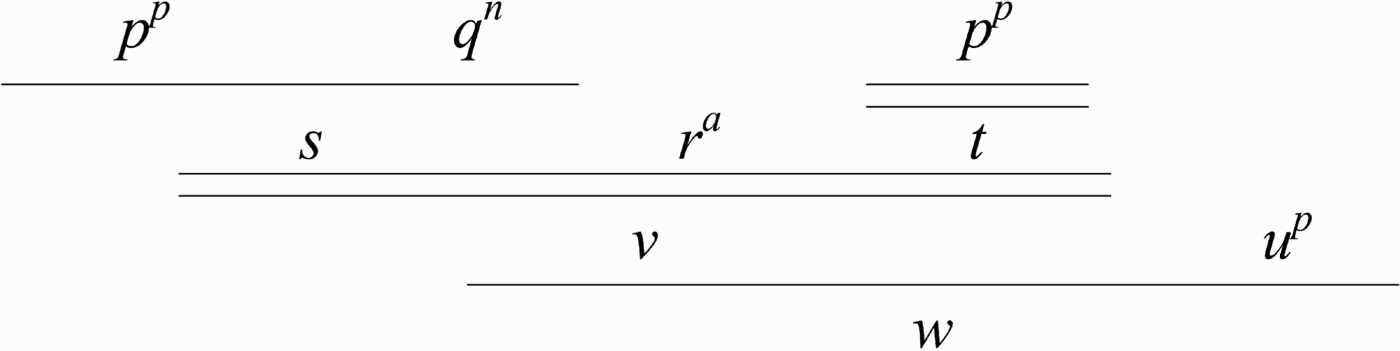
An argument.
An argument strict if
defeasible if
firm if
plausible if
We write
In Example 3.7 the argument
(From hereon, the theory will be left implicit if there is no danger for confusion.)
Now that the notion of an argument has been defined, orderings on arguments can be considered. Below
In Section 6, two ways will be discussed to define
Let if A is firm and strict and B is defeasible or plausible, then if
(Vreeswijk also assumes that an argument cannot be stronger than its weakest subargument but in Section 6 the so-called ‘last-link’ principle will be discussed, which violates this assumption.) The first condition says that strict-and-firm arguments are stronger than all other arguments, while the second condition says that a strict inference cannot make an argument weaker or stronger.
argumentation theories
An argumentation theory is a triple
Attack and defeat
Dung's use of the term ‘attack’ might at first sight lead to the belief that Dung's framework has no place for preferences. However, Dung's attack relation can also be seen as abstracting from the use of preferences: in this view, an attack relation in his framework may be the result of applying preferences to a syntactic conflict. This view on Dung's attack relation was, to my knowledge, first used by Prakken and Sartor (1997), it was also employed by Amgoud and Cayrol (2002) and it was the basis of Bench-Capon's (2003) value-based AFs. It was also the reason why Prakken and Sartor (1997) and Prakken and Vreeswijk (2002) replaced Dung's term ‘attack’ with ‘defeat’, to reflect that it may incorporate evaluative considerations. This convention will also be adopted in the present paper, while the term ‘attack’ will be reserved for non-evaluative syntactic notions of conflict. The idea then is that defeat is determined by attack plus preference (except in some cases, where attack automatically leads to defeat).
The notion of a defeasible inference rule naturally leads to two notions of rebutting and undercutting attack, introduced by Pollock (1974) and first formalised by Pollock (1987). The third kind of attack, premise attack (in this paper called undermining), is a natural addition (and for deductive inferences it is the only kind of attack) but highlights the philosophical distinction between plausible and defeasible reasoning discussed above. It was independently introduced by Vreeswijk (1993, chap. 8) and Elvang-Göransson, Fox, and Krause (1993). In line with Prakken and Sartor (1997), rebutting and undercutting attacks can also be launched on subarguments. This is essential in making the system an instantiation of Dung's abstract framework.
Attack
First the ways in which arguments can be attacked are defined. Recall that these are just syntactic categories and do not reflect any preference between arguments. The first way of attack corresponds to the case where one argument uses a defeasible rule of which another argument says that it does not apply to the case at hand. Its definition assumes that inference rules can be named in the object language; the precise nature of this naming convention will be left implicit.
undercutting attack
Argument A undercuts argument B (on
In Example 3.7, argument A8 can be undercut in two ways: by an argument with conclusion
Undercutting attackers only say that there is some exceptional situation in which a defeasible inference rule cannot be applied, without drawing the opposite conclusion. Rebutting attacks do the latter: they provide a contrary or contradictory conclusion for a defeasible (sub-)conclusion of the attacked argument.
Argument A rebuts argument B on (
In Example 3.7, argument A8 can be rebutted on A5 with an argument for
The final way of attack is an attack on a (non-axiom) premise.
Argument A undermines B (on ϕ) iff
In Example 3.7, argument A8 can be undermined with an argument that has conclusion
The following example (based on Example 4 of Caminada and Amgoud (2007)) illustrates the interplay between strict and defeasible rules in rebutting attack.
Now that we know how arguments can be attacked, the argument ordering can be used to define which attacks result in defeat. For undercutting attack, no preferences will be needed to make it result in defeat, since otherwise a weaker undercutter and its stronger target might be in the same extension. This would be strange since then the extension contains an argument that applies an inference rule of which another argument in the same extension says that it should not be applied.4
Modgil (2009) argued that in some contexts such extensions make sense. It seems that the formal results in Section 6 on rationality postulates also hold for undercutting defeat with preferences, but this should be formally verified.
Argument
This definition determines whether a rebutting attack is successful by comparing the conflicting arguments at the points where they conflict. Thus, in Example 3.18, the conflict between
As noted by Caminada and Amgond (2007), Example 3.18 also illustrates why Definitions 3.14 and 3.19 should not allow that a defeasible argument with a strict top rule can be (successfully) rebutted on its final conclusion. The reason is that otherwise if all defeasible rules in the example are of equal preference, the set
successful undermining
Argument
This definition exploits that an argument premise is also defined to be a subargument.
In Example 3.7, any argument for
It remains to be discussed how the framework should deal with arguments that have issue premises. As explained above, the idea is that arguments with issue premises are always unacceptable. There are various ways to formalise this idea. One would be to let a special designated argument, or perhaps all strict-and-firm arguments, defeat any argument with an issue premise (as in Modgil (2009) and Prakken and Sartor (1997)). Here another solution is adopted: an argument can defeat another only if it has no issue premises. Then in Definition 2.1, only sets
The three defeat relations can now be combined into an overall definition of ‘defeat’.
defeat
Argument
In the literature other combinations of these kinds of attack have been considered. For example, Prakken and Sartor (1997) (who have no undermining) give precedence to undercutting defeat over rebutting defeat, so that if
Finally, argumentation theories can be linked to Dung-style argumentation frameworks.
AF
An abstract argumentation framework AF corresponding to an argumentation theory AT is a pair <
Def is the relation on
To leave arguments with issue premises out of any extension, Definition 2.1 should now start with ‘Let
It is now also possible to define a consequence notion for well-formed formulas. Several definitions are possible. One is as follows.
acceptability of conclusions
For any semantics
ϕ is skeptically S-acceptable in AT if and only if all S-extensions of AT contain an argument with conclusion ϕ;
ϕ is credulously S-acceptable in AT if and only if there exists an
An alternative definition of skeptical acceptability is
ϕ is skeptically S-acceptable in AT if and only if there exists an argument with conclusion ϕ that is contained in all
While the original definition allows that different extensions contain different arguments for a skeptical conclusion, the alternative definition requires that there is one argument for it that is in all extensions.
Using the framework: domain-specific vs. general inference rules
The framework defined in the previous section can be used in two ways, depending on whether the inference rules are domain-specific or not. The inference rules of argumentation systems are not part of the logical language
The argument that Wiebe is tall then has the form as displayed on the left in Figure 2.

Domain-specific vs. general inference rules.
With general inference rules, the two rules must instead be represented in the object language
Then the argument that Wiebe is tall has the form as displayed on the right in Figure 2.
Although the present system can be used both ways, both Vreeswijk and Pollock intended their inference rules to express general patterns of reasoning, which is much more in line with the role of inference rules in standard logic. Indeed, an important part of John Pollock's work was the study of general patterns of (epistemic) defeasible reasoning, which he called prima facie reasons. He formalised prima facie reasons for reasoning patterns involving perception, memory, induction, temporal persistence and the statistical syllogism, as well as undercutters for these reasons. The ASPIC framework allows for such general use of inference rules, by expressing the rules through schemes (in the logical sense, with metavariables ranging over
E is an expert in domain D
E asserts that P is true
P is within D
P is true
This scheme has six critical questions:
How credible is E as an expert source? Is E an expert in domain D? What did E assert that implies P? Is E personally reliable as a source? Is P consistent with what other experts assert? Is E's assertion of P based on evidence?
A natural way to formalise reasoning with argument schemes is to regard them as defeasible inference rules and to regard critical questions as pointers to counterarguments (this approach was earlier defended by Bex, Prakken, Reed, and Walton (2003) and Verheij (2003b). More precisely, the three kinds of attack on arguments correspond to three kinds of critical questions of argument schemes. Some critical questions challenge an argument's premise and therefore point to undermining attacks, others point to undercutting attacks, while again other questions point to rebutting attacks. In the scheme from expert opinion questions (2) and (3) point to underminers (of, respectively, the first and second premise), questions (4), (1) and (6) point to undercutters (the exceptions that the expert is biased or incredible for other reasons and that he makes scientifically unfounded statements) while question (5) points to rebutting applications of the expert opinion scheme. Thus, we also see that Pollock's prima facie reasons are examples of epistemic argument schemes and that his undercutters are negative answers to one kind of critical question.
Now one benefit of having undermining attack in addition to rebutting and undercutting attack can be discussed in more detail: if the inference rules are supposed to be domain-independent, then representing facts with non-conditional inference rules (as done by Caminada and Amgoud (2007)) does not make sense.
Before it can be studied to what extent the present framework satisfies the rationality postulates of Caminada and Amgoud (2007), first some technicalities concerning strict inference rules must be discussed. To start with, Caminada and Amgoud define the notions of a transposition of a strict rule and closure of sets of strict rules under transposition.
transposition
A strict rule s is a transposition of
transposition operator
Let
If
We say that
Now the subclass of argumentation systems closed under transposition can be defined.
closure under transposition
An argumentation system
Caminada and Amgoud (2007) also define the closure of a set of formulas under application of strict rules.
closure of a set of formulas
Let
if
If
It is also relevant whether strict inference satisfies contraposition.
closure under contraposition
An argumentation system is closed under contraposition if for all
Closure under transposition does not imply closure under contraposition, as shown by the following counterexample (in all examples below, sets which are empty are not listed).
Let
In general, it neither holds that closure under contraposition implies closure under transposition, as shown by the following counterexample.
Let
So
However, contraposition does imply transposition in the following special case.
Consider any argumentation theory with
Note that the proposition does not hold if the condition ‘
Dung's semantics can be seen as rationality constraints on evaluating arguments in abstract argumentation frameworks. The refinement of his abstract approach with structured arguments naturally leads to the question whether this additional structure gives rise to additional rationality constraints. Caminada and Amgoud (2007) gave a positive answer to this question by proposing a number of ‘rationality postulates’ for what they called ‘rule-based argumentation’. Four of their postulates formulate constraints on any extension of an argumentation framework corresponding to an argumentation theory:5
Caminada and Amgoud (2007) proposed similar postulates for the intersection of extensions but since their results on these postulates directly follow from the ones for individual extensions, they will be ignored.
Closure under subarguments: for every argument in an extension also all its subarguments are in the extension.
Closure under strict rules: the set of conclusions of all arguments in an extension is closed under strict-rule application.
Direct consistency: the set of conclusions of all arguments in an extension is consistent.
Indirect consistency: the closure of the set of conclusions of all arguments in an extension under strict-rule application is consistent.
The postulates of closure under subarguments and strict-rule application still hold unconditionally for the present framework. (Here that a given semantics is subsumed by complete semantics means that any of its extensions also is a complete extension).
Let <
Let
As for the two consistency postulates, Caminada and Amgoud's results do not generalise unconditionally. Consider the following example.
Let
Now assume that
that rebuts B's subargument B′ for q. Then since by condition (2) of Definition 3.10 a strict continuation of an argument cannot make it weaker,
However, this line of reasoning does not hold without a further assumption on the argument ordering. Consider a more complex variant of Example 6.3.
Let
A:
B′:
The problem is that A cannot be extended with any transposition of
However, assuming contraposition or transposition, direct consistency can still be proved if it can also be assumed that there is a way to extend A with all but one of B's maximal defeasible subarguments that is not weaker than the remaining one. In our example, this means that either A extended with B′ is not weaker than B′′ or A extended with B′′ is not weaker than B′. Intuitively, this assumption seems acceptable given that A is stronger than both B′ and B′′. It is therefore to be expected that it will be satisfied by many reasonable argument orderings. Since similar situations can arise with undermining attack, the notion of a maximal fallible subargument is needed.
For any argument A, an argument
there is no
The set of maximal fallible subarguments of an argument A will be denoted by
For any argument A, it holds that
Argument ordering ⪯ is reasonable if it satisfies the following condition. Let A and B be arguments with contradictory conclusions such that
A final problem to deal with is that in Example 6.3,
An argumentation theory is well formed if:
no consequent of a defeasible rule is a contrary of the consequent of a strict rule; if
Condition (2) in effect says that assumptions can only be contraries of other assumptions. An example of an argumentation theory that is not well formed is
and such that s is a contrary of
Now it can be proved that under certain conditions an argumentation theory satisfies the postulate of direct consistency.
Let <
Caminada and Amgoud (2007) also prove that their system satisfies the postulate of indirect consistency. This follows from their Proposition 7, which says that if an argumentation theory satisfies closure and direct consistency, it also satisfies indirect consistency. Since in the present case, the conditions of the proof of direct consistency had to be strengthened, the same holds for indirect consistency.
Let <A, Def> be an argumentation framework corresponding to a well-formed argumentation theory that is closed under contraposition or transposition and has a reasonable argument ordering and a consistent
If the conditions of Theorem 6.10 are satisfied, then for any extension E under a given semantics subsumed by complete semantics the set
Concluding this section, two intuitively plausible argument orderings will be shown to be reasonable, namely, the weakest-link and last-link orderings from Amgoud et al. (2006). The versions below are slightly revised to make the principles arguably more intuitive. Both orderings define a strict partial order
The last-link principle prefers an argument A over another argument B if the last defeasible rules used in B are less preferred than the last defeasible rules in A or, in case both arguments are strict, if the premises of B are less preferred than the premises of A. The concept of ‘last defeasible rules’ is defined as follows and is essentially the same as Prakken and Sartor's (1997) notion of a ‘relevant set’.
Let A be an argument.
If A =
An example with more than one last defeasible rule is with
The above definition is now used to compare pairs of arguments as follows.
Let A and B be two arguments. Then A
condition (1) of Definition 3.10 holds or
(Amgoud et al. 2006 do not include the second condition so if both arguments are strict the ordering on the knowledge base is ignored.) This definition in effect compares sets on their weakest elements.
The last-link argument ordering is reasonable.
Consider the following example (taken from Prakken 1997) on whether people misbehaving in a university library may be denied access to the library.
Let
Assume that
The weakest-link principle considers not the last but all uncertain elements in an argument. It prefers an argument A over an argument B if A is preferred to B on both their premises and their defeasible rules.
Let A and B be two arguments. Then
If
(Amgoud et al. (2006) do not have condition (2), so that with two strict arguments neither of them can be preferred.)
The weakest-link argument ordering is reasonable.
Consider again Example 6.16. With the weakest-link principle, the outcome is different. To resolve the conflict between
We finally return to Example 1. Let
As discussed by Pollock (1994) and Caminada and Amgoud (2007), self-defeating arguments can cause problems if argumentation systems are not carefully defined, particularly if they include standard propositional logic. In the present framework, two types of self-defeating arguments are possible: serial self-defeat occurs when an argument defeats one if its earlier steps, while parallel self-defeat occurs when the contradictory conclusions of two or more arguments are taken as the premises for
Let
One of Pollock's (1994) examples of parallel self-defeat has the following form.
Let
Pollock (1994) also discusses the following variant of this example (with the same argumentation theory):
According to Caminada (personal communication), the only way to solve this problem is to make parallel self-defeat impossible. One way to implement this solution is to disallow arguments with a contradictory set of subconclusions. However, this affects the proof of Theorems 6.9 and 6.10. The reason is that for such systems the argument
Let
Now if
A similar example for systems closed under contraposition is as follows.
Let
Note that
Since these problems only arise in particular argumentation systems and with particular semantics, no general solution will be pursued here; instead, such solutions are left for future research on instantiations of the framework. Note also that Examples 7.3 and 7.4 only contain strict rules, so that the problem may also arise in assumption-based frameworks, which will in the next section be proved to be a special case of the ASPIC framework.
After having presented his fully abstract approach to argumentation, Dung joined Kowalski, Toni and others in their development of a more concrete version of his approach (e.g. Bondarenko et al. 1997; Dung et al. 2006, 2007). In this approach, arguments essentially are sets of formulas called ‘assumptions’, from which conclusions can be drawn with strict inference rules. Arguments can be attacked with arguments that conclude to the ‘contrary’ of one of their assumptions. In fact, the extensions defined by the various semantics of Bondarenko et al. (1997) are not sets of arguments but sets of assumptions. However, Dung et al. (2007) showed that an equivalent fully argument-based formulation can be given.
In this section, it will be shown that assumption-based argumentation is a special case of the present framework with only strict inference rules, only assumption-type premises and no preferences. The proof will be given for the argument-based version of Dung et al. (2007) and carries over to Bondarenko et al. (1997) by the equivalence result of Dung et al. (2007).
First the main definitions of ABA are recalled (in the formulation of Dung et al. (2007)).
Dung et al. 2007, Definition 2.3
A deductive system is a pair
An assumption-based argumentation framework (ABF) is a tuple
If - is a total mapping from
The third condition amounts to a restriction to so-called flat ABFs. This restriction is not entirely innocent, since in debates it may occur that someone first assumes a premise and, after it is defeated, constructs an argument for it, in an attempt to rebut the defeater. To make Dung et al.'s analysis apply to all stages of such a debate, assumptions should be deleted from 𝒜 as soon as they are supported with an argument.
Since the notion of an argument is central to the present concerns, the informal explanation of Dung et al. (2007, p. 646) will be quoted in (almost) full. Deductions can be understood as proof trees: the root of the tree is labelled by the conclusion of the deduction and the leaves are labelled by the premises supporting the deduction. For every non-terminal node in the tree, there is an inference rule whose conclusion matches the sentence labelling the node, and the children of the node are labelled by the premises of the inference rule. (…) we define deductions as sequences of frontiers
Dung et al. 2007, Definition 2.4
Given a selection function f, a (backward) deduction of a conclusion α based on (or supported by) a set of premises P is a sequence of multi-sets If If
Each
Now an assumption-based argument is defined as follows:
Dung et al. 2007, Definition 2.6
An argument for a conclusion on the basis of an ABF is a deduction of that conclusion whose premises are all assumptions (in
As for notation, the existence of an argument for a conclusion α supported by a set of assumptions A is denoted by
Finally, Dung et al.'s notion of argument attack is defined as follows.
Dung et al. 2007, Definition 2.7
an argument an argument
The argumentation theory corresponding to an assumption-based framework is now defined as follows.
Given an assumption-based framework
Note that
The main task now is to prove that there is an ABF-argument for α from P if and only if there is an
For all ABF such that
From this it follows that
For all ABF such that
Now the main correspondence result can be proved.
For all ABF, any semantics S subsumed by complete semantics and any set E:
if E is an S-extension of ABF then
if E is an S-extension of AT then
Theorem 8.9 in fact says that there is a one-to-one correspondence between the extensions of an ABF and those of its corresponding AT. From this we have the following:
For any ABF, any semantics S subsumed by complete semantics, and for any formula ϕ it holds that ϕ is skeptically (credulously) S-acceptable in ABF if and only if ϕ is skeptically (credulously) S-acceptable in
As was said above, the present framework is inspired by the work of Pollock (1987, 1994) and Vreeswijk (1993, 1997). Essentially, it takes from both the idea that defeasible reasoning proceeds by chaining two kinds of inference rules into inference trees. The present mathematical formulation of this idea is directly adopted from Vreeswijk (1993, 1997). The present notions of undercutting and rebutting defeat are taken from Pollock's work and then generalised to arbitrary preference relations on arguments (Pollock only has a notion of probabilistic strength), and to logical languages with arbitrary contrary mappings. They are then combined with a notion of undermining defeat.
In fact, the system of Pollock (1994) is not formalised in terms of arguments but in terms of the so-called ‘inference graphs’, in which nodes are connected either by inference links (applications of inference rules) or by defeat links. The nodes are ‘lines of argument’, which are propositions plus an encoding of the argument lines from which they are derived. So if a proposition is derived in more than one way, it occurs in more than one line of argument. Such duplications cannot be avoided, since defeat relations depend on the strength of a proposition, which in turn depends on the way in which it is derived. Nodes are evaluated in terms of the recursive structure of the graph. Jakobovits and Vermeir (1999) proved that Pollock's system can be given an equivalent formulation as an instance of Dung's abstract argumentation frameworks with preferred semantics.
With Vreeswijk's framework, the relation with Dung-style semantics is still an open issue, since it models conflict not as a relation between two individual arguments but as a property of sets of arguments: a set of arguments is said to be in conflict if there exists a strict argument from their conclusions for
Gordon et al. (2007) proposed the Carneades framework ‘of argument and burden of proof’. Carneades' main structure is that of an argument graph, which, despite its name, is similar to Pollock's inference graphs. Statement nodes are linked to each other via argument nodes, which record the inferences from one or more nodes to another. This notion of an argument does not have the recursive structure of Definition 3.6 but instead stands for a single inference step. As explained in Section 3.1, the premises of an argument can be of three types: presumptions (similar to the present issues), assumptions (similar to the present ordinary premises) and exceptions (similar to contradictories of the present assumptions). Carneades has no distinction between strict and defeasible inference rules and, unlike Pollock, does not express conflicts as a special type of link between statement nodes. Instead, inferences (i.e. arguments) can be either pro or con a statement. Because of this, statements occur only once in the graph. Also, attack relations are thus expressed either as arguments pro and con the same statement or as an argument pro an exception-type premise of another argument. Carneades thus allows for rebutting and undermining but not for undercutting; instead, undercutters are simulated by arguments pro exceptions. Carneades' inference graphs are assumed to contain no cycles, which excludes the representation of mutual attack relations through exceptions.
In Carneades, the evaluation of statements in an argument graph is, as with Pollock's inference graphs, defined in terms of the recursive structure of the graph. Statements are acceptable if they satisfy their ‘proof standard’. The general framework abstracts from their nature but Gordon et al. (2007) give several examples of proof standards. The proof standards are at the heart of Carneades' acceptability notion, just like the notions of defence and admissibility are at the heart of Dung-style semantics. None of the examples given by Gordon et al. (2007) have a known relation with any existing Dung-style semantics or the present framework, which thus is an issue for future research. Here it is also relevant that Carneades incorporates dialogical elements since it matters whether a statement is ‘stated’, ‘questioned’, ‘accepted’ or ‘rejected’. These statuses of a statement are assumed to be provided by a dialogical context in which Carneades is embedded.
Verheij (2003a) presents a ‘sentence-based’ (as opposed to ‘argument-based’) logic for defeasible reasoning, called DefLog. Verheij assumes a logical language with just two connectives, a unary connective
As already suggested by Verheij, there is a close formal relation between DefLog and assumption-based argumentation. First, dialectical interpretations are easily proved to be equivalent to stable labellings, which are known to be equivalent to stable semantics (first proved by Verheij (1996); see also Jakobovits and Vermeir (1999), and Caminada (2006)). Furthermore, DefLog theories can be mapped onto assumption-based frameworks by letting an ABF contrary mapping be
Several argumentation systems model deductive argumentation. Here arguments are proofs according to some deductive logic with consistent premises taken from a possibly inconsistent knowledge base expressed in the language of the logic (usually taken to be standard propositional or first-order logic). In Amgoud and Cayrol (2002), which is based on propositional logic, the structure of arguments is left undefined, except that the premises imply the conclusion according to propositional logic. Several notions of defeat are then considered. One of them corresponds to the present undermining defeat, where arguments are compared in terms of a partial preorder on the belief base from which their premises are taken. Argument acceptability is defined according to grounded semantics.
This variant of Amgoud and Cayrol (2002) can be reconstructed as a special case of the present framework as follows. First, ℒ is any propositional language closed under classical negation, where
Besnard and Hunter's (2008) version of deductive argumentation is similar to that of Amgoud and Cayrol (2002), except for a generalised notion of undermining: an argument is undermined by any argument of which the conclusion negates the conjunction if its premises. It remains to be seen whether this version of undermining can be reduced to the present version.
Two other logics for defeasible reasoning with both (domain-specific) strict and defeasible inference rules are Defeasible Logic (DL), first proposed by Nute (1994), and Defeasible Logic Programming (DeLP; e.g. Garcia and Simari 2004). In both systems, the logical language is restricted in logic-programming style. DL is not explicitly argument-based but defines the notion of a proof tree, which interleaves support and attack. Governatori, Maher, Antoniou, and Billington (2004) investigated the relation with Dung-style semantics. One variant of DL is proved to instantiate grounded semantics. In DeLP, the only way to attack an argument is on a (sub-)conclusion. DeLP's notion of argument acceptability has no known relation to any of the current argumentation semantics.
Prakken and Sartor (1997) presented an argument-based version of extended logic programming, designed as an instance of Dung's abstract argumentation frameworks with grounded semantics. Their system comes close to being a special case of the present framework. It has (domain-specific) strict and defeasible inference rules and allows for rebutting and undercutting defeat. Furthermore, its notion of an argument comes close to a ‘deduction’ version of Definition 3.6, i.e. it represents a particular order in which an argument can be constructed. A difference is that in Prakken and Sartor (1997) two parallel subarguments do not need to be completed with an inference from their conclusion, so that, for example (in the present notation),
A final difference with the present framework is that in Prakken and Sartor (1997) the role of strict rules in defeat is different. As in the present framework, only defeasible inferences can be attacked, but an argument A with conclusion ϕ rebuts an argument B with conclusion
In one respect, Prakken and Sartor (1997) go beyond the present framework, namely, in making the preference relation on the set of defeasible inference rules defeasible and derivable within the framework. In this respect, the system is a forerunner of Modgil's (2009) extended AFs.
Conclusion
The main rhetorical aim of this paper has been to present the ASPIC framework as a general abstract framework for rule-based argumentation. In previous publications on the ASPIC framework its unifying potential was underexposed because of a focus on domain-specific inference rules instead of on general inference patterns. Here it has been argued that ASPIC, although it can be used as a specific logic at the same level of abstraction as systems such as DeLP, DL and Prakken and Sartor (1997), can also be used as an abstract framework for reasoning with general inference rules, including argument schemes. Moreover, it has been shown that by including undermining attack and generalising negation to arbitrary contrary mappings, the ASPIC framework unifies rule- and assumption-based approaches to argumentation. The latter claim has been backed by a formal proof that assumption-based argumentation (Bondarenko et al. 1997; Dung et al. 2007) is a special case of the framework and by semi-formal explanations that the same holds for Verheij's (2003) DefLog and (to a large extent) Amgoud and Cayrol's (2002) version of deductive argumentation.
In addition, the following technical contributions have been made:
a generalisation of the ASPIC framework to arbitrary relations of contrariness between well-formed formulas; an extension of the ASPIC framework with preference information for resolving conflicts between arguments; an extension of the ASPIC framework with four types of premises and with undermining attack; proof that Caminada and Amgoud's (2007) rationality postulates still hold for the thus generalised and extended framework, and that they hold not only for systems closed under transposition but also for systems closed under contraposition.
The framework can be further extended and investigated in several ways. First as indicated above in Section 3.3.2, several alternative ways to define the relation between the three kinds of defeat are possible. It could be investigated to what extent such alternatives affect the present results. The same holds for the use of preferences to resolve undercutting attack (also discussed in Section 3.3.2), for the constraint that arguments have consistent premises (cf. the discussion of deductive argumentation in Section 9) and for alternative ways to define argument conflicts involving strict rules (cf. the discussion of Prakken and Sartor (1997) in Section 9).
Finally, as touched upon at the end of Section 9, an important extension of the present framework is making the preference relations that are used for resolving conflicts defeasible and derivable within the framework. This could be done along the lines of Prakken and Sartor (1997), after which it should be investigated whether Modgil's (2009) reconstruction of Prakken and Sartor (1997) as an instance of his extended argumentation frameworks can be adapted to the extended ASPIC framework.
Footnotes
Acknowledgements
This work was partially supported by a Distinguished Visitor grant from the Scottish Informatics and Computer Science Alliance (SICSA). I thank Chris Reed and the School of Computing, University of Dundee, Scotland, for their hospitality during the summer of 2009 and Chris Reed for encouraging me to write this paper. Floris Bex, Phan Minh Dung, Tom Gordon, Sanjay Modgil, Leon van der Torre, Bart Verheij and Gerard Vreeswijk gave useful feedback on earlier versions of this paper. Finally, I thank my former collaborators in the ASPIC project for working with me on previous versions of the ASPIC framework.