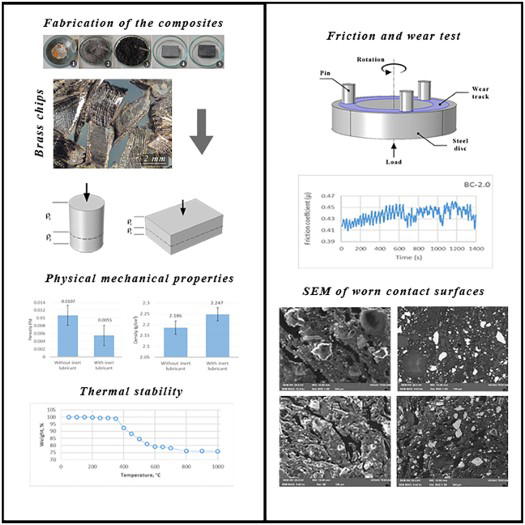
This research is focused on investigating new low metallic non-asbestos organic friction composite materials obtained by conventional powder metallurgy techniques. Three different composite mixtures were prepared by varying brass concentrations 1.5, 2.0 and 2.5wt-% using the glycerin as a plasticizer. The prepared brake pad materials were subjected to density, hardness, thermal stability, friction and specific wear rate analysis. Tribological properties of friction specimen were studied on pin-on-disc type friction testing machine model MMW-1 using nominal contact pressure 7.69MPa, sliding velocity 1.74m/s and 1.57km sliding distance conditions. Microstructural characterization of worn surfaces was carried out using scanning electron microscopy. Obtained test results indicate that brass chips have an important effect on improving tribo-performance. Physical–mechanical characterization of friction composites showed that the use of glycerin improves the physical properties of materials by improving the powder compressibility and reducing the structural defects formed by brass chips.
ShindeD, BulsaraM, MistryKN.Tribological performance of non-asbestos brake friction material in contact with brake disc of varying topography. Ind. Lubr. Tribol. 2020;72(10):1277–1283.
2.
FiciciF, DuratM, KapsizM.Optimization of tribological parameters for a brake pad using Taguchi design method. J. Braz. Soc. Mech. Sci. Eng. 2013;36:653–659.
3.
AhmadijokaniF, AkbarS, SaraD, . Effects of hybrid carbon-aramid fiber on performance of non-asbestos organic brake friction composites. Wear. 2020;452:203280.
4.
NilovA, KulikV, GarshinA.Analysis of friction materials and technologies developed to make brake shoes for heavily loaded brake systems with disks made of a ceramic composite. Refrac. Ind. Ceram. 2015;56:57–68.
5.
SanjeevS, JayashreeB, MukeshK.Comparison between nano-and micro-sized copper particles as fillers in NAO friction materials. Nanomat. Nanotechnol. 2013;3:1–9.
6.
XingmingX, YanY, JiushengB, . Review on the friction and wear of brake materials. Adv. Mech. Eng. 2016;8:1–10.
7.
ShindeD, JhavarS, PathakS.A Review on non-asbestos friction materials: material composition and manufacturing. Adv. Mat. Res. 2018;1150:22–42.
8.
ZhaoX, OuyangJ, TanQ, . Interfacial characteristics between mineral fillers and phenolic resin in friction materials. Mater. Express. 2020;10(1):70–80.
9.
LuoY, YangZ.Effect of different-condition parameters on frictional properties of non-asbestos phenolic resin-based friction material. Adv. Mech. Eng. 2017;9(5):1–14.
10.
LeeJ-J, LeeJ-A, KwonS, . Effect of different reinforcement materials on the formation of secondary plateaus and friction properties in friction materials for automobiles. Tribol. Int. 2018;120:70–79.
11.
BijweJ, KumaraM, GurunathPV, . Optimization of brass contents for best combination of tribo-performance and thermal conductivity of non-asbestos organic (NAO) friction composites. Wear. 2008;265:699–712.
12.
SellamiM, KchaouR, KusJ, . Impact of brass contents on thermal, friction and wear properties of brake linings composites. Mech. Ind. 2018;19(105):1–9.
13.
Asrar AhmedaK, Rasool MohideenaS, BalajiaMAS, . Tribological performance of brass powder with different copper and zinc content in the brake pad. Tribol. Ind. 2020;42(2):177–190.
SugozuB, DaghanB.Effect of BaSO4 on tribological properties of brake friction materials. Int. J. Innov. Res. Sci. Eng. Technol. 2016;5(12):30–35.
16.
WangW, QiH, LiuP, . Numerical simulation of densification of Cu–Al mixed metal powder during axial compaction. Metals (Basel). 2018;8(7):1–24.
17.
BerhanMN, DariusGS, DavidNV, . Thermogravimetric analysis of novel brake friction materials. WIT Trans Eng Sci. 2005;51:175–182.
18.
NawangsariP, JamasriJ, RochardjoHSB.Effect of phenolic resin on density, porosity, hardness, thermal stability, and friction performance as a binder in non-asbestos organic brake pad. IOP Conf Series: Mater. Sci. Eng. 2019;547:1–8.
19.
MenapaceC, MaraL, VlastimilM, . Dry sliding behavior and friction layer formation in copper-free barite containing friction materials. Wear. 2018;398:191–200.
20.
ChangYH, JooBS, LeeSM, . Size effect of tire rubber particles on tribological properties of brake friction materials. Wear. 2018;394–395:80–86.
21.
GuanchenL, XiaoliangS, YuchunH, . Effects of friction layer characteristics on the tribological properties of Ni3Al solid-lubricating composites at different load conditions. Mater Res Express. 2018;5:1–10.
22.
SunW, ZhouW, LiuJ, . Development of a composite friction material with excellent fade resistance by employing oversized ceramic particles. Tribol. Lett. 2018;66:1–11.
23.
LuoQ.Electron microscopy and spectroscopy in the analysis of friction and wear mechanisms. Lubricants. 2018;6(58):1–19.
24.
BarrosLY, NeisPD, FerreiraNF, . Morphological analysis of pad-disc system during braking operations. Wear. 2016;352–353:112–121.
25.
ÖztürkB, MutluT.Effects of zinc borate and fly ash on the mechanical and tribological characteristics of brake friction materials. Tribol. Trans. 2015;59:1–39.
26.
HutchingsP, ShipwayP.Tribology. friction and wear of engineering materials. Butterworth-Heineman. Oxford. 2nd edition. 2017. p. 412
27.
ÖztürkB, ÖztürkS.Effects of resin type and fiber length on the mechanical and tribological properties of brake friction materials. Tribol. Lett. 2011;42:339–350.
28.
BijweJ, NeelamegamA, SharmaS, . Nano-abrasives in friction materials-influence on tribological properties. Wear. 2011;296:693–701.
29.
ManoharanS, SureshaB, BharathPB, . Investigations on three-body abrasive wear behaviour of composite brake pad material. Polym-Plast. Tech. Mat. 2014;3:10–18.
30.
SugözüB, DağhanB, AkdemirA.Effect of the size on the friction characteristics of brake friction materials: a case study with Al2O3. Ind. Lubr. Tribol. 2018;70(6):1020–1024.