



Abstract
It has been assumed that fluent reading requires efficient integration of orthographic and phonological codes. However, it is thus far unclear how this integration process develops when children learn to become fluent readers. Therefore, we used masked priming to investigate time courses of orthographic and phonological code activation in children at incremental levels of reading development (second, fourth and sixth grade). The first study used targets with small phonological differences between phonological and orthographic primes, which are typical in transparent orthographies. The second study manipulated the strength of the phonological difference between prime and target to clarify whether phonological difference influences phonological priming effects. Results in both studies showed that orthographic priming effects became facilitative at increasingly short durations during reading development, but phonological priming was absent. These results are taken to suggest that development of reading fluency is accompanied by increased automatization of orthographic representations. The absence of phonological priming suggests that developing readers cannot yet activate phonological codes automatically.
Introduction
In transparent orthographies, children acquire grapheme-phoneme correspondences rapidly, which allows them to read highly accurate within the first year of reading instruction (de Jong & van der Leij, 1999; Seymour, Aro, & Erskine, 2003). Reading fluency, on the other hand, develops more gradually (Landerl & Wimmer, 2008; Vaessen & Blomert, 2010) and distinguishes between good and poor readers (de Jong & van der Leij, 2003). It has been assumed that fluency results from the efficiency with which a reader can integrate orthography and phonology (Breznitz, 2002; Ehri, 2005; González et al., 2015; Hahn, Foxe, & Molholm, 2014; Perfetti & Hart, 2001). In line with this assumption, brain imaging studies show that orthography-phonology integration at the level of individual letters is related to reading fluency (Blau et al., 2010; Blau, van Atteveldt, Ekkebus, Goebel, & Blomert, 2009) and that cortical area’s associated with orthography-phonology integration show deviant activation in persons with dyslexia, who are known to be characterized by reading fluency deficits (Cao, Bitan, & Booth, 2008; Horwitz, Rumsey, & Donohue, 1998; Shaywitz et al., 2002; Žarić et al., 2014).
Important insights into the process of orthography-phonology integration in skilled readers has come from studies employing masked priming. This technique involves the presentation of a target word, which is preceded by a briefly presented and masked prime word. It is generally assumed that the overlapping features between prime and target allow for the word recognition process to start at perception of the prime, thus resulting in a time advantage at the moment the target is perceived (Forster, Mohan, & Hector, 2003). Since primes can be presented very briefly, their influence must affect the earliest phases of the word recognition process. Therefore, the masked priming paradigm allows investigating the early lexical access stage when orthography-phonology connections are activated. In time course analyses of masked priming effects, the exposure duration of orthographic and phonological primes is manipulated in order to examine when orthographic and phonological information become available during visual word recognition (Ferrand & Grainger, 1992, 1993, 1994). The paradigm encompasses a lexical decision task in which target words are preceded by three nonword primes: (1) a phonological prime, which is pronounced identical, yet spelled slightly different than the target (a so called pseudohomophone, e.g., bote—BOAT); (2) an orthographic prime, which shares the same degree of orthographic overlap with the target as the phonological prime, but is not a pseudohomophone (e.g., boti—BOAT); and (3) a control prime, which shares neither orthography nor phonology with the target (e.g., rune—BOAT). Faster recognition of a target that is preceded by an orthographic prime in comparison to a control prime is referred to as orthographic priming, and indicates that the orthographic overlap between prime and target facilitates target recognition. Phonological priming is defined as the difference in recognition rate in the phonological as compared to the orthographic prime condition. Since both orthographic and phonological primes share the same degree of orthographic overlap with the target, any additional facilitation by the phonological prime is assumed to result from shared phonology.
Time course analyses in skilled readers of orthographies as diverse as French (Ferrand & Grainger, 1993), Chinese (Perfetti & Tan, 1998) and English (Grainger, Kiyonaga, & Holcomb, 2006) have shown that orthographic and phonological processes follow distinct time courses. During lexical access, orthographic codes are accessed initially, but these are subsequently translated into phonological codes. This pattern was also found in skilled Dutch readers, who initially accessed orthography, yet within 50 ms also activated phonological codes, with phonological influences dominating the remainder of the lexical access stage (Zeguers, Snellings, Huizenga, & Van der Molen, 2014). This indicates that skilled readers integrate orthography and phonology very quickly during word recognition, indicating that phoneme-grapheme correspondences are highly automatized.
This insight into the time course of orthographic and phonological code activation in skilled readers raises the question how these processes evolve during reading development. However, time course analyses of orthographic and phonological priming have not been conducted with developing readers in visual word recognition tasks. In a naming task, Booth, Perfetti, and MacWhinney (1999) did investigate developmental effects of orthographic and phonological priming at two prime exposure durations. Results showed that younger readers exhibited smaller phonological priming effects at 30 ms than at 60 ms, whereas for older readers priming effects were similar at both durations. This indicates that with increasing reading skill, phonological information becomes effective at shorter durations, suggesting more rapid convergence between orthographic and phonological information. However, this study did not use lexical decision, but adopted a naming task instead. Consequently, these results apply to reading aloud, where the computation of a phonological code is clearly more essential than in visual word recognition. In addition, since orthographic and phonological priming effects were present at both durations, this leaves unanswered the question when orthographic and phonological information become available.
Theoretical accounts of reading development make contradictory predictions with respect to developmental changes in priming effects. These predictions have been supported with studies on the magnitude, but not yet on the timing of priming effects. First, the lexical-quality hypothesis (Perfetti, 2007; Perfetti & Hart, 2002) argues that when reading skill improves, grapheme-phoneme connections of word representations become more precise, thereby allowing more efficient activation of orthographic and phonological information. With respect to priming, the lexical-quality hypothesis predicts that both orthographic and phonological primes become increasingly beneficial during reading development. In accordance with this prediction, Booth et al. (1999) reported increases in orthographic and phonological priming effects with increasing reading skill. In addition, Comesaňa, Soares, Marcet, and Perea (2016) used consonant/vowel asymmetries in letter position priming as an indicator of phonological priming, and found this asymmetry to be present in adults but not yet in children. This provides additional support for the suggestion that the effect of phonological priming increases during reading development.
Second, dual-route models (Coltheart, Curtis, Atkins, & Haller, 1993; Coltheart, Rastle, Perry, Langdon, & Ziegler, 2001) propose a developmental shift in word recognition strategy, from slow, serial phonological decoding to predominantly quick, parallel letter activation, which directly accesses orthographic representations. Consequently, the dual-route model predicts increases in orthographic influences during reading development (similar to the lexical-quality hypothesis; e.g., Lété & Fayol, 2013; Ziegler, Bertrand, Lété, & Grainger, 2014), whereas phonological priming effects have been assumed to either remain stable (Ziegler et al., 2014) or decrease with reading skill (see post-hoc analyses of Davis, Castles, and Iakovidis, 1998). Third, according to the lexical tuning theory (Castles, Davis, & Letcher, 1999; Castles, Davis, Cavalot, & Forster, 2007), reading development is accompanied by expansion of the orthographic lexicon. Consequently, the word recognition system needs to employ increasingly strict criteria to distinguish a target word from similar-looking other words in the lexicon. The lexical tuning theory therefore predicts reduced sensitivity to similar-looking orthographic primes during development, which is supported by findings of decreases in orthographic priming effects in children with incremental reading skills (Acha & Perea, 2008; Castles et al., 1999; Castles et al., 2007).
In sum, masked priming results are inconsistent as to whether priming effects decrease or increase during the development of visual word recognition. Moreover, since time course analyses have not been conducted, it is unknown to what extent developmental changes in orthographic and phonological processes influence the timing of priming effects. The lexical-quality hypothesis assumes increasingly efficient activation of orthographic and phonological information. This hypothesis thus predicts that both orthographic and phonological priming effects commence increasingly early when reading skill improves. Dual-route theories also predict increasingly early appearance of orthographic priming effects, due to increased use of quick, direct access to orthographic representations. However, phonological recoding is assumed to become less dominant during reading development, and to become involved only after direct orthographic access failed to find a solution in skilled readers. Therefore, it could be argued that dual-route models predict phonological priming effects to occur increasingly late during development. Alternatively, since phonological recoding is assumed to be a slow process, it may commence too late to exist in the initial phases of word recognition when priming occurs. Accordingly, phonological priming effects could be absent in all age groups. Finally, since the lexical tuning theory assumes diminishing sensitivity to orthographic primes with increasing reading skill, this could result in increasingly delayed activation of orthography, and thus a developmental increase in latencies of orthographic priming effects.
Therefore, in the current study, we will conduct time course analyses of orthographic and phonological priming effects during silent word recognition in children at incremental levels of reading proficiency. We focus on reading development in the transparent Dutch orthography. We study children in Grades 2, 4 and 6 since at these ages children have generally passed the initial reading stage of acquiring grapheme-phoneme correspondences. They can read familiar words accurately without the need to decode out loud, yet still progress in their fluency of word recognition. Previous studies have shown that phonological priming effects are generally small (Rastle & Brysbaert, 2006). Therefore, we manipulate exposure duration, with a large range of priming durations (33, 50, 67 and 83 ms), and include large samples of each age group to enhance the sensitivity to detect priming effects. By outlining the time courses of orthographic and phonological priming effects, we will determine how early orthographic codes can be activated and coupled to phonological codes during reading development.
Study 1
Method
Participants
One hundred and four Grade 2 students (46% female, mean age 7.7 years), 102 Grade 4 students (57% female, mean age 9.7 years) and 123 Grade 6 students (54% female, mean age 11.8 years) participated in Study 1. The number of participants was based on a-priori power analyses. The children were recruited from two small city elementary schools. Parents received informed consent folders. All participating children were native speakers of Dutch and none suffered from vision, hearing or language problems. Participants received a small present for participation. The study was approved by the ethical review board.
Materials and design
The lexical decision task that was used in the current study was used previously with skilled adult readers (Zeguers et al., 2014). The information about the stimulus selection and task design provided below is to a large extent copied from Zeguers et al. (2014). The stimulus set of the lexical decision task consisted of 90 words with lengths of 4, 5 or 6 letters and a mean CELEX frequency of 60.57 per million (range 2-364). The targets were selected as to allow the generation of three pronounceable and syntactically correct nonword primes: (1) a phonological prime, which was a pseudohomophone of the target (e.g., vrient—VRIEND); (2) an orthographic prime with the same number of shared letters with the target as the phonological prime, but not homophonic (e.g., vrienk—VRIEND) and (3) a control prime that had no letters in common with the target (e.g., claumf—VRIEND). All three primes related to a particular target were generated to have the same number of letters, phonemes and syllables. In addition, the three primes were matched on the number of orthographic neighbors and the frequency of the highest frequent orthographic neighbors. The 90 targets were selected from a sample of 217 words on the basis of three criteria: (1) selected targets were rated as familiar to second and fourth grade children by 14 elementary school teachers. (2) For the selected targets, shared neighbors between the target and the three accompanying primes were absent. (3) For each selected target, the corresponding phonological prime was pronounced identical to the target in a naming task administered to a pilot sample of 29 Grade 3 children.
For the purpose of the lexical decision task, 90 additional pseudo words were generated to serve as foil targets. Each foil target was created by changing one or two letters of a word target. Consonants were replaced by consonants and vowels by vowels. Due to this procedure target words and foil pseudo words were matched in number of letters, phonemes, syllables and consonant-vowel structure. The foil pseudo words did not differ significantly from the words in mean bigram frequency, number of neighbors and frequency of the highest frequent neighbor. In a similar way as described for the target words, for each target foil three different pseudo word primes were generated, a phonological prime, an orthographic prime and a control prime. The stimulus set was identical to the stimulus set used in a previous experiment with skilled readers (Zeguers et al., 2014) and is depicted in supplementary Table S1. Lexical characteristics of the stimulus set are described in supplementary Table S2.
With these stimuli, three different experimental lists were created. Each of the 90 target words (and similarly each of the 90 target foils) was presented in all three lists, but was associated with a different prime in every list. This ensured that each target word was presented once in each list, and that across lists, each target appeared in each priming condition. Thus, for example, the target VRIEND was primed with the phonological prime vrient in List 1, with the orthographic prime vrienk in List 2 and with the control prime claumf in List 3. Priming conditions were rotated semi-randomly across lists, ensuring that each list contained an equal number of phonological, orthographic and control primes (30 items from each priming category). For each list, the 90 words and 90 pseudo words were randomly divided into six subsets of 15 words and 15 pseudo words. The content and ordering of subsets was held constant across lists. Each pseudo word was presented in a different subset than the word it was derived from so that no subset contained both a word and its derivate pseudo word. Within every subset, words and pseudo words had equal numbers of items from each word length category and items were presented in randomized order.
Following Ferrand and Grainger (1992, 1993, 1994), four different prime exposure durations were used: 33, 50, 67 and 83 ms. Each participant was presented with all four exposure duration conditions in randomized order, and received the same experimental list across these four exposure durations. Thus, each participant was presented with all 180 target stimuli in each of the four prime exposure conditions, comprising a total of 720 items. List was treated as a between variable to allow disentangling effects of priming condition and prime exposure condition, without the need to have participants complete all 12 possible combinations of list and exposure duration, since such a task was expected to exceed attentional limits of the children.
Tasks
Primed lexical decision task
The primed lexical decision task was presented on nine identical 15-inch Acer Travelmate 4150 laptops, running Presentation (www.neurobs.com). Stimuli appeared on the screen in a 16-point Courier font, in black letters on a white background. Letters were 4 mm in length and were presented in uppercase. Children were seated at a viewing distance of 40–60 cm. To assure that every child understood the procedure well, the standardized instruction of the lexical decision task was read aloud by a well-trained test assistant and simultaneously presented visually on the computer screen. The task started with twelve practice trials, divided into two blocks. During these practice blocks the test assistant could check understanding and repeat instructions if necessary. The practice trials included both six word targets and six pseudo word targets that were not included in the experiment.
Every trial consisted of the following sequence of stimuli: (1) a fixation cross (800 ms); (2) a forward mask consisting of a row of six hash marks (800 ms); (3) the prime, presented in lower case letters for one of the four prime exposure durations (33, 50, 67 or 83 ms) and (4) the target, presented in upper case letters. All stimuli were presented in the same location of the computer screen. The target remained on the screen until the participant responded, with a maximum response duration of 10 s. Children were instructed to respond as quickly and accurately as possible. They responded by pressing one of two pre-allocated green and red colored buttons on the keyboard. The colors were counterbalanced in order to compensate for possible handedness-effects or color associations. The children received no feedback on the accuracy of their responses.
Categorization task
With a short categorization task, the children were introduced to the stimulus material of the lexical decision task in order to reduce learning effects. In addition, the task familiarized the children with the concept of nonwords. In the paper-and-pencil categorization task, all 180 word and nonword targets were printed in sets of four in quasi-random order. Children were instructed to indicate whether the four items within a set were (1) all words, (2) all nonwords or (3) a combination of words and nonwords. Children responded by selecting one of three pictures related to the three response options.
Procedure
Children participated in the experiment during school hours in a silent room in their school. The experimental tasks were presented in five testing sessions: the categorization task and four exposure duration conditions of the lexical decision task (in randomized order). All testing sessions were 1 week apart.
Results
Preprocessing
Data cleaning was conducted in a seven-step procedure. First, trials in which prime duration deviated more than 7 ms from the intended prime duration were removed (0.04 % of the data). Second, premature responses were excluded by the removal of all responses below 250 ms (0.6% of the data). Third, targets to which Grade 2 participants performed at chance level (<.57) were considered unfamiliar. This led to the removal of ten targets (the words “chaos,” “cirkel,” “radijs,” “success,” “file,” “actie,” “vonk” and “recept,” and the pseudo words “fink” and “sekker,” 5.5% of the data). Fourth, conditions were removed in which children performed at chance level (<.57, 0.54% of the data). Fifth, the correct word reaction times (RTs) were transformed to their natural logarithmic (log RT) in order to normalize the RT distributions. Sixth, outlier trials were removed by excluding trials with log RTs > 2.5 standard deviations above the mean log RT in a particular (prime type x prime duration) condition (1.63% of the correct word trials). Seventh, outlier participants were excluded, by removing participants with mean log RT > 2.5 standard deviations above the mean log RT in a particular (grade) group. This lead to removal of one Grade 8 participant.
Non-transformed mean RTs and accuracy rates for all 12 prime type x prime exposure duration conditions for all three grade groups are depicted in Table 1. Information about the variance in accuracy rates is provided as supplementary material (Table S3). As Table 1 shows, accuracy is high in all groups and all conditions, and approaches ceiling in Grade 4 and Grade 6. Therefore, subsequent analyses are based on response latencies. All analyses reported below are based on word trials only. However, RT’s and accuracy rates for the pseudo word trials are provided as supplementary material (Table S4). We did not observe consistent priming effects in pseudo word trials, a finding in line with previous findings from lexical decision experiments (Ferrand, Segui, & Grainger, 1996; Forster & Davis, 1984; Forster, Davis, Schoknecht, & Carter, 1987; Rajaram & Neely, 1992; but see Perea, Gómez, & Fraga, 2010 for a demonstration of masked priming effects on nonword targets as well as a discussion of the influence of experimental task on priming effects on nonwords).
Mean target word recognition rate in ms (and accuracy between brackets) as a function of prime type and prime exposure duration in Study 1.
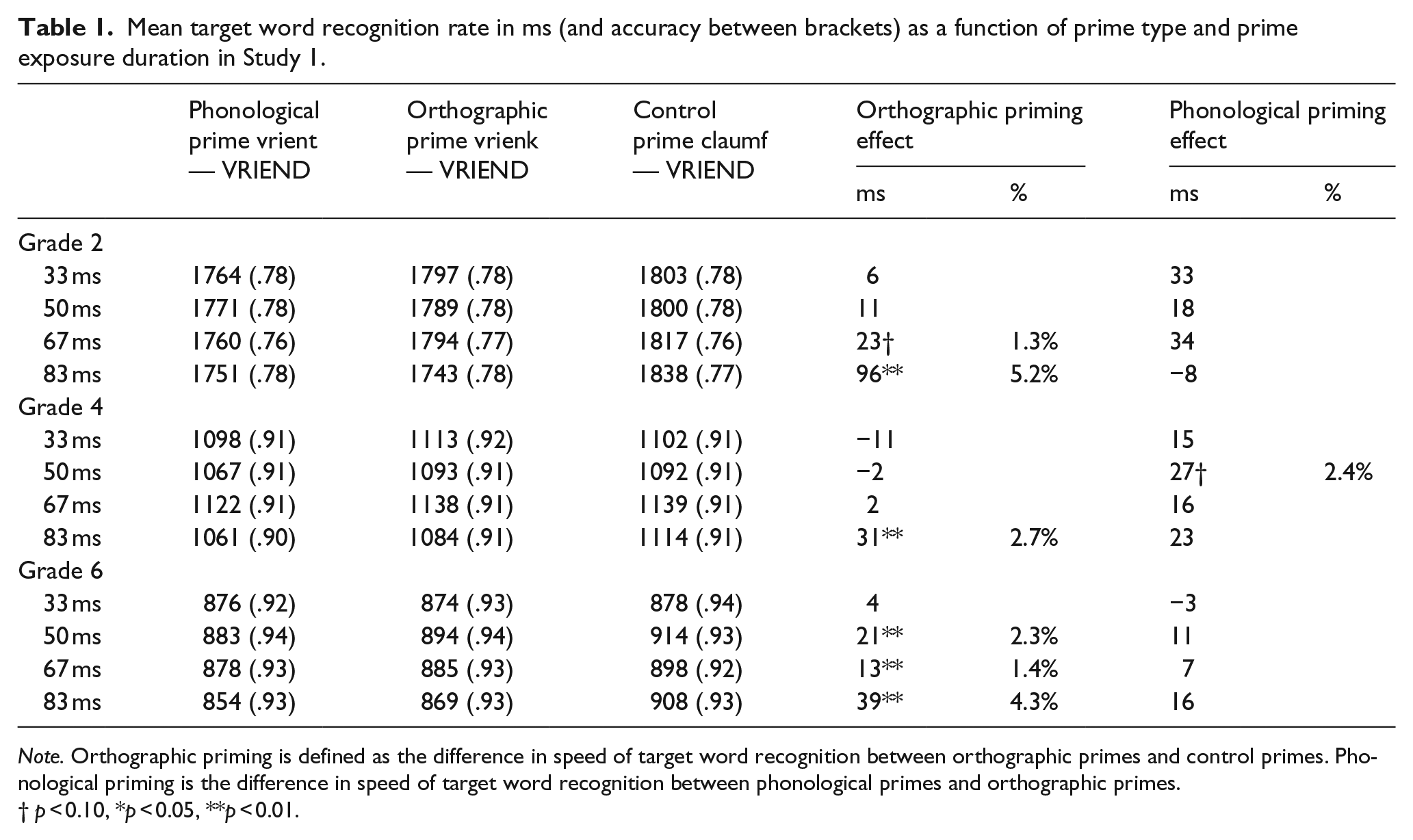
Note. Orthographic priming is defined as the difference in speed of target word recognition between orthographic primes and control primes. Phonological priming is the difference in speed of target word recognition between phonological primes and orthographic primes.
p < 0.10, *p < 0.05, **p < 0.01.
Time course analyses of priming effects
The data were analyzed with a mixed-effects model on the log transformed RT’s of the correct responses. The main advantage of a mixed-effects analysis is that both items and subjects can be incorporated as random effects in one analysis, which dissolves the need for separate item- and subject-level analyses (Baayen, Davidson, & Bates, 2008). Analyses were performed with the lme4 (Bates, Maechler, Bolker, & Walker, 2014) and lmerTest (Kuznetsova, Brockhoff, & Chris-Tensen, 2013) R packages. As random effects we included random intercepts at both the item and subject level.
We first conducted overall analyses, including fixed nominal effects of group (Grades 2, 4 and 6), primetype (phonological, orthographic and control) and exposure duration (33, 50, 67 and 83 ms). These analyses showed a main effect of group, F(2, 326) = 244.13, p < 0.001, a main effect of primetype, F(2, 91,940) = 59.66, p < 0.001, and a main effect of exposure duration, F(3, 91,954) = 4.59, p = 0.003. In addition, there was an interaction between group and exposure duration, F(6, 91,954) = 9.91, p < 0.001, and an interaction between primetype and exposure duration, F(6, 91,936) = 7.35, p < 0.001.
In order to specify these effects and identify the time courses of orthographic and phonological priming effects, subsequent analyses were performed for each of the three age groups and each of the four prime exposure durations separately. In the analyses, the orthographic priming effect was operationalized as the mean log RT difference between the orthographic and control prime conditions. Phonological priming was defined as the mean log RT difference between the phonological and orthographic prime conditions. Prime type (orthographic or control prime in the analyses on orthographic priming, phonological and orthographic prime in the analyses on phonological priming) was included as fixed effect.
Grade 2
Orthographic priming was not significant at 33 ms, t(2040.64) = −0.47, p = 0.640, and 50 ms, t(89.64) = −1.05, p = 0.296. There was a trend toward significant orthographic priming at 67 ms, t(3142.91) = −1.81, p = 0.071, but only at 83 ms did the effect become truly significant, t(84.30) = −3.74, p < 0.001. The phonological priming effect was not significant at any of the four prime exposure durations, 33 ms: t(86.68) = −0.29, p = 0.775; 50 ms: t(1150.04) = 0.29, p = 0.775; 67 ms: t(2186.83) = −0.51, p = 0.609; and 83 ms: t(56.89) = −0.16, p = 0.876.
Grade 4
There were no orthographic priming effects at 33 ms, t(92.44) = 0.30, p = 0.763; 50 ms t(100.13) = −1.17, p = 0.243; and 67 ms, t(61.92) = −1.50, p = 0.139. Orthographic priming was present at 83 ms, t(84.30) = −3.74, p < 0.001. Phonological priming was not significant at any of the four prime exposure durations, although there was a trend toward significance at 50 ms, 33 ms: t(97.20) = −0.81, p = 0.420; 50 ms: t(94.00) = −1.76, p = 0.082; 67 ms: t(71.18) = −1.02, p = 0.312; and 83 ms: t(52.84) = −1.11, p = 0.271.
Grade 6
Orthographic priming was absent at 33 ms, t(78.51) = −1.30, p = 0.199, but clear orthographic priming emerged from 50 ms onward, 50 ms: t(70.58) = −3.30, p = 0.002; 67 ms: t(70.56) = −2.77, p = 0.007; and 83 ms: t(81.36) = −5.50, p < 0.001. Phonological priming was not present at any of the prime exposure durations, 33 ms: t(112.78) = 0.47, p = .642; 50 ms: t(121.02) = −0.95, p = 0.346; 67 ms: t(64.10) = −0.95, p = 0.347; and 83 ms: t(69.65) = −1.26, p = 0.211.
The study was designed to achieve ceiling level accuracy rates, which would allow us to analyze response latencies only. However, although accuracy was high in all grades, it did show some variability. In order to check whether priming also affected accuracy, we conducted a generalized linear mixed model analysis for each priming duration and each age group separately, with primetype as a fixed effect. The initial model included also intercepts and priming effects that were random over targets and participants, but this model often failed to converge. We therefore removed the random priming effects over targets and participants, leading to increased convergence but not in all analyses. Upon additional removal of the random intercept over targets, all analyses converged. Analyses were carried out by the glmer function with a binomial family, as implemented in the lme4 package (Bates et al., 2014). Analyses showed no significant priming effects on accuracy.
Discussion
The results of Study 1 show clear orthographic priming effects in all three age groups. Among second and fourth grade students, this orthographic facilitation occurs only at 83 ms, whereas sixth grade students can already benefit from orthographic priming at 50 ms. This indicates that children from 7 years onwards can use prelexical orthographic information to facilitate efficiency of word recognition, and that this orthographic information can be accessed at increasingly short durations during reading development. However, the results of Study 1 do not show phonological priming effects in any of the age groups. The absence of phonological priming effects could be interpreted to suggest that phonological codes are not yet activated during the early lexical access stage in beginning readers. However, an alternative explanation is provided by a previous study on the time course of phonological and orthographic priming in adults (Zeguers et al., 2014). This study showed that strong phonological differences between orthographic and phonological primes are required to identify phonological priming effects. That is, in the transparent Dutch orthography, a letter is generally pronounced identically across words. This impedes the construction of phonological and orthographic primes that are phonologically very different yet share the same degree of orthographic overlap with the target. Consequently, phonological manipulations in typical Dutch words are generally subtle. This was also the case in Study 1. The difference mostly involved only one phoneme (e.g., the phonological prime “
In order to test whether strong phonological manipulations are required to separate orthographic and phonological priming effects in children as well, we conducted a second study in which we performed the time-course analyses of Study 1 using two sets of stimuli: Targets with small and large phonological differences between the phonological and orthographic primes. We aimed to answer two questions: (1) Do phonological priming effects in children depend on phonological differences, as they do in adults? and (2) What is the time course of orthographic and phonological code activation in children?
Study 2
Method
Participants
In Study 2, 99 Grade 2 students (53% female, mean age 8.1 years), 92 Grade 4 students (57% female, mean age 10.2 years) and 120 Grade 6 students (52% female, mean age 12.2 years) participated. The number of participants was based on a priori power analyses. The children were recruited from four elementary schools in urban and suburban areas. Parents received informed consent folders. All participating children were native speakers of Dutch, and none suffered from vision, hearing or language problems. None of the children participated in Study 1. The study was approved by the ethical review board.
Materials and design
The stimulus set was used previously in a masked priming experiment with advanced, adult readers (Zeguers et al., 2014). The information about the stimulus selection provided below is to a large extent copied from Zeguers et al. (2014). Target stimuli were 120 words with a length of 4-6 letters. The same procedure as in Study 1 was used to generate three nonword primes for each target word; a phonological prime, an orthographic prime, and a control prime. For 60 target words, the phonological difference between the phonological and orthographic prime was small (PDsmall), whereas for the other 60 target words this phonological difference was large (PDlarge). A small phonological difference was defined as a change of one phoneme between the phonological and orthographic prime (e.g., vrien
An additional 120 nonwords were generated to serve as foil targets in the lexical decision task, each accompanied by the same three types of nonword primes as the word targets; a phonological, orthographical and control prime. As in Study 1, foil targets were created by changing one or two letters of a word target. However, 12 PDlarge word targets required a change in three or four letters to create a pseudohomophone phonological prime. All foil targets were created such as to maintain the CVC-structure of their derivate target word. The foil targets did not differ significantly from the word targets in mean bigram frequency, number of neighbors, mean frequency of neighbors and frequency of the highest frequent neighbor. The manipulation on phonological difference that was applied to the word targets was maintained for the foil targets, resulting in 60 PDsmall foil targets, and 60 PDlarge foil targets. For both types of foil targets, the three prime types were matched on bigram frequency, mean frequency of neighbors and frequency of the highest frequent neighbor. The stimulus sets are depicted in supplementary Tables S5 (PDsmall condition) and S6 (PDlarge condition), lexical characteristics of the stimulus sets are described in supplementary Table S7.
The stimulus set was initially selected for use with adult readers. Hence, targets in the PDsmall and PDlarge conditions were matched on frequency estimates from a corpus based on adult literature (Celex; Baayen et al., 1993). To rule out the possibility that differences between the PDsmall and PDlarge conditions would result from differences in target familiarity to the participating children, we examined whether targets in the two conditions were also matched on frequency estimates from a corpus based on children literature (Basilex; Tellings, Hulsbosch, Vermeer, & van den Bosch, 2014). A t-test indicated that the frequency of appearance in children’s literature was similar for the PDsmall and PDlarge targets, t(118) = 0.563, p = 0.574. Although frequency and familiarity are not equivalent, this suggests that the targets in the two conditions were equally familiar to the children.
Similar to Study 1, three different experimental lists were created, each including all 120 word targets and 120 foil targets divided in six blocks of 40 targets. PDlarge and PDsmall stimuli were intermixed in the experiment to reduce strategic effects. Each block contained 10 PDlarge targets, 10 PDsmall targets, 10 PDlarge foils and 10 PDsmall foils. The primes in the three lists did not differ with respect to mean bigram frequency, number of neighbors, mean frequency of neighbors and frequency of the highest frequent neighbor. The same four prime exposure durations as used in Study 1 were adopted: 33, 50, 67 and 83 ms. This resulted in a total number of 960 items for each participant.
Tasks
Primed lexical decision task
The primed lexical decision task was designed and administered in an identical manner as in Study 1.
Word training
The stimuli of the lexical decision task were selected as to allow a large phonological difference between the phonological and orthographic prime in the PDlarge condition. Since such words are uncommon in the transparent Dutch orthography, the stimulus set contained many words that were either of low frequency or comprised an irregular spelling pattern. A four day word training was implemented prior to the lexical decision experiment to assure that all participants were familiar with both the pronunciation and spelling of all stimuli.
To assess whether children had indeed learned the target stimuli during the training, a word-reading test was presented prior to the first lexical decision task. Children were provided with a wordlist containing all 120 target stimuli, and asked to read these words aloud. All participating children could correctly pronounce at least 65 of the 120 targets (63%), and 95% of the children pronounced more than 96 targets (80% of the total number of targets) correctly. This indicates that most target items were well learned by the vast majority of the participants.
Procedure
Children first followed the word training during four days within one week. Training was provided in their classroom. During the next week, children completed the four exposure duration conditions of the lexical decision task, on four consecutive days. The lexical decision task was conducted in a silent room in the children’s school. The training and experimental sessions took part during school hours.
Results
Preprocessing
Data cleaning was similar to Study 1. This led to the following removal percentages: Step 1: 1.54%, Step 2: 1.54%, Step 3: 0.83% (the targets “quote” and “coach”), Step 4: 2.35%, Step 6: 1.39% of correct word trials and Step 7: 0% (no outlier participants). Non-transformed mean RTs and accuracy rates for all 12 prime type x prime exposure duration conditions for all three grade groups are depicted in Tables 2 (PDsmall condition) and 3 (PDlarge condition). Information about the variance in accuracy rates is provided as supplementary material (Table S8 for the PDsmall condition and Table S9 for the PDlarge condition). RT’s and accuracy rates for the pseudo word trials are provided in supplementary Table S10 (PDsmall condition) and Table S11 (PDlarge condition), and indicate the absence of priming effects. As in Study 1, all reported analyses are based on response latencies in the word trials.
Mean target word recognition rate in ms (and accuracy between brackets) as a function of prime type and prime exposure duration in the PDsmall condition of Study 2.
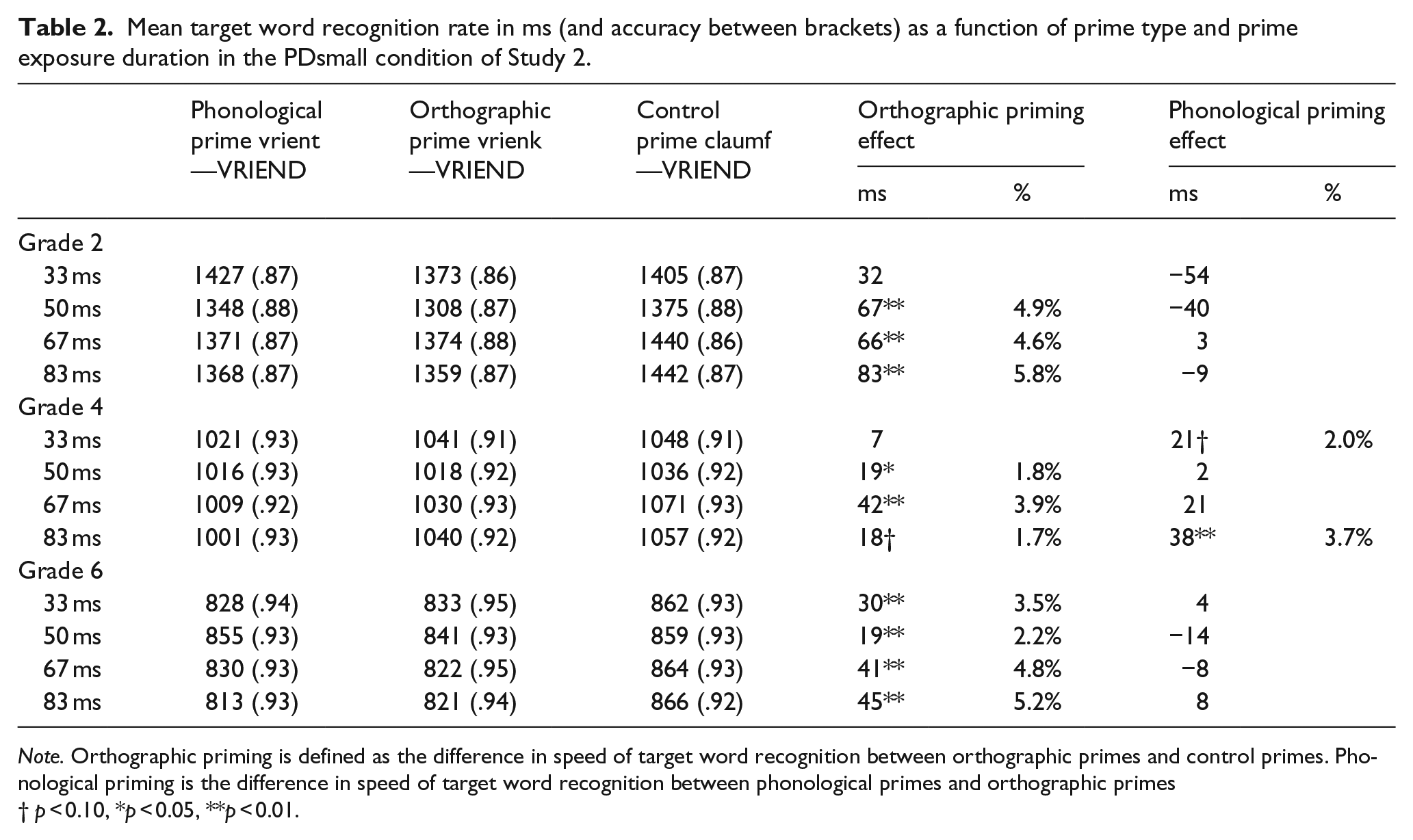
Note. Orthographic priming is defined as the difference in speed of target word recognition between orthographic primes and control primes. Phonological priming is the difference in speed of target word recognition between phonological primes and orthographic primes
p < 0.10, *p < 0.05, **p < 0.01.
Mean target word recognition rate in ms (and accuracy between brackets) as a function of prime type and prime exposure duration in the PDlarge condition of Study 2.
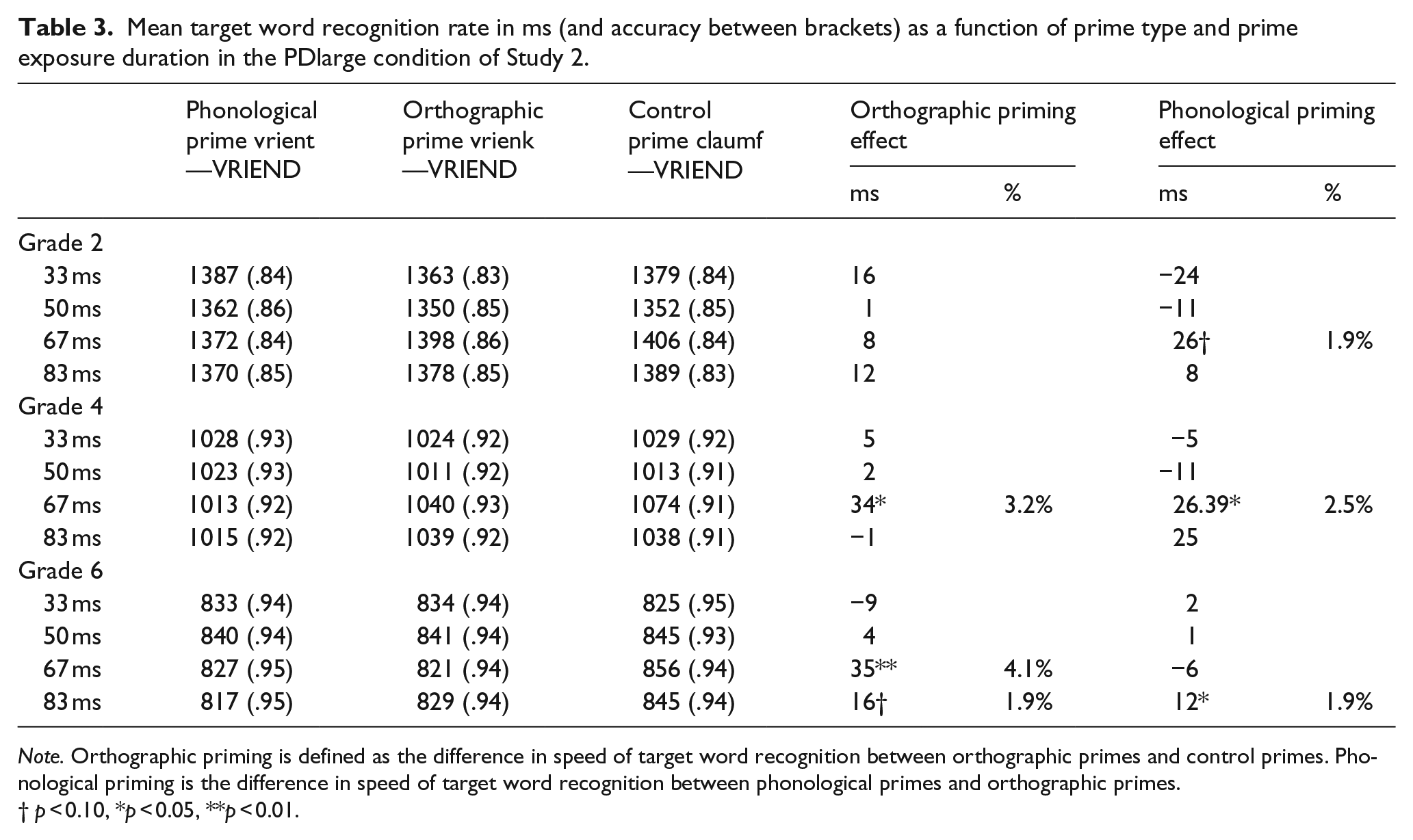
Note. Orthographic priming is defined as the difference in speed of target word recognition between orthographic primes and control primes. Phonological priming is the difference in speed of target word recognition between phonological primes and orthographic primes.
p < 0.10, *p < 0.05, **p < 0.01.
Time course analyses of priming effects
The method of data analysis was similar to Study 1, with phonological difference (PDlarge, PDsmall) included as additional fixed effect.
Small phonological difference
Overall analyses, including fixed effects of group (Grades 2, 4 and 6), primetype (phonological, orthographic and control) and exposure duration (33, 50, 67 and 83 ms), were conducted first. These showed a main effect of group, F(2, 307) = 174.28, p < 0.001, and a main effect of primetype, F(2, 62,904) = 105.24, p < 0.001. In addition, there was an interaction between group and primetype, F(4, 62,905) = 3.66, p = 0.006, an interaction between group and exposure duration, F(6, 62,953) = 5.43, p < 0.001, and an interaction between primetype and exposure duration, F(6, 62,902) = 6.96, p < 0.001. In order to specify these effects and identify the time courses of orthographic and phonological priming effects, subsequent analyses were performed for each of the three age groups and each of the four prime exposure durations separately.
Grade 2
Orthographic priming was not present at 33 ms, t(58.44) = −0.60, p = 0.553, yet became significant from 50 ms onwards, 50 ms: t(89.00) = −3.93, p < 0.001; 67 ms: t(58.33) = −2.82, p = 0.006; and 83 ms: t(57.88) = −3.43, p = 0.001. The phonological priming effect was never significant, 33 ms: t(57.52) = 0.47, p = 0.639; 50 ms: t(86.13) = 1.09, p = 0.278; 67 ms: t(44.17) = −0.01, p = 0.988; and 83 ms: t(58.90) = 0.09, p = 0.928.
Grade 4
There were no orthographic priming effects at 33 ms, t(1936.90) = −0.68, p = 0.496. However, orthographic priming was significant at 50 ms, t(742.98) = −2.38, p = 0.018, and 67 ms, t(38.01) = −3.95, p < 0.001, and showed a trend toward significance at 83 ms, t(80.63) = −1.79, p = 0.078. Phonological priming was absent at the first three prime exposure durations, although there was a trend toward significant priming at 33 ms, 33 ms: t(40.86) = −1.75, p = 0.088; 50 ms: t(79.63) = −0.16, p = 0.874; 67 ms: t(53.39) = −1.57, p = 0.123. However, phonological priming became significant at 83 ms, t(57.20) = −3.50, p < 0.001.
Grade 6
Orthographic priming was significant at all durations, 33 ms: t(88.04) = −3.58, p < 0.001; 50 ms: t(99.73) = −3.14, p = 0.002; 67 ms: t(97.65) = −6.04, p < 0.001; 83 ms: t(40.58) = −7.00, p < 0.001. Phonological priming, on the other hand, was never significant, 33 ms: t(93.26) = −0.58, p = 0.565; 50 ms: t(106.12) = 1.27, p = 0.207; 67 ms: t(58.00) = 0.77, p = 0.446; 83 ms: t(44.42) = −1.47, p = 0.148.
Large phonological difference
Overall analyses showed a main effect of group, F(2, 306) = 190.03, p < 0.001, a main effect of primetype, F(2, 60,217) = 16.26, p < 0.001, and a main effect of exposure duration, F(3, 60,268) = 4.59, p = 0.003. In addition, there was an interaction between primetype and exposure duration, F(6, 60,214) = 4.30, p < 0.001). In order to specify these effects and identify the time courses of orthographic and phonological priming effects, subsequent analyses were performed for each of the four prime exposure durations separately. Despite the absence of interaction effects with group, subsequent analyses were also performed for each of the three age groups separately, in order to allow comparability with results of Study 1 and the PDsmall condition of Study 2, and also to enhance interpretability of results.
Grade 2
There were no orthographic priming effects at any of the exposure durations, 33 ms: t(78.70) = −0.14, p = 0.890; 50 ms: t(2570.50) = −0.40, p = 0.691; 67 ms: t(84.33) = −0.03, p = 0.975; and 83 ms: t(46.22) = −1.45, p = 0.153. Phonological priming was also never significant, although there was a trend toward significant priming at 67 ms, 33 ms: t(78.97) = 0.26, p = 0.799; 50 ms: t(2064.85) = 0.37, p = 0.710; 67 ms: t(89.89) = −1.90, p = 0.06; and 83 ms; t(73.40) = 0.02, p = 0.988.
Grade 4
Orthographic priming effects were not significant at 33 ms, t(86.61) = −0.06, p = 0.951; 50ms, t(42.49) = −0.61, p = 0.542; and 83 ms, t(80.19) = −0.68, p = 0.501; yet were present at 67 ms, t(47.26) = −2.50, p = 0.016. Similarly, phonological priming was absent at 33 ms t(51.90) = −0.08, p = 0.935; 50 ms t(79.03) = 0.09, p = 0.928; and 83 ms, t(44.66) = −1.28, p = 0.205, but was significant at 67 ms, t(80.15) = −2.00, p = 0.049.
Grade 6
Orthographic priming was absent at 33 ms, t(48.04) = 0.43, p = 0.668, and 50 ms, t(111.56) = −0.73, p = 0.469, but became facilitative at 67 ms, t(65.08) = −3.12, p < 0.001, and showed a trend toward significance at 83 ms, t(107.69) = −1.67, p = 0.098. Phonological priming was not significant at the shortest three exposure durations, 33 ms: t(51.15) = −0.35, p = 0.730; 50 ms: t(1506.35) = −0.58, p = 0.565; and 67 ms: t(58.97) = 0.64, p = 0.524, but became significant at 83 ms: t(54.79) = −2.69, p = 0.010. 1
The study was designed to achieve ceiling level accuracy rates, in order to analyze response latencies. The results indicated that although accuracy was high, it did also show some variability. Therefore, we checked whether priming affected accuracy. We conducted a generalized linear mixed model analyses for each priming duration and each age group with primetype as a fixed effect. The initial model included also intercepts and priming effects that were random over targets and participants, but this model often failed to converge. We therefore removed the random priming effects over targets and participants, leading to increased convergence but not in all analyses. Upon additional removal of the random intercept over participants, all analyses converged. Analyses were carried out by the glmer function with a binomial family, as implemented in the lme4 package (Bates et al., 2014). Most analyses indicated nonsignificant priming effects. However, significant orthographic priming was found in the PDsmall condition at 33, 67 and 83 ms in Grade 6, and in the PDlarge condition at 83 ms in Grade 2. In the PDsmall condition, the orthographic priming effects on accuracy coincide with orthographic priming effects on response latencies. This indicates, that in sixth grade the orthographic priming effect is so strong that it effects both the correctness and fluency of word recognition. In the PDlarge condition, the orthographic priming effect on accuracy is not accompanied by an orthographic priming effect on response latencies. This, in combination with the finding that orthographic priming on accuracy is not found consistently, but only at one exposure duration in one age group, made us refrain from interpreting this effect.
Discussion
In Study 2, the results in the PDsmall condition were largely similar to the findings from Study 1. As in Study 1, children from all three grade levels experienced facilitation from orthographic primes during visual word recognition and this orthographic facilitation affected the word recognition process at increasingly early stages when children became more proficient readers. These results support the suggestion that orthographic information becomes increasingly early accessible during reading development. As in Study 1, facilitation from phonological primes did not consistently exert influence on the visual word recognition process in any of the three grade levels. The finding of orthographic priming effects in the absence of phonological priming effects is in line with the hypothesis derived from Study 1, that the small phonological differences in the PDsmall targets result in intertwined orthographic and phonological priming effects, thereby preventing the finding of distinct phonological priming effects. According to this hypothesis, orthographic and phonological effects should be distinguishable in targets with large phonological differences. However, results from the PDlarge condition showed neither consistent orthographic nor phonological priming in any of the three grade levels. The absence of phonological priming effects in the PDlarge condition is obviously not in line with our hypothesis and also diverges from our previous findings in adults, who did clearly benefit from phonological facilitation in the PDlarge condition. This indicates that in adults strong phonological contrasts are a prerequisite to separate orthographic from phonological influences, but when phonological contrasts are large enough, orthographic and phonological code activation appear to follow distinct time courses. In contrast, in children, phonological code activation does not become observable, even with the use of strong phonological contrasts.
General discussion
We performed two studies to examine the time course of orthographic and phonological code activation in children at incremental levels of reading proficiency. The first study showed clear orthographic priming effects in children from second grade onwards. With increasing levels of reading proficiency, orthographic priming became facilitative at increasingly short durations. Unexpectedly, phonological priming effects were absent. We reasoned that this absence might have been due to the small phonological differences in the first study. However, the second study, in which phonological difference was manipulated yielded a similar pattern of results. Contrary to our previous finding in adults (Zeguers et al., 2014), phonological priming was absent in children, even with the use of stimuli with large phonological differences.
Although the large number of tests that were conducted in the current experiments warrants cautious interpretation of results, the main finding of orthographic priming effects at increasingly early durations suggests that orthographic codes become increasingly early accessible during reading development. This is in line with both the lexical-quality hypothesis (Perfetti, 2007; Perfetti & Hart, 2002) and dual-route models of reading (Coltheart, Rastle, Perry, Langdon, & Ziegler, 2001; Grainger & Ziegler, 2011), but does not seem to square with the lexical-tuning hypothesis (Castles et al., 1999; Castles et al., 2007). With respect to the lexical-quality hypothesis, our finding supports the assumption that lexical retrieval becomes increasingly efficient when reading skill increases. With respect to dual-route models, our finding is in agreement with the assumption of increased use of quick, parallel orthographic activation during reading development. However, the lexical-tuning hypothesis assumes reduced sensitivity to similar-yet-different prime words during reading development. In contrast, our results seem to indicate that children become more sensitive to primes when reading skill increases, as they benefit from these primes at increasingly short presentation durations
The second finding, the absence of phonological priming effects in developing readers, even with large phonological differences, is in line with dual-route models of reading (Coltheart et al., 1993; Coltheart et al., 2001). These models assume that phonological recoding is a laborious, slow process that does not yet occur during the initial stages of the word recognition process. Note, however, that although our findings on phonological priming in children are conform predictions from dual-route-models, our findings in adults (Zeguers et al., 2014) do not. That is, dual-route models assume that phonological recoding remains slow even when high proficiency in reading skill is achieved, since phonological recoding occurs only when direct orthographic access does not succeed in retrieving the correct lexical representation. In contrast with this latter assumption, adult readers do show phonological priming effects, indicating that in proficient readers phonological information does become quickly available (Zeguers et al., 2014; and see Ferrand & Grainger, 1992, 1993, 1994; Frost, 2003; Lukatela & Turvey, 1994a, 1994b; Rastle & Brysbaert, 2006 for similar findings of phonological priming effects in skilled readers). Our findings therefore suggest that phonological processes are not yet automatized in second to sixth grade readers, and that automatic phonological processing emerges later in development. This absence of automatization would imply that phonological priming effects may become available at exposure durations that are longer than those used in the current studies. The significant phonological priming effect at the longest exposure duration (83 ms) in the most advanced developing readers (Grade 6) in Study 2 supports this hypothesis. In line with this reasoning, the development of automatized reading has been shown to endure well beyond elementary school (Froyen, Bonte, van Atteveld, & Blomert, 2009).
Interestingly, if phonological codes are indeed not yet accessed automatically in developing readers, then this also entails that the orthographic priming effects that are present in Study 1 and the PDsmall condition of Study 2 do not reflect combined orthographic and phonological influences, but are manifestations of isolated orthographic processing. This would indicate that orthographic codes are already automatically available in second grade readers and become increasingly automatized throughout elementary school. In contrast, the coupling to corresponding phonological codes does not yet reach the stage of automaticity in Grade 6. In support of this interpretation, previous studies have also reported orthographic priming effects in the absence of phonological priming effects in developing readers (Comesaña, Soares, Marcet, & Perea, 2016; Davis, 1998).
Alternatively, it could be argued that the absence of phonological priming effects resulted from the low pre-training familiarity of the participating children with the PDlarge targets. That is, research with pseudo word targets showed that priming effects are absent for words that have no representations in the lexicon (Ferrand, Grainger, & Segui, 1994; Forster & Davis, 1984; Forster et al., 1987; Rajaram & Neely, 1992; but see Bodner & Masson, 1997). Although a word reading test had indicated that most target items were well learned by the vast majority of the participants during training, many children did not master all items and there were individual differences in the exact items that were acquired correctly. In order to investigate the influence of the familiarity of a target item on priming effects, we conducted post-hoc analyses in which accuracy on the word reading test was included as an additional fixed factor. These analyses showed that there was no interaction between primetype and word reading accuracy in most conditions. In the PDsmall condition, the interaction between primetype and word reading accuracy was only significant for orthographic priming at 67 ms in Grade 4, t(2422.59) = 2.56, p = 0.011. In the PDlarge condition, the interaction between primetype and word reading accuracy was significant for phonological priming only at 83 ms in Grade 4, t(1669.63) = 2.70, p = 0.007, and for orthographic priming, the interaction was only significant at 33 ms and 83 ms in Grade 2, 33 ms: t(2648.69) = 2.01, p = 0.044, 83 ms: t(2081.83) = −2.55, p = 0.011. These analyses thus showed that there was no consistent pattern of interaction effects between primetype and word reading accuracy, neither for primetypes nor for grades. This suggests that both the reported orthographic and phonological priming effects were not consistently influenced by the degree of familiarity of the items for the children.
One might question whether the absent phonological priming effects are due to insufficient sensitivity of the study’s design or a lack of statistical power. The go/no go version of the lexical decision task and the sandwich priming technique have been suggested to enhance sensitivity (Lupker & Davis, 2009; Perea, Jiménez, & Gomez, 2015; Perea, Soares, & Comesaňa, 2013). However, in a recent study that adopted both the go/no go version of the lexical decision task and the sandwich priming technique, phonological priming effects were also absent in developing readers (Comesaňa et al., 2016). In addition, since the current studies included large numbers of participants, insufficient statistical power seems an unlikely explanation.
A few findings require further clarification. First, the absence of consistent orthographic priming effects in the PDlarge condition of Study 2 contrasts with the clear orthographic priming effects in all age groups in the PDsmall condition. This indicates that although children are able to access orthographic codes automatically, they cannot do so with the PDlarge stimuli. Since the orthographic overlap between orthographic primes and targets is generally larger in the PDsmall condition (e.g., VRIEND-vrien
Second, despite the strong resemblance between the results in Study 1 and the PDsmall condition of Study 2, small differences exist. Most notably, across grade levels, orthographic priming effects arose earlier in Study 2 than in Study 1. Since we found the same effect in a related study with adults (Zeguers et al., 2014), it suggests that the stimulus set of Study 2 was more sensitive. This might have resulted from enhanced matching of the lexical characteristics of stimuli between conditions.
Third, children from Grades 2 and 4 appeared to show an identical timing of orthographic priming effects, whereas priming effects emerge earlier in children from Grade 6. This suggests that after Grade 4, the reading process experiences a developmental leap, which advances the speed of access to orthographic representations. Interestingly, in the Netherlands, the end of Grade 4 is the time when average readers are considered to reach the level of “functional literacy” (Verhoeven, 1992). Functional literacy allows children to read various kinds of printed language in daily situations, resulting in a rapid increase in reading practice.
Fourth, we assumed that the orthographic priming effects in Study 1 and the PDsmall condition of Study 2 were manifestations of orthographic processing. However, if the subtle phonological manipulations in these studies have resulted in combined orthographic and phonological influences, as suggested in the adult study, it could be argued that conclusions about isolated orthographic processes are impossible. However, in visual word recognition, orthographic codes are inherently activated before phonological codes (Carreiras, Perea, Vergara, & Pollatsek, 2009; Ferrand & Grainger, 1992, 1993; Grainger et al., 2006). Therefore, the earliest subcomponents can be assumed to be orthographic in nature. This leaves the conclusion that orthographic priming effects become increasingly early accessible when children become more fluent readers intact.
Fifth, in order to allow comparison of results, we applied the same procedure of analyses throughout the different studies and conditions. This consistency in analyses procedure increased interpretability of the findings. However, it also entailed that many analyses were performed, thereby risking type-1 errors. Specifically, the Study 1 findings could be argued to be false positives, since in this study there was no overall interaction between Group and Primetype. If this is true, it would indicate that orthographic codes were not yet activated at 83 ms in the second and fourth grade students, and at 50 ms in the sixth grade students. However, the findings of Study 2 argue against the presence of these false positive findings. That is, in the PDsmall condition of Study 2 there was an overall interaction between Group and Primetype, and follow-up analyses replicated the findings from Study 1. In fact, in Study 2 orthographic priming effects even became apparent at earlier durations than in Study 1. This strengthens the conclusion that orthographic codes are accessed in children from second to sixth grade.
In conclusion, the current study extends our understanding of the important, yet relatively little investigated, stage of reading development following the acquisition of accurate decoding skills. This stage entails the fine-tuning of reading processes into a fluent, rapid and flexible word recognition system. Time course analyses of priming effects suggest that access to orthographic representations becomes increasingly early available when children become more fluent readers. This supports the notion that reading fluency develops long after the initial reading stage, and indicates that this development of reading fluency is accompanied by enhanced automatization of orthographic representations.
Footnotes
Acknowledgements
We like to thank Jasper Wijnen for programming the lexical decision task and Anna van Elsas, Anneloes Lemstra, Fleur Vleeming, Rianne Zomer, Rosalie van der Aa, Nik Goedemans, Joelle Berendsen, Roxanne van der Linden and Hulya Aydemir for assistance with data collection.
Declaration of conflicting interests
The author(s) declared no potential conflicts of interest with respect to the research, authorship and/or publication of this article.
Funding
The authors disclosed receipt of the following financial support for the research, authorship, and/or publication of this article: This research was made possible by a grant awarded to Patrick Snellings, Maurits van der Molen and Hilde Huizenga by the research priority area Brain and Cognitive Sciences of the Research Institute of the Psychology department of the University of Amsterdam.

Notes
References
Supplementary Material
Please find the following supplemental material available below.
For Open Access articles published under a Creative Commons License, all supplemental material carries the same license as the article it is associated with.
For non-Open Access articles published, all supplemental material carries a non-exclusive license, and permission requests for re-use of supplemental material or any part of supplemental material shall be sent directly to the copyright owner as specified in the copyright notice associated with the article.
