



Abstract
Yttria-stabilised zirconia (Y-TZP) ceramics are widely used for dental and prosthesis applications; however, they are susceptible to low-temperature degradation (LTD). Despite several explanations of the LTD mechanism, it is not fully understood yet. Commercial TZ-3Y-E grade powder was used to further study the LTD before sintering it. Hydrothermal ageing treatment was applied to samples at 134°C for 5 h. STA analysis confirmed that the powder is binderfree. SEM and XRD analyses show homogeneous particle size and tetragonal as a major phase and monoclinic as a minor phase, respectively. BET method analysis shows a slight change in the pore size, pore volume and surface area of the powder samples, before and after heating at 400°C. Particle size distribution (SD) calculated from SEM images shows ∼ 40–50 nm particle size range of the powders. The results show that LTD was not observed in the powder after hydrothermal ageing treatment.
Introduction
Zirconia-based ceramics have been studied since the early nineteenth century [1-3] to understand their behaviour under various service conditions for many applications [46]. The most important application of zirconia-based ceramics is in dentistry. They are used for manufacturing dental implants, such as roots, crowns and bridges [711]. The mechanical properties of zirconia-based ceramics, such as bending strength (1000–1200 MPa) and hardness (10–12.5 GPa) [10,1216], make them the most favourable materials. These ceramics are translucent in nature and can be stained with a colouring agent to match natural tooth colour, making them aesthetically desirable materials for dental applications [17,18].
The zirconia has three distinct phase structures at different temperatures, cubic (stable above 2300°C), tetragonal (stable between 1600°C and 2300°C) and monoclinic (stable between 1600°C and room temperature). This phase transformation from tetragonal to monoclinic happens martensitically [17]. The zirconia is doped with pentavalent oxides, such as MgO, CaO and Y2O3, to retain the tetragonal phase at room temperature [12,17].
Yttria-stabilised zirconia Y-TZP is a commercially used material in dentistry. Adding yttria between 2 and 5 mol-% partially stabilises the tetragonal phase in zirconia at room temperature. A tetragonal phase is desired for the transformation toughening (TT) mechanism which helps to increase the fracture toughness under the stress due to applied load[19]. Cracks formed on the surface of materials are suppressed by the tetragonal to the monoclinic transformation process. During the applied load on the material, change in internal stresses triggers tetragonal to monoclinic phase transformation spontaneously. As a result, it changes the volume of the material, which compresses the crack edges and thus stops further crack growth [3,17,20]. Nevertheless, a few disadvantages have also been widely reported in the literature[16,19,20]. Among the limits for material use, the low-temperature degradation (LTD) is a major problem [2,7,21-23]. LTD is caused by the spontaneous phase transformation of the meta-stable tetragonal phase to the monoclinic phase in a humid environment and temperature close to the normal human body, i.e. 37°C [20,24]. There are representative models explaining the LTD mechanism; however, it is not fully understood yet. There is no solution to avoid LTD in 3Y-doped ZrO2 ceramics[16,17,25]. It is still necessary to understand the mechanism of LTD in order to provide a possible solution to improve the properties and decrease the risk of LTD in zirconia ceramics. LTD is associated with different factors, such as density, porosity, grain size, surface conditions and residual stresses in sintered products and all these factors are complexly interdependent[20]. There has been very less or no attention paid to the 3Y-doped ZrO2 powder before sintering and without other extrinsic factors affecting the LTD mechanism[26]. This research aims to investigate the LTD in 3Y-doped ZrO2 commercial powders before sintering to avoid the effect of residual stresses due to sintering on LTD. Furthermore, readers interested in LTD in fully sintered powder can review the previous work of the authors[26].
Experimental details
Yttria-doped ZrO2 commercial nanopowder (Grade TZ-3Y-E, Lot NO. Z307175P Tosoh corporation Japan) [27] was used in this study. LTD is widely reported in this grade of material[13,26,28]. The particle size is 40 nm as per the data sheet provided by the manufacturer[27]. Grain SD was measured using ImageJ software from the SEM images to confirm the particle size of the powder. Thermogravimetric analysis TGA was performed by simultaneous thermal analyser STA (Thorn Scientific STA1500) on 20 mg nano zirconia powder from ∼21°C to 800°C, at the heating rate of 10°C per minute, and the machine was switched off to cool down to room temperature naturally, to confirm the presence of binders. Powders were heated in a conventional furnace (Carbolite 1800C Box furnace) to remove the moister at 10°C per minute to 400°C held for 5 h and the furnace was switched off to cool down to room temperature naturally. BET (Brunauer, Emmett and Teller) method analysis was done on the powder before and after heating at 400°C by using Nova 4200e (Quantachrome instruments), and the samples were degassed for 24 h at 80°C. Adsorption–desorption curve of type IV isotherm was produced in the nitrogen gas environment (N2 at 77 K on carbon; slit pore, non-local density functional theory (NLDFT) equilibrium model) with a relative pressure range of 0.0–1.00. The pore size, cumulative pore volume and cumulative surface area values were calculated by using the multipoint DFT (density functional theory) method. Accelerated hydrothermal ageing (LTD) was induced by using a hydrothermal autoclave at 134°C for 5 h and a pressure of approximately 0.2 MPa as per ISO standard (ISO 13356:2008)[29]. Scanning electron microscopy was performed by using FEI inspect (Oxford Equipment). To characterise the microstructure of all powders, samples were glued separately with a carbon tap on an aluminium stub and were gold coated by using an automatic sputter coater (Agar Scientific) at 30 mA current for 80 s to produce a conductive coating layer. X-ray diffraction analysis of samples was carried out by using a Panalytical CubiX3 diffractometer at standard scan parameters (Ni filtered Cu-Kα radiations, λ = 1.5418 Å) in the 2-theta range of 15°–70° at a step size of 0.0315(°) and a time per step of 200 s. The sample names based on treatment are without any treatment (TZ-3Y-E As-received Non-LTD) and with hydrothermal ageing (TZ-3Y-E as-received LTD), after heating at 400°C without hydrothermal ageing (TZ-3Y-E 400°C Non-LTD) and with hydrothermal ageing (TZ-3Y-E 400°C LTD).
Results and discussion
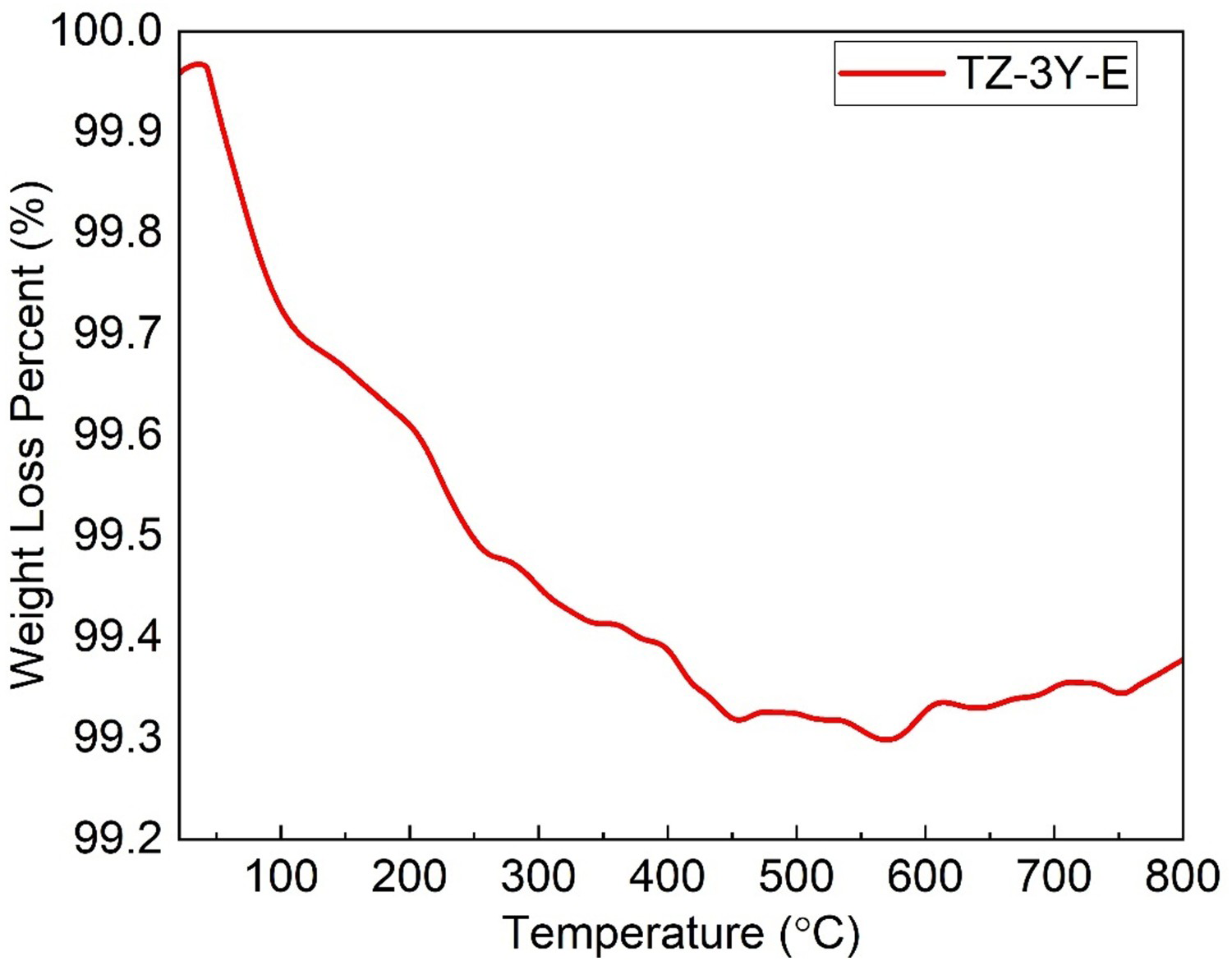
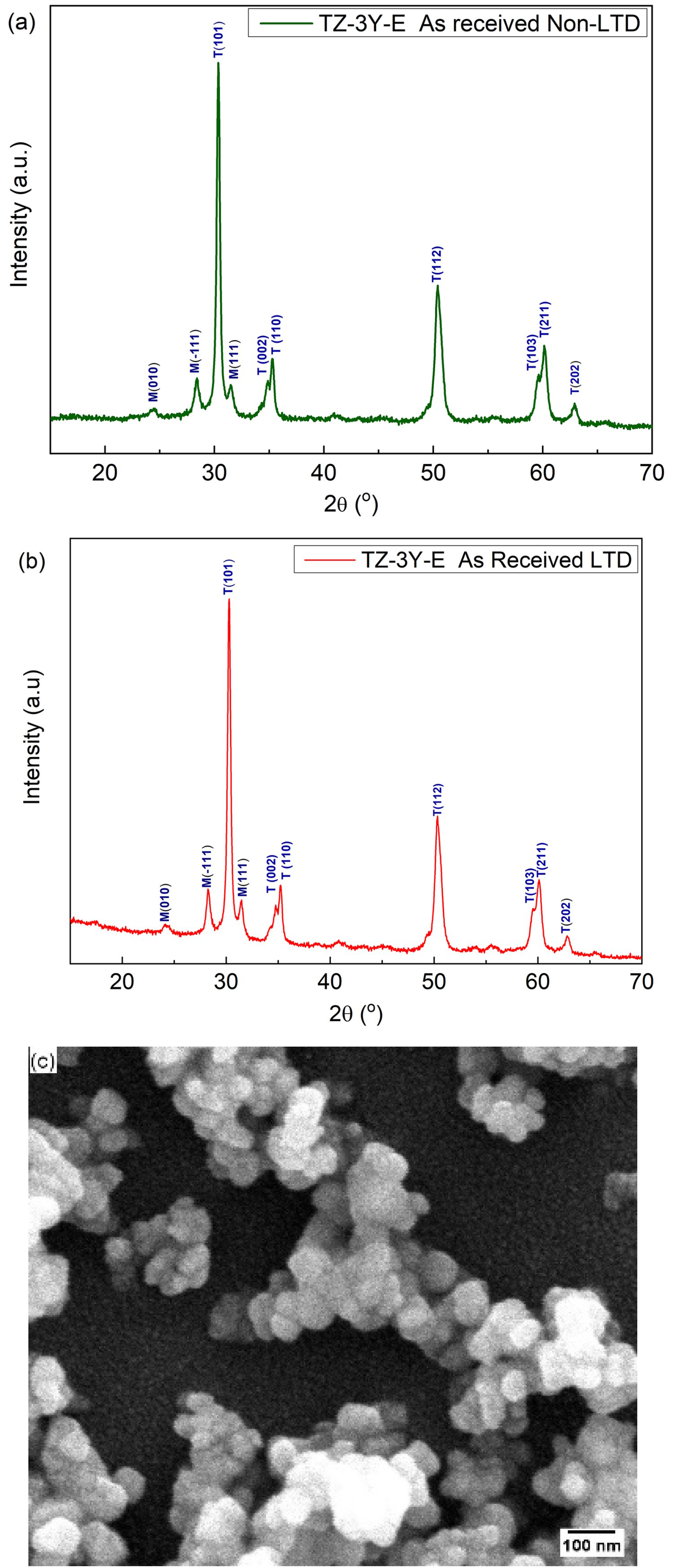
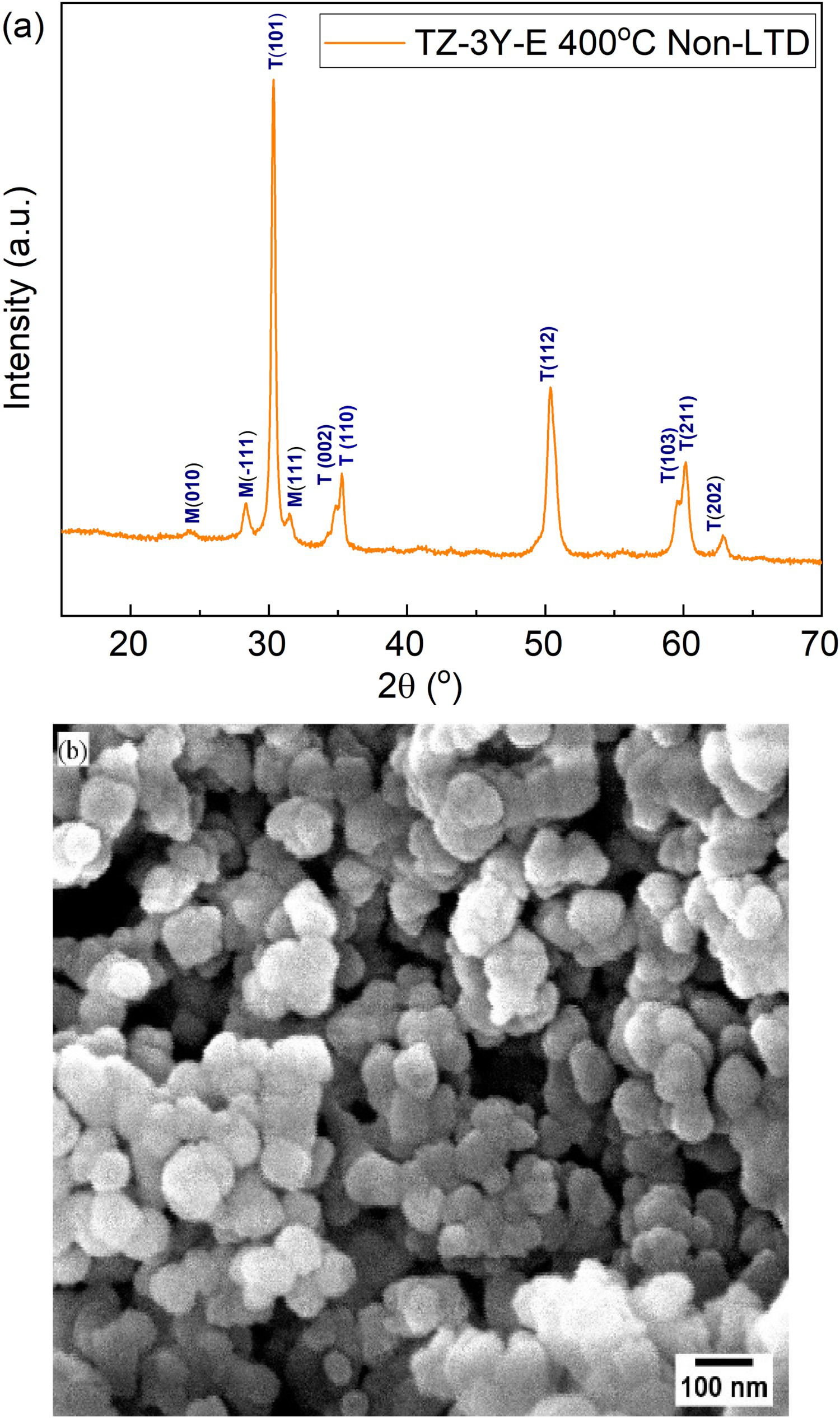
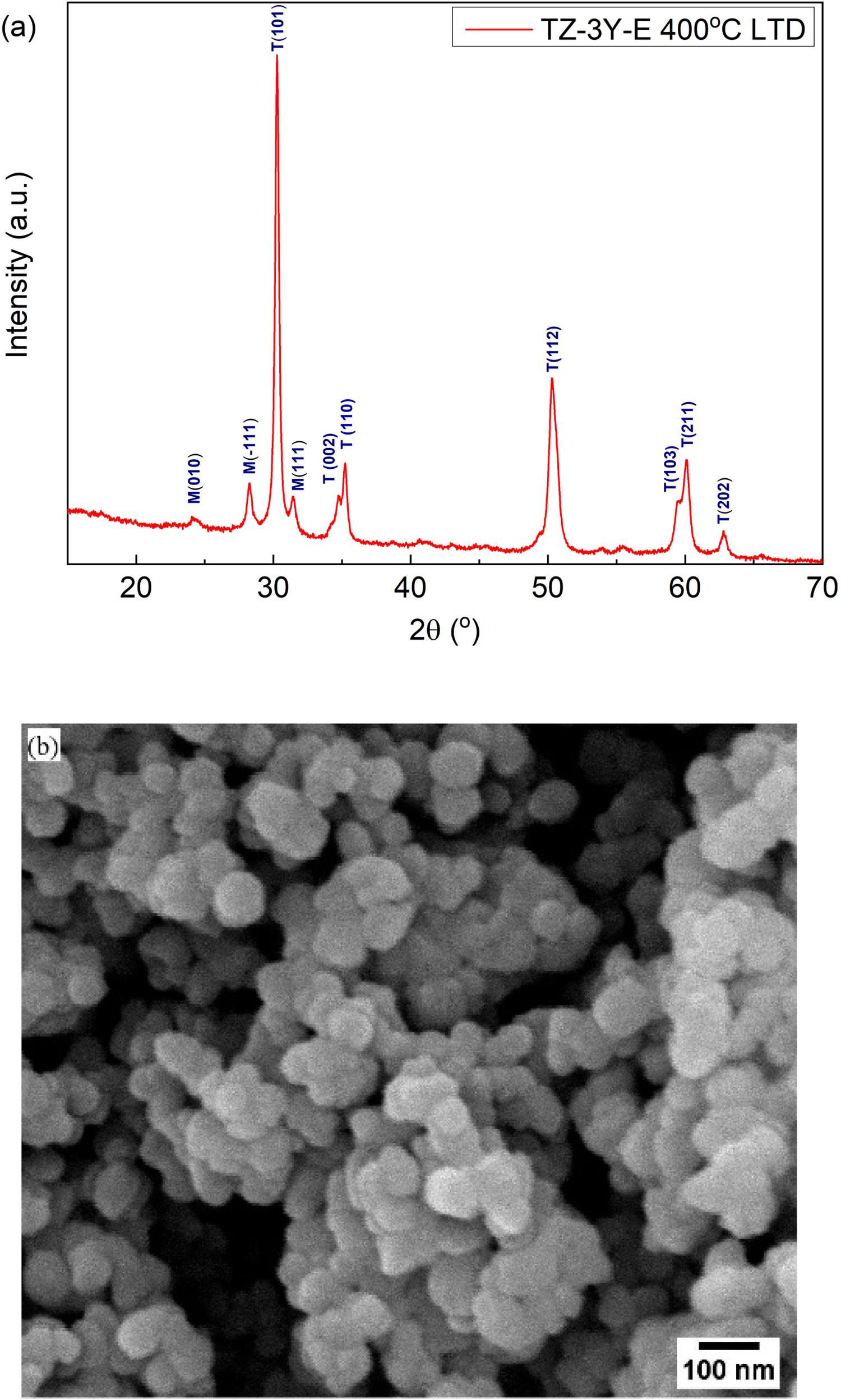
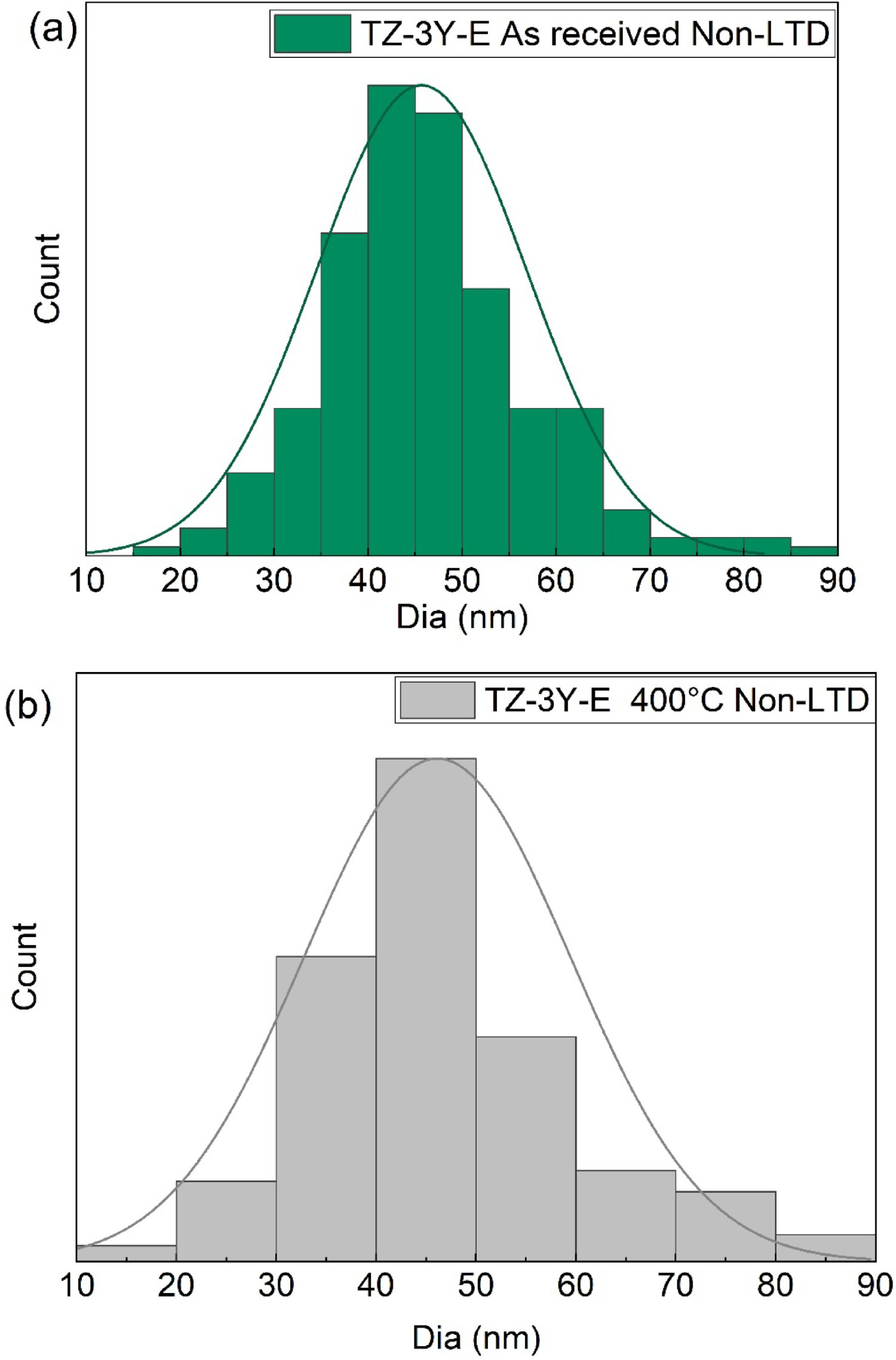
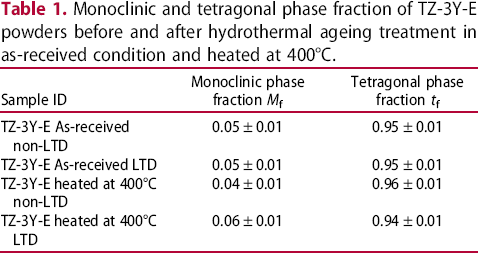
TGA result in Figure 1 reveal a minor change (∼0.2%) in weight loss percent, and it can be considered as any moister content in the powder[30,31]. The TGA curve becomes stable after 400°C; therefore, the powder was heated at 400°C and results were compared with the as-received powder. Inhomogeneity in the heating curve in the TGA results (Figure 1) can be related to machine error and/or powder attrition with the escape of the gases from the bulk powder[30,31]. The particle SD results of the TZ-3Y-E powder particles in as-received and heated at 400°C are shown in image Figure 5(a,b). The average grain size of the powder particles is in the range of approx. 40–50 nm and these results are close to the particle size given in the datasheet [27] provided by the manufacturer and in the literature[32]. ISO standard (EN-ISO-13356:2015) recognised equation (Equation (1)) by Toraya et al. [33] was used to calculate the monoclinic and tetragonal phase fraction (tf) from the XRD results. The results are shown in Table 1.
TGA result of TZ-3Y-E as-received powder. (a) XRD non-hydrothermal ageing treatment, (b) XRD after hydrothermal ageing treatment, and (c) SEM of as-received TZ-3Y-E powder. (a) XRD, and (b) SEM, after heating at 400°C. (a) XRD, and (b) SEM, after heating at 400°C and hydrothermal ageing treatment. Grain SD (a) as-received TZ-3Y-E powder, and (b) after heating at 400°C. Monoclinic and tetragonal phase fraction of TZ-3Y-E powders before and after hydrothermal ageing treatment in as-received condition and heated at 400°C. BET analysis of the powder samples in as-received condition and after heating at 400°C.

Conclusion
Results obtained from TGA analysis show that as-received TZ-3Y-E powder is binder-free. Comparison of the BET analysis of powder in as-received and heated at 400°C and XRD data before and after hydrothermal ageing treatment of the powders does not show any change in monoclinic and tetragonal phase fraction. It can be concluded that extrinsic factors, such as pore size, pore volume and the surface area, do not affect the LTD in nano zirconia powders. Therefore, LTD is not observed in the TZ-3Y-E powder free from the influence of residual stresses due to sintering and other extrinsic factors. This information is one step forward in understanding the LTD phenomenon in zirconia-based ceramics.
Footnotes
Disclosure statement
No potential conflict of interest was reported by the author(s).