




Abstract
While many approaches have been proposed to deal with energy/latency trade-offs, they are likely to be insufficient for the applications where reduced delay guarantee is the main concern. In this article, we investigated the potential application of a decentralized two-tiered network architecture, in large-scale wireless sensor networks, where an upper layer Wireless Local Area Network (WLAN), offering more powerful capabilities, serves as a backbone to an adaptively-clustered Low-Energy Adaptive Clustering Hierarch (LEACH)-based wireless sensor network. The WLAN layer will be involved in the communication between the sensor network and the control station, mitigating the impact of the limited capacities of the sensor nodes. With this two-tiered architecture we target to provide more reliable data delivery with reduced delay bounds, and lower energy consumption in the underlying sensor network, thereby increasing its lifetime. Simulation results show that the two-tiered network architecture achieved a relatively long lifetime, while preserving remarkably low latencies, compared to a single-tiered LEACH and a super-clustered LEACH-based network architectures.
Introduction
Recently, the wireless sensor networks have been deployed for a wide range of applications. However, a number of formidable challenges must be solved before these exciting applications may become reality. Many current Wireless Sensor Networks (WSNs) solutions are developed with simplifying assumptions about wireless communication and the environment, even though the realities of wireless communication and environmental sensing are well known.
A wireless sensor network design is influenced by many factors that include hardware constraints, transmission media, power consumption, network topology, scalability, and fault tolerance [1, 2]. An important challenge in the design of wireless and mobile systems is that two key resources, communication bandwidth and energy, are significantly more limited than in a tethered network environment [3]. These restrictions require innovative communication techniques to increase the amount of bandwidth per user and innovative design techniques and protocols to use available energy efficiently. Furthermore, wireless channels are inherently error-prone and their time-varying characteristics make it hard to consistently obtain good performance [4]. Communication protocols must be designed to adapt to current conditions instead of being designed for worst-case conditions. Applications differ in which features are most important. For example, an application that supports wireless data communication might prefer longer latency in exchange for longer node lifetime. On the other hand, long latency is unacceptable for a cellular phone application. Similarly, lossy compression is unacceptable for data transfers, but represents a good trade-off to extend the node lifetime for voice transfers. These unique considerations for different applications, coupled with the tight resource constraints of wireless systems, suggest the need for application-specific protocols.
We note that, in general, there is an excellent understanding of both the theoretical and practical issues related to wireless communication. For example, it is well known how the signal strength drops over distance. Effects of signal reflection, scattering and fading are understood. However, when building an actual wireless sensor network, many specific systems, applications, and cost issues also affect the communication properties of the system. Radio communication in the form of Amplitude Modulation (AM) or Frequency Modulation (FM) broadcast from towers performs quite differently than short range, low power wireless signals found in self-organizing sensor networks. Of course, while the same basic principles apply, the system performance characteristics vary considerably. In other words, the size, power, cost constraints and their tradeoffs are fundamental constraints. In the current state-of-the-art, the tradeoff among these constraints has produced a number of devices currently being used in WSNs. As better batteries, radios, and microcontrollers become available and as costs reduced, new platforms will be developed. These new platforms will continue to have tradeoffs between these parameters.
Novel network protocols that account for the key realities in wireless communication are required. New research is needed to:
Measure and assess how the theoretical properties of wireless communication are exhibited in today's and tomorrow's sensing and communication devices, Establish better models of communication realities to feed back into improved simulation tools, Invent new network protocols that account for the communication realities of real world environments, Test the individual solutions on real platforms in real world settings, and Synthesize novel solutions into a complete system-wide protocol stack for a real application.
This article is organized as follows. In Section 2 we provide a suitable background for the reader followed by an illustration of two-tiered networks, in Section 3. Simulation results are presented in Section 4 with a thorough discussion in Section 5. Finally, we conclude in Section 6.
Background
Due to the battery resource constraint, it is a critical issue to save energy in wireless sensor networks, particularly in large sensor networks [5]. The typical many-to-one traffic pattern causes uneven energy consumption among sensor nodes, i.e., sensor nodes near the sink or the cluster head have much heavier traffic burden and run out of power much faster than other nodes. While clustering presents massive potential in increasing the lifetime of a sensor network, sensors' energy cannot support long-range communication to reach a sink which is generally far away from the data source. Two-tiered network architectures present a promising research direction for wireless sensor networks. The concept of the two-tiered architecture itself is commonly known in many different networking areas. As an example, IP over Asynchronous Transfer Mode (ATM) aimed at improving network security, and Quality of Service.
This concept has been previously investigated by several researchers; however, most research is still needed through investigation and lacks conclusive results. One solution was to form a heterogeneous sensor network by deploying a small number of powerful high-end sensors in addition to a large number of low-end sensors [6–10]. For example, the authors in [6] tested a LEACH network of 100 nodes where 10 nodes began with 200 J of energy and the remaining 90 nodes began with only 2 J of energy. Each of the 10 nodes that began the simulations with 200 J was a cluster head an average of 89 times during the simulation, whereas each of the 90 nodes that began the simulations with 2 J was a cluster head an average 0.25 times during the simulation. Despite that, the network lifetime did not exceed a few thousands of seconds.
In another example, the Intel researchers have explored the concept of heterogeneous sensor networks [3]. The Intel solution consists of using an IEEE 802.11 mesh network as an overlay of a sensor network. This study simply presents the concept and provides some analysis based on some experimental results. However, to our best knowledge the authors have not presented any details on the coordination and communication mechanisms. Also, the choice of a basic IEEE 802.11 in DCF (Distributed Coordination Function) mode may be inefficient, since this protocol does not provide QoS guarantees.
Another study has proposed the use of a two-tiered wireless sensor network architecture for structural health monitoring [4]. This is a GSM-like architecture, which divides the monitored area into several clusters. Each cluster is managed by a local master that handles the communication using TDMA-like protocols inside the cluster. Local masters gather the sensory data and send them to the control station. This approach is only interesting for a topology with only a few number of nodes inside each cluster, due to the scalability limitation of the TDMA protocol [9]. Furthermore, it is only applicable in structures like buildings and bridges where regular power supplies exist to support the infrastructure. Also, to ensure communications, this network architecture is entirely dependent on the presence of a local master that is the single-point of failure, which is not suitable for WSN. In fact, for a large-scale network, this network architecture is unpractical since the number of local masters increases linearly with the number of deployed nodes, resulting in a significant increase of the overall cost.
On the other hand, the researchers in [10], who also proposed to form a heterogeneous sensor network by deploying a small number of powerful high-end sensors in addition to a large number of low-end sensors, also designed a routing protocol based on a novel chessboard clustering scheme they proposed to maximize network lifetime by balancing node energy consumption. Although this scheme increases network lifetime, and performs better than LEACH, it requires global knowledge of the network topology, and the chessboard layout, and more importantly the communication is highly dependent on the presence of the high-end nodes which are the single-point of failure. A final drawback of the operation of this clustering protocol emphasizes on occurrence of cluster re-formation only when high-end nodes are switching roles, which implies that low-end sensors are awake through the entire lifetime of the network.
Another research aimed at defining scalable, reliable, real-time, and energy-efficient communication and coordination schemes in the design of a two-tiered sensor network architecture, through the use of the IEEE 802.11 WLAN protocol on top of the IEEE 802.15.4 protocol designed for low-rate wireless private area networks (LR-WPAN) [11]. The authors studied the potential use of an IEEE 802.11 WLAN on top of an IEEE 802.15.4 sensor network. The performance of IEEE 802.15.4 was analyzed and then compared against the performance of the two-tiered architecture where an IEEE 802.11 network supports the IEEE 802.15.4 sensor network, particularly in heavy load situations. The authors extended their work and investigated the performance of a three-tiered wireless sensor networks for a hospital environment [12].
Two-Tiered Network Architecture
To provide more reliable services with reduced end-to-end delays, and lower energy consumption in the underlying sensor network, we propose the application of a decentralized two-tiered network architecture, in large-scale, self-organizing, adaptively-clustered LEACH-based wireless sensor networks, where an upper layer Wireless Local Area Network (WLAN), serves as a backbone to the wireless sensor network. A conceptual illustration of this architecture is shown in Fig. 1.

A Conceptual illustration of a two-tiered sensor network architecture.
The deployment of a two-tiered network architecture benefits from an upper level wireless network in supporting a wireless sensor network with more powerful communication capabilities; longer transmission range, higher bandwidth, and sufficient power supply. The main objectives of this network architecture are:
Supporting real-time communications by providing bounded and reduced latencies by means of higher data rate wireless links, Improving the communication reliability by reducing the error rate and the packet loss probability in multi-hop networks, by decreasing the number of hops, requiring long transmissions.
The following sections outline the two-tiered sensor network architecture proposed in this work and address its design goal in more detail.
The general architecture of the two-tiered, large-scale wireless sensor network proposed in this work is presented in Fig. 2.

The general architecture of the two-tiered LEACH-based sensor network.
This network is composed of a low data rate, short transmission range, and energy-constrained large-scale adaptively-clustered sensor network supported by an overlay WLAN, which has more suitable capabilities, including high data rate, large transmission range, and sufficient energy resources, to ensure real-time communications. The wireless sensor network is homogeneous in the sense that all sensor nodes possess the same battery-power and processing capabilities, including the ability to use power control to vary the amount of transmitted power, as well as having sufficient computational power to support different MAC protocols and perform signal processing functions.
Using LEACH, the wireless sensor network is self-organized into adjacent clusters of nodes. The routing devices of the WLAN layer (i.e., the access points) act as local, distributed base stations. Cluster heads in the wireless sensor network are no longer required to reach the centralized base station in one expensive hop, but rather forward its data to a much nearer local base station, using less transmission energy each time. Conceptually, the large-scale LEACH-based wireless sensor network is organized as an assemblage of adjacent smaller-scale wireless sensor networks, also LEACH-based, in which clusters are given the option to choose the nearest local base station.
The operation of the LEACH protocol is essentially the same as described in [13, 14]. In the setup phase of each round, a node is selected to be a cluster head. Once the node is selected as a cluster head, it broadcasts an advertisement message to the surrounding nodes. The receiving nodes (that are not clusters heads for that round) determine to which cluster they would join by computing the signal strength of the advertisement message, and thereafter send a joining message to the cluster head node intended. Before the steady-state operation could begin and actual data transmission could occur, and while waiting for all joining messages to arrive, the cluster head searches for the nearest local base station. Using the IEEE 802.11 protocol, the cluster head nodes attempt to reach the nearest WLAN access point, acting as the local base station. After receiving all joining messages, the cluster head node creates a TDMA schedule assigning a time slot for each node, which is broadcasted to all the nodes in the cluster.
The WLAN layer consisting of the local base stations will be involved in the communication between the sensor network and the control station, mitigating the impact of the limited capacities of the sensor nodes, and offering more powerful networking capabilities. With this two-tiered network architecture we target to provide more reliable data delivery with reduced delay bounds, and lower energy consumption in the underlying sensor network, thereby increasing its lifetime.
This two-tiered network architecture can improve the network performance in terms of real-time, reliability, and energy consumption. Real-time improvement can be achieved by the grant of higher bandwidth and long transmission range in the WLAN layer resulting in lower hop count to reach the destination. Also, since WLAN access points are supposed to be more reliable than sensor nodes because they have powerful communication capabilities, the communication reliability will be consequently improved, reducing the number of lost/erroneous packets (e.g., due to a sensor node failure or mobility). In addition, the underlying sensor network will benefit from an extended lifetime, since the major part of the data delivery will be held by the WLAN, and thus sensor nodes will save much energy since they will be less frequently involved in the communication process.
In the following, the main design goals of the proposed two-tiered network architecture are outlined. The first major design goal is scalability. As wireless sensor networks are usually large-scale and deploy huge number of nodes randomly scattered in the environment, scalability is an important feature that must be considered in the design of the two-tiered network architecture. The overlay WLAN must be able to deal with a large number of nodes so that the increase in the number of nodes does not affect the dependability of the two-tiered network architecture.
Another predominant feature intended for the two-tiered network architecture is Real-Time performance. In fact, the additional cost in terms of hardware, development, deployment, and maintenance of this network architecture must be vindicated by guaranteeing improved real-time performance. It is important to address the real-time performance of both upper and lower layers of the two-tiered network architecture.
Furthermore, the overlay network must enhance the reliability of data communication since the access points of the WLAN (i.e., the local base stations) are less power-constrained, support higher data rate, and enough memory, and thus are not as error-prone as sensor nodes.
Two imperative features of the two-tiered network architecture are that it should be self-organizing, and transparent. Due to the potential dynamic changes of a wireless sensor network, resulting from the sensor node alternating between active and inactive states, the sensor nodes may become faulty at any time, or even mobile nodes going in/out of range, it is critical for the two-tiered network architecture to be self-organizing so that the network is adaptive of such dynamic changes of the network topology. In addition to self-organization, it is essential that the two-tiered network architecture is transparent in the sense that the non-support of the overlay WLAN in the communication process must not prevent in any case the continuous operability of the underlying sensor network. On the other hand, the wireless sensor network must take profit as much as possible from the existing access points to improve the overall performance of the network.
Finally, the two-tiered network architecture should ensure load-balancing. In overload situations, a given access point (i.e., local base station) may be subject to a bottleneck problem. In such situations, the network should be able to dispatch the traffic through different routes to balance the total load on the other access points.
Analysis and Simulation
For even moderately-sized networks with tens of nodes, it is extremely difficult to analytically model the interactions between all the nodes. Therefore, we used J-Sim [15] to evaluate the two-tiered network architecture and compare it to other architectures. We compare against a single-tiered LEACH network architecture and a super-clustered network architecture.
In this work, and as assumed by LEACH [13, 14], a simple first-order radio model is used to model the energy dissipation. In this model, the radio dissipates an amount of Eelec energy to run the radio electronics of the transmitter or receiver circuitry, and an amplification of ε amp for the transmitter amplifier, where Eelec is set to 50 nJ/bit and εamp is set to 10 pJ/bit/m2.
For the experiments conducted in this paper, each node begins with only 5 J of energy and an unlimited amount of data to send to the base station. The central base station is located at position (0,0), in all the experiments. The bandwidth of the channel was set to 1 Mbps, and the processing delay was 25 μs on the transmitting side and 25 μs on the receiving side. Each data message was 2000 bytes long, and the packet header for each type of packet was 40 bytes long. The number of nodes in these experiments varies from 100 nodes up to 2000 nodes, and the network size, in terms of geographic coverage expands from 100 m × 100 m to 600 m × 600 m accordingly. These parameters are summarized in Table 1.
Characteristics of the Test Networks
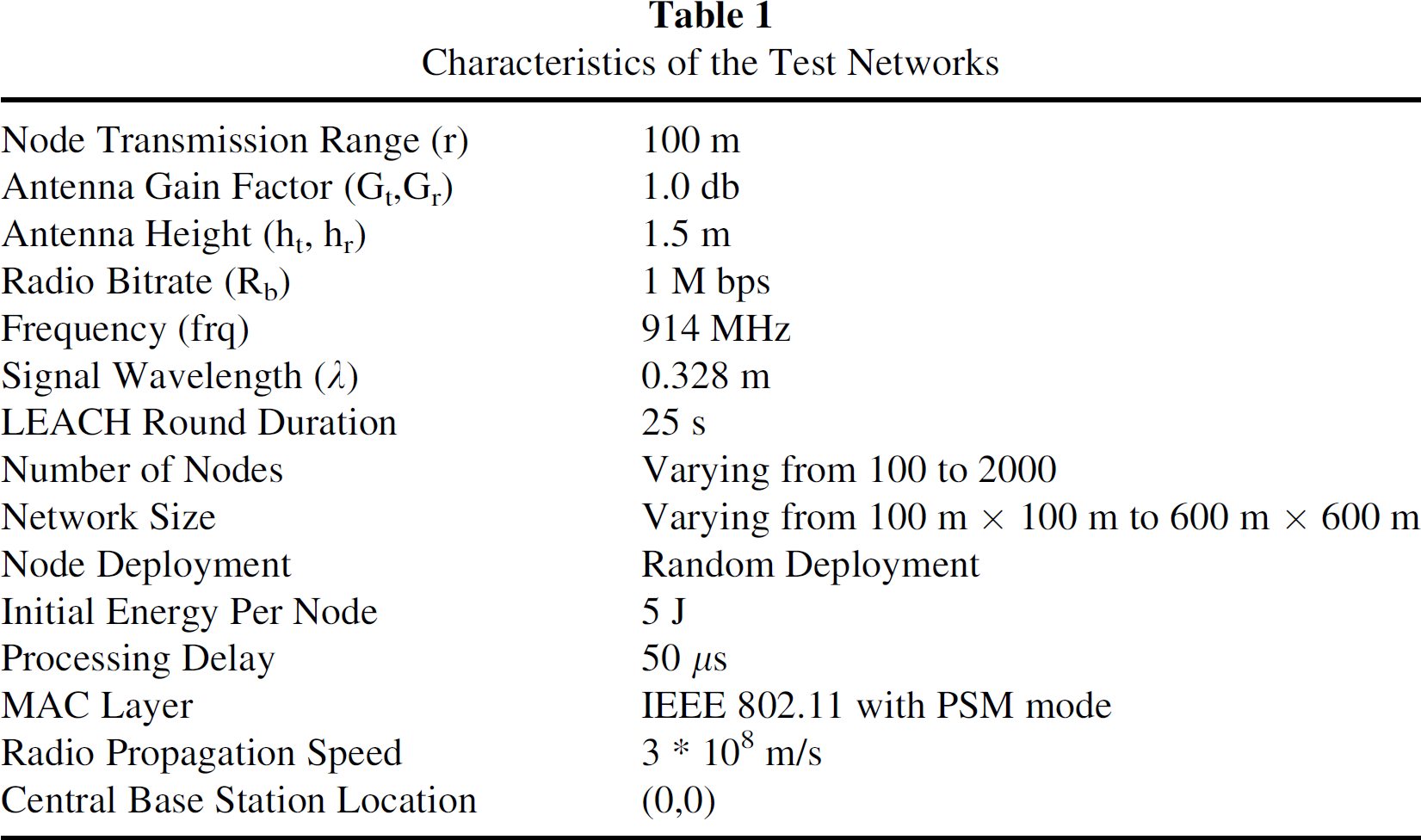
Characteristics of the Test Networks
The network size is an important parameter when comparing routing protocols and architectures that use wireless multi-hop communication approaches. Increasing the network size will increase the number of hops, or as in LEACH the distance of the hop, that packets take to reach the base station, which consequently increases the end-to-end delay. Moreover, increasing network size will increase the traffic loads on the sensor nodes that are closer to the base station. Hence, without additional supporting devices, those nodes will quickly drain their energy, and die faster than the other nodes. Yet, the latter situation is unattainable in LEACH-based networks, as although LEACH uses multi-hop communication, cluster heads forward packets directly to the base station, without the need of other relaying nodes. Nonetheless, increased the network size can have a great influence, due to the increased distances between cluster heads and the base station resulting in more energy consumption required for the transmission.
In this section, we compare the two-tiered network architecture against the single-tiered network architecture, in terms of network lifetime, packet delivery ratio, latency or average end-to-end delay, and network overhead. For comparing the network lifetime of both the network architectures, we conducted a series of experiments, in which we varied the network coverage and the number of nodes, as stated in previous sections, the number of clusters is varied accordingly, aiming to have a near-optimal number of clusters. Target nodes generate packets at a rate of 1 packet/sec each. The results of these experiments are shown in Figs. 3 through 5.

Network lifetime, in rounds, on a 200 m × 200 m region.

Network lifetime, in rounds, on a 400 m × 400 m region.

Network lifetime, in rounds, on a 600 m × 600 m region.
It is obvious how the two-tiered sensor network architecture outperforms the single-tiered LEACH sensor network architecture. Figure 3 shows that for a region of 200 m × 200 m, the proposed architecture outperforms the single-tiered network by an average of 140%. LEACH has proven to have scalability problems when attempting to increase its coverage, and number of nodes deployed. As shown in Figs. 4 and 5, the network lifetime of the two-tiered architecture is, on average, 6 times better in the 400 m × 400 m region, and 60 times better for the 600 m × 600 m coverage. The latter result undoubtedly shows that the single-tiered LEACH network failed to survive for more than a few hundreds of rounds. Furthermore, the proper operation of LEACH requires that each node is able to transmit data to the base station in one hop. Consequently, obliged to tremendously increase the transmission range of the sensor nodes, it was found that doubling the transmission radius of the sensor nodes decreased the network lifetime by an average of 45%.
For real-time communications have specific end-to-end delay requirements, it is imperative to compare the two network architectures in terms of the average end-to-end delay. All packets are delivered to the centralized base station located at position (0,0). In the 200 m × 200 m network, the LEACH delivered packet to the base station with an average of 15 times more that the two-tiered network. On the other hand, for the 400 m × 400 m network, LEACH latency was 16 times greater than that of the two-tiered network. Finally for the 600 m × 600 m network, LEACH latency was only 13 times greater than that of the two-tiered network. We justify this trend by the effect of increased node density, since more clusters are formed, many of which are closer to the base station. Nevertheless, the single-tiered LEACH network architecture is evidently outperformed by the two-tiered architecture. These results are shown in Figs. 6 through 9.

Average end-to-end delay, in seconds, on a 200 m × 200 m region.

Average end-to-end delay, in seconds, on a 400 m × 400 m region.

Average end-to-end delay, in seconds, on a 600 m × 600 m region.

Average end-to-end delay, in seconds, on a 600 m × 600 m region for two-tiered networks.
One may think that the delay of the two-tiered networks in the figures almost constant and is independent of the network size; Figure 9 explains that this is not the case. This is not the case. In fact delay is increases as the network size increases, but not significantly.
The size of the transmitted data and the frequency of data transmission influence the manner in which any general data network operates. With the well-known limitations in wireless networks, and particularly in sensor networks, of bandwidth limitation, scarce energy supply, energy-delay tradeoff, and their self-organizing ad hoc nature, it is imperative to ensure the proper operation of such networks under extreme conditions of heavy network load, even if with degraded performance.
Being LEACH-based network architectures, both architectures share a powerful feature; the ability to perform data aggregation (also known as data fusion). Data aggregation is the combination of data from different sources using various functions such as suppression functions for eliminating duplicates, or functions capable of calculating, any or a combination of, minimum, maximum, or average values.
Varying the number of packets injected in the network, and the sending rate had exceptionally little effect on end-to-end delay, proving that LEACH is, in fact, applicable for real-time communications, and under heavy traffic load situations.
Although LEACH has proven to support heavy network load in both architectures, the two-tiered network topology undoubtedly outperformed the single-tiered LEACH, this id due to the support of the Wireless Local Area Network (WLAN), featured with higher bandwidth, and more processing capabilities. Compared to the single-tiered architecture, the two-tiered architecture had negligible latency, proving its suitability for real-time communications, within end-to-end delay requirements acceptable to most time-critical sensor network applications.
As the previous section focused on comparing the performance of LEACH in two different architectures, the focus of this section is comparing the proposed two-tiered sensor network architecture against existing sensor network architectures that build on the concept on multi-tiered architecture. Multi-tiered architecture canbe obtained using the idea of clustering as in [16–18].
Due to the battery resource constraint, it is a critical issue to save energy in wireless sensor networks, particularly in large sensor networks [19–22]. The typical many-to-one traffic pattern causes uneven energy consumption among sensor nodes, i.e., sensor nodes near the sink or the cluster head have much heavier traffic burden and run out of power much faster than other nodes. While clustering presents massive potential in increasing the lifetime of a sensor network, sensors' energy cannot support long-range communication to reach a sink which is generally far away from the data source. Hence, we study the performance of a multi-layered LEACH-clustering network architecture, (i.e., super-clustered network architecture), in which the local base stations of the WLAN overlay are replaced by super-nodes, with much higher battery power.
We study a 200 m × 200 m network, while varying the number of sensor nodes and target nodes from 250, and 50 to 1500 and 250, respectively. Replacing the 4 access points (local base stations) of the WLAN overlay, we deploy 10 super nodes, with much higher battery power, which constitute the upper layer of the clustering hierarchy. Figure 1 presents an illustration of the super clustered sensor network architecture.
For this sensor network architecture, the more powerful nodes of the super clustering hierarchy are each equipped with a power source of 300 Joules, the sensor nodes remain the same as assumed in previous networks with 5 Joules each. Assuming that the access points (local base stations) of the WLAN are equipped with an unlimited power supply, we increased the number of super nodes to 10, thereby forming 10 super clusters in the upper-layer of the super-clustered network architecture, compared to 4 access points, forming 4 blocks, in the two-tiered network architecture. This part of the simulation focuses on comparing the two network architectures in terms of energy consumption and network lifetime.
As clearly noticed from Fig. 10, the total amount of energy consumed per round in both networks increases as the node density is increased. It was found that on average the super-clustered network consumes 20% more energy than the two-tiered network. We justify this observation by the higher bandwidth provided by the WLAN overlay, and the more powerful access points (local base stations). With the ability to perform data compression, and the higher bandwidth of the wireless channel, the access points (local base stations) can transmit the same data sent by the super cluster heads in compressed form, thereby requiring less energy.

Energy consumption per round (in joules) of super-clustered (multi-layer LEACH) network, of 10 super clusters, vs. a two-tiered network, of 4 blocks, both 200 m × 200 m.
On the other hand, when looking into the achieved network lifetime in Fig. 11, the super-clustered network is constrained by the amount of energy of the super nodes. Although clearly surviving much longer than a single-layered clustered network, as the single-tiered LEACH network examined in the previous section, the two-tiered network architecture still achieves a longer lifetime by an average of 30%.
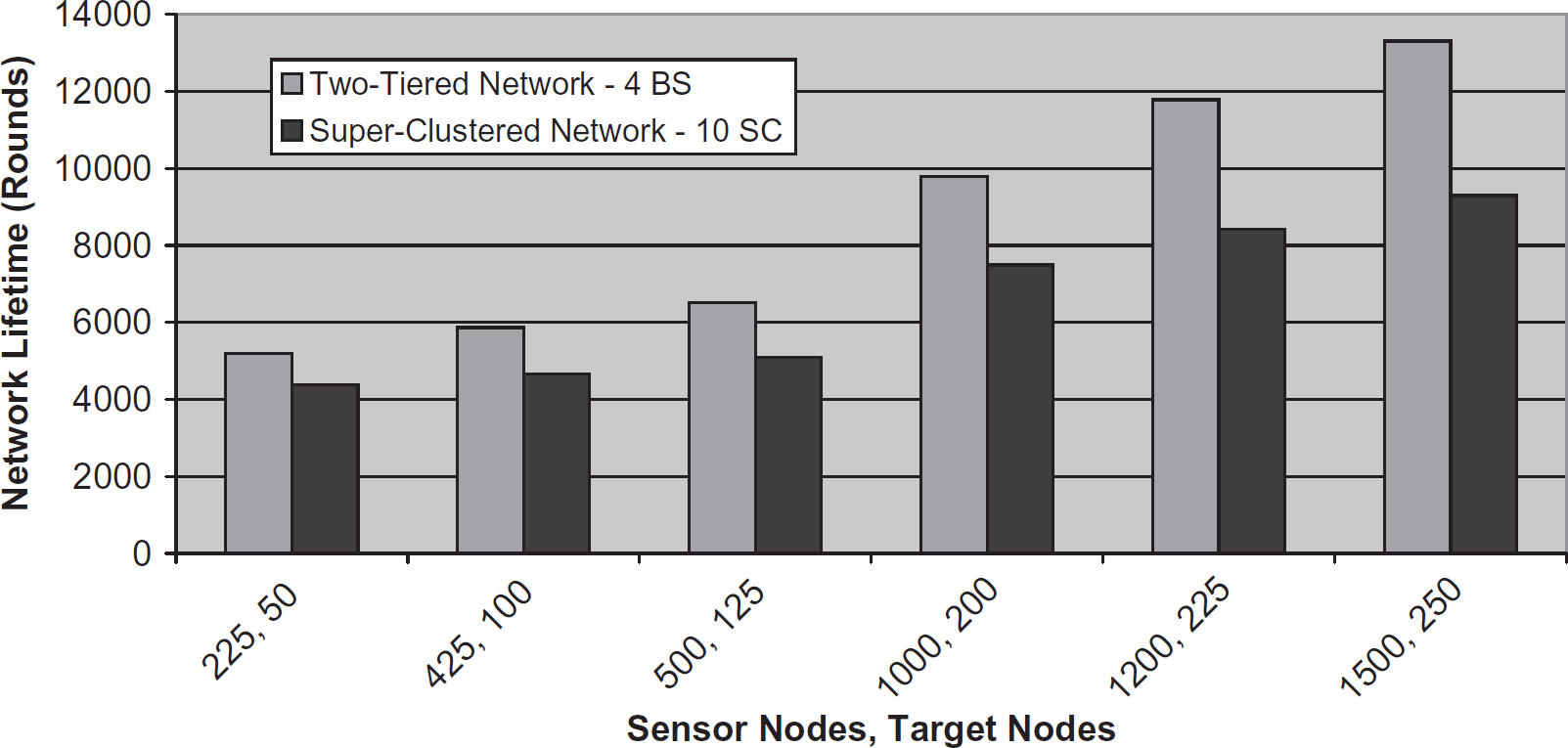
Network lifetime (in rounds) of a super-clustered (multi-layer LEACH) network, of 10 super clusters, vs. a two-tiered network, of 4 blocks, both 200 m × 200 m.
As shown by these results, since the local base stations are handling the long-distance communication with the central base station, more energy consumption is expected in larger network sizes.
Furthermore, with more nodes and higher node densities, the data rate increases, accordingly increasing the total energy consumed per round. Although this addition of local base stations obviously increases the overall energy consumption of the proposed sensor network architecture, the advantage is in the increased network lifetime, and higher reliability achieved.
Due to the limited battery resources of sensor nodes, the underlying routing protocols must become aware of the power level at each sensor in the network. Furthermore, the routing protocol must minimize end-to-end delay through selecting the path with minimal latency, as well as reduce the energy consumption and network overhead by reducing the control packets as much as possible.
Although all existing approaches clearly improve the time performance of wireless sensor networks, we do believe that they are likely to be limited for time-critical applications, particularly in emergency situations where the network has to support real-time communications under heavy traffic loads. Providing real-time and reliable services requires more powerful communication infrastructures, which cannot be granted by sensor nodes. Particularly, for large-scale multi-hop networks, real-time and reliability requirements are even more challenging.
The use of clusters for transmitting data to the base station leverages the advantages of small transmit distances for most nodes, requiring only a few nodes to transmit greater distances to the base station. While LEACH outperforms classical clustering algorithms by adapting the clusters depending on which nodes are cluster heads for a particular round, and allowing the energy requirements of the system to be distributed among all the sensors, there are some areas for improvement to make the protocol more widely applicable. For one, LEACH assumes that all nodes are within communication range of each other and the BS, which limits the scalability of the protocol. Yet, thanks to the TDMA paradigm, LEACH offers a good support for real-time communications, for it uses at most two hops to forward data to the base station. Nonetheless, it suffers from the scalability problem, since the maximum number of nodes within a cluster is limited.
While many approaches have been proposed to deal with energy/latency trade-offs, they are likely to be insufficient for the applications where reduced delay guarantee is the main concern. In this work, we presented a decentralized two-tiered network architecture for wireless sensor networks, where an upper layer Wireless Local Area Network (WLAN) serves as the backbone of a large-scale wireless sensor network. This network is composed of a low data rate, short transmission range, and energy-constrained large-scale adaptively-clustered sensor network supported by an overlay WLAN, which has more suitable capabilities, in terms of data rate, transmission range, and energy resources, to ensure real-time communications. The deployment of a two-tiered network architecture benefits from an upper level wireless network in supporting a wireless sensor network with more powerful communication capabilities, longer transmission range, higher bandwidth, and sufficient power supply. The main objectives of this network architecture are supporting real-time communications by providing bounded and reduced latencies by means of higher data rate wireless links, and improving the communication reliability by reducing the error rate and the packet loss probability in multi-hop networks, by decreasing the number of hops, requiring long transmissions. The WLAN layer consisting of the local base stations will be involved in the communication between the sensor network and the control station, mitigating the impact of the limited capacities of the sensor nodes, and offering more powerful networking capabilities.
This study is the first to investigate the operation of LEACH in large-scale highly-dense sensor networks. While most LEACH researchers studied LEACH in small-scale networks; a 100 m × 100 m area consisting of up to 150 sensor nodes, this work investigates the application of LEACH in areas up to 600 m × 600 m in coverage, with up to 2000 sensor nodes. It was found that, with a proper setting of the number of clusters formed, LEACH can scale to wider network spans, nevertheless at the expense of increased overhead, increased end-to-end delay, more rapidly decreasing energy, and hence a considerable decrease in network lifetime. In fact, it was found that in each quadrupling in the network coverage, the network lifetime decreases on average by 34%, for coverage not exceeding a 400 m × 400 m region. Trying to extend the network span to further than 400 m × 400 m in area, LEACH failed to survive for more than a few hundreds of rounds, decreasing the network lifetime by 80% compared to the lifetime of the 400 m × 400 m network. Furthermore, the proper operation of LEACH requires that each node is able to transmit data to the base station in one hop. Consequently, obliged to tremendously increase the transmission range of the sensor nodes, it was found that doubling the transmission radius of the sensor nodes decreased the network lifetime by an average of 45%. On the other hand, the average end-to-end delay increases by an average of 67%.
This simulation-based study involved modeling two network architectures. One was a traditional single-tiered adaptively-clustered LEACH-based wireless sensor network with a centralized base station. The second model we studied was the proposed decentralized two-tiered architecture in large-scale wireless sensor networks, where an upper layer Wireless Local Area Network (WLAN), serves as a backbone to the self-organizing adaptively-clustered, also LEACH-based wireless sensor network. Hence, it is our belief that this paper is the first comprehensive study that implements LEACH in large-scale sensor networks, and under extreme conditions. Furthermore, this paper presents a new direction for wireless sensor networks through the concept of a two-tiered network architecture, while most research focused on proposing new MAC and network protocols relying solely on the capabilities of the wireless sensor networks.
While varying the number of sensor nodes from 110 nodes up to 2000 nodes, the two-tiered network architecture outperformed the single-tiered LEACH architecture by several orders of magnitude in several areas of interest. For a region of 200 m × 200 m, the proposed architecture achieved an increase in network lifetime by an average of 140% over the single-tiered network. Furthermore, the network lifetime of the two-tiered architecture is, on average, 6 times better in the 400 m × 400 m region, and 60 times better for the 600 m × 600 m coverage. On the other hand, in the 200 m × 200 m network, the LEACH delivered a packet to the base station with an average end-to-end delay of 15 times more that the two-tiered network. On the other hand, for the 400 m × 400 m network, LEACH latency was 16 times greater than that of the two-tiered network. Finally for the 600 m × 600 m network, LEACH latency was 13 times greater than that of the two-tiered network. Moreover, the proposed network architecture has shown high tolerance for high node densities, without degrading either the network performance or the system lifetime. In addition, the results show that the two-tiered network architecture is more energy-efficient, and achieves higher packet delivery ratios, especially for larger-scale sensor networks.
The concept of the two-tiered architecture itself is commonly known in many different networking areas, currently offering an exceptionally promising research direction for wireless sensor networks. The two-tiered architecture triggers many research challenges. Ongoing research is investigating this concept in both homogeneous and heterogeneous wireless sensor networks. Not obliged to rely solely on the capabilities of the wireless sensor networks, and tolerate any limitations that they may suffer, researchers are more and more favoring multi-tiered architecture-based sensor networks.
The effectiveness of the two-tiered network architecture was proven when compared to a network architecture that built on the concept of Multi-Tier or Multi-Layer. We compared our two-tiered LEACH network architecture with 4 WLAN access point (local base stations) against a two-layered (Super-Clustered) LEACH networks with 10 super nodes. The two-tiered network achieved a longer network lifetime by an average of 30%, and consumed less energy by an average of 20%.
Conclusion
In this work, we have presented a decentralized two-tiered network architecture for wireless sensor networks, where an upper layer wireless local area network serves as the backbone of a large-scale wireless sensor network. Several major aspects that are crucial for the two-tiered architecture in real-time communication have been thoroughly investigated, including network lifetime, packet delivery ratio, end-to-end delay, energy consumption, network overhead, and scalability. In addition, a comparisons study has been made between the two-tiered architecture and single-tier architectures. All performance analysis has been presented based on thorough simulation results.
The obtained results have shown that the two-tiered architecture outperformed the single-tiered architecture by several orders of magnitude in several performance issues. For example, the network lifetime was increased up to 60 times better than the single-tiered lifetime when varying the network size from 110 to 2000 sensor nodes. This has proven the scalability of the two-tiered architecture in large size networks. Moreover, the two-tiered networks were able to deliver the packet at a much higher rate, and up to 16 times faster than the single-tiered networks. In addition, the two-tiered architecture has prolonged the network lifetime by 30% compared to the super-clustered architecture in the single-tiered networks, with 20% less energy consumption.
There are some other important issues that have not been covered in this study including cost-effectiveness tradeoffs, security [23], and the proper functionality of the access points in wireless area networks.