



Abstract
In normal operations, the opposite surfaces of the power plant components are exposed to two different environments, i.e. air/flue gas on the one side and steam on the other side. Exposure under such dual-environment can lead to accelerated corrosion of the components on the air side. The oxidation behaviour of ferritic/martensitic steel T92 was investigated under dual-environment in a specially designed test equipment. The samples were exposed to dry oxyfuel flue gas (CO2–27%N2–2%O2–1%SO2) on one side and to steam on the other side up to 1000 h at 650°C. The formation of oxide scales was characterised by optical microscopy and scanning electron microscopy with attached energy-dispersive spectroscopy. Oxidation rate of specimens under dual-environment condition was almost three times higher than that in single-environment condition. This is explained based on hydrogen transport through the bulk alloy from the steam side to the flue gas side.
This paper is part of a supplementary issue from the 17th Asia-Pacific Corrosion Control Conference (APCCC-17).
Introduction
The focus for the development of advanced power plant is to have combustion concepts with reduced CO2 emissions. One of the most promising techniques in that direction is to develop thermal power plants based on oxyfuel combustion concept that allows the capture of CO2 from the exhaust gas [1–4]. The principle of oxyfuel process consists of combusting coal or other fossil fuel in pure oxygen rather than in air with the aim of eliminating atmospheric nitrogen from the flue gas stream. This increases the volume fraction of carbon-di-oxide in the flue gas to more than 50% which has a beneficial effect with respect to its capture. Additionally, the oxyfuel flue gas contains much higher water and sulphur-di-oxide volume fractions compared to the conventional flue gases [2–4]. Other major gaseous components in flue gases include carbon monoxide, nitrogen from fuel and possible leakage, up to 4% oxygen, and nitrogen oxides [2].
The change in flue gas composition has prompted many researchers to study afresh the fireside corrosion of boiler tube materials in simulated oxyfuel environment [1–3,5–7]. However, most of these studies have been carried out by exposing samples to single-environment of flue gas. In normal operations, the power plant components are exposed to two different environments on the opposite surfaces: air or flue gas on the outer surface (fireside) and steam on the inner surface (steam side). Under such dual-environment conditions, the oxidation of materials on the fireside can be accelerated which can reduce the wall thickness of components faster than expected and shorten the life time of critical sections. However, very limited investigations [8–10] have been devoted on high temperature corrosion of materials under dual-environment related to power plant conditions. These studies [8–10] have shown increased oxidation rate of materials on the air side under the conditions of steam/air dual-environment, compared to that in simple air under single-environment condition. The increased oxidation rate on the air side was related to hydrogen permeation from the steam side [10]. Several oxidation studies [11–15] have also been carried out on metallic interconnects in solid oxide fuel cells which are also exposed to a dual-environment: fuel i.e. hydrogen on one side and oxidiser i.e. air on the other side. These investigations also show increased oxidation rate and change in the oxide-scale chemistry, e.g. formation of Fe-rich oxide scales instead of more protective Cr-rich oxides [14]. It is postulated that hydrogen transport through the steel and its subsequent incorporation into the air side of the oxide scales promotes accelerated corrosion via defect chemistry changes, decreased local oxygen partial pressures, and steam formation [15].
The aim of the present study is to analyse the oxidation behaviour of T92 steel in oxyfuel environment and the influence of single (oxyfuel flue gas) and dual (oxyfuel flue gas/steam) environment conditions on the oxidation rate.
Experimental
Chemical composition (wt-%) of T92 steel under investigation.

The oxidation tests under single-environment condition were performed at ambient pressure in a horizontal furnace equipped with an alumina tube. Specimens were oxidised isothermally at 650°C for fixed time periods of 250, 500, 750 and 1000 h. The specimens were kept in a hanging position in an alumina crucible and were exposed to the flowing dry oxyfuel flue gas consisting of CO2/N2/O2/SO2 (70/27/2/1 vol.-%) at a laminar gas flow of 0.18 m s−1. Oxidation tests under dual condition were done in a specially designed experimental setup which is schematically shown in Figure 1.
Schematic diagram showing the experimental setup for oxidation under dual-environment condition.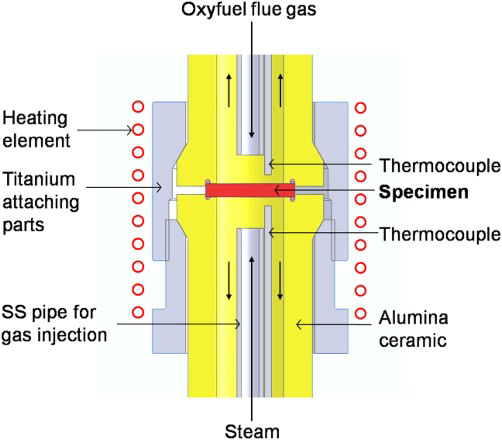
The experimental details for this setup have been described elsewhere [16]. The specimens were kept at 650°C and were exposed to the same composition of the dry oxyfuel flue gas described for the single-environment exposure on the one side. The other side of the specimen was exposed to steam by using tap water having a dissolved oxygen content of 9 ppm. The oxidation tests under dual condition were carried out for fixed time periods of 25, 250 and 1000 h. For both single and dual-environment exposures to the flue gas, individual gases were preheated to 300°C before mixing and entering the furnace to avoid condensation of sulphuric acid.
The cross-sections of the oxidised specimens were mounted in an epoxy resin and subsequently fine polished using standard metallographic techniques. The thickness of oxide scale layers on the specimens was measured to determine the oxidation kinetics. The alloy microstructure and the oxide scales were examined using optical microscopy and scanning electron microscopy (SEM) with a field-emission electron (FEG) gun. SEM was also equipped with a Quantax 800 energy-dispersive spectroscopy (EDS) from Bruker AXS microanalysis which was used for elemental mapping and quantification.
Results and discussion
Microstructure in as-received condition
The optical micrograph in Figure 2 shows the typical microstructure of base material T92 on which the oxidation study was carried out. The microstructure consists of martensite phase with very fine carbides distributed mainly along the martensitic laths and the prior austenite boundaries.
Optical micrograph showing the microstructure of the base alloy T92.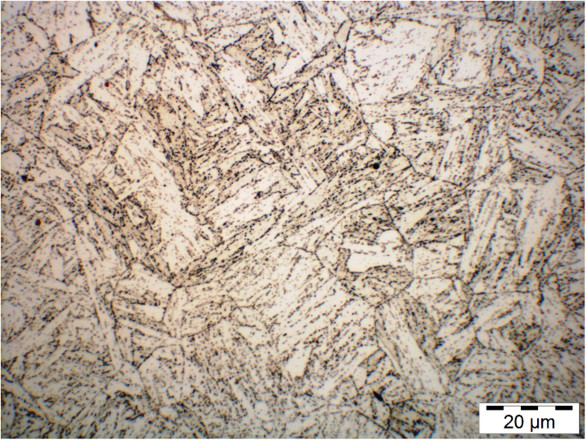
Oxidation kinetics
The oxidation kinetics of T92 steel was evaluated by measuring the average thickness of oxide scales. The scale thicknesses as a function of oxidation time for T92 exposed to oxyfuel flue gas under dual- and single-environment condition are plotted in Figure 3(a). The thicknesses of oxide scales are much higher when samples are exposed under dual condition of flue gas/steam as compared to single-environment exposure to flue gas. The thickness of oxide scale as a function of oxidation time on the steam side under dual-environment condition is shown in Figure 3(b).
The time dependence thickness of the oxide scale after exposure to (a) flue gas under dual- and single-environment conditions and (b) steam under dual-environment condition.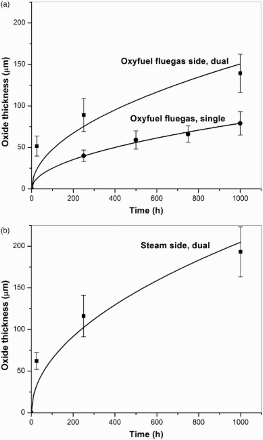
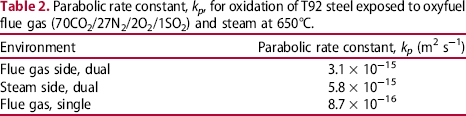
The oxide thickness on the steam side is higher than the flue gas side. In all oxidation cases (flue gas or steam), the kinetics is well described by the parabolic rate law [17]:

Parabolic rate constant, kp, for oxidation of T92 steel exposed to oxyfuel flue gas (70CO2/27N2/2O2/1SO2) and steam at 650°C.
Oxide scale morphology and composition
In agreement with the results of oxidation kinetics, the optical microscopic examination showed oxide scale on the steam side to be thicker as compared to that in flue gas side under dual condition. This is clear by observing the cross-section of T92 specimen in Figure 4 that shows oxide scales on both the sides after exposure to dual flue gas/steam environment for 1000 h.
Metallographic cross-section of oxide scales on T92 steel after exposure to dual-environment of flue gas/steam at 650°C for 1000 h.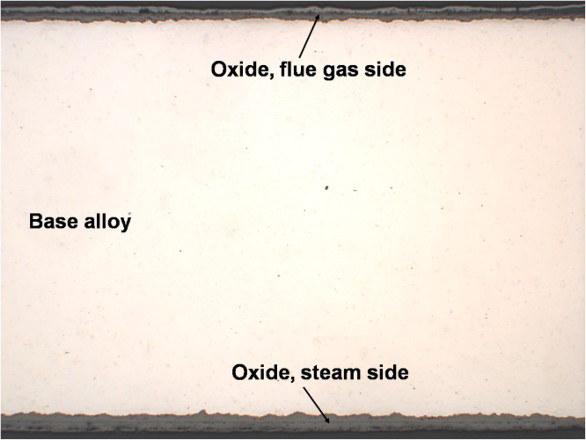
Figure 5 shows, at a higher magnification, the metallographic cross-sections of the oxide scales formed at 650°C in flue gas under dual-environment condition after different time periods. The scales formed under dual-environment condition consist of similar oxide phases to those formed under single-environment oxidation which was described in earlier studies [18,19]. The oxide scales typically consist of an outer layer (consisting of both haematite and magnetite) that grows by outward diffusion of Fe cations and an inner layer (consisting of Cr-rich spinel, (Fe.Cr)3O4, and Fe3O4) formed beneath the original alloy surface that grows by inward diffusion of O anions. In all cases, the two layers are separated by a near-ideally straight line (Figure 5) depicting the original alloy surface. Two colour contrasts can be seen in the outer oxide layers: the light-coloured outermost layer at the gas/oxide interface consists of haematite while the inner dark-coloured layer consists of magnetite. In general, the thickness of haematite layer is higher than the magnetite layer. The inner layer with the darkest contrast consists of spinel mixture of Fe3O4 + (Fe,Cr)3O4. Regions of orange contrast visible in the inner layer of the oxide scales are iron sulphides (FeS) which are more predominantly present and visible for the specimen oxidised for 250 h (Figure 5(b)) and 1000 h (Figure 5(c)). The oxide phases in the scales described above were identified by electron back-scattered diffraction (EBSD) in our earlier studies [18,19]. Discrete precipitates in the base alloy near the oxide/alloy interface are also observed for all the oxidised specimens (Figure 5). These precipitates were identified as (Fe,Cr)-sulphides by SEM-EDX mapping indicating that T92 is affected by sulphidation in the oxyfuel environment.
Optical micrographs showing oxide scale cross-section of T92 steel on the flue gas side after exposure to dual-environment of flue gas/steam at 650°C for (a) 25 h (b) 250 h and (c) 1000 h.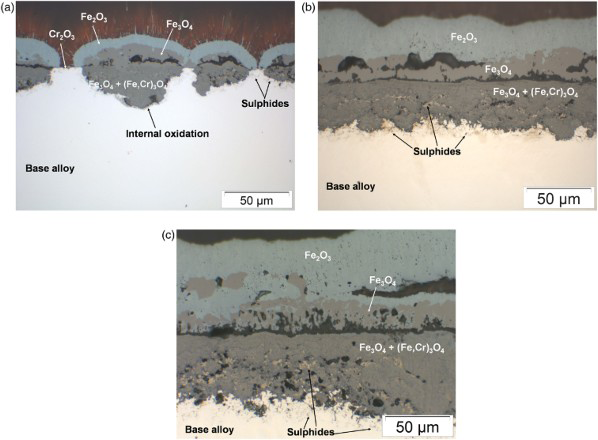
The specimen after exposure of 25 h (Figure 5(a)) does not form a continuous oxide scale; rather Fe-rich oxide nodules separated by localised regions of chromia (Cr2O3) layer. Formation of chromia at this temperature (650 °C) is not continuous allowing the formation of rapidly growing Fe-rich oxide scale. With increasing oxidation time, the chromia layer disappears and is replaced with continuous scale of Fe-rich oxides after 250 h (Figure 5(b)) and 1000 h (Figure 5(c)). T92 steel oxidised for 25 h also shows internal oxidation in few regions of the oxide/alloy interface. Internal oxidation is a typical feature of oxide scales developed in Fe-Cr alloys exposed to water vapour containing environments and is caused by preferential oxidation of Cr to Cr2O3 or Cr-rich (Fe,Cr)3O4 [20]. However, no water vapour is present in the flue gas environment to which the T92 specimens are exposed to. Therefore, the presence of internal oxidation on the flue gas side suggests that hydrogen generated on the steam side diffuses through the base alloy towards the flue gas side. Substantial void formation is also observed in both the outer and inner scales of all the oxidised specimens. The size of the voids is relatively large in the outer scales (Figure 5). Several voids and pores in the oxide scale are supposed to be due to the condensation of cation vacancies, since the growth of the outer oxide is primarily due to the outward diffusion of Fe cations [6,21].
Figure 6(a–c) shows the cross-sections of the oxide scales formed on the steam side of the T92 specimens after 25, 250 and 1000 h, respectively, in dual-environment of flue gas/steam. In contrast to the outer layer of haematite and magnetite on the flue gas side, the outer layer of the scale in the steam side is mostly composed of magnetite. Haematite is present only as a very thin outermost layer which is formed during the cooling of the specimen after the experiment is stopped. The equilibrium oxygen partial pressure in the steam environment is very low; hence haematite does not form on the steam side. This is not the case in the flue gas side where the oxygen partial pressure at the oxide surface is quite high (p O2 = 0.02) leading to formation of haematite in the outermost layer. The inner layer of the scales on the steam side also consists of a mixture of Cr-rich spinel and Fe3O4. In addition, at the oxide/alloy interface, internal oxidation of the alloy is also observed which is caused by preferential oxidation of chromium occurs along the martensitic laths and the prior austenite grain boundaries. Comparing the cross-sections of the oxide scales on the steam side (Figure 6) with that on the flue gas side (Figure 5) for similar oxidation time, it is clear that the thickness of oxide scale on the steam side is higher. Note that the optical micrographs in Figure 6 are at lower magnification than those in Figure 5.
Optical micrographs showing oxide scale cross-section of T92 steel on the steam side after exposure to dual-environment of flue gas/steam at 650°C for (a) 25 h (b) 250 h and (c) 1000 h.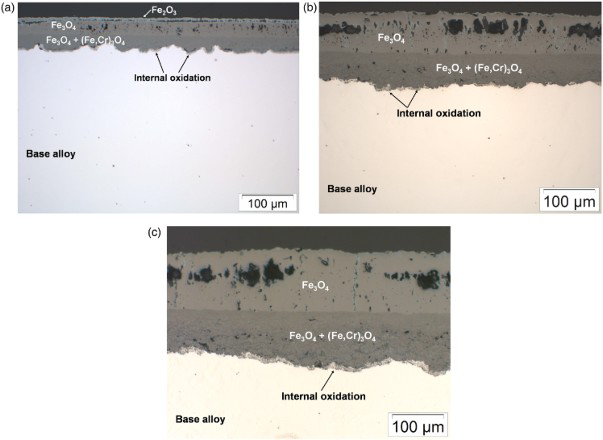
The microstructure of the oxide scales formed in oxyfuel flue gas during single-environment exposure at 650°C has been described in an earlier study [18]. As a representative case, the cross-section of the oxide scale formed after 1000 h is shown in Figure 7.
Metallographic cross-section of oxide scale of T92 steel after exposure to single-environment of oxyfuel flue gas at 650°C for 1000 h.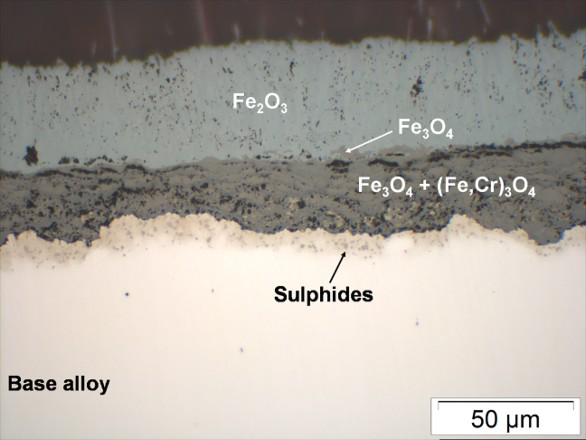
The microstructure of the scale is similar to those formed under dual-environment condition with the only difference that in the case of single-environment oxidation, the outer layer is composed mostly of haematite phase. Only a small fraction of magnetite is formed at the interface of outer and inner layers of the scale. The thickness of haematite layer in the outer scale is an indication of the amount of protective or Cr-rich inner scale formed [10]. Cr-rich inner scale leads to reduced diffusion rate of Fe-ions towards the outer scale and hence magnetite is oxidised to haematite. Higher thickness of haematite layer for single-environment exposure is due to formation of more protective inner scale. Therefore, dual-environment oxidation of materials wherein the opposite surfaces are exposed to flue gas and steam, respectively, represents more corrosive condition than the simple oxidation in a single-environment. The inner layer is again composed of a mixture of Cr-rich spinel (Fe,Cr)3O4, Fe3O4 and FeS. Precipitates of (Fe,Cr)–sulphides are also formed at the oxide/alloy interface in the base alloy. Comparing the thicknesses of the scales after 1000 h of exposure between the dual- and single-environment of flue gas, it is clear that the oxide formed in flue gas/steam dual condition is much thicker. Another important observation to be noted is that the outer layer of the scales formed under dual-environment condition (Figure 5) contain large voids/pores which are almost absent in case of oxidation in single-atmosphere (Figure 7).
The accelerated scale growth on the flue gas side under dual-atmosphere condition as compared to that in single-atmosphere condition is thought to be related to the diffusion of hydrogen through the bulk alloy from the steam side to the flue gas side. Assuming hydrogen diffusion rate constant, D = 4.5 × 10⁻⁴ cm2 s−1 at 650°C in α-iron [22], the corresponding diffusion distance (d = √Dt) is 12.7 mm in 1 h. Similar orders of diffusivity and diffusion distance of hydrogen in steels have been reported by other oxidation studies under dual-environment condition [8,14,23,24]. In the present study, the sample thickness is 3 mm, so, hydrogen will diffuse from the steam side to the flue gas side in few minutes.
Nakagawa et al. [10] have measured permeation of hydrogen from the steam side to the air side through the bulk alloy during steam/air dual-environment exposure. It is suggested that the hydrogen diffusing through the alloy to the air side reacts with oxygen in the scale to form water in the pores. The generated water can speed up the corrosion process with reduction and oxidation reactions inside pores. Another mechanism suggested for accelerated oxidation on the air side is related to changes in the defect chemistry of the oxide scale when hydrogen is incorporated into the scale [15]. Effectively positive protonic defects dissolved in the oxide scales from hydrogen may be compensated by increasing the cation vacancies (effectively negative) and, hence, would enhance the metal diffusivity from the oxide/alloy interface to the gas/oxide interface. Consequently, this would lead to increased scaling or oxidation rate of the alloy. An alternative explanation for accelerated oxidation of the air side is the increase in diffusion paths (e.g. voids/pores) because of high steam pressure developed within the scale after formation of water close to the oxide/alloy interface [14]. This may mechanically lead to formation of pores in the scale. These pores then allow for faster diffusion of oxygen as a gas through the scale and increase the oxidation rate. As described earlier in this study, T92 exposed to flue gas under dual-environment oxidation show higher number of voids/pores in the oxide scale which supports the above hypothesis (Figure 6).
To determine the effect of oxyfuel environment on the composition and structure of the corrosion layers, elemental mappings of the inner oxide scales using SEM-EDS were carried out. Irrespective of the single- or dual-environment exposure in the flue gas, the outer layer of the scale consisted of pure iron oxide while the inner oxide layer also contained chromium. Cr-enrichment was also observed in the inner oxide layer. This is clearly shown in the quantified X-ray mapping of the inner oxide layer of the scale formed in flue gas after 250 h at 650°C under dual-environment condition (Figure 8).
SEM micrograph and the corresponding quantified EDX maps of O, S, Fe and Cr of the inner oxide layer on the flue gas side of T92 after 250 h at 650°C in dual-environment of flue gas/steam.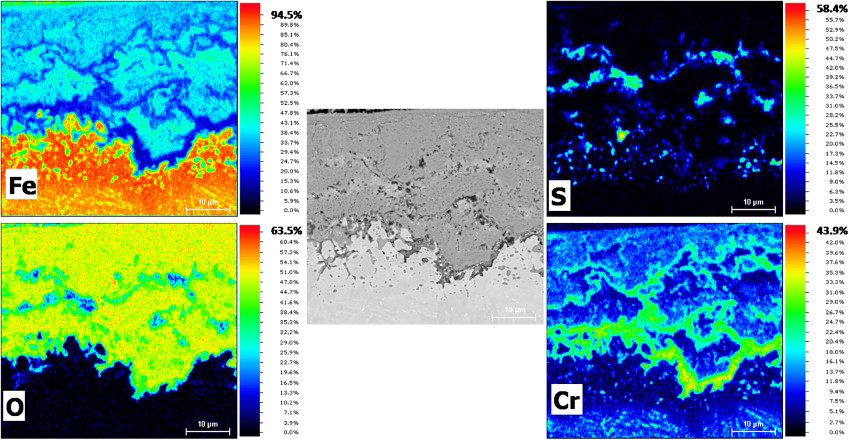
It is evident from the chromium map that continuous and parallel Cr-rich oxide stringers are formed in the inner layer. A strong enrichment of Cr (up to about 35 at.%) is measured along these stringers. Because of the selective oxidation of Cr in the inner layer, regions of Cr–depletion are visible in the alloy beneath the oxide/alloy interface (Figure 8). Considering the S-map, it is evident that sulphur is enriched in the inner layer and near the oxide/alloy interface in the base alloy. No sulphur was detected in the outer layer. Sulphur is enriched up to 50 at.% corresponding to the FeS phase in the inner layer. As stated earlier, the sulphur-rich regions in the inner layer were identified as FeS using EBSD [18,19]. The X-ray mapping of sulphur also confirms that the precipitates formed at the oxide/alloy interface (Figure 8) correspond to (Fe,Cr)-sulphides. These results indicate that the inner layer of scale formed in the oxyfuel flue gas consists of mixtures of oxides and sulphides together with the sulphidation of the base alloy.
Conclusions
Oxidation of T92 steel was investigated at 650°C in oxyfuel flue gas/steam dual-environment and in single-environment of oxyfuel flue gas after exposure times up to 1000 h. T92 steel formed a multi-layered oxide scale in oxyfuel flue gas. Typically, the outer layer was composed of haematite followed by magnetite in the sub-scale. The inner layer was composed of a spinel mixture ((Fe,Cr)3O4 + Fe3O4) and sulphides. Sulphidation of the base alloy also occurred in the form of precipitation of (Fe,Cr)-sulphides beneath the oxide/alloy interface. The oxidation rate of T92 in steam was more than that in flue gas under single- or dual-environment conditions. Oxidation rate of T92 steel on the flue gas side is increased by about three times under the conditions of flue gas/steam dual-environment compared to that in single-environment of flue gas. The increase in oxidation rate is attributed to diffusion of hydrogen from the steam side to the flue gas side which increases the defects (voids/pores) in the scales. Higher density of voids/pores allows for faster diffusion of oxygen as a gas through the scale and increases the oxidation rate.
