



Abstract
The Czech Republic has a well-developed nuclear programme with two nuclear power plants currently in operation and three operational near-surface repositories serving for the disposal of institutional and operational low- and intermediate-level waste. Spent nuclear fuel will be disposed of in a deep geological repository to be constructed in crystalline or metamorphic rock approximately 500 m below the surface. Czech Ca–Mg bentonites will be used as the buffer and backfilling material. Steel-based materials are currently considered as the reference metallic materials in the Czech disposal canister concept. The preferred design is based on a double-walled canister with an inner shell of stainless steel and an outer shell of carbon-steel. Both parts of the canister must provide mechanical stability; the wall of the carbon-steel canister will be strengthened for corrosion-resistance purposes. The presented work focuses on canister design as confirmed by means of mechanical, thermal and criticality calculations and a detailed experimental corrosion plan.
This paper is part of a supplement on the 6th International Workshop on Long-Term Prediction of Corrosion Damage in Nuclear Waste Systems.
The concept of radioactive waste and spent nuclear fuel in the Czech Republic
The Czech Republic has a developed nuclear programme with two currently operational nuclear power plants: Dukovany, which was commissioned in 1985-1987 and Temelin, which was commissioned in 2000-2002. The Dukovany NPP (nuclear power plant) is a light water VVER-440 reactor type, with four units and the Temelin power plant is a light water VVER-1000 reactor type, with two units. The country has two dry SNF (spent nuclear fuel) storage facilities, one within the Dukovany NPP complex, the second in the Temelin complex. In addition, the country has three low- and intermediate-level waste disposal facilities, Richard and Bratrstvi which are intended for the disposal of institutional waste and Dukovany which is used for operational waste.
Producers are responsible for waste/SNF management up until the radioactive waste (RAW) is transferred for disposal. SURAO, a state organisation, is responsible for the safe disposal of RAW.
According to the Czech concept, the deep geological repository (DGR) is intended for the disposal of SNF from ‘the open cycle’ of the reactor, i.e. the direct disposal. A small amount of activated materials stored during the operational period of the NPPs and a small amount of waste generated during decommissioning (activated measuring sensors, thermocouples, reactor surveillance samples, absorbers, in-core parts, serpentinite concrete, backfill, etc.) will be processed during the nuclear facility decommissioning to meet the safety requirements of the DGR.
The basic disposal principles are set out in the Atomic Act (Act No.263/2016 Coll.) and a set of relevant government implementing decrees. At the international level, the IAEA has provided a set of recommendations that will be fully taken into account.
Disposal concept and current stage with regard to deep geological disposal in the Czech Republic
The DGR disposal concept is based on the Swedish KBS concept with certain modifications – it will be constructed in crystalline host rock using steel-based disposal canisters and bentonite as buffer material. The direct disposal of SNF is anticipated and the encapsulation plant will be located within the DGR complex.
The site investigation process started early in the 1990s, with preliminary studies to evaluate the geology of the Czech Republic. A total of 11 sites were determined, 7 of them in crystalline rock formations, the others in sedimentary rocks. However, due to public opposition, the siting process was suspended for 5 years from 2004 to 2009. In 2013, SURAO applied for permission for the first phase of geological survey investigation work and in 2015 the Ministry of the Environment issued the necessary licenses.
The siting process will be made up of three phases, the first one will consist of reducing the number of sites from 7 to 3 or 4 and will involve the gathering of geological data (for geological and hydrogeological mapping purposes and for the potential application of geophysical and geochemical methods; the remote sensing method will be applied), the construction of three-dimensional models to be used for safety assessment support purposes and the preparation of feasibility studies. These data will also allow for a detailed comparison of all the sites and to define preferred sites for the second phase. This will start with geological investigation work involving borehole drilling aimed at obtaining data from depths of interest for future DGR. New, more detailed, site-specific safety cases and feasibility studies will then be compiled. This phase will be concluded with the selection of two candidate sites. The third phase will be finalised in 2025 with the selection of the final site.
It is planned that Czech bentonite will be used as the buffer and backfill material. This bentonite is mined in the western part of the Czech Republic and is of the Ca–Mg type with a higher amount of iron in the octahedral positions [1]. Quartz, illite, carbonates and anatase are present as accessory phases [2]. The higher amount of potassium originates from alternate potassium feldspars [1]. Cation-exchange capacity varies from 59.4 to 65.7 meq/100 g [3]. For a dry density value of 1.4 g cm−3, a swelling pressure of around 2 MPa and hydraulic conductivity of from 10–12 m s−1 to 10–13 m s−1 can be expected [4].
Czech disposal canister concept and current stage with regard to R&D
The history of canister development was launched in the 1990s and the double-walled canister concept originated in 1999 based on a number of factors, including the inventory, criticality and thermo and mechanical calculations. The selection of the materials was conducted on the basis of knowledge available from the nuclear industry; however, the selection has not been verified yet by means of a targeted experimental programme. The aim of the R&D programme, which started in 2014, consists of the complete revision and updating of the candidate materials and the design of the canister, demonstration of the behaviour of various materials under simulated DGR conditions (experimental approval), conceptual design of the handling equipment and verification of the manufacturing technology. The programme will include the construction of a full-scale prototype canister from a diameter point of view and half of the envisaged canister length.
The following various basic requirements will be specified at the beginning of the programme: the legislative requirements of Decree No.379/2016 Coll. will have to be fulfilled (criticality, mechanical resistance, radiation protection), the temperature applied to the surface of the canister will be <95°C, the canister will be required to endure an external pressure of 20 MPa, and the minimum lifetime will be set at 10 000 years. Calculations of the inventory [5–7], thermal output [8] and criticality [9–11], and mechanical [12] and radio-shielding [13–15] have already been conducted employing data on the SNF released by existing power plants. Indeed, the calculation of the inventory of planned new nuclear units was based on available data from EPR1600-type and AP1000-type plants.
Following the detailed processing of background research, four candidate materials were identified: carbon-steel, stainless steel, copper and titanium alloy [3]. Two design concepts were proposed: the first one involves carbon-steel as the outer shell canister material and stainless steel as that of the inner shell (corrosion acceptable concept) [3]. The second one involves corrosion resistant materials using copper or titanium alloy as the outer shell material and carbon-steel as that of the inner shell (corrosion resistance concept). The thickness of the materials will depend on their corrosion and mechanical resistance. The subsequent research phase will focus principally on the first concept as, it is the most effective solutions as long as safety requirements are met (Figure 1).
Double-walled canister design, corrosion acceptable concept (first concept).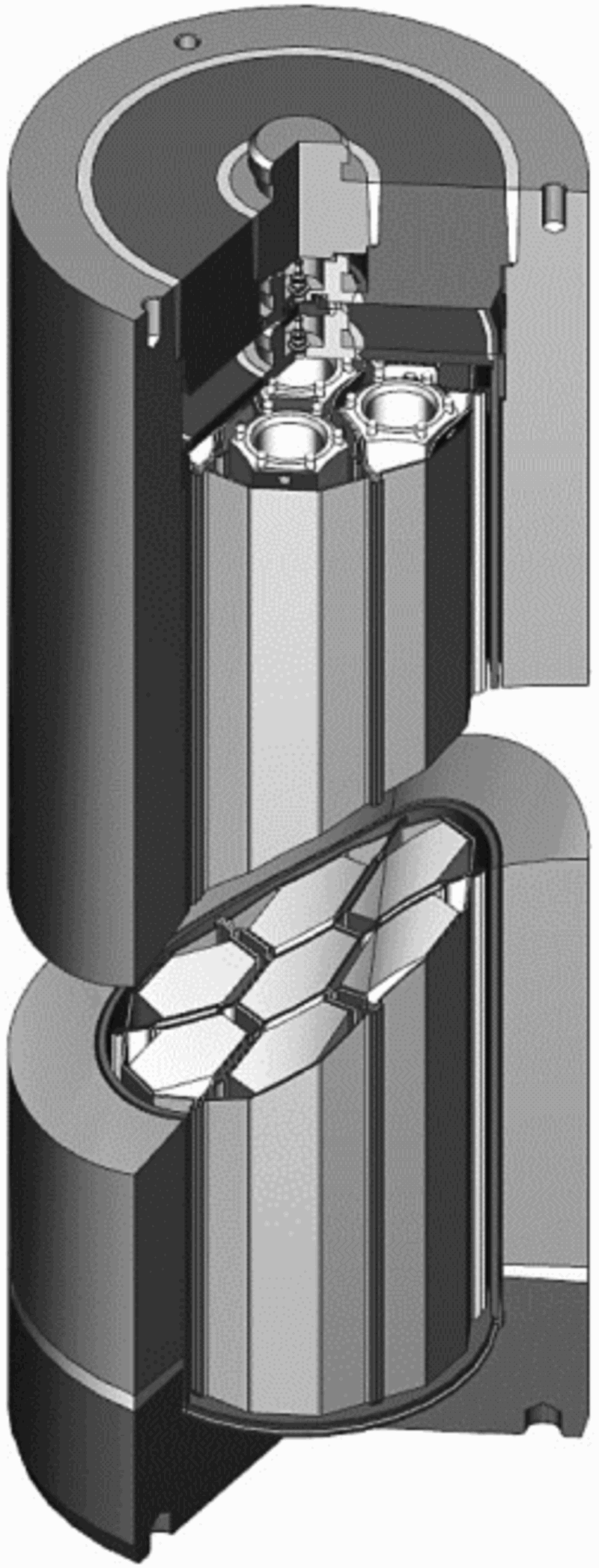
The basic requirements with respect to the thickness of the canister concern the inner shell, which must be mechanically resistant to a pressure of 20 MPa and the outer shell must be mechanically resistant to a pressure of 20 MPa plus a so-called corrosion allowance calculated based on the presumption of 10 000 years of corrosion. A corrosion rate of 5 µm a−1 was taken into account (based on previous experimental testing) as input for the calculations [16]. The design and the various corrosion assumptions will be confirmed in the context of the ongoing experimental plan and, eventually, by means of detailed safety assessment analysis reports.
The ongoing experimental plan includes both of aerobic and anaerobic corrosion experiments. The aerobic experiment simulates the initial phase following canister disposal (with the presence of residual oxygen). Various laboratory experiments are being conducted as part of the anaerobic experimental plan including the testing of the influence of ionising radiation, the influence of contact with bentonite, the testing of the influence of varying conditions in terms of the bentonite suspension and temperature, the testing of stainless steel corrosion under anticipated DGR conditions with the aim of determining the critical concentrations of chlorides and the testing of stress corrosion cracking; experiments involving the testing of Ti-alloy and carbon-steel/stainless steel are in the preparation stage, including galvanic corrosion assessment for carbon-steel/copper, carbon-steel.
The experiments testing the influence of ionising radiation on the corrosion of materials which make up the outer shell are being performed at high temperature (90°C) and low-dose rate (0.3 Gy h−1, 60Co source) conditions. The applied dose rate was calculated, in accordance with the design of the canister, as value acting upon the surface of the canister's outer shell [17]. Experiments are also underway with concern to modelling the influence of synthetic bentonite pore water; metal samples (CSN422707.9 steel, Cu-OF and Ti-alloy Grade7) were placed in sealed glass vials containing an argon atmosphere to prevent oxygen ingress into the system. The experiments are aimed at investigating a corrosion system affected by ionising radiation and a reference system conducted under the same conditions but excluding exposure to ionising radiation. The final goal of the experiments consists of determining the influence and time dependence of material corrosion under those conditions expected in the future DGR.
Preliminary studies of the corrosion behaviour of the potential canister materials were performed employing synthetic de-aerated bentonite pore water [3,18]. Testing focused on the prospective elevation of a chloride and sulphate concentration as a result of water evaporation on the heated surface of a canister. The non-linear dependence between the corrosion rate of CSN422707.9 steel and copper (Cu-OF) and the chloride and sulphate concentration was observed. The maximum CSN422707.9 steel corrosion rate, represented by polarisation resistance after 2 hours of exposure, was determined as the result of a triple concentration of chlorides and sulphates observed with respect to the equilibrium concentration of such corrosion stimulators. A further increase in the concentration of chlorides and sulphates was found not to result of a triple concentration of chlorides and sulphates observed with respect to the concentration of such corrosion stimulators in synthetic bentonite pore water solution. A further increase in the concentration of chlorides and sulphates was found not to result in an increase in the corrosion rate; indeed, the opposite was the case: the corrosion rate decreased in the electrolyte with a 100th multiple of the concentration in synthetic bentonite pore water solution. Naturally, independent of any chloride and sulphate concentration, the corrosion rate after 2 hours of exposure in a de-aerated solution was found to increase with an increase in temperature from 40 to 90°C (Figure 2).
Influence of temperature and enrichment of the basic equilibrium synthetic bentonite water by chlorides and sulphates of CSN 422707.9 steel in the solution deoxygenated with nitrogen (c – first, third, thirty-third, hundredth multiple of the equilibrium concentration).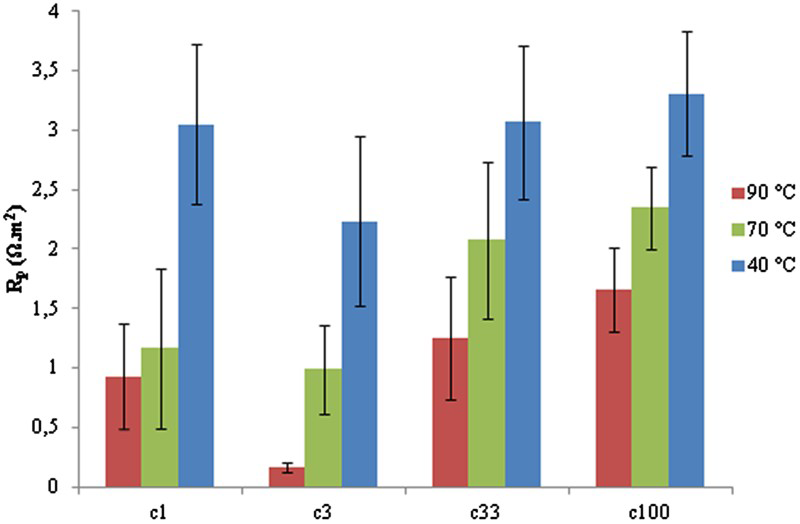
Further important experiments concerning the safety assessment of the design of the Czech canister are focusing on the influence of contact between bentonite and CSN422707.9 steel, Cu-OF and Ti-alloy Grade 7 under anaerobic conditions. One type of experiment involves the use of specific constructed corrosion cells in which compacted Ca–Mg bentonite with a density of 1.6 g cm−3 in contact with a metal sample (bentonite is placed above the metal sample). The bentonite is then saturated with synthetic granitic water under a pressure level of 5 MPa. The temperature on the surface of the samples is maintained at 70°C – the value set out in the Czech canister concept for the time period following the period of time of residual heat emission after DGR closure. The aim of these experiments is to determine the time dependence of material corrosion and, in the case of steel, to attain a steady state.
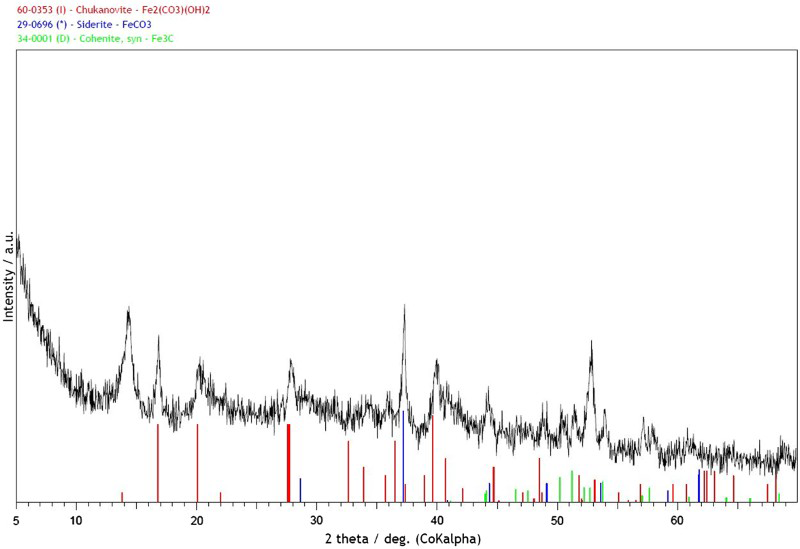
After 1 year of experimentation, the corrosion rate of the CSN 422707.9 steel samples has not yet reached a steady state and continues to decrease over time (Figure 3). A range of post-experimental analysis has been conducted. Corrosion products were characterised by using X-ray diffraction, and Raman spectroscopy. The changes in bentonite cation-exchange capacity were determined. The experiments, inter alia, led to the qualitative determination of the corrosion products siderite and chukanovite (Figure 4).
Corrosion rate of CSN 422707.9 steel in bentonite at 70°C. Dry density of bentonite – 1.6 g cm−3. Qualitative analysis of corrossion products by X-ray diffraction: siderite and chukanovite were determined.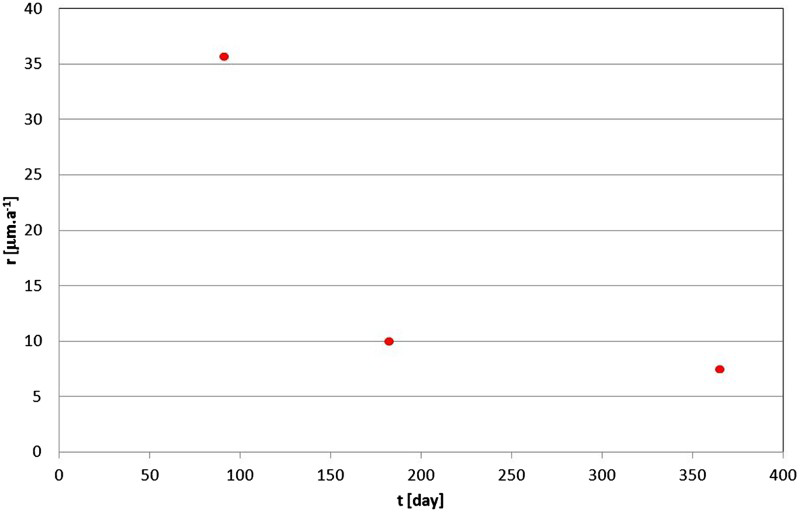
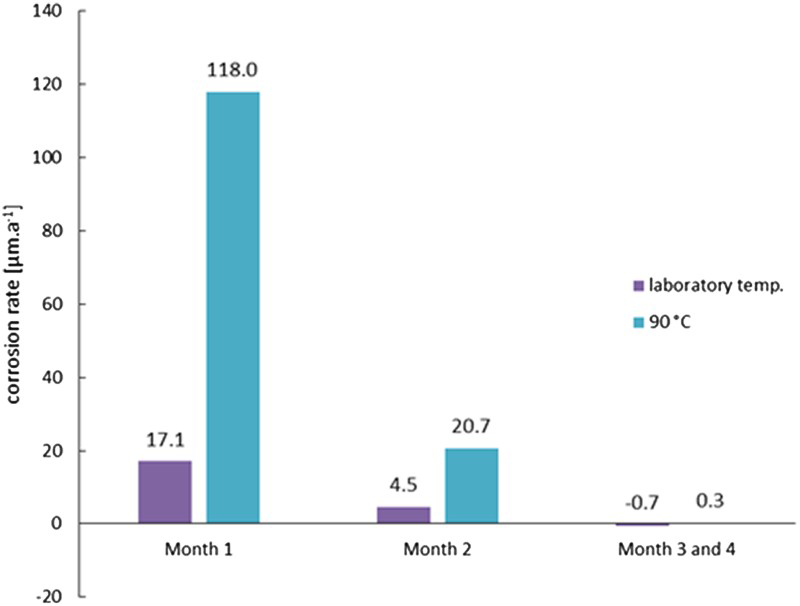
Long-term exposure experiments followed in a simplified simulated environment consisting of a de-aerated bentonite suspension. Flat CSN 422707.9 steel specimens (1-mm thick and 50 × 50 mm2 of exposed area) were embedded in a de-aerated bentonite suspension for 1, 2 and 4 months. The bentonite residuals were removed by means of water jetting and the mean corrosion rate was determined by dissolving the corrosion products in several pickling cycles using a solution in compliance with ISO 8407 standard (hydrochloric acid solution inhibited by hexamethylenetetramine). The depth of corrosion was quantified by means of the weight loss of the specimens. The results revealed a very rapid decrease in the corrosion rate over time. The average corrosion rate after 1 month of exposure in a de-aerated bentonite suspension at laboratory temperature (24 ± 3°C) ranged between 15 and 20 µm a−1, while after 4 months of exposure it slightly exceeded 5 µm a−1 (Figure 5). Excluding the corrosion loss after 2 months of exposure from the overall corrosion loss after 4 months – thus obtaining the average corrosion rate between 2 and 4 months – revealed that the corrosion rate decreased to an undetectable level when the weight loss technique was applied (Figure 6). The corrosion rate was roughly estimated at maximum of 1 µm a−1. Elevated temperatures were found to significantly affect the corrosion behaviour of steel in the early stage. The average 1-month corrosion rate at 90°C exceeded 100 µm a−1; however, it decreased to less than 1 µm a−1 within 4 months of exposure. The exposure of the remaining specimens is currently ongoing. The corrosion rate between the 12 month and the 6 year of exposure will be determined later on.
Average corrosion rate of steel after 1, 2 and 4 months of exposure in deaerated bentonite suspension at laboratory temperature and 90°C. Average corrosion rate of steel within first, second and third-to-fourth month of exposure in deaerated bentonite suspension at laboratory temperature and 90°C.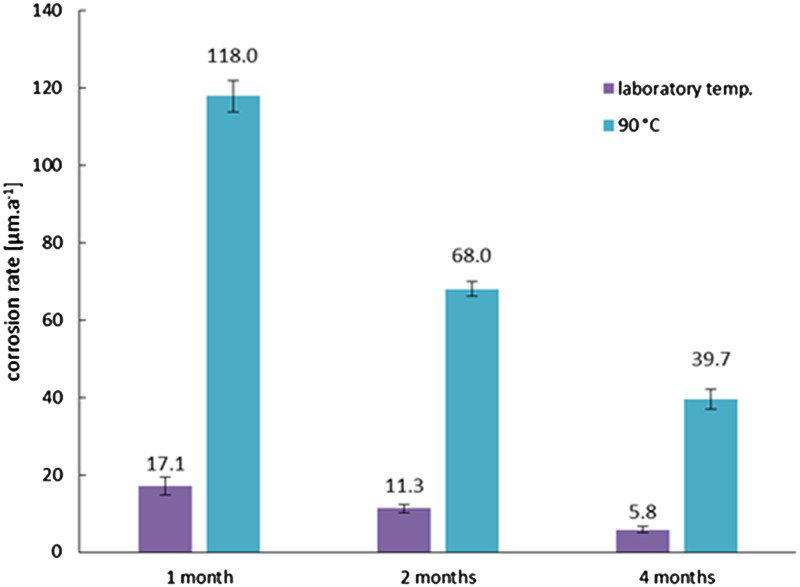
Reference materials are also being tested in the context of the Material Corrosion Test (MaCoTe) underway at the Grimsel Test Site in Switzerland (2013-2022). The aim of the experimentation is to study the time dependence of material corrosion under anaerobic conditions both at a normal level of temperature and 70°C. Samples of carbon-steel, stainless steel, copper and a material with a copper surface were placed in specific-designed modules (Figure 7) and surrounded with compacted bentonite, both MX-80 and bentonite of Czech origin. The modules were then fitted into corrosion probe assemblies that were subsequently emplaced in boreholes drilled into the rock massif. The goal of this in situ testing is to determine the time dependence of material corrosion in conditions expected in the future DGR.
Module for samples used in the heated experiment of the MaCoTe project.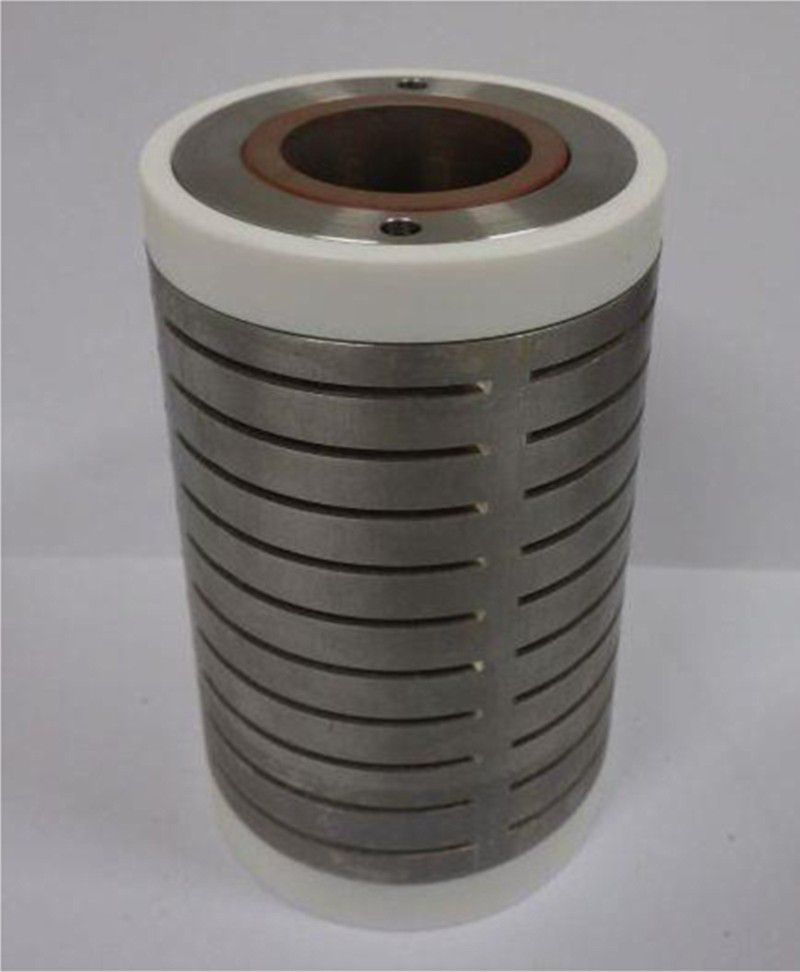
Conclusions
A double-walled canister has been developed as part of the Czech canister design programme. Fulfilment of the extensive laboratory experimental plan (2014-2018) is ongoing and it has already been determined that the duration of specific experiments will be extended, focusing on the research of the consequences of contact between the various canister materials and bentonite. On the basis of experience obtained to date, the experimental programme will be expanded and new experiments will be launched with concern, for example, to the influence of fully corroded carbon-steel on stainless steel as well as the influence of bentonite on the corrosion rate of carbon-steel (contact with different types of bentonite). The MaCoTe in situ experiment, which will continue until 2022, is ongoing and the results are being made available on a continuous basis. In addition, SURAO proposes to conduct its own in situ testing at its recently constructed Bukov Underground Research Laboratory (southeast Czech Republic) to compare the results conducted in similar geological conditions to that envisaged for the future Czech DGR and therefore justify the selection of the canister material.
Footnotes
Notes on contributors