




Abstract
The Nuclear Waste Management Organization (NWMO) has developed a comprehensive Proof Test Plan to evaluate the feasibility and safety of its deep geological repository solution for nuclear waste. This work plan includes many active research programs to build confidence in the Canadian used nuclear fuel container design, a copper-coated steel vessel that is optimised for the CANDU waste form. Ongoing research within the Proof Test Plan includes several programs to evaluate the possible extent of damage that may be caused by various corrosion mechanisms: the anoxic corrosion of copper in pure water, concentrated chloride solutions, and in the presence of sulphide; a comparison of the corrosion behaviour of copper coatings on steel with wrought copper; the localised corrosion and surface roughening of copper; the γ-radiolysis-induced corrosion of copper; the galvanic corrosion of through-coating defects; and the localised corrosion of the internal steel weld region.
This paper is part of a supplement on the 6th International Workshop on Long-Term Prediction of Corrosion Damage in Nuclear Waste Systems.
Introduction
The Nuclear Waste Management Organization (NWMO) was formed in 2002 to manage the long-term care of Canada's used nuclear fuel [1]. In parallel with extensive public and aboriginal engagement activities, the NWMO has a large technical program that is developing plans for and evaluating the safety of a deep geological repository (DGR) as a passive long-term safety system. Key to the DGR design concept is the use of multiple natural and engineered barriers to isolate the nuclear waste from the environment. The used fuel container (UFC) is a major engineered barrier that must be strong enough to withstand geological pressures, including the hydrostatic load of glaciation events, and chemically resistant to long-term corrosion. For many years, the NWMO considered a modified version of the KBS-3 ‘dual-vessel’ UFC design (Figure 1(a)) that would consist of a large cast-iron inner vessel for structural strength and a 25 mm thick cylindrical copper ‘overpack’ for corrosion resistance (Figure 1(b)) [2]. The choice of copper as a corrosion-resistant material was originally based on its thermodynamic stability under predicted DGR conditions and is now supported by decades of corrosion research and by examples of archaeological and natural copper that have remained intact in the earth for hundreds/thousands or millions/billions of years, respectively [3].
Comparison of the (a) KBS-3, (b) the original NWMO reference (NWMO IV-25) and (c) the current Canadian reference (NWMO Mark II) used fuel container designs. The latter design is optimised for CANDU fuel bundles and applies modern coating techniques that significantly decrease the amount of copper required.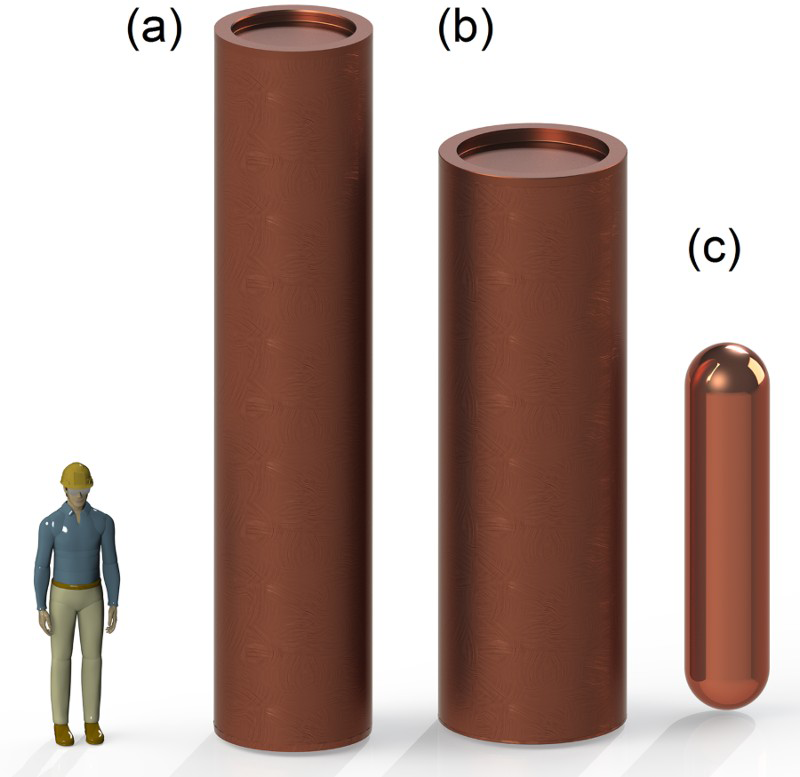
Starting in 2011, the NWMO engineering team conducted a significant re-evaluation of its container design, repository layout, and emplacement plans (Figure 2). One significant result was the development of new UFC designs optimised for CANDU fuel bundles and for manufacturing considerations. Of these, the ‘Mark II’ UFC (Figure 1(c)) has now been adopted as the current Canadian reference design [4]. This UFC has much smaller dimensions that facilitate easier handling and placement in a DGR. The design also significantly decreases the amount of copper required, as it utilises modern coating technologies to apply the copper directly to the steel, a concept that eliminates the need for the copper to be self-supporting during fabrication. Electrodeposition (i.e. electroplating) has been selected for the empty containers and lids before fuel loading (i.e. via conventional industrial operations), and cold spray for covering the closure welds of filled containers, where radiological operations can be expected [5,6]. Despite the much thinner coating (3 mm), the copper layer still significantly exceeds the current conservative corrosion allowance of <1.3 mm in the first 1 000 000 years [7,8].
The proposed multiple barrier system in a Canadian deep geological repository, showing the redesigned used fuel container.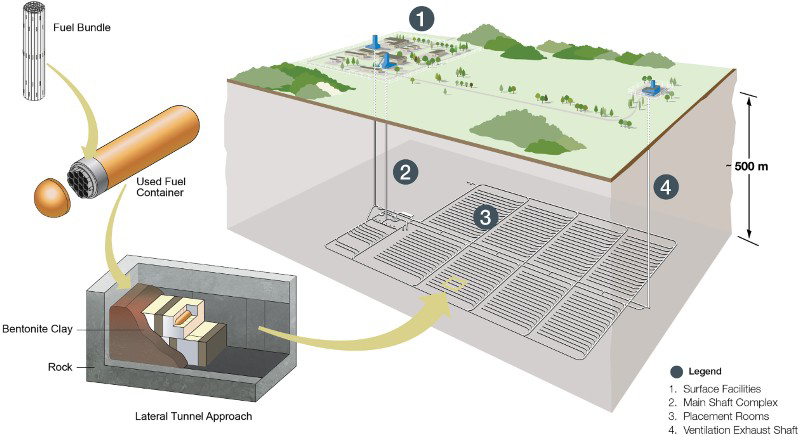
The NWMO proof test plan
During the course of redesigning the DGR, the NWMO developed a project plan to build confidence in the updated DGR concept. This Proof Test Plan (PTP) is composed of several Work Element Definition (WED) sheets that describe the scope of individual research activities. The goal of these programs is to build confidence in the feasibility and safety of the multiple barrier systems and the Canadian DGR concept. The WEDs are organised into several major systems:
Used Fuel Container Engineering Tools Buffer and Backfill Emplacement Thermal Analysis and Room Layout Encapsulation Plant Engineered Barrier Analysis
Given the dimension of the copper layer in the new UFC design (3 mm cf. 25-50 mm for designs that utilise separately fabricated copper shells over iron/steel inserts), there is a considerably smaller tolerance for uncertainty in the copper corrosion allowance. It is therefore critical that the corrosion behaviour has been thoroughly investigated and demonstrated to build sufficient confidence in this design. In the area of UFC corrosion, the NWMO has several ongoing WED research activities under way. The experimental aspects of these programs are primarily performed through collaboration with research partners at university and government laboratories. The overview that follows provides a brief summary of each of these programs and an update on their current progress.
The anoxic corrosion of copper in water and concentrated chloride solutions
Whether copper corrodes in anoxic pure water has been a contentious question for many decades [9–14]. Historically, this ongoing debate has prevented efforts to include anoxic corrosion in the NWMO copper corrosion allowance (if one is even necessary) [7,8]. Moreover, the nature of an as-of-yet unidentified H x CuO y surface species and the resulting equilibrium H2 pressure remain unresolved. In response, the NWMO has initiated a program to assess the corrosion rates of copper containers in anoxic groundwaters, including pure water and a range of chloride concentrations.
Experimentally, copper samples are exposed to anoxic pure water or chloride solution, accompanied by the measurement of trace quantities of hydrogen gas via a highly sensitive probe. In order to evaluate a maximum corrosion rate, it is presumed that all the hydrogen is formed by anoxic corrosion mechanisms, such as reactions (1) and (2). These ongoing measurements are anticipated to establish reliable maximum values for the NWMO copper corrosion allowance in a range of solution environments.


The anoxic corrosion of copper in the presence of sulphide
The reaction of copp
A comparison of the properties and corrosion behaviour of copper coatings on steel
By applying copper as an integrally bonded coating, the Canadian UFC concept eliminates concerns faced by dual-vessel designs regarding creep ductility and stress corrosion cracking. However, a key assumption is that the corrosion behaviour of the NWMO copper coatings (i.e. electrodeposited and cold spray) is essentially the same as that of wrought copper (i.e. SKB OFP). The NWMO has ongoing research programs to collect the necessary data to support this assumption, including long-term electrochemical tests, materials characterisation, and surface analysis [15,16]. Whereas cold sprayed metals can sometimes be quite porous, the NWMO's methods limit the porosity to <1%. The results from this program have so far demonstrated that the copper coatings behave very similarly to wrought copper samples in oxygenated and anoxic sodium chloride solutions. Further work is under way to more broadly explore additional corrosion scenarios, such as the influence of sulphides.
The localised corrosion behaviour and surface roughening of copper in the anticipated DGR conditions
Whereas early waste container predictions allowed for a tolerance of pitting corrosion [17,18], more recent reports suggest that only general copper corrosion is expected in a DGR environment(s) [8,19]. In order to build certainty whether localised corrosion such as pitting may occur during the oxic period immediately following emplacement of the used fuel containers, a localised corrosion program has been initiated. Its general approach is to: (i) predict possible pore-water/groundwater conditions based on known geological data, (ii) collect input electrochemical data for copper oxidation over a very wide range of potential pore-water/groundwater conditions, including for pH and electrolyte type and amount, (iii) develop models for oxic corrosion of both active and passive conditions and (iv) assess and quantify the degree of damage to the UFC due to localised corrosion processes based on a combination of experimental and modelled data. This program has so far established a range of possible near-field conditions during the early thermal transient (see King et al. [20]) and, from potentiodynamic polarisation curves, has examined the passivity of copper in these conditions (see Qin et al. [21]). In this context, passivity is considered to be a thin and continuous layer of cuprite. The results indicate that the passivation of copper, which is prerequisite for pitting to occur, is extremely unlikely in a DGR setting. Work is ongoing to evaluate the boundary conditions for active and passive behaviours, and to collect a larger inventory of critical potential values (i.e. E corr, E B and E RP).
The γ-radiolysis-induced corrosion of copper
In order to address concerns that γ-radiolysis of the environment surrounding a UFC may lead to container corrosion [22,23], a series of experiments are under way to determine the influence of γ-radiation on copper corrosion during the different stages of DGR conditions: (i) radiolysis modelling of the anticipated repository environments, (ii) direct measurements of radiolytic copper corrosion in humid gaseous environments at dose rates close to repository values (i.e. ∼0.3 Gy h−1), as well as much higher dose rates (i.e. ∼ 3 kGy h−1), (iii) quantification of copper corrosion in aqueous nitric acid (to simulate the possible concentration of humid air radiolysis products in condensed water droplets on the container surface) and (iv) measurement and modelling of radiolytic copper corrosion in high chloride solutions. The radiolysis modelling in this program builds upon previous works [24,25] and is focused on establishing a humid air radiolysis model and a groundwater radiolysis model. Ultimately, this program is expected to develop a model to relate radiolysis and corrosion processes with a maximum copper corrosion allowance.
Corrosion behaviour of through-coating defects
While it is extremely unlikely, a defect through a copper coating is potentially a highly damaging corrosion scenario. Although oxidising conditions and the associated galvanic couple between oxygen reduction at copper and steel oxidation are expected for only a limited period, general corrosion of any exposed steel could persist indefinitely under wet, anoxic conditions owing to its reactivity with water. While such anoxic steel corrosion is very slow for DGR conditions [26], this process may lead to eventual container failure. This program is examining the evolution of corrosion damage over time that would occur in the case of such a defect. A series of experiments has been initiated in which defective coatings are simulated by drilling through copper coatings to expose the underlying steel substrate. A range of electrochemical, spectroscopic, and microscopic techniques are being employed to develop a large dataset. Notably, X-ray tomography is being used to directly observe the distribution of corrosion damage at the defect location. The ultimate goal of this program is to develop a reliable model for the long-term consequences of a through-coating defect, especially how it would affect the UFC lifetime.
The localised corrosion of the internal steel weld region
Although the inventory of oxygen in a sealed UFC is insufficient to lead to penetration of the vessel by general corrosion, extreme localised corrosion could, in principle, lead to container failure. The possibility of localised processes occurring is being examined using experiments that compare reactivity of the internal steel weld region and the bold container surfaces. The influences of γ-radiation and solution parameters such as pH are also being considered. The experimental portion of this program includes coupon corrosion tests of steel weld samples, galvanic coupling experiments for steel electrodes with various gap spaces, and high dose rate (∼3 kGy h−1) γ-radiation exposure tests. Results show that corrosion at the weld is much slower than corrosion of the bold surface, and that general corrosion is favoured overall, rather than localised corrosion. Detailed parametric studies are ongoing to determine the evolution of the steel corrosion and corresponding solution conditions in different water volumes.
Summary and future outlook
As part of its Proof Test Plan, the Nuclear Waste Management Organization (NWMO) has developed and initiated a variety of research programs to evaluate the feasibility and safety of its current deep geological repository concept. These activities include several active research programs to build confidence in the Canadian used fuel container design, a copper-coated steel vessel that is optimised for the CANDU waste form. The corrosion programs within the Proof Test Plan are evaluating the possible types and extents of damage that may be caused by various corrosion mechanisms: the anoxic corrosion of copper in pure water, concentrated chloride solutions, and in the presence of sulphide; a comparison of the corrosion behaviour of copper coatings on steel with wrought copper; the localised corrosion and surface roughening of copper; the γ-radiolysis-induced corrosion of copper; the galvanic corrosion of through-coating defects; and the localised corrosion of the internal steel weld region. These programs are anticipated to produce an accurate and reliable copper corrosion allowance in a Canadian DGR environment.
Footnotes
Acknowledgements
The authors acknowledge the extensive contributions of their numerous collaborators at Western University, the University of Toronto, York University, Canmet materials, Integrity Corrosion Consulting Ltd, Integran Technologies, and National Research Council Canada, as well as the contributions of their NWMO peers.
Disclosure statement
No potential conflict of interest was reported by the authors.
