




Abstract
Dynamic lateral instability of the femoral head develops in patients with osteoarthritis (OA) of the hip. Recently we have developed a hip brace, called the WISH-type hip brace, and showed successful response of the patients quantitatively. However, a negligible effect was observed in patients with bilateral involvement. Here, we extended the application of the WISH-type hip brace for two patients with bilateral OA joints. The resultant WISH-type hip brace with two S-form portions for bilateral thighs provided good recovery in hip function. Interestingly Timed Up & Go (TUG) test performed for one patient revealed a positive effect of the brace on the functional mobility. To the best of our knowledge, this is the first report elucidating the therapeutic effect of brace therapy with bilateral hip stabilization from hip functional and functional mobility points of view. Application of the present brace should be taken into account for patients with painful bilateral hip OA before easy application of invasive surgery such as total hip arthroplasty.
Introduction
Dynamic lateral instability of the femoral head develops in patients with osteoarthritis (OA) of the hip, and causes symptoms including joint pain, limitation of movement and limping, that results in difficulties in performing normal daily activities.1 Although recently we have developed a hip brace, called the WISH-type hip brace, and showed successful response of the patients quantitatively, a negligible effect was observed in patients with bilateral involvement.2 Here, we extended the application of the WISH-type hip brace for such patients, by adding another S-form portion, which holds the newly-affected thigh, to the WISH-type hip brace equipped previously.
To the best of our knowledge, this is the first report elucidating the therapeutic effect of brace therapy with bilateral hip stabilization from hip functional and functional mobility points of view.
Case reports
Case 1
A 52-year-old woman complained for 20 years of a dull pain in her left hip joint, which worsened in the recent year. Past and familial history revealed casting treatment for congenital hip joint displacement in her childhood. Although muscle exercise around the left hip joint was performed for several months, hip pain as well as restriction of range of motion (ROM) in the right hip joint developed over one month. Examination showed reduced ROM and Trendelenburg sign in both hip joints, providing especially low functional scores of the right hip in Harris and JOA scoring systems (55.7 and 52, respectively). The patient required 180 mg loxoprofen sodium, an analgesic drug, every day.
Radiographs showed bilateral secondary hip osteoarthritis, estimated as grade I (Figure 1A) according to Crowe et al.3 The WISH-type hip brace was applied for the right hip, and the effect on the hip function as well as pain were observed immediately, and the right hip functional scores increased to over 70 in both scoring systems a month later (Figure 1B, 1C). Interestingly, the improvement of hip function was also observed in the other side as well. Three months after brace equipment, the dose of the analgesic drug was reduced to 60 or 120 mg per day on an as-required basis. One year after brace equipment, the patient became free from the brace.
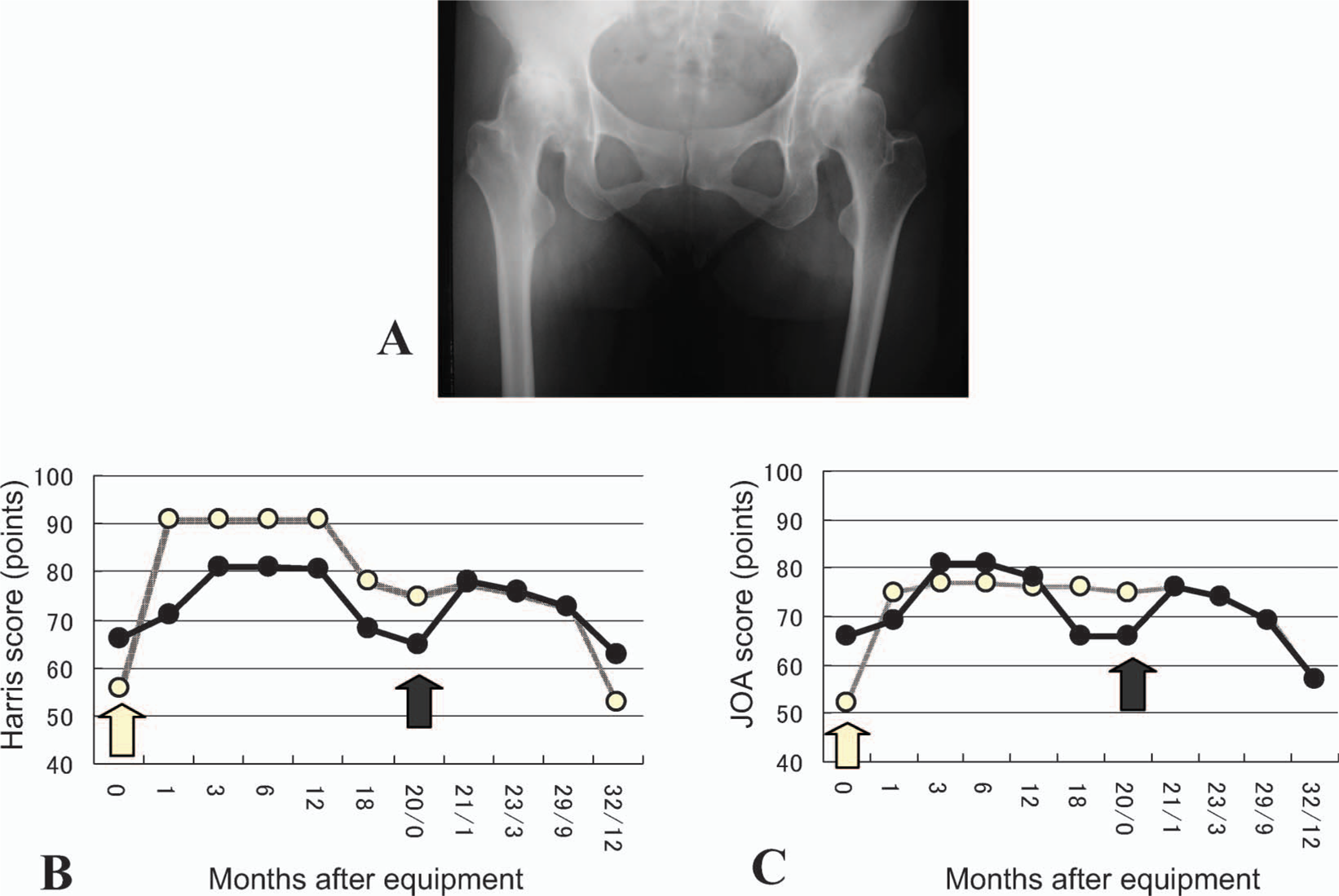
Case 1: Radiograph showing bilateral roof dysplasia, joint space narrowing, and subchondral sclerosis, indicating bilateral OA of the hip with grade I (A), and the time course of the Harris (B) and JOA (C) scores estimating the right (white circle) and left (black circle) hip joints. Abscissa indicates the months after the equipment of the brace for the right/left hip joint, respectively. Arrows indicate the timing of the equipment with right (white) and left (black) thigh portions of WISH-type hip brace.
After 15 months passed, however, the bilateral hip function was gradually impaired with pain on motion, especially for the left hip. The patient was again dependent on 180 mg loxoprofen sodium, and equipped the brace everyday. Twenty months after the equipment of the brace, another S-form portion around the left thigh was designed negatively with casting materials on the WISH-type hip brace, and then a bilateral WISH-type hip brace was made, and improved hip function over 70 points in both Harris and JOA scores in a month (Figure 1B, 1C). After one year passed, however, both hip functions were impaired again, while few radiographic changes were found. Then total hip arthroplasty (THA) was performed 36/16 months after the equipment of the brace for the right/left hip joint, respectively (Figure 3). The brace and the analgesic drug was continuously used until surgery.
Case 2
A 43-year-old woman complained for four months of a dull pain in her right hip joint. There was no remarkable past or familial history. Although muscle exercise around the right hip joint was performed during the recent three months, the pain was augmented gradually and the pain in the left hip also developed gradually. Examination showed reduced ROM and Trendelenburg sign in both hip joints, providing low functional scores of the right hip in Harris and JOA scoring systems (69 and 65, respectively). The patient required 180 mg loxoprofen sodium everyday.
Radiographs showed bilateral secondary hip osteoarthritis, estimated as grade I (Figure 2A). A WISH-type hip brace was applied for the right hip and the effect on the hip function as well as pain were observed immediately, and the right hip functional scores increased to over 80 in both scoring systems by a month later (Figure 2B, 2C). At that time, the patient became completely independent of the analgesic drug. After one year passed, however, the contralateral hip function was gradually impaired with pain on motion. Fourteen months after the equipment of the brace, another S-form portion around the left thigh was designed negatively with casting materials (Figure 3A) on the WISH-type hip brace, and then bilateral WISH-type hip brace was made (Figure 3).
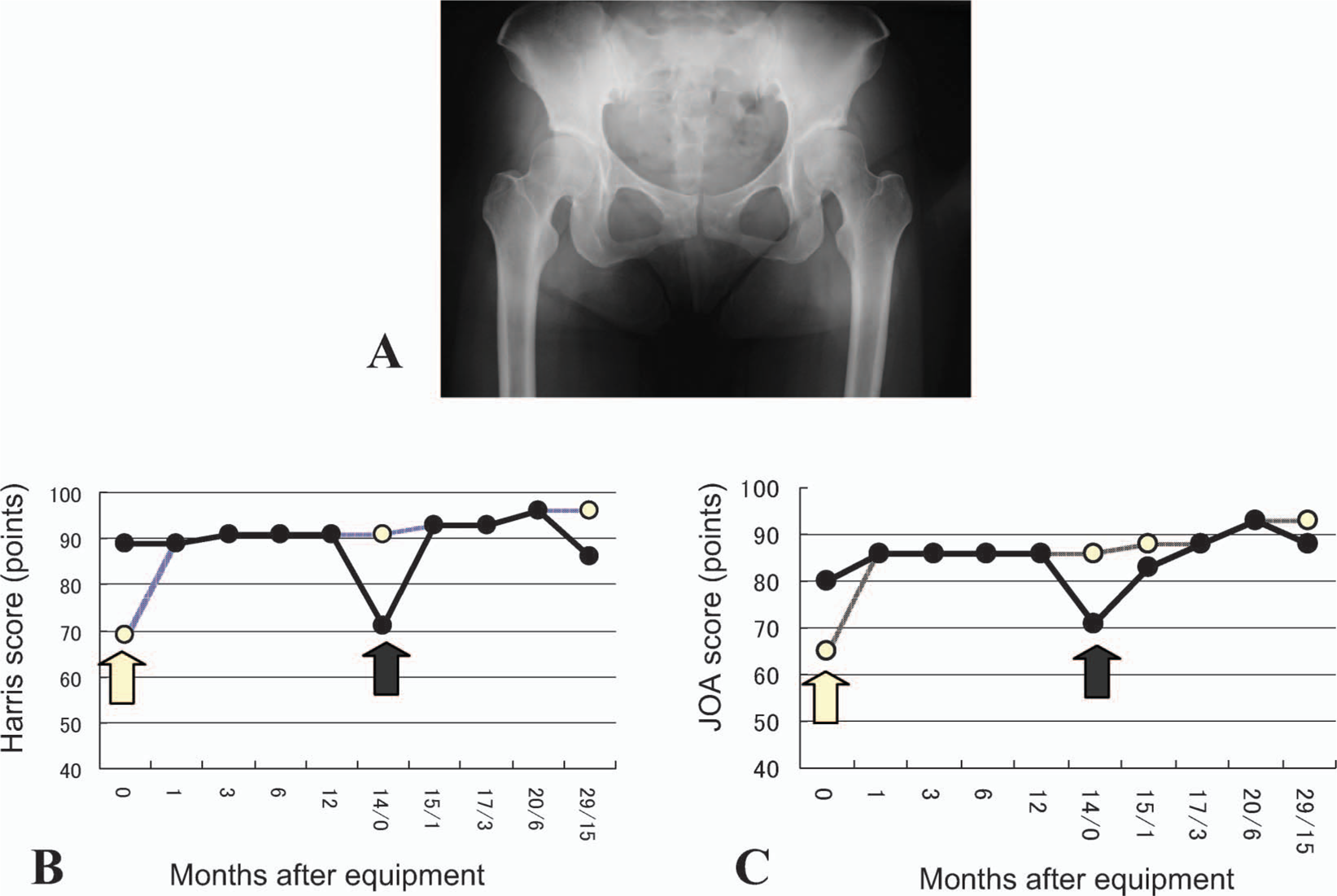
Case 2: Radiograph showing bilateral roof dysplasia and slight joint-space narrowing, indicating bilateral OA of the hip with grade I (A), and the time course of the Harris (B) and JOA (C) scores estimating the right (white circle) and left (black circle) hip joints. Abscissa indicates the months after the equipment of the brace for the right/left hip joint, respectively. Arrows indicate the timing of the equipment with right (white) and left (black) thigh portions of WISH-type hip brace.
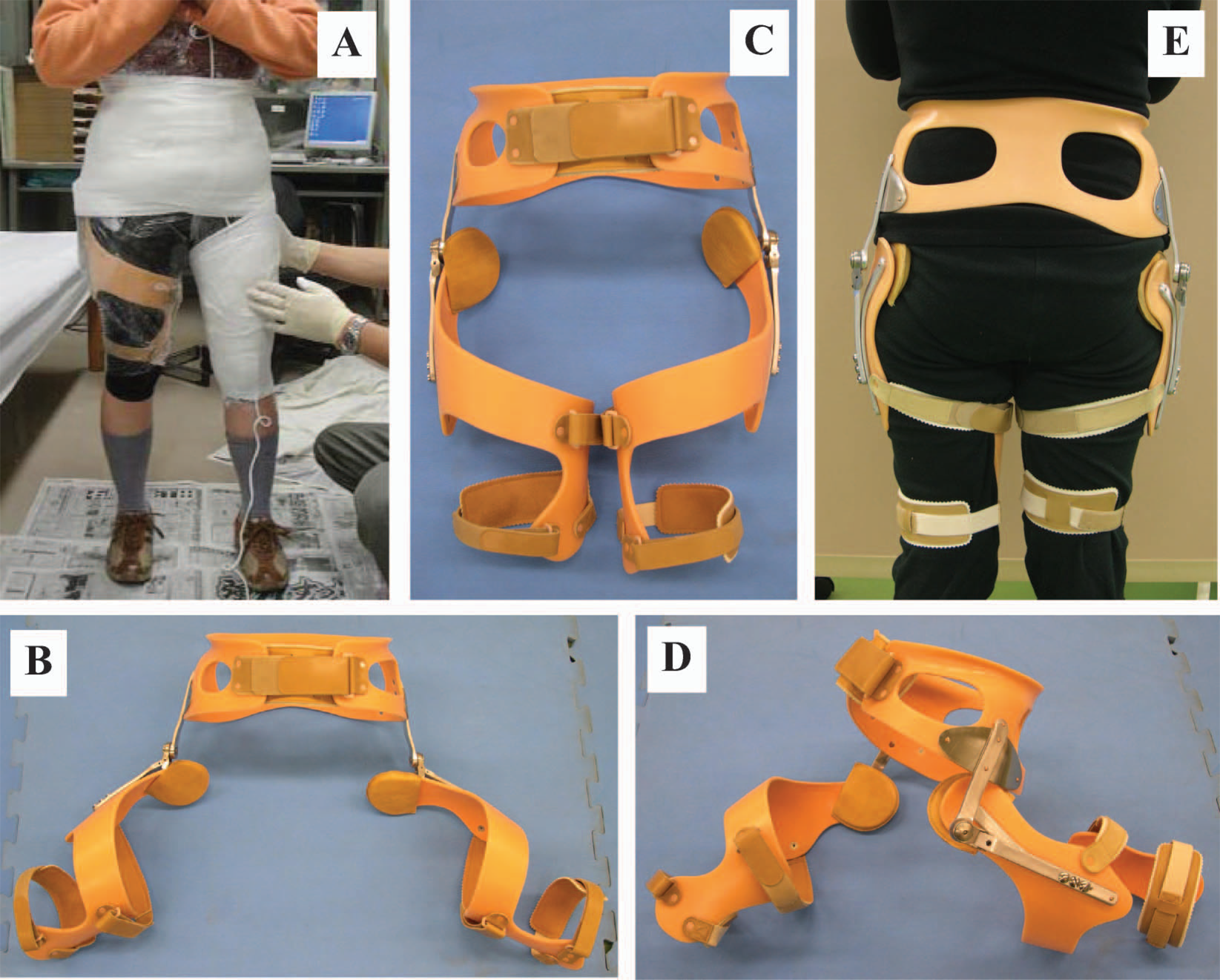
Designing and the completed product of the bilateral WISH-type hip brace: Adding another S-form portion around the left thigh was designed negatively with casting materials on the WISH-type hip brace in case 2 (A), and then the resultant bilateral WISH-type hip brace is shown in the front view with (B) and without (C) abduction as well as lateral view (D). Posterior view shows simultaneous compression onto the bilateral great trochanters (E). The components of the brace were described in detail previously.2
Bilateral application of the brace improved hip function over 90 points in both Harris and JOA scores in a month (Figure 2B, 2C). Interestingly Timed Up & Go (TUG) test, performed quickly according to Shumway-Cook et al.,4 revealed a positive effect of the brace on the dynamic balande of the patient (Table I). The pain was reduced independent of palliative non-steroidal anti-inflammatory drug (NSAID), and the hip function was kept at a high level 29/15 months after the equipment of the brace for the right/left hip joint (Figure 2B, 2C). The patient used the brace in the case of walking or job engagement everyday, resulting in good compliance. The local ethics committee approved the study (Gunma University, Maebashi, Gunma, Japan), and each individual participating in the study gave informed consent.
Timed Up & Go (TUG) test performed in Case 2a.
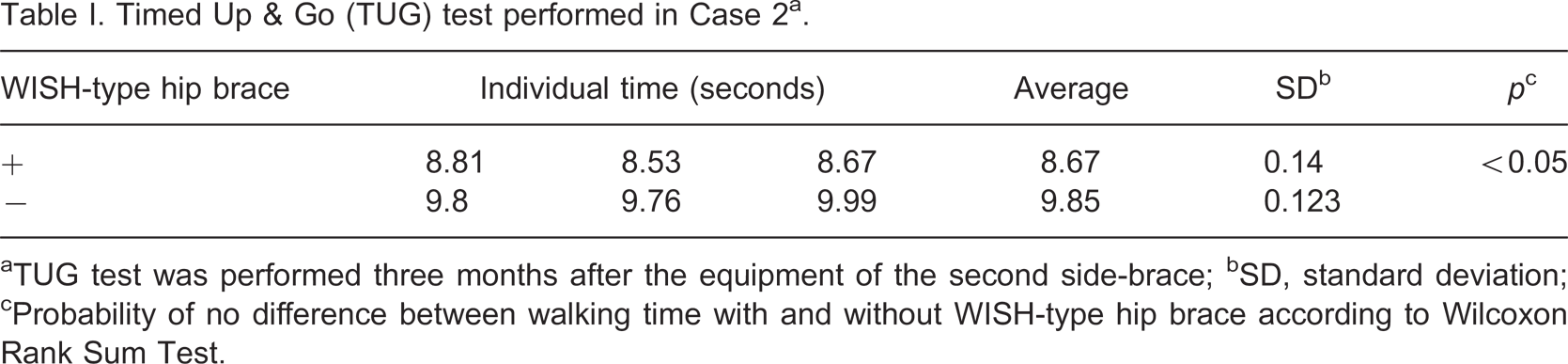
aTUG test was performed three months after the equipment of the second side-brace; bSD, standard deviation; cProbability of no difference between walking time with and without WISH-type hip brace according to Wilcoxon Rank Sum Test.
Discussion
Previously we have shown that high compliance of the WISH-type brace equipment was obtained with successful response of the patients with painful OA of the hip.2 The pain control effects encouraged patients to perform daily walking exercise, the outcome of which was not temporal. Two independent measures, Harris and JOA scoring systems, revealed these positive effects of the brace quantitatively.2 However, two patients did not respond positively to the brace and one of them resulted in THA replacement in a relatively short period. The common factors in these two cases included bilateral involvement.2
Impaired hip function can be compensated for by an increase in pelvic motion and muscle power generation or absorption modifications in other joints of the contra-lateral leg during walking. Patients with bilateral hip OA hardly compensate with the contra-lateral leg joint during gait, and show a unique gait pattern.5 Even the brace improves the hip function, when the contra-lateral hip function is impaired, the OA hip supported by the brace might be overloaded with the compensation.
In the present study, both cases showed reduction of contra-lateral hip function approximately one year after the first application of the brace. Addition of another thigh portion to the existing brace recovered the hip function on both sides. The present unique brace with the ability to stabilize the bilateral femoral head toward internal direction may be useful for, at least, delaying the application of heavily invasive surgery such as THA, as well as impaired ADL due to painful bilateral hip OA.
The TUG test was introduced by Podsiadlo and Richardson, and is a useful simple functional mobility test.6 The predictive ability of the TUG to screen for older adults at risk for future falls has been demonstrated. In older adults with hip OA the TUG was shown to be a useful screening instrument to predict those who have frequent near-falls.7 Interestingly, the TUG has responded positively to functional change in patients following THA surgery.8
In the present case, TUG was improved with the equipment of the present WISH-type hip brace. This finding may suggest the preventing effect of the brace against hip-OA associated falling. On the other hand, TUG has shown to be related to knee function in patients with knee OA.9 In evaluating factors affecting self-reported pain and physical function in patients with hip OA, the TUG test has been significantly associated with all main outcome measures, and it is suggested to use it to describe the functional severity experienced in hip OA.10 Taken together, TUG may be capable of representing hip function of OA patients, although further study with many numbers of the patients will be necessary.
To the best of our knowledge, this is the first report elucidating the therapeutic effect of brace therapy with bilateral hip stabilization from hip functional and functional mobility points of view. Compact configuration,2 allowing the bilateral fixation of the S-form thigh portion to the pelvic portion, may simultaneously stabilize bilateral hip joints. Survival of the primary THA is not long, and resultant revision surgery is required for many patients. Thus from a time-saving point of view before operation, conservative treatments play an important role, especially for younger patients. Application of the present brace should be taken into account for patients with painful bilateral hip OA before easy application of THA.