




Abstract
A patient suffering from diabetes and a trans-tibial amputation presented with stump wounds caused by improper donning of the liner. His diminished hand function resulted in improper donning, with air being trapped between the liner and stump. This caused blisters on the skin after loading the prosthesis.
Introduction
A 62-year-old male patient with insulin dependent diabetes and a trans-tibial amputation on the left side, the result of necrotizing fasciitis after a burn injury 7 years ago, was seen in the outpatient clinic because of large blisters on the stump.
The patient had been seen a few weeks earlier because of shrinking of the stump volume and the sinking of the stump in the socket. The stump skin was in good condition with no wounds. The patient had experienced gradual deterioration of hand function, with diminished grip strength and sensation, during the years due to the diabetes, but claimed to have no difficulties in donning or doffing the prosthesis. He mentioned that he could not walk at all and only made transfers with his current prosthesis because of the poor fit, but wanted to start walking again. He also mentioned that his walking was unsure and only possible in the home with the assistance of his wife, because of a left hip fracture a few years ago and a diabetic right foot.
Initially, the patient had used a conventional prosthesis with thigh corset, but for the past 6.5 years he had used a Kondylen Bettung Münster (KBM)-type prosthesis with silicon liner. He had not previously complained of stump wounds. A new socket and tighter-fitting liner of the same type was prescribed. A week after the new socket and liner were delivered, the patient was seen with four large, open blisters on the distal part of the stump (Figure 1). The patient had had no trauma of the stump and only mentioned that, directly after delivery and donning the prosthesis and walking a short distance in the home, he noticed the blisters on his stump at the end of the day after taking off the prosthesis. We checked the donning technique of the patient and saw that he did not flatten the distal portion of the liner during application, instead applying it with a cup form with air trapped between the liner and stump. The skin sensitivity of the stump (checked by brushing the skin lightly) was clearly diminished. The wounds were treated and healed a week later, after which the stump was formed with a compression liner. A thicker, looser-fitting and softer liner was applied for use in the prosthesis. The patient could turn the liner inside out and flatten the distal portion of the liner against the stump adequately and was instructed to do so every time he donned the prosthesis. No air was trapped and he could function adequately afterwards. No wounds were seen during the subsequent consultations.
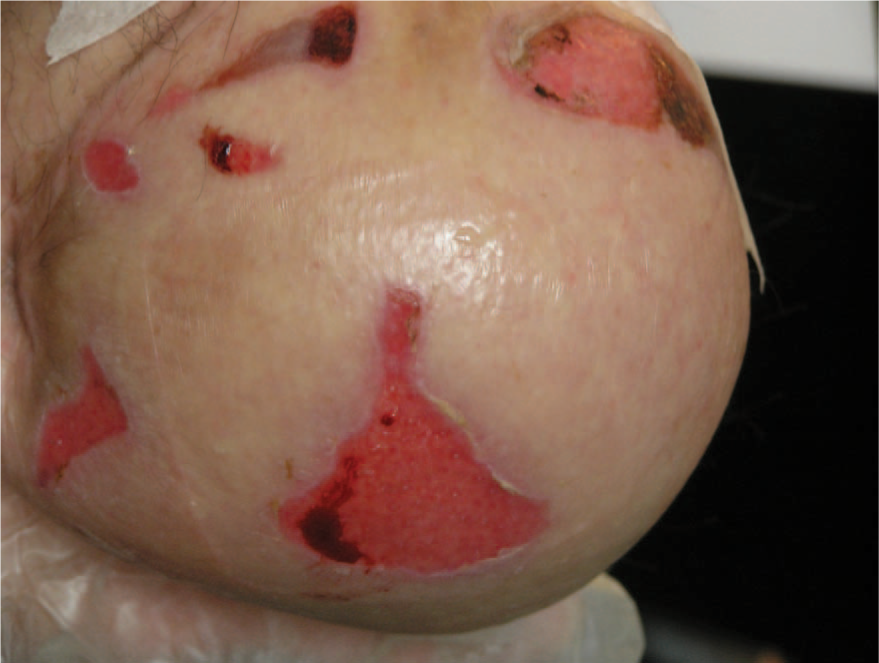
Blisters on the patient's stump.
Discussion
This case report shows that proper donning technique of a silicon liner is essential, and that improper donning with air becoming trapped distally can easily cause large blisters to form on the distal stump skin. With this patient, the donning technique was not evaluated before a new socket and liner were prescribed. Also, the patient did not mention having trouble with donning. In our experience, this is often the case with patients who have experienced (gradual) deterioration of hand function, and such patients should be asked explicitly if donning the prosthesis is a problem. A demonstration of the donning technique by the patient can be very informative.
We assume that the old liner, which did not have a good fit, let any trapped air escape proximally during loading of the prosthesis. The tighter new liner caused air to be trapped that could not escape and, during the loading response of the prosthesis, this air heated and caused skin temperature to rise (bike-pump phenomenon). The pattern of blister formation, forming a circle on the distal end of the stump, shows that friction on the skin also plays an important role. Because of the air becoming trapped distally, the liner loses contact with the skin in a circular pattern. This results in shearing forces taking effect because of the loosening of liner contact with the skin. This effect, in combination with the elevated skin temperature, causes blisters. Blisters can form quickly, especially when the shearing forces are combined with elevated skin temperature (Levine 1982; Zhang et al. 1994). The fact that the patient could not walk with his old prosthesis protected him from developing these blisters because the prosthesis was not loaded; thus, the trapped air was not heated and friction forces remained minimal.
The new liner we prescribed was softer, more pliable, could be handled more easily, and had also a looser fit so that any trapped air could escape. The patient could resume walking short distances in his home with two crutches, but did not reach his original level of walking because of his long period of inactivity, in combination with the progression of the diabetes.
The literature pays little attention to the donning and doffing of lower-limb prostheses. There are only a few studies that mention donning, and that in relation to a larger study objective. For example, in one paper comparing the function of a KBM prosthesis with the function of the liner prosthesis, mention is made of the ease of donning the different fitting systems (Cluitmans et al. 1994; Datta et al. 1996; Yiğiter et al. 2002). Gauthier-Gagnon et al. (1999) state that the donning of a prosthesis is an enabling factor for use of the prosthesis, and that more than 8% of the trans-tibial patients have problems, while more than 3% need help. Difficulties in donning can be caused by deficiencies in the upper limb, either of strength or of dexterity, and impaired vision (Cochrane et al. 2001). In addition, diminished sensation in the fingers and hemiplegia can cause problems (Hachisuka et al. 1998). In previous research, we have found that impaired hand function poses an increased risk for skin problems in the stump (Baars et al. in press). To facilitate donning, different solutions have been developed in the form of a special prosthesis suspension table or donning apparatus (Figueroa et al. 1980; Tamir et al. 2003). In light of these studies and our case report, it is odd to note that experts in the field of amputation and prosthesis in The Netherlands do not seem to regard donning and doffing as a primary influence on prosthetic prescription (Van Der Linde et al. 2004).
In our opinion, donning of the prosthesis is an essential prerequisite for safe use and this should be considered when prescribing a prosthesis. Not only is optimal function of the prosthesis dependent on a proper donning technique, but also stump-skin integrity. Blisters can form quickly, especially when the skin temperature is elevated (Levine 1982). The large blisters shown in this case report appeared quickly as the result of one-time improper donning.
Conclusions
The lesson to be learned from this case report is that an improper donning technique can result in a serious stump-skin complication. It is important to take time and observe the prosthesis donning and doffing techniques of the patient, especially if the hand function is compromised. If proper instruction does not lead to an adequate result, the prosthetic prescription must be adapted to facilitate safe donning. In the case of a liner, one should think of using a softer, more pliable liner to facilitate the flattening of the distal cup of the linerm so that a proper application to the stump can be achieved and the risk of air being trapped can be eliminated.