




Abstract
Measurement of human posture and movement is an important area of research in the bioengineering and rehabilitation fields. Various attempts have been initiated for different clinical application goals, such as diagnosis of pathological posture and movements, assessment of pre- and post-treatment efficacy and comparison of different treatment protocols. Image-based methods for measurements of human posture and movements have been developed, such as the photogrammetry, optoelectric technique and video analysis. However, it is found that these methods are complicated to set up, time-consuming to operate and could only be applied in laboratory environments. Electronic sensors and systems with advanced technology, namely accelerometer, gyroscope, flexible angular sensor, electromagnetic tracking system and sensing fabrics, have been developed and applied to solve the relevant application problems of the image-based methods. Nonetheless, other problems for using these electronic sensors emerged, including the environment influence and signal extraction difficulties. Further development of these electronic sensors and measurement methods could enhance their clinical applications in institutional as well as community levels. This article reviews the possible applications of these electronic sensors and systems, and precautions of their applications in analysis of human posture and movement. Such information would help researchers and clinicians in selecting and developing the most appropriate measurement techniques of using the electronic sensors for clinical applications of human posture and movement analysis.
Introduction
Measurement of human posture and movement is an essential area of research in the bioengineering and rehabilitation fields. It is motivated by different goals in clinical application, such as in comparing normal movements with pathological movements, planning and evaluating treatment protocols, and evaluating design of orthosis and prosthesis. Human postures and movements have been measured by using different image-based methods including photogrammetry (Weissman 1968; Bullock and Harley 1972; Thometz et al. 2000; Liu et al. 2001), optoelectric analysis (Pearcy et al. 1987; Dawson et al. 1993; Gracovetsky et al. 1995), and video analysis (Robinson et al. 1993; Masso and Gorton 2000; Nault et al. 2002; Engsberg et al. 2003). The characteristics of different image-based methods were summarized by Hsiao and Keyserling (1990). Photogrammetric systems have been used to record two- or three-dimensional image of posture. This type of system uses either light-reflective markers or light-emitting diodes affixed to the human body, and captures data with cameras and films for measuring the orientation of body segments through data reduction processing. Optoelectric analysis applies the same principles as photogrammetric system to measure the position of joints and body segments. The optoelectric sensing unit is used for collecting the data instead of films. Video systems also use the similar basic principles as both photogrammetric and optoelectric systems but capture data with optoelectric units or cameras of higher sampling rate. These systems can be used to capture and record three-dimensional body movements. The availability of these image-based methods has helped to achieve the goals of monitoring and analysing human posture and movement. However, inherent limitations of these methods, which are complicated to set up, time-consuming to operate, and limited to the laboratory environment (Hsiao and Keyserling 1990), so the chance of using these methods in the clinical applications are restricted. In recent years, low-powered and miniaturized electronic sensors, which are for use in robotic, industrial, aerospace and biomedical applications, have been developed by using advanced electronic circuit technology. The use of these electronic sensors has been considered as alternative methods for human posture and movement analysis in clinical applications. The purpose of this article is to review the possible clinical applications of different types of electronic sensors and systems, and their problems and limitations which are faced in the human posture and movement measurements. Such information would help researchers and clinicians in developing and selecting the most appropriate measurement techniques of using the electronic sensors for clinical applications of human posture and movement analysis.
Electronic positional sensors and systems
Five types of electronic positional sensors and systems for tracking human posture and movement are reviewed in this article, namely accelerometer, gyroscope, flexible angular sensor, electromagnetic tracking system and sensing fabric.
Accelerometer
Accelerometer is a type of positional sensor operated by measuring acceleration along the sensitive axis of the sensor based on Newton's second law (Force = Mass × Acceleration). Most accelerometers use a sensing method as a proof mass excited in a mass-spring-damper system as shown in Figure 1 (Gardner 1994; Westbrook 1994).
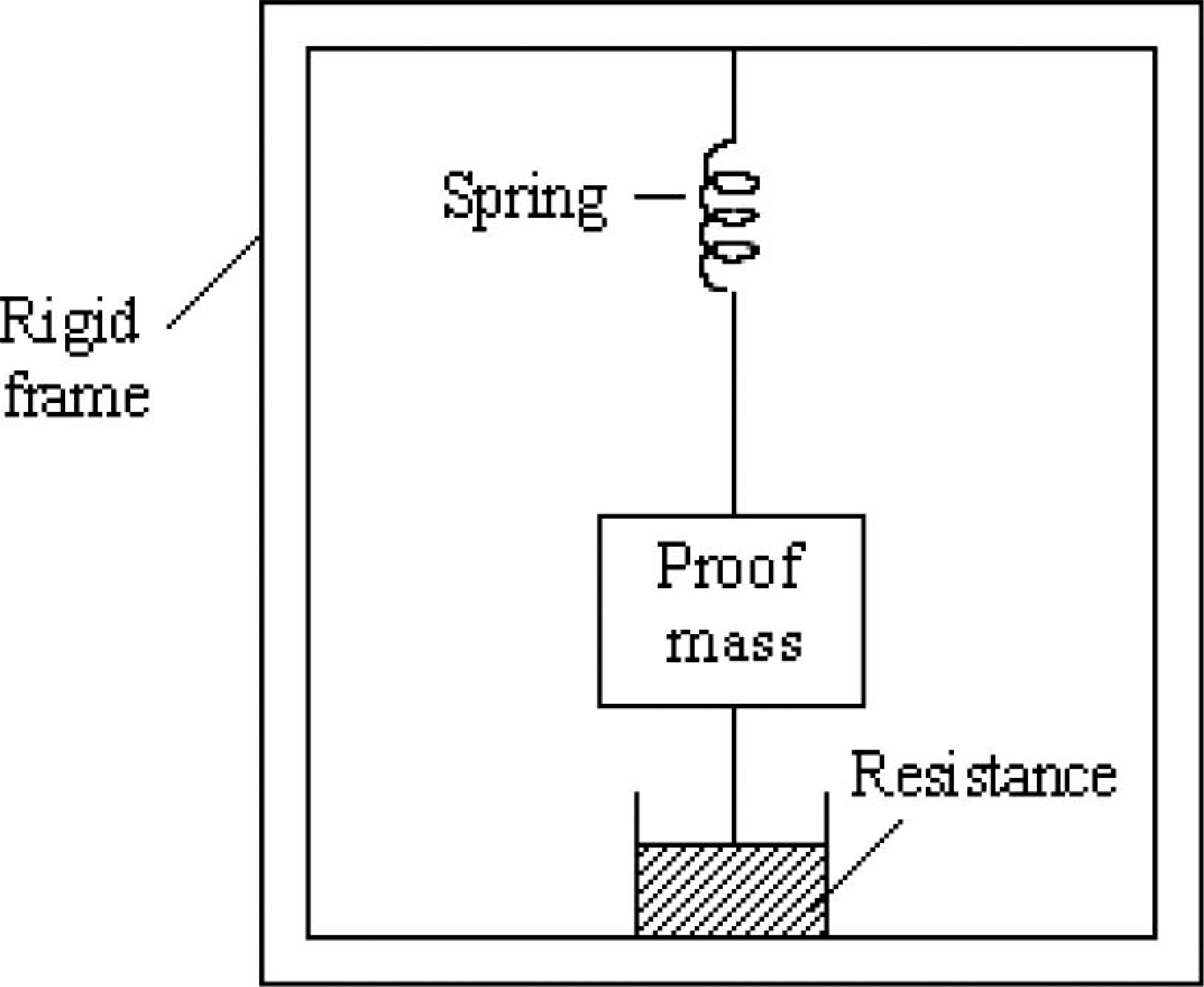
Basic layout of accelerometer. In the mass-spring-damper system, the loading force drives a second order damped harmonic oscillator, where the displacement of the proof mass relative to the rigid frame is considered (Gardner 1994). Under a constant acceleration condition, the displacement is directly proportional to the given acceleration.
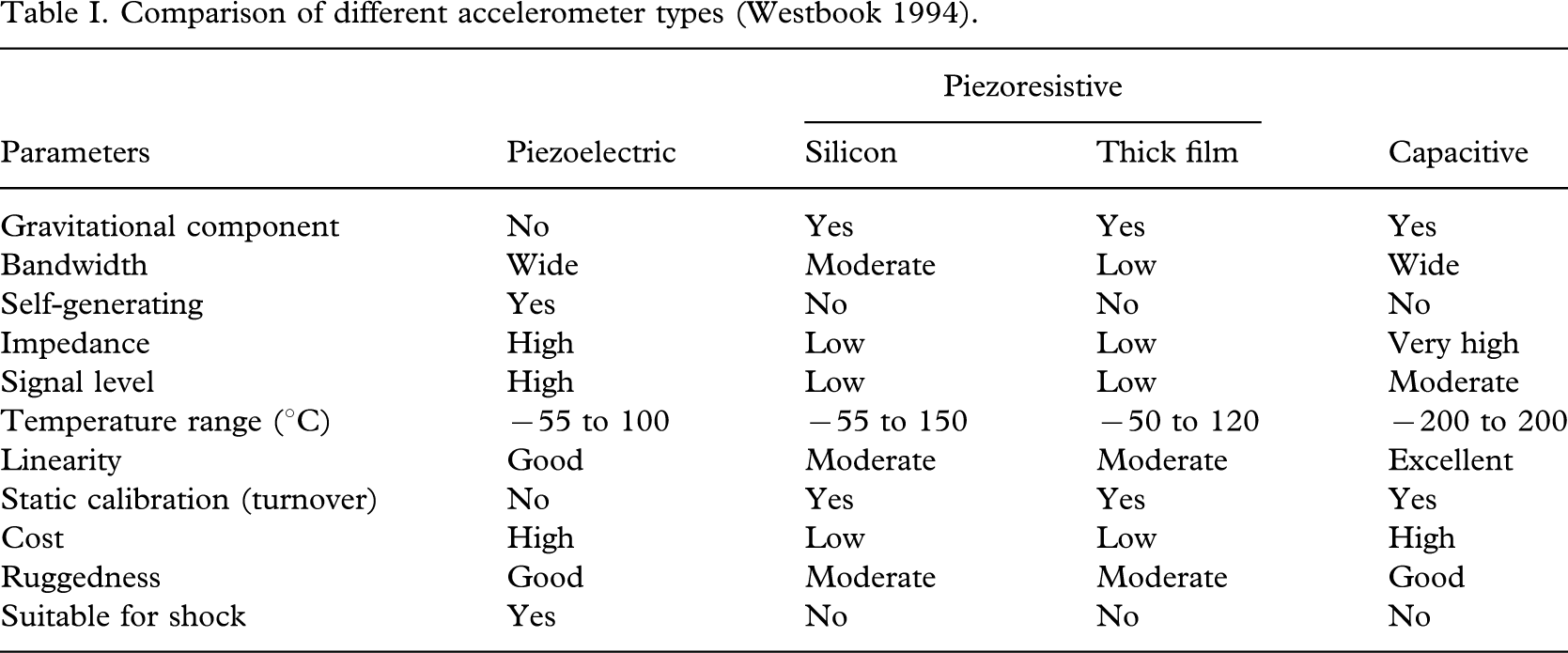
There are three common types of accelerometers, namely piezoelectric, piezoresistive and capacitive types. The characteristics of these types of accelerometers are shown in Table I (Westbrook 1994). In general, the capacitive accelerometers have higher stability, sensitivity and resolution than piezoresistive ones (Gardner 1994). The measured acceleration of piezoresistive and capacitive accelerometers consists of two components, including a gravitational component and a component from other acceleration force (Bouten et al. 1997; Mathie et al. 2001; Westbrook 1994). During static acceleration, accelerometers can function as inclinometers for measuring inclination or tilting angle with respect to axis of the gravitational field. The piezoresistive and capacitive accelerometers are suitable for measuring human posture and movement because they can provide dual acceleration components. Commercial accelerometers are now available in the market. One of the surface-micromachined capacitive accelerometers (Analog Devices, Model: ADXL203) is shown in Figure 2.
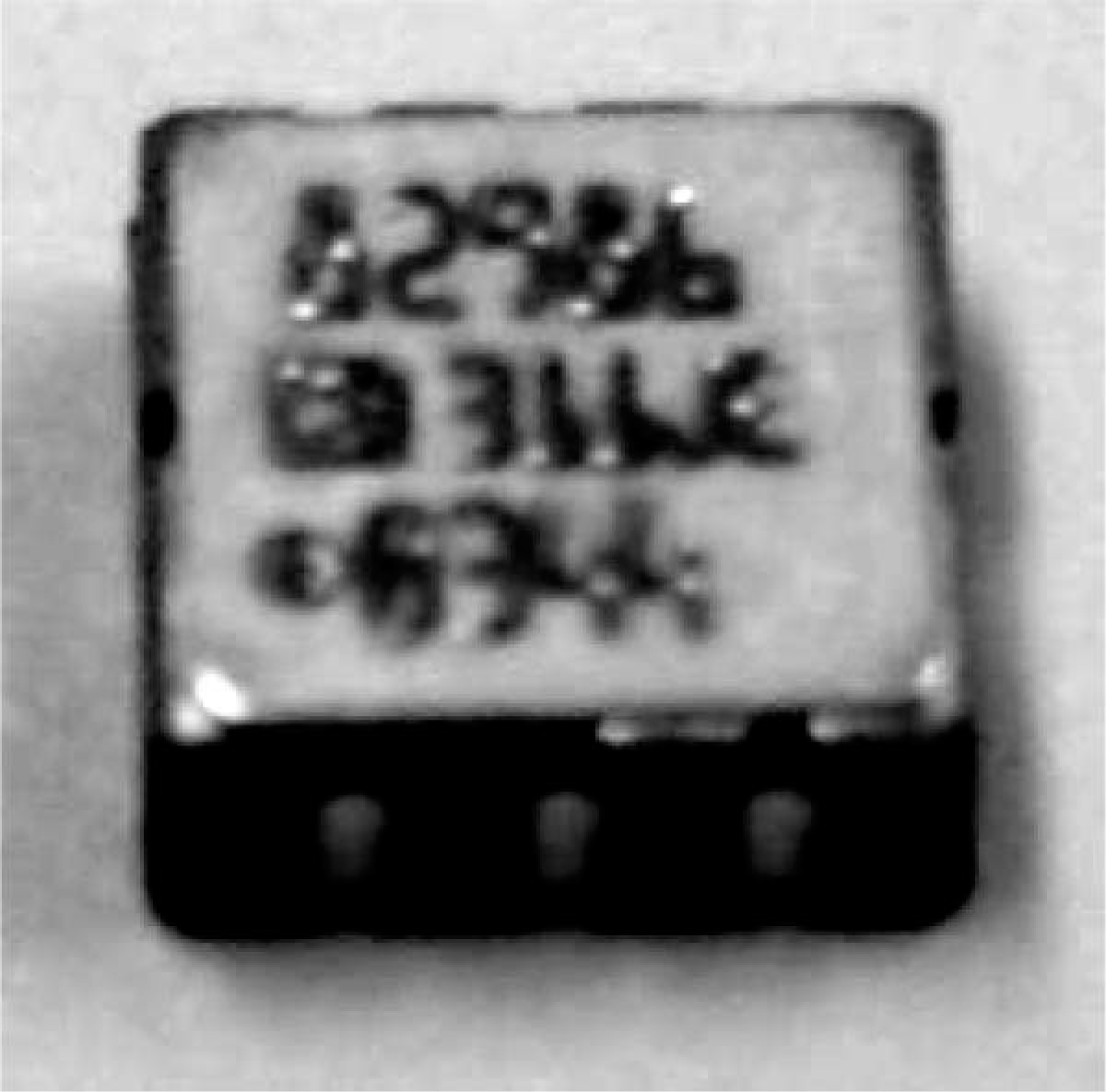
Photo of a capacitive accelerometer (Analog Devices, Model: ADXL203, Size: 5×5×2 mm).
Comparison of different accelerometer types (Westbook 1994).
The reliability and accuracy of accelerometers should be evaluated before applying them to measure human posture and movement. Hansson et al. (2001) found that the angular error of a tri-axial accelerometer system is 1.3°, the reproducibility is 0.2°, and the inherent angular noise is 0.04° and its operation is independent of the orientation of the device. This finding could demonstrate technological advancements and their potential for clinical applications. It is likely that sensors with the capacity to quantify dynamic accelerations and some features like low-power consumption and small size could be suitable for the objective assessment of body posture and movement in daily activities.
Gyroscope
Gyroscope is an angular velocity sensor which is commonly used for measurement of human posture and movement. It is generally based on the concept of measuring the Coriolis force of vibrating devices (Senturia 2001). Coriolis force is an apparent force that arises in a rotating reference frame. It is proportional to the angular rate of rotation. A simple model for analysing gyroscope behaviour is shown in Figure 3. The angular orientation can then be obtained from integration of the gyroscopic signal (Senturia 2001). One type of commercial gyroscope that has been considered for measuring human posture and motion analysis is shown in Figure 4 (Aminian et al. 2002; Sabatini et al. 2005).
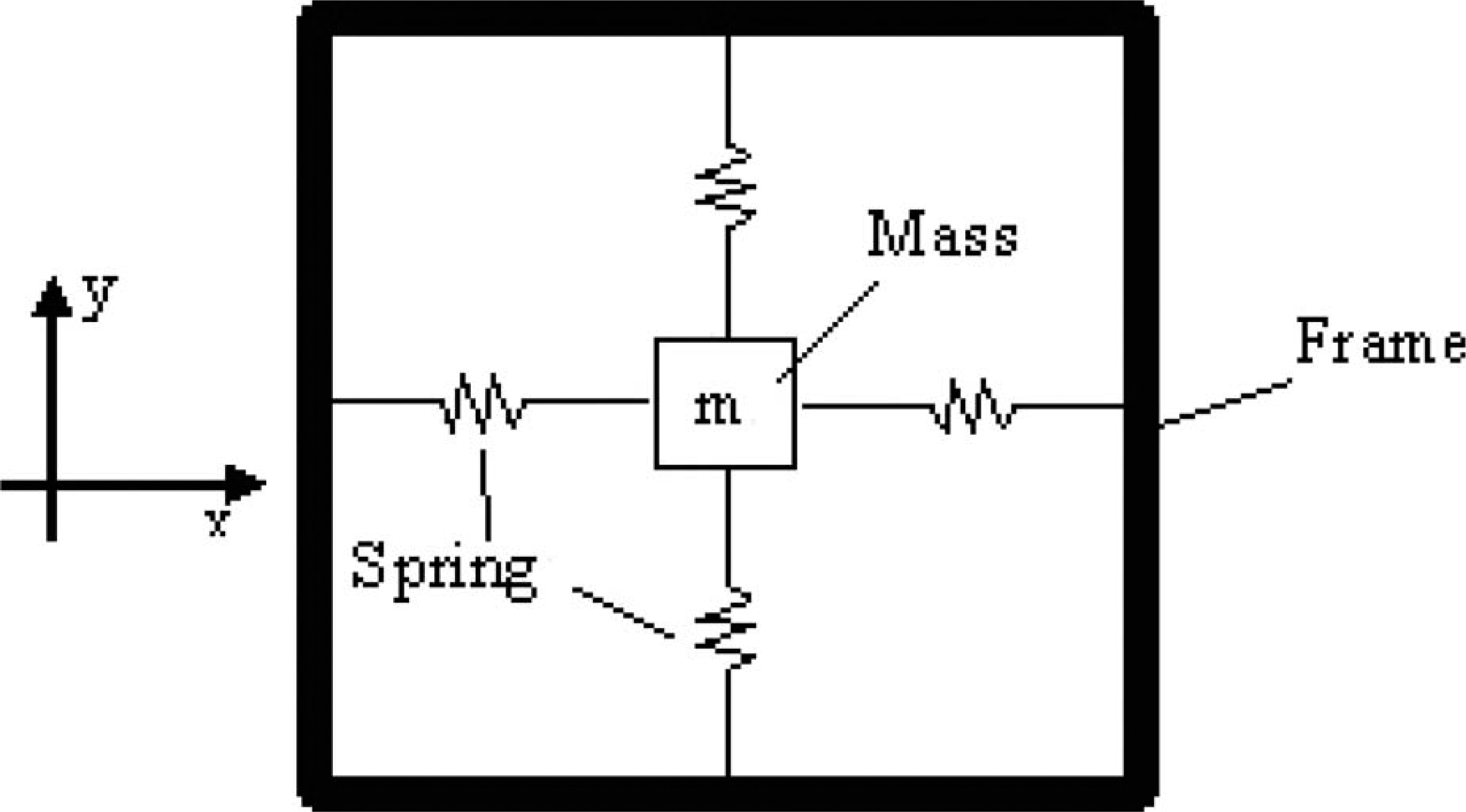
A simple model for analysing gyro behaviour. A single mass is suspended by four springs in x and y directions. The frame is presumed to rotate about the z-axis. Assuming small-amplitude motions which will be true in resonant gyroscopes, the x-motion and y-motion can be coupled only through the Coriolis-force term and the term involving angular acceleration. The Coriolis force then induces motion in the third direction which is perpendicular both to the direction of rotation and to the driven motion.
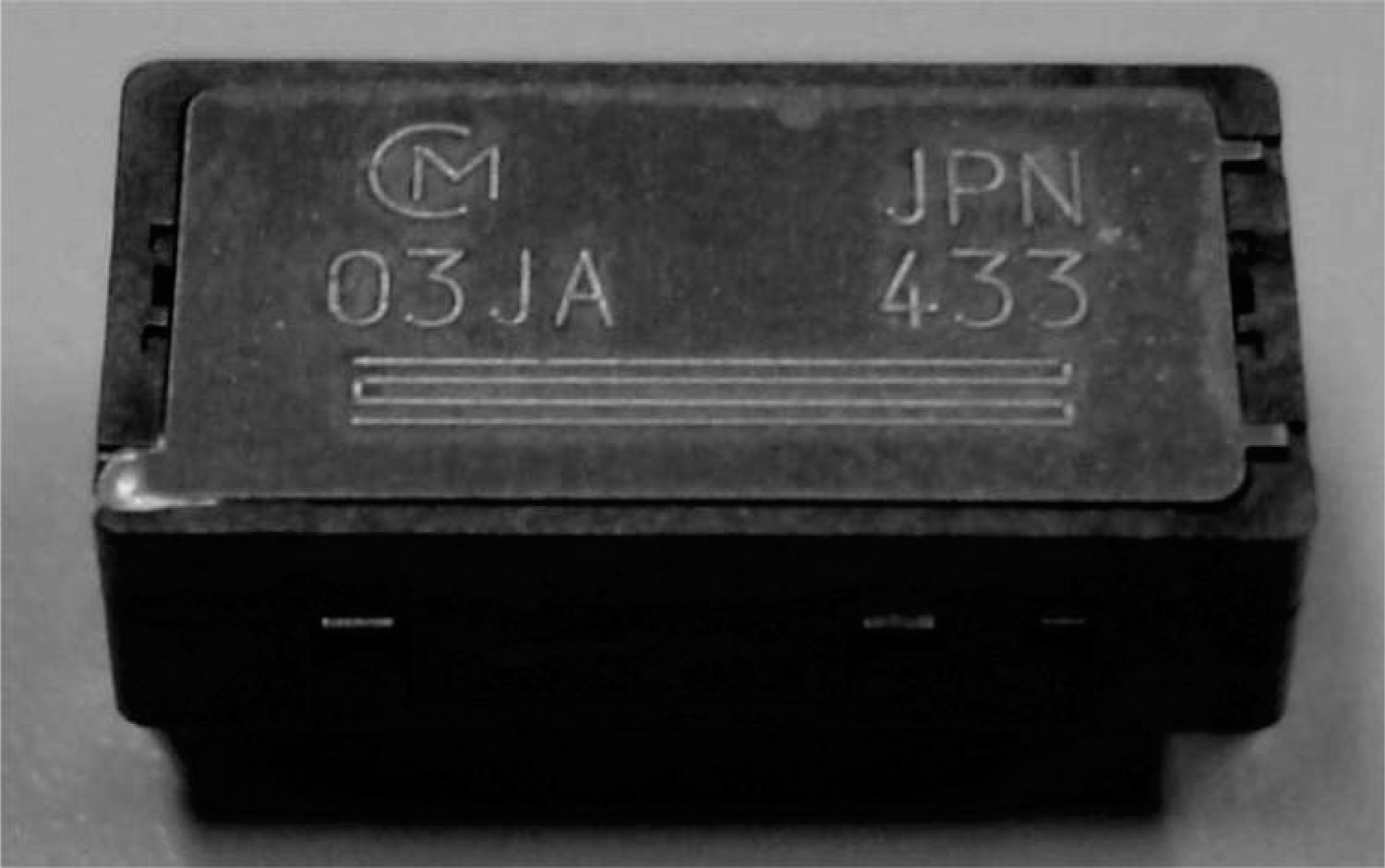
Photo of a piezoelectric vibrating gyroscope (Murata, Model: ENC-03J, Size: 15.5×8×4.3 mm).
Flexible angular sensor
Flexible angular sensor is not a type of inertial sensor as the aforementioned sensors. It is operated by measuring change of electrical output or displacement with respect to angular change. However, it may be applicable for measurement of movements between human body segments.
Strain gauges have been used in flexible electro-goniometer for angle measurement in clinical use (Nicol 1987). The device produces a linear relationship between electrical output and the subtended angle between one encapsulated end and the other. Flexible electro-goniometer is available commercially (Penny and Giles, Blackwood, UK) for measurement of posture and spinal motion in two planes (sagittal and coronal planes). It consists of two lightweight plastic end-blocks which are separated by a flexible spring.
A mechanical flexible device was developed with different mechanism by Roduit et al. (1998), using a pair of wires to measure bending angles. The wires were anchored at one end. The angular change could be collected and calculated by measuring the displacement between the ends of two wires during bending along different paths.
Electromagnetic tracking system
Electromagnetic tracking system is a three-dimensional measurement device that has been used in human posture and movement analysis. In general, the system consists of a transmitter and receivers. A low-frequency magnetic field is generated by the transmitter and detected by the receivers. The positions and orientations of the receiver relative to the transmitter can be calculated by the system. Systems with similar design are commercially available for kinematics studies in movements in different body segments, including upper limbs (Finley and Lee 2003; Ramanathan et al. 2000) and spine (Bull and McGregor 2000; Lee 2001; Mannion and Troke 1999; Pearcy and Hindle 1989; Willems et al. 1996).
Sensing fabric
Knitted stretch fabrics sensors have been introduced for detecting the posture and movement of the users. The operational concept of this type of sensor is to measure the changes of resistance in knitted strips. It gives a linearly increasing asymptotic resistance when it is stretched, up to almost maximum stretch (Farringdon et al. 1999). De Rossi et al. (2000) developed a minimally intrusive wearable system consisting of a Lycra leotard with conductive polymer strain sensors chemically deposited in selected areas. A wet process included in the direct deposition of polypyrrole layers onto fibres with a mask based procedure for appropriate patterning of the sensorized areas. Other combinations of materials and polymers were used to optimize the response time of the sensors. Scilingo et al. (2003) postulated that polymeric conductors and semiconductors offer several advantages with respect to metal and inorganic conductors: lightness, large elasticity and resilience, resistance to corrosion, high flexibility, impact strength, etc. Because of its elasticity, ergonomic comfort, and high piezoresistive and thermoresistive coefficients, the combination of polypyrrole as conducting polymer and Lycra/cotton as fabric is particularly effective.
Clinical applications
The previously introduced electronic positional sensors have been found in various clinical applications including the analyses of general physical activity, gait, posture, trunk and upper limb movement.
General physical activity analysis
Several studies used both “acceleration vector” and “gravitational vector” components of the signals of accelerometers to analyse the static and dynamic activities of the subjects. The static and dynamic activities could be discriminated, and the postures and the orientations of body segments could also be detected (Bouten et al. 1997; Fahrenberg et al. 1997; Foerster et al. 1999; Lyons et al. 2005; Mathie et al. 2001; Veltink et al. 1993; 1996). Therefore, the accelerometer was found to be useful for physical activity monitoring in everyday life.
Gait analysis
In 1973, Morris suggested an accelerometry technique to study the movement of shank, using accelerometers. The angular velocity, angle, translational acceleration, velocity and position of the shank in walking were assessed. The findings showed that accelerometers could be used to provide sufficient information to define the movement of the body segment in gait analysis. In recent years, accelerometers have been miniaturized in size and advanced in circuit technology to improve reliability. Several locomotion studies have tried to use accelerometers to determine the stages of lower limb movement in gait analysis (Veltink and Franken 1996; Veltink et al. 1998; Willemsen et al. 1991). The accelerometers were usually mounted on the thigh and shank. In addition, the use of accelerometer on the trunk for gait analysis was pursued. Villanueva et al. (2002) studied an electronic instrument with accelerometers for monitoring the trunk trajectory of human body walking on a treadmill. A pair of uniaxial accelerometers was affixed to the waist of the subject at the level of the second sacral vertebra with an elastic belt. The instrument was able to assess gait cycle time and the number of walking steps from measured trunk acceleration. This study demonstrated that the feasibility of using accelerometers for studying the kinematics of human lower limbs and trunk during locomotion. The accelerometer could be considered as a component of a portable instrument used for studying standing balance and temporal gait parameters in both experimental and clinical environment. Its operation is simple and the disturbance in gait could be minimized. It could be applied to different potential patient groups including post-stroke and cerebral palsy.
Miniaturized gyroscopes have been employed for measuring lower limb movement in walking. Tong and Granat (1999) investigated the possibility of using uniaxial gyroscopes to develop a practical gait analysis system by evaluating the angular parameters derived from the gyroscope with motion analysis system, and described solutions for solving the problem of gyroscope's signal drifting. The results showed that the knee joint angles derived from the gyroscopes was highly correlated (correlation coefficient = 0.93) with those from motion analysis system, and the correlation has been further upgraded (correlation coefficient = 0.98) by using a high-pass filter to correct the drift of the knee angle. This confirmed the feasibility of using the gyroscopes to measure angular parameters in gait analysis. Aminian et al. (2002) described an ambulatory system with miniaturized gyroscopes to estimate spatio-temporal parameters during long periods of walking. The gyroscopes were attached on the thigh and shank. The system errors for velocity and stride length estimations were 0.06 m/s and 0.07 m respectively and these accuracies were not high enough in measuring spatio-temporal parameters in clinical gait analysis and should be improved further before routine applications. Tsuruoka et al. (1999) suggested a method to evaluate human movement stability by analyzing the relative power contribution in head, trunk and pelvic movement derived from the measured signals of gyroscopes during walking. By analysing the relationship of the three body parts, it could provide useful information for planning treatment protocols for hemi-paresis patients.
In order to collect more information at the same time, some research studies made use of a combination of accelerometer and gyroscope to form a measuring system. Wu and Ladin (1999) used this combination to study the kinematics variables of lower limb during locomotion. The system directly measured the linear displacement, angular velocity, and linear acceleration of the lower limb segments, and identified the heel strike transients. Sabatini et al. (2005) used the combined sensing unit affixed to the foot instep to estimate spatio-temporal gait parameters. The signals of the accelerometer were modeled and double-integrated to obtain the position of the foot. The gyroscope was used to measure angular velocity for assessing the sagittal orientation of the foot to remove the gravitational contribution of the accelerometer signals before applying the integration. The measured walking speed and inclination, which derived from signals of the system, were comparable to the preset treadmill speed and inclination.
Apart from inertial sensors, mechanical flexible angular sensing device was applied to measure knee angles during walking (Roduit et al. 1998). Roduit's research team used the captioned device to compare against a conventional goniometer in testing real conditions by binding it on the leg of the subject. The measured accuracy of the system was ± 2° on a stroke of 100°. It also achieved a resolution of less than 0.1° and the temperature dependence of less than 0.2°/C. It was possible to recognize clearly the different phases of gait cycle. The possible source of error in the results may be due to the misalignment of the flexible sensor and conventional goniometer, and the instruments shift during the walking. However, it is a potential portable system for ambulatory monitoring due to its small size and sturdiness, and it can be easily fastened on a leg.
Posture and trunk movement analysis
Several commercial systems have been applied to measure posture and trunk motions. One of these systems, commercial electromagnetic tracking systems, has been employed in some research studies of posture and trunk motion analysis (Bull and McGregor 2000; Lee 2001; Mannion and Troke 1999; Pearcy and Hindle 1989; Willems et al. 1996). In 1989, Pearcy and Hindle demonstrated that electromagnetic tracking system could provide high resolution accuracy (error less than 1°) and repeatability (less than 0.2°) in spinal motion analysis. In the experimental setup, the receivers were attached on the body segment and the transmitter was placed in a fixed position within specific operational zone. The accuracy of the measurement was affected by the distance between the transmitter and receivers. The separation of receivers from the electromagnetic transmitter was recommended to be between 271 and 723 mm in order to have an optimal operational zone for minimizing error by Bull and McGregor. (2000). However, this would depend on the specification of the system. Therefore, the experimental setup and design are limited and cannot be used to take measurements in activities such as walking and lifting.
Besides commercial electromagnetic tracking system, non-commercial portable electromagnetic system has been developed to measure human physical trunk features, e.g., shoulders tilting (Lou 1998). The system was combined with a feedback unit to provide a signal to the scoliotic children for informing them to adjust their posture. The accuracy of the system was evaluated by comparing the measurement from the images of the back. The results demonstrated that the accuracy of the system could be 5 mm for the distance measurement in the distance 300 – 480 mm and 5° for angle measurements from 0 – 90° (Lou et al. 1999, 2000). The authors concluded that the portable electromagnetic tracking system could be used for measuring the shoulders asymmetry and detecting the postural changes. This portable design could be used in more clinical applications if the accuracy of this device is comparable to the commercial products.
The use of commercial flexible electro-goniometer to provide continuous quantitative information on lumbar spinal motion has been reported by Boocock et al. (1994) and Thoumie et al. (1998). The electro-goniometer was directly attached onto the surface of the lower back. The findings of Boocock's team showed that the measurements on the lumbar sagittal motion were comparable with those measured by a fluid-filled inclinometer or a flexicurve. Thoumie et al. (1998) compared the results of radiography with the electro-goniometer in measuring lumbar curvature and motion change during flexion-extension of the spine. Although the measurements of electro-goniometer were not comparable with the value of radiographic data in lumbar curvature and range of motion, the device could provide quantitative information of lumbar sagittal motion in continuous measurement and was recommended for use in a variety of occupational and recreational environments (Boocock et al. 1994). The inherent limitations of the flexible strain-gauged electro-goniometer should be considered in its application. The flexible strain gauge of the commercial electro-goniometer may be susceptible to bending or buckling during studies of seated tasks with lumbar support (Boocock et al. 1994). The measurement range of the spinal motion could be limited by exceeding the maximum preset distance between the two attachments with linear displacements occurring during flexion and extension of the lumbar spine.
Non-commercial accelerometer system with one accelerometer was developed by Lou et al. (2001) for posture monitoring and training. The sensor was attached to the upper trunk of a kyphotic subject. It was claimed to be capable of detecting the postural change of thoracic spine. In fact, using one accelerometer on the trunk could only provide measurement of the trunk tilting but could not give enough information for posture training to patients with hyperkyphosis. Therefore, more accelerometers should be used on different body segments as reference points such as lower thoracic, lumbar or pelvic region to collect more postural information. Nevins et al. (2002) made use of six accelerometers for continuous monitoring of spinal posture on the sagittal plane. Spinal posture was measured during daily activities by positioning accelerometers along the vertical axis of the spine on the mid-sagittal plane. Although more sensors could provide more information about the orientation of spine, their disturbance of trunk movement should not be neglected. A comprehensive consideration could give a more practical design in posture sensing system for daily activities.
Moreover, a combination of accelerometer and gyroscope has been considered to be applied in tracking the pattern of trunk movement. Seo and Uda (1997) monitored the low back risk imposed by asymmetric posture at workplaces using detectors which consisted of gyroscopes and accelerometers, and compared with the data measured by motion analysis system. Trunk rotation could be calculated from the angular velocities and inclination measured at both the waist and shoulder. There was a high correlation in angular velocity between the two methods for the model tasks of box transfer (correlation coefficient = 0.949) and box lifting (correlation coefficient = 0.815) respectively. This design demonstrated a practical use for monitoring trunk rotation in terms of angular velocity and repeated pattern of trunk motion. Ochi et al. (1997) evaluated the trunk motions of stroke patients, cerebral palsy patients and normal subjects in walking. Three sensing units were put on top of the head, spinous processes of T1 and S1 for measuring the motion of the head, trunk and pelvis respectively. The results suggested the feasibility of using gyroscopes and accelerometers in detecting walking characteristics before and after treatment.
The use of gyroscopes was not only combined with accelerometer. Lee et al. (2003) described a method of using an inertial tracking device to measure three-dimensional movement patterns of the lumbar spine in real time, which consisted of gyroscopes, and also with gravitometers and magnetometers. The additional sensors rather than gyroscopes were used to sense the gravitational and magnetic fields of the earth respectively, which could provide additional information for eliminating drift of gyroscopes. One sensing unit of the system was placed over the spinous process of L1 and the second sensor over the sacrum. The results of this study showed that the reliability of gyroscope measurement was high (correlation coefficient ranged from 0.972 – 0.991) in motions of the anatomical planes. The findings showed that the inertial tracking device could be a reliable tool for clinical measurement as well as biomechanical investigations.
Sensors with more flexibility, “sensing fabrics”, were also shown to be possible for tracking the posture and movement of the body segments. De Rossi et al. (2000) used up to 20 sensors which were deposited onto fabrics by using a wet process. Each appropriate set of sensors was mapped in different parts of body such as vertebral column, scapular segment, gleno-humeral and elbow joints to detect posture and movement of the trunk. The movements of the body segments were determined by measuring changes of relative resistance. It could minimize disturbance in movement measurement and be utilized for long-term application due to its flexibility. Sensing fabrics could be employed in rehabilitation by embedding them into garments or gloves for physical exercise monitoring and evaluation for the patients with stroke, cerebral palsy, postural disorders or instability. However, the accuracy of the sensing fabrics in the measurement of human body movement depends on the calibration methods because the electrical resistance of the fabrics varies with orientation, stress and temperature. Therefore, a well developed calibration process is essential for the development of sensing fabrics in posture and movement measurements.
Upper limb movement analysis
Commercial electromagnetic tracking systems have been used for measuring upper limb movements (Finley and Lee 2003; Ramanathan et al. 2000). A sensorized glove was developed by De Rossi et al. (2001), who used elastic textile fibres and strain sensors to monitor movement of hand segments. Van Someren (1996) suggested using an accelerometer to measure the duration and intensity of wrist movement in patients with Parkinson's disease. This study demonstrated that accelerometers are appropriately sensitive to the age-related decrease in activity and a continuous assessment of wrist movements and rest activity rhythm of aging patients with either Alzheimer or Parkinson's disease. Veltink et al. (1997) used tri-axial accelerometers to measure the cyclic movement of the forearm in terms of angle rather than frequency for providing objective continuous assessment of the momentary severity of bradykinesia (defined as the slow execution of movement) over a long period of time. The feasibility of using accelerometers for kinematic analysis was established in the assessment of bradykinesia for near static circumstances. The devices in the above two studies were designed as wrist-watch format which could facilitate long-term assessment during daily activity. Therefore, accelerometers have demonstrated its clinical value for continuous assessment and evaluation of tremor in different parameters to provide more information for clinicians to plan for treatment protocol.
Summary of the sensor applications
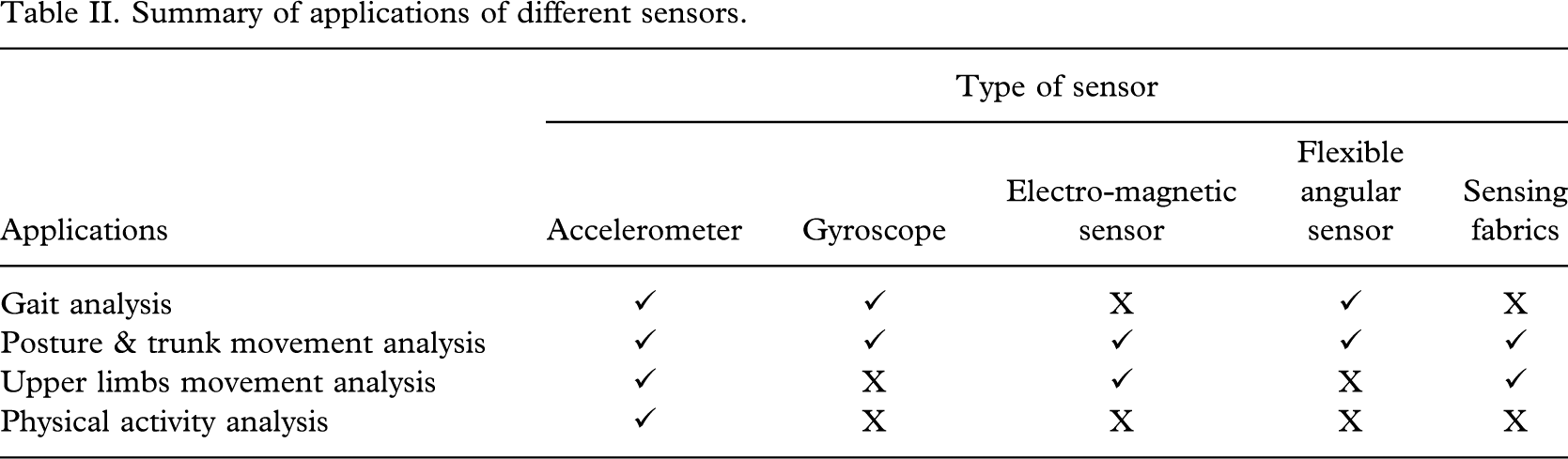
Tables II and III are the summaries of the sensors' applications and measured parameters in different studies respectively. Accelerometer tends to be the most commonly used and has the widest range of applications on different body parts among the five types of sensors.
Summary of applications of different sensors.
Summary of different parameters measured using the positional sensors.

Limitations of different sensors
From the literature, it was found that the electronic positional sensors have many attractive advantages such as miniature in size, lower power consumption and portable. However, there are typical limitations and problems of different sensors in the application of human posture and movement analysis.
Environment effects
Signals of sensors would be affected by the surrounding environments. In the case of sensing fabric, its signals could be affected by humidity and temperature (Scilingo et al. 2003). The major limitation of accelerometers is the detection of rotational angle around the axis of gravity that is the basic operation theory of the accelerometer (Hansson et al. 2001).
In the electromagnetic system, the accuracy can be adversely affected by the presence of metallic objects. Lou et al. (2000) found that metallic interference occurred when a metal object was placed within 100 mm of the transmitter or the receiver of the system. The resolution of the system was affected by the distance between the transmitter and the receiver, the smaller distance between them, the better the resolution (Lou 1998; Lou et al. 1999, 2000). The transmitter and receivers of the electromagnetic tracking system should be set within the optimum operation zone based on the specification of each system. As such, the electromagnetic system would be used only in the prepared environment (such as clinic or laboratory) without any metallic interference. Therefore, it is not suitable for the patient with metallic implants and prostheses, and the experimental environment should be free from metallic objects.
The inherent limitations of the flexible strain-gauged electro-goniometer should be considered in its application. The flexible strain gauge may be susceptible to bending or buckling during studies of seated tasks with lumbar support (Boocock et al. 1994). The measurement range of the spinal motion could be limited by exceeding the maximum preset distance between the two attachments with linear displacements occurring during flexion and extension of the lumbar spine.
Difficulties on extraction of signal
Output signal of the sensor can provide the acceleration, velocity and tilting angle of the body segments but no reference to external coordinate system. The manipulation of the sensor signals involved many mathematical methods. For instance, in the gyroscope's system, angular displacement can be calculated theoretically by numerical integration of angular velocity but it is not easy to apply directly because of output drift and accumulated error of the sensor (Lee et al. 2003; Seo and Uda 1997). Moreover, it would be unrealistic to calibrate the system repeatedly. The output signal may also be affected by undesirable movement of the device (e.g., clothing or skin movement). Thus, careful site selection and appropriate form of fixation of the sensor is very important for measurements (Mathie et al. 2001; Morris 1973).
The accuracy of the sensing fabrics in measurement of human body movement depends on the calibration methods because the electrical resistance of the fabrics varies with orientation, stress and temperature. Therefore, a well-developed calibration process is essential for the development of sensing fabrics in posture and movement measurements.
Conclusion
This article has reviewed the studies of a number of electronic sensors and systems, including accelerometer, gyroscope, flexible angular sensor, electromagnetic tracking system and sensing fabrics, and their possible clinical applications. These sensors could be considered as alternatives to the image-based systems in the measurement of human movement and posture. Accelerometer tends to be the most commonly used among these five types of sensors and systems. Although these electronic sensors could provide many advantages such as miniature in size, lower-power consumption and portable, their limitations such as environment effect and difficulties in extracting signal should be considered. It is concluded that there is a need to further develop the measurement methods with these sensors and use new technologies to solve the existing technical problems. More considerations in fusion of sensors should be employed in designing new systems for human movement and posture analysis.
From previous researches, signals from different sensors could be used to cover some of limitations of other sensors. Luinge et al. (1999) suggested a method to solve the problem of output drift when using gyroscope. They proposed that the drift error could be estimated using a Kalman filter and the signals from accelerometers. It implies that fusion of sensors would be a research direction to develop for human posture and motion analysis.
In the future, the development of portable posture and movement measurement system can be advanced by compactness in size of sensors, advancement of portable data logging device and wireless data transfer system, and well developed user-friendly computerized interface. It can provide more and continuous information of human movement and posture in the situation of real life activities outside artificial environment. Apart from being used as a clinical tool for assessment and evaluation in human posture and movement, these systems can provide information about the vital sign of patients and the elderly and can also be utilized as a therapeutic or control system for orthotic or prosthetic devices to monitor various parameters, such as compliance, range of motion and magnitude of force. Therefore, the miniaturized positional sensors would become widely used in biomedical research, clinical and rehabilitation fields.