




Abstract
At the request of a polio survivor, a partially flexible thigh cuff made of leather and canvas for a carbon KAFO was devised to allow the wearer to feel more comfortable while sitting on a toilet seat. The original, acrylic resin, thigh cuff was partially excised to make an opening (15×10 cm), which was stuffed with rubber sponge, and was sealed with leather and canvas. The opening's surround was vertically and horizontally reinforced with carbon fibres. This modification provided relief to the polio survivor from the discomfort previously experienced while sitting on a toilet seat, and satisfied her needs in daily life.
Introduction
Because carbon fibre is light, tough and durable, it has been used in the manufacture of prostheses and orthoses (Nelham 1981). As a carbon fibre reinforced plastic orthosis (carbon orthosis) fits very well, and is lightweight and durable, it has sometimes been prescribed for polio survivors (Heim et al. 1997; Hachisuka 2002; Steinfeldt et al. 2003; Hachisuka et al. 2006). At the request of a polio survivor that the orthosis “would not scratch the toilet seat” and would allow the wearer to be “comfortable while sitting on a toilet seat,” a partially flexible thigh cuff was devised for the carbon KAFO. The case is reported and including the technical details relevant to this modification.
Case report
A 64-year-old female suffering from poliomyelitis came to the authors' post-polio clinic seeking a prescription for a KAFO. She had severe muscle weakness in her right lower limb without any sensory disturbance. Using the MRC scale muscle function was recorded as gluteus maximum 1/5, gluteus medius 1/5, iliopsoas 1/5, quadriceps 0/5, tibialis anterior 0/5, and triceps surae 1/5; the length of her right leg was 5 cm short; ankle dorisflexion on the right side was limited to 5° plantarflexion. The patient had already used an ordinary KAFO with double metal uprights, but complained about the weight of the orthosis (1450 g) and about scratching of the toilet seat while sitting on it with the ordinary KAFO. Therefore a lightweight carbon KAFO with Swiss lock knee joints, free ankle joints, and a heel cup was prescribed with the modification that part of the thigh cuff be replaced with flexible materials, i.e. leather and canvas. Using the carbon KAFO with the partially flexible thigh cuff, she could walk stably and safely, she felt comfortable while sitting on a toilet seat and, also, the flexible thigh cuff did not scratch the seat. This modification of the carbon KAFO satisfied the polio survivor well in her daily life.
Methods
Because the entire procedure of manufacturing and checking out the carbon KAFO has already been reported elsewhere (Hachisuka et al. 2006), only the method of modifying the thigh cuff is described herein. Before acrylic resin (617H55, C-Orthocryl, Otto Bock, Germany) was poured over the positive model of her lower limb made from the temporary KAFO, the horizontal carbon fibre reinforcement in the thigh cuff was shifted to a lower position 10 cm above the knee joint axis, and the vertical reinforcement remained at the original position (Figure 1).
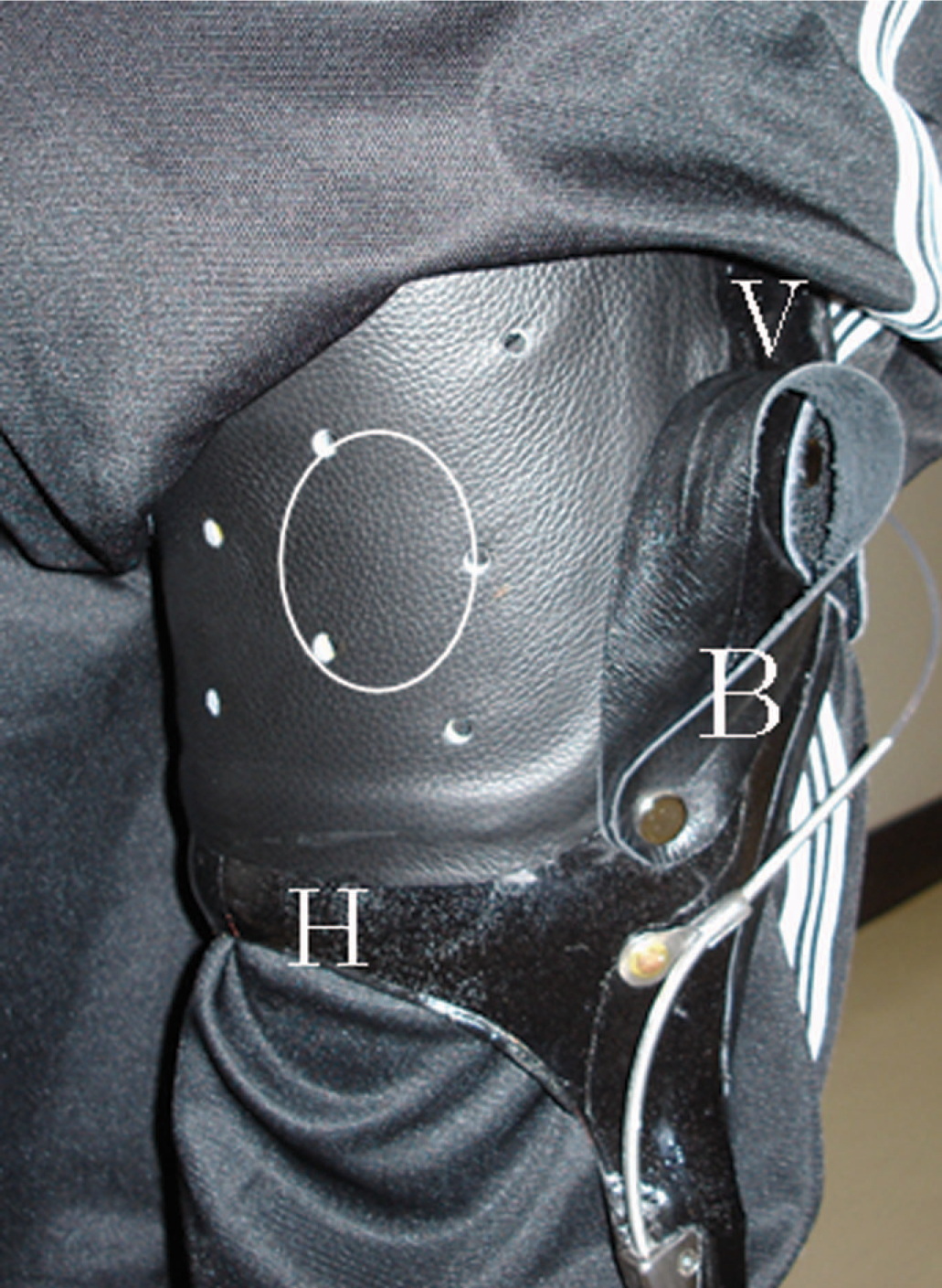
Posterior view of the partially flexible thigh cuff. A part of the thigh cuff was excised (open circle) and was filled with rubber sponge and sealed with leather and canvas. The area surrounding the opening was reinforced with carbon fibres (V: vertical reinforcement of carbon fibres, H: horizontal reinforcement of carbon fibres). A belt (B) was attached to the lateral aspect of the thigh cuff by her preference, but was not standard.
The reinforcement consisted of double stockinettes (616G2, Carbon Fibre Stockinette, Otto, Bock, Germany) and a sheet (CO1303, Carbon Fibre Fabrics, Toray Industries Inc., Japan). After the acrylic resin had set, the thigh cuff was partially excised to make an 15×10 cm opening (Figure 1), the size and position of which had already been determined while the patient sat on a toilet seat wearing a temporary KAFO. The opening was filled with rubber sponge (2 mm thick); the inside of the opening was sealed with leather (1.2 mm thick), and its edge was glued to the inner face of the thigh cuff; the outside of the opening was covered with leather and canvas (Sailcloth #11, 0.5 mm thick, Mitsufuku, Japan), and each edge was glued to the outer face of the thigh cuff (Figure 2). After completion, the fit was assessed while the patient walked within the clinic, sat on a chair, and also, sat on a toilet seat. The patient confirmed that the thigh cuff region felt comfortable (Figure 3).
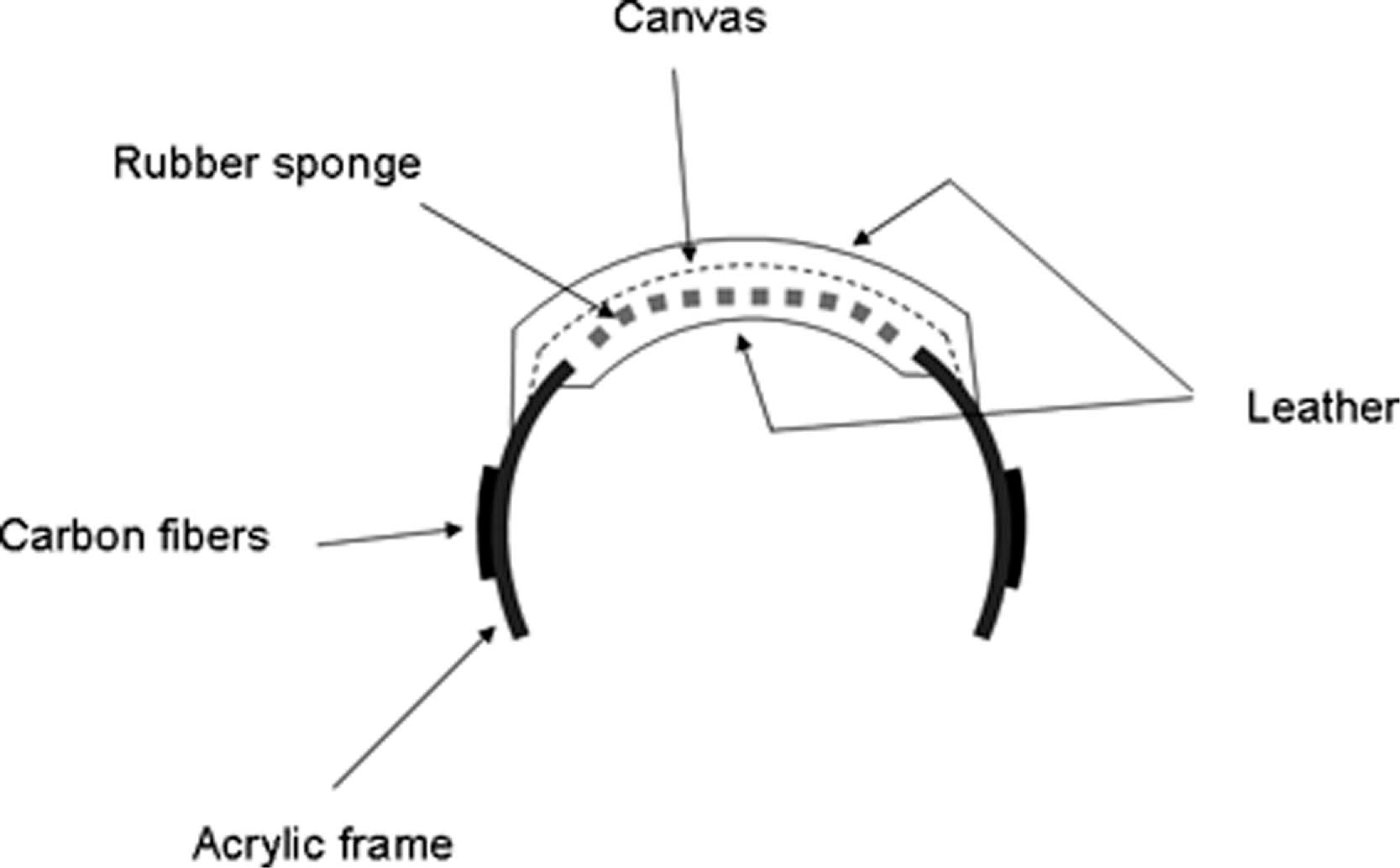
Horizontal section of the partially flexible area. A rough sketch of a horizontal section through the middle of the partially flexible area is shown. The opening was stuffed with rubber sponge, which was not glued to the acrylic frame, and was sealed with leather and canvas which were glued to the acrylic frame.
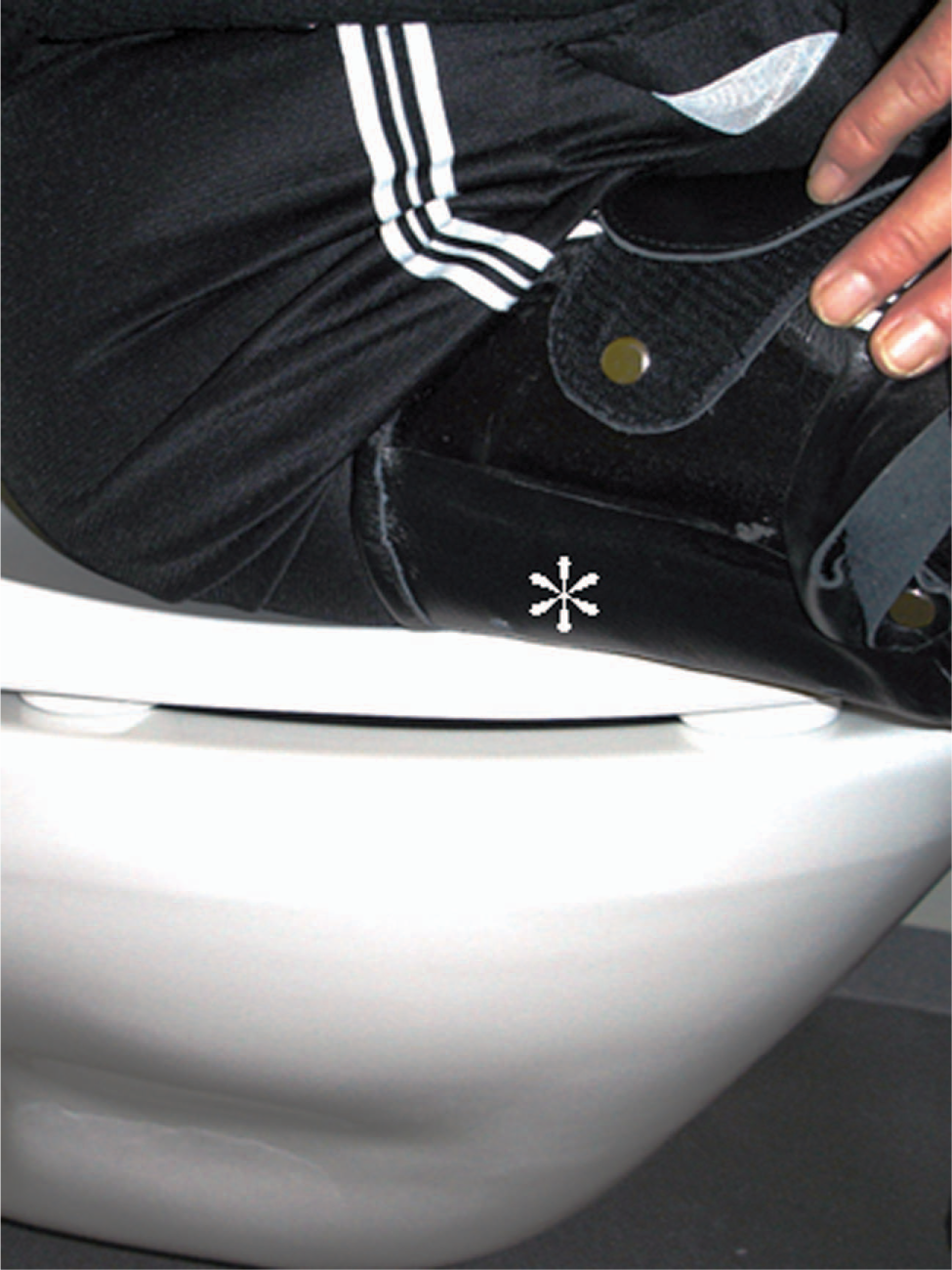
Carbon KAFO with the partially flexible thigh cuff. The patient is sitting on a toilet seat. ∗partially flexible thigh cuff.
Discussion
The carbon KAFO is slim and thin, and does not cause discomfort while sitting on a chair in general. The fit of these devices while sitting on a chair had been previously checked, and none of the patients using the carbon KAFO complained of any discomfort. Using the patient's request that the KAFO would not scratch the toilet seat as a starting point, feedback was sought from all polio survivors using a carbon KAFO. It became apparent that there were problems associated with the thigh cuff: A thigh cuff of a carbon KAFO in that it sometimes scratched a toilet seat, and caused discomfort while sitting on a toilet seat, and sitting on a hard park bench was also uncomfortable. The partially flexible thigh cuff relieved the patient's discomfort while toileting and this modification will satisfy polio survivors who want to use the carbon KAFO, frequently sitting down and getting up again, especially while sitting on a toilet seat or on a chair with a hard seat.
The partially flexible thigh cuff of the carbon KAFO has advantages as described above but also has a few disadvantages. Firstly, the modified thigh cuff may be fragile, because the upper portion of the thigh cuff is necessary to support the thigh and prevent distortion of the KAFO. The opening in the thigh cuff was made as small as possible to maintain its structural integrity and ensure that there was sufficient carbon fibres placed vertically and horizontally around the opening. Secondly, as the leather may become stretched it was, therefore, necessary to use canvas with the leather to prevent stretching. Combining canvas and leather allowed flexibility and yet maintained the shape and size of the cuff over a one-year period. Because no polio survivors have used the carbon KAFO with the partially flexible thigh cuff for more than one year, there is no data on the durability of this modification. Thirdly, a thigh cuff that needs to be ischial weight bearing may not be replaced with the flexible materials.
The partially flexible thigh cuff is desirable for polio survivors who use a carbon KAFO right through the day, except when showering and sleeping, and this modification has already been regarded as a standard element of a carbon KAFO in the authors' post-polio clinic.
Conclusion
The partially flexible thigh cuff, made of canvas and leather, was devised for the carbon KAFO to allow the wearer to feel comfortable while sitting on a toilet seat. This modification satisfied the patient using the carbon KAFO in daily life.