



Abstract
It is widely acknowledged that there is an underrepresentation of women in Science, Technology, Engineering and Mathematics (STEM). Science Foundation Ireland, the largest funder of STEM research in Ireland, has been developing initiatives to remove and mitigate any existing or perceived factors that may limit the participation of women in STEM careers. In this paper, we present a review of gender initiatives across our funding programmes since 2011 and highlight those that are supporting a stronger representation of women in STEM. Overall, we have seen an increase in female award holders from 21% in 2015, to 26% in 2017. In 2015, a gender initiative was introduced into SFI's Starting Investigator Research Grant Programme, which led to a 22 percentage point increase in female award holders compared to the 2013 call, when no gender initiative was in place. Science Foundation Ireland will continue to monitor the impacts of these actions, and to innovate and contribute to international best practice.
Keywords
Introduction
It is well documented that women are underrepresented in the areas of Science, Technology, Engineering and Mathematics (STEM) in both research and innovation (R&I) and higher education (NSF 2011; EC 2016; EC 2019). These observations have been reflected in Science Foundation Ireland's (SFI) portfolio of awards. During 2005, SFI started to implement gender equality initiatives after observing a low participation rate for female applicants in its funding calls. These first initiatives primarily targeted researchers returning to active research after a prolonged absence. Since this time, SFI has trialled a number of other gender balancing initiatives and has endeavoured to monitor their effectiveness. Since the development of SFI's online Grants and Awards Management System in 2011, we have been collecting and analysing data on application submission and success rates by gender and examining gender balance across the portfolio of SFI research awards year on year.
Science Foundation Ireland (SFI) has been a leading member of the Science Europe Working Group on Gender and Diversity since its establishment in 2013, which brought together experts for the implementation of gender equality policies in Research Funding Organizations (RFOs) and Research Performing Organizations (RPOs) across Europe. The working group collected and reviewed best practices regarding methods to monitor gender equality and avoid unconscious bias in peer-review processes (SE 2017a). Indicators of best practice were defined, and these were used to gather data from all Science Europe members, which were subsequently published in aggregate (SE 2017b).
In 2016, the Higher Education Authority of Ireland (HEA) released a national review of gender equality in Irish higher education institutes (HEA 2016). This review was chaired by Máire Geoghegan-Quinn, former EU Commissioner for Research & Innovation and current SFI board member. The HEA review made specific recommendations on actions which were to be implemented by Irish Research Funding Organizations.
In response to these reviews and ongoing assessment, Science Foundation Ireland continued to strengthen initiatives to remove and mitigate any existing or perceived factors that might limit the participation of women in STEM careers. In 2016, SFI consolidated its position with the launch of its Gender Strategy (SFI 2016) providing a comprehensive framework which enabled the streamlining of gender initiatives across all SFI's funding programmes, with the overarching aim of improving the gender balance amongst its award holders.
SFI is taking several approaches towards realizing its Gender Strategy. The first approach involves supporting researchers at the most critical junctures in their careers; the second encourages more applications from excellent female researchers to the full suite of funding programmes; the third is focused on improving gender balance within SFI team member cohorts, and the fourth aims to integrate the gender/sex dimension in research and innovation (R&I) content. These actions are being complemented by a top-down approach, whereby the institutional culture can be made more aware of gender issues and become proactive in improving gender imbalance. The latter is being addressed by the Athena SWAN Charter in Ireland (HEA 2017).
The policies being developed by SFI and associated outcomes will complement and support the Athena SWAN initiative, whereby the Irish Research Council, SFI and the Health Research Board will require research bodies to have attained a bronze institutional Athena SWAN award by the end of 2019 to be eligible to apply for research funding. At the close of 2018, all Irish universities had attained a bronze certification with Athena SWAN.
Science Foundation Ireland is involved in a range of international gender initiatives. Prof Mark Ferguson, SFI Director General, participates in many international fora focusing on gender in science. SFI is also currently participating in EU gender projects to share knowledge, establish networks and develop international best practice.
Here, we present an analysis of gender disaggregated data across SFI funding programmes since 2011. This paper summarizes these data and describes ongoing and recently launched initiatives to (a) improve gender balance in our portfolio of awardees, and (b) address the full range of objectives outlined above. We report four types of initiatives that have been implemented: (1) pre-award activities, (2) post-award activities, (3) changes to existing funding programmes, and (4) the creation of a new funding programme.
Methods
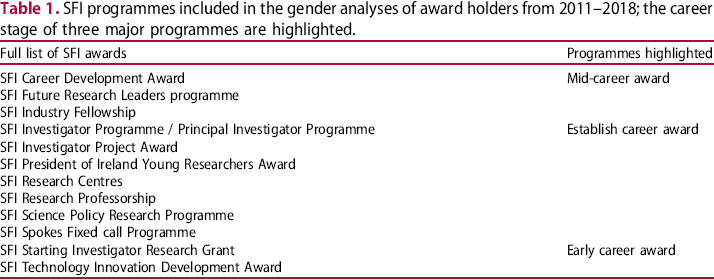
SFI programmes included in the gender analyses of award holders from 2011–2018; the career stage of three major programmes are highlighted.
The analyses include awards offered by SFI, irrespective of whether the award was accepted or declined by the applicant, as this best represents completion of the SFI peer-review process. Where awards were transferred or underwent different ownership after their inception, data were based on the lead applicant's self-declared gender at the time the award decision was made and currently reflects a binary categorization of gender, e.g. male or female. As part of this report, we present an analysis of gender disaggregated data for SFI's review processes (with exclusions as described previously) between 2011 and 2018. Data were analysed for trends in Tableau 2018.2 (Tableau Software Inc, Seattle, Washington). The data presented in this paper are openly accessible (see Data availability statement).
Science Foundation Ireland has a key performance indicator for gender representation in its portfolio which aims to increase the representation of women in Science, Technology, Engineering and Mathematics (STEM) in Ireland (SFI 2017). This is defined as the percentage of active (within the calendar year) award holders that are female. The original target was 25% female award holders. This target was revised upwards to 30% in 2017 after the original target was reached (SFI 2018).
Results and observations
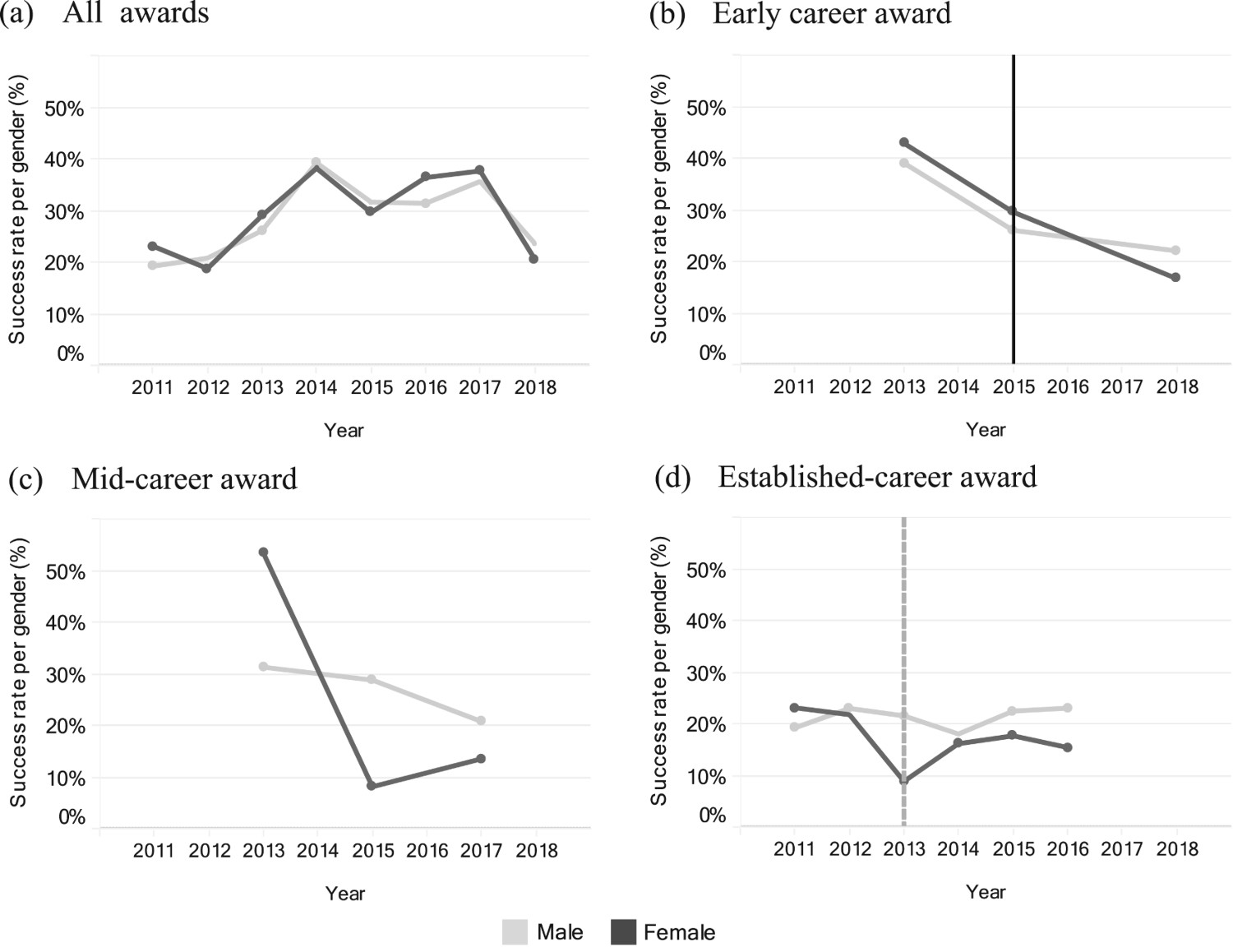
SFI has been aware for some time that we receive more applications from male candidates compared to their female counterparts (Figure 1(a)); these trends concur with those observed in other funding agencies (Hechtman et al. 2018). In aggregate however, there is little difference in male and female success rates following the SFI peer-review process (see Figure 2(a)). SFI has therefore focussed on initiatives to increase the number of applications received from excellent female researchers whilst maintaining its high standards of peer review for excellence and impact, criteria which are core to the organization's current strategy (SFI 2012).
Percentage of applications by gender, over-time, of (a) all awards, (b) early career stage award (SIRG), mid-career stage award (CDA) and established career stage award (IVP). The solid line denotes the time point at which the SIRG gender initiative was implemented; the grey dashed line indicates the change of SFI's legal funding remit. Percentage success rate per gender, over-time, of (a) all awards, (b) early career stage award (SIRG), mid-career stage award (CDA) and established career stage award (IVP). The solid line denotes the time point at which the SIRG gender initiative was implemented; the grey dashed line indicates the change of SFI's legal funding remit.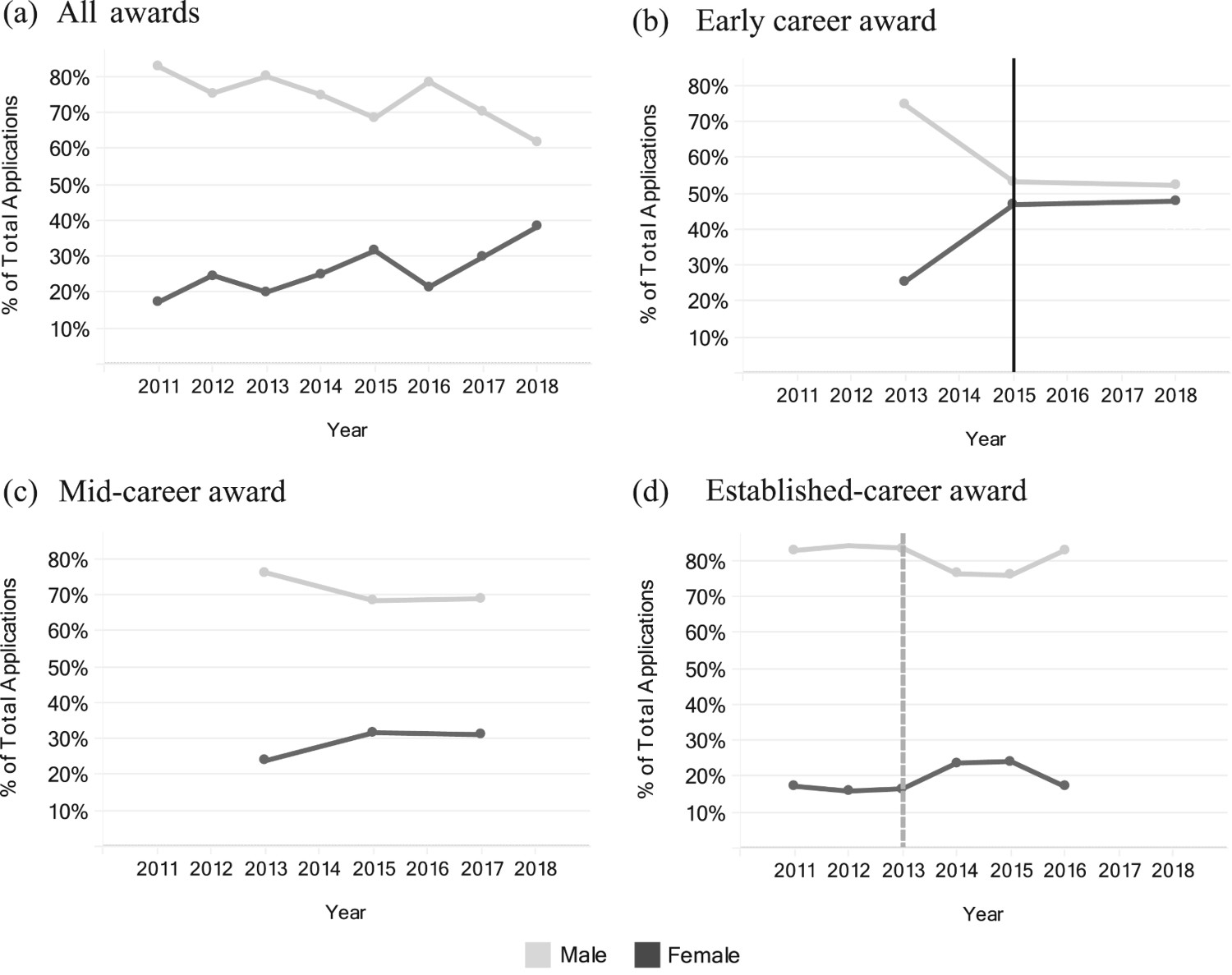
Individual led awards
Science Foundation Ireland offers a range of awards to researchers at different career stages, starting with applicants with at least three years of research experience since completing their PhD (see Table 1). The SFI Starting Investigator Grant (SIRG) is considered an early career award that is open to applicants who are between three- and eight-year post-PhD without an academic position. The Career Development Award (CDA) is considered a mid-career award open to applicants with three- and fifteen-years of experience post-PhD who currently hold an academic position. The SFI Investigators Programme (IvP) is considered an established career stage award, where applicants must be at least five years post-PhD 1 and at least ten senior author publications. 2 The percentage of applications made and application success rates by gender of these three award types are shown in Figures 1 and 2, respectively.
One of the first gender initiatives in SFI created specifically to target women was the SFI Advance Award Programme which launched in 2014. The programme's objectives were to support female researchers to remain and advance in STEM research and to attract those currently outside of STEM back into the system. This programme was an early career initiative that targeted female postdoctoral applicants and was run for one year only. As of 2019, all 10 awardees have remained in academia with four holding lecturing positions, five holding research positions, and one working in research support. This initiative was subsequently incorporated into the SFI Industry Fellowship Programme, since the areas of opportunity being provided by the latter were similar to those being targeted by the SFI Advance Award Programme.
Academic STEMa staff in Irish universities by contract type for 2015 and 2017 (HEA, Forthcoming).
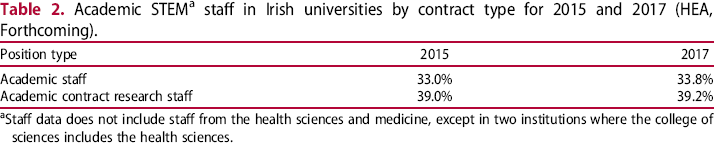
aStaff data does not include staff from the health sciences and medicine, except in two institutions where the college of sciences includes the health sciences.
Before the SIRG gender initiative was launched, institutions were permitted to nominate five candidates for this funding call, whose gender was not specified. The SIRG gender initiative incentivised Research Bodies to nominate excellent female candidates by permitting an increase in the number of candidates allowed per institution to 12, with a maximum of six males candidates. Upon submission to SFI, all applications were treated equally regardless of their gender. The applicant numbers were capped per institution in line with the available budget and resources within SFI. The SIRG gender initiative correlated with an increase in the number of female applicants from 25% in 2013 to 47% in 2015 (Figure 1(b)) and in support of comparable success rates with their male counterparts, female awardees rose from 27% in 2013 to 50% in 2015. Results from the 2018 call were similar; 48% of the applications received were from female researchers and 41% of those awarded funding were female (Figure 1(b)). The success rates for male and female applicants were very similar, both before and after the gender initiative was implemented (Figure 2(b)). These data support that there were suitable female candidates available, but that they were not being represented in the application pool.
The SIRG gender initiative created an incentive for institutions to seek out excellent female researchers and there has been consistent positive feedback from the research community. While the SIRG gender initiative has been successful in raising the number of successful female applicants, it is not without its caveats. The SIRG award process is a capped initiative, where a maximum number of applications can be submitted by each institution. Using this approach, an element of the selection process occurs prior to the peer-review process in the research funding organization. In the funder-led peer-review process, guidelines are provided to reviewers which may involve training such as those pertaining to unconscious bias. In contrast, there are no published procedures regarding the selection process that occurs in the various institutions who put their candidates forward for review; this is likely to vary between different organizations. As such, this capped style gender initiative could benefit from assurance that there are no limitations imposed on the candidates who wish to be nominated by their respective institutions, other than their eligibility for the funding call.
SFI has for the most part received positive feedback from the research community about this and other gender balancing initiatives it has implemented. With the SIRG gender initiative, there was some misunderstanding initially that the programme would apply a quota on the number of female awardees. While this gender initiative does limit the number of male applicants, it does not apply a quota on the number of awardees from either gender, as all applications are treated equally in the evaluation process. Only applicants deemed excellent and impactful are recommended for funding. To overcome this misunderstanding, SFI has produced an infographic on the initiative and endeavoured to enhance public understanding of the SIRG initiative.
SFI's Career Development Award Programme (CDA) is also a capped initiative whereby twelve applications are allowed per institution. However, in comparison with the early career award initiative in SIRG, there has been little change in the percentage of female applicants over the same time-period (Figure 1(c)) in CDA Programme calls. Furthermore, the success rate for female applicants has not shown an obvious trend over time (Figure 2(c)). A capped SIRG-style gender initiative has not been implemented in this programme yet. In 2015, c. 30% of academic staff in STEM fields in Irish universities were female (Table 2). In consideration of this percentage, it was determined that for a capped style gender initiative to be effective, the number of applications from each gender would need to be similar. The SFI Frontiers for the Future Programme, a new funding call with an uncapped gender initiative, has recently replaced the CDA programme. This new funding initiative is described in detail below.
The SFI Investigators Programme (IvP) is an uncapped, established career stage award. The percentage of applications from male candidates to this programme has been consistently higher than that corresponding to female applications over the years monitored (Figure 1(d)). This application rate reflects the low numbers of female STEM researchers in Ireland at senior career stages, which is under 25% of academics at professor level in all subject areas (HEA 2018). In fact, the representation of females at these levels is lower again for STEM fields. The higher rate for male applicants to SFI's Investigators Programme is similar to that described by Beck and Halloin (2017), who found that for the Belgian National STEM funding agency, Fonds de la Recherche Scientifique, the proportion of male applicants was higher for grants where tenure was required. In Belgium, women represent 32.7% of researchers with tenure. This underrepresentation of women in senior academic roles has been highlighted as a priority area in Ireland's Gender Action Plan (HEA 2018). In response, the Department of Education in Ireland has recently announced the ‘Senior Academic Leadership Initiative’, which will provide funding for 45 female professor positions starting in 2019–2020 (DES 2018).
The success rates for male applicants in the SFI Investigators Programme is on average higher than female applicants, but this has not been consistent over the years monitored (Figure 2(d)). In 2013, the female success rate declined; this appeared to correlate with a change in the areas of research where SFI's legal remit permitted it to fund. Specifically, Science Foundation Ireland is mandated to fund research within the areas set out in the recommendations of the National Research Prioritization (NRP) Steering Group report; this was adopted as government policy in 2012 (DJEI 2011). There has been a criticism levelled that these priority areas are biased towards male dominated subject areas (O'Connor 2019). It is worth considering whether this might explain, in part, the lower success rates for female applicants in this year. These are strategic areas of research for Ireland, thus proactive measures to increase female representation at the senior academic level are required. SFI is endeavouring to address this need through SFI's Research Professorship Programme, as discussed below.
In 2017, SFI achieved its target of 25% female award holders. After attaining this target, it was revised upwards to 30% (SFI 2017). The 2017 analysis of SFI award holders showed that the percentage of female SFI award holders in 2017 was 26%, up on 23% in 2016 and 21% in 2015 (SFI 2018). The percentage of female team members (those working on SFI awards) was 37%, an increase of 35% in 2016 (SFI 2018).
To improve the success rate amongst female STEM researchers, a new programme has recently been launched that will incorporate the mid and established career stage awards; it is the SFI Frontiers for the Future Programme. To be eligible to apply to this pilot programme, a lower number of senior author publications are required compared with the predecessor programmes (mid- and established career stage awards), allowing applicants with fewer research active years to apply. Two categories of application are allowed, with one category weighting the quality of the research proposal above the researcher's track record, allowing researchers with a ‘less populated’ track record to be competitive. In this way, the SFI Frontiers for the Future Programme will allow researchers who were not eligible to apply to previous funding programmes, due to their publication output not reaching a certain bar, to compete with researchers with a more established track record. This initiative is inclusive, allowing new entrants, as well as researchers re-entering research, to be competitive for prestigious awards of scale, regardless of their gender.
Recent research suggests ‘the peer review system is not substantially better than random selection in identifying the best candidates once an initial pre-selection of the most promising ones is performed’ (Klaus and del Álamo 2019). Due to the variable nature of the peer-review process, SFI will pilot rounding final scores and using gender as a tie-breaker in this new programme. When ranking applications from the SFI Frontiers for the Future Programme, final scores will be rounded to the nearest half point to create bands in rank order. Ties will be broken using gender as a strategic objective, allowing female applicants to advance. Results of this pilot will be monitored to judge the effectiveness of this new initiative.
Further rollout of gender balancing initiatives amongst SFI programmes includes encouraging more applications from excellent female researchers to the SFI Research Professorship Programme, an established career stage award. As part of this initiative, SFI is mandating that for all institutions wishing to nominate candidates to the programme, one of the next two successful Expressions of Interest (i.e. approved by SFI) must be associated with a female candidate, which must then be followed up with the submission of a full proposal.
Pre-award activities
Research suggests that academic scientists show ‘implicit’ or ‘unconscious’ bias reflecting cultural stereotypes (Lai, Hoffman, and Nosek 2013). To this end all SFI staff and members of the SFI Board receive face-to-face training on unconscious bias. Currently, all postal reviewers must agree to SFI's Reviewer Code of Conduct before gaining access to review documentation; as part of this they are requested to review and consider guidance provided in a training video, reproduced by kind permission of The Royal Society. Sitting review panels are also briefed on unconscious bias prior to the review process being undertaken. SFI has recently developed its own training video and this will be used as part of a more extensive programme on unconscious bias training going forward.
SFI has been providing an opportunity (since c. 2006) for applicants who have taken periods of leave, including that corresponding to maternity, to avail of supports that assist their career progression. Periods of absence for maternity and adoptive leave are also taken into consideration by reviewers when evaluating an applicant's research active years/outputs. However, this is difficult to standardize across reviewers. In sitting panels, where an open discussion can occur between reviewers, there is greater opportunity for the group to discuss these periods of leave, and thus these career breaks to be considered in the final application score. However, there is limited knowledge to what extent remote postal reviewers consider periods of leave when formulating their opinion during the review process and thus it is difficult to gauge their level of awareness in their evaluations. Regarding reviewers, SFI also aims to achieve 40% representation of panellists of each gender (in both sitting and remote panels, and among postal reviewers) by 2020.
Currently there are seventeen SFI Research Centres, which SFI funded following the recommendation of expert merit review in a series of competitive calls. These research centres cover a range of STEM research areas. SFI Research Centres applying for phase two funding in 2019 have been evaluated on measures they have taken to address gender balance within their research teams. Gender Equality Plans are also required to be submitted by each Research Centre during their Phase 2 award term.
Another aspect of SFI's Gender Strategy is to ensure that gender is integrated as a perspective in SFI funded research where relevant. During 2017, wording was developed for inclusion in all call documents that required applicants to provide a statement articulating the sex/gender variables in their research, as well as guidance for applicants and a request for comment from reviewers. This approach was ‘soft’ launched for a number of SFI programmes during 2017 and 2018. It included a link to the gender strategy and a recommendation to consider sex/gender in the research programme. The ‘full launch’ has been applied to the SFI Frontiers for the Future Programme, where applicants are required to provide a statement articulating the sex/gender variables in their research which will be assessed (as part of the research programme) and thus considered in the reviewers’ narratives and scores.
Post-award activities
In order to support award holders SFI provides supplements for Maternity/Adoptive Leave. This ensures all personnel employed on an SFI grant may hire a replacement for this period of leave. We recently performed a survey of our award holders that availed of the SFI Maternity/Adoptive Leave Allowance since its inception to review the impact of this support. Researchers were very positive about this supplement. This and other feedback will be incorporated into the review of the Maternity / Adoptive Leave policy, to ensure the process of application is efficient and straightforward.
Summary & policy implications
In the three years since the adoption and implementation of SFI's Gender Strategy, several actions are helping to improve the gender balance in SFI's portfolio of awards, while for others, it is too early to demonstrate their effectiveness. Overall, there has been an increase in female award holders from 21 percentage in 2015, to 26% in 2017.
Specific initiatives have been particularly successful thus far, such as the capped SIRG gender initiative leading to a c. 20 percentage point increase in female award holders. In this initiative, research institutes were incentivised to support and encourage excellent female candidates to apply for funding, since there was an opportunity to double the number of applicants the research institution could put forward with each female applicant nominated (up to a maximum of 12 applicants). This gender initiative has been SFI's most successful in increasing the number of female award holders in its portfolio. This style of gender initiative should be considered by other research funding organizations as a method to address gender imbalance, especially where the success rates for female and male candidates are similar, but application rates for female candidates are low. The success of this type of initiative requires sufficient eligible female candidates in the application pool. For example, the SIRG programme targeted contract research staff in Ireland, where c. 40% of contract research staff in STEM fields are female (Table 2). Further research is required to investigate how shortlisting for capped calls occurs within the research institutes, as it is possible that biases may occur in this step of the process.
Capped funding calls, where the number of applicants per institution are capped at a specific number, are rare internationally. SFI has a new non-capped gender initiative, the SFI Frontiers for the Future Programme, which is being piloted to enable researchers with fewer research active years to compete with more experienced researchers. Two categories of application are allowed, with one category weighting the quality of the research proposal above the researcher's track record. Eligibility criteria for the call have also been widened to allow a larger pool of eligible candidates to apply. Specifically, the requirement for the applicant to have held an independent research grant has been removed and the number of senior author publications has been reduced to three. Changes to these two eligibility criteria have significantly increased the number of researchers that are eligible to apply to this call by including researchers with ‘less populated’ track records. Since increasing the number of female award holders is a strategic objective of the SFI Frontiers for the Future Programme, gender will be used as a tie-breaker in ranking applications.
Science Foundation Ireland is committed to working towards a goal where Ireland, by 2020, will be ‘the best country in the world for both scientific research excellence and impact’ (SFI 2012). We are doing this by supporting the development of research capability and human capital in areas of science, technology, engineering and mathematics (STEM) that demonstrably support and underpin enterprise competitiveness and societal development in Ireland. In attaining this goal, we are endeavouring to ensure that gender balance is evident in our portfolio of awards and the gender dimension is addressed in SFI funded research. We are implementing changes in support of these aims in an iterative way that is informed by data, best practice and at times, trial and error. We will continue to monitor the impacts of the gender balancing actions we are implementing, and to innovate and collaborate to contribute to international best practice in this important area.
Footnotes
Data availability statement

Disclosure statement
No potential conflict of interest was reported by the authors.
1.
In earlier iterations of the SFI Investigators Programme this requirement was eight years, up to and including the 2011 call.
2.
Only original research publications, and not review articles or other secondary research literature, are acceptable. For this programme, senior authors are defined as follows: (1) Authors that are listed as first or joint-first author, reflecting the fact that they have provided the greatest intellectual contribution, have held the primary responsibility for collecting and analysing data, and for the writing of the manuscript and associated drafts. (2) Last authors will also be considered as a senior author, since this position generally reflects their overall responsibility for the study and suggests that a level of mentorship has been provided. (3) It will be noted that different publishers have differing rules on how the senior authorship is indicated; however, it is of overriding importance that the applicants should be able to convince and reassure reviewers that they are the key author on these publications. Joint-first authorship may only be claimed where the article clearly states that two (or more) authors have provided equal and significant contributions to the work described.