



Abstract
This article documents some examples of the event-responsive poetry of the British poet Bob Cobbing (1920–2002) and compares it to the unique theory of the event structure developed by British sculptural and conceptual artist John Latham (1921–2006). It establishes points of intersection between their practices, and particularly at the level of aesthetics where very little comparative work exists. While both men are best known for their experimental 1960s work (Cobbing in relation to sound and concrete poetry, and Latham in relation to conceptual art) this article focusses on their earlier work as being preparatory to their later, more developed practice. Artistic affinities are contextualized in relation to World War II, the dialectic of romantic and classical art, and the institution of welfare-capitalism. How poet and artist both visually represented time (drawing on scientific discourses to do so) is further identified as a link between their practices.
Keywords
Introducing events
In conversation in the 1980s Bruce Andrews suggested radical poetic activity in England was developing through Schools of Cobbing, Mottram and Prynne. Deprived of its proper context – which, though he was not anti-academic, was certainly not institutional – Cobbing's sound poetry risks the exotic; perhaps his ‘school’ may be comprised of those who analyse the disturbances his interventions have given rise to in a definable social field for further use. (Clarke 2007, n.p.)
What is Bob Cobbing's (1920–2002) ‘proper context’? Adrian Clarke's insightful definition of the School of Cobbing as being comprised of ‘those who analyse the disturbances his interventions have given rise to in a definable social field for further use’ suggests one answer. But how should this ‘social field’ be mapped, and can the forward-facing direction of time – implied by the phrase ‘further use’ – be reversed or at the very least disturbed? Can a ‘School of Cobbing’ be retrospectively constituted? How might situating Cobbing in his proper socio-historic context lead to an increased awareness of his interventions and their significance? In response to these questions, this article argues that we reach a fuller understanding of Cobbing's work once the artist John Latham (1921–2006) is viewed as a member of Cobbing's school. Neither Cobbing or Latham would recognize themselves as belonging to a school, let alone the same one, and so to this extent this article is revisionist. However, such an approach is warranted by aesthetic imperatives located within Cobbing and Latham's poems and artworks.
Any historical survey of Cobbing and Latham's connections needs, at some point, to negotiate and acknowledge Bomb Culture, Jeff Nuttall's semi-autobiographical and impressionist account of counter-cultural activity in the 1960s. Bomb Culture records that Latham and Cobbing visited Braziers Park in July 1964 to take part in sigma. This gathering is one of the earliest examples of Cobbing and Latham working in the same cultural and physical space, and it is logical to begin a survey of their shared connections here. Sigma was conceived as a ‘cultural jam session’ by the English situationist Alexander Trocchi who hoped it would serve as a prototype for a ‘spontaneous university’ – ‘a community of mind whose vital function [would be] to discover and articulate the functions of tomorrow … a living model for society at large’ (1964, 193). Trocchi stated in Sigma: A Tactical Blueprint that the mathematical term ‘sigma’ was chosen as the name for the event-concept because it designated the ‘all, the sum, the whole’. The term also neatly expressed the larger social purpose to ‘link mind with mind in a supranational (transcategorical) process’ (196). Given Trocchi's definition of sigma, certain questions suggest themselves: Why did Latham and Cobbing attend the gathering at Braziers Park; what artistic principles underpinned their involvement; and how did both men approach and understand sigma's unificatory and transcategorical ambitions? Answering these questions is complicated, not least by Nuttall (also a sigma participant), whose account emphasizes its discordant realities, and places stress on the difficulties attendees had in arriving at agreed upon actions.
Nuttall reports that Cobbing interrogated Trocchi as to how sigma would be funded: ‘Where is the money coming from?’ … Where is it then? … How much? … Trocchi hurled [a piece of] driftwood at Cobbing, Cobbing grinned’ (Nuttall 1968, 214–215). Latham's intervention (documented by a photograph reproduced in John A. Walker's John Latham: The Incidental Person – His Art and Ideas) is also framed as a protest. The photograph shows that Latham took an aerosol spray gun and sprayed a large black circular disk of paint onto the white living room wall before sticking a black-bound book near its circumference (Walker 1995, 72). Nuttall describes Wall Painting and Book Relief as ‘the most graphic condemnation possible of our evasive waffle’ (Nuttall 1968, 217). Another participant, the poet Tom McGrath, registered violence in the gesture: ‘It looked like an explosion on the wall, with cinders and ashes of black and white paint flying in all directions’ (McGrath quoted in Walker 1995, 73). Nuttall's account of sigma (when taken in isolation) presents Cobbing as deliberately mischievous, an antagonistic, hectoring figure, whose concern with the financial apparatus of the sigma event was diametrically set against Trocchi's belief in the primacy of the creative-self. Latham, on the other hand, is presented as an artist who rejects language altogether in favour of direct, immediate visual expression. Elsewhere in the same account, Nuttall states, ‘John Latham burned a Skoob Tower’ but does not offer further comment on the meaning of this artistic intervention (Skoob Towers took the form of a stacked pile of books that Latham then set fire to). Nuttall's account is typified by a tendency to mark these kinds of divisions, and part of the joy of Bomb Culture is seeing how he synthesizes his own uncompromising views and those of his contemporaries into narrative form. There are, however, ways of locating coherence within the event which does not rely on sequential, narrative time or on making sharp distinctions between artistic practices that were sympathetic to one another. Namely, by seeing Latham's use of the spray gun and Cobbing's concern with the external realities of funding as two different but intersecting attempts to enact a unifying theory of the event within the promise of sigma.
To see Latham and Cobbing's interventions this way we need first to look back to their experiences during and immediately after World War II. Cobbing was a conscientious objector. His occupations included clerical work in a hospital near Enfield, agricultural work on farms in Buckinghamshire and in Wiltshire, and from 1943 to 1947 work as an unqualified assistant teacher at Swindon High School. During his last year in Swindon, Cobbing developed close associations with Swindon Arts Centre, which was the first institution of its kind in the country. 1 Swindon Arts Centre was given government approval in 1946, the same year that the Council for the Encouragement of Music and the Arts was granted a Royal charter and reconstituted as the Arts Council of Great Britain. The state's role in supporting both these institutions was part of a policy of welfare-capitalism instituted after the war. Being a conscientious objector brought Cobbing into the orbit of early local arts centres and alerted him to this new relation between the artist and the state. Latham was on active duty during the war and had no such opportunity. He served as an ordinary seaman in the Navy on the flagship of the home fleet, The King George, and later was promoted to temporary acting sub-lieutenant on motor torpedo boats, before becoming the skipper of a minesweeper (Walker 1995, 9). Following the war, Latham attended art classes at the Regent Street Polytechnic and with an ex-serviceman's education grant he applied to study full time at Chelsea School of Art. Cobbing was admitted to Bognor Training College under the Emergency Training Scheme in January 1948, where he trained to be an art teacher. Cobbing and Latham's different exposures to the realities of World War II and the new relationship between the artist and the state that proceeded it had a direct bearing on how they developed their thinking on the event. This can be seen when comparing Latham's painting Dream of the Battle Cruiser Hood (1956) to Cobbing's monotype World in Ruins (Cataclasm) (1951).
Latham's concept of the event after the event of World War II
In the past hundred years of art and science we are looking at a development that contradicts common sense and its logic … we live within a network of contradictions … The contradictions may be resolved … in terms of event, rather than those of object … Languages depend on objects (that is to say nouns, named entities), and is [are] unfitted to handle event and process. … Art on the other hand reverses this order. Art is Event Structure. (Latham 1984, 7)
Dream of the Battle Cruiser Hood has either been ‘lost or destroyed’, which is somewhat fitting given that concepts of destruction and loss are central to the work's meaning. A photograph of the painting is however included in Walker's John Latham: The Incidental Person – His Art and Ideas, and it is this version of the work I refer to in what follows. The painting depicts the destruction of the HMS Hood by the German battleship Bismark in which over 1,400 men lost their lives. The Hood sunk within minutes of being shelled, its bow reaching an almost vertical point while it sank. Latham witnessed this destructive event from the crow's nest of the King George, and the multiple perspectives of the painting register Latham's elevated view. To the right of the painting smudged spray-paint depicts the outline of The Bismark as if viewed from the side. This perspective is carried into the centre of the painting where the outline of The Hood's elevated bow is faintly sketched. Further to the left, this figurative side-on view is disrupted by a large, roughly circular, spray painted zone that may resemble an explosion as viewed from above. I say ‘may’ as the painting registers the violent destruction of The Hood by enacting the destruction of figurative art. The recognizable shape of the ship is eclipsed by Latham's use of the spray gun.
Latham started using the spray gun to make art in 1954 and Dream of the Battle Cruiser Hood was composed two years later. Latham's use of the spray-gun technique was a means of negotiating the violence, damage and trauma of the War – a way of continuing to make art in its aftermath. The idea that violence needs to be negotiated over time is just one of the time-scales registered in the painting.
2
The Hood's disappearance into the sea – its sudden destructive transition from something into nothing – is another, as is the fact that the painting registered the sinking of The Hood five years after the actual event, and was given the status of a ‘dream’. This last time-scale suggests that the painting was a record of a mental rather than a physical image. These features are significant to his wider understanding of the event, not least because Latham devoted a lot of intellectual energy to interpreting the temporal implications of his spray-gun technique. In an interview conducted in 2002, Latham stated that:
a spray gun is a very meaningful instrument for getting over what happened in painting – which was a countdown to zero. A countdown to zero starts from complete confidence in spatial appearances … to a complete rejection of the idea that the spatial appearance of the world is anything but an illusion’ (Latham 2009, 324).
In place of an illusory, spatial conception of the world, Latham proposed one based on time. He identified the ‘blank unmarked canvasses’ that Robert Rauschenberg exhibited with this ‘state zero’, and framed his own use of the spray gun as an extension: ‘what was important was the blank white board, and taking the spray gun to register a history on it with discrete marks of an accretive process that had permanence’ (Latham 2009, 324). The idea that spray-gun marks register a history has implications for how we can think about sigma and the history of other counter-cultural events Latham was involved in. Before exploring these implications, we need first to unpack Latham's conception of ‘permanence’.
In the 1950s, and working closely with two scientists, C.C.L. Gregory and Anita Kohsen, Latham perceived an analogue between the discrete marks made by the spray gun and a quantum unit of light as described by theoretical physics:
Once a point mark has gone down, it doesn't disappear. And an inference that I drew … was that this is an insistently recurrent event that makes it seem permanent. And an insistently recurrent event is like a quantum unit of light, it doesn't have an interval between its discrete bits. … What we regard as time is counting. Counting via caesium atoms, clocks, days, years. And very high frequencies in the Planck world [Latham is referring here to the physicist Max Planck] give us new techniques. It goes down to something … beyond what we can either repeat or imagine. An initial Insistently Recurrent Event (IRE) is an oscillation between nothing – the blank canvas – and a point mark, and it translates as a proto-event universe.
While Rauschenberg's paintings displayed an equivalence between art and a state of ‘no action’ (Latham 2009, 324), Latham believed his art works invested this very same state with activity and potential. Nothingness, for Latham, had the potential to become active, and active states had the potential to collapse back into nothing, a notion which correlates with quantum physical descriptions of the formation of the universe.
Latham's understanding of ‘permanence’ – a continual oscillation between nothingness and the ‘point mark’ made by the spray gun – informs his definition of the ‘least event’: ‘An occurrence of not-nothing on a state of nothing, for a least instant’ (Latham 1975, 191). This definition implies that there is a fundamental unit of time, which like a fundamental particle (a photon, for example), cannot be further divided, and each single point mark made by the spray gun represents an undifferentiated whole. There are two conclusions we can draw from Latham's statements on the relation between art and time (as also manifested in his spray-gun paintings). First, they offer an alternative to the narrative modelling of time that Nuttall used in his history of sigma, and second, that Latham's interest in the possibility of art to provide a universal language helps explain his interest in the unificatory promise of the sigma event in the first place. In Report of a Surveyor Latham argued that a ‘general rule of the transition from space-based to time-based logic is that art is a contingency of the (historical and localized physical) context in which it appears’ (1984, 33–34). Latham's use of the spray gun to make art has a history that stretches back to 1954, he also conceived of the technique as a way of registering history. I have attempted to recall both these histories in my reading of sigma as a site where different attempts to enact a unifying theory of the event met and intersected. For these reasons, Latham's use of the spray gun to make Wall Painting and Book Relief needs to be understood less as a form of dissent against sigma, and more as a complex historical record of sigma and the artistic possibilities it contained.
These contingent relations, between sigma and Latham's spray-gun technique, are further described by what Latham would later term ‘event-structure’, a concept he arrived at by thinking about how the spray gun produces masses of pigment through the accumulation of single marks:
Once there were three spots of paint, a ‘geometry’ emerged, that is, a set of points enabling subsequent judgements of relatedness, size and distance to be made. As spots accumulated, ever more complex ‘events’ were suggested. A hierarchy of levels (or meta-languages) also came into play. In effect, the evolution of spray painting re-enacted the evolution of the cosmos (Walker 1995, 23).
Given Latham's understanding of the relation between art and time, I suspect he viewed sigma as something akin to a meta-language, an event which allowed him to further extend his own concept of the event-structure. Walker argues that Latham's concept of the event-structure marked the translation of time ‘into a geometry of space’ (Walker 1995, 24), and Cobbing's attendance at the sigma event meant he became part of the event's social and temporal geometry. This in turn implies that Latham's artwork was, at least in conceptual terms, also contingent on Cobbing's attendance and his actions at sigma. To understand the significance of Cobbing's intervention, and how this relates to Latham's event-concept, we now need to look at the artistic work Cobbing was making in the aftermath of the Second World War.
Cobbing's concept of the event after the event of World War II
Cobbing was very much an occasional poet, and that is praise, responding to events to be celebrated, changes of season and invitations. If he went to a place then likely he would make a poem about it. If he did a gig, he might turn up with a dedicated pamphlet e.g. Totally Barton for Totleigh Barton. (Upton 2009, n.p.)
As poet, and Cobbing's close collaborator, Lawrence Upton suggests, Cobbing, like Latham, understood his creative practice as ‘a contingency of the (historical and localized physical) context’ in which it appeared. Also like Latham, this aspect of Cobbing's work can be traced back to the 1950s when he identified himself as a painter rather than as a poet. However, whereas Latham was interested in the relation between time, observation and destruction, Cobbing was more concerned with an aesthetics of reconstruction. This can be seen by looking at ‘World in Ruins (Cataclasm)’, a monotype that Cobbing produced in 1951, which was later reprinted as a poem under the new title ‘Cataclasm’ in Lame Limping Mangled Marred and Mutilated: Collected Poems Volume 9 (London: David Barton, 1986). The first thing to note is the significance of the title. At first sight the two parts of the title seem to be saying something similar (a world in ruins is cataclysmic) but in fact, Cobbing's choice of word – hinting at his future fascination with wordplay – generates a positive counterpoint to ‘world in ruins’. Rather than referring to a destructive event of sudden violent change as one might expect (given that the painting was made after the War), Cataclasm alludes to the organic process of cataclasis where new metamorphic rock is wholly or partly formed through the progressive fracturing of existing rock. In this way (Cataclasm) offers a solution to the catastrophic global situation registered by World in Ruins, and the monotype that results expresses a synthesis: a process of reconstruction occurring through an initial phase of destruction. This synthesis is figured visually in the monotype through the interaction of geometric forms (rectangles and triangles made with stencils) that construct and order space and more organic forms (splodges of unevenly applied ink applied with a roller) that collapse, fracture and reform the visual field (Figure 1).
Bob Cobbing, ‘World In Ruins (Cataclasm)’ (1951). Monotype. Reproduced in Lame Limping Mangled Marred and Mutilated: Collected Poems Volume 9 (London: David Barton, 1986), n.p. Reprinted with permission of the Cobbing family.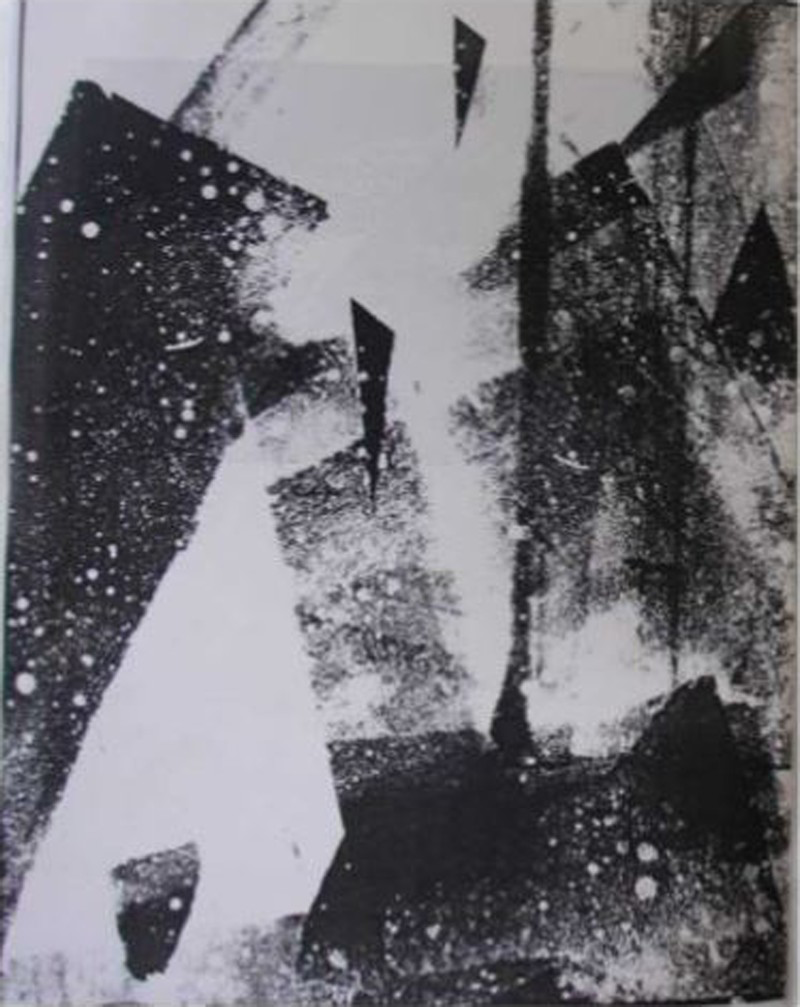
With this monotype Cobbing was positioning himself in relation to post-war debates about art's social function. In Herbert Read's essay ‘This Changing World’ published in the magazine World Review (1941) Read is optimistic about the power of art to affect change:
The individuals in whom the spirit of modernism is embodied still survive, still work, still create … .When the cloud of war has passed, they will re-emerge, eager to rebuild the shattered world … They will say: our world is in ruins … let us direct your work and we promise you that out of the ruins a better world will emerge. (Read quoted in Stephens 2003, 134, italics mine)
Read has been described as the ‘principle conduit for the reception of visual modernism in conservative Britain’ (Goodway 1998, 10), and Cobbing was certainly familiar with Read's writings on art. 3 The reception of Cobbing's early paintings were also aided by Read's organizational efforts. 4 Whether or not Cobbing was directly referencing ‘This Changing World’ with the title World in Ruins (Cataclasm), Read's ideas about art's social purpose provide us with a way of thinking about Cobbing's aesthetics as organic, and as related to his identity as an event organizer. This is important as it is Cobbing's identity as an organizer that is brought to the fore in Nuttall's history of sigma.
Across his interwar and post-war writings Read developed an influential theory about organic art. In The Meaning of Art (1931) Read compared the ‘static harmony’ of the Greek vase to the ‘dynamic harmony’ that the Chinese vase achieves: The Chinese vase ‘is not only a relation of numbers, but also a living movement. Not a crystal but a flower’ (42). A crystal's atoms are arranged in an orderly and repeated pattern while a flower's growth is more unpredictable. Read thought that this kind of distinction between geometric and organic form persisted throughout art's history. He argued that while Greek art of the classical period was at one point essentially the same as Palaeolithic and Bushman art (which Read called ‘organic’) they diverged when the Greeks not ‘content with the vitality of nature and art’ sought to ‘explain it by formulas, and discovered, or thought they discovered, certain fixed ratios both in nature and art’ (79). The title ‘World in Ruins (Cataclasm)’, with its evocation of geological fractures, and the impressionistic, unevenly distributed patches of ink on the surface of the monotype (caused by the pressure Cobbing exerted during the printing) exemplify the kind of ‘living movement’ and ‘dynamic harmony’ that Read associates with organic form. 5
In a later text, Surrealism (1936), Read restaged the dialectic in terms of romantic and classical art, with Read stressing surrealism's shared affinities with the romantic. Here, he describes classicism as the ‘intellectual counterpart of political tyranny’ and as the ‘official creed of capitalism’, and declares: ‘whenever the blood of martyrs stains the ground, there you will find a Doric column or perhaps a statue of Minerva’ (Read 1936, 23). In opposition to this, Read defines the romantic spirit as a ‘principle of life, of creation, of liberation’ which he identifies with the artist. Classicism is the ‘political concept of art to which the artist is expected to conform’ (27). However, in the context of this opposition Read charges the artist with resolving the contradiction between ‘the sensational and social world of active and economic existence … and the world of subjective fantasy’ (40). This imperative politicized Read's earlier writings on organic art and was derived, in part, from scientific epistemologies: ‘physicists affirm that the whole universe is undergoing a process of continuous change [and] dialectics are … a logical explanation of how such a change takes place’ (54). He also questioned the autonomy of art by suggesting the aesthetic realm extended to the artist's life. Read argued that ‘Surrealism, like Communism, does not call upon artists to surrender their individuality; but it does insist that artists have common problems to solve and common dangers to avoid, and that a certain coherence, even a certain mutuality, is one of the conditions of the efficacy of art’ (60). One conclusion we can draw from all this is that through Read, Cobbing began to perceive the organization of events (and a pragmatic attitude towards them) as an extension of an organicist aesthetics conceived as a political, historical and universal project which placed the artist at the centre. Next to Latham's decisive action and inclusive theory, Cobbing's concern with the financial apparatus of the sigma event might seem unartistic, but his attitude towards the event had a unifying, universal aspect which was grounded in his understanding of aesthetics. In 1965 Cobbing was asking Latham, Trocchi and the other sigma participants to question how money and the availability of funding sources related to or fitted with their concept of the event. This was typical Cobbing. Throughout the whole of his career as a poet Cobbing tested the artistic potentialities and capacities of state-funded art structures and organizations and built, secured funding, or self-funded many of his own (HAT, Writers Forum, Association of Little Presses and Poets Conference). Like Cobbing, Latham also wanted to reconceive ‘the post-1945 understanding of culture, the arts and education’ which had been ‘formed in the same ideological framework as the other main welfare institutions’ (Sinfield 1997, 58). One of the ways that Latham hoped to achieve this circumvention was through the Artists Placement Group (APG).
The state, money and the event
APG was founded and co-ordinated by Barbara Steveni in 1965 and involved artists who were already working ‘in terms of event rather than of the art object’ (Latham 1984, 40). One of its first acts was to commission a report to ‘investigate the circumstances of a state of separation between artists and industrial concerns’. This initial work was funded by the Arts Council, but when this state subsidy was withdrawn APG focussed on ‘the more public and beneficial field of government departments.’ An approach to the Civil Service Department in Whitehall resulted ‘in the formulation of an instrument which recommended government departments to act on APG's proposals … It was the first such instrument relating artist to government ever to be negotiated’ (44). For Latham, the work of APG was in keeping with his ideas of event-structure and its unifying possibilities. Steveni helped place artists within the Department of Health (Ian Breakwell) and the Department of Environment (Roger Coward), within state owned companies like British Steel Corporation (Garth Evans), and within nationally significant organizations like London Zoo (David Toop). Latham believed the divided state in human affairs was ‘generated and intensified by the media of language and money … sectional interests determined by … dividing media’. By placing time-based artists in direct relation to the decision-making processes of government, concepts could be formulated and implemented outside of the ‘language + money’ media. There is an implicit dialogue here between the processes and placements of APG and Cobbing's events, not least because they shared collaborators. Formed in 1972, abAna, a trio of Cobbing, percussionist Paul Burwell and guitarist David Toop worked to interpret ‘Cobbing's visual poems through improvisation, as if they were graphic scores’ (Toop 2005, 34–35). Toop and Burwell also served as directors of APG, and there are deep-felt connections between Latham's theory of event-structure and the intersubjective socioesthetic dynamics of live improvisation (Toop 2015), especially in terms of their treatment of media and time. As we will see, Cobbing's engagements with state-funded art organizations in Hendon, and the gradual evolution of ‘World In Ruins (Cataclasm)’ across time – from painting to visual poem to potential graphic score – are an essential historical counterpart to Latham and Steveni's sustained investigation into the relations between the artist and the state.
In the 1950s Cobbing used hire-purchase and the Local Government Act of 1948 to support his artistic activities in Hendon. By April 1953 the Hendon and District Experimental Art Club had established a lending library to encourage people to place pictures in their homes, and had £1000 worth of pictures for hire. By 1954 this library was augmented by a system of hire purchase. Cobbing used hire purchase to sell his art in response to a specifically middle class suburban trend that had been developing since the inter-war years. The first restrictions on hire purchase came in January 1952 and took the form of statuary regulations that specified the minimum down payment and the maximum period of repayment. This was at a time when it had become a relatively popular method for consumers and businesses to acquire goods. Hire purchase would have been more familiar to Hendon's residents as a way to acquire commodities such as kitchen appliances and cars. Selling art in this way undercut the idealist view of art as being somehow elevated or opposed to the commercial and industrial world, and appropriated the mechanism in the name of art.
The Local Government Act of 1948, unlike hire purchase, directly empowered local authorities to support the arts, and broadly speaking, was exactly the kind of state provision that was meant to compensate for the disadvantages of capitalism, such as the impoverishment caused by the unethical practices of finance companies who offered hire purchase. Cobbing invoked the Local Government Act in 1956 to put pressure on Hendon Borough Council to support the work of the Hendon Arts Council to which HAT had recently affiliated. At a meeting with the Hendon Borough Council on 10 September 1956 Cobbing wanted HAC to be able to offer facilities and financial assistance to societies which could not hope to cover their expenses and to fund the Hendon Arts Festival scheduled for spring 1957. He argued that the festival – which was to fill local shop windows with art – had wide public support, and that half of the money applied for was to go towards it. Despite this, the Hendon Borough Council refused to grant the HAC money. In response, Cobbing led the Hendon Arts Council Executive Committee in calling on all affiliated organizations to strike: no subscriptions would be accepted from local societies or from associate members for 1957–1958; and no activities of any kind would be undertaken. Cobbing felt strike action was necessary because Hendon Borough Council had ‘broken faith with local societies and [had] not carried out its original worthy aims.’ Cobbing argued that the
Under the local Government act 1948 […] the [borough] Council had power to spend money in providing or promoting entertainment [and that] it would be entirely a matter for the [Hendon] Arts Council to decide whether it wanted financial assistance or not.
6
The strike was meant to remind the Hendon Borough Council of its own policy and commit it to using taxation to allow the members of the local community, and specifically artists, to direct the cultural life of the borough.
The episodes and tactics described above anticipate Cobbing's engagement of structures of the state in the operation of his poetics at a national level in the 1970s (Willey 2012, 252–253). They are an important part of Cobbing's personal history of working within state-sponsored bureaucratic art institutions until they did not, and could not, live up to his expansive artistic principles. Cobbing's responses to institutional adversity were often funny, vital and artistic. For example, two days before the Hendon art strike Cobbing added Sergei Eisenstein's film ‘Strike’ to the Hendon Film Society programme. This testing of the moral, economic and aesthetic limits of such structures was equalled only by his stubborn determination to remain within them to make art. It is this kind of testing attitude that is behind his probing of Trocchi at the sigma event. Such testing, of course, resulted in irrevocable inter-personal and institutional tensions, and Cobbing was often forced to find new situations, collaborators and media in which his idea of poetry could thrive. The history of the event in Cobbing's work is somewhat defined by this poetics of survival – a working out of how an artist might function more fully in a capitalist world.
Cobbing and Latham's counter cultural event-based connections
In the final section of this article I want to extend my survey of the event-based connections that exist between Cobbing and Latham in terms of some of the other counter-cultural events they participated in, starting with the 36th exhibition of Group H (October 1966) held at the Drian Gallery.
7
This event is of interest for three reasons. Firstly, works by Latham and Cobbing are featured in the catalogue which accompanied the exhibition (Figure 2). In this form and on pages reproduced with a duplicator, striking aesthetic similarities emerge between their work. Both poet and artist present wordless monochromatic visual pieces which are left untitled. Black sprays of paint (in Latham's case) and black splatters of ink (in Cobbing's) are presented on otherwise white pages, with Latham's artwork displaying a more pared-down aesthetic. A second edition of the catalogue was printed in 1969 and was circulated independently from the exhibition on what was essentially a poetry list. In this form, they both appear as page-based artists working through seemingly similar aesthetic concerns, perhaps related to the ‘dirty’ concrete poetry for which Cobbing and Writers Forum became well known. The catalogue's reproduction and distribution invites this conflation, and an aesthetic similarity is highlighted that would otherwise have been obscured due to the variety of both men's practices. It is often noted that Latham's artworks are not easy to place within wider narratives of contemporary art. Abstract but figurative, conceptual but also deeply concerned with gesture and material, they seem to exceed and escape categories. Reading Cobbing and Latham's work through the 36th Group H exhibition on the other hand suggests that Latham's work could be usefully contextualized in relation to movements in contemporary poetry, especially sound and concrete poetry.
'Untitled’ by Bob Cobbing and John Latham in Group H (London: Writers Forum, 1969), a booklet issued at the time of Group H's thirty-sixth exhibition held at the Drian Galleries, October 1966. Reprinted with permission of the Cobbing family.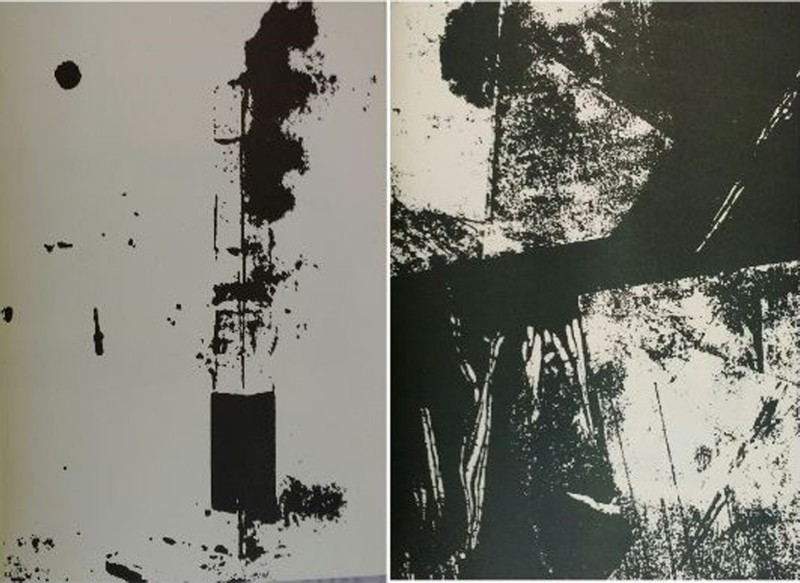
Group H is also of interest to this survey as it grew to include key artists from the counter-cultural London scene, but still played up to an idea of rollicking suburban amateurism. Proud of its roots in London's suburbia, the genealogy of Group H reminds us how important it is to understand the experimental 1960s in terms of developments that took place a decade previous. This is how John Rowan, a member of Group H since its formation in Hendon in 1951, introduced the exhibition catalogue:
Group H, that's a laugh, twenty-odd nuts in search of a feller named Bob Cobbing the noted sound poet, bookshop destructor, film maniac, ham actor and art commando. All right, Group H the well-known local art group – since 1951 purveyors of far-out art to the burghers of Hendon and points North (is there anywhere North of Hendon) (Hendon for God's sake) with branches in the Charing Cross Road.
A review published in the weekly Whitechapel-based anarchist newspaper Freedom (12 November 1966) reports that the exhibition was forgotten almost as soon as it was over. The reviewer, the artist and bus conductor Arthur Moyse, presents the exhibition as a favourable alternative to the Destruction in Art Symposium, which had taken place over the preceding months: ‘DIAS deserved to fail for its portentous sterility and the nastiness of its imported gimmicks … group H succeeds within its own parochial frame of reference but history and the Town have passed it by’ (Moyse 1966). Moyse goes onto suggest that it was a ‘tactical failure’ of DIAS that it did not incorporate and utilize the ‘local talent’ of Group H arguing that if they had been incorporated into the ‘monied setup’ of DIAS it ‘could have put on an act that would have had the Town [London] kicking up its heels for at least a week.’ Moyse makes geographic, nationalist and economic distinctions between the ‘imported gimmicks’ of DIAS and the ‘local talent’ of Group H, but is unaware of Cobbing and Latham's involvement in both. In critiquing the ‘monied setup’ of DIAS he also seems unaware of Cobbing's attempts to secure local government subsidy for Group H in the 1950s. The review further underplays the internationalist orientation of Group H members such as Jeff Nuttall, Peter Stroud, Bruce Lacey, Barry Flanagan and Nuttall, and misses the wider significance of locality to Cobbing's poetics. 8 In other words, Cobbing and Latham's involvement in the 36th Group H event reminds us that the globally oriented events of London's 1960s counter-culture and the more locally oriented suburban experiments in art could work together, in this case to facilitate the meeting of two distinct theories and practices of the event.
As I have argued, Cobbing and Latham thought deeply about how their artistic and poetic works were contingent on wider organizational structures and theoretical frames of reference. These were meta-languages that contextualized their practices. It is significant then that the catalogue which accompanied the 36th exhibition significantly deviates from the conventions surrounding the form. These deviations are of interest to this survey. The catalogue does not reproduce the exhibition's artworks alongside explanatory notes about subject matter, material, processes employed or biographical information about the artists. Instead the artworks compiled are completely different from the ones that were displayed on the walls of the gallery. For readers who only had access to the catalogue, the page-based artworks are the principle access point to the exhibition. Given what we know of Cobbing's practice in the 1950s, we can assume that this was a considered choice. After all, the catalogue was compiled by Cobbing and published by Writers Forum (1966), the poetry press that Cobbing had founded in Hendon.
John Rowan's impressionistic, introductory essay also draws attention to the substantial differences between the gallery space and the catalogue. Here, for example, is Rowan's description of the work that Polish artist, film maker and illustrator Franciszka Themerson (another Group H artist) submitted for display:
If you thought Franciszka Themerson only did little spindly illustrations to funny books, have a look at her blood stained ‘Presences’ in this show. Tatters of canvas, held together with blood, pus and drawing pins make an impact that has nothing to do with funny books – unless you think Naked Lunch is a funny book.
The degradable bodily excrescences used in Themerson's ‘Presences’ are absent from the artwork she selected for inclusion in the catalogue. In her untitled page-based work two line-drawn, distended figures – one sitting on top of the other's back, the body of the first drawn the same size as the other's head – are stuck in a painful journey. The drawing is characteristic of Themerson's sense of the sad absurdity of human relationships, a style Rowan perhaps too quickly dismisses as ‘funny’ and ‘spindly’, especially when the drawing is read through Themerson's exile from Poland during World War II. The discrepancy in media between Themerson's line drawing and ‘Presences’ marks a distinction between the catalogue and the gallery space in terms of how the human body can be represented. In his introduction to Themerson's collection Traces of Living, Edward Lucie-Smith described Themerson's drawings as ‘utterly pitiless’ because of the way they leave the artist with ‘nowhere to hide’ (1969, 2). For Lucie-Smith, Themerson's use of unshaded, hand-drawn black lines accentuated the white of the page. In the context of the 36th Group H exhibition Themerson's technique foregrounds the materiality of the catalogue. The decision (which was Cobbing's, since he compiled and edited the catalogue) to place a drawing of two bodies – one supporting the other – as the first artwork in the catalogue seems at first to convey the expected relationship of support between the catalogue and the gallery event. However, the difference in media between Themerson's line drawing (in the catalogue) and the blood and pus of ‘Presences’ (in the gallery) suggests each space was distinct in terms of the artistic possibilities it offered. One reading of this differential is to see it as an example of Cobbing's event-based poetics, where an attentiveness to the externalities of the gallery event reached a point where the catalogue itself became part of the event. Or, in other words, Themerson's drawing is part of the catalogue's syntax, and the way the catalogue is organized in relation to itself, and the way it marks distance and its difference from the gallery event is instructional. Tracing the relations between different artworks in the catalogue and reading them against the catalogue's introduction and the genealogy of Group H that it documents gives us an insight into how Cobbing thought about events, and how he wanted his audience to think about them too. Many of the decisions Cobbing made about how to organize events were likely intuitive, but they also encourage critical reflection. This is the case even when Cobbing and Latham were physically absent from events that their artistic work nevertheless frames. I am thinking here of the International Poetry Incarnation (IPI) of June 1965 hosted by Trocchi, one of the most seminal poetry readings of the 20th Century.
Latham and Cobbing's involvement in the IPI was defined by their varying degrees of absence from the stage. Latham prepared for a performance with Nuttall but never made it onstage having passed out after covering himself in lead-based paint, while Cobbing sat in the audience and witnessed Anselm Hollo, Allen Ginsberg and Ernst Jandl read from books he had published through Writers Forum. Latham's aborted performance is often commented upon in histories of the event while Cobbing's input as a publisher is seldom mentioned. Both contributions are vital however for how they invite us to rethink the centrality of live, improvised performance to the IPI and the artistic value of immediacy more generally. Writing on Latham and Nuttall's aborted performance at the IPI and its restaging at Stratford East Theatre as part of DIAS, Walker (1995) states: ‘The two protagonists of the planned performance were intended to represent a Dionysian poet and an Apollonian poet. Red and blue, their respective colours, symbolized two traditions, one informal and romantic the other formal and classical’ (75). By 1975 Latham had developed a third position. He began to conceive his art in terms of a ‘Time-based classical’ tradition. This tradition ran alongside the ‘orthodox, art-historical “classical” development’ described by Read, and Latham thought that developing this tradition would provide an ‘agreed standard of arbitration as to how a global future [could] be organised’ around art (Latham 1975, 189).
Like Latham, Cobbing used the terms Romantic and Classical art well into the 1970s. In an interview with poet and friend Eric Mottram (2000) Cobbing used the terms to describe an analogous relationship between ‘clean’ and ‘dirty’ concrete poetry:
you start splashing [paint] all over the canvas you sort of push it around and welcome the accidents. It is the classical as opposed to the romantic attitude … . In concrete there are clean and dirty … I have always been regarded as dirty.
Another late interview, this time conducted by Steven Ross Smith (1998, 8), develops this theme in terms of artistic discipline:
one can work spontaneously, one can use what would be called “organic” form. A poem is an organism and the poet's job is to bring that organism to birth and make it as perfect as he can … the discipline is a … spontaneous one.
The idea that there could be such a thing as a discipline of spontaneity combines a sense of art as an intuitive process with that of rational and reflective thought. Cobbing believed that the poet had to try and make the poem ‘as much like itself as possible’ (Cobbing 1998, 6), and that there were many ways of ‘making a poem more like its self’ (1974, 59). To speak of a self in this context might seem to imply the emergence of an essence (i.e. the poem becomes self-identical when its outer layers are stripped away) but paradoxically these outer layers are conceived as different versions of the poem that are then disseminated as such. Cobbing states that there could be visual, sound, spatial and even choreographic versions of the same poem. The poem's essential life is, like Latham's art, contingent, relational and time-based.
While Cobbing's thinking around poetry was shaped by Read's writing on art, Latham knew Read personally. Read visited Latham's studio in the late 1950s, and Latham used one of Read's books in a sculpture. A document in the Latham Archive titled ‘notes from a conversation with John Latham’ (13 December 1958) written by Anna Barker states: ‘JL thinks that a poker went through it – HR didn't recognize it as a compliment’. Read could not have been too upset about this. In a letter to his parents (11 April, 1958) Latham writes with genuine excitement about ‘a big international competition to be held in Milan where some 20 artists from all over the world are being invited to submit their work’. He adds, ‘Sir Herbert Read is on the jury and has submitted my name to the organisers’ (Latham 1959). This event was also significant enough for Latham to recall it in a letter sent to the director of the Tate Gallery 25 years later (Latham 1983): ‘Observer I was made in 1958, and went, under the aegis of Herbert Read to the first Venti Quadri exhibition at the Ariete Gallery in Milan. Read reported that it “aroused curiosity rather than admiration” there’. Curiosity implies sceptical distance, and this rational response corresponds to one of the three levels of human self-awareness that Latham tried to both express and encourage in those that viewed the work. In each of the five mixed media reliefs that comprise the Observer series (1959–1960) scorched books and metal fragments are arranged in a triadic structure which Latham described (as has frequently been noted) in terms of the three different personalities of the Karamazov brothers – Mitya, Ivan and Alyosha – from Dostoyevsky's 1880 novel. Whereas in Dream of the Battle Cruiser Hood intersecting lines connected the figurative space-based section of the artwork to the abstract time-based zone of the spray-gun explosion, ‘Observer I’ expressed relations sculpturally. A metal wire joined Mitya to Ivan (the instinctive to the rational) with Alyosha (the reflective-intuitive) being positioned towards the top as if observing the relation between the two. Latham's definition of event-structure in terms of human relations, dispositions and degrees of self-awareness marks a key moment in Latham's conception of the event relative to Cobbing's.
This pedagogical dimension – the desire to instil self-awareness in one's audience through the relationships between art and event – can be seen in other aspects of Cobbing and Latham's event-based work in the 1960s. For example, Latham was actively involved in The sTigma, a multi-media environment conceived as a public and self-critique of sigma's idealism. It was constructed in the basement of Better Books, the Charing Cross Road bookshop where Cobbing worked as manager of the paperback department, and once Cobbing became the manager of the entire shop he hosted four performances organized by Latham. During the last of these performances, ‘Wind, Foam and Dream’ (April 1967), taped audio recordings of Cobbing and Jandl were played into the room as polyurethane foam was pumped from PVC tubes into books. Latham's ‘book-plumbing’ technique and Cobbing's tape-based work, used by Latham as an aural frame during ‘Wind Foam Dream’ (1965), indicates how the movement between artistic mediums, and into sound specifically, was by this point a significant aspect of Cobbing and Latham's event-based practice.
This collaborative work developed many of the aesthetic and ethical concerns that motivated Cobbing and Latham's involvement in the Destruction in Art Symposium the previous year (September 1966). For the Symposium Cobbing produced and displayed two artworks, ‘Six Variations on Typestract One for DIAS’ and ‘Destruction in Art’. Both these works can be read as reflecting critically on the DIAS event. As well as exhibiting these works, Cobbing served on the organizing committee, and was hired as a projectionist by Yoko Ono to screen her film No. 4 (also known as ‘Bottoms’). Latham's contributions were equally various. He read his paper ‘Event Structure and the English Dream’ at the Africa Centre in King Street, detonated a block of Chambers’ encyclopaedias for his work Encyclopaedias over London at the London Free School, performed Film at Mercury Theatre in Ladbroke Grove, a piece which further reimagined the performance he and Nuttall were forced to abandon in 1965, and he, like Cobbing, also supported Ono by hosting her for two weeks at his house (Walker 1995, 81–82). A further connection between Latham and Cobbing during this period comes via the London Filmmakers Co-operative (LFMC), an organization that Cobbing had been instrumental in setting up at Better Books, which also screened and distributed Latham's films during its early years and informed the public about new developments in film. When the Antiuniversity of London was founded in Shoreditch in 1968 (a counter-cultural institution like the one imagined by Trocchi) both Cobbing and Latham were listed as faculty members. By managing Better Books, by serving on the organizing committee at DIAS, and by founding the LFMC Cobbing's organizational efforts provided conceptual and public frames for Latham's art. Cobbing also briefly served as the Antiuniversity's administrator, and through this organization the pedagogical aspects of both Cobbing and Latham's events come strongly to the fore.
Concluding events
In the 1950s Latham conceptualized relational networks on the canvas, and by the 1960s he was working with Cobbing to create networks between people. The metropolitan, counter-cultural events in which Cobbing and Latham participated in London remind us that belief in the value of collective endeavour across national and disciplinary borders, and in art as a driver of social and political change. Like an electrical junction box, Cobbing and Latham's events were points of convergence for diverse artistic currents, making manifest the energies inherent in international artistic networks at specific points in time. They curated and created networks of correspondence and did so publically. By bringing together Latham's theory of the event with Cobbing's event-responsive poetics we see how the global ambitions of these events were negotiated at the level of the individual artist, the artwork and the poem. This shift in focus away from the art-object onto art as a network of relations and onto the supporting structures of the event-as-art can be further contextualized in terms of what Craig Saper has called ‘networked art’ (2001, 3–5). Drawing on the category of the ‘receivable’ as defined by Roland Barthes, ‘networked art’ denotes sociopoetic work that is ‘distributed through compilations … and in artists’ networks [which] seeks to ‘catch hold’ of the participants’, where ‘social situations … function as part of an artwork’. Cobbing and Latham's experiments promise to reverse Saper's formula; their artworks and poems catch hold of social situations. As I have argued elsewhere, this aspect of Cobbing's work is one of its most defining features across time, and culminated in late performances where he would literally ‘read the room’ (Willey 2013, 12). For example, in a late interview with Aleric Sumner (1999) Cobbing insisted he could read any patterned surface: ‘I quite enjoy in performance … going up to a painting on the wall and doing that. It startles people, but the painting has a pattern to it and that pattern can be interpreted in sound.’ Here the external situation of the work's production – a painting hung on a wall – becomes a creative component of internal form in a poetry performance which then provides us with access back into the event.
The presentation of early paintings as poems is also related to Cobbing's conviction that visual work could be vocally sounded and to how he redefined the relation between romantic and classical art across his career. It also mirrors Cobbing's personal transition from a painter to a poet. Given these translations and transitions, we can safely speculate that Cobbing understood Latham's paintings and the visual patterns of his other work as poetry. Rather than being isolated figures working on hermetically sealed, individual projects, Cobbing and Latham were two significant members of a larger experimental generation. Reading Cobbing and Latham's work in relation to each other, and finding novel, experimental ways to do this, honours that generation and the potential energy of their work.
Footnotes
Disclosure statement
No potential conflict of interest was reported by the author.
Notes on contributor
2
Untitled (Fallen Warrior) (1955), and several other spray gun paintings from the 1950s depict fragmented or extended bodies – see, for example, Figures (1956) and Two Figures (1957) in [… .]. These paintings also suggest that violence was a prominent theme in Latham's spray gun paintings of the 1950s.
3
Cobbing's ‘The Purpose of Art’ (1949) – completed during his teacher training at Bognor Training College – includes materials from four of Read's books of the inter-war period: The Meaning of Art ( ), Art Now (1933), Surrealism (1936) and Unit One: The Modern Movement in English Architecture, Painting and Sculpture (1934). For quotations from The Meaning of Art, Art Now, Unit One, Surrealism see 259, 265, 202 and 210 respectively.
4
In May 1952 Cobbing exhibited paintings he had made in Hendon at an exhibition of amateur art that The Society for Education through Art (SEA) had organised in Manchester. This marked the first reception of Cobbing's work as ‘modernist’ (Bone ). Formed in 1940, Read had been instrumental in the formation of the SEA and became its president in 1953. Furthermore, Read's Education Through Art (1943) which became known for its chief tenet that every child was a special kind of artist was a key text for teachers of the visual arts like Cobbing.
5
Titles of Cobbing's other abstract artworks from this period also come from nature: ‘Shore’ (1947), ‘Four Stones’ (1950), ‘Tree-Stump, Hampstead Heath’ (1951), ‘Landscape with Contours’ (1951), ‘Flowering Stone’ (1955), ‘Fossil Stone’ (1955), ‘Excavated Forms’ (1955) ‘Marine Forms’ (1955), ‘Noxious Plant’ (1955), ‘Folded Landscape’ (1955), ‘Seascape’ (1956) and ‘Ice Dance’ (1957).
6
Cobbing noted that in 1950 a one pence rate levied on the local community would produce £8,150, and that it was the Hendon Borough Council's view that the sums likely to be under consideration would have a negligible effect on the amount of the rate.
7
The Drian Gallery was known for its group shows, its international outlook and its support of modernist art. In naming the gallery, its founder, the Polish artist Wisely Halima Nalecz, followed a procedure of her own devising. She opened an art manual at random, stuck a pin at the opening and on finding the name Mondrian, sliced it in half, a procedure that faintly recalled the gallery's former life as a butcher's shop. The Inaugural Exhibition (23 October–11 November 1957) displayed the work of sixty one artists, and included non-figurative artist Denis Bowen, founder of the New Vision Group, leading British Modernists, Ben Nicholson, Henry Moore and Barbara Hepworth as well as modernist artists from France, Belgium and Germany (Wykes-Joyce , 10).
8
The contributors to the Group H catalogue were: Franciszka Themerson, Jennifer Pike, Barry Flanagan, John Rowan, Criton Tomazos, Jeff Nuttall, Alan Baker, Bob Cobbing, Kenneth Swain, Islywn Watkins, Jeff Cloves, John Latham, William Chard, David Warren, Dave Trace, Hannah Swain, Gabi Weissman. Other artists who exhibited but who were not in the catalogue included David Rothman, Brian Wall, Frank Taylor, Peter Stroud, Andrew Walters and Daniel Carter.