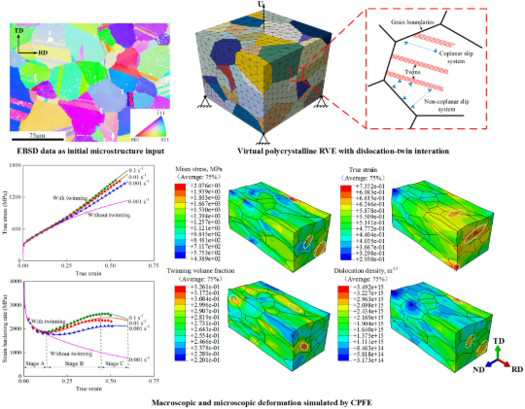
A crystal plasticity finite element model with dislocation-twin interaction was developed to study the strain rate-dependent hardening of Fe–Mn–Al–C twinning-induced plasticity steel. Microstructural state variables including twinning space and dislocation density were incorporated to describe the mechanical twins hindering gliding dislocations. In situ scanning electron microscope tension and electron backscatter diffraction tests were conducted as validation and supplement. Predicted stress and strain hardening rate at various strain rates agree well with the experimental results. The increasing strain hardening stage is attributed to the dynamic competition between deformation twinning and dynamic recovery of dislocations. The intergranular deformation heterogeneity associated with the competitive activities of deformation mechanisms was also studied. The results indicate a larger contribution of slip to overall hardening than twinning.
MadivalaM, SchwedtA, PrahlU, Anisotropy and strain rate effects on the failure behavior of TWIP steel: a multiscale experimental study. Int J Plast. 2019;115:178–199. doi: 10.1016/j.ijplas.2018.11.015
2.
LiYZ, LuoZC, LiangZY, Effect of carbon on strain-rate and temperature sensitivity of twinning-induced plasticity steels: modeling and experiments. Acta Mater. 2019;165:278–293. doi: 10.1016/j.actamat.2018.11.048
3.
BouazizO, ZurobH, ChehabB, Effect of chemical composition on work hardening of Fe-Mn-C TWIP steels. Mater Sci Technol. 2011;27:707–709. doi: 10.1179/026708309X12535382371852
4.
Gutierrez-UrrutiaI, RaabeD.High strength and ductile low density austenitic FeMnAlC steels: Simplex and alloys strengthened by nanoscale ordered carbides. Mater Sci Technol. 2014;30:1099–1104. doi: 10.1179/1743284714Y.0000000515
5.
GuoXR, SunCY, LiR, A dislocation density based model for twinning induced softening of TWIP steel. Comput Mater Sci. 2017;139:8–15. doi: 10.1016/j.commatsci.2017.07.013
6.
BarbierD, GeyN, AllainS, Analysis of the tensile behavior of a TWIP steel based on the texture and microstructure evolutions. Mater Sci Eng A. 2009;500(1):196–206. doi: 10.1016/j.msea.2008.09.031
7.
Gutierrez-UrrutiaI, RaabeD.Multistage strain hardening through dislocation substructure and twinning in a high strength and ductile weight-reduced Fe-Mn-Al-C steel. Acta Mater. 2012;60(16):5791–5802. doi: 10.1016/j.actamat.2012.07.018
8.
ShenYF, JiaN, MisraRDK, Softening behavior by excessive twinning and adiabatic heating at high strain rate in a Fe-20Mn-0.6C TWIP steel. Acta Mater. 2016;103:229–242. doi: 10.1016/j.actamat.2015.09.061
9.
XuM, MiZ, LiH, Deformation mechanism transition in Fe-17Mn-0.4C-0.06 V TWIP steel with different strain rates. Mater Sci Technol. 2018;34:242–251. doi: 10.1080/02670836.2017.1370157
10.
LiK, YuB, MisraRDK, Strain rate dependence on the evolution of microstructure and deformation mechanism during nanoscale deformation in low carbon-high Mn TWIP steel. Mater Sci Eng A. 2019;742:116–123. doi: 10.1016/j.msea.2018.11.006
11.
DingSX, ChangCP, TuJF, Microstructure and tensile behaviour of 15-24 wt-%Mn TWIP steels. Mater Sci Technol. 2013;29:1048–1054. doi: 10.1179/1743284713Y.0000000251
RahmanKM, VorontsovVA, DyeD.The effect of grain size on the twin initiation stress in a TWIP steel. Acta Mater. 2015;89:247–257. doi: 10.1016/j.actamat.2015.02.008
14.
LebedkinaTA, LebyodkinMA, ChateauJP, On the mechanism of unstable plastic flow in an austenitic FeMnC TWIP steel. Mater Sci Eng A. 2009;519:147–154. doi: 10.1016/j.msea.2009.04.067
15.
KalidindiSR.Incorporation of deformation twinning in crystal plasticity models. J Mech Phys Solids. 1998;46(2):267–290. doi: 10.1016/S0022-5096(97)00051-3
16.
StaroselskyA, AnandL.A constitutive model for hcp materials deforming by slip and twinning: application to magnesium alloy AZ31B. Int J Plast. 2003;19:1843–1864. doi: 10.1016/S0749-6419(03)00039-1
17.
SunCY, GuoN, FuMW, Modeling of slip, twinning and transformation induced plastic deformation for TWIP steel based on crystal plasticity. Int J Plast. 2016;76:186–212. doi: 10.1016/j.ijplas.2015.08.003
18.
KocksUF, MeckingH.Physics and phenomenology of strain hardening: the FCC case. Prog Mater Sci. 2003;48:171–273. doi: 10.1016/S0079-6425(02)00003-8
19.
KnezevicM, BeyerleinIJ, BrownDW, A polycrystal plasticity model for predicting mechanical response and texture evolution during strain-path changes: application to beryllium. Int J Plast. 2013;49:185–198. doi: 10.1016/j.ijplas.2013.03.008
20.
KalidindiSR, BronkhorstCA, AnandL.Crystallographic texture evolution in bulk deformation processing of FCC metals. J Mech Phys Solids. 1992;40:537–569. doi: 10.1016/0022-5096(92)80003-9
21.
ZhangH, DongX, WangQ, An effective semi-implicit integration scheme for rate dependent crystal plasticity using explicit finite element codes. Comput Mater Sci. 2012;54:208–218. doi: 10.1016/j.commatsci.2011.10.011
22.
ZhangH, LiuJ, SuiD, Study of microstructural grain and geometric size effects on plastic heterogeneities at grain-level by using crystal plasticity modeling with high-fidelity representative microstructures. Int J Plast. 2018;100:69–89. doi: 10.1016/j.ijplas.2017.09.011
23.
VermaRK, BiswasP.Crystal plasticity-based modelling of grain size effects in dual phase steel. Mater Sci Technol. 2016;32:1553–1558. doi: 10.1080/02670836.2015.1131959
24.
LiH, YangH.An efficient parallel-operational explicit algorithm for Taylor-type model of rate dependent crystal plasticity. Comput Mater Sci. 2012;54:255–265. doi: 10.1016/j.commatsci.2011.10.018
25.
DongH, ZhuJC, LaiZH, Study of fcc metal tension behaviour by crystal plasticity finite element method. Mater Sci Technol. 2012;28:788–793. doi: 10.1179/1743284711Y.0000000090
26.
AllainS, ChateauJP, BouazizO.A physical model of the twinning-induced plasticity effect in a high manganese austenitic steel. Mater Sci Eng A. 2004;387-389:143–147. doi: 10.1016/j.msea.2004.01.060
27.
KondoR, TadanoY, ShizawaK.A phase-field model of twinning and detwinning coupled with dislocation-based crystal plasticity for HCP metals. Comput Mater Sci. 2014;95:672–683. doi: 10.1016/j.commatsci.2014.08.034
28.
DongY, KangG, YuC.A dislocation-based cyclic polycrystalline visco-plastic constitutive model for ratchetting of metals with face-centered cubic crystal structure. Comput Mater Sci. 2014;91:75–82. doi: 10.1016/j.commatsci.2014.04.030
29.
BertinN, CapolungoL, BeyerleinIJ.Hybrid dislocation dynamics based strain hardening constitutive model. Int J Plast. 2013;49:119–144. doi: 10.1016/j.ijplas.2013.03.003
30.
ArsenlisA, ParksDM.Modeling the evolution of crystallographic dislocation density in crystal plasticity. J Mech Phys Solids. 2002;50:1979–2009. doi: 10.1016/S0022-5096(01)00134-X
31.
ShiekhelsoukMN, FavierV, InalK, Modelling the behaviour of polycrystalline austenitic steel with twinning-induced plasticity effect. Int J Plast. 2009;25(1):105–133. doi: 10.1016/j.ijplas.2007.11.004
32.
QueyR, DawsonPR, BarbeF.Large-scale 3D random polycrystals for the finite element method: generation, meshing and remeshing. Comput Methods Appl Mech Engrg. 2011;200(17):1729–1745. doi: 10.1016/j.cma.2011.01.002
33.
ArdeljanM, MccabeRJ, BeyerleinIJ, Explicit incorporation of deformation twins into crystal plasticity finite element models. Comput Methods Appl Mech Engrg. 2015;295(10):396–413. doi: 10.1016/j.cma.2015.07.003
34.
KnezevicM, DrachB, ArdeljanM, Three dimensional predictions of grain scale plasticity and grain boundaries using crystal plasticity finite element models. Comput Methods Appl Mech Engrg. 2014;277(277):239–259. doi: 10.1016/j.cma.2014.05.003
35.
BachmannF, HielscherR, SchaebenH.Texture analysis with MTEX-free and open source software toolbox. Solid State Phenom. 2010;160(160):63–68. doi: 10.4028/www.scientific.net/SSP.160.63
36.
LiL, ShenL, ProustG.A texture-based representative volume element crystal plasticity model for predicting Bauschinger effect during cyclic loading. Mater Sci Eng A. 2014;608(25):174–183. doi: 10.1016/j.msea.2014.04.067
37.
PierceDT, NowagK, MontagneA, Single crystal elastic constants of high-manganese transformation- and twinning-induced plasticity steels determined by a new method utilizing nanoindentation. Mater Sci Eng A. 2013;578:134–139. doi: 10.1016/j.msea.2013.04.049
38.
GebhardtT, MusicD, KossmannD, Elastic properties of fcc Fe-Mn-X (X = Al. Si) Alloys Studied by Theory and Experiment. Acta Mater. 2011;59(8):3145–3155.
39.
KalidindiSR.Modeling anisotropic strain hardening and deformation textures in low stacking fault energy fcc metals. Int J Plast. 2001;17(6):837–860. doi: 10.1016/S0749-6419(00)00071-1
40.
KimJ, EstrinY, De CoomanBC.Application of a dislocation density-based constitutive model to Al-alloyed TWIP steel. Metall Mater Trans A. 2013;44(9):4168–4182. doi: 10.1007/s11661-013-1771-2
41.
XiB, FangG, XuS.Multiscale mechanical behavior and microstructure evolution of extruded magnesium alloy sheets: experimental and crystal plasticity analysis. Mater Charact. 2018;135:115–123. doi: 10.1016/j.matchar.2017.11.034
42.
HuJ, ZhuangZ, LiuF, Investigation of grain boundary and orientation effects in polycrystalline metals by a dislocation-based crystal plasticity model. Comput Mater Sci. 2019;159:86–94. doi: 10.1016/j.commatsci.2018.12.010
43.
MohammedAAS, El-DanafEA, RadwanA-KA.Equivalent twinning criteria for FCC alloys under uniaxial tension at high temperatures. Mater Sci Eng A. 2007;457(1):373–379. doi: 10.1016/j.msea.2006.12.113