



Abstract
The Bagaryatskii and Isaichev orientation relationships between cementite and ferrite are closely related but not identical. They cannot easily be distinguished using ordinary electron diffraction methods and precise methods indicate that the Bargaryatski orientation does not exist. The issue is important when considering the mechanism by which cementite forms during the tempering of martensite or the formation of lower bainite, where the iron and substitutional solutes are unable to diffuse during the course of precipitation. It is demonstrated here that just one of the orientation relationships is consistent with the mechanism of precipitation at low temperatures, and is associated with much smaller deformations than the other.
Introduction
There are inconsistencies between orientation relationships and the atomic mechanism of transformation when cementite (θ) precipitates from supersaturated ferrite (α, e.g. bainite or martensite) at temperatures that are too low to sustain the diffusion of iron or substitutional solutes. The details are described in the next section, but the key issues can be summarised as follows:
The popular If cementite is to form without the diffusion of substitutional atoms, then is the observed orientation relationship consistent with existence of a glissile transformation interface?
 Bagaryatskii orientation relationship may not in fact exist. It could simply be an imprecise representation of the closely related Isaichev orientation [1,2]. If this is the case, then what justifies the existence of the Isaichev relation?
The carbon concentration of cementite is large so any displacive transformation mechanism would involve paraequilibrium at the transformation front, with the growth rate controlled by the diffusion of carbon towards the growing cementite particle. This is akin to the displacive, paraequilibrium growth of Widmansätten ferrite in steel [3] and to the precipitation of β-vanadium hydride [4]; in both cases, the change in crystal structure is achieved by a deformation of the parent lattice into that of the product, but at a rate dependent on the diffusion of interstitial solute.
Crystallographic analysis is presented here which we believe resolves the issues listed above. We note that the orthorhombic crystal structure of cementite has been represented in two ways [5]. The space group is Pbnm when the lattice parameters  , and Pnma when
  . The latter corresponds to the original solution by Lipson and Petch [6] and is used across the disciplines; it is also the most abundant space group of known inorganic crystals and minerals [7]. Therefore, the Pnma convention is used consistently throughout this paper.
Analysis
The Bagaryatskii orientation relationship is given by [8]
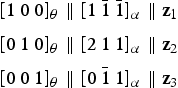
 ,
,  and
and  .
.
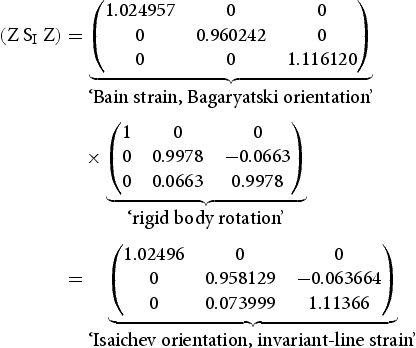
Andrews’ model [9] on the displacive transformation of ferrite to cementite begins with the observed Bagaryatskii orientation relationship and proposes a deformation in which the orthogonal vectors listed in the identities (1) are either contracted or expanded but not rotated. This is a pure deformation (Z S Z)
1
which would convert the ferrite to the cementite cell, although as Andrews pointed out, the deformation would be accompanied by the shuffle of atoms within the unit cell to recover the correct structure, and by the necessary diffusion of carbon. Referring the deformation to the orthonormal basis Z (identities (1)):
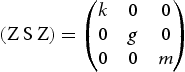
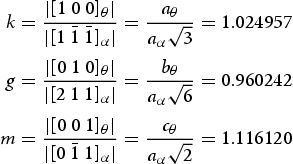
 and
and  ,
,  and
and  . Since two of these deformations are expansions and the third a contraction, it is not possible to find an invariant line between the two lattices without adding a rigid body rotation as an additional deformation. However, any such rigid body rotation would alter the orientation relationship from the observed Bagaryatskii relation. It follows that the Andrews deformation cannot lead to a glissile interface between the ferrite and cementite, a fundamental requirement for displacive transformation.
Using rational indices, the Isaichev orientation relationship [11] is given by
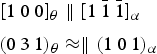
 and
and  are not exactly parallel, some 1.5–2
 apart. Modern literature states this angle to be larger, at 3.8
 [12–14], although the same publications use
  when quoting the orientation relationship.
The Isaichev orientation relationship is close to that of Bagaryatskii making them difficult to distinguish using conventional electron diffraction. As already pointed out, it deviates from Bagaryatskii by a rotation of  about the a-axis of the cementite [14]. Accurate measurements on tempered martensite have repeatedly identified the Isaichev orientation relationship and this has led to the suggestion that the Bagaryatskii orientation does not exist [1,2]. In some cases, electron diffraction patterns interpreted to show the Bagaryatskii orientation for tempered martensite [15] have been shown to be more consistent with the Isaichev relationship [2].
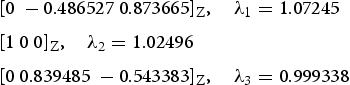
It turns out the deformation described in Equation (2), when combined with a rigid body rotation, that converts the Bagaryatskii orientation in that of Isaichev, renders the combination an invariant-line strain. The matrix representing the rigid body rotation is obtained by substituting the angle-axis pair of  about the a-axis into, for example, Equation 7.9 of [5]:
The eigenvectors and eigenvalues ( ) for
) for  are
are
 Bargaryatski orientation.
The process described above for cementite is analogous to the martensitic transformation of austenite, where the Bain strain [16] changes the lattice but does not leave any line invariant, and the orientation relationship implied by the Bain strain is not that observed. The correct irrational orientation relationship that is observed is obtained by adding a precise rigid body rotation that in combination with the Bain strain becomes an invariant-line strain.
Summary
The Bagaryatskii deformation as described by Andrews does not leave any vector invariant. It has been discovered here that when the Bagaryatskii deformation is combined with a rigid body rotation that generates the Isaichev orientation, the resulting total deformation is an invariant-line strain. Furthermore, the principal deformations associated with this invariant-line strain are substantially smaller than those of the Bagaryatskii deformation. This explains the occurrence of the Isaichev orientation relationship.
 are the principal distortions:
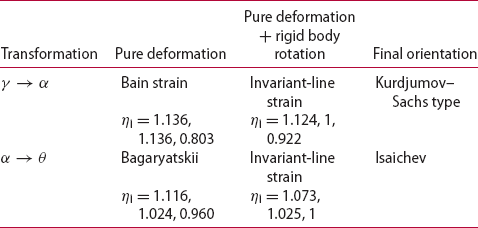
The calculations will depend on the lattice parameters of cementite and ferrite, but as long as the parameters are known as a function of temperature and composition, they are straightforward to repeat.
As a corollary, the following observations now are compatible with the paraequilibrium, displacive precipitation of cementite supersaturated ferrite at low temperatures:
It is possible to define a homogeneous deformation which is an invariant-line strain for the Cementite variant selection occurs when elastically-loaded martensite is tempered [17]. Such selection is characteristic of a strong interaction of the shape deformation accompanying transformation, with the applied stress. The displacive precipitation of cementite would require the diffusion of carbon. However, the iron to substitutional solute ratio must remain constant. This has been verified using the atom-probe technique [18].
 transformation. This is a minimum condition for the existence of a glissile interface between the parent and product lattices.
Footnotes
Acknowledgments
I would like to thank Professor Sergey Kaloshkin of the National University of Science and Technology (NUST-MISIS) in Moscow for sending me a copy of Isaichev's original manuscript. Dr Yurii P. Ivanov in Cambridge kindly assisted in its translation. I also thank Dr Saurabh Kundu and Professor Pat Kelly for their comments on the manuscript.
Disclosure statement
No potential conflict of interest was reported by the author.
1
This notation is due to Bowles and MacKenzie [5, ] to indicate that the deformation ‘S’ is defined relative to the basis ‘Z’.
References
 C
C lath boundary and cementite in tempered 0.2C steel