




Abstract
Molecular dynamics (MD) simulation has been used to study the martensitic transformation in iron at the atomic scale. The paper reviews the available interatomic interaction potentials for iron, which describe the properties of different phases present in that system. Cases on the fcc-to-bcc transformation in iron by MD simulations were included in the present paper. Factors affecting the fcc-to-bcc transformation in iron were analysed: (a) structural factors, such as grain/phase boundaries, grain sizes and stacking faults; (b) simulation conditions, such as the presence of free surfaces, external stress/strain and studied temperatures; (c) the interatomic interaction potential. The main emphasis of the present paper is on results giving insight on the mechanisms of the nucleation and growth of bcc phase in iron.
Introduction
Background
As one of the most important construction materials, iron is widely used in varied fields of industry, such as the automotive, gas transport and power generation. 1 The thermodynamic phase diagram for pure iron indicates three different crystal structures as well as the liquid phase. Under the standard atmosphere pressure, iron exhibits the body centred cubic (bcc) crystal structure (α-Fe) from room temperature to 1184 K, the close-packed face centred cubic (fcc) structure (γ-Fe) between 1184 K and 1665 K and the high-temperature bcc phase (δ-Fe) above 1665 K until 1809 K (the melting point), respectively. Under a pressure above about 13 GPa, the ε-Fe with a hexagonal close-packed (hcp) structure remains stable at 0 K. 2
Martensite forms from austenite during the quenching process of steels.3,4 The formation of martensite involves a collective movement of atoms over less than an interatomic distance at a velocity possibly as high as that of sound. 5 Due to the difficulty in observing these atomic processes, experimental studies on the nature of martensitic transformation are limited.
Molecular dynamics (MD) simulation proves to be one of the methods that can contribute to a better understanding of the experimental results and the mechanisms of the martensitic transformation.6–8 The present paper focuses on the recently-published results about the fcc-to-bcc transformation in pure iron by MD simulations. The factors, which may affect the mechanisms of fcc-to-bcc transformation are summarised, such as the grain size of fcc crystal, the orientation relationships (ORs) at the bcc/fcc interfaces and temperatures etc.
Martensitic transformation paths
During the martensitic transformation, the coordinated movement of atoms leads to a specific OR between the parent austenite (γ) and newly formed ferrite (α) lattices, in which a pair of close-packed planes in the α and γ phases are parallel or nearly parallel. In 1924, Bain proposed the fcc to bcc crystal structure transformation path by defining a bct unit cell in the fcc crystal. 9 The Bain path involves in an expansion of z-axis by about 21% and a contraction of x, y-axes by about 12%. However, the mainly observed ORs between the fcc parent phase and bcc martensite differ from the one predicted by the Bain transformation. 10 Several alternative ORs were proposed between the parent fcc phase and the product bcc phase, including the Kurdjumov–Sachs orientation relationship (KS OR), 11 the Nishiyama–Wasserman orientation relationship (NW OR), 12 the Pitsch orientation relationship (Pitsch OR),13,14 the Greninger–Troiano orientation relationship (GT OR) and the inverse Greninger–Troiano orientation relationship (GT’ OR). 15 The ORs for these transformation paths are as follows:
Bain OR:
9

KS OR:
11

NW OR:
12


GT OR:
15

GT’ OR:
15

The first two models introduce a main shear in the  direction of the
  plane, which explains the existence of the conjugate habit planes in the martensitic transformation. About 90% of the α–γ phase transformation obeys either the NW or KS OR or an OR that is close to these two.
16
plane, which explains the existence of the conjugate habit planes in the martensitic transformation. About 90% of the α–γ phase transformation obeys either the NW or KS OR or an OR that is close to these two.
16
Interatomic potentials
There are a number of interatomic potentials for MD simulations on iron. Engin et al. 17 calculated the free energies of several existing interatomic potentials for iron using the metric scaling and thermodynamic integration methods. Thus, relative stabilities of the fcc and bcc phases were characterised. It was found that, among all the available embedded atomic (EAM) potentials, the ‘Finnis–Sinclair’ potential, 18 ‘Johnson–Oh’ potential 19 and ‘Ackland’ potential 20 indicate the lowest free energy for the bcc phase at all temperatures. Thus, bcc phase is more stable than the fcc phase for these three potentials. The ‘Meyer–Entel’ potential 21 is the only EAM potential that allows the bi-directional fcc-bcc phase transformation in iron as studied by Engin et al. 17 The ‘Meyer–Entel’ potential 21 shows a phase transformation from fcc to bcc at a temperature of around 550 ± 50 K. The fcc phase is stable above this temperature and the bcc phase is stable below this temperature. Engin et al. 17 also studied the ‘Chamati’ potential, 22 which describes both the low-temperature bcc data and high-temperature fcc data. Besides, there are also some other EAM potentials for iron, such as the ‘Farkas’ potential, 23 ‘Mendelev’ potential 24 and ‘Simonelli’ potential. 25
Recently, a bond-order potential was established by Müller et al. 26 for iron. Besides the γ/α transition, this potential is also able to describe the γ/δ transitions at 2210 K, just below the melting temperature of 2270 K. Bi-directional phase transition between the bcc and fcc iron was also studied by Tateyama et al. 27 using the modified ‘Finnis–Sinclair’ potential with a cut-off function in the atomic charge density. The influence distance (i.e., cut-off distance) of the atomic charge density has an effect on the relative stability between the bcc and fcc phases at high temperature. The bcc phase is stable at a long cut-off distance and the fcc is stable at a short cut-off distance. Therefore the bi-directional phase transformation between fcc and bcc phase across the transition temperature of iron from bcc-to-fcc phase (A3 temperature) was incorporated by changing the cut-off distance at the A3 temperature (TA3). Moreover, two modified embedded-atomic method (MEAM) potentials for iron were proposed by Lee et al. 2 Compared with the EAM potential, the MEAM potential includes the effects of the angular distribution of the background electron density of adjacent atoms.
Martensitic transformation in pure Fe with fcc crystal structure
In MD simulation, the simplest way to start the solid–solid phase transformation is with a metastable crystal structure. For simulations of martensitic transformation in iron, the low-temperature fcc structure is the metastable phase in most cases as indicated by Engin et al. 17 In such cases, the bcc phase is more stable than the fcc phase for all temperatures from 0 K to the melting temperature. The Gibbs free energy difference between the two phases will lead to spontaneous fcc-to-bcc transformation at sufficiently high temperature, on account that no volume or other constraints hinders the phase transformation.
Engin and Urbassek
28
studied the fcc-to-bcc transformation using the ‘Finnis–Sinclair’ potential, which describes a stable bcc phase. The fcc-to-bcc transformation was characterised by the evolution of the free energy as a unit cell of fcc structure is distorted along the Bain path to the bcc structure. Simulations were done at 1200 K and 1400 K, respectively. An initial configuration of pure fcc was constructed and the temperature was fixed at zero pressure. The martensitic transformation occurred spontaneously at 1400 K with non-periodic boundary conditions in all directions, while no transformation happened at 1200 K. The strain and stress from the thermal fluctuations of the simulation volume led to the phase transformation. Additionally, an intermediate twin structure appeared before the fcc structure transformed to the bcc structure completely and finally it vanished, as shown in Fig. 1. In experiments, the typical twin structure also forms during the martensitic transition in steel. However, it remains stable because the volume of the martensite phase is constrained by the austenitic matrix. Besides, an incubation time was needed for the martensitic transformation because a large thermal fluctuation is required to bring the system into a favourable condition for the cooperative movement of atoms.
Cross-sectional view through the transforming crystallite (T = 1400 K) at various stages of the transformation process
28
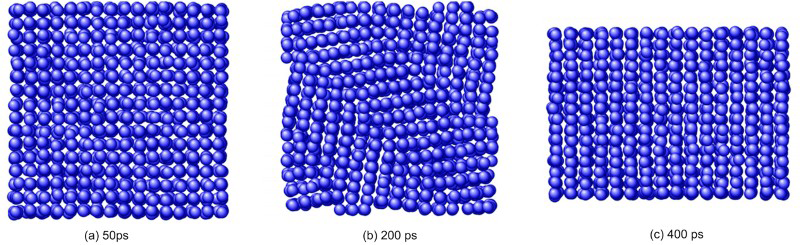
It should be noted that ‘homogeneous nucleation’ of bcc phase was reported to be observed without nucleation sites such as extended defects, dislocations or grain boundaries. However, non-periodic boundary conditions were employed in all directions during the simulations, which means that free surfaces may act as the nucleation source for the fcc-to-bcc transformation. Considering that different crystal structures were in the same colour in the configurations shown in Fig. 1, it is difficult to identify where a bcc nucleus started. The adaptive common neighbour analysis should be a good choice in distinguishing the crystallographic structures of different phases and locating phase interfaces or grain boundaries. This may help determine whether the bcc phase nucleated homogenously inside the fcc phase or heterogeneously at the surfaces. Furthermore, it is difficult to distinguish neighbouring nucleation centres in the system with a small volume, which included only several thousands of atoms. A simulation system consisted of atoms on the order of 1 000 000 should contribute to the observation of nucleation sites.
External constraints, i.e. fixed volume of the simulated system, will also have an effect on the fcc-to-bcc transformation. With the volume of the system fixed no phase transformation happened even at high temperatures while the transformation occurred spontaneously without an incubation period for an entirely free system. 28
Besides, by introducing internal means of volume/pressure relaxation, the fcc-to-bcc phase transformation occurred even in simulations with fixed volume.28,29 Previous studies
30
indicated that martensitic transformation happened in a simulation with an exaggerated density of vacancies in the bulk of Fe–Ni alloys. Isolated non-spherical particles
31
or an array of nanoparticles can also contribute to martensitic nucleation in simulations with decreasing temperature, for which the fcc phase transformed to bcc locally near triple junctions of grains.
32
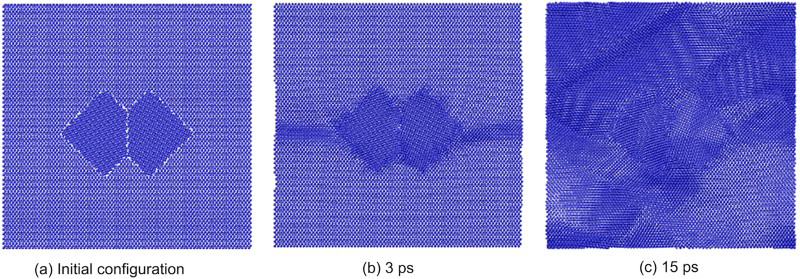
Two fcc grains in a twin geometry were embedded in an fcc matrix, as shown in Fig. 2. The fcc-to-bcc transformation started from where the two grains met and propagated horizontally sideways, which resulted in heterogeneous structures. It was believed that the combination of the interface energy and the free volume at the grain boundaries induced the spontaneous transformation.
28
Cross-sectional view through the simulation crystallite containing a grain boundary at the beginning of the simulation, and at two times during the transformation: a initial configuration, b 3 ps, c 15 ps
28
The role of fault band intersections on the nucleation of martensite from austenite was investigated by Sinclair and Hoagland
33
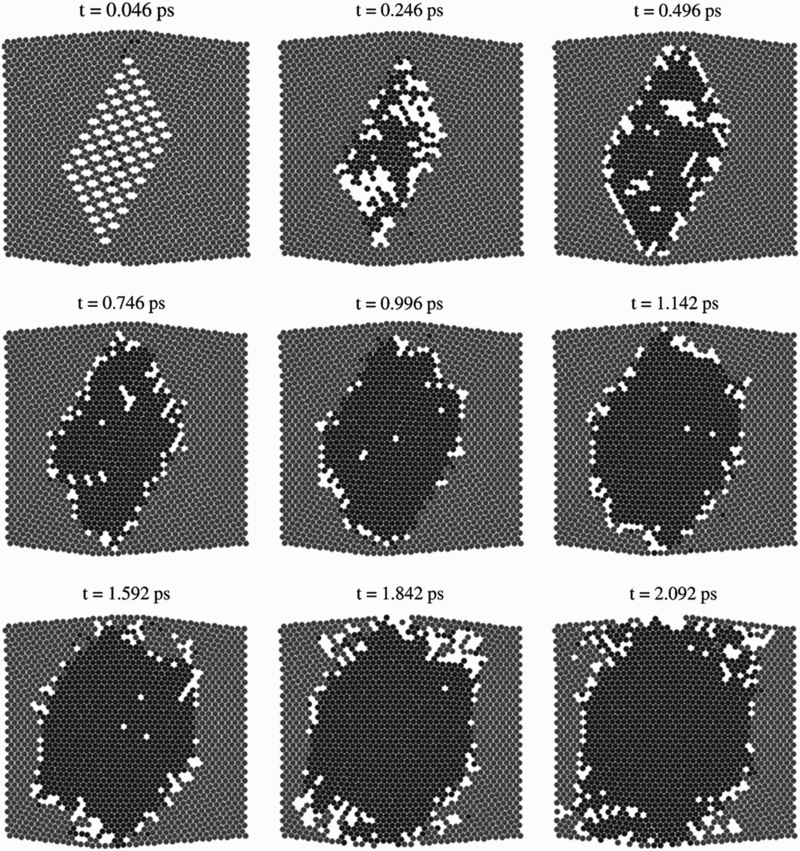
by MD simulations. Two types of dislocations as the Graphical illustration of simulation cell (viewed along the [0 1 1]fcc direction) as a function of relaxation time (given above each image) showing the gradual formation of eight-coordinated atoms (dark grey) first within the intersection volume followed by growth into the fault bands and unfaulted fcc matrix
33
 and
and  1 μm were placed in the simulation cell, introducing faults passing through the simulation cell. The type γD dislocation created a band of stacking faults on every second atomic plane, generating T/2 fault. The type αB dislocation created a band of stacking faults on every third atomic plane, generating T/3 fault. Thus an intersection area of those two fault bands was obtained as the fault band intersection. The EAM potential fit by Ackland et al.
20
indicates a higher cohesive energy of the fcc and hcp lattices than that of the bcc lattice at all temperatures. The Olson and Cohen
34
model of fault band intersections was used as the initial configuration. The crystallography structure was differentiated according to the coordination number of atoms: atoms in an fcc or hcp structure have 12 nearest neighbours and those in a bcc structure have 8 nearest neighbours. After relaxation of the simulation cell, nucleation and growth of bcc phase occurred and this transformation started first within the intersection volume, as shown in Fig. 3. After 1 ps, the bcc nucleus grew out of the original intersection volume with lower transformation rate, and the average interface velocity was calculated to be approximately 620 m/s. 2.09 ps later, the intersection volume was completely converted to bcc lattice, which nearly did not grow out of the initial intersection volume. Additionally, the formation of the bcc phase led to fcc/bcc interfaces between the fcc and bcc crystals. The crystallography of the product bcc phase indicated the Pitsch OR. That was different from experimental results, which mostly indicate mostly the KS OR.
1 μm were placed in the simulation cell, introducing faults passing through the simulation cell. The type γD dislocation created a band of stacking faults on every second atomic plane, generating T/2 fault. The type αB dislocation created a band of stacking faults on every third atomic plane, generating T/3 fault. Thus an intersection area of those two fault bands was obtained as the fault band intersection. The EAM potential fit by Ackland et al.
20
indicates a higher cohesive energy of the fcc and hcp lattices than that of the bcc lattice at all temperatures. The Olson and Cohen
34
model of fault band intersections was used as the initial configuration. The crystallography structure was differentiated according to the coordination number of atoms: atoms in an fcc or hcp structure have 12 nearest neighbours and those in a bcc structure have 8 nearest neighbours. After relaxation of the simulation cell, nucleation and growth of bcc phase occurred and this transformation started first within the intersection volume, as shown in Fig. 3. After 1 ps, the bcc nucleus grew out of the original intersection volume with lower transformation rate, and the average interface velocity was calculated to be approximately 620 m/s. 2.09 ps later, the intersection volume was completely converted to bcc lattice, which nearly did not grow out of the initial intersection volume. Additionally, the formation of the bcc phase led to fcc/bcc interfaces between the fcc and bcc crystals. The crystallography of the product bcc phase indicated the Pitsch OR. That was different from experimental results, which mostly indicate mostly the KS OR.
Recently, Song and Hoyt 35 studied the ORs of the bcc nuclei formed at the grain boundaries of a polycrystalline fcc matrix in iron by MD simulations. The simulations were done in the canonical (NVT) ensemble using the ‘Ackland’ potential. 20 The bcc grains nucleated heterogeneously at the fcc grain boundaries with at least one interface boundary oriented with the fcc crystal in the NW or KS OR. The KS OR was the dominant OR between the product bcc phase and the parent fcc phase. The forming bcc/fcc interface propagated by a terrace-ledge-kink growth mechanism.
For simulations in nanoscale systems, the surface may exert strong influences on the fcc-to-bcc transformation due to the finite size. Sandoval and Urbassek 36 studied the solid–solid phase transitions in cylindrical iron nanowires and the dependence of transition temperature on the nanowire diameter (2.5–4 nm), the heating/cooling rate (0.5–4 K/ps) and the tensile stress (0–3 GPa) applied in axial direction by the means of MD simulation. The EAM potential for iron proposed by Meyer and Entel 21 was used and periodic boundary conditions along the cylinder axis were employed. It was observed that the fcc/hcp-to-bcc transformation point was independent of the cooling rates (in the range of 0.5–4 K/ps) for the nanowire with a diameter less than 3.5 nm, while the transition temperature decreased for the nanowire with a diameter of 4 nm. Additionally, it was observed that the fcc/hcp-to-bcc transformation point was inversely proportional to the applied axis stress at relatively small values (lower than 3 GPa). The nanowire did not recover its initial form with a critical tensile stress higher than 3 GPa, above which the fcc/hcp-to-bcc phase transition was inhibited.
From the analysis above, it can be seen that in the simulation cell without phase interfaces, the fcc-to-bcc transformation happens under the external conditions, e.g. external stresses (distortion in certain direction), defects (stacking faults, vacancies) and free surfaces etc. However, a simulation cell with fixed volume may exhibit no transformation even at high temperatures. The martensitic transformation will preferentially start at regions where strain or stresses exist. If homogeneous nucleation occurs, incubation time is needed for forming the critical nucleus. Additionally, introducing grain boundaries will also facilitate the fcc-to-bcc transformation, due to the high potential energy stored in the grain boundaries. The free volume from the grain boundaries also provides the atoms with the mobility for the start of the transformation.
Martensitic transformation in pure Fe containing fcc/bcc interfaces
The structural and dynamic properties of the interface during the martensitic transformation in Fe can be studied by introducing an fcc/bcc interface in the MD simulation. Since the fcc is metastable at low temperatures, the bcc phase will grow and the interface will begin moving.
Effects of ORs on the fcc-to-bcc transformation
The martensite transformation is characterised by the special ORs between the fcc and bcc phases, which correspond to different transformation paths. The most common orientation relations between the product bcc phase and fcc phase are the KS OR and NW OR, which are therefore the most frequently studied orientations at the bcc/fcc interfaces in the initial configurations of MD simulations.
Bos et al.
6
constructed two interfaces, close to the Bain and KS orientations, to study the fcc-to-bcc transformation using MD simulation. The initial configuration, as shown in Fig. 4, included two bcc/fcc interfaces. The ‘Johnson–Oh’ potential
19
was used for modelling. The simulation was performed at zero pressure and at constant temperature, using a barostat and a thermostat of the Berendsen type. Systems with different sizes and with periodic boundaries in either two or three directions were examined, as shown in Table 1.
A typical starting configuration for interface type C, a system with only one non-periodic direction (the y direction). Bcc atoms are dark; fcc atoms are light. The x direction in the figure coincides with the fcc [1 0 0] direction, y with fcc [0 1 0 This table provides an overview of the simulations performed in Bos et al.
6
η represents the volume to surface area ratio.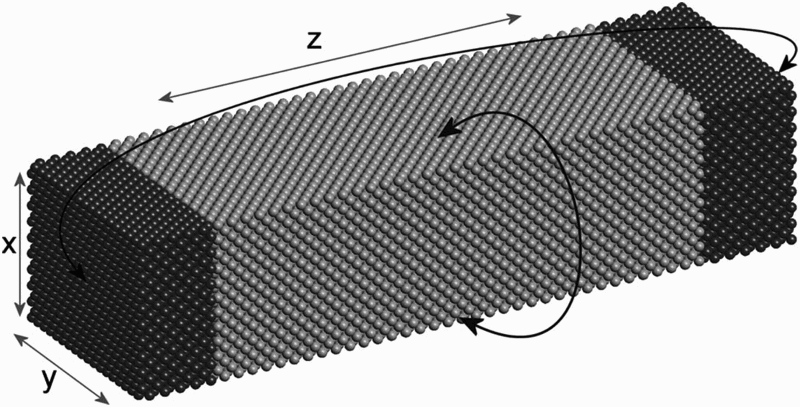
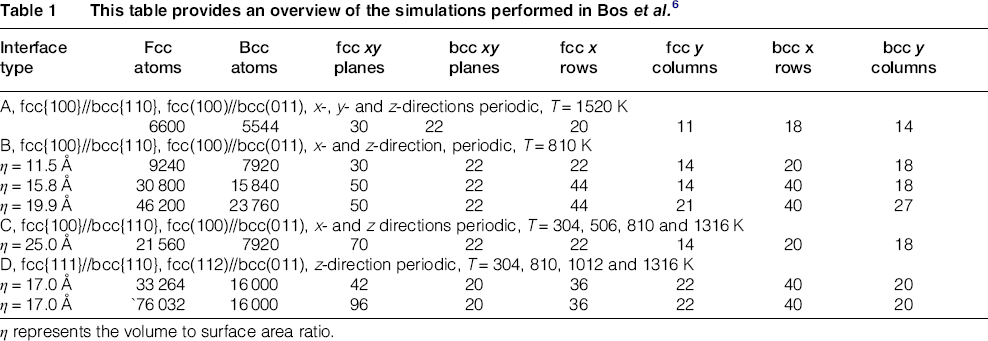
In System A with periodic boundary conditions in all three directions, there was no significant interface movement at different temperatures. The number of bcc-configured atoms increased only slightly in the initial stage with no subsequent phase transformation. For systems B, C and D with at least one free boundary, the fcc/bcc interface moved very rapidly and an incubation time was observed for all those systems. It was found that longer incubation time was needed for larger volume to surface area ratio, because larger absolute misfit had to be accommodated at the free surface. The volume to surface area ratio only affected the incubation time but not the transformation rate. During the incubation time, a specific interface structure formed for all systems, which appeared to be essential for the martensitic transformation afterwards. The movement of the atoms during the transformation was highly coordinated over a small distance and slip occurred along closely packed crystallographic planes. The fcc-to-bcc transformation was of a martensitic nature.
Tateyama et al.37,38 investigated the kinetics of (1 1 0)bcc//(1 1 1)fcc interfaces following various ORs in iron during the fcc-to-bcc transformation by MD simulation. The ‘Finnis–Sinclair’ potential
18
was used. The initial configuration was constructed by connecting bcc and fcc single crystal at 2.0 Å gap. The bcc and fcc single crystals were connected by satisfying the NW OR. In the case of KS OR, the OR was rotated by 5.26° from the NW OR with respect to the [1 1 1]fcc axis. Other intermediate ORs between the NW and KS OR were prepared by rotating the OR 2° and 4° from the NW OR with respect to the [1 1 1]fcc axis, respectively. Two propagation modes were found: planar and needle-like propagation. For all orientations between the NW and the near NW ORs, the planar propagation of the fcc-bcc interface was observed at the initial stage of phase transformation. For KS and the near KS ORs, however, a needle-like propagation was found after an initial planar propagation, as shown in Fig. 5. The velocity of the needle-like growth was calculated to be ten times faster than that of planar propagation at the initial propagation stage. In this study, the driving force for the phase transformation during the interface propagation was not discussed, because the energy difference between the bcc an fcc phase was independent of temperature using the ‘Finnis–Sinclair’ potential.
18
Snapshots of the calculation cell with the interface of a NW OR, b the intermediate OR with a rotation angle of 2.00° from NW, c the intermediate OR with a rotation angle of 4.00° from NW OR and d KS OR during relaxation at 0.5 TN. Only atoms with bcc configuration are shown in c and d for clarity
37
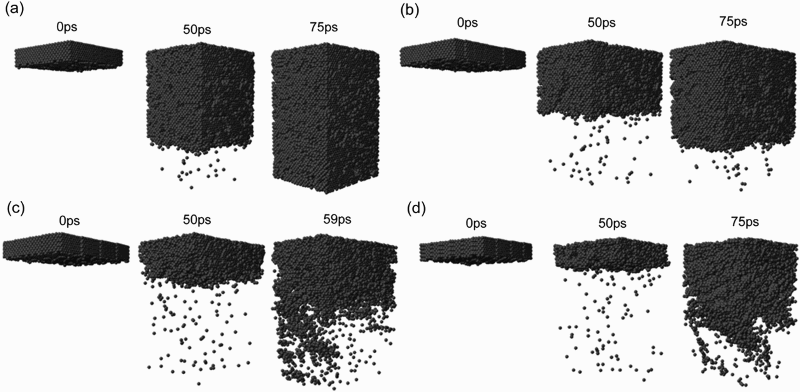
The effect of lattice matching on the kinetics of the fcc-to-bcc phase transformation was also investigated. It was found that the phase transformation began at the lattice matching area and followed the Bain transformation path. Additionally, the fcc-to-bcc transformation started preferentially at the area with small atomic stress that corresponded to the area with good lattice matching between the fcc and bcc lattices. The ratio of matching area in the NW relation was found to be higher than that of the KS relation, which was the reason for the planar and needle-like propagation modes of the bcc/fcc interface in the NW and KS OR, respectively.37,38
Ou 39 studies the bcc/fcc interfaces in the NW and KS OR in iron by MD simulation using the EAM potential. 24 The analysis of the phase transformation at the bcc/fcc interfaces is based on the energies of atoms instead of the ‘matching/mismatch’ of lattices between bcc and fcc phase. The growth of the original bcc phase is found to start from the low potential energy areas and to finalise at the high potential energy areas at the bcc/fcc interfaces. Stacking of atoms at the low potential energy areas was studied before and after the phase transformation, which shows a good agreement with the shear model proposed by Olson and Cohen 40 based on the Bogers and Burgers model, 41 as well as the published experimental results.42,43 Mechanisms controlling the growth of the original bcc phase were also studied based on the displacements of atoms in such areas, which indicated a martensitic mechanism for low potential energy areas and occasional diffusional jump of atoms for high potential energy areas.
Wang and Urbassek44,45 also studied the influence of the bcc/fcc interfaces in the NW or KS OR on the fcc-to-bcc transformation. ‘Meyer–Entel’ potential 21 was used in the MD simulation in order to describe the bidirectional transformations between the bcc and fcc phases. The interfaces were relaxed through the method of energy minimisation by conjugate gradients at 0 K and the phase boundary structure remained undestroyed after relaxation. The continued simulation was done at a constant temperature of 100 K with all periodic conditions in NPT ensemble. Different characteristics of the nucleation and interface motion were observed during the simulation process.
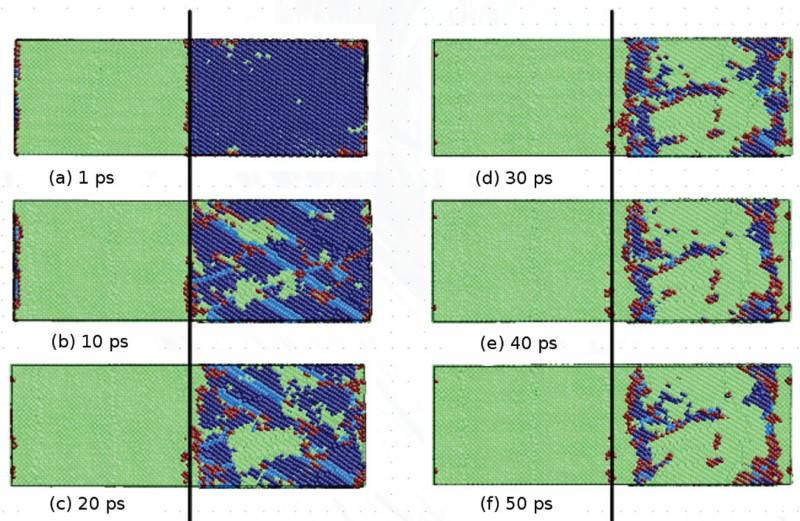
For systems with the NW OR, both homogeneous and heterogeneous nucleation of the bcc phase was observed during the martensitic transformation, as shown in Fig. 6. ‘Heterogeneous growth’ (as described by the authors) occurred at the phase boundaries and involved the interface motion with a velocity of 24 m/s, which was much slower than the interface velocity reported by Tateyama et al.37,38 The homogeneous nucleation of new bcc phase occurred within the fcc grain and it was oriented towards the initial fcc phase in the KS relationship. The bcc phase growing from the phase boundary had a different OR with the bcc phase nucleating homogeneously inside the bulk fcc phase, which led to grain boundaries separating the initial bcc phase and the homogeneously nucleated bcc phase.
Snapshots showing the time evolution of the fcc-to-bcc transition (NW interface) at 100 K. The original position of the interface has been marked by a black line. Colours represent different phases: green-bcc, dark blue-fcc, light blue-hcp, red-unknown
45
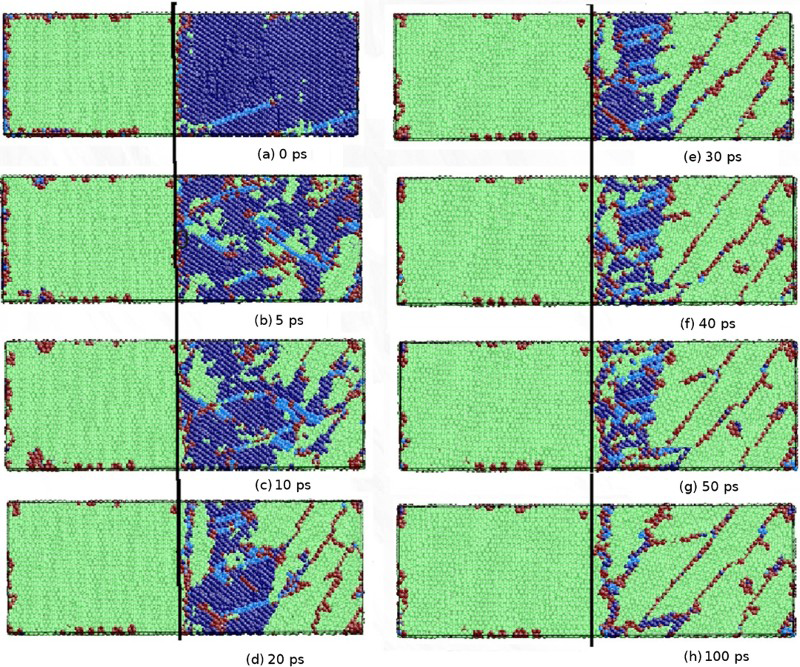
For systems with the KS OR, however, the fcc-to-bcc phase transformation was dominated by homogeneous nucleation and no heterogeneous nucleation was observed, as seen in Fig. 7. Stacking faults, rather than grain boundaries, were found in the product bcc phase. Besides, the newly formed and initial bcc phase had exactly the same OR. Thus the parent fcc crystal transformed to the product bcc phase following the KS relationship.
Snapshots showing the time evolution of the fcc-to-bcc transition (KS interface) at 100 K. The original position of the interface is marked by a black line. Colours represent different phases: green-bcc, dark blue-fcc, light blue-hcp, red-unknown
44
It should be noted that the studies by Wang and Urbassek44,45 named the growth of the bcc phase at the original interfaces as ‘heterogeneous growth’. This may mean that the growth of the original bcc phase resulted from the heterogeneous nucleation of bcc phase at the interfaces. Similarly, the so-called ‘homogeneous growth’ of bcc phase by Wang and Urbassek,44,45 which may mean the growth of the bcc nuclei forming homogenously inside the fcc bulk. Besides, it would be more convincing if more proofs were provided for the conclusions of the homogeneous or heterogeneous nucleation of bcc phase. For the homogeneous nucleation, an examination work has been performed by the present author in iron with one single fcc crystal including 108 000 atoms by MD simulations using the ‘Meyer–Entel’ potential. The simulation is performed at the constant temperature of 100 K and under the atmosphere pressure with periodic boundary conditions. No homogeneous nucleation is observed in 500 ps. Compared with the results by Wang and Urbassek,44,45 the bcc nuclei may not form homogeneously but heterogeneously inside the fcc bulk. The stacking faults resulting from the relaxation of the original bcc/fcc interface may act as the heterogeneous nucleation source for the bcc phase, as shown by the atoms coloured in light blue in Fig. 6. As for the propagation of the bcc/fcc interfaces, the previous study by the present author 39 indicates a shear-induced fcc-to-bcc transformation at local regions in the interface planes. As the interface propagated into the fcc bulk in a facetted style, heterogeneous nucleation of bcc phase was found nearby the interface pinning its further migration. 46
From the analysis described above, it can be seen that the OR between the fcc and bcc phase at the interfaces may affect the mechanism of nucleation and growth of the newly formed bcc phase. The NW or near NW relations seem to be more favourable to both homogeneous and heterogeneous nucleation, as well as the planar growth of the interfaces, while the KS or near KS relations tend to result in homogeneous nucleation but not in heterogeneous nucleation. Due to its poorer lattice matching between the fcc and bcc phase, the interface of the KS relation moves much faster than that of an NW relation in a needle-like way. Moreover, different initial configurations with different ORs also have effects on the resulting OR of the new bcc grains. Additionally, the heterogeneously nucleated bcc phase tends to have a different OR with the homogeneously nucleated bcc phase. This shows that it is necessary to take into account the different effects of different ORs when doing MD simulation in pure iron.
Effects of temperature on the fcc-to-bcc transformation
Bos et al. 6 also studied the effects of temperature on the fc-to-bcc phase transformation. It was found that the temperature does have an influence on the maximum interface velocity, which varied in the range of 200–700 m/s, depending on the interface orientation and on temperature. The interface velocity decreased linearly with increasing temperature, indicating that the interface motion was not thermally activated. Instead, the free energy difference between the bcc and fcc phases acted as the driving force for the fcc-to-bcc transformation at the interfaces and thus the interface motion.
By fixing the temperature at 100 K, Wang and Urbassek44,45 found that the fcc-to-bcc phase transformation occurred. While at a fixed temperature of 1300 K, the inversed bcc-to-fcc phase transformation was observed. Considering the ‘Meyer–Entel’ potential 21 they used, the bcc phase is more stable than the fcc phase under a temperature of 550 ± 50 K, whereas above that temperature the fcc phase is more stable than the bcc phase. Besides, the authors also found a strong temperature dependence of the nucleation and interface motion of the fcc/bcc bi-directional phase transformations. 47
In this study, 47 a simulation cell containing a bcc/fcc interface in the NW OR was constructed. The simulation was performed in an NVT ensemble with the periodic conditions in all three directions. Shear deformation was applied. The authors studied five temperatures ranging from 300 to 700 K with 100 K as increment, which encompassed the range below and above the transition temperature of the ‘Meyer–Entel’ potential. 21 With no strain applied, the system and the interfaces remained table with no phase transformation at those temperatures. With shear applied, the fcc phase transformed to the bcc phase at temperatures below 500 K while the fcc-to-bcc transformation did not occur for temperatures at or above 500 K.
With shear applied at 300 K, both homogeneous and heterogeneous nucleation of the bcc phase were observed, and the growth of the homogeneous nucleated bcc phase led to new grain boundaries. The homogeneously nucleated bcc phase had a different OR with the bcc phase growing from the phase boundary, which led to the survival of the newly formed grain boundaries, as was reported in the previous studies. 45 The fcc phase shrunk with the motion of the original fcc/bcc interface. Besides, the homogeneous bcc nucleus occupied about 70% of the space in the original fcc phase. In the final configuration more than 90% of the system transformed to the bcc phase with the extra 10% mainly in the form of stacking faults in the fcc lattice.
At 400 K, a similar phase boundary motion was also observed. However, the intermediate hcp structure was found to form in the original bcc phase at low shear angles, which seemed to be different from the results of simulation at 300 K. Moreover, the homogeneous nucleation was not found in this simulation and only heterogeneous growth of the bcc phase at the phase boundary was observed. At 400 K, which is close to the transition temperature, the driving force for the homogeneous nucleation is small. Considering that the activation energy must be overcome for the formation of a stable nucleus for homogeneous nucleation, it is more favourable for heterogeneous nucleation energetically. For the sample with large shear angle (26.5°), twin structures were found, which were not observed at any other temperatures studied. The homogeneous stress state from the exclusive interface motion may result in the twin bands, which are known to be an efficient means to relieve high stress. In addition, the fcc-to-bcc phase transformation was not complete with a residual austenite phase in the system.
At 500 K, the system was close to the equilibrium transition temperature and no phase transformation was observed. Neither homogeneous nor heterogeneous nucleation of bcc phase was found. At temperatures higher than 500 K, the bcc phase transformed to hcp or fcc phase because the temperature was higher than the transition temperature of 550 K at 0 pressure for the ‘Meyer–Entel’ potential. 21
Different temperatures have an effect on the nucleation and interface mobility of the fcc-to-bcc transformation, as mentioned above. Meanwhile, different relaxation temperature will also affect the relative stabilities between the bcc and fcc phase.
By relaxation of an fcc/bcc bi-phasic system at various temperatures, the propagation of an fcc/bcc interface with a NW OR was examined by Tateyama et al. 27 The modified ‘Finnis–Sinclair’ potential 18 was used in the simulation by introducing the influence distance of the atomic charge densities. The authors found that the influence distance (i.e., cut-off distance) of the atomic charge density, which generates the attractive force, affects the relative stability between the bcc and fcc phases as a function of temperature. At high temperature, the bcc was stable at a long cut-off distance and the fcc was stable at a short cut-off distance.
Periodic boundary conditions in all three directions were employed. After relaxation of the system at 1516 K, the bcc-to-fcc phase transformation was observed for the cut-off distance of 3.17 Å or less while the fcc-to-bcc transformation was observed for the cut-off distance of 3.21 Å or more. For the cut-off distance between 3.17 and 3.21 Å, no phase transformation was found. Then the fcc/bcc interface was relaxed at three temperatures, which were 1511 K, 1516 K and 1521 K, respectively. They chose two cut-off distances Rc = 3.3 Å at T ≤ TA3 (bcc stable) and Rc = 3.1 Å at T > TA3 (fcc stable) (TA3 = 1516 K for ‘Finnis–Sinclair’ potential). The motion of the fcc/bcc interface is shown in Fig. 8. At 1511 K, the fcc to bcc phase transformation were found and no interface motion was found at 1516 K. Relaxation at 1521 K induced the bcc-to-fcc phase transformation. It should be noted that the propagation of the interface with an NW OR followed a planar-like growth, which coincides with the previous results published by Tateyama et al.37,38
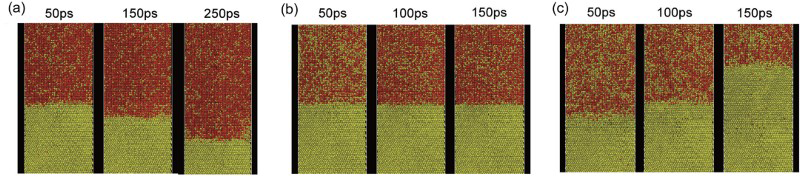
Snapshots of the fcc-bcc interface with the NW OR during relaxation at various temperatures: a 1511 K (below TA3 of the ‘Finnis–Sinclair’ potential), b 1516 K (the TA3) and c 1521 K (above the TA3). Brown and yellow spheres represent atoms with the bcc and fcc configurations, respectively
27
By introducing a parallel array of steps (or disconnections) into the original fcc/bcc interfaces, Song and Hoyt
48
studied the velocities, mobility and activation energy for motion of the fcc/bcc interface in pure Fe under temperatures in the range of 600–1400 K. The ‘Ackland’ potential
20
was used, which describes a stable bcc phase. The fcc crystal is titled by 4.04° from the NW relationship, thus defects were introduced at the interface boundary in the form of a series of steps. The x–y plane of the fcc crystal was tilted by 4.04° about the z axis to create a series of equally spaced parallel steps, which are known as structural disconnections. The actual OR was given by:


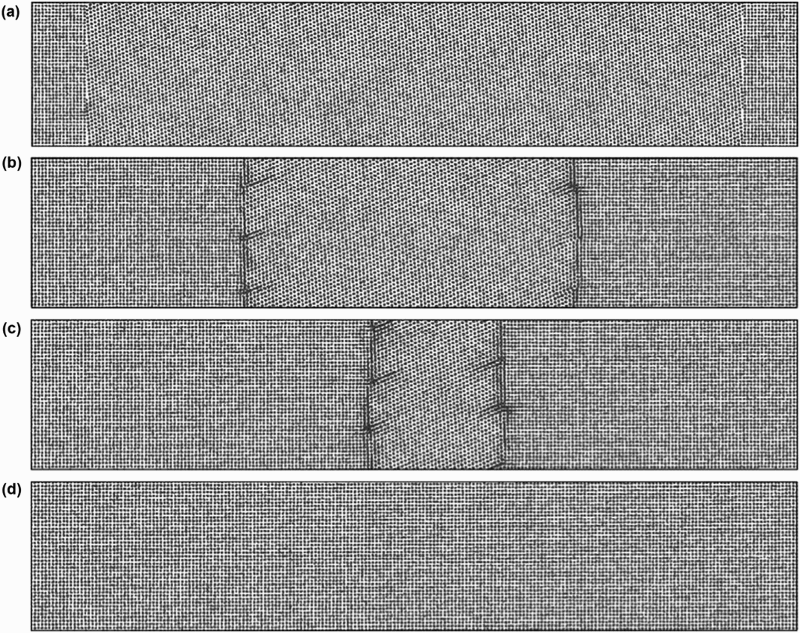
The simulation system was periodic in all directions without free surfaces. Figure 9 shows the snapshots of the simulation during the massive transformation at a temperature of 800 K. It can be seen that the strain field associated with the three interface steps extended for a considerable distance into the fcc crystal. The interface boundary fluctuated during growth, indicating that some steps grew faster than the others. The fcc-to-bcc transformation completed in 15 ns. The interface velocities were calculated to be in the range of 0.7–3.4 m/s, which were considerably lower than the interface velocity (400 m/s) reported by Bos et al.
6
The temperature dependence of the interface mobility in the form of Arrhenius plot showed a linear relationship, indicating the thermally activated atomic mechanism for interface migration. The free energy difference between the bcc and fcc phases acted as the driving force for the interface motion. The activation energy was found to be 16 ± 5 kJ/mol, which was considerably lower than experiments on the massive transformation in Fe alloys. The study by Bos et al.
6
reported a lower activation energy of 5.8 kJ/mol.
An example of the fcc-to-bcc transformation process for a temperature of 800 K. a The initial state of the simulation box shows a sandwich structure, with two bcc phases connecting the two sides of a fcc phase. b and c The positions of the interfaces at 5 and 10 ns. d The equilibrium bcc phase after the transformation
48
Furthermore, Song and Hoyt
49
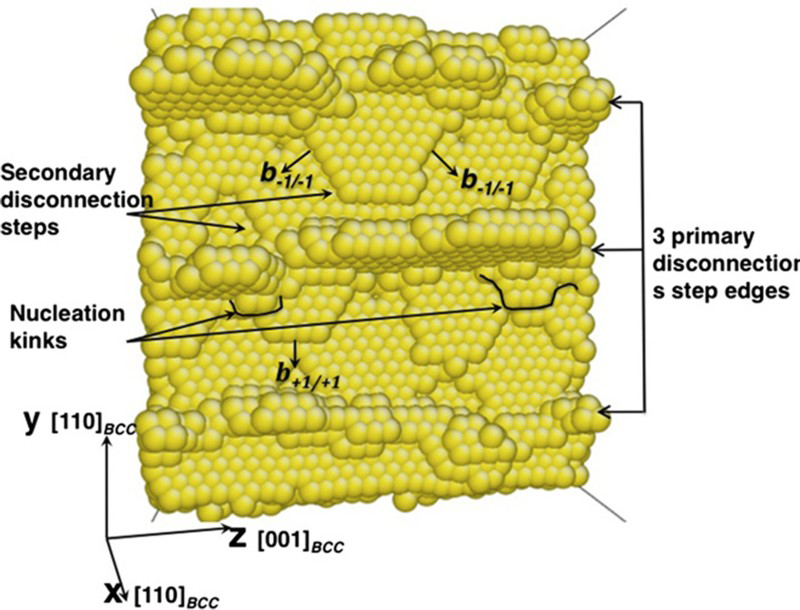
studied in detail the nucleation and growth mechanisms of the new bcc phase at the temperature of 1000 K by MD simulation. Figure 10 shows that, except for the three primary steps (disconnections) at the interface, there were also some glissile secondary disconnection steps. The disconnection possessed both dislocation and step character, the Burgers vector of the disconnection was defined as the sum of the ledge translation vectors of the fcc and bcc phase on the terraces at the interface boundaries.
49
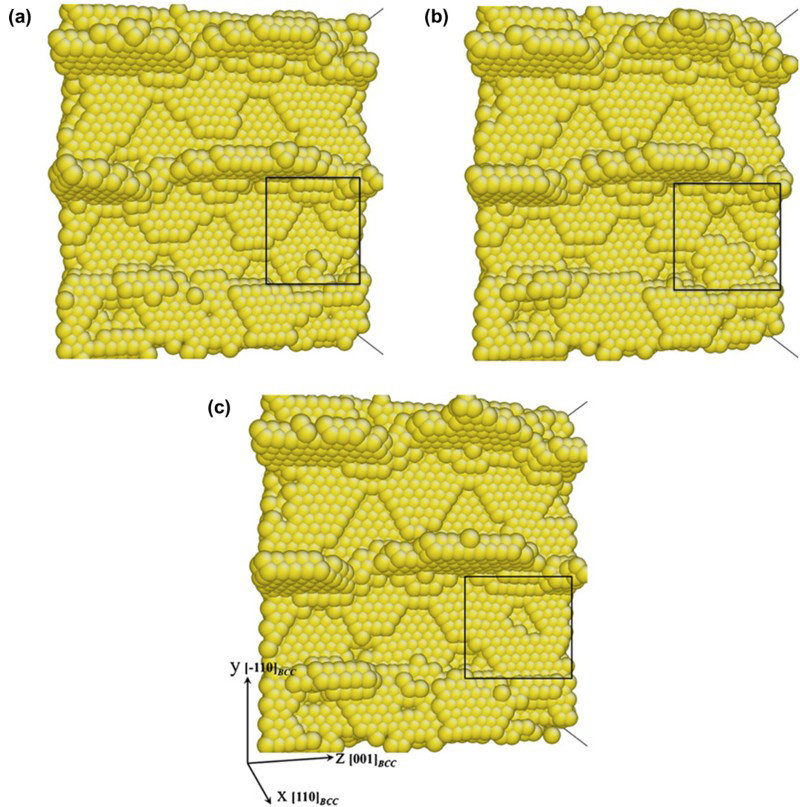
It was reported that the interface motion proceeded by the lateral translation of these secondary disconnections, as shown in Fig. 11. The primary disconnections acted as heterogeneous nucleation sites for the continuous formation of new secondary disconnections, thus the nucleation was the operative mechanism in the interface migration. An incubation time was found to be needed for a complete layer of fcc transforming to bcc because of the necessity of forming a critical bcc island nucleus. It was estimated that the critical nucleus included 13 atoms. The growth mechanism of the interface boundaries was characterised by a nucleation and growth process.
Cross-sectional view normal to the interface (110)bcc during the transformation with only the bcc atoms indicated. Islands of the bcc nucleate on the edge of the primary disconnection steps and several secondary disconnections grow along their Burgers vectors direction in each terrace plane
49
Normal view of the fcc-bcc interface (110)bcc as a sequence of time starting from snapshot (a). Each snapshot a, b and c is separated in time by 0.8 ps. The black square depicts the region where the translation of a glissile secondary disconnection occurs
49
The interface mobility might indicate the mechanisms of the phase transformations at the interfaces, providing that the interface migrates for a sufficiently long distance perpendicular to the interface in a planar style. Alternatively, the displacement vectors of atoms may determine whether the fcc-to-bcc transformation is of a martensitic mechanism in MD simulations. The martensitic transformation requires that a group of atoms moving collectively in the same direction in less than one interatomic distances. Thus, calculation of the displacement vectors of atoms provides direct and valid proof of the martensitic transformation. One example is from the present author and co-authors,39,46 who investigated the fcc-to-bcc transformation at the bcc/fcc interfaces by MD simulations. By calculation of the displacements, it was found that atoms in the low energy areas move collectively in the same direction in less than one interatomic distance while those in the high-energy areas move randomly. Thus, a mixed mechanism was obtained for the fcc-to-bcc transformation at the interface: the martensitic mechanism at the low energy areas and a diffusional mechanism at the high energy areas.
As can be seen from the discussion above, temperature has an important effect on the nucleation and growth process of the bcc phase in the fcc-to-bcc transformation. Heterogeneous nucleation may occur at both low and high temperatures while homogeneous nucleation may happen at low temperature due to the requirement of forming a critical nucleus. As for the interface mobility, temperature seems to have a different influence as the EAM potential varies. For the EAM potential that exhibits an fcc-to-bcc transition temperature, the interface velocity decreased as the temperature moved towards the transition point. Also, the temperature will affect the transformation rate of fcc-to-bcc transition, which decreased as the simulation temperature was near the transition temperature of the concerned potential. However, for the EAM potentials that have a more stable bcc phase at all temperatures, the interface mobility tended to increase with temperature. However, it is not clear whether the different EAM potential will affect the nucleation of bcc phase. Further, it is significant to choose the proper cutoff distance for the EAM potential because it may affect the stability of the fcc and bcc phases at high temperatures. Suitable cutoff distance can be used to distinguish the fcc and bcc phases too.
Other factors affecting the fcc-to-bcc transformation
Recently, the dependence of martensitic transformation on external stresses became a major issue. Such stresses develop invariably in realistic situations, either by external influences or by the developing microstructure itself. The martensitic transformation itself leads to stresses due to the change in lattice structure and volume of the new phase. 7
This table provides an overview of the simulations in Wang and Urbassek 44

Similar results were observed for Systems 1–3. Both homogeneous and heterogeneous nucleation of bcc phase occurred. The homogenous bcc nucleus inside the original fcc crystal grew rather fast, with no apparent incubation time. Simultaneously, heterogeneous nucleation of bcc phase happened at the original fcc/bcc interface, thus the bcc/fcc interfaces roughened and moved into the original fcc phase. A stable grain boundary existed between the original bcc phase and the newly formed bcc grains inside the bulk fcc phase. The fcc-to-bcc transformation in the biggest System 4 was dominated by homogeneous nucleation of bcc phase with no heterogeneous nucleation observed. The original fcc/bcc interface was immobile with only some fluctuations around its original position. The interface velocity was found to decrease with the system size increasing, because the interface motion may be hindered by the growth of the homogeneously nucleated bcc phase energetically and spatially. The fcc-to-bcc transformation rate decreased with increasing size for Systems 1–3. However, a high transformation rate was obtained for System 4, because the homogeneous nucleation lost its ‘competitor’ and exhibited accelerating transition speed.
Wang and Urbassek
47
also studied the effects of shear deformation on the fcc-to-bcc transformation in System 2 in Table 2 by MD simulation. The shear deformation that was applied to the bcc-fcc system is shown in Fig. 12. The shear deformation a NW relationship during the martensitic transition. The blue atoms are fcc and the green are bcc. The blue planes indicate the {111}fcc planes. The arrows indicate the first motion of the atoms (shear deformation of the {111}fcc planes in the  was connected to the shear angle
  via
via  . The
. The  varied in steps of 1.74% up to a maximum deformation of 50%. The maximum shear angle amounted to 26.5°, which is beyond the repaired angle of 19.5° for the fcc-to-bcc transition in the NW path. The system was equilibrated in an NVT ensemble at 300 K.
 direction), which initiates the phase transition; the dashed arrow indicates the invariant direction, which is shared by the bcc and fcc phases. b The shear deformation that is applied to the bcc-fcc system. Orientations are indicated
47
direction), which initiates the phase transition; the dashed arrow indicates the invariant direction, which is shared by the bcc and fcc phases. b The shear deformation that is applied to the bcc-fcc system. Orientations are indicated
47
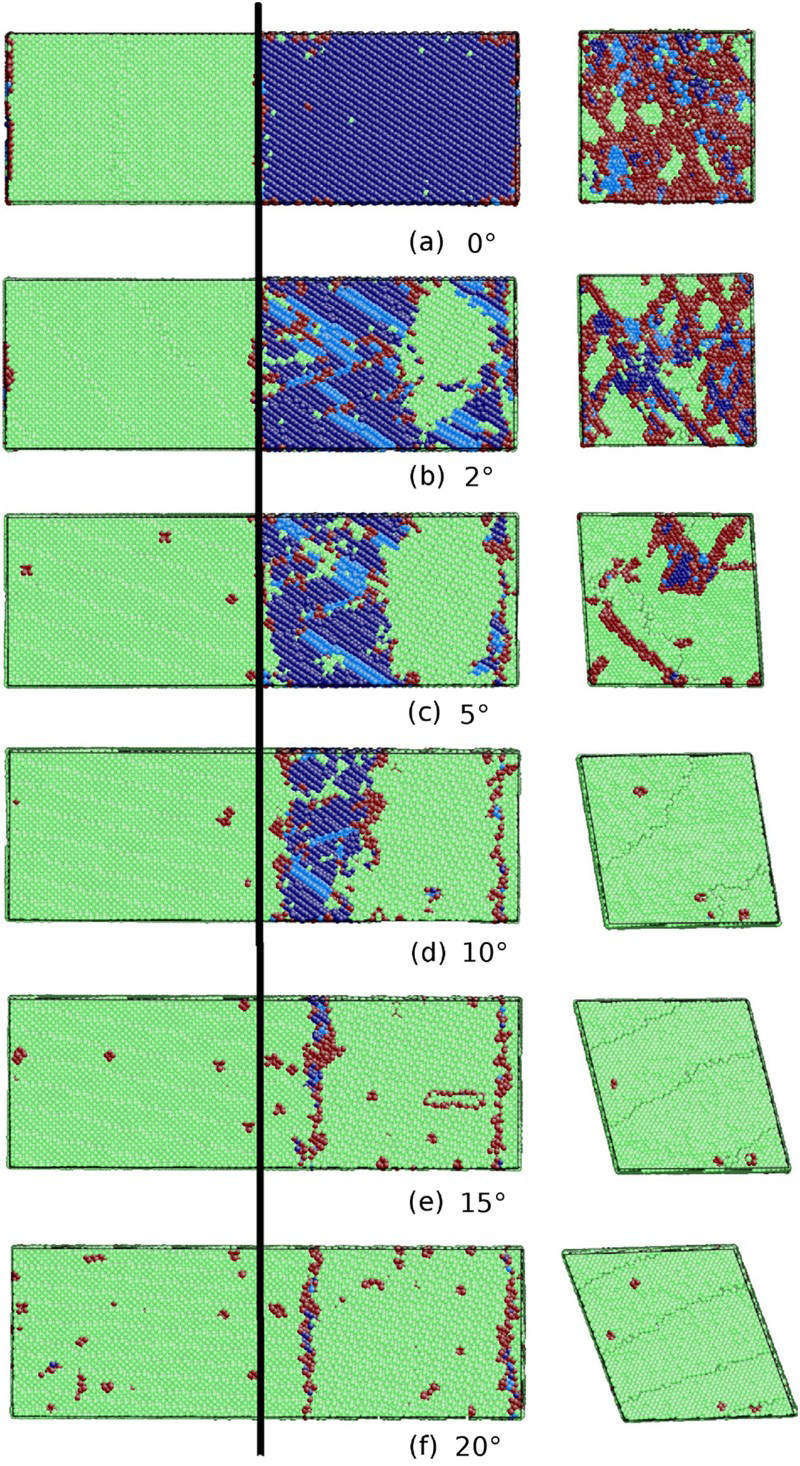
Without shear deformation, the system was stable with no fcc-to-bcc transformation. Both homogeneous and heterogeneous nucleation was observed when shear angles were up to 20°, as shown in Fig. 13. The homogeneously formed bcc phase occupied 70% of the space in the original fcc phase, which inhibited the interface movement. The homogenously nucleated bcc phase had a different OR with the heterogeneously nucleated bcc phase at the original bcc/fcc interface, leading to the survival of grain boundaries in the final configuration. Besides, the relief structure evolved on the surface during shearing due to the applied shear deformation, which resulted from the considerable lattice distortion and the high-residual stress during the martensitic phase transition.
Snapshots showing the local structure of the fcc-bcc biphasic system at a temperature of 300 K for shear angles of up to 20°. The pictures on the left show the phase evolution in the y-z plane; those on the right show the original interface plane (x–z plane) in the middle of the system. The colours denote the local crystal structure. Green: bcc; dark blue: fcc; light blue: hcp; red: unknown. The original interface position is marked by a black line
47
Recently, Yang et al.42,43 investigated the plastic deformation induced  martensitic transformation in iron by MD simulations using the ‘Mendelev’ potential.
24
The martensitic transformation at the bcc/fcc interfaces either with KS OR or Pitsch OR was found to obey the Bogers–Burgers–Olson–Cohen model.40,41 A hard sphere model from fcc to bcc phase transformation was proposed by Bogers and Burgers for the martensitic transformation in steels.
41
Based on the Bogers and Burgers model, Olson and Cohen
40
indicated that the fcc phase transformed to an hcp structure and then to the bcc structure during the martensitic transformation. Two shears were involved in the fcc-to-bcc transformation. The first shear was
martensitic transformation in iron by MD simulations using the ‘Mendelev’ potential.
24
The martensitic transformation at the bcc/fcc interfaces either with KS OR or Pitsch OR was found to obey the Bogers–Burgers–Olson–Cohen model.40,41 A hard sphere model from fcc to bcc phase transformation was proposed by Bogers and Burgers for the martensitic transformation in steels.
41
Based on the Bogers and Burgers model, Olson and Cohen
40
indicated that the fcc phase transformed to an hcp structure and then to the bcc structure during the martensitic transformation. Two shears were involved in the fcc-to-bcc transformation. The first shear was  on every
  plane and the second shear was
  on every
  plane, which corresponded to the T/3 and 3 T/8 transformation dislocation, respectively (T represents a Shockley partial dislocation for fcc twin shear). The results coincided well with their experimental observations by high-resolution transmission electron microscopy.
Conclusions
Molecular dynamics simulation has been proven to be a valuable method to study the mechanisms controlling the nucleation and growth of martensite in iron. The fcc-to-bcc transformation is found to take place in the MD simulations by introducing structural defects, such as fcc/fcc grain boundaries, dislocations, phase interfaces and stacking faults. External conditions, such as suitable temperature, stress–strain and free surfaces, will also affect the evolution of the fcc-to-bcc transformation. The coordinated atomic displacements and the growth velocity of the newly formed bcc phase can be used to identify whether the fcc-to-bcc transformation is of a martensitic nature. The special ORs, mainly the NW, KS and Pitsch ORs, are introduced at the bcc/fcc interfaces to study the mechanisms of the martensitic transformation.
MD simulation establishes a bridge between theory and experimental observations, which extends the understanding and knowledge of the mechanisms of martensitic transformation in iron at an atomistic scale. Considering that none of the existing interatomic interactive potentials completely describe the true phase transformations in iron, researchers have to be careful with the adopted potentials. Among all the existing EAM potentials, only the ‘Meyer–Entel’ 21 potential and the modified ‘Finnis–Sinclair’ 18 potential are able to describe the bi-directional fcc-bcc phase transformation. In such cases, the simulation temperature should be low enough for the fcc-to-bcc transformation to take place. The nucleation of bcc phase and the interface mobility are affected by temperature. These characteristics for the fcc-to-bcc transformation can be studied for both the potentials describing the bi-directional fcc-bcc transformation and the ones describing the stable bcc phase from 0 K to the melting temperature.
Besides, most of the MD simulations were focused on studies of the mechanisms of martensitic transformation from a structural point of view. The thermodynamics of the martensitic nucleation would be a challenging and interesting field for future investigation on iron.
Footnotes
Acknowledgments
The research leading to review has received funding from the European Research Council under the European Union's Seventh Framework Programme FP7/2007–2013/ERC grant agreement number [306292]. The author would like to thank the supervisors Assoc. Prof. Maria J. Santofimia and Prof. Jilt Sietsma from Delft University of Technology, the Netherlands, for their careful and patient guidance.
