






Abstract
Keywords
There is a growing international concern regarding the level of preventable harms attributed to adolescent alcohol consumption, including physical injury, violence, and risky sexual practices [1–3]. Alcohol consumption is also associated with the three major causes of deaths within this age group [2,4]. Research indicates that the rate of alcohol-related harms incurred by adolescents is rising [5]. Adding to this concern is the growing literature demonstrating that consuming alcohol at a young age (i.e. before the age of 15) is a significant risk factor for the development of alcohol-related problems later in life [6–8]. Recent studies have found that over 80% of adolescents in Britain and Australia have consumed alcohol by the time they are 15 years old, a quarter of British adolescents have repeatedly consumed alcohol at harmful levels by the time they are 16 years old, and nearly half of Australian 17 year olds have consumed alcohol at risky levels within the past week [9–12].
In order to address concerns regarding harmful adolescent alcohol consumption, the United Kingdom's Chief Medical Officer has recently produced alcohol guidelines for people under the age of 18, while the recently amended Australian national alcohol guidelines now include recommendations for people under the age of 18 [13,14]. Recommendations made by the two guidelines are similar: adolescents under the age of 15 should refrain from drinking any alcohol, adolescents between the ages of 15 and 17 should delay initiating alcohol consumption for as long as possible, and any alcohol consumption by adolescents between the ages of 15 and 17 should be at low risk levels in a safe environment supervised by adults. The UK guidelines highlight the importance of parental influence upon their offspring's alcohol-related attitudes and behaviours and identify the need for parental advice on how to implement alcohol guidelines for their children [13]. The Australian guidelines provide no direction regarding how the guidelines can best be put into practice. There is extensive literature demonstrating that parents play an influential role in their offspring's alcohol consumption [15,16]. Implementation of the two new national guidelines would benefit from complementary evidence-based guidance for parents regarding specific parenting strategies that are effective in delaying the age of adolescent alcohol initiation, and in minimizing the risk for later alcohol-related problems.
The UK guidelines provide a brief review of some of the evidence regarding parenting factors associated with adolescent alcohol use, however this review is not comprehensive [13]. To our knowledge, only one systematic review of parental influences on adolescent alcohol use has been carried out and this had only basic interpretation of the findings [17]. Importantly, both these reviews included cross-sectional studies which provide a weaker level of evidence than that available from longitudinal studies [18]. In this paper, we present findings from a systematic review of longitudinal studies investigating parenting factors associated with adolescent drinking. The objective of the current review is to inform parents about what behaviours they can modify to delay the onset of their adolescent drinking as well as minimize their adolescent child's subsequent alcohol consumption, in line with the new guideline recommendations for alcohol consumption by people under the age of 18.
Method
A systematic search was conducted according to the PRISMA Statement [19]. Methods of analysis and inclusion criteria have been documented in a protocol, which is available on request from the corresponding author.
Seven electronic databases (Academic Search Complete, Family Studies Abstracts, MEDLINE, Psychology and Behavioral Sciences Collection, PsycINFO, and Social Work Abstracts) were searched using the search terms parenting AND adolescent OR youth AND alcohol, between September 2008 and 14 October 2009. Studies published in English after 1980 were included in the review, with references from the initial search also scrutinized for additional relevant references. Inclusion criteria for the review were (i) longitudinal cohort studies; (ii) measurement of one or more parenting factors during adolescence or pre-adolescence (between the ages of 8 and 17) as a predictor (iii) outcome measurement of any alcohol use and/or alcohol-related problems during adolescence at least one time point after the initial parenting factor was measured, and/or problem drinking in adulthood. Studies were excluded if alcohol use was combined with other substance use or problem behaviour as an outcome variable, or if different parenting factors were combined as a single predictor variable for analysis.
As delaying initiation to drinking alcohol by adolescents has been recommended by both the Australian and UK guidelines, the current review set out to investigate parenting factors associated with age of initiation of alcohol consumption, as well as parenting factors associated with levels of adolescent drinking. Studies were included for age of alcohol initiation if they investigated uptake of alcohol consumption of baseline adolescent abstainers of any age, or measured any alcohol outcome for adolescents under the age of 15 (as both new alcohol guidelines recommend adolescents under 15 abstain from any drinking). Studies included in the review for levels of adolescent alcohol consumption investigated associations between parenting factors and increases in alcohol use or alcohol-related problems, or associations with adult alcohol-related problems.
Parenting factors were defined as family variables modifiable by the parent. Because parenting variables identified within the literature were highly variable in name, definition and measurement, parenting variables were grouped according to themes. A definition was developed for each theme by two authors (S.R. and A.J.), based on definitions most commonly used in the literature for each theme, and studies were grouped accordingly. Themes investigated by more than two studies were included for review. Individual reviews of a parenting strategy were written by one author (S.R.) with each statement made in the review checked for accuracy against the original papers by a second author (A.J.).
The diversity of study designs, statistical analysis, and reporting within the literature meant that it was impossible to extract standard effect sizes for a meta-analysis. Stouffer's method of combining p values [20] was identified as a suitable method for synthesizing results from diverse studies in order to draw conclusions regarding the significance of observed associations between variables. Reported associations were uniformly judged as significant if the p value was less than 0.05, even when authors applied different levels of significance. Two authors independently extracted p values from articles, and protocols were established via consensus between these two authors for when multiple p values were quoted in articles. We regarded an association as worthy of discussion when the combined p value was 0.01 (1-tailed) based on at least two studies.
Results
Figure 1 summarizes the results of the different phases of the literature search. Seventy-seven articles were identified via the systematic search for inclusion in the literature review.
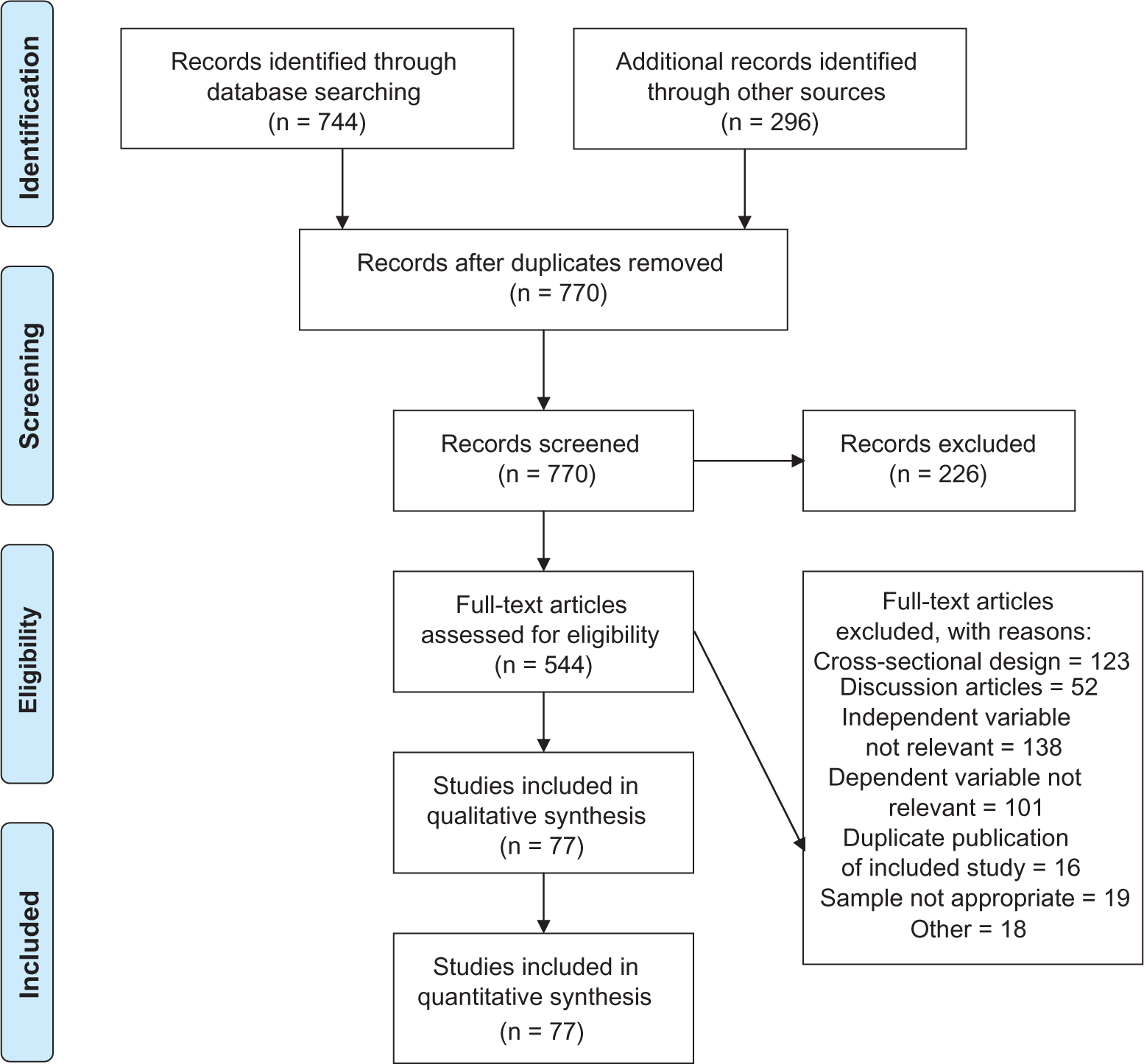
PRISMA flowchart for literature search.
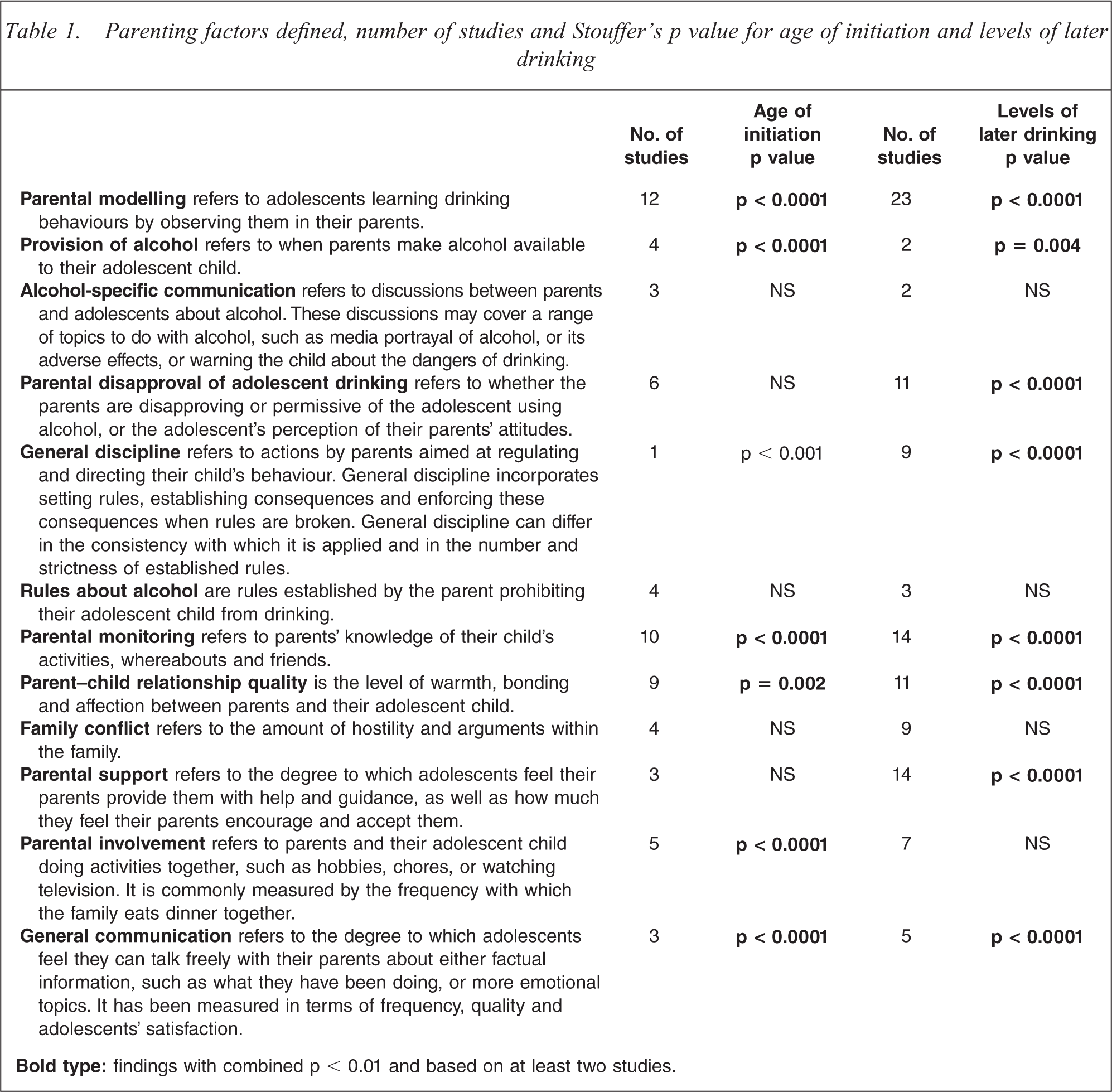
Based on the existing literature, 12 themes were identified as factors potentially modifiable by parents. Results from the review are summarized in Table 1.
Parenting factors defined, number of studies and Stouffer's p value for age of initiation and levels of later drinking
Parental modelling
Association with early initiation
Eight studies have found that parents’ alcohol consumption is associated with earlier adolescent alcohol initiation [16,21–27]. Four studies failed to find an association [28–31].
Association with levels of later alcohol use
Twelve studies found that parents’ drinking is predictive of adolescents’ alcohol use [15,23,32–41]. Some of these studies only found an association with one parent's drinking, or adolescents of a particular age group or gender [32,35,37,39,40]. Three studies found parental modelling to be associated with alcohol-related problems in young adulthood [42–44]. Eight studies failed to find a relationship between parents’ drinking and how much adolescents drink [16,22,28,30,31,45–47].
Conclusion
The evidence indicates that parental modelling of drinking is associated with both earlier initiation to drinking (p < 0.0001) and increased later alcohol use (p < 0.0001).
Provision of alcohol
Association with early alcohol initiation
Two studies found that early alcohol initiation is more likely to occur if children are allowed to drink alcohol at home [24,26]. Another study found that early initiation often took place at family gatherings [48]. One study failed to find a relationship between parents introducing adolescents to alcohol and early initiation to drinking [25].
Association with levels of later alcohol use
One study found that being permitted to drink at home was associated with increased levels of adolescent alcohol use [49] while another found that parents providing alcohol to the child, and alcohol accessibility at home, were both associated with increased adolescent drinking [50].
Conclusion
The evidence indicates that provision of alcohol is associated with both earlier alcohol initiation (p < 0.0001) and higher levels of later alcohol use (p = 0.0044).
Alcohol-specific communication
Association with early alcohol initiation
Three studies failed to find a relationship between alcohol-specific communication and the age that adolescents start drinking alcohol [22,24,28].
Association with levels of later alcohol use
Two studies failed to find an association between alcohol-specific communication and levels of adolescent alcohol use [22,28].
Conclusion
The evidence indicates that alcohol-specific communication is not associated with early alcohol initiation. There is insufficient evidence regarding its association with levels of later drinking.
Parental disapproval of adolescent drinking
Association with early alcohol initiation
Three studies found that adolescents whose parents disapproved of adolescent drinking were more likely to delay alcohol initiation [27,28,51]. Two studies failed to find an association [25,31], while another had inconsistent findings [30].
Association with levels of later alcohol use
Seven studies found that parental disapproval is associated with reduced adolescent alcohol use [15,27,31,37,52–54]. For one of these studies, the association was for parents of the same gender with younger adolescents [37]. Three studies failed to find an association between parental disapproval and levels of adolescent drinking [28,30,39]. One study found that favourable family attitudes towards adolescent alcohol use were not related to alcohol-related problems in young adulthood [42].
Conclusion
There is no clear evidence that parental disapproval of adolescent drinking is associated with delayed drinking initiation, but evidence does indicate that it is associated with lower levels of later alcohol use (p < 0.0001).
General discipline
Association with early alcohol initiation
One study found that low levels of general discipline in grade 5 were associated with increased alcohol use in grade 7 [24].
Association with levels of later alcohol use
One study found that strict parental discipline was associated with less alcohol use later in adolescence [55]. Another study found that a father's consistency in discipline was associated with reduced adolescent drinking, but a mother's was not [56]. Three studies found that having a drinking problem in young adulthood was associated with low levels of general parental discipline during adolescence [42,57,58]. For one of these studies the association was found only for boys [58].
One study found there was an optimal level of parental strictness, such that being lax or overly strict was associated with increased binge drinking, while moderate strictness was associated with less binge drinking [59]. Three studies have failed to find that strict general discipline was associated with lower levels of adolescent alcohol use [38,54,60].
Conclusion
As only one study has been carried out investigating the association between general parental discipline and early alcohol initiation (p < 0.001), further studies are required. The evidence indicates that general discipline is associated with lower levels of later alcohol use (p < 0.0001).
Rules about alcohol
Association with early alcohol initiation
One study found that having strict alcohol-specific rules in place was associated with delayed adolescent alcohol initiation [61]. Three studies failed to find a significant relationship [22,24,31].
Association with levels of later alcohol use
One study found that strict alcohol-specific rules were related to lower adolescent alcohol use [61]. Two studies failed to find a relationship between alcohol-specific rules and adolescent drinking [22,31]. Unexpectedly, one of these studies found that rules about alcohol were associated with increased later heavy drinking [32], while the other found a similar non-significant trend [22].
Conclusion
The evidence indicates that rules about alcohol are unrelated to early alcohol initiation, and do not appear to reduce subsequent alcohol consumption.
Parental monitoring
Association with early alcohol initiation
Six studies found that parental monitoring was associated with later initiation to alcohol use [21,23,62–65]. Four studies failed to find a consistent association between parental monitoring and adolescent alcohol initiation [22,29,66,67].
Association with level of later alcohol use
Nine studies found that increased parental monitoring was associated with lower levels of adolescent drinking [23,38,53,68–73]. Five studies failed to find an association between parental monitoring and levels of adolescent drinking [22,74–77].
Conclusion
The evidence indicates that greater parental monitoring is associated with early alcohol initiation (p < 0.0001) and lower levels of later alcohol use (p < 0.0001).
Parent–child relationship quality
Association with early alcohol initiation
Four studies found that adolescents who had good relationships with their parents were more likely to delay initiation to drinking [21,26,62,78]. Five studies failed to find an association between parent–child relationship quality and onset of alcohol use [29,58,65,79,80].
Association with level of later alcohol use
Five studies found that good parent–child relationships were associated with lower levels of adolescent alcohol use [34,69,76,81,82]. For one of these studies, this association was found only for adolescents who were late initiators [82]. One study found that adolescents with good relationships with their parents were less likely to drink heavily in adulthood [83]. Three studies failed to find an association between parent–child relationship quality and adolescent alcohol use [55,70,84]. Two studies failed to find an association between parent–child relationship quality and alcohol problems in adulthood [48,58].
Conclusion
The evidence indicates that good parent–child relationship quality is associated with both delayed alcohol initiation (p = 0.002) and reduced levels of later alcohol use (p < 0.0001).
Family conflict
Association with early alcohol initiation
One study found that earlier alcohol initiation was associated with increased family conflict [26]. Three studies failed to find a relationship between family conflict and age of onset of alcohol use [23,51,64].
Association with level of later alcohol use
Two studies found that increased family conflict was associated with increased adolescent alcohol use [85,86]. Another study found the association in only some age and gender groups [37]. Four studies failed to find an association between family conflict and adolescent drinking [38,73,87,88]. Two studies failed to find an association with problem drinking in adulthood [42,44].
Conclusion
The evidence suggests that there is unlikely to be an association between family conflict and either age of alcohol initiation or levels of later alcohol use.
Parental support
Association with early alcohol initiation
Three studies found no significant association between parental support and adolescent alcohol initiation [22,24,51].
Association with levels of later alcohol use
Five studies have demonstrated a relationship between high levels of parental support and lower levels of adolescent alcohol use [53,54,56,60,89]. One study found that support from fathers was associated with less adolescent drinking, but not support from mothers [71]. Two studies found an association in younger but not older adolescents [38,49]. One study found that parental support was a protective factor only for young adolescent girls [37]. Four studies failed to find a relationship between parental support and later adolescent alcohol use [22,41,68,90]. One study found that parental support during adolescence was unrelated to problem drinking in adulthood [57].
Conclusion
The evidence indicates that parental support is not associated with older drinking initiation, but is associated with lower levels of later alcohol use (p < 0.0001).
Parental involvement
Association with early alcohol initiation
One study found that children whose parents spent time with them were less likely to start drinking at a young age [62]. Two studies found that regular family dinners were related to delayed alcohol initiation for girls, but not boys [91,92]. Two studies failed to find a relationship between parents spending time with their adolescents and alcohol initiation [74,78].
Association with levels of later alcohol use
One study found that greater parental time spent with their adolescent was associated with lower levels of drinking two years later [74]. Four studies failed to find an association between parental involvement and levels of adolescent alcohol use [37,38,72,93], and another found it was not related to alcohol problems in adulthood [42]. One study found no association between frequency of family dinners and levels of adolescent alcohol use [92].
Conclusion
The evidence indicates that parental involvement is associated with delayed alcohol initiation (p < 0.0001), but not with levels of later alcohol use.
General communication
Association with early alcohol initiation
Two studies found that good general communication was associated with later alcohol initiation [62,78]. One study failed to find an association [23].
Associations with level of later alcohol use
Four studies have found that good general communication was associated with lower levels of adolescent alcohol use [53,59,94,95]. One study failed to find an association [23].
Conclusion
The evidence indicates that good communication is associated with both delayed alcohol initiation (p < 0.0001) and lower levels of later alcohol use (p < 0.0001).
Discussion
As far as we are aware, this is the first systematic review of the highest level of evidence relevant to this area, longitudinal studies, to examine the impact of parenting behaviours on adolescent alcohol use. The current study improved on previous research in that it used combined significance levels to determine whether associations between variables were reliable. While there are many conflicting findings across these studies, we found supporting evidence that parental modelling, limiting availability of alcohol to the child, parental monitoring, a good parent–child relationship quality, parental involvement and general communication were associated with delaying early alcohol initiation. Evidence was also found that parental modelling, limiting availability of alcohol to the child, disapproval of adolescent drinking, general parental discipline, parental monitoring, good parent–child relationship quality, parental support and general communication were all associated with reduced levels of later drinking by adolescents. It is notable that a number of factors previously identified in the literature were not confirmed by the current review. The present review has a number of strengths compared to previous reviews that may have led to these differences. Importantly, we excluded cross-sectional data. We also categorized parenting factors according to content rather than by variable name, providing a purer investigation of associations between variables. We used Stouffer's method of combining p values, which led to a more objective criterion for judging the reliability of associations where there appeared to be inconsistency across studies.
While many longitudinal studies have been carried out, a number of limitations were observed in the evidence base. Studies varied greatly in definitions and measurements employed for predictor and outcome variables, as well as in approaches to analysis. These differences limit the capacity for comparison between studies. Studies within the literature frequently combined alcohol use with other outcome measures such as the use of other substances or other risky or adolescent behaviours for analysis, limiting the applicability of findings to alcohol use alone. Other studies combined divergent parenting factors as a measure of parenting style, preventing the capacity to determine which parenting strategies were significantly associated with adolescent alcohol consumption. The current study addressed these limitations by excluding studies that combined distinct constructs as either predictor or outcome variables.
The definition of parenting factors within the literature also lacked consistency. Parenting factors frequently overlap conceptually, limiting understanding of which specific parenting strategies are effective in reducing adolescent alcohol use. Another limitation was that statistical analysis and reporting of statistics was extremely diverse. The current review highlights the need for researchers to establish defined, distinct parenting variables with consistent methods of measurement. The use of consistent methods of data analysis and reporting would also allow a meta-analysis to be performed. Identification and investigation of practical, instructional strategies that operationalize parenting factors identified by the current review would also be extremely beneficial in informing parents as to how they can best prevent and/or minimize their adolescent's alcohol use.
The current study was not without limitations. Only studies published in English were included in the review, possibly biasing results. Also 55 of the 77 reviewed studies were conducted in the USA, potentially reducing the relevance to other countries. Furthermore, due to the heterogeneity of the studies included, estimating the effect size of associations found was not possible.
Despite these limitations, the current review provides valuable clarification of parenting factors that are associated with delaying adolescent alcohol initiation and reducing levels of their offspring's alcohol consumption. The strategies identified by the current review provide health professionals and parents with guidance for implementing recent British and Australian recommendations for limiting the harms associated with adolescent drinking.