




Abstract
There has been some controversy in the literature on the types and nature of difficulties experienced by gifted and talented children, with some studies supporting the idea that these children are more vulnerable to experiencing behavioural and emotional problems, while others suggest that there is no more risk than for any other children [1]. There is some evidence that gifted children and their parents experience unique challenges, but there is a lack of research about the nature and extent of difficulties experienced, and there is a paucity of literature on the parenting experience of parents of gifted and talented children. This article provides an overview of the literature on difficulties experienced by parents of gifted and talented children, and reports the results of a survey conducted among parents of gifted and talented children, aimed at enhancing understanding of child behavioural and emotional adjustment and parenting difficulties.
Vulnerabilities of gifted and talented children
There is some evidence that gifted and talented children may be more vulnerable to adjustment, behavioural, and mental health problems [2–4], and particularly if they are also from a minority or disadvantaged background [5]. In general, there is growing consensus that gifted and talented children on average do not experience more difficulties than other children [6–9], but there are a number of factors that may place individual children at higher risk for developing behavioural or emotional problems. These factors include asynchronous development [2], [10], [11]; unrealistic expectations of parents and teachers, including excessive and inappropriate use of praise [11], [12]; parent over-involvement; a mismatch between the child's ability and the instructional environment; and difficulties with peer groups [13].
Parenting gifted and talented children
Most research in the area of giftedness has focused on supporting children educationally, examining both parents’ perceptions of their children's educational needs [14], and focusing on providing the parents with skills to enhance their ability to support their gifted child academically [15], [16]. While gifted and talented children have specific educational needs that require identification and support within the school system, they also present particular challenges in terms of parenting. Although there is limited empirical research on the experience of parenting a gifted child, there is some evidence that the role presents additional challenges to those of parenting a non-gifted child [17–22]. Parents of gifted children report that they require assistance not only with meeting their child's educational needs, but very importantly with aspects of parenting [23–26].
Few studies examine parents of gifted children and the focus has been on differences in the environments of gifted versus non-gifted children, such as the amount of time parents spend on school-related activities [19], [27], parental perceptions of children's use of leisure time [28], and parental mediation of children's television and computer game use [29]. There is some evidence that differential outcomes for gifted children depend on the family environment [26], [29–34], but the extant research suffers from a number of limitations including a lack of empirically valid measures, retrospective accounts, and small sample sizes. Overall, little is known about the variations in parenting a gifted and non-gifted child, and existing research suggests that most parents face similar issues, but there are differences in terms of parent expectations and confidence in their ability to manage and assist their gifted child.
Study aims
Gifted children are vulnerable to the development of emotional and behavioural problems, but there is little evidence available as to the nature of this vulnerability as well as the factors contributing to it. Furthermore, parents of gifted children often experience additional challenges in their role as parents, but, these challenges are not well understood and described. In the present study a survey of parents of gifted and talented children was conducted, with the aim of describing children's behavioural and emotional adjustment, and the factors that contribute to children's difficulties. Data from this study for children's behavioural and emotional adjustment were compared to Australian data for a similar sample of 1359 parents of 4–9-year-old children conducted by Hawes and Dadds [35]. The second aim of the study was to examine the styles of discipline used by parents of gifted and talented children as well as their level of confidence in managing specific parenting tasks.
Method
Participants
A total of 409 parents with children between the ages of 2 and 16 participated in the survey. The majority of children (68%) had received a formal assessment of their intellectual ability, while 30.8% had not (five parents did not report whether the child had received an assessment). For the purposes of the present study, data were analysed only for children for whom a formal assessment had been conducted (n = 278), and for whom results provided by the parents clearly indicated that the child was gifted: that is, verbal or performance or full-scale IQ score >130 (n = 214). For the remaining 64 cases (23.0%), insufficient information was available to determine whether the child was gifted. For children who had received a formal assessment of their intellectual ability, and for whom a full-scale IQ was provided (n = 197), scores ranged from 121 to 180, with a mean of 138.82 (SD = 9.79). When a verbal ability quotient was provided (n = 153), scores ranged from 85 to 164, with a mean of 134.98 (SD = 11.19); and when a non-verbal ability quotient was provided (n = 121), scores ranged from 105 to 157, with a mean of 133.78 (SD = 10.18).
Most survey respondents were mothers (91.6%), with a smaller proportion of fathers (7.9%), as well as one grandparent (0.50%). Respondents reported on 131 boys (61.2%) and 83 girls (38.8%). The mean age of children was 8.49 (SD = 2.54). Most children lived with parents who were married (85.0%), in their original families (86.9%), with an average of 2.23 children (SD = 1.00) in the household. Mother's age ranged from 26 to 56, with a mean of 40.32 (SD = 5.27), and fathers were slightly older, with ages ranging from 31 to 80, and a mean of 42.89 (SD = 6.88). Most parents reported their background as Australian (93.4%), with a small minority of Asian families (1.9%) or other ethnicities (4.7%). A large proportion of both parents had a university education (67.9% of mothers and 59.2% of fathers). More than 92% of fathers were employed for an average of 44.2 h per week (SD = 11.55). Seventy-one per cent of mothers were employed, working an average of 24.3 h per week (SD = 12.56). Four per cent of families had an annual income of <$AUD25 000, 10.3% between $AUD25 000 and $AUD50 000 annually, 16.4% between $AUD50 000 and $AUD70 000, and 67.8% had an annual income of >$AUD70 000.
The Accessibility/Remoteness Index of Australia (ARIA) was used to assess participants’ relative access to services [36]. ARIA calculates remoteness as accessibility to service centres based on road distances, grouped into five categories using a 0–12 continuous scale. The average ARIA score for this sample was 1.00, indicating that most participants had no restrictions in accessing services. One hundred and sixty-eight participants (78.5%) lived in highly accessible areas, 22 (10.3%) in accessible areas, 11 (5.1%) in moderately accessible areas, three (1.4%) in remote areas, and two (0.9%) in very remote areas.
Procedure
Ethics clearance for the study was sought and received in accordance with the ethics review processes of the University of Queensland and within the guidelines of the National Health and Medical Research Council. Participants were recruited through Gifted and Talented Associations and primary schools Australia-wide. In addition, media releases and school presentations were utilized in order to gain as wide a participant pool as possible. Three state-based Gifted and Talented Associations agreed to send the surveys to all association members. Approximately 630 surveys were sent to members through the Associations. All other Associations provided information about the survey to parents either on the Association's website, or through regular newsletters. All primary schools with a publicly listed email address were contacted via email, with an explanation about the project, and a request to disseminate the information to their school community. In addition to the surveys sent directly to parents via the Gifted and Talented Associations, a further 476 parents contacted the project directly, and an assessment package containing a set of questionnaires, along with an information sheet outlining the study were sent to all eligible families. The criterion for eligibility for this survey was presence in the family of a gifted and talented child, between the ages of 3 and 10 years.
Of the approximately 1100 packages sent, 409 families (37.2%) returned questionnaires. This rate of return is comparable to rates generally found in the literature for similar outreach campaigns [37]. Questionnaire packages sent through the Gifted and Talented Association were sent to all members, which includes schools and other organizations, as well as parents of older children, which means that only a proportion of these reached eligible parents.
Measures
Child behaviour and emotional adjustment
The Strengths and Difficulties Questionnaire (SDQ) consists of 25 items that make up five, five-item subscales assessing conduct problems, hyperactivity–inattention, emotional symptoms, peer problems, and prosocial behaviour [38]. For each item the parent indicates on a 3 point scale, how true the statement is of their child, ranging from 0 = not true to 1 = certainly true. The subscales, except for prosocial behaviour, are summed to create a total score. The questionnaire also assesses the impact of the problems, by asking the parent to rate on a 4 point scale (not at all–a great deal), the extent to which the problems impact on the child's home life, friendships, classroom learning and leisure activities, as well as how much they upset or distress the child. The scale has good convergent validity and in this sample had good internal consistency (α = 0.83). Hawes and Dadds found the scale to have similar internal consistency (α = 0.82) in an Australian sample, and also evidence of validity and stability (r=0.77) [35].
Parenting style
The Parenting Scale (PS) is a 30-item questionnaire measuring three dysfunctional discipline styles [39]. Each item has a more and a less effective anchor, and parents indicate on a 7 point scale, which end better represents their behaviour. It yields three factors: laxness (permissive discipline), overreactivity (authoritarian discipline, displays of anger), and verbosity (overly long reprimands or reliance on talking). The scale has good test–retest reliability (r = 0.83, 0.82, 0.79 and 0.84, respectively), and in this sample each scale and the total score had good internal consistency (α = 0.80, 0.83, 0.61 and 0.84, respectively).
Parent confidence
The Parenting Tasks Checklist (PTC) is a 28-item tool used to assess task-specific self-efficacy [40]. For each item parents are asked to indicate on a scale of 0 (certain I can't do it) to 100 (certain I can do it) how confident they feel in managing each child behaviour. The PTC consists of two subscales, Behavioural and Setting Self-Efficacy, both with excellent internal consistency (α = 0.97 and 0.92, respectively) in this sample.
Parent conflict
The Parent Problem Checklist (PPC) is a 16-item questionnaire that measures inter-parental conflict over child-rearing and rates parents’ ability to cooperate and work together in family management [41]. It provides an index of the number of disagreements (Problem Scale) as well as the frequency of occurrence of such disagreements (Extent Scale). The scale has good test–retest reliability (r = 0.90), and the Problem and Extent scales had good internal consistency (α = 0.80, and 0.87, respectively) in this sample. A score ≥5 on the Problem score was used as a clinical cut-off.
Marital relationship
The Relationship Quality Index (RQI) is a six-item index of relationship quality and satisfaction [42]. Five items assess various aspects of marital relationships on 7 point scales, and one global item assesses the happiness of the relationship. Scores can range from a minimum of 6 to a maximum of 45, and the clinical cut-off is ≤29. The measure had excellent internal consistency (α = 0.95) in this sample.
Parental adjustment
The Depression Anxiety Stress Scale-21 is a 21-item questionnaire assessing symptoms of depression, anxiety and stress in adults [43]. Parents indicate the extent to which each item applies to them on a scale from 0 = did not apply to me at all, to 3 = applied to me very much or most of the time. Scores on each scale can range from 0 to 42. It has good convergent and discriminant validity, and in this sample had good internal consistency for each scale (α = 0.85, 0.80, and 0.89, respectively).
Results
Child behavioural and emotional adjustment
Parent reports in this sample were compared to the published norms for the SDQ [38], as well as Australian normative data [35]. As can be seen from Table 1, on average parents in this sample reported their child's behaviour and emotional adjustment to be somewhat poorer than published norms, in the areas of emotional symptoms and peer problems. Children's mean scores for conduct problems, hyperactivity, and prosocial behaviour were in the normal range. In comparison to a similar Australian sample, both boys and girls in this sample exhibited higher levels of problems. In terms of the percentage of children in the normal versus the clinical range, Table 2 provides a summary for each of the SDQ subscales. Table 2 shows that in most cases the majority of children were in the normal range, but a significant minority had problems in the clinic range. In particular, children were more likely to have scores in the clinic range for emotional symptoms and peer problems. Where parents indicated that their child had problems in behaviour or emotional adjustment, they tended to rate the problem as having a significant impact on the child's functioning.
Children's behavioural and emotional adjustment
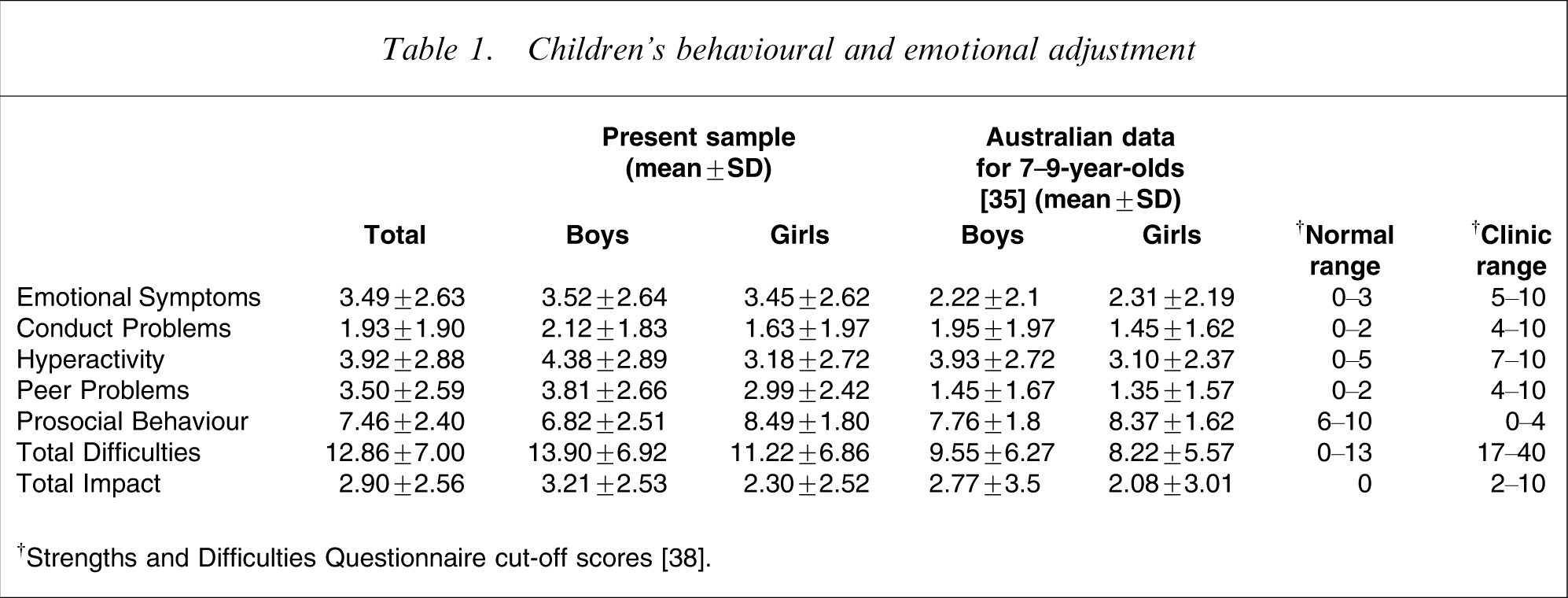
†Strengths and Difficulties Questionnaire cut-off scores [38].
Children in the normal, borderline and clinic range on the SDQ
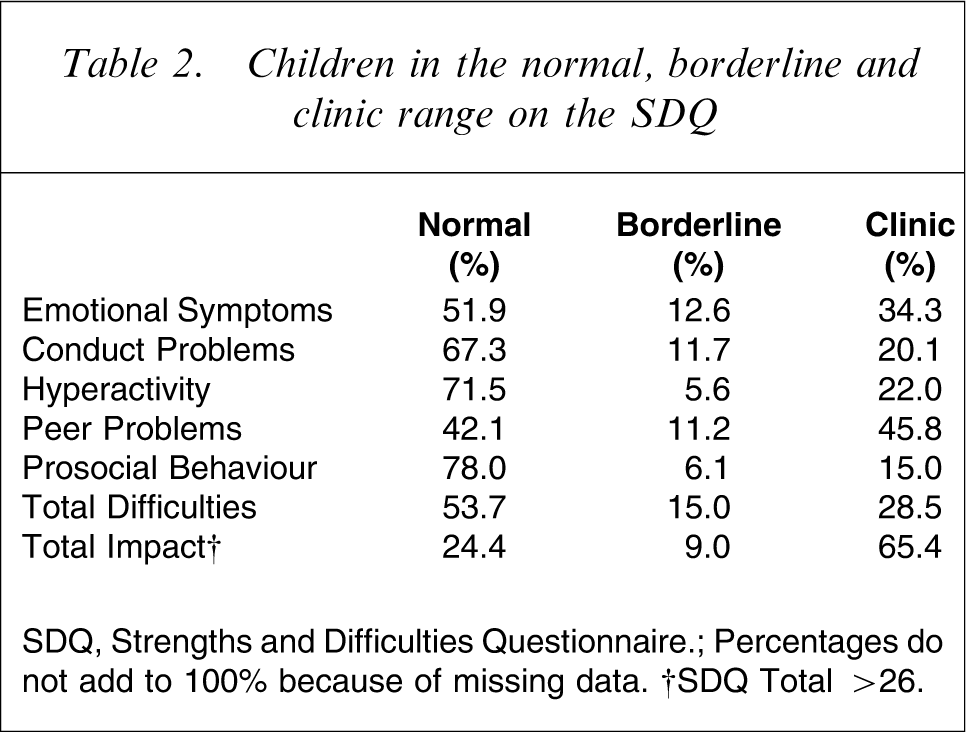
SDQ, Strengths and Difficulties Questionnaire.
Percentages do not add to 100% because of missing data. †SDQ Total >26.
Parenting style and confidence
Parents reported parenting styles consistent with normative means for community samples. For laxness, mean±SD = 2.29±0.68, verbosity = 3.51±0.84, and overreactivity = 2.87±0.84, on average the scores fell within the normal range. But although the majority of parents were not in the clinical range for laxness (87.9%), a considerable minority of parents scored in the clinical range on verbosity (27.6%), and overreactivity (41.6%).
Parents in this sample reported a comparative level of Setting Self-Efficacy and Behavioural Self-Efficacy (mean = 88.59±11.57 and 80.14±17.60, respectively), to the published normative mean for a community sample (mean = 88.66 and 81.86, respectively). Parents felt least confidence with the following items: child refusing to do as they are told, mean±SD = 76.42±22.33; child acts defiantly when asked to do something, mean±SD = 76.54±20.92; child gets upset when don't get their way, mean±SD = 78.93±23.65, when parent on the phone, mean±SD = 79.17±21.10.
A median split was performed on parental confidence, in order to examine the differences between parents who reported high confidence, versus those who reported low confidence. The differences in terms of child behaviour and family variables between the two groups were compared using one-way ANOVAs. As can be seen from Table 3, there were many differences between parents with higher versus lower levels of confidence. Parents who reported higher confidence reported fewer child behavioural and emotional problems, less use of ineffective discipline, less depression and stress, fewer conflicts over parenting, and more relationship satisfaction.
Differences between parents who report high vs low parenting confidence
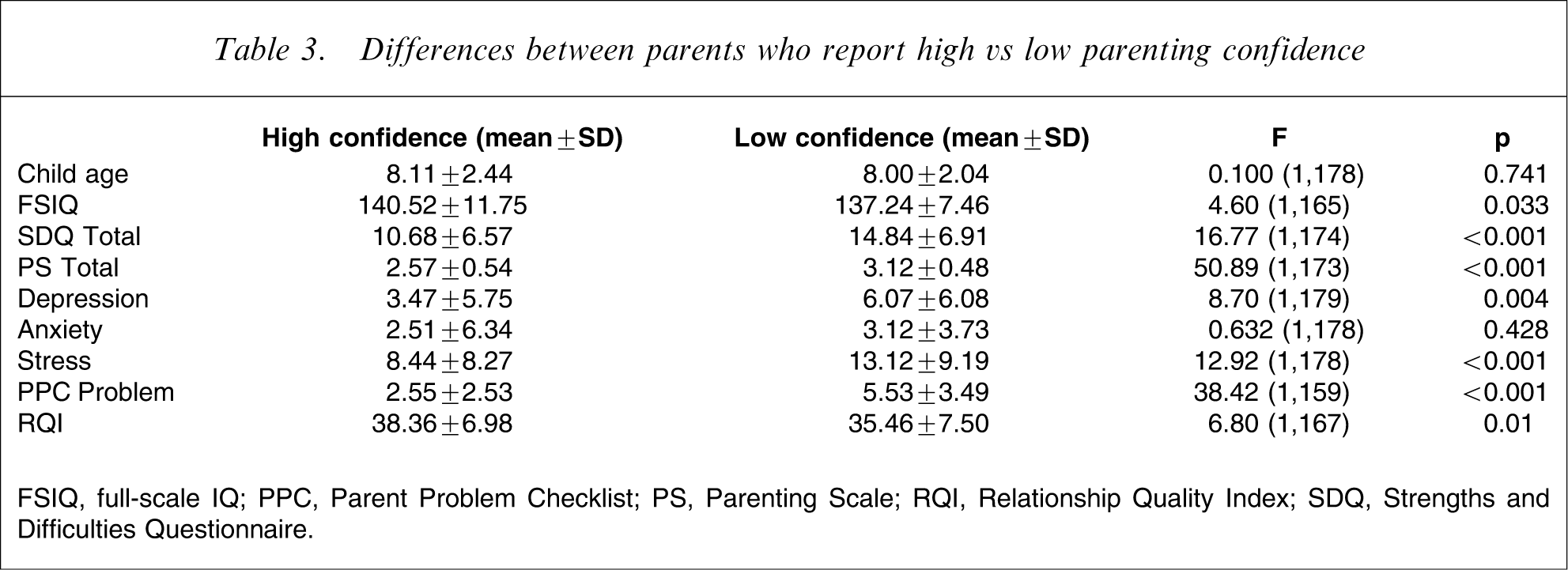
FSIQ, full-scale IQ; PPC, Parent Problem Checklist; PS, Parenting Scale; RQI, Relationship Quality Index; SDQ, Strengths and Difficulties Questionnaire.
Parental adjustment and relationships
Overall, in this sample parents reported few symptoms of depression, mean±SD = 4.82±6.22; anxiety, mean±SD = 2.84±5.08; or stress, mean±SD = 10.74±8.88. Furthermore, the scores on the PPC Problem scale were in the normal range, mean±SD = 4.18±3.35, as were scores on the RQI, mean±SD = 36.41±7.75. This indicates that with respect to parent adjustment and relationship conflict and satisfaction this was a normative community sample.
Predictors of child behavioural and emotional problems
Hierarchical multiple regression was used in order to examine the relationship between child behavioural and emotional problems, using the SDQ Total score and a range of child, demographic and family variables, based on significant correlations between the variable and the SDQ Total score. Child gender was entered at step 1, family sociodemographic factors at step 2, and measures assessing parenting style, parenting confidence, parental adjustment, and parental relationship were entered at step 3. A significant relationship was found between child behaviour and child gender at step 1 (R = 0.187; F(1,159) = 5.75, p = 0.018), accounting for 3.5% of the variance (Radj 2=0.03) in child behaviour. The standardized regression coefficients (β), as well as their 95% confidence intervals and tests of significance, zero-order and squared semi-partial correlations for steps 1, 2 and 3 are shown in Table 4. Addition of mother's education level and household income at step 2, significantly contributed to prediction, Fchange(2,157) = 3.08, p = 0.049. Child and demographic predictor variables together accounted for 7.1% of the variance (Radj 2=0.05), in child behaviour, F(3,157) = 4.02, p = 0.009. Only child gender was significantly related to child behaviour as indicated by significant t-values and confidence intervals, which do not span zero. Addition of parent variables at step 3, significantly contributed to prediction of child behaviour, Fchange(5,152) = 7.25, p < 0.001. All the variables accounted for 25% of the variance (Radj 2=0.21) in child behaviour, F(8,152) = 6.34, p < 0.001. The variables significantly related to child behaviour were child gender, mother's education level, and parenting confidence, as indicated by a significant t-value and confidence intervals, which do not span zero.
Hierarchical multiple regression predicting child behaviour (SDQ Total)
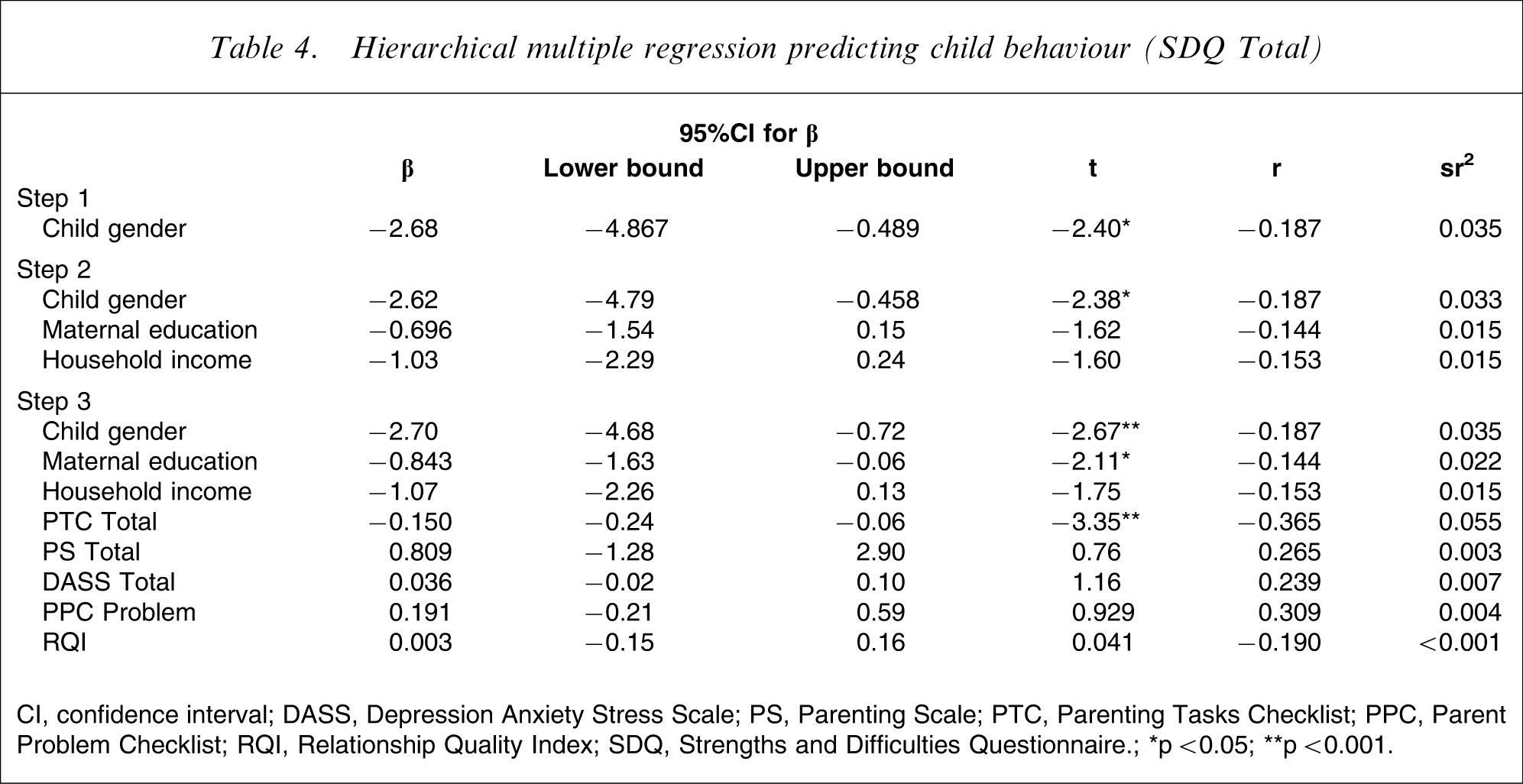
CI, confidence interval; DASS, Depression Anxiety Stress Scale; PS, Parenting Scale; PTC, Parenting Tasks Checklist; PPC, Parent Problem Checklist; RQI, Relationship Quality Index; SDQ, Strengths and Difficulties Questionnaire.
∗p < 0.05; ∗∗p < 0.001.
Discussion
The literature on gifted and talented children has been equivocal in relation to the nature and extent of behavioural and emotional problems. The present study has demonstrated that for a community sample, in general gifted and talented children exhibit no more difficulties than do other children. The two exceptions to this were that children in this sample seemed to show higher levels of emotional symptoms (e.g. often seems worried), and peer difficulties when compared to normative data. In particular, children seemed to have most difficulties with peer relationships (e.g. gets along better with adults than with other children), with <than 45% of children scoring in the normal range on the SDQ for this subscale. Compared to a normative Australian community sample, children in this sample had slightly more problems across all areas.
Difficulties with peer groups have been identified as a specific problem for gifted and talented children [13], and may relate to their asynchronous development, their feelings of difference, or a lack of shared interests and opportunities with other children. By virtue of their higher intellectual ability gifted children are likely to be perceived as different by other children, and may be labelled as ‘nerdy’ or a ‘teacher's pet’ [13], [44]. Such labelling can make it difficult for the gifted child to initiate and sustain social interactions, and may place them at risk of social isolation and bullying [45], [46]. Furthermore, gifted children are either placed in classrooms with children of the same chronological age, or they are accelerated. Putting aside any discussion of the relative advantages and disadvantages of acceleration, gifted children may simply find themselves in a peer group that is not matched to their ability and interest level. If children are with their chronologically matched peers, they may be too advanced cognitively compared to their peers, and not find other children interesting; conversely, if placed with older children they may lack the social skills and development to integrate well. Finally, gifted children may have specific interests or talents that are different to those of most children, and may find that they have little in common with others [47].
While the design of the present study precludes conclusions about any causal mechanisms, children's difficulties with peers may contribute to the higher level of emotional symptoms present in this sample. Previous research has demonstrated that difficulties in social interactions and relationships can contribute to poorer emotional adjustment. Furthermore, there is some suggestion in the literature that gifted children are more sensitive and susceptible to the development of emotional disorders [2], [48–50], and the findings of the present study are consistent with this notion. The present results also demonstrated that the best predictors of children's difficult behaviour included male gender, lower maternal education, and lower parental confidence. Parental confidence was the best predictor of child behaviour, and is the only of the three variables that is potentially modifiable.
One of the central aims of the present study was to examine parenting discipline styles and confidence, as well as broader family adjustment for parents of gifted and talented children. Parents in the present study reported good personal adjustment, and low levels of marital dissatisfaction or conflict regarding parenting. In general, parents reported parenting styles consistent with normative means for community samples. Interestingly, while the majority of parents reported that they were not permissive in their discipline style, there were much higher levels of verbosity and overreactivity in the context of discipline. This suggests that although parents are less likely to be permissive with their child, they may tend to use a more authoritarian style of parenting characterized by lecturing and a strong reaction to any problems. Previous research has provided very limited information about the parenting styles of this group of parents, and has mainly focused on very broad assessments of the family environment [33], [51]. The present study provides insight into some of the specific areas where parents might experience difficulties in disciplining their gifted child. Consistent with clinical observations of parents of gifted and talented children, many parents place a high value on negotiation skills. While negotiation is an important skill for children to learn, negotiation in relation to issues of discipline is often counterproductive. For example, if the parent is not prepared to change their position on their child having a bath in the evening, negotiation in relation to this is futile, and is likely to be frustrating for both parents and children.
Parents in this sample generally felt confident in managing both specific child behaviours, and handling their child in different settings. Parents felt less confident in managing behaviours, as opposed to settings. In particular, parents felt least confidence in handling children's non-compliant and defiant behaviours, such as the child refusing to do as they were told. A parallel may be drawn here to parental reports of how they handle such incidents. Parents felt least confident in handling oppositional behaviour, and they may manage such behaviour by negotiation with the child, and lecturing. This parenting response is likely to contribute to future difficult behaviour on the part of the child, and increasingly coercive interactions between the parent and child [52]. Finally, parents who reported higher confidence reported fewer child behavioural and emotional problems, less use of ineffective discipline, less depression and stress, fewer conflicts over parenting, and more relationship satisfaction.
The present study had a number of limitations that need to be considered. First, sample recruitment may have led to a selection bias, in the sense that parents who were more motivated, and more resourceful were more likely to participate. Children in high-risk families are less likely to be identified and assessed as gifted, and hence are less likely to participate in research of this nature [5]. Although this may certainly apply in the case of the present research, it does point to the broader need for better identification and assessment of gifted children from all social and cultural backgrounds. Although a comparison was made to Australian normative data, no control group was available for this study. Future research could extend this comparison using a between-groups design, but gifted and talented children also need to be examined within groups to clearly enunciate areas of difficulty.
A further limitation of the present study was the narrow range of child and parent behaviours assessed. For practical reasons only a limited range of assessment tool were utilized to assess parent and child behaviours. Nevertheless, this research provides a more extensive description of gifted talented children and their parents than much of the research in this area, providing a framework for variables that need to be addressed in more depth. For example, future research could focus on the specific emotional and peer relationship difficulties identified in the present study. Similarly, observational research examining parent–child interactions would add light to how parents successfully facilitate children's learning and development and manage difficulties. Finally, children's views could also be explored through self-report and interviewing to gain a more comprehensive picture of areas of strengths and difficulties.
The present results provide areas of focus for both research and clinical practice in working with parents of gifted and talented children. In particular, more research emphasis needs to be placed on the interactions between gifted children and their parents, both using parent and child self-report, as well as observational studies. Parents subjectively report that parenting a gifted child is different, and appear to use somewhat different parenting strategies compared to other parents. Exploration of the similarities and differences would assist parents in their role, and help guide effective intervention delivery. Clinically, it is important that evidence-based interventions are developed and empirically evaluated, in order to aid professionals working with this group of parents in providing the most effective level of support. Based on the present findings, parenting interventions may need to focus specifically on ways to manage difficult behaviour, but also to assist in enhancing parent's confidence in their own role. One example of such an intervention is Gifted and Talented Triple P, which is discussed extensively by Morawska and Sanders [53], and is currently being evaluated using a randomized controlled trial methodology. While this is a step forward in the research, more evaluations of interventions to guide clinical work are required.
Footnotes
Acknowledgements
This research was supported by a research grant from the Telstra Foundation. We would like to acknowledge the work of Emma Sanders, Lorna Hobbs, and Dale Parkins in administering the project and with data entry.