




Abstract
Keywords
Acute interventions to prevent long-term psychiatric morbidity have become one of the most contentious areas of mental health research. The issues raised by the debate about the relative merits (or otherwise) of these interventions and particularly psychological debriefing (PD) have ramifications for psychiatry beyond the field of psychological trauma. Despite 17 years of research since Mitchell originally described critical incident stress debriefing (CISD) [1], the role of acute intervention remains the subject of heated debate both within the professional community and among the general public.
Preventing posttraumatic stress disorder (PTSD), and other more recently recognised and equally important, but much less well-defined posttraumatic illnesses, has become a major public health issue. More than two-thirds of the population at some point in their lives are exposed to potentially traumatising events of sufficient severity to meet the ‘stressor’ criterion for current PTSD diagnostic criteria [2]. The point prevalence of clinically significant PTSD in the general population is at least 2–3% [3]. The victims of accidents, terrorist outrage [4], disasters [5,6] and personal tragedy such as torture or rape [7] are all vulnerable to PTSD. Unfortunately, many of these receive little or no psychological support, particularly when there are also serious physical injuries, which take precedence on a busy trauma unit, deflecting attention from psychological problems. Under these circumstances, any psychological intervention has to demonstrate clear face validity and be manifestly effective and pragmatic if it is to be accepted as part of routine trauma care by non-mental health professionals who are often at best sceptical about the value and merits of psychological interventions.
The value of acute psychological interventions following traumatising events have recently become a matter of medico-legal importance and concern to employers and those in occupational medicine [8]. Numerous ‘high-risk’ occupations are clearly associated with an increased incidence of serious and potentially disabling posttraumatic illness including PTSD. In a climate of increased individual rights, many countries have established stringent occupational health and health and safety at work legislation. Faced with the threat of litigation, it is hardly surprising that employers have begun to take a keen interest in the psychological wellbeing of their workforce. The military has been especially affected by these attitudinal changes where the prevalence of chronic PTSD in combat veterans has been reported to exceed 31% [9]. The emergency services face similar high rates of exposure to traumatising events. Posttraumatic stress disorder prevalence figures as high as 30% or more have been reported in observers and rescuers alike following serious accidents and disasters [5,6,10]. The handling and identification of human remains is particularly likely to be associated with subsequent psychological morbidity [11,12] and is recognised as a stressor that ‘can make victims of rescuers’ [13]. Significant psychological morbidity has also been reported in ‘second-line’ support workers such as administrators, control room and reception staff, switchboard operators, hospital ancillary and volunteer workers as well as the families of servicemen and emergency service personnel [14]. The witnesses of conflict and disaster including aid workers, journalists and other members of the media all suffer from a high incidence of PTSD. It is somewhat ironic that, although the media have been quick to criticise the lack of psychological support in the military and other organisations, its own employees: journalists, photographers and cameramen generally receive little or no psychological support themselves after witnessing and reporting traumatic events.
Preventing PTSD in these ‘high-risk’ groups has important implications for employers and occupational health physicians. Organisations which routinely send their employees into potentially traumatising situations have a statutory ‘duty of care’ to protect the health of employees and minimise the impact of occupational health hazards to which employees may be exposed. Identifying effective techniques to minimise long-term psychological sequelae is an important, but neglected, area of occupational health medicine which may improve the morale and health of a workforce as well as discharging an employer's duty of care under occupational health legislation. Recent litigation has arisen not because workers have suffered PTSD per se, rather their employers have been negligent in failing to minimise the risk of exposure to trauma, detect or offer treatment for psychiatric injury which has developed as a result of workplace exposure [15].
The importance of debriefing
Efforts to minimise long-term psychiatric morbidity following traumatic events have resulted in calls for the routine provision of acute psychological interventions for the victims of trauma. These calls are based on the assumption that the earlier intervention occurs, the less opportunity there is for maladaptive and disruptive cognitive and behavioural patterns to become established [16]. Although intuitively appealing and a response to perceived need, whether or not these interventions work remains strenuously contested.
The role of acute interventions, particularly in disaster planning, has also become extremely newsworthy. The media exposes the public to a regular diet of accident, disaster and conflict, as well as often controversial litigation in which victims and rescuers seek compensation following traumatic events. Disaster entertains and public curiosity and a fascination with the ‘human interest’ story heighten media attention. When disaster strikes the media routinely reports that ‘… trained counsellors have arrived at the scene to counsel the survivors’. However, their training, competence and qualifications, as well as the specific nature of their interventions, are often highly variable. Moreover, the risks and benefits of these interventions are themselves equally uncertain. Public attitudes towards victims and therapists alike are viewed with ambivalence and at times suspicion and downright hostility. Stigma, fear born of ignorance and discrimination pervade public attitudes to the victims of psychological trauma and mirror attitudes to psychiatry in general. Patients are frequently portrayed as scrimshankers and malingerers, counsellors and therapists as quacks and charlatans. These negative perceptions have been fuelled by contentious litigation in which plaintiffs have sought (and sometimes recovered) financial compensation disproportionate (in the public perception) to any loss or suffering.
Furthermore, disaster projects psychiatrists and other mental health workers into the media spotlight where their attitudes, conduct and effectiveness have become an important ‘showcase’ for the mental health professions. Psychiatry in general has a hostile press and only receives media attention in the wake of a tragedy when things have gone wrong. Interest in the psychological aftermath of traumatic events affords a rare opportunity to educate the public. It is noteworthy that the largely positive impact of military psychiatry during World War II was a significant stimulus to postwar research (resulting, for example, in the foundation of the National Institute for Mental Health in the USA), as well as stimulating the social psychiatry movement that led psychiatry out of the asylums. Delivering timely, effective interventions in high-profile events invites positive reporting of the work of mental health professionals which can have a powerful opinion-forming influence on public perceptions and attitudes both to victims and mental health workers.
Preventing psychological trauma raises important theoretical, as well as numerous practical, issues and challenges. Government health policy in many developed nations places increasing emphasis on preventive medicine. Considering the high prevalence of mental illness and its social and economic burden to society, psychiatry has little to offer by way of preventive mental health strategies. Posttraumatic stress disorder is a common and potentially disabling disorder, its epidemiology well known following traumatic events, the ‘at risk’ population and the interventions employed can potentially be well defined [17]. No other area of mental health lends itself so well to preventive research, and the complexities of methodology and experimental design encountered in trauma research should serve as an exemplar for prevention research in other areas of mental health.
Moreover, the effects of psychological trauma provide potentially important insights into neuroscience that affords a unique opportunity to explore the relationship between external events, brain biology and mental phenomena. Research into psychological therapies seldom measures biological outcome variables. Exploring associations between neuroendocrine markers, phenomenology and the influence on these of psychological techniques enables the development of heuristic models to explore similar relationships in other areas of psychiatry [18]. Biological abnormalities in PTSD are well documented, and demonstrating the impact of psychological therapies on these not only reveals insights into brain function, but also challenges the Cartesian ideology and ‘mind–body’ dualism that still pervades and restricts research in psychology and other neurosciences.
The effectiveness of acute interventions to prevent PTSD or other long-term psychological sequelae has become increasingly politicised and more than a matter of science. The interpretation of a number of recent randomised controlled trials (RCTs) is keenly contested [19]. Many workers in the field of psychological trauma clearly have powerful vested interests in promoting the efficacy of interventions such as PD that often they themselves have developed. Indeed research grants, as well as the livelihoods of individuals employed by companies contracted to provide debriefing services, might depend on it! The last decade has witnessed the emergence of a ‘disaster industry’. Not uncommonly, diverse professional groups including psychologists, social workers, the clergy and psychiatrists (sometimes from the same institution and unaware of each other's activities) appear in the wake of a disaster to offer identical interventions in an uncoordinated and sometimes overlapping manner. More worrying, lay workers and volunteers with little professional background and training descend in their hordes on a disaster site to offer assistance. Against this background it is not surprising therefore that some of these groups have uncritically promoted debriefing techniques in order to establish a role for themselves following traumatic events [20]. Although intuitively appealing and a response to perceived need, demonstrating the effectiveness of early intervention has been extremely difficult [21] and it is only recently that PD has been subject to randomised controlled clinical trials (RCTs). Dialectically opposed to these groups are the ‘antitherapy’ movement (both from within psychiatry and outside) who have also taken an interest in debriefing and have been quick to draw parallels between debriefing, psychotherapy and counselling in general. The (essentially negative) results of RCTs of preventive interventions, particularly PD [22], have been used as a ‘stick’ to beat and challenge the evidence base of psychotherapy and the counselling industry. Debriefing, however, is not psychotherapy nor is it counselling. Its clients are not ill, nor are they seeking help. Debriefing aims to prevent the normal stress response becoming abnormal, it is primarily educational and instructive in content rather than a psychotherapeutic process. Generalising the findings of debriefing research to the psychological treatment of established disorder and disparate forms of counselling in diverse settings such as marital breakdown, bereavement, rape and sexual abuse is both illogical and deceptive.
Outcome research into the effectiveness of acute interventions such as debriefing raises important questions about the ethics as well as the status of conventional RCT methodology as the imprimatur of evidence-based medicine (EBM). Randomised controlled clinical trials have become the dominant paradigm of treatment outcome studies to the virtual exclusion of observational or case studies. Critical incident stress debriefing was designed for groups of emergency service workers following traumatic events. Conducting a methodologically rigorous RCT of group debriefing would be extremely difficult given that group trauma generally only occurs in unpredictable and often chaotic circumstances such as war or disaster. In emergency situations such as these the operational imperative is paramount and investigators must do the best they can with the available material under difficult and at times extremely fraught circumstances. Irrespective of whether or not debriefing reduces long-term morbidity many individuals find it subjectively helpful at the time [21]. Under these circumstances, can it therefore be ethically justifiable to employ ‘non-intervention’ controls denying individuals short-term support whatever the long-term outcome? In conflict, following disaster or accident, naturalistic studies, often conducted opportunistically, remain useful and have considerable heuristic value despite methodological shortcomings, particularly relating to sample selection and randomisation to different treatment conditions. Applying the stringent criteria demanded by the arbiters of EBM, such as the Cochrane Library, to trials of preventive interventions means that much useful work might go unpublished. Clinicians might well lament that in attempting to satisfy such rigorous methodological criteria RCTs have become so divorced from clinical reality that their findings become meaningless. It is noteworthy that even in the most robust RCTs subjects are seldom selected from epidemiological samples. Researchers may be forgiven for forsaking such methodologically challenging research entirely in favour of more biologically orientated research where variables can be more easily controlled, confounding factors minimised and publishable outcomes virtually guaranteed. Randomised controlled trials are not the sine qua non of EBM and debriefing studies which challenge their hegemony and lend credibility to observational studies have important implications for the ways in which the quality and value of research evidence is assessed, both in social psychiatry and empirical science in general.
Are we speaking the same language: the nature of acute interventions
Numerous variations on the basic model of Mitchell have been developed. Indeed the basic Mitchell model is itself derived from a long clinical tradition [23]. The roles of these models within trauma management have themselves shifted with time. At one extreme, intervention packages have been developed which are primarily educational, pragmatic and supportive, often conducted by peers or line managers [24]. These are often employed in organisations such as the military where the prevailing culture inhibits the open expression of emotion and tends to be rejecting of outsiders and mental health professionals. Other models, generally employed with victims in civilian settings, have been developed with a more psychodynamic emphasis, highlighting the importance of group processes and the relationship between group members and facilitators [25]. Even within a well-defined intervention such as PD, the ‘goalposts’ have shifted and the recommended number, frequency and timing of the intervention have varied with time, as has the recommended use of adjunctive therapy including simple counselling, practical support and the use of formal cognitive behavioural techniques. Redefining the role or content of an intervention keeps the technique one step ahead of the researcher and makes efficacy difficult to refute and comparisons between studies difficult to draw.
Evaluating the effectiveness of debriefing is often hampered by a lack of any clear description of its content; those techniques that are described frequently vary considerably. As the term becomes more widely used so its actual content seems to vary more. An example of the confusing use of nomenclature is the PD advocated by Hayman and Scaturo [26] who suggested a 10-session intervention for US Army Gulf veterans which, as a preventative intervention, is longer than many treatment programs.
The timing, as well as the frequency, of the intervention also varies greatly in reported studies [19]. Immediate debriefing is often neither possible nor desirable. Following serious trauma individuals are often extremely fatigued and in a poor physical state needing food, rest and medical attention before debriefing can take place. Furthermore, many individuals experience emotional ‘numbing’ during and immediately following traumatic events and do not benefit from immediate debriefing. Dyregrov himself [25] suggests that debriefing should optimally take place 48–72 h after the incident, although some authors have reported on debriefing several months after the incident [27,28]. Due to logistic problems, especially with the wide dispersal of victims, as in the King's Cross Fire [29], delays of up to a few weeks may be inevitable. The advocates of PD believe that, although immediacy is important, delayed debriefings can still help [30]. It is hardly surprising that attempts to compare and evaluate these studies result in confusion and controversy.
How effective is psychological debriefing?
There are numerous anecdotal reports suggesting that providing debriefing for everyone involved in a traumatic experience reduces subsequent psychological morbidity [1,31]. The acceptance of such claims has led to the widespread use of debriefing following traumatic events. Indeed it is now used routinely in Scandinavia and in a number of commercial organisations following traumatic events such as bank robberies. A single, stand-alone intervention is clearly popular with employers anxious to discharge their ‘duty of care’ as inexpensively as possible. Unfortunately, at present there is little other than anecdotal evidence to demonstrate the effectiveness of debriefing and the vast majority of published data suffers from various methodological difficulties (Table 1).
Common methodological shortcomings in psychological debriefing (PD) research
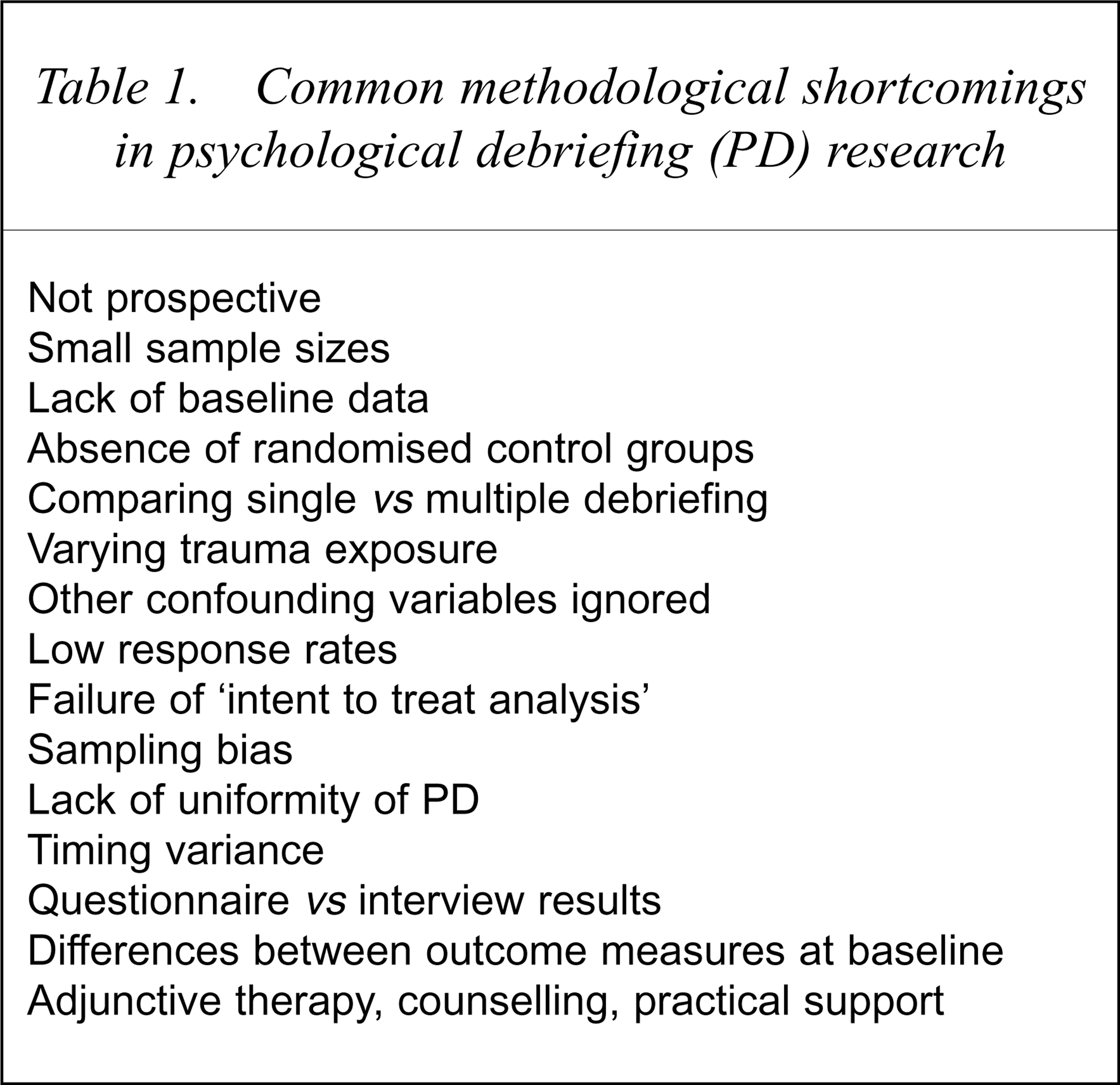
The more important shortcomings most commonly cited by the critics of debriefing include the lack a prospective controlled designs and random allocation to treatment groups. Few studies have employed controlled designs with pre- and post-treatment measures [32]. Other important deficits inviting scepticism include a lack of preintervention data on subjects and a reliance on questionnaire results as opposed to validated interview data.
No two traumatic events are the same and comparing one incident with another is problematic. Unfortunately, standard measures of the dimensions of the trauma are rarely recorded and comparisons are often made between relatively minor traumatic events and major disasters [33]. Similar problems arise when single-event trauma is compared with sustained or repetitive traumatic events. Other factors known to influence psychological outcome are seldom considered. These include the context in which an event occurs as well as personal factors such as past psychiatric history, individual coping mechanisms and the presence of an acute stress reaction at the time of the trauma. Enthusiasts of RCTs and the Cochrane library assert that the true effectiveness of PD can only be assessed in well-controlled studies taking these other dimensions into account. Whether evermore refined and better-controlled RCTs can be devised to accommodate these variables is debatable and, in the context of debriefing research, this goal may prove illusory. What observational, case-series and comparison studies may lack in method, they often gain in clinical relevance. Randomised controlled trials risk ‘throwing the baby out with the bathwater’, becoming increasingly remote from workaday practice and loosing face validity in an effort to satisfy ever-more demanding methodological criteria.
Another common problem in the literature is low response rates resulting in sample bias. Lindy [34] described the ‘trauma membrane’ which needs to be penetrated. If a group of individuals is sceptical about the value of any psychological intervention, they are unlikely to cooperate or sanction ‘experimentation’ with colleagues or loved ones. In their outreach program following the Beverly Hills Supper Club fire only 5% of those involved ‘engaged’ despite extensive publicity and personal invitations to attend. The prevailing culture in the armed forces and emergency services, with its emphasis on psychological ‘tough-mindedness’, creates particular difficulties in studying these groups.
Comparison studies
Comparison studies consider a group of individuals involved in a traumatic event(s) and then compare them according to whether or not PD was received. Their findings are weakened by the absence of random allocation to intervention or non-intervention groups: the reasons that determine whether or not individuals attend PD may be extremely important and result in considerable sample bias, markedly affecting the outcome. Conversely, their strength is that they are frequently conducted in emergency situations, which reflects the original intended use of debriefing.
McFarlane followed up 469 firefighters involved in a series of Australian bushfires [14]. Although not the main focus of the paper, he found that those who received PD shortly after the incident were less likely to develop an acute posttraumatic stress reaction than those who were not debriefed. However, the effectiveness of the debriefing process was thrown into doubt by his finding that individuals who developed a delayed onset posttraumatic stress reaction were more likely to have attended a debriefing than those who had suffered no psychological disorder at any time during the follow-up period. This led McFarlane to comment that psychological debriefing may have immediate protective value, but has little effect in the longer term.
Deahl et al. considered the effectiveness of PD in soldiers who acted as gravediggers during the Gulf War [35]. Seventy-four soldiers took part in the study; 55 of them received a PD soon after completing their duties. Nine months later, 50% of the group showed evidence of PTSD. Debriefing made no difference to the incidence of PTSD. Soldiers who developed PTSD were more likely to have experienced an acute stress reaction or believed that their lives were in danger. Interestingly, soldiers experiencing relationship difficulties with partners were also more likely to develop PTSD. Hyton and Hasle similarly questioned the effectiveness of PD as a result of their study of 58 non-professional firefighters exposed to dead bodies following a major hotel fire in Norway [36]. They found no difference in psychological symptoms 2 weeks later between those formally debriefed and those who had talked with colleagues.
Where individuals have an adequate support network debriefing may be redundant. Joseph et al. found that survivors of the Jupiter shipwreck who received more ‘crisis support’ from family and friends suffered less avoidance symptoms at 18 months, although they experienced similar levels of intrusion to the comparison group [37]. They argued that individuals without such support could be identified and offered more help. The identification of ‘high risk’ groups seems sensible, particularly when resources are scarce.
Controlled studies
There have been few adequate prospective controlled studies of debriefing involving random subject allocation to PD or no intervention which satisfy inclusion criteria for the Cochrane Library of EBM [22]. Although the studies included in the Cochrane library have been much vaunted, their weakness lies in their content (generally a single subject debriefing) and context (single intervention). In achieving methodologically robust subject selection and randomisation criteria these studies have tested debriefing in a very different arena from which it was originally intended. Bunn and Clarke assessed the use of a 20 min ‘supportive interview’ with a psychologist as opposed to no intervention in the relatives of severely ill or injured patients admitted to an emergency ward [38]. Those interviewed were less anxious immediately after the interview, but there was no follow up to assess its effectiveness even in the short term.
In the wake of such disappointing results, five subsequent RCTs have been conducted which have largely confirmed those findings failing to demonstrate any benefit of PD in preventing subsequent PTSD and other psychiatric disorders. These studies have randomised individuals following disparate traumatising events of varying severity. Debriefing has generally followed the Dyregov model, although the timing of the intervention has varied both within and between studies. Hobbs and Adshead conducted two RCTs, one studying 42 victims of various traumas, the other a follow-up study of 86 road traffic accident victims [39]. In both these studies, debriefing was carried out within 24 h of the traumatic event. Three months later there were no significant differences in rates of PTSD between those debriefed and the control group. Lee et al. studied 39 women 2 weeks following miscarriage [40]. This study actually reported an adverse, albeit non-significant effect, in the debriefed group compared with non-debriefed controls 4 months later. Bisson et al. studied 110 burn victims, the treatment group received debriefing on average 6 days following their injury [41]. In this study the debriefed group actually had a worse outcome although it was suggested that they had a greater pre-incident vulnerability. A study of road traffic accident victims failed to demonstrate any difference at 1 and 6 month follow up between a group of 68 victims who received a preventative counselling program and 83 who did not [42]. Ten per cent satisfied the criteria for PTSD in both the intervention and control groups. It is interesting to note that in common with Robinson and Mitchell's PD findings [43], those who received the intervention said they found it useful. This perceived usefulness does not always seem to be detectable with the research tools employed in the studies. In a recent trial of debriefing for 157 victims of violent crime, the subjects in both groups improved with time and no particular benefit was found in the debriefed group at 6 and 11 months follow up [44]. Although debriefing was designed for groups of emergency service workers, there have been few adequate RCTs of group debriefing to date.
In clinical practice PD is seldom used in isolation and PD is generally employed as one element of a comprehensive critical incident stress management package. Evaluating PD as a ‘stand-alone’ intervention may not be valid. Moreover, PD was originally devised for groups of ambulance workers attached to the emergency services and RCTs of PD in individuals disregards the complex group dynamics among a cohesive close-knit group of individuals who have shared a common trauma. In a recent study of group debriefing carried out among a group of soldiers returning from UN peacekeeping duties in Bosnia [45] debriefing appeared to make no differences to PTSD or affective symptomology after 1 year. However CAGE scores (a widely used measure of alcohol misuse), were significantly reduced in the debriefed group 6 months and 1 year later. These findings suggest that debriefing may have an effect, but that a broader range of outcome measures should be used including substance misuse and social dysfunction (both common behavioural sequelae of PTSD) to evaluate outcome.
Few studies have compared debriefing with any other form of practical support. This is unfortunate, as outcome research in psychological therapies has increasingly acknowledged the inadequacies of ‘waiting list’ or no-intervention controls, which fail to control for the effects of a ‘sympathetic ear’. Bordow and Porritt studied 70 male road trauma victims who were hospitalised for at least 1 week [46]. The 30 individuals in group A received no intervention. The 10 in group B were ‘reviewed’ (an intervention similar to PD with detailed discussion of the trauma) soon after their admission, but received no further intervention. The remaining 30 (group C) received the ‘immediate review’ and then between 2 and 10 hours of formal intervention from a social worker looking at practical, social and emotional levels of support depending on their apparent needs. Follow up 3 to 4 months later revealed that group C suffered significantly fewer psychological sequelae than group B who in turn fared better than group A.
More complex early interventions: a pragmatic approach to acute intervention?
Bordow and Porritt's study [46] suggests that more complex preventative interventions following traumatic events may be more effective than PD alone. A number of workers argue that a CISD model is too simplistic and have suggested that a ‘loss and bereavement’ model is more appropriate. Mitchell himself acknowledges that ‘not everyone in every instance will benefit from a CISD. Many times they will need more help than a debriefing alone can provide’ [47]. Robinson and Mitchell [43] emphasised that PD should be one element of a comprehensive management plan following trauma and the British Psychological Society's working party [20] concluded that single methods of support in isolation following traumatic events are unlikely to be effective unless combined with other measures. Recent trauma stress management programs have become increasingly selective, targeting vulnerable individuals (particularly those suffering from acute stress disorder) with a combination of debriefing techniques and practical support. The emphasis is on follow up, risk assessment and management reflecting general trends in health care [24]. There are several studies describing more complex interventions after various traumatic events including the extensive literature on crisis intervention in psychiatry [48].
Some of the most striking data on the effectiveness of early interventions comes from Israeli studies on combat stress reaction (CSR) sufferers during the Lebanon war. In this conflict, the principles of proximity (to the battlefield), immediacy (of treatment) and expectancy (of return to duty), or PIE, in the outcome of CSR victims have been investigated [49]. Where all three PIE principles were employed 60% returned to duty and 40% had developed PTSD 1 year later. Where PIE was not employed only 22% returned to duty and 71% were suffering with PTSD after 1 year. Although it is important to appreciate that these individuals were already unwell and therefore unlike the recipients of PD, the study nevertheless seems to confirm the impression that early intervention may help to reduce psychological sequelae in this vulnerable group, but not actually prevent them. It is interesting to compare the 71% of PTSD in these CSR victims with the 14% incidence of PTSD among veterans who had not suffered CSR [50]. There is now increasing evidence that the presence or absence of acute stress disorder (ASD) following trauma is one of the strongest predictors of long-term psychiatric morbidity. Indeed ASD in a proportion of victims may have more effect on long-term outcome of the entire group than the presence or absence of early psychological intervention administered to everybody irrespective of whether or not they are suffering from ASD following trauma.
Risks of debriefing
It has become increasingly recognised that there may be risks associated with PD and other forms of early psychological intervention. The provision of such services results in ‘helpers’ being exposed to the expression of powerful emotions by the victims of the trauma, making their work extremely stressful. An unfortunate corollary is the recognition that the service providers may themselves become ‘secondary’ victims [51–53].
Another risk is the possibility of passive participation and resentment engendered by mandatory PD [54]. A good example of enforced early intervention is the case of the Americans held hostage in Iran in the late 1970s [55]. Many of the hostages felt ‘ready to fly home immediately’, but instead spent a 4 day period of seclusion and gradual reintroduction in Germany before being reunited with their families. Although ‘nearly all’ acknowledged that their initial feelings were ‘overly optimistic’, no comment was made on the feelings of those who were forced to undergo this process against their will.
Another danger of early intervention discussed by McFarlane is that overenthusiasm for primary preventative methods might delay the institution of diagnosis and effective treatment for those who do suffer psychological sequelae [56]. He argues that ‘clear definition of the limitations of the crisis intervention approach and the point at which more formal treatment is required’ is needed. His concerns were fuelled by his finding that many individuals with psychiatric disorders arising out of the Australian bushfires presented late due to other professionals' fears that labelling would occur following referral to a psychiatrist [57]. Such fears must be overcome if the victims of trauma are to receive the treatment they often need. If PD is employed following traumatic events some form of follow-up is important. This facilitates the identification of those who go on to develop serious psychological sequelae and ensures that they are offered adequate treatment.
Conclusions
Whether or not acute preventative interventions such as debriefing reduce the incidence of long-term psychological morbidity following trauma remains uncertain. The data available from mostly methodologically flawed studies suggest that, at best, PD affords some sense of hope and understanding and, at worst, makes no difference and may even make some individuals worse. Certainly individuals receiving PD are not immune to developing long-term psychological sequelae. Therefore, regardless of whether PD is employed following traumatic events, formal follow up to identify individuals who do go on to develop serious psychopathology is vital.
Before recommending the widespread use of, and committing substantial resources to, any acute psychological intervention, it is crucial to unequivocally demonstrate clinical effectiveness. The function of the intervention must also be clearly defined. Despite a lack of adequate data supporting the long-term efficacy of PD, it appears to have short-term benefit and have a (as yet untested) role in sustaining individuals in emergency operations and helping emergency workers suffering from acute stress reactions return to duty. Clinical experience suggests that many individuals value the opportunity to express feelings of anger and guilt and derive comfort from the realisation that these are a normal emotional response to trauma. Many of the feelings expressed during PD, particularly those associated with guilt and anger, are intensely personal and disaster workers and victims often experience difficulty in confiding in, and indeed tend to be suspicious of, ‘outsiders’, especially mental health professionals. Researchers must appreciate that victims' feelings of anger, resentment and sense of exploitation may be exacerbated by ill-timed, insensitive approaches by investigators who may themselves unwittingly further sensitise and distress their ‘subjects’. If any intervention is to be effective it should be carried out as locally as possible and preferably within a few days of the trauma. Considering the entrenched ‘antitherapy’ attitudes of emergency workers and the logistic difficulties facing mental health professionals gaining access to a rescue scene, acute interventions should become the responsibility of military commanders, managers within the emergency services and primary health care workers. The primary role of mental health professionals should be directed towards educating these groups rather than trying to deliver a service themselves.
At present PD is but one of a large number of psychological interventions which urgently require proper evaluation [58]. The role of PD within a comprehensive intervention package must be clearly defined. Who should deliver PD, when, and what form it should take are all important unresolved issues. The answers to these questions should give a clearer indication as to whether PD should be routinely offered to everyone involved in traumatic events, be restricted to vulnerable individuals or those suffering from an acute stress reaction, or be abandoned. Whatever the outcome of such research, overenthusiasm for preventative methods must not be allowed to delay diagnosis and effective treatment for those who do suffer psychological sequelae. Whatever the benefits of PD it is clear that a single, ‘standalone’ PD is inadequate and indeed may be harmful [59]. Debriefing, however, clearly has an educational role informing individuals what symptoms they might anticipate following psychological trauma and when and where to seek help. The CISD-PD model has without doubt been heuristically useful, but should not be restrictive and limit efforts to develop alternative acute interventions. Whether CISD and PD is effective or not risks becoming the centre of an ideological and ultimately sterile intellectual debate in which investigators become diverted by a fruitless quest to conduct a definitive RCT of debriefing in an attempt to finally resolve the issue. This quest may prove illusory, and even if it were achievable, it would be unlikely to satisfy the protagonists on either side of the debate regardless of its scientific merit.
Future research should seek to identify imaginative and novel strategies to reduce morbidity following trauma. These should include a greater emphasis on primary preventative measures such as more careful recruit selection, realistic training, stress-inoculation and operational-stress training packages. Outcome measures employed in debriefing trials have focused on PTSD symptomology such as intrusive (nightmares, flashbacks etc.) or avoidance phenomena. Although the symptoms of PTSD are an important consequence of psychological trauma, they should not be used as the sole measure of outcome in studies of treatment or epidemiology. A variety of adjustment, affective and other anxiety disorders as well as enduring personality changes are all recognised, but much less understood following trauma [60]. The efficacy of PD in preventing other trauma related disorders is unknown. Broader outcome measures such as social functioning and substance misuse are seldom studied. These are both important behavioural sequelae of PTSD and often the patient's presenting complaint. Future studies should employ a wider range of outcome measures than previously and assess social and occupational function, personality, substance misuse and a broader range of psychopathology, as well as the symptoms of PTSD.
In the aftermath of traumatic events, rescuers can feel helpless and impotent. The desire to ‘do something’ is a powerful human instinct. Psychiatrists and other mental health professionals have a duty to resist ‘knee-jerk’ responses, do no harm and provide credible interventions underpinned by a sound evidence base. In a field so subject to public scrutiny we must eschew instinctive responses and apply clinically effective techniques for the sake of victims and psychiatry alike.