






Abstract
More than 16 years after the first description of hemicrania continua (HC), its aetiology and pathogenesis remain obscure. Clinically, HC is considered a syndrome with two pivotal characteristics: (i) strictly unilateral (moderate, fluctuating, relatively long-lasting) headache; and (ii) absolute response to indomethacin. HC is further characterized by some ancillary, but mostly ‘negative’, features such as: (iii) relative paucity of accompaniments; and (iv) lack of precipitating factors. The female preponderance is also remarkable, although not diagnostic in the solitary case. Finally, a non-specific, but remarkable feature is the temporal pattern. HC may present as a remitting or chronic (continuous) headache. In HC, unilaterality and absolute response to indomethacin are considered crucial diagnostically. Existing controversy, such as regarding atypical features, particularly the so-called ‘HC resistant to indomethacin’, is discussed. The nature of hemicrania with negative indomethacin response remains most unclear; it may not belong to the HC cycle at all. Accordingly, we propose that the typical clinical picture of HC, including an absolute response to indomethacin, be termed Hemicrania continua vera. More or less analogous, but indomethacin-resistant, clinical pictures can provisionally be termed Hemicrania generis incerti (of undetermined nature), provided other diagnostic possibilities have been ruled out. The differential diagnosis of HC vs. other unilateral headaches is commented on. Previous attempts at classification of HC into the group chronic daily headache (CDH) are discussed. The only acceptable ‘link’ of HC with the other headaches classified as CDH is the temporal pattern (which is a non-specific feature). HC is probably pathophysiologically different from the others disorders classified under CDH. Conversely, HC and chronic paroxysmal hemicrania share many common features, including the absolute response to indomethacin. HC should probably be included in the IHS group 3.
Keywords
Introduction
Sixteen years after the first report of hemicrania continua (HC), a substantial number of patients have been detected around the world and several considerations regarding the clinical picture and diagnostic criteria (1–20) have been made. Attempts to classify HC have also been proposed (21, 22). However, neither the aetiology nor the pathogenesis of HC are known, which makes such attempts particularly difficult. For the time being, HC should be considered as a syndrome. In the absence of aetiopathogenic criteria, syndromes are classified according to the strategy of considering clinical features as probably revealing a common underlying malfunction and pathology. The set of characteristics, constantly present in a given disorder, are considered to be interrelated and sharing a common pathogenic origin, and such symptoms and signs—pecularia et perpetua phaenomena—can be selected as diagnostic criteria. Differences in intensity, temporal pattern and association of non-specific features may give rise to the variants or even a spectrum.
A syndrome reflects a chain of physiological processes that, when interrupted, produces the same impairment of bodily functions (23). For obvious reasons, for a syndrome to be present, at least two specific clinical features must be present.
The syndrome HC presents two robust characteristics: (i) strict unilaterality of the pain (moderate, fluctuating, relatively long-lasting); and (ii) absolute response to indomethacin. These two features may reflect the most reliable characteristics of a syndrome: localization and pathogenesis. HC is further characterized by mostly ‘negative’ features, such as (iii) relative paucity of accompaniments; and (iv) lack of precipitating factors. Finally, non-specific, but remarkable features are the temporal patterns: either episodic or chronic, as happens in many (all?) headaches. If we follow the mandatory diagnostic hierarchy of characteristics, constant positive features should prevail over both negative and non-specific features. Atypical features may provisionally be accepted, provided they appear in patients exhibiting otherwise typical traits. Problem cases should be coded as non-classifiable cases until further insight is available.
The clinical picture
Unilaterality
Anatomically speaking, a strictly unilateral headache, as any other unilateral neurological symptom, is likely to originate from a lateralized lesion or dysfunction. HC is not just a unilateral headache, but a strictly unilateral one. Strictly unilateral means that only one—and always the same—side is symptomatic. From a conceptual point of view, this is absolutely different from unilateral but shifting sides headaches, i.e. disorders in which the pain may arise from either side. In bilateral or holocranial headaches, both sides are synchronously and rather symmetrically affected. Neither headaches shifting sides nor bilateral headaches, in principle, qualify for a diagnosis of HC, as in the absence of a clarification of the pathogenetic mechanisms of this headache, atypical features per se cannot be accepted as belonging to the diagnostic criteria. Regarding localization, one can only accept atypical features, i.e. side shift or bilaterality, when the remaining signs and symptoms are typical, and when other headaches have been ruled out. Even when these conditions are met a diagnosis of HC should be made only with considerable reservations. The demands as to the interpretation of the response to indomethacin (see later) will have to be strict in such cases. Only one new sign, or symptom, should be allowed at a time and then still with a question mark until either more reports substantiate such a new finding or the unravelling of pathogenesis and aetiology finally confirm the clinical picture.
Response to indomethacin
HC patients respond dramatically, within 24 h and many in less than 8 h, to a standard oral dose of indomethacin (24). If administered intramuscularly, the response should be expected within 1–2 h (25). The latter trial is the ideal one in the diagnostically problematic case, chiefly because of the quick and clear response. What makes this pharmacological response so unique is that HC uniformly responds to only one drug, indomethacin. Virtually all NSAIDs have been tried in HC and—in equipotent doses—not one showed the extraordinary effect provided by indomethacin. Therapeutic alternatives in patients with intolerance to indomethacin may include aspirine (1–4, 11), piroxicam (26, 27), ibuprofen (28) and rofecoxib (29).
Indomethacin provides a complete response, provided the dosage is titrated, and there does not seem to be any tachyphylaxis, and a substantial reduction of the dose may be expected in time (30). Typical fluctuation of pain exists, and patients need to modify the dose accordingly, dosages ranging between 25 mg every 2 days and 250 mg daily. Even if one is faced with a headache that in principle is indomethacin-responsive, the untoward effects of the high dosage may hinder an optimal trial of indomethacin. Moreover, the persistent requirement of high indomethacin doses may indicate the presence of a symptomatic form (31, 32).
Indomethacin provides only a remission, not a cure. Withdrawal of medication generally allows the symptoms to reappear after a variable latency provided the patient has reached the continuous phase. After discontinuation of indomethacin a relatively long-lasting symptom-free period has been observed in three patients, the mean follow-up time being reported as 13 months (33).
Indomethacin response as a diagnostic criterion
If a treatment interrupts the chain of pathogenic events, it should be regarded as a crucial specific agent. If, in addition, there is only one effective drug it should be classified as extreme selectivity. Taking these properties together, they are reminiscent of what one can expect from antidotes. The selective sensitivity and superb response point towards considering indomethacin as a rather specific drug that probably reaches the core of the pathogenetic mechanisms of HC. HC shares this sensitivity to indomethacin with only one other headache: chronic paroxysmal hemicrania (CPH).
Cases with lack of response to indomethacin (‘indomethacin-resistant’ cases) have been described (16, 17). From another perspective, only a successful trial with indomethacin allows a diagnosis of HC. Only HC and CPH (34, 35) are absolutely responsive to indomethacin. This rather unique drug effect has therefore been included in the syndrome definition itself as regards both CPH and HC.
It has been proposed to consider indomethacin responsiveness as a confirmatory trait (36), instead of a sine qua non diagnostic criterion. This proposal at face value might seem to alleviate the discomfort of having to rely upon a pharmacological response as a diagnostic criterion. However, this introduces the possibility of a non-confirmed hemicrania continua, which increases diagnosis uncertainties. The attempt to develop diagnostic criteria for HC that would require either absolute indomethacin responsiveness or associated autonomic features (at least one) during exacerbations (36) may be not operative in HC. One reason for this is that the autonomic features are meagre and proper autonomic signs and symptoms may even not have occurred by the time the patient presents herself.
The pharmacological response should be considered diagnostic only when the test has been conducted in an optimal way. With a negative indotest the actual disorder would be at variance with HC and other diagnostic possibilities should be explored (37–41; Table 1). With a negative indotest, continuous indomethacin therapy is not indicated. Even when ‘direct’ diagnostic tools eventually become available, in HC it may be hard to skip this test.
Strictly unilateral, primary, headaches with some resemblance to hemicrania continua
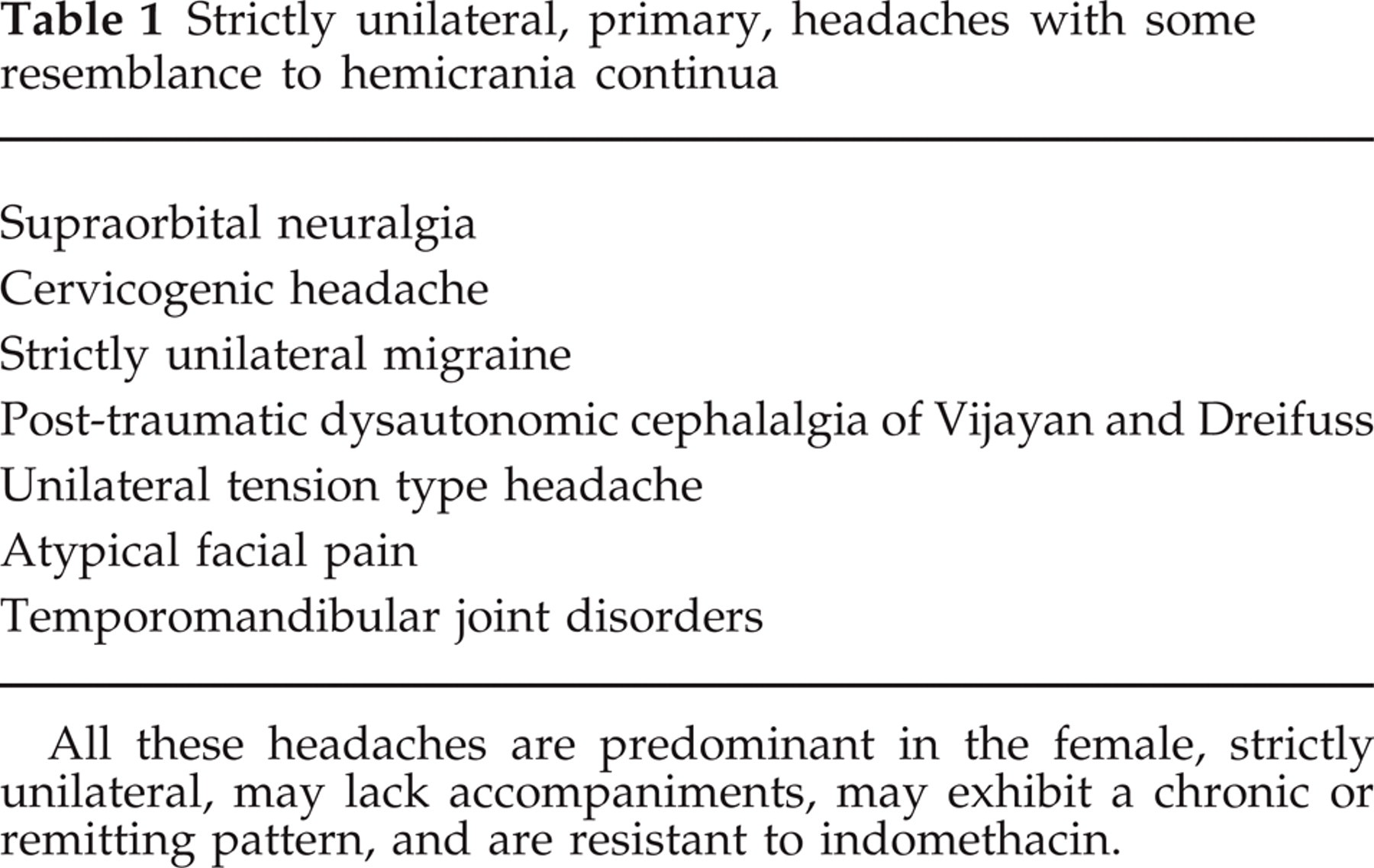
All these headaches are predominant in the female, strictly unilateral, may lack accompaniments, may exhibit a chronic or remitting pattern, and are resistant to indomethacin.
Alleviation of the pain by some manoeuvres or therapeutic approaches is classically considered among the characteristics of various syndromes and in particular in some painful conditions. The response to treatment is actually—and wisely—acknowledged by the current IHS classification of headaches and cranial neuralgias (37) as diagnostic criteria for several conditions such as: (i) CPH, the other headache absolutely responsive to indomethacin; (ii) Tolosa–Hunt syndrome, ‘pain is relieved within 72 h after initiation of corticosteroid therapy’; (iii) retropharyngeal tendinitis, ‘alleviation within 2 weeks of treatment with nonsteroidal anti-inflamatory drugs in recommended doses’; and (iv) giant cell arteritis, ‘disappearance of headache within 48 h of steroid therapy’. If this pharmacological attribute were to be removed, could it then be replaced by another, more specific or relevant criterion? The answer is ‘no’, or—to put it more correctly—‘not yet’.
In other neurological disorders positive pharmacological responses are required for a better diagnosis. This includes the Tensilon test in myasthenia gravis, dopa-responsive dystonias, or an urgent flumenazil trial whenever a benzodiazepine overdose coma is suspected. The use of a pharmacological criterion in these disorders is not widely different from the classic procedure in which the final diagnosis of a given condition must await the expected results of the treatment and course (42).
Other primary headaches may respond promptly to drugs, but with marked variability both intra- and inter-individually. In contrast to what is the case with HC, this rather heterogeneous, pharmacological response prevents the use of pharmacological tests in the diagnosis of such headaches. As generally the clinical pictures are typical enough in these headaches, adherence to drug test is by no means obligatory.
How can the ‘indomethacin-response dilemma’ be clarified?
Unilaterality and prompt and absolute response to indomethacin are insignis morbi of HC. Ancillary features, such as moderate, relatively long-lasting pain, lack of precipitating stimuli, paucity of accompanying phenomena, and temporal patterns, are clinically useful provided the two crucial features are present. Accordingly, we have recently proposed (43) that the typical clinical picture of hemicrania continua, i.e. including an absolute response to indomethacin, be termed hemicrania continua vera. More or less analogous but ‘indomethacin-resistant’ clinical pictures are—by definition of the syndrome—different from HC and can be termed hemicrania generis incerti, provided other possibilities (see Table 1) have been ruled out. Moreover, both headaches according to the proposal could be classified along with cluster headache and CPH (43). The proposed nosologic frame for these strictly unilateral primary headaches is represented in Figure 1. It illustrates how the so-called ‘indomethacin resistant HC’ cases should be considered apart from HC. The same has been acknowledged in CPH in its differentiation from cluster headache, which has never been considered as ‘indomethacin-resistant CPH’. With regard to indomethacin responsiveness, hemicrania generis incerti is as different from hemicrania continua vera as cluster headache is different from CPH.

Proposed nosologic position of hemicrania continua. We have graphically represented cluster headache, CPH, HC vera and hemicrania generis incerti. The categorization principle is: primary strictly unilateral headaches. The nosological requirements: distinction, grouping, and gradation, have all been achieved. Indeed, the arrangement of the figure shows the relationships between these strictly unilateral primary headaches. On the left (1 + 2): the two relatively short-lasting, excruciatingly severe headaches, associated with marked autonomic features. On the right (3 + 4): the two relatively long-lasting, moderately severe, ‘autonomically modest’ headaches. At the bottom (2 + 3): the two headaches absolutely responsive to indomethacin. At the top (1 + 4): the two headaches non-responsive to indomethacin. ∗Provided other diagnostic alternatives (see text and Table 1) have been ruled out.
Paucity of accompaniments and lack of precipitanting mechanisms
During exacerbations, patients occasionally report that pain may be accompanied by a variable combination of ipsilateral, autonomic features such as conjunctival injection, lacrimation, photo- and phonophobia, ocular discomfort and nasal stuffiness (1–4, 11). When present, all these accompaniments seem to have a modest dimension, at least as compared with other unilateral headaches, such as CPH and cluster headache (11). Nausea may be present, but vomiting is not typical of this headache. In the largest series of HC (44), accompaniments were noticeable only during exacerbations. Less than one-third of the patients exhibited conjunctival injection, nasal stuffiness, rhinorrhea or ptosis, whereas lacrimation nausea, photophobia and phonophobia were found in c. half the patients.
Precipitating mechanisms—at least noticeable ones—are as a rule lacking in HC. More specifically, precipitants that are operative in other headaches generally seem to be of little relevance in HC (11); this goes for stress, menses, alcohol, vasodilators, or exteroceptive stimuli acting on the tissues supplied by the trigeminal nerve. Furthermore, the headache is not aggravated by the supine position (like cluster headache) or other positions, Valsalva manoeuvre, physical activity and—above all—neck movements (like cervicogenic headache and some cases of CPH) (45). Of course, it is unwarranted, or rather illusory, to consider the absence of certain characteristics as an intrinsic quality of a given condition. Negative features should be considered in the appropriate context which may or may not enhance the importance of the negative features.
Temporal patterns
This is an important but non-specific feature. In fact, many headache categories may exhibit both episodic and chronic patterns, but the crucial symptoms remain the same. HC may present with two temporal patterns: a remitting (non-continuous) and a chronic (continuous) pattern (1–4, 11, 12, 44). Putatively, patients may start their symptoms with either temporal pattern and remain in the same stage indefinitely without transition to the other stage. However, a frequent development is that the remitting pattern precedes the chronic stage. Such transition has frequently been reported by chronic HC patients. Documented transition from the remitting to the chronic stage has also been reported (46). The reverse temporal development, i.e. from the chronic to the remitting form, has rarely been observed after successful treatment with indomethacin (47). It is worthy of note that in patients with documented transitions between stages, indomethacin provided an absolute improvement whatever the stage was (46, 47). This supports the notion that HC is a single syndrome, presenting with two different temporal patterns.
HC has been proposed as a category of ‘chronic daily headache’ (CDH) based on its eventually continuous pattern (22). The only acceptable ‘link’ of HC with the other headaches classified as CDH is the temporal pattern: HC may present with daily symptoms in the same way as many other headaches and a myriad of disorders. However, as already mentioned, temporal patterns are non-specific. CDH is an expression that stresses the way a certain number of primary headaches may occur, and does not represent a distinct nosological entity. Therefore, CDH does not seem to be a satisfactory final diagnosis, but rather an explanation of how a headache manifests chronically in a certain patient. For the future, HC would probably be better classified together with CPH (IHS group 3), as an indomethacin-responsive headache (43, Figure 1).
Analgesics and other useful drugs that are employed in painful syndromes may modify both pain and accompaniments. However, there is ample reason to believe that a given disorder can not be transformed into an essentially different one through the medication, e.g. treatment, because each disease has a distinctive aetiology and pathogenesis, the nature of which cannot be changed by treatment. A modified condition, however, is a change in the form or appearance of the original condition. Changes in symptom intensity or in the temporal pattern give rise to clinical variants, but never to another entity. Therefore, a ‘transformed’ or ‘chronified’ migraine is still a migraine, and a chronic or episodic tension-type headache are both tension-type headaches. Thus, a particular manifestation of a disease, drug-induced or not, must not be upgraded to a new diagnostic label. A patient with a certain headache disorder that changes with time cannot be classified twice: once under primary headaches and thereafter under CDH.
Admittedly, analgesic abuse may modify a given headache, giving rise to a chronic, daily pattern. HC is also usually characterized by chronic daily pain. The chronic use of indomethacin obviously does not produce another headache (CDH). Indomethacin has by now been given for > 25 years in some cases without producing persistent headache, as demonstrated in CPH (see 46). The headache that appears on drug discontinuation of indomethacin is the original unilateral headache, with the unilateral accompaniments. It has, nevertheless, recently been argued that analgesic abuse is associated with HC (18). As HC is absolutely and permanently responsive to indomethacin, the main reason for HC sufferers to abuse analgesics and other medications is obviously the lack of appropriate diagnosis and treatment, or intolerance to indomethacin. Moreover, if a given patient suffering from HC abuses medication, which has been the case in many undiagnosed HC sufferers, the symptoms cannot be abolished unless indomethacin is administered. Otherwise, if indomethacin is discontinued, the symptoms will reappear sooner or later and will only be relieved upon resuming indomethacin medication. It is acknowledged that in order to consider a headache as directly related to medication abuse it is necessary to verify that symptoms first improve, and later more or less disappear after withdrawal of medication. HC behaves precisely inversely, provided it has been correctly diagnosed and treated. In a reported case of HC evolved from analgesic rebound (19), the patient was never even prescribed indomethacin. The positive effect of this drug should be regarded as an obligatory criterion for the diagnosis of HC.
CDH sufferers not only are suffering from a headache, but somehow contribute to the making of the headache themselves. In addition to a pre-morbid constitution, several symptom-producing habits, such as analgesic abuse, exposure to stressors, and various other circumstances, contribute to the final course of their headaches. Contrary to what is the case in HC, the patho-biography is probably crucial in understanding CDH.
Supplementary studies and research
In our experience, the exploration of forehead sweating (48), pupillometry (49) and pain pressure threshold (50) has not yielded any evidence of gross impairment in HC. The same trend was observed using pericranial nerve blockade (51) and sumatriptan administration (52). Only one single patient with an abnormal unilateral phlebographic pattern has been described so far (53). In the routine work-up, these tests do not seem to distinguish between HC and other unilateral headaches.
MRI of the brain failed to demonstrate gross pathological changes (53). However, at the present stage of knowledge, considering the possibility of the HC-like pictures (31, 32), one should at least be highly aware of two potentially dangerous situations: (i) continuously high indomethacin requirement; and (ii) decreasing indomethacin effect. The conclusion to be drawn from these situations seems to be that even though the clinical history might fit with a picture of ‘primary’ HC, it may be necessary to carry out a CT-scan and/or MRI of the brain in such patients until such time as other confirmatory tests are available for HC.
Conclusions
‘Nothing more practical than a good theory’ said L. Boltzmann. The term ‘vera’ (i.e. hemicrania continua vera) is in our opinion the best term for the genuine form of HC. Hemicrania generis incerti is a provisional concept. Headache phenotypes like this brand may provide us with higher insight into this field. In the foreseeable future, we may be in the position to ascertain whether hemicrania generis incerti is a variant of hemicrania continua or—what is more likely—another disorder. We believe that the postulated nosology may end the present period of controversy and bewilderment.