





Abstract
Since the 1980s, there has been a growing interest in considering how adaptive mechanisms can underpin psychopathology [1–5]. As psychopathology often involves perceptions of loss and threat, one place to begin to search for evolved mechanisms in psychopathology is in the natural defences elicited to losses and threats. Indeed, it is possible to suggest that ‘symptoms’ are often related to the activation of defence mechanisms which evolved to respond to losses and threats, with the type of defence (e.g. anxious arousal and heightened vigilance associated with fight, flight, submit) being mirrored in particular symptom presentations [1, 4, 6, 7]. This paper will outline some common defensive behaviours and then explore ways in which they are represented in various disorders.
The nature of defence mechanisms
Adaptive defence mechanisms require animals to be able to detect threats in their environment and respond to them appropriately [7]. The functions of defence mechanisms are thus to protect animals from harm and to minimize subsequent harms in the event of a loss or some damage occurring to the animal. The processes of defences involve attentive sensitivity and vigilance to potential threats and losses, with activation of psychobiological systems (e.g. activation of the hypothalamic pituitary adrenal axis [8]). The strategic behaviours of defences involve either active-energized behaviours (e.g. fight, flight) or passive-inhibited behaviours (e.g. submission, demobilization, passive avoidance). There is good evidence now that people with anxiety and depressive disorders have attentional biases to threat stimuli [9], and that these biases play a key role in the triggering and maintenance of disorders [10]. There is also good evidence that threats (detection and meaning) are often processed through fast-processing systems (designed for rapid responding) in limbic areas such as the amygdala [8]. In psychopathology such processing can be associated with various cognitive distortions (e.g. jumping to conclusions) that use a strategy of ‘better safe than sorry’ and can result in overestimates of the harmfulness of stimuli and events [11].
Due to the need to process and respond to threats quickly, the activation of defences can be rapid, override conscious thinking and may even be counter to conscious wishes. For example, a socially anxious person may experience anxiety in situations where they would like to appear confident and strong; a blood phobic may faint even when they are trying to stay conscious. The (fear of) lack of control over defences can lead to secondary avoidance; both the social phobic and blood phobic may fear the consequences of social observation of their lack of control over defences (e.g. being seen as anxious) and thus avoid the feared situation or engage in other safety behaviours if anxiety is triggered [12]. It is also possible to consciously enhance defences. For example, if we find ourselves sitting on a train next to an aggressive-looking, drunk, young man, we may increase our submissive behaviour by intentionally avoiding gaze and shrinking into the corner.
Conservation of defensive processes and behaviours
Many natural defences are highly conserved in most mammals [6, 7, 13, 14] and have two salient functions. The first is to remove the animal from the danger. Second, if the danger in another sentient being and flight is not possible or useful, a defensive response should impact on the source of the threat. For example, fainting and ‘playing dead’ may fool or deceive a predator. Displays of aggression may signal risk of harm to a predator or attacker so they cease their ‘attack’. Predators tend to select young, weak or wounded animals where the chances of injury to themselves are minimized. The value of submissive behaviours depends on the degree to which they succeed in changing the behaviour of a conspecific by reducing or limiting the attacks of the attacker. And when a submissive display (inhibited, eyes cast down and looking fearful) is part of a shame display it often succeeds in reducing an attacker's desire to cause harm [15].
It is, of course, important that defensive responses are appropriate to the perceived threat. Submissive behaviour is not helpful when confronted with a predator. Hence, a defence is often associated with the type of threat and its likelihood of success. For example, people with a blood phobia may faint to the sight of blood, those confronted with a threat to an important attachment bond may cry and show distress, those with social anxiety may exhibit submissiveness to a social threat. It follows therefore that psychopathology can be viewed in terms of both the specific threat sensitivity of a person and the typical activated responses. In order to develop this view of psychopathology it is useful to consider the types and functions of common defensive behaviours that have evolved in humans and other animals. Table 1 outlines some of these and, although not meant as an exhaustive list, suggests the most common ones.
Some types of common defensive behaviours
A person may use defences individually or in combination. Sometimes defences are ambivalent in that both flight and attack strategies, for example, are activated [13], or both help-seeking and aggression (as in angry protest [16]). And camouflage can be used to hide other defensives. Chimpanzees, for example, have a degree of self-awareness and are also able to conceal the display of their social signals. Cheney et al. noted [17], p.1364]: In a captive group of chimpanzees two adult males Nicki and Luit were engaged in a prolonged struggle for dominance. During one fight Nicki was driven into a tree. As Luit sat at the bottom of the tree, he nervously ‘fear grinned’. He then turned away from Nicki, put a hand over his mouth and pressed his lips together to hide a sign of submission. Only after the third attempt when Luit succeeded in wiping the grin from his face did he once again turn to face Nicki.
In many primates, and especially humans, in addition to basic individual ways of coping with threats, such as fight, flight and submit, another important way of coping is help-seeking. This is a central coping behaviour in the young who use the parent as a safe and reassuring base [16]. It is well known now that a supportive other(s) can help by not only directly coping with a threat, but also have important physiologically calming effects [18] and affect the immune system [19].
Much has been written on how children use and experience their caregivers and develop inner working models of the safeness or dangerousness of others which affect their interpersonal behaviour and emotional sensitivities [20]. Adverse rearing experiences can significantly affect psychobiological maturation and functioning of defences [18, 21, 22]. Early relationships have significant impacts on neurochemical systems that control mood, and threat and stress sensitivity and reactivity [22, 23]. Belsky et al. [24, 25] used an evolutionary model to suggest a direct link between early rearing environments, subsequent interpersonal strategies and psychopathology. They argued that early environments act to select which social and reproductive strategies the child will come to adopt (e.g. affiliative, stable pair-bonding and high investment in offspring vs less affiliative, unstable pair-bonding and low investment in offspring).
Preparation for threats
Whether related to early sensitization or other factors, threats or harms which are anticipated can lead to a number of potential options [7, 14]. One is avoidance: avoiding getting too close to that which threatens. Avoidance, however, is often a double-edged sword. For example, social relationships often provide opportunities as well as threats. If individuals are too threat-oriented in social situations then they can also lose out on the potential benefits from those social situations (e.g. developing friendships). Individuals who have grown up in abusive relationships may be highly sensitive to the threats involved in close relationships. This means that their capacity to use social relationships to their advantage is significantly compromised. Indeed, when such individuals experience closeness and intimacy they may become fearful and alarmed and move away. They can engage in an oscillating pattern of seeking closeness and avoiding closeness [20].
Another way to prepare for and deal with threats is to engage in what might be called the ‘attack first’ strategy. Individuals who feel threatened in certain types of social environment may engage in a bullying or intimidation strategy. The advantage of this strategy is that it creates fear in others, who may be less likely to challenge as a result. Indeed, there is good evidence now that a dominant who expresses signals of aggression to conspecifics affects their stress and serotonin systems such that some subordinates will not be confident to make a challenge [26]. Hence, the strategy of the bully is to maintain high stress in subordinates such that they lack confidence for a potential challenge.
An alternative strategy for dealing with threatening others is to turn them into friends and alliances [27]. If one is able to do this then alliances may be supportive and protective and come to your aid when you are in danger or under threat. The ease by which this is done probably depends on how comfortable and secure one feels in the social domain, which in turn is related to early attachment experiences. This strategy is also based on attractiveness enhancement and being able to manipulate the positive emotions of others [28]. A person is less likely to be attacked or threatened if he/she is liked by others and/or is perceived to have some value to others.
Hence, many psychological strategies and manoeuvres are in part oriented towards planning and developing strategies which minimize the number of threats and losses in the environment. This can be achieved by gaining skills and knowledge, and developing alliances that will make threats less likely or easily surmountable if, and when, they are encountered.
So far it has been suggested that animals and humans are endowed with various innate mechanisms for detecting, processing and responding to threats and losses. It has also been suggested that various psychopathologies can be classified in terms of the type of threat and defence mechanisms activated. Table 2 offers some examples of what such a classification might look like. Again this is not to offer an exhaustive list, but only suggest the value of conceptualizing psychopathology as rooted in adaptive defences.
Examples of disorders and their associated threat focus and defensive strategies
Social motives and social threats
As suggested by Table 2, many common psychopathologies focus on social threats. To explore further the relationship of defences in psychopathology therefore requires some consideration of why the social domain can present such a high frequency of threats. Basically, social threats arise because animals pursue biosocial goals such as seeking sexual partners, forming alliances with others or pursuing resources that others want for themselves; that is, there are conflicts of interest between individuals [29]. Thus, social threats arise from the need to pursue social resources, and part of the nature of psychopathology pertains not just to the defences activated in any situation, but also to the arousal of the social motives involved, and the perceived success or failure in achieving them. Space does not allow for a full description of the interaction between motivational systems (e.g. sexual, attachment, see Buss [29]), or for their linkage to defence systems (see Gilbert [1, 6]), but a brief outline of the key types of social relationship and the resources sought offers a way of linking biosocial goals to defences. We can assume for a moment that the key biosocial goals for nonhuman primates and humans include: eliciting care from others [16], caring for and investing in offspring and kin [30, 31], developing friends and alliances [32], cooperating in groups [32, 33], seeking to gain and maintain social status (rank) [26, 34] and gaining access to and control over sexual partners [29, 35]. In engaging in any of these behaviours an individual must be sensitive to the safeness of their pursuit (and the likely success of the endeavour), but also various threats. Threats come from others who may be hostile, abusive, non-co-operative, deceptive or exploitative, and who may resist one's own efforts to raise one's status and efforts to control resources if this damages their own status/control manoeuvres.
While part of the nature of pychopathology reflects how people cope with such conflicts, and may under- or overestimate threats, or the likely success to their social pursuits, humans can also be aware that unmodulated expression of felt defensive emotions (e.g. jealousy, anxiety, anger) can be further damaging to their social relationships and sense of self. For example, overexpression of jealous anger may lead a sexual partner to defect; or overexpression of anxiety in social situations may lead others to reject the person. This monitoring of one's own outputs and awareness of the harm that can be done (e.g. to one's reputation, attractiveness or sense of self) by inappropriate modulation of affect expression is another source of potential threat. Space does not allow for further exploration here, but, clearly, monitoring one's own outputs for the purpose of gainful impression management is an important area of threat-management [36]. The relationship between biosocial goals and the defences, as modified by the need to engage in strategic self-presentations that do not alienate others, is depicted in Figure 1.
Examples of social goals, threats and emotions.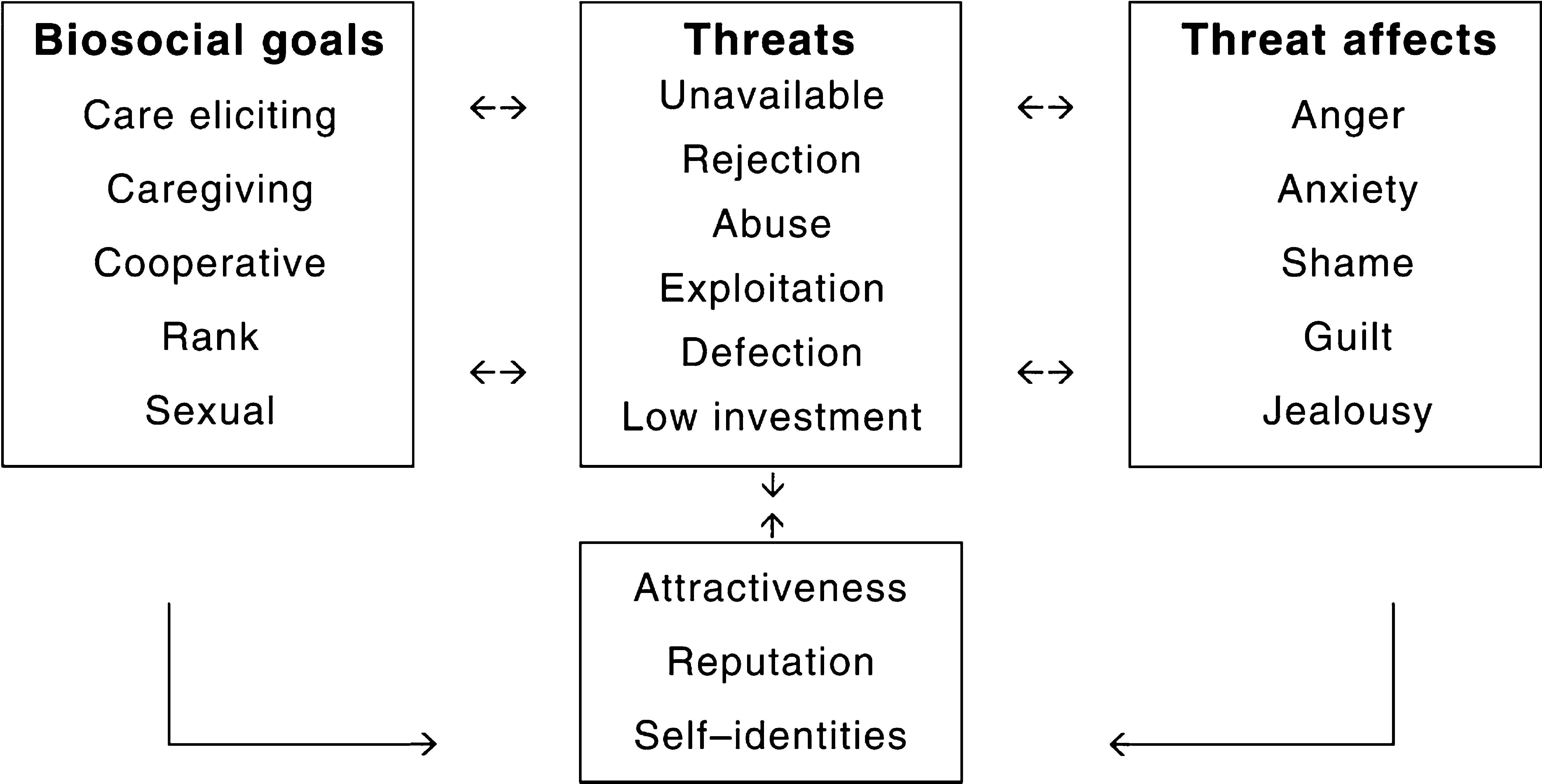
These complications give rise to various problematic uses of defences, one of which is that the expression of aroused defensive behaviour can be arrested and inhibited.
Arrested defences
When individuals are strongly motivated to engage in a specific defensive behaviour(s) (e.g. to escape or express anger), but are not able to, defences are said to be arrested and under inhibitory control [13, 37]. Although people may inhibit the expression of (acting out) certain defensive behaviours for self-presentational reasons (e.g. don't wish to cry or elicit care, express protest anger or take flight), there are various other reasons why strongly activated defences cannot be acted on.
Arrested flight
An individual may be strongly motivated to escape, but is simply blocked, as in the learned helplessness paradigm [38]. An individual may be strongly motivated to escape from an abusive relationship, stressful work situation or the demands of others, but lacks the resources to leave, feels too guilty at leaving children behind, may be fearful of being alone and starting again, or leaving (e.g. a stressful, but highly paid job) entails too great a loss of resources. Whatever the reasons, having to stay in the aversive environment, with strong desires to escape from it, but feeling unable to, has recently been shown to be highly associated with depression [39, 40]. Brown et al. [41] found that negative life events that are experienced as humiliating or shaming, and from which the person feels unable to escape, are more depressogenic than loss events alone.
Arrested aggression
Individuals may have very strong desires to be aggressive or retaliate, but may refrain from doing so because they are frightened of retaliation, would feel guilty or worry that their aggression would damage others or their alliances. Being unable to assert oneself when one would dearly love to is a form of arrested aggression and the more the person ruminates on their powerlessness and sense of injustice the more stressed they are likely to be [42, 43]. Also, if that anger remains highly aroused, but not expressed, the person is more likely to stay in the anger-arousing situation.
Arrested help seeking
Individuals might like to seek the help and comfort of supportive intimate relationships, but they are frightened to do so. For them the costs of closeness and support seeking outweigh the benefits, especially if the relationship means revealing things they feel are shameful, invalidates a ‘stand on one's own feet’ self-identity, or there is basic mistrust of others.
Arrested defensives and chronic stress arousal
The important aspect of arrested defences is that they suggest a high level of unabated arousal. The arousal is maintained by a constant activation of the defence system. This is due to remaining in proximity to the cues that arouse a sense of threat or loss (i.e. stress), and also because innate defences (e.g. fight/flight) are activated, but not acted on (expressed), or if they are they do not reduce the experienced threat or loss. Hence, all the time individuals are motivated (by either internal or external cues) to escape, retaliate or find a reassuring other, but are not able to, their defence system is active. Indeed, it could be argued that although there is considerable evidence that loss of control is linked to psychopathology [44, 45], the linkage between control and psychopathology is also via the arousal and arresting of natural defensive behaviours [42].
Ineffective defences
Some defensive behaviours can be simply ineffective. For example, one runs away, but one does not successfully escape; or one tries to fight, but constantly loses; or one seeks the help and support of others, but is rejected, or fails to elicit the signals that are sufficiently reassuring. For example, it would appear that in the case of depression, an individuals' help-seeking behaviour can elicit aversive behaviours from others [46]. In some of these situations there seems to be a failure to change strategies that are not working, and indeed the failure of defensive strategies may increase stress.
Defensive strategies vary within populations
People clearly vary in their sensitivity to various threats and the arousability of certain emotions (e.g. anger, jealousy, anxiety). In evolutionary terms this means that different individuals will pursue biosocial goals and strategies in different ways. For example, Sapolsky [47] found that different dominant baboons may use different basic strategies. The affiliative dominant baboon is relatively relaxed (unless threatened), forms affiliative alliances with others (especially females), is quick to respond to social challenges, but rarely initiates fights. The aggressive dominant baboon is unpredictable, tense and vigilant, will initiate fights and issue threats to others frequently and maintain high levels of arousal in conspecifics. He is less likely to spend time with females or develop alliances with them. Aggressive and affiliative dominant strategies are associated with different physiological profiles, and are also noted in humans [1, 48].
In regard to coping with defeats, Von Holst [49] found that tree shrews showed two alternative strategies to defeat. Following an agonistic defeat, one type of animal became highly submissive, but continued with its activities, and remained wary of the victor. The other type became highly demobilized by the defeat and died shortly afterwards.
In humans, there has been much research on personality differences. These reflect variations in the balance of social motives, the strategies used to pursue them and the ease of defence activation. Neuroticism, for example, seems to be a generally raised threshold for high defensive activation mirrored in the ease of activation of negative affects [6, 8]. The work of Kagan [50] suggests that approximately 15% of children have inhibited temperaments which show up as increased fearfulness to novel environments and low exploration [51]. Questions arise, therefore, as to how different strategies increase susceptibility to psychopathology in different environments, and how such strategic variation is distributed within populations.
Evolution allows alternative strategies to operate and compete within populations because they (or other traits associated with them) have advantages and this is so even for disorders like manic-depression [52]. This is because traits are in constant competition with each other. For example, in a population of ‘selfish’ individuals, traits for altruism may gain some advantages. As the population becomes more altruistic (i.e. genes for altruism spread through the population) traits for deception and exploitation gain advantage. At any one time the relative distribution of traits will vary within the population as traits and strategies ‘battle it out’ [29].
Clearly, what specific strategies and goals individuals pursue at any one time will be related to complex interactions between genes, development and current environmental contexts. Moreover, some strategies may never be enacted in the lifetime of an individual even though the individual is capable of them. For example, if no one you love dearly dies before you, you may never know the profound despair of grief. The capacity for grief is silent unless activated. In peacetime many men will never engage in rape, but in war…! And given that depression varies between populations and subgroups then there is a clear interaction between innate potential (e.g. for low mood, sleep disturbance) and environmental recruitment.
Disadvantages and maladaptive defences
Although we can illuminate possible adaptive mechanisms underlying various forms of psychopathology, this is not to say that these adaptive mechanisms always function adaptively, or that various forms of psychopathology are adaptive. In fact, this whole issue has recently been subject to intense debate and a recent special issue of the Journal of Abnormal Psychology (August 1999) was devoted to it. One way of approaching these difficulties is to apply the concept of harmful dysfunction to the pathological functioning of innate mechanisms, as suggested by Wakefield [5]. The harmful dysfunction analysis proposes that there should be (i) an identified evolved/designed mechanism serving a specific function (e.g. vomiting reflex or panic response, which, in the analysis outlined here, would include various defence mechanisms); (ii) a scientific judgement of the range over which a function is said to fail (e.g. if one fails to be alarmed by, and take defensive action against, a predator; or becomes overly anxious in friendly situations and avoids them); and (iii) the failure of the function causes harm. Although each of these propositions is not without its difficulties (e.g. is it harm to the person or to inclusive fitness?), Wakefield uses the concept of natural function in an ‘intuitive sense’. He argues that ‘natural selection is the essential process that explains functions and dysfunctions’ and that ‘evolution is the most incisive theory of the nature of functions and dysfunctions’ (p. 374).
Hence, an identification of adaptive mechanisms underlying psychopathology does not imply that a disorder itself is adaptive. For example, diarrhoea and vomiting are common bodily defences to pathogens, and yet if these are triggered inappropriately, too frequently, too intensely or are of too long duration then they become maladaptive and may even kill the person [4]. The same is true for behavioural defences, indicating a need to consider carefully factors controlling trigger thresholds, frequency, intensity and duration of defences.
Furthermore, the activation of many defences often involves trade-offs. Engaging in a defensive behaviour, be it flight, aggression, avoidance or even alliance formation, is not cost free. And there are at least two types of cost. This first is the potential loss of resources. For example, in the case of escape behaviour this may mean giving up on, or losing access to, certain kinds of resources that were available in the place that one has escaped from. If one uses aggression too much, one might not be able to develop affiliative alliances, or existing alliances may turn against one. If one is too affiliative, one may risk being exploited. If one uses avoidance too much and adopts an extreme risk-avoidance approach, one might lose out on opportunities for gains. Socially successful individuals will balance strategies to minimize threats and maximize opportunities appropriately to specific environments, that is, be highly affiliative in some, but more aggressive in others. Psychopathology may in part relate to problems in being (in)flexible to changing environments [1].
The second type of cost is physiological. Most threats activate similar neurobiological and neurohormonal systems in most mammals. For example, all threats tend to activate the stress system (e.g. hypothalamic-pituitaryadrenal, or HPA, axis) because it impels action, suppresses appetitive functions and biases information towards processing threatening stimuli. So defences are highly conserved both in terms of their psychobiology (e.g. HPA axis) and behavioural outputs and action tendencies. However, many defences are designed for shortterm use. Just as too long a duration of vomiting and diarrhoea can be damaging, so may chronic activation of defensive behaviours like fight/flight. Recent work has found that chronic stress can damage many organs including various areas of the brain such as the hippocampus [53]. Indeed, one way of thinking about depression is in relation to the overactivity and chronic arousal of stress systems [54, 55]. The fact that long-term activation of defences may become maladaptive is an evolutionary trade-off. Generally, successful coping terminates the source of threat and allows the stress system to settle. Indeed, the speed of deactivation and the factors facilitating deactivation of the HPA axis may be as important to understand in psychopathology as the speed of activation.
Threat and the internal world
Threats that trigger, increase and maintain stress are not just external, but also come from internal cues such as styles of self-conscious thinking. Self-consciousness may have evolved because of the advantages it gave us in reading other people's minds by having insight into our own [56]. Again, we cannot explore the evolved benefits of this adaptation, but simply note that humans have a particular talent for self-reflection, self-monitoring, selfrepresentations (e.g. how I see myself, the kind of person I think I am), future thinking (what I think my future looks like and how to change it etc.) and projection/mind reading (how I think others see me). Although such abilities offer enormous advantages in strategic social interactions, as with so much in evolution, self-conscious abilities are a two-edged sword. They may have given rise to the abilities for increased intellect, science, art and controlling one's social presentation, but our selfconscious thoughts can also create many problems. First, people may make mistakes in mind reading. They may under- or overestimate people's hostile intents or thoughts. The socially anxious assumes that the way they think they look to others is indeed how they are actually perceived by others: this is often far more negatively than is actually the case [12]. Paranoid people read hostile intents in others when none exist, which (as noted in Table 2) might be due to overactivity in some ‘detect hostile others’ defence system. Second, conscious thoughts access our physiology. Most adolescents learn that generating sexual fantasies and images can give rise to sexual excitement (release hormones from the pituitary) and auto-eroticism. As far as we know such internally driven sexual arousal is fairly limited to humans, but even if it isn't, the fact is that our thoughts can have powerful physiological effects in cascading interactions of thinking, images, emotions and physiological arousal. Cognitive therapists [57, 58] argue that it is our conscious thoughts and interpretations of events that generate arousal and these can be potent even in the absence of external signals.
In essence our own thoughts can act as stimuli that activate the defence system. Suddenly remembering that we left a very suicidal patient sitting in the waiting room before taking off for holiday may generate rapid arousal! And there is increasing evidence that intrusive memories of traumatic events are themselves stressful [59]. The basis of the argument is simple therefore: that what we think about and how we see ourselves as coping activates and/or can maintain defensive system arousal. Ruminating on our sense of defeat or inferiority can act like a signal of down-rank attack to which we feel increasingly inferior and defeated [60]. Rumination then, in a way, acts as a kind of constant ‘re-infection’ process that can stimulate defensive arousal. Moreover, our thoughts and feelings can also activate defensive behaviours. For example, low mood and painful ruminative thoughts can trigger such high desires for escape that it leads to suicide [60], or people can engage in forms of cut-off and avoidance of those thoughts that cause distress [13].
Positive feedback
Klein [61] made the interesting point that evolution rarely uses positive feedback, for to do so could result in a runaway or escalation of systems interaction. Most biological systems are regulated by inhibitory feedback that is able to control functions when certain set points have been reached. The evolution of self-consciousness, and in particular the ability to ruminate and predict the future, may be one exception to this rule. If our conscious negative cognitions are able to generate stress arousal and stress arousal in turn increases threat and harm-focused information processing [8], then this may be an example of positive feedback. Such feedback is at risk of ‘runaway’ which may interfere with the ability to recover from harms and losses. Some depressions and other disorders may be seen as examples where negative cognitions literally produce spirals of negativity that become relatively ‘locked in’ [43, 57]. If this is the case, then one way cognitive therapy may work is to disrupt positive feedback between negative thinking and stress, mood and help reset mood systems.
Depression: the maladaptive functioning of adaptive mechanisms?
So far we have looked at some of the complexities of defence mechanisms. It has been noted that (i) there are attentive mechanisms that can be biased towards threat detection; (ii) processing of potential harmful stimuli can be via fast limbic system based mechanisms; (iii) these can be sensitized due to early (aversive) rearing experiences, trauma and genetic dispositions; (iii) social threats and losses that are particularly arousing are those that have some evolutionary meaning (e.g. threats or actual abandonment, rejection, deception, hostile other groups); (v) when threats are detected they can prime evolved psychobiological responses (e.g. fight, flight, submit, help seeking); and (vi) these in turn may be arrested (blocked) either because of secondary fears of the consequences of their expression (e.g. on selfpresentation, self-identities or the bonds of a relationship), or because of environmental blocks (e.g. lack of resources to leave). We can explore how this approach can be applied to one disorder: depression. The view taken here is that depression is in part a state of chronic overarousal of the stress system [55] related to experiences of defeat and entrapment [54] in which strong motives for flight and flight are blocked, forcing demobilization [42].
Depression has long been explored in terms of adaptive and maladaptive functions. Some depressions at mild levels can be adaptive if they enable individuals to disengage from aversive environments and to relocate [39, 62], or elicit new resources (e.g. care of others) from the environment. However, such mechanisms probably evolved long before the advent of self-consciousness, the capacity for rumination and styles of social relating that make spacing (e.g. getting away from stress-inducing cues) almost impossible for some people. One way to think of depression then is as a failure in stress system deactivation and regulation [3].
There are a number of possible reasons that depressed people suffer chronic overarousal of their stress and defence systems. First, safeness and reassuring cues, which can deactivate stress, do not work. An example of this is the case of anxious attachment [16]. Anxiously attached children become distressed when their parent leaves the room, but even when their parent returns this does not seem to deactivate their stress system and they remain highly aroused and distressed for some time. Similarly for depression. Depressed people are rarely easily reassured and, in cases where reassurance does work, the type of depression was more likely to have been relatively mild and short lived. Conversely, avoidant attachers may be too suspicious of getting close enough to others to elicit and utilize intimate forms of support and reassurance [20].
Second, stress system deactivation is related to the social rank of the animal. For example, there is good evidence now that following an aversive social encounter subordinates will stay physiologically aroused after being stressed for far longer than a dominant animal [53]. This shows up in both stress hormones and also blood pressure. Depressed people often see themselves as defeated and highly subordinate and inferior to others and these subordinate self-perceptions may act to maintain subordinate physiological profiles [40, 26].
Third, when people are confronted with stressors and losses (e.g. to their physical health, social relationships or control over resources) they may not be able to generate coping behaviours that will settle their stress systems. For example, they may not be able to come to terms with these events. Indeed, rumination on the losses, threats or blocked desires to escape or fight with no obvious solution increase stress.
Fourth, depressed individuals may engage in defensive behaviours, but these actually can make the situation worse. So, for example, individuals who are easily threatened by close relationships may solve the problem by disengaging from social relationships, but this can then produce a new set of perceived threats: those related to abandonment, isolation and aloneness. Avoidance reduces the opportunities to elicit calming or supportive social signals. This is an example where a defence can actually cause more trouble. Similar concerns have been put forward for social phobia [63].
Fifth, a person maybe highly motivated to escape, but is not able to. Lack of resources, fear or guilt may all contribute to being trapped, and depressed people often ruminate on their entrapment and wish to ‘get away’ [39, 41]. They are in an arrested flight situation [13, 40] stuck with the (internal and/or external) environment in which stress-arousing cues are present.
Sixth, the process of rumination (e.g. on self-criticisms, worthlessness, defeat, entrapment and hopelessness) can constantly activate stress arousal. Indeed, losing control over one's own negative thoughts and wanting to get away from them is highly associated with depression [40]. The content and styles of one's rumination and beliefs about how easily one can recover from a threat or loss, is influenced by previous learning, especially in childhood, and the development of what cognitive therapists call early schema [57]. Learning about oneself in relationship to others (e.g. how loved, attractive and in control one can be, or how subordinate one has to be, or how caring/aggressive others are) in childhood and rumination may both have many useful functions, but when they operate to maintain stress and a sense of defeat and failure they may become maladaptive.
Adaptive functions can come to function maladaptively [4]. This should be seen against the backdrop that such possibilities are by no means rarities in evolution, because evolution has never been about best design, but of trade-offs that offer comparative advantages, but also costs [3, 4].
Conclusion
Evolutionary approaches to psychopathology are relatively new although the psychodynamic theories of Freud and Jung always assumed that psychopathology was generated by an evolved mind, interacting with developmental and social factors. We are still a long way from a genuine bisopsychosocial evolutionary approach to psychopathology [34], or even from deciding what is pathology and what are ‘alternative strategies’ [5]. Nonetheless, postulating the existence of specialized defence systems, that can bias attention to certain types of threat, trigger specialized coping behaviours, including patterns of psychobiological arousal, may help to illuminate the evolved basis of typical forms of psychopathology. From here it is possible to study the effects of early life on defence systems sensitivity (e.g. attentional biases, the ease by which defence systems are aroused and ease by which they can be settled) and the role of cognitions in acting as internal cues for stress and defence system arousal. Finally, it was noted that many defences are designed for short-term use, and can become maladaptive due to a variety of factors that maintain them in an active but ineffective state. Among these factors are blocked and arrested defences, ineffective defences or defensive responses (e.g. avoidance or aggression) that cause other problems (e.g. avoidance leading to aloneness or rejection), and internal selfconscious thinking.
Evolutionary approaches to psychopathology offer ways to conceptualize the organization of internal mental mechanisms and to bridge links between the biological and psychosocial. In regard to therapy, most evolutionary psychotherapists work within already existing schools of therapy, but adapt their approaches in line with evolutionary ideas [64]. It is possible that rooting our science of psychopathology in evolutionary approaches will help us develop new ways of understanding psychopathology and its treatment. Such an approach would not have been out of favour with the early pioneers of Freud and Jung,