



Abstract
Thank you very much indeed, Peter, for those very kind comments. I welcome all of you to this celebration of 10 years of clinical experience with sumatriptan. When people asked me if I am proud of having discovered a drug, I said; ‘Well, let's wait until it has been on the market for 5 years, when we will know whether it really is a drug’. I guess after 10 years we can be confident that the Glaxo team and I really did discover an important medicine and obviously that is very satisfying. But today I would particularly like to acknowledge my colleagues in research who contributed to the pioneering work that led to the discovery. I am not going to go through everybody's name here but I would particularly like to acknowledge Wasyl Feniuk, who I am delighted is here today; and Helen Connor, who will be talking later. These two senior pharmacologists on the team made really significant contributions to the discovery and development of sumatriptan and, later, naratriptan. Our research still focuses on pain, on potential new anti-migraine drugs and on the visceral pain of irritable bowel syndrome, so we are still together as an effective research team.
I also have to acknowledge many other colleagues in the company — clinicians, pharmacists, toxicologists and marketing people — who made a significant contribution too. The sumatriptan team probably numbers 250 in all and I would also like to acknowledge many friends and collaborators with whom we have worked over the years, as well as some of the major seminal contributions of academic researchers.
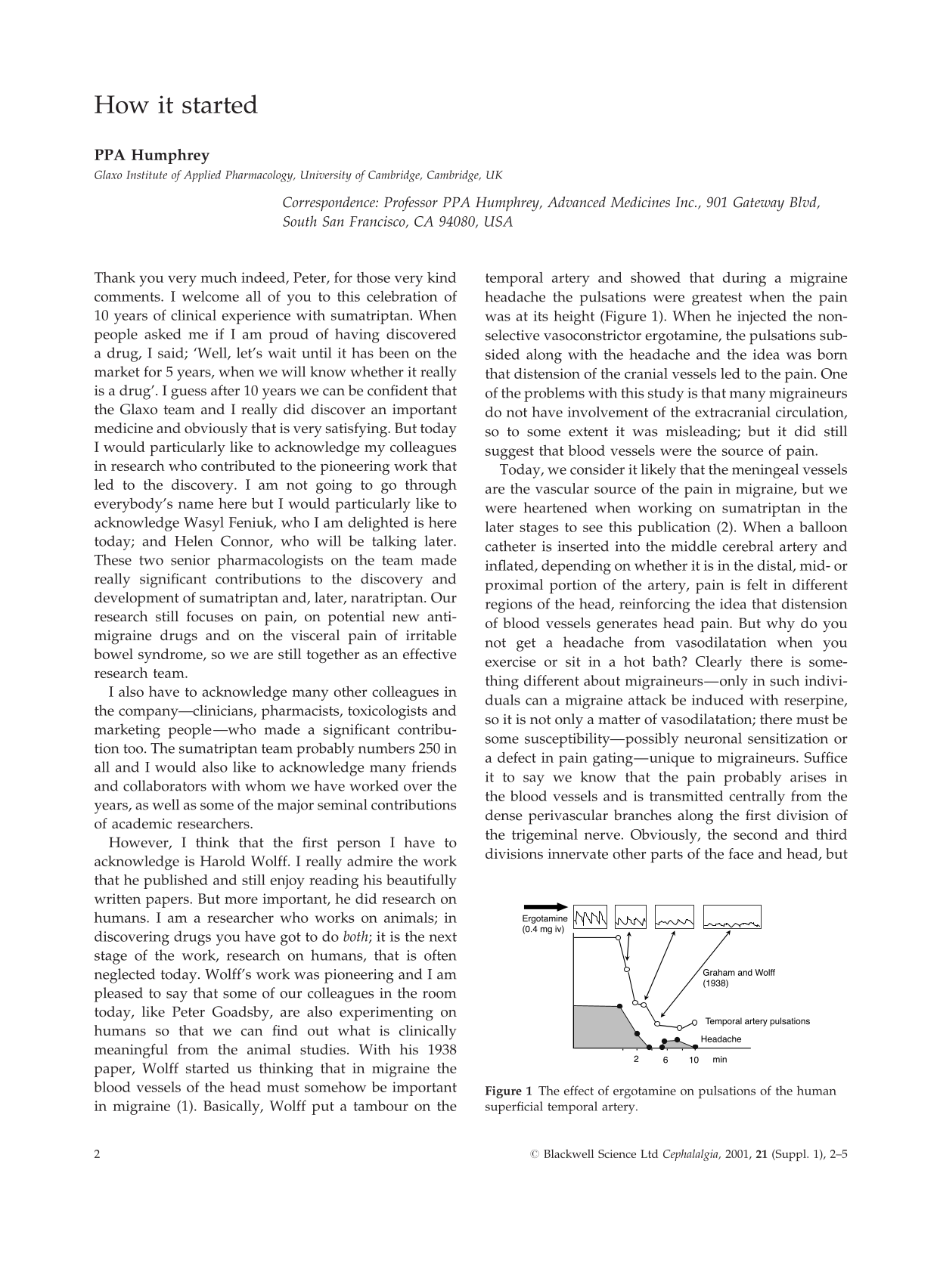
However, I think that the first person I have to acknowledge is Harold Wolff. I really admire the work that he published and still enjoy reading his beautifully written papers. But more important, he did research on humans. I am a researcher who works on animals; in discovering drugs you have got to do both; it is the next stage of the work, research on humans, that is often neglected today. Wolff's work was pioneering and I am pleased to say that some of our colleagues in the room today, like Peter Goadsby, are also experimenting on humans so that we can find out what is clinically meaningful from the animal studies. With his 1938 paper, Wolff started us thinking that in migraine the blood vessels of the head must somehow be important in migraine (1). Basically, Wolff put a tambour on the temporal artery and showed that during a migraine headache the pulsations were greatest when the pain was at its height (Figure 1). When he injected the non-selective vasoconstrictor ergotamine, the pulsations subsided along with the headache and the idea was born that distension of the cranial vessels led to the pain. One of the problems with this study is that many migraineurs do not have involvement of the extracranial circulation, so to some extent it was misleading; but it did still suggest that blood vessels were the source of pain.

The effect of ergotamine on pulsations of the human superficial temporal artery.
Today, we consider it likely that the meningeal vessels are the vascular source of the pain in migraine, but we were heartened when working on sumatriptan in the later stages to see this publication (2). When a balloon catheter is inserted into the middle cerebral artery and inflated, depending on whether it is in the distal, mid- or proximal portion of the artery, pain is felt in different regions of the head, reinforcing the idea that distension of blood vessels generates head pain. But why do you not get a headache from vasodilatation when you exercise or sit in a hot bath? Clearly there is something different about migraineurs — only in such individuals can a migraine attack be induced with reserpine, so it is not only a matter of vasodilatation; there must be some susceptibility — possibly neuronal sensitization or a defect in pain gating — unique to migraineurs. Suffice it to say we know that the pain probably arises in the blood vessels and is transmitted centrally from the dense perivascular branches along the first division of the trigeminal nerve. Obviously, the second and third divisions innervate other parts of the face and head, but how do we explain the associated cutaneous allodynia in some individuals, or why it is not just the upper parts of the head but also the jaw that can be painful (3)? We have to hypothesize in addition some central sensitization at the level of the trigeminal nucleus caudalis or above, such that the gating or descending inhibition might be defective in migraineurs. Or, as work from Christoph Diener's and Peter Goadsby's laboratories suggest, maybe there is a migraine generator that activates efferent pathways leading to vasodilatation or sensitization of central synapses or perivascular nerve endings on the arterial walls. There is still much to learn about the pathophysiology of migraine.
While it is unquestionable that pain can arise from the walls of blood vessels, new data have moved our thinking on. Starting the project, we were much influenced by the teachings of James Lance. I read his book many times because initially we were not migraine experts, but starting from scratch. It is clear that vasodilators like alcohol and glyceryl trinitrite can induce migraine-like attacks in susceptible individuals, and vasoconstrictors can abort them. The archetypal vasoconstrictor is ergotamine, but noradrenaline and 5-HT also aborted attacks, as described in Lance's book (4). I felt that noradrenaline and 5-HT must be acting as vasoconstrictors as well, so we set out to study the blood vessels of the head to determine whether the 5-HT receptors there might be different from those in the periphery. This turned out to be a long voyage; the two 5-HT receptors we knew then have today increased to about 15.
Another seminal observation came from Lance's comparative trial of 5-HT antagonists in about 1970 (5). We were struck by the marked placebo effect and only methysergide was convincingly better. All the 5-HT antagonists available were pretty dirty compounds, which did not do much better than placebo, except pizotifen (which was marginally better) and methysergide (which was much better). So we asked; what is different about methysergide? Again I was encouraged by James Lance, who told me that he had seen individuals in a migraine attack who had gained some immediate relief from methysergide — so it worked acutely as well. That led us to focus on the pharmacology of methysergide and at the same time Saxena published the results of experiments on anaesthetized dogs injected with methysergide, which constricted or at least reduced flow in the carotid arterial bed, amazingly without raising blood pressure. Ergotamine would have led to a huge increase in blood pressure because it constricts all vascular beds, but methysergide selectively affected the carotid circulation. We confirmed this, using electromagnetic flow probes. A flow probe on the femoral artery showed us that, if anything, femoral artery flow increased. This was the first clue that methysergide was not only acting selectively on carotid receptors causing constriction, but also causing neuronal inhibition of sympathetic nerves (6). We generated the hypothesis that methysergide acted on an undiscovered 5-HT receptor present on the cerebral blood vessels but not in the periphery, and that turned out to be right in all the animal species that we studied. Eventually we found this compound, sumatriptan, which is structurally similar to 5-HT, but a small modification to the molecule is enough to change its pharmacology radically, so that sumatriptan is remarkably selective for the 5-HT1 receptor. It does not activate the 5-HT2 through to 5-HT7 receptors, and even within the 5-HT1 subgroup it only activates some subtypes. It constricted excised intracranial blood vessels just like 5-HT, yet did not constrict blood vessels from the legs, the gut or even from the heart. As we now know, the latter contain predominantly 5-HT2 but not 5-HT1 receptors.
Well, that is all very well in isolated tissues, but we had to find out what happened in the whole animal. Pramod Saxena played a major part in teaching Wasyl Feniuk and I the use of radio-labelled microspheres to measure blood flow in all the organs of the body in one experiment. In the cat we found that ergotamine at low doses, say 30 μg/kg, led to an increase in resistance in every vascular bed, including the brain, whereas sumatriptan, even with the huge dose of 1 mg/kg, had no effect on the heart, brain or kidney vasculature (Table 1) (7).
Regional changes in vascular resistance produced by intravenous ergotamine and sumatriptan (G43175) in the anaesthetized cat

What it did do was selectively constrict the so-called arteriovenous anastomoses (Figure 2). These are complex anatomical arrangements of the carotid vasculature seen in domestic animals. There is no equivalent in man, although the human meningeal circulation does apparently have arterial shunts within it. Sumatriptan's remarkable dose-dependent constriction of shunt vessels correspond to an increase in vascular resistance, recorded using electromagnetic flow probes, but microspheres in the carotid circulation showed no effect on cerebral nor extracranial blood flow, only on the shunts. So this selective receptor agonist only constricted certain blood vessels within the carotid circulation.

Vasoconstrictor action of sumatriptan within the carotid vasculature of the anaesthetized cat (after ref. (7)).
This remarkable selectivity encouraged clinicians to want to learn whether the drug would have an anti-migraine effect. Professor Doenicke and Dr Brand (8) were the first physicians to try this drug intravenously in an uncontrolled study of some 30 patients, and they showed dramatic benefits. General acceptance of the drug followed the 1991 New England Journal of Medicine paper reporting the efficacy of the subcutaneous formulation. From then on there has been a tremendous amount of effort to determine how sumatriptan works, still unfinished, although we have learned an enormous amount about the pathophysiology of the disease itself.
Michael Moskovitz led the drive to determine whether sumatriptan was primarily acting as a neuronal inhibitor rather than a vasoconstrictor, but the first definitive, direct evidence of sumatriptan's neuronal inhibitory action came from Peter Goadsby's work, stimulating the trigeminal afferent nerve endings in the cat. He showed that cFOS activation within the trigeminal nucleus caudalis and the dorsal horn at C1 and C2 is activated by mechanical stimulation, and that sumatriptan in very low doses causes substantial inhibition. This provided the first definitive evidence that sumatriptan has a neuronal inhibitory action on cranial perivascular nerves. The second seminal observation was his study of sumatriptan's central actions using electrophysiological recordings from the trigeminal nucleus caudalis. He obtained about 50% inhibition here with sumatriptan in response to electrical stimulation of the nerve terminals in the meninges or the sagittal sinus, but only if mannitol was given to disrupt the blood–brain barrier. So here was good evidence that sumatriptan worked centrally only if the blood–brain barrier was disrupted. But we still do not know whether it is disrupted during a migraine attack or not, although the newer triptans, including naratriptan, do act in this model without having to disrupt the barrier, albeit the doses tend to be rather high.
I think that sumatriptan probably acts through both mechanisms (vasoconstriction and neuronal inhibition; Table 2), although there is renewed focus today on the importance of vasoconstriction. Inhibition of trigeminal nerve afferents at the level of the blood vessel wall must be relevant, however; interestingly you can do this with 5-HT1B, 5-HT1D or 5-HT1F agonists. If you want to get central inhibition without vasoconstriction, you would have to have a highly selective 5-HT1D or a 5-HT1F agonist. But as to whether central inhibition is really important in the actions of any of the triptans is not yet clear and whether there is actually a breakdown in the blood brain barrier during the migraine attack also needs to be resolved. If people want to discount or prove the neuronal theory then they have probably got to develop a totally selective 5-HT1D or 5-HT1F agonist. All the current triptans act on all of these receptors, certainly 5-HT1B and 5-HT1D, and most at 5-HT1F as well.
Anti-migraine actions of triptans

I end by looking forward. We have learned a huge amount in the last 10 years about migraine and about how the triptans work, but we have got more still to learn, such as the question I have just posed. Will a 5-HT1D or a 5-HT1F agonist be the migraine drug of the future? We will see. But we also need to understand why all oral triptans are less efficacious than parenteral sumatriptan; we really still do not understand the pharmacokinetics of that. Can triptans be used pre-emptively or not? Bates and colleagues (9) showed nicely that when sumatriptan was given during the aura it neither ended the aura nor prevented the headache, but that finding may not apply to all triptans, as there is some suggestion that naratriptan might be useful pre-emptively in menstrual migraine. What is that teaching us? We still need to know whether the vasoconstrictor action is essential. If it is not necessary, we can design drugs to turn off trigeminal neurones without vasoconstriction, that would theoretically be advantageous and there remains the question of whether sumatriptan has a central action in treating the migraine attack (Table 3).
Unanswered questions on mode of action

We can look back with satisfaction over 10 scientifically fascinating years but we must also look forward to the next 10 years, addressing questions like these, even trying new agents beyond 5-HT-based drugs. I can envisage that 10 years on I might be invited back to talk about totally different pharmacological mechanisms in migraine therapy.
Thank you very much indeed.