






Abstract
Discounting rate refers to people’s tendency to reduce the rate of subjective value from delayed benefit over time. The current study investigates the relationship among belief in a just world (BJW), sense of control, and discounting rate, especially the mediating effect of sense of control between BJW and discounting rate. The study recruited 412 undergraduates to complete a BJW scale, Sense of Control scale, and the Monetary Choice Questionnaire. The results show that (1) BJW positively predicted sense of control, (2) BJW and sense of control were negatively correlated with discounting rate, and (3) sense of control completely mediated the associations between BJW and discounting rate. These findings extend those of prior studies and indicate that a sense of control underlies the association between BJW and discounting rate.
Delay discounting refers to the extent to which outcomes or consequences decrease in effectualness to predict or control behavior in the light of there being a delay to their happening (Madden, Begotka, Raiff, & Kastern, 2003; Shamosh et al., 2008). Individuals often need to choose between the two-dimensional benefits of quantity and time, that is, between moderate short-term benefits and larger delayed benefits (Bickel, Yi, Landes, Hill, & Baxter, 2011). The discounting rate is defined as the reduction rate of subjective value from delayed benefits over time (Businelle, McVay, Kendzor, & Copeland, 2010). A larger discounting rate means that the discount of subjective value from delayed benefit accelerates over time, and the individual is more willing to select a small short-term benefit at the expense of a larger delayed benefit (Alessi & Petry, 2003). In real life, people are often well aware of the harm associated with certain behaviors (e.g. smoking, drinking, gambling, drug use) but still relinquish long-term benefits (i.e. health) in favor of immediate enjoyment. In recent years, empirical studies have increasingly linked delay discounting to various health-related behaviors (Madden et al., 2003; Malesza, 2017; Peng et al., 2017). Results reveal that rates of delay discounting are positively correlated with suboptimal behaviors, with higher rates of discounting tied to an array of disadvantageous behaviors, such as human immunodeficiency virus risk behaviors, smoking, drug dependence, excessive drinking, problem gambling, and obesity. However, this issue requires further investigation, particularly in terms of the psychological mechanisms underlying delay discounting. By reviewing relevant literature, the authors infer that psychosocial variables such as belief in a just world (BJW) and sense of control may have an impact on delay discounting, especially the mediating effect of sense of control between BJW and discounting rate. The results of studies on delay discounting have also been drawn largely from Western samples; relevant evidence from non-Western samples, such as Chinese, is relatively sparse. China offers a unique social and cultural background against which the characteristics and psychological mechanisms of delay discounting can be explored. Given rapid developments in the country’s economy and society, more Chinese citizens are pursuing instant gratification, which may influence people’s psychology and behaviors.
Discounting rates differ among individuals; some are farsighted whereas others are shortsighted. The discounting rate has been found to be correlated with education level and income. Green, Myerson, and Ostaszewski (1999) discovered that when education levels were essentially the same, elders with higher incomes exhibited significantly lower discounting rates than those with lower incomes. Reimers, Maylor, Stewart, and Chater (2009) found that individuals with less education and lower income tended to select small short-term rewards. Personality also has an important influence on discounting rate, particularly in the case of impulsivity (Alessi & Petry, 2003; Green & Myerson, 2004; Peng et al., 2018). For example, Ostaszewski (1996) noted that the discounting rate was significantly higher in more impulsive individuals. Kirby, Petry, and Bickel (1999) found impulsiveness and discounting rates to be significantly positively correlated among heroin addicts. Hirsh, Morisano, and Peterson (2008) noted that extraversion, one of the Big Five personality traits, was significantly and positively correlated with delay discounting, as more extroverted individuals preferred small immediate rewards.
BJW posits that individuals believe they live in a predictable world where people get what they deserve (Bai, Liu, Shang, Zhong, & Zhang, 2016; Dalbert, 1999; Furnham, 2003). Similarly, individuals tend to think they live in a stable and orderly physical-social world, which helps them prioritize quantity over time; in other words, they are more likely to select a larger delayed benefit at the expense of a small short-term benefit (Rubin & Peplau, 1975). Without this belief, individuals would have no motivation to put in the effort to focus on long-term goals or abide by social standards (Bai, Liu, & Kou, 2014; Faccenda & Pantaleon, 2011; Rubin & Peplau, 1975; Schindler & Reinhard, 2015). Dalbert (1999) differentiated BJW by general belief in a just world (GBJW; i.e. the general environment) and personal belief in a just world (PBJW; i.e. based on the individual; Schindler & Reinhard, 2015). GBJW suggests that the surrounding environment is predictably fair and gives individuals what they deserve; PBJW mainly involves individual-centered justice, such as when an individual thinks he/she has received fair treatment (Donat, Peter, Dalbert, & Kamble, 2016).
BJW is a basic motivation and a stable individual difference variable (Mendonça, Gouveia-Pereira, & Miranda, 2016). Compared with low-BJW individuals, high-BJW individuals have been shown to be more capable of handling negative events in daily life and experience less negative affect and more positive affect (Bai et al., 2016; Oarga, Stavrova, & Fetchenhauer, 2015; Schaafsma, 2013). BJW is an especially important internal protectiveness factor for groups in unfavorable circumstances (Dzuka & Dalbert, 2002, 2007; Otto, Boos, Dalbert, Schöps, & Hoyer, 2006). High-BJW individuals also showed more preference to forego short-term monetary rewards for long-term rewards (Hafer, Bègue, Choma, & Dempsey, 2005). Otto et al. (2006) found that higher BJW young criminals were more willing to coordinate long-term plans and were more determined to achieve them. The research from Callan, Harvey, Dawtry, and Sutton (2013) indicated that people who listed long-term monetary outcomes stated that a just world was important in order for them to realize the goals more than did people who listed only short-term goals. Callan, Shead, and Olson (2009) found that participants exposed to the suffering of an innocent (high just world belief threat) versus non-innocent victim (low just world belief threat) more steeply discounted the value of the delayed reward; that is, they were willing to accept smaller immediate rewards in place of the larger, delayed reward, which provided evidence that BJW encourages long-term rewards. In addition, Laurin, Fitzsimons, and Kay (2011) determined that socially inferior groups with greater BJW were more likely to devote time and effort to long-term goals. It can be concluded from those literatures that individuals with high BJW showed a tendency to choose larger, more delayed rewards over smaller, more immediate rewards because they think that the world is fair. At the same time, delay discounting is an indicator of the personal balance between short-term and long-term benefits and indicates whether attention is directed to long-term objectives. Thus, the authors hypothesize that BJW is correlated with discounting rate, with a stronger BJW implying that more attention will be paid to long-term goals accompanied by a smaller discounting rate.
BJW encourages individuals to pursue long-term goals (Furnham, 2003); however, the psychological mechanism remains unclear. The current study focused on the role of sense of control. Sense of control means an individual believes his/her behaviors can control objective events, and the individual gradually forms expectations regarding the consistency between personal behaviors and consequences (Mittal & Griskevicius, 2014). Sense of control has been used to predict subjective well-being, mental health, and academic achievement (Seeman & Seeman, 1983). Individuals with a higher sense of control generally tend to have greater autonomy and self-efficacy and can more easily adapt to daily life stressors (Chou & Chi, 2001b). A poor sense of control can contribute to the manifestation of psychological problems and behaviors such as anxiety and depression, with the worst outcome being learned helplessness (Keeton, Perry-Jenkins, & Sayer, 2008; Sullivan, 1993; Yao, Wang, Peng, & Song, 2018).
BJW promotes the development of a sense of control: all people get what they deserve and believe their own behaviors can influence event development and consequences. Feinberg, Powell, and Miller (1982) found BJW to significantly positively predict sense of control. Testé and Perrin (2013) suggested that higher BJW led to a greater sense of control, which was central to individuals’ environmental adaptation. A sense of control may compel individuals to focus on long-term larger goals but not fewer short-term benefits. For instance, sense of control can forecast an individual’s dedication to weight control (Schifter & Ajzen, 1985). Hall, Perry, Chipperfield, Clifton, and Haynes (2006) found that sense of control also encouraged undergraduates to commit to their academic goals. Sheffer et al. (2012) found groups of lower socioeconomic status were less able to delay gratification, and the discounting rate was negatively correlated with sense of control. Given these findings, the authors hypothesize that sense of control is positively correlated with BJW, and negatively correlated with discounting rate.
BJW may negatively predict individuals’ discounting rate. That is, to acquire greater long-term goals, people may temporarily delay current satisfaction. Evidences show that belief in fairness contributes to belief in predictability (Callan et al., 2009; Ramos, Correia, & Alves, 2014; Sheffer et al., 2012), which provides people with a sense of control. In other words, people with high BJW believe the development of an event is largely within an individual’s control, and the efforts are proportional to the harvest. This logic has been implied in many studies and underpins the third hypothesis: sense of control can mediate the effect of BJW on the discounting rate.
To summarize, the present study explores the relationship among BJW, sense of control, and discounting rate, especially the mediating effect of sense of control between BJW and discounting rate, in Chinese undergraduates. The following hypotheses are investigated: BJW is negatively correlated with the rate of delay discounting. Sense of control is positively correlated with BJW, and negatively correlated with the rate of delay discounting. Sense of control mediates the effect of BJW on delay discounting.
Methods
Participants
A sample of 412 undergraduate students, comprised of 175 women (42.48%) and 237 men (57.52%) from a Chinese university participated in the survey. Participants were majoring in journalism (n = 98; 23.79%), history (n = 102; 24.76%), civil engineering (n = 104; 25.24%), and English (n = 108; 26.21%). They ranged between 17 and 22 years old (M = 19.74, SD = 1.04). A paper-and-pencil survey was used for data collection. All 412 distributed questionnaires were valid. Prior to completing the assessment measures, all participants signed an informed consent form. Participants earned ¥5 as compensation (approximately $0.8). The Ethics Committee of the authors’ university approved this research, confirming the study adhered to relevant ethics provisions.
Instruments
Data analysis
To evaluate the hypotheses of the present study, descriptive statistics and correlations analysis were first determined to evaluate the relationships among variables. Then, to explore the mediating effects of sense of control between discounting rate and BJW, the two-step process proposed by Anderson and Gerbing (1988) was followed. Confirmatory factor analysis (CFA) was employed to study the factorial validity of sense of control and BJW. If the fitness indexes met the requirements, then maximum likelihood estimation was adopted for structural equation modeling (SEM). A model was considered reasonable and suited to the data if the following indices were met: (a) a standardized root mean square residual (SRMR) below 0.08; (b) a root mean square error of approximation (RMSEA) below 0.08; (c) a comparative fit index (CFI) of no less than 0.95; and (d) all path coefficients significant at the .05 level (Hair, Ringle, & Sarstedt, 2011; Hu & Bentler, 1999; Malesza & Ostaszewski, 2017). SPSS for Windows 16.0 was used to calculate descriptive statistics and correlation analyses. AMOS 17.0 was used to run the CFA and SEM analyses.
Results
Table 1 shows the means, descriptive statistics, and intercorrelations of the variables. Significant correlations appeared between discounting rate and all dimensions of BJW, as well as sense of control. The discounting rate was negatively correlated with personal BJW (r = −.35, df = 410, p < .01), general BJW (r = −.30, df = 410, p < .01), mastery (r = −0.30, df = 410, p < .01), and constraints (r = −.28, df = 410, p < .01). Additionally, all dimensions of BJW and sense of control were significantly and positively correlated (p < .01). H1 and H2 were thus supported. Gender differences on the observed variables are listed in Table 2; scores on delay discounting for women were significantly higher than those of men; however, no significant differences emerged on scores of personal BJW, general BJW, or sense of control.
Means, standard deviations, and correlations of the observed variables

Note: PBJW= personal belief in a just world, GBJW = general belief in a just world, Constraints subscale has been reverse coded.
p < .01.
The gender differences on the observed variables
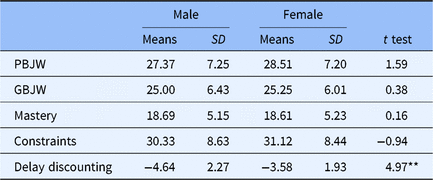
Note: Constraints subscale has been reverse coded.
p < .01.
Since BJW and sense of control were both latent variables, CFA was adopted to assess whether the measurement model fit the sample data. To avoid common method variance, Harman’s Single-Factor Test was used, which tests the significance of fitting index difference between the single factor model and multifactor model. In this study, a two-factor model, which consisted of two latent variables (BJW and sense of control) and four observed variables (PBJW, GBJW, mastery, and constraints; see Figure 1), and a single dimension model (BJW and sense of control were combined) were compared (see Table 3). The proposed two-factor model provided the best fit index, and all the factor loadings for the indicators on the latent variables were significant (p < .01), indicating that both the two latent constructs were well represented by their indicators.
The measurement model.
Measurement models comparison

Next, SEM was adopted to analyze the mediation effect. First, the total effects of BJW (predictor variable) on log K (dependent variable) without the mediator (sense of control) were found to be significant (β = −0.39, p < .01; see Figure 2a). Then, a partially mediated model containing the mediator (sense of control) and direct path from BJW to log K were tested (see Figure 2b); results show that the goodness-of-fit of the model was acceptable, but the direct path of BJW to log K was not significant (β = −0.05, p = .48), suggesting sense of control completely mediated the association between BJW and discounting rate. In the final model, the direct path from BJW to log K was deleted (see Figure 2c). The completely mediated model fit the data well (χ2/df = 3.21, RMSEA = 0.03, SRMR = 0.01, CFI = 0.99). Taken together, these results indicate that sense of control mediated the effect of BJW on discounting rate completely; hence, H3 was supported.
The structural models analysis.
Discussion
In this study, the authors explored the relationships among BJW, sense of control and the discounting rate, and examined the mediating effect of sense of control between BJW and discounting rate. Results suggest that BJW significantly predicted sense of control and the discounting rate, and sense of control completely mediated the effect of BJW on the discounting rate in this study.
Similar to previous studies, the present study found BJW to be negatively correlated with discounting rate, supporting H1: a stronger BJW induces greater attention to long-term benefits and goals (Bai et al., 2016; Dalbert, 1999; Furnham, 2003). Hafer et al. (2005) stated that BJW is not a congenital instinct but rather a consequence under the joint action of multiple acquired factors, particularly maintenance of a personal contract. During childhood, individuals’ psychological development gradually enables them to acquire longer term and more valuable goals while delaying or controlling enjoyment (i.e. delayed gratification; Fowler & Kam, 2006). An individual may be willing to constrain immediate gratification under the belief that a more valuable result will be achieved if short-term gratification is foregone on behalf of greater investment in the future. This pattern represents a so-called personal contract (Dalbert, 1999). People need to believe they live in a predictive just world to be willing to invest time, effort, or materials toward their future goals and feel confident they will reap the abundant returns they expect and deserve (Ramos et al., 2014). However, people become more shortsighted when BJW is threatened, at which point they begin to prefer immediate happiness. For instance, studies of crime victims and victims of natural disasters have shown that when people do not believe in BJW, the discounting rate increases significantly, and they focus on current enjoyment while neglecting long-term goals (Correia, Vala, & Aguiar, 2007; Laurin et al., 2011; Xie et al., 2011).
Like previous research, the present study also found sense of control to be negatively correlated with the discounting rate, supporting H2. Time is an important dimension when people make judgments and decisions. Studies have revealed that individuals with a low level of control are not confident enough about the future, as well as themselves, thus discount the value of delayed rewards more strongly compared to those with high sense of control (Cao & Su, 2007; Chou & Chi, 2001a). As mentioned previously, individuals with a high sense of control assign more weight to long-term goals and expand their short-term horizons, leading to a sense that the future is imminent; this belief cultivates a sense of connection with one’s future self (Malesza & Ostaszewski, 2017; Narisada & Schieman, 2016; Sullivan, 1993). On the other hand, impulsive individuals devalue delayed goals more strongly, presumably due to their altered perception of weight for rewards as time passes (Kirby et al., 1999). Thus, people with a high sense of control generally opt for longer term and greater rewards over immediate but smaller rewards, demonstrating a low level of delay discounting.
More importantly, the current study documented that sense of control completely mediates the effect of BJW on discounting rate, supporting H3. Lerner (2003) suggested that when people believe in a stable and orderly world, consequences are more predictable, and individuals therefore believe they will be treated fairly rather than falling victim to unanticipated disaster. Only under this premise can people have full confidence in the future. Dalbert (1999) summarized three functions of BJW: (1) it represents an individual contract and confirms individuals’ belief in obligatory fair behavior; (2) it endows individuals with confidence and enables them to believe they will be treated fairly rather than becoming victims of unpredictable disaster; and (3) it conceptualizes daily events in a meaningful way. These three functions of BJW offer individuals a sense of safety and control, maintain the illusion of a “just world”, and provide people with a sense of control and confidence in life (Kaiser, Vick, & Major, 2004). When individuals have a sufficient sense of control, they believe future results are based on current effort and choices; only then will they strive for long-term goals and relinquish smaller benefits now for larger benefits later (Narisada & Schieman, 2016). Given this premise, sense of control can mediate the effect of BJW on discounting rate, as suggested by H3. This result implies that when individuals experience unfairness in real life, they become less confident in the future and are aimless. By contrast, when they believe the world is just and reasonable, they have a greater sense of control over their environment and may be more likely to forgo immediate success and benefits in favor of longer-term goals.
The results of the current study suggest that BJW can promote willingness to forego short-term benefit for long-term gain by increasing sense of control. In practical terms, these results indicated that school counselors and educators might conceive designing interventions for educating people to believe the world is reasonable and just and enhancing their confidence for consequences are more controllable through their current effort. Consequently, such intervention may have important contribution to help individuals to form good habits and behavior and positively cope with stress.
Limitations
In this study, the authors discussed the relationships among BJW, sense of control and the discounting rate and came to several meaningful conclusions. However, this research is not without limitations. First, Faccenda and Pantaleon (2011) and Correia et al. (2007) considered BJW a stable individual difference variable, and in the current study, BJW was also regarded as a stable trait variable; however, other work has conceptualized BJW as a basic motivation that can be activated by post-conscious priming and is situational (Murray, Spadafore, & McIntosh, 2005). Further studies are needed to validate whether it significantly affects the discounting rate under experimental conditions. Second, the MCQ was used to evaluate the discounting rate, which only partially reflects individuals balancing short- and long-term benefits during economic selection; it does not fully reveal short- and long-term goals. The results of this work found discounting rate to be only moderately associated with BJW and sense of control, which also indicates that monetary choice does not fully reflect individual immediate decision making. The authors recommend that future studies incorporate other indicators of long-term goals. Third, as this cross-sectional study did not reveal between-variable causality, findings should be interpreted cautiously.
Footnotes
Author Orcid
Jiaxi Peng,
Acknowledgements
Sincere thanks are due to the Handing editor and anonymous reviewers for their professional and constructive comments.
Financial Support
This study was founded by the Social Sciences Planning Project of Sichuan Province (SC18C003).