






Abstract
Introduction
Strength training has proved to be an effective way to prevent injuries, but the evidence of the impact of strength training on finger injuries is lacking. A fingerboard is a sport-specific tool used by climbers for strength training of fingers. In this study, we searched for associations between fingerboard training and finger injuries in climbers with different lengths of climbing experience and levels of performance.
Methods
A web-based survey was used to collect information on self-perceived pain or injury in fingers (SPIIF) and regular fingerboard training (RFT). The survey was administered to the Finnish climbing community. Data were analyzed using contingency tables; chi-square was used to evaluate statistical significance.
Results
No significant correlations between SPIIF and RFT were found when analyzing all the participants (n=434) together. In climbers with 6 y or more in the sport, SPIIF was not common and RFT was negatively associated with SPIIF (χ2 [1, n=200]=4.57; P=0.03). In contrast to this, in male climbers who had been climbing for less than 6 y and had advanced to 7a level or higher (French lead/Font bouldering), SPIIF was common and RFT was positively associated with SPIIF (χ2 [1, n=75]=4.61; P=0.03).
Conclusions
We suggest that doing RFT may prevent SPIIF in climbers with a long background in the sport as fingerboard training can help build stronger fingers and thereby stronger tendons and ligaments. Climbers with fewer years in the sport and less adaptation to the fingers should be cautious with their training loads and RFT to avoid finger injuries and pain.
Keywords
Introduction
Climbing is a new Olympic sport with a growing number of participants and venues for the sport. With growing popularity, sport-specific injuries are increasing. 1 However, modern sport climbing is considered to have a low risk of severe injuries. 2
The most common site of climbing-specific injuries is the fingers, and a significant proportion of finger injuries are overuse injuries. 2 -4 More than 40% of chronic climbing injuries are finger injuries, and 67% of climbers have experienced a finger injury during the past 36 mo.3,5 To our knowledge, there are no prior studies about the mechanisms of overuse injuries in climbing. In general, overuse injuries are often caused gradually by repetitive microtraumas. 6 Progressive training and controlled training loads appear to be key methods to prevent finger injuries.
The anatomical sites in fingers prone to injuries—annular pulleys, finger flexor tendons, finger collateral ligaments, volar plates, and finger bones—adapt to the load caused by climbing. 7 -11 Some of these adaptations are already seen in young climbers, but adaptations often take multiple years of high-level climbing to develop. 7 -12 For some of these adaptations (tendons and bones), the high load seems to be more effective than volume or frequency.11,13
A fingerboard (Fig. 1 and 2) is a climbing-specific training tool used by many climbers to strengthen fingers. 14 A fingerboard contains grips of various sizes to hang from or to conduct pull-up–related exercises. 15 Hanging is usually performed with body weight or added weight. 15 Load reduction with a pulley system is also possible. The possibility to control load, change the grip size or type, and vary the amount and length of repetitions and recovery time allows controlled and systematic finger training. Fingerboard training has been shown to increase finger flexor strength in climbers more than climbing alone.16,17
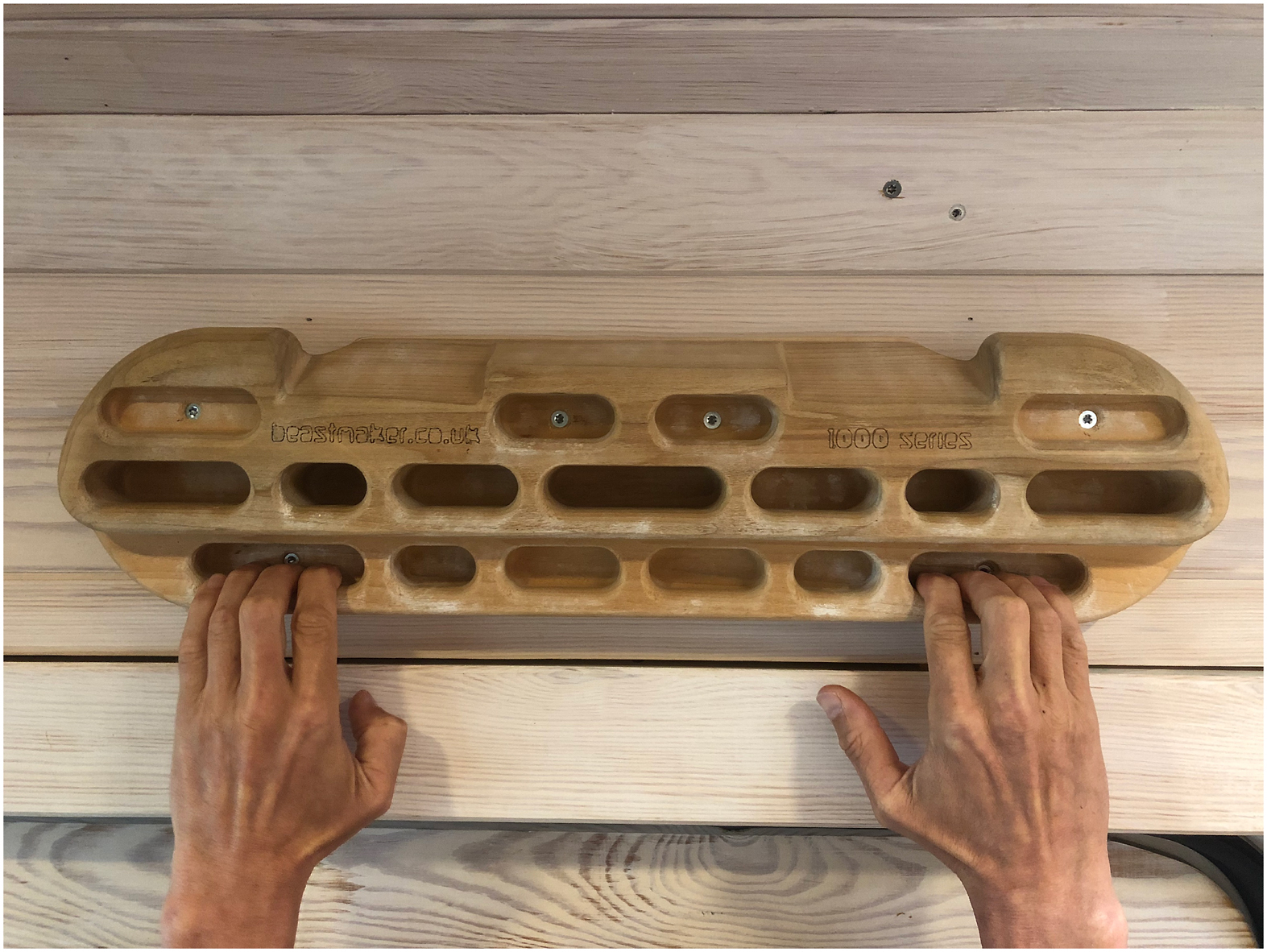
An example of a fingerboard.
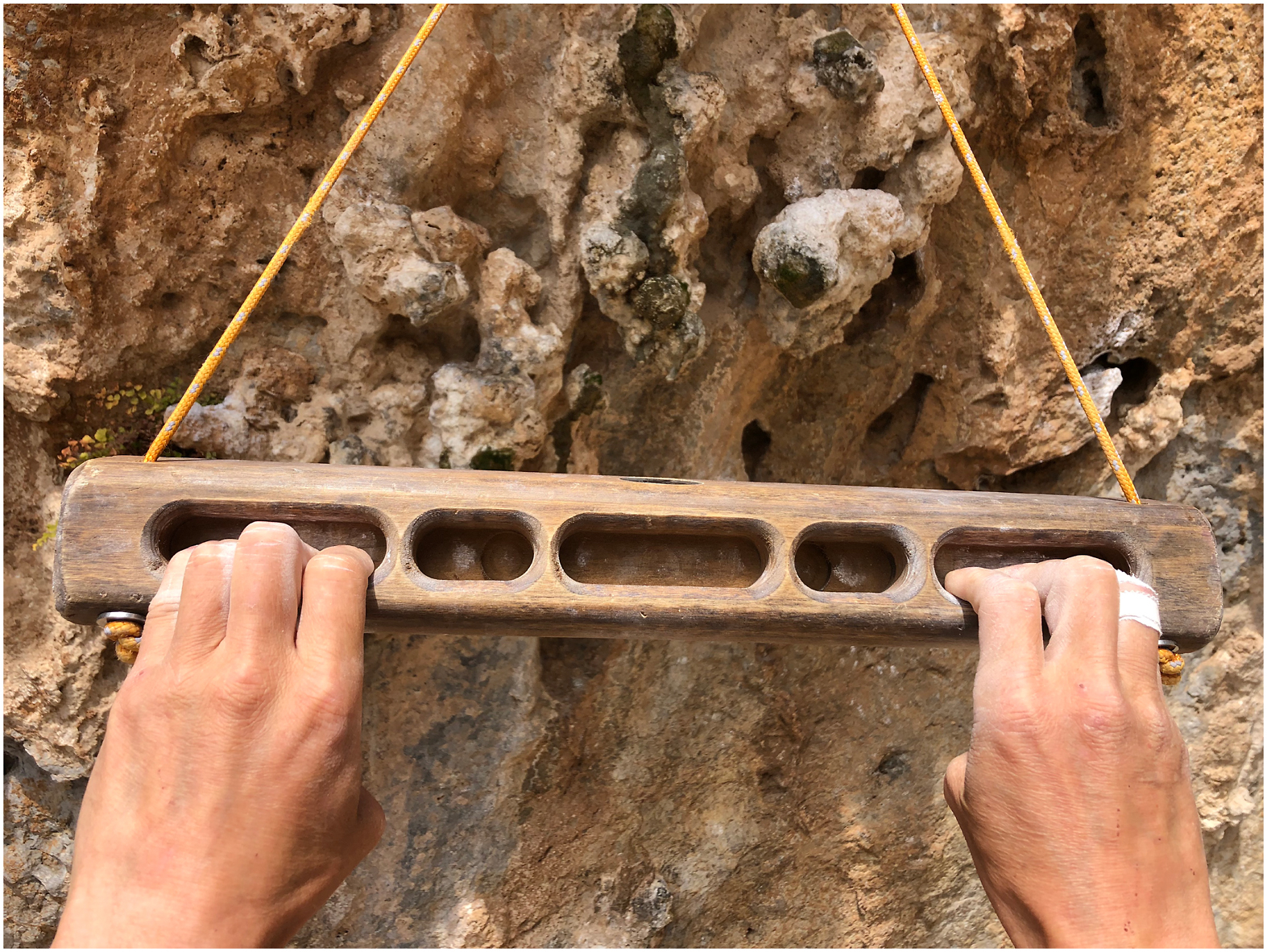
An example of a fingerboard.
Neuromuscular training, and especially strength training targeting athletes’ intrinsic risk factors, is an effective way to reduce acute and overuse injuries. 18 -21 Currently, most studies of neuromuscular training and injury prevention are focused on team sports and injuries in the lower extremities or shoulders. However, the mechanism of strength training as a method to increase tissue capacity and thus prevent sports injuries is suggested to be generally applicable to other sports as well.19,22 To our knowledge, there are no studies on strength training as a tool to prevent finger injuries in climbing. This study aims to evaluate the influence of fingerboard training on finger injuries in climbers with different lengths of climbing experience and levels of performance. We hypothesized that regular fingerboard training (RFT) is negatively associated with finger injuries.
Methods
The research setting was nonpersonal and anonymous. According to the Finnish National Board on Research Integrity TENK, this type of research setting does not require ethical review from the committee. However, good ethical research principles in data collection, analysis, and publication were closely followed.
Design, Participants, and Setting
This study is based on an anonymous, cross-sectional, retrospective survey using a web-based questionnaire. The questionnaire was shared on national and locally based Facebook pages used by the Finnish climbing community. Furthermore, the link to the survey was reposted by others to an unknown extent.
The survey was open for respondents between May 9 and July 31, 2019. Only respondents who answered all of the questions; were aged 18 y or older; practiced climbing on a regular basis, once a week or more; and were doing at least one of the following climbing disciplines: bouldering, sport climbing, indoor bouldering or indoor lead climbing, were included in the study.
Participant Characteristics
The survey included questions on climbers’ age, sex, height, and weight. The maximal achieved level of performance during the past 12 mo was asked, either according to the French lead climbing or the Font bouldering scale (≤6a+, 6b–6c+, 7a–7b+, 7c–8a+, and ≥8b). The respondents were asked how many years they had been doing regular climbing; how often they were climbing; whether they preferred bouldering, route climbing, or both; and whether they were climbing mainly indoors, outdoors, or both. The data were analyzed in 3 parts: females only, males only, and combined. Groups of climbers with a longer career (≥6 y of climbing), climbers with a shorter career (<6 y of climbing), climbers with a higher level of performance (≥7a as in Lion et al 5 ), and climbers with a lower level of performance (<7a) were analyzed separately, as well as climbers who only did bouldering.
Fingerboard Training
Fingerboard training regimens were identified by asking whether respondents trained regularly on fingerboards. Several more questions were asked to clarify the frequency and nature of fingerboard training. Fingerboard training that happened regularly, at least monthly, was defined as RFT.
Self-Perceived Pain or Injury In Fingers
Self-perceived pain or injury in fingers (SPIIF) was assessed by asking the respondents if they had any pain or injury in their fingers or palm, forcing them to have a total break from climbing, climb cautiously, or restrict climbing during the past 6 mo. An additional question about the location of SPIIF helped to rule out a few cases of injuries that did not affect the finger or palm area.
Statistical Analyses
The data were analyzed using SPSS Statistics (version 27 for Mac; SPSS INC, Chicago, IL). Possible associations between relevant variables were assessed with contingency tables. Chi-square was used to evaluate the statistical significance of the relationships. The statistical significance level was set at P<0.05.
Results
Participant characteristics
The participants’ (n=434) ages ranged from 18 to 59 y; the mean age was 34 y. Of the participants, 158 (36%) were women and 276 (64%) were men. A majority of the respondents had been climbing for over 3 y and were climbing 3 to 4 times a week. For most participants, the level of performance was 7a to 7b+. As only 1 respondent was climbing at a harder level than 8b, the 2 highest groups were merged in the final analysis. Most respondents were climbing both indoors and outdoors and performing bouldering as well as route climbing (Table 1).
Participant characteristics
BMI, body mass index.
Fingerboard training
Of all the participants, 24% were doing RFT. Regular fingerboard training was more common among men (31%) than among women (11%). Regular fingerboard training was common among the climbers with a higher level of climbing performance: 15% of level 4 to 6a+ climbers, 12% of 6b to 6c+ climbers, 25% of 7a to 7b+ climbers, and 45% of 7c– climbers did RFT.
Fingerboard training was mainly performed 1 to 2 times a week. Almost all respondents described their fingerboard training as either maximal finger flexor training or intermittent hangs (“repeaters”). Maximal finger flexor training was typically performed by hanging for 5 to 10 s with maximal weight, and intermittent hangs typically performed by hanging for 5 to 10 s and resting for 3 to 5 s multiple times in a row. The respondents were mainly hanging their body weight with 2 arms or hanging with 1 arm or using added weight (see Table 2).
Fingerboard training (intensity, load, number of weekly sessions)
Spiif
Of the respondents, 42% reported that SPIIF affected their training during the past 6 mo (see Table 3). Self-perceived pain or injury in fingers was equally present in women (41%) and men (42%). No significant correlations were found between SPIIF and the frequency of climbing.
Self-perceived pain or injury in fingers by years of climbing and level of climbing
Fingerboard Training Vs Spiif
When analyzing all the participants together, there were no significant correlations between SPIIF and RFT as SPIIF was almost as common in the groups of climbers doing RFT as it was in the groups of those not doing RFT (39% vs 43%). In women who did RFT, SPIIF was not as common as in the group of women who did not do RFT (28% vs 43%), but the difference was not significant (χ2 [1, n=158]=1.50; P=0.22).
For those who had been climbing for 6 y or more, fingerboard training was negatively correlated with SPIIF (χ2 [1, n=200]=4.57; P=0.03). In this group, 28% of those who did RFT had experienced SPIIF during the past 6 mo. Of those who did not train on fingerboard, 44% had faced SPIIF during the past 6 mo (see Table 4).
Finger injury prevalence and fingerboard training among all respondents who have been climbing for 6 y or more and among men who have been climbing for less than 6 y and whose performance level is 7a or higher
Among male climbers who had been climbing for less than 6 y and whose level of performance was 7a or higher, 78% of those doing RFT had experienced SPIIF. Of those who did not do RFT, 52% had experienced SPIIF (see Table 4). The relationship between these variables was significant (χ2 [1, n=75]=4.61; P=0.03). The tendency was even more clear in climbers who were only bouldering. Of male boulderers who had been climbing for less than 6 y, whose performance level was 7a or higher, and who did RFT, 85% had encountered a finger injury during the past 6 mo (χ2 [1, n=46]=4.29; P=0.04).
Discussion
This study suggests possible connections between RFT and SPIIF. We found that in climbers who had been climbing for 6 y or more, RFT was associated with a lower risk of SPIIF. Furthermore, for male climbers who had been climbing for less than 6 y and whose level of performance was 7a or higher, RFT was associated with a higher risk of SPIIF. Among those climbers who did bouldering only, this trend was seen even more clearly. Thus, our results suggest that in climbers with a long background in the sport, RFT may prevent finger injuries. On the contrary, in climbers performing at a high level in the early stages of their career, fingerboard training may increase the risk of finger injuries.
To our knowledge, the effects of fingerboard training on injuries have only been studied once before. Auer et al 23 found that fingerboard training first seemed to increase the injury risk, but after adjusting for age, history of injury, and climbing years, no significant connections were found. As they were studying the relationship between fingerboard training and overall injury risk and had not included an in-depth analysis of climbing years or level of performance, a direct comparison of our findings and their study is not possible.
In previous studies, the rate of finger injuries has varied between 24% during the past 6 mo and 67% during the past 36 mo.3,5 In our study, with a relatively broad definition for finger pain and injuries, the incidence of SPIIF during the past 6 mo was 42%. Along with the time loss of climbing, we also used the functional loss as suggested by Bahr.24,25 This together with methodological differences may explain why our results seem high compared with those of previous studies.3,5,23
Injury prevention programs in sports, targeting neuromuscular training and its subsets, such as strength training, have been shown to be effective in various sports.18,21 Strength training has been hypothesized to prevent injuries by strengthening adjacent tissues and thus reducing critical joint loads in addition to muscle strength improvements. 19 Adjacent tissues play a key role in fingers, as there is basically no muscle mass in fingers. Thus, the role of strengthening the adjacent tissues, such as pulleys, tendons, volar plates, and ligaments, should be emphasized in climbing.
Finger loading caused by years of climbing has been associated with adaptation reactions visible on magnetic resonance imaging and radiography, such as thicker flexor tendons, pulleys, and volar plates and increased bone mass density.7,9-12 In tendons and bones, high loading has been connected to stronger adaptation reactions.11,13 We found that respondents with a long career in climbing had less SPIIF if they were doing RFT. As fingerboard training is usually done with relatively high loads, we hypothesize that our findings in climbers with more years in the sport are caused by adaptation reactions. Furthermore, in this study, high-level male climbers with shorter careers had a high rate of injuries (Table 4), highlighting the theory that ligaments and tendons require several years to adapt to the high loads in climbing. We showed that RFT was associated with the risk of injuries in this group. The trend was even stronger among those who mainly did bouldering. As bouldering is considered to maximally load fingers, we interpret that fingerboard training on top of constant bouldering can increase the risk of training loads growing too high in individuals whose fingers are not fully adapted to climbing. Therefore, long adaptation processes, overloading risks, and progressive training need to be considered in the injury prevention strategy.
High or rapidly growing training loads are associated with greater injury risk. 26 The size and distance of hand and foot holds, friction, and angle of the wall are the factors influencing the difficulty rating of a climbing route. 11 In our study, most of the men reached the 7a level after 3 to 5 y of climbing. During these years, the risk of SPIIF was also the highest. Performing fingerboard training further increased the risk of SPIIF. If the transition to a higher performance level is fast, we speculate that climbers’ fingers are under continuously growing stress that may exceed their capacity to cope. We also suggest that fingerboard training on top of the rapidly rising level of performance may cause excessive strain for most individuals and thus increase the risk of injuries, especially if not applied reasonably.
Strengths and Limitations of The Study
The online survey specified that it concerned finger injuries, which may have caused selection bias as climbers with an injury were probably more likely to take part in the survey. The respondents were not informed about the focus of the study being on possible connections between finger injuries and fingerboard training.
With this kind of research setting, it is impractical to specify whether it is the role of physical adaptations or other factors evolving within one’s climbing career that cause different outcomes of fingerboard training for climbers with shorter and longer careers in the sport. Training errors, climbing technique, intensity of training, nutrition, recovery, and presence of coaches or more experienced climbing partners may all influence injury rates. Thus, the results of this study should be interpreted carefully.
Broad definitions of fingerboard training and finger injuries were, at the same time, a weakness and a strength in the study. Not differentiating between strength training and strength endurance training on a fingerboard and not knowing what kind of fingerboard was used may have affected the results.
Looking for all types of finger problems, from little tweaks to total pulley ruptures, gives a good overview of the respondents’ self-assessed pain, disabilities, and injuries. In contrast, medical details of the respondents’ SPIIF and knowing which fingers were injured and whether or not there was a direct link between RFT and injury could help to specify the underlying causes of the connections found between RFT and SPIIF.
We could not exclude the possibility that climbers with pain or injury in their fingers might have performed less fingerboard training. However, participants were asked about injuries from the past 6-mo period, whereas most respondents had been performing RFT for longer than 7 mo. As previous injuries increase the risk of a new injury, 27 a history of finger problems may influence the willingness to start fingerboard training. That could be one reason why climbers with a long background in the sport who do not perform RFT have more injuries.
Fingerboard training is an important tool for strength training for goal-oriented climbers aiming to progress in the sport. Future studies may benefit from specifying the intensity and frequency of fingerboard training in relation to finger injuries in climbers with different training backgrounds. The role of hand dominance and finger flexor strength training in climbing techniques and in preventing shoulder and elbow injuries would be beneficial to study. In future studies, we suggest that bouldering and lead climbing levels be analyzed separately as they are not completely comparable. In this study, analyzing the highest achieved level in either lead climbing or bouldering allowed a larger number of participants.
Conclusions
In the group of male climbers who had been climbing for less than 6 y and had advanced to a 7a level or higher, SPIIF was common and RFT was connected to more SPIIF. In the group of all climbers with 6 or more climbing years, SPIIF was not as common and RFT was connected to less SPIIF. Fingerboard training increases finger flexor strength and can prevent injuries. However, those advancing in climbing with a relatively short history in the sport should be cautious when adding fingerboard training into their training schedule. Excessive climbing combined with intensive fingerboard training or other training errors may overload fingers and increase the risk of injuries. To conclude, training should be a continuous process during which loading is carefully monitored to result in appropriate tissue adaptations and physiological changes instead of injuries.
Footnotes
Acknowledgements
Author Contributions: study concept and design (AES); data acquisition and analysis (AES); drafting of the manuscript (AES; GG); critical revision of the manuscript (GG; MVJ); approval of final manuscript (AES, GG, MVJ).
Financial/Material Support: None.
Disclosures: None.