






Abstract
Mediterranean loggerhead sea turtles (Caretta caretta) are very large. During spawning season, they land on the beaches of Turkey and Greece at night, which are frequently visited by humans, and lay their eggs. Typically, they suck feed in deep water. It is uncommon for C caretta, which have strong mouths and jaws, to attack people. We report a case of a 44-y-old female patient who was attacked by a turtle on the Mediterranean beach in September 2020. She was brought to the emergency department, where she was noted to have a deep cut on the thumb and large bruises on the left side of her waist. The patient was discharged with appropriate wound care, antibacterial drug, and tetanus vaccine. The wound healed within a few months by developing granulation tissue. However, this report draws attention to the fact that, under some circumstances, C caretta can become aggressive toward people swimming off heavily populated beaches.
Keywords
Introduction
Caretta caretta are giant sea turtles with massive heads and strong jaws that first appeared approximately 150 million years ago. 1 Most of their lives are spent in the depths of the sea; only 10% of their life span is spent at the water’s surface.1,2 From January until July, they go ashore at night and nest in the sand on Mediterranean beaches. 3 The nesting sites are near cliffs or crevices near beaches. The nesting period varies with the latitude and geographical features of the coast.2,3 Adult males weigh approximately 113 kg (250 lb). Loggerhead sea turtles’ powerful jaws allow them to crush shellfish and horseshoe crabs. They also suck feed on jellyfish, shrimp, sponges, and fish and sometimes even on seaweed and algae.4,5
Freshwater animals can sometimes harm swimmers, and the victims may need medical attention. One example is an adolescent boy who was bitten by a large alligator snapper (Macrochelys temminckii) in North America, which almost completely severed his index finger. 6 Although they lack teeth, the biting power of C caretta increases in proportion to body size. 5 In Turkey, protection zones have been established in areas on the Mediterranean coast where C caretta come to lay their eggs.7,8 These areas attract many tourists. Recently, local newspapers have reported that chicken meat is being used to attract C caretta for tourism purposes. 9 -11 Turtles that have habitually foraged on beaches in recent years rarely attack people. 11 There is limited scientific evidence that C caretta attack humans. However, we report the case of a woman who sustained a deep finger cut and superficial skin damage as a result of a C caretta attack while swimming in the sea.
Case Report
The patient was swimming in 3-m–deep water in a rocky area that motel guests can access by stairs when she experienced severe pain in her thumb. She noticed a 1-m–long turtle (C caretta) next to her. Its size suggested that the turtle was sexually mature. At that time, no other turtle was seen. While trying to escape in a panic, she was attached from behind by the turtle, which bit and sucked on her back and waist. She returned to the shore with the help of her relatives. Her finger sustained a very painful throbbing laceration. In the emergency department, large bruises were seen on the left side of her waist, and the fingernail was almost avulsed (Figure 1a and b). No radiological examination was performed, and the physician decided that sutures were not needed. After dressing the wound, the patient was vaccinated against tetanus and given oral levofloxacin. Approximately 3 mo later, granulation tissue was observed in the wound and a new nail had formed.
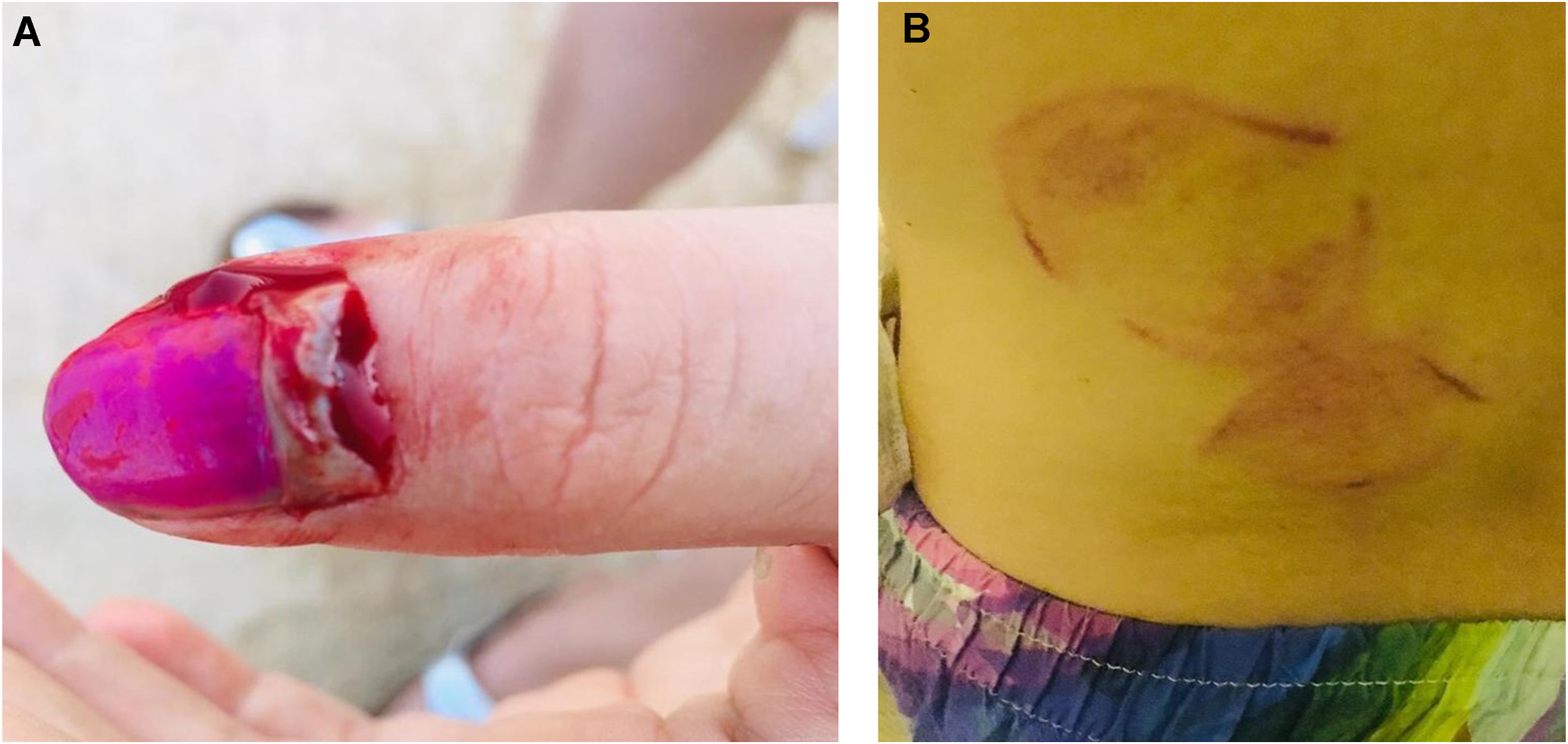
A, The laceration was deep enough to avulse the thumb nail. B, A large bruise appeared over the left side of the waist.
It was subsequently learned that similar turtle attacks had occurred in the same area, which resulted in injuries to other individuals. It was understood that these attacks were not intentional.
Discussion
National newspapers reported 11 C caretta attacks along the Mediterranean coast in August 2022. In one of these cases, it was reported that the same turtle attacked a rescuer who was trying to help the victim, who suffered injuries to her thigh and left hand. 11 The case report presented here deals with a large C caretta that unexpectedly attacked a swimming woman, injuring her finger and back.
It is important to consider what provoked the C caretta, which are normally very placid creatures. The attack did not occur during the turtle spawning season. On the basis of climate models, the literature projects that increases of 3 to 5°C in the air and sea temperature might cause the sea turtle nesting and foraging seasons to advance by approximately 2 mo. 12 However, the season does not provide an explanation for the attack.
Many aquatic species can be encouraged to feed on land. 13 An analysis of bite kinematics showed that the environment can influence the feeding behavior of some aquatic emydid turtles. Aquatic turtles feeding on land use long bites and exhibit more jaw movements and more extensive movements of the hyoid bone during underwater suck feeding. 14 Regional newspapers from the Mediterranean region of Turkey reported that people on the beach fed chicken pieces to turtles.9,13 This behavior encourages turtles to forage on land and affects their feeding behavior. The turtle’s bite and attempt to suck the woman’s back after attacking her finger seen in our case may support this idea.
Wildlife feeding by humans is a controversial issue. The generally accepted view is that there is no biological justification for this behavior, except to help sick animals. 15 This type of feeding may have harmful effects on humans, such as injury and infection, and can also affect the eating behavior, health, and levels of aggression of animals. 15 -18 Although studies have reported that wildlife feeding (of land animals) can increase aggression toward humans, there have been fewer reports on marine animals. 16 -19 The use of wildlife to attract tourists or for entertainment purposes is also an ethical issue. 15 The literature on human feeding of C caretta is limited. However, the fact that turtles are seen as a commodity to promote tourism indicates a need for more detailed research on this issue.
The risk of infection from reptile bites in an aquatic environment should also be considered. One study reported antibiotic resistance of gram-negative isolates of Escherichia spp and Pseudomonas spp on oral and cloacal swabs from C caretta living in the central Mediterranean Sea. High resistance rates were reported against cephalosporins, tetracyclines, amoxicillin, and colistin, whereas the same isolates had little or no resistance to gentamicin, amikacin, enrofloxacin, and ciprofloxacin. 20
Conclusion
C caretta can become aggressive, which may be related to environmental factors or human that affect its feeding behavior. In case of an attack, victims should be evaluated for lacerations or blunt trauma, and a tetanus vaccine should be administered. Because bacteria may be resistant to antibiotics, culture examinations are required.
Footnotes
Acknowledgements
Author Contributions: literature review (BB, SA); manuscript draft (BB, SA); review (BB, SA); approval of final manuscript (BB, SA).
Financial/Material Support: None.
Disclosures: None.