






Abstract
In 1755 in Bergemoletto, Italy, an avalanche buried 4 people (2 women, a girl, and a boy) and several animals in a stable. After 37 d in a pitch-dark confined space, 3 of the 4 people were rescued alive. The 3 survivors had only goat milk, a few chestnuts, a few kg of raw kid meat, and meltwater for nutrition. We describe the longest-known survival in an avalanche burial and discuss the medical and psychological problems of the survivors. The boy died. When they were extricated, all 3 survivors were exhausted, cachectic, and unable to stand or walk. They were severely malnourished and were experiencing tingling, tremors, and weakness in the legs; constipation; changes in taste; and amenorrhea. One of the women had persistent eye problems and developed symptoms consistent with post-traumatic stress disorder. The survivors were given slow refeeding. It took from 1 to 6 wk before they could walk. We compare this case to other long-duration burials, especially mining accidents, and describe the rescue and patient care after long-duration burials. This case demonstrates that people can overcome extremely adverse conditions and survive.
Keywords
Case presentation
On March 19, 1755, in Bergemoletto, a hamlet (population of approximately 150 in 1755) in the western Italian Alps, an avalanche deposited snow, approximately 18 m deep over an area of 117 × 26 m, causing 22 deaths.1,2 The heavy snowfall also caused 200 fatalities in the Maritime Alps of northern Italy. Four people were buried in a stable: A.M. (about 40-y old), her daughter M. (about 11-y old), her son A. (about 5-y old), and her sister A.R. (about 24-y old). The 2 women and the girl survived. The boy died during the burial. Several contemporary sources, some translated into English, 3 and a detailed historical summary, 4 recount this tragic event and give medical information from 2 d after the rescue until 2 y later.
The 3 survivors were buried for 37 d in a pitch-dark confined space (approximately 3.7 × 2.4 × 1.5 m) in a collapsed stable. A manger approximately 1 m wide and full of hay with a hayloft above, ran along one side of the stable. The group of 4 huddled next to each other in the manger “with their knees to their noses.” 3 The stable was built of stone, mud, and lime. The roof was thatch, and the stones were supported by heavy wooden beams. The main beam of the roof remained intact (Figure 1). 1 Two goats, a donkey, and several hens were trapped with the 4 people. The main sources of sustenance for the people were a few chestnuts, milk from the goats, and water from snowmelt. One of the goats gave birth to a kid that the survivors killed and ate to maintain the sparse milk production of the mother goat. The donkey, the goats, and the hens died one after another. On about the 12th day, the 5-y-old boy died. The stench of the decomposing bodies and the excrement was overwhelming.
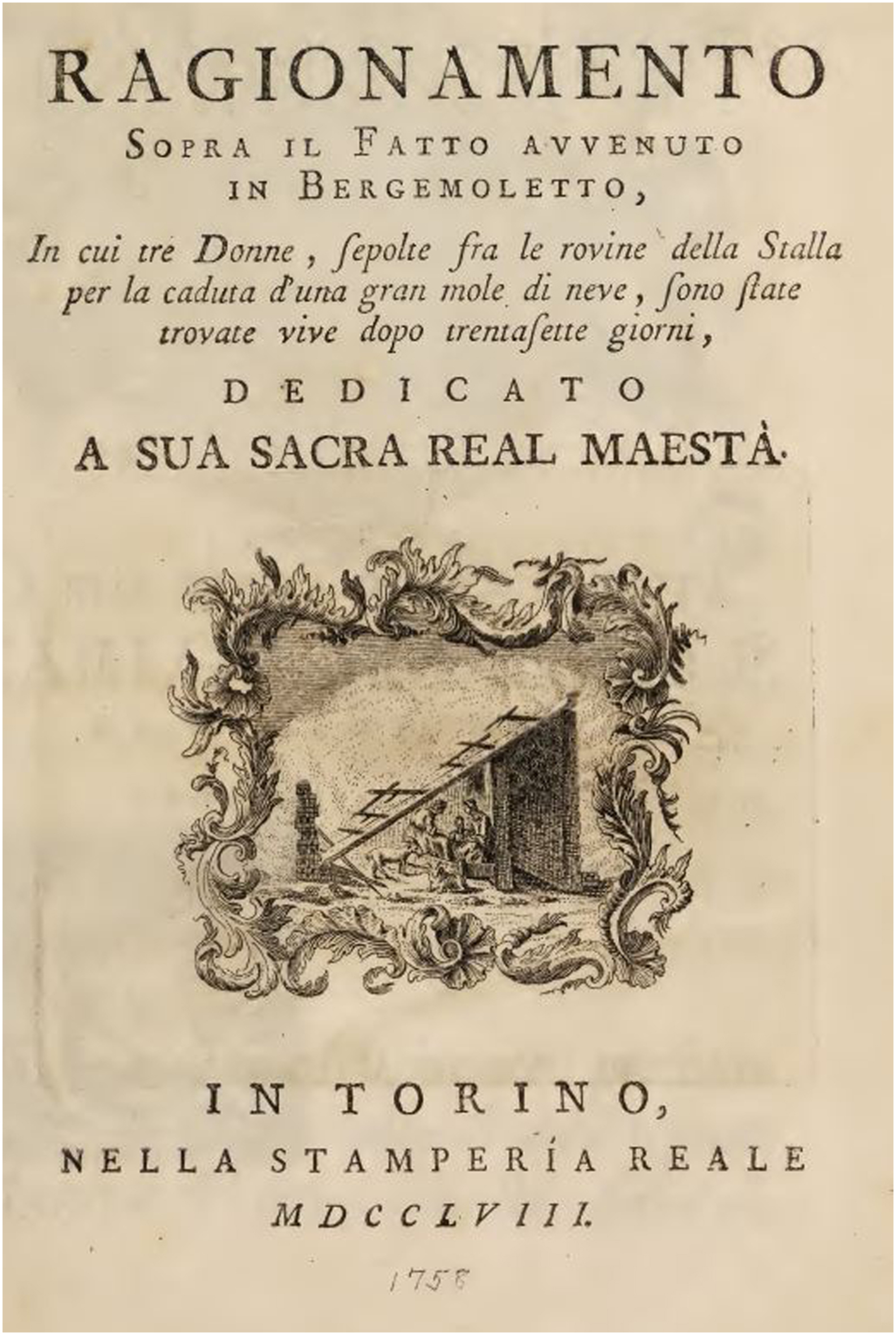
Cover of an account of this event from 1758 by Somis. 1
When the 3 survivors were dug out, their clothes were rotted, they were disfigured with louse-bitten skin, and they were exhausted and unable to stand or walk because of swollen and contracted limbs. They were put to bed in a warm and semidark stable in one of the 2 undamaged houses near the stable. All 3 were experiencing thirst, abdominal pain, and shortness of breath. They were cachectic and pale. A.M. reported eye pain and dim vision, with red eyes, tears, and dilated pupils, dizziness, headache, numbness from her thighs to her feet, and insomnia. She had lost nearly all her hair and had little muscular strength. A.R. had fewer problems but also reported a headache; hot flashes; and tingling, tremors, and weakness in her legs. She had pain in her right knee. M. had the fewest problems, mainly abdominal pain.
After they were rescued, the survivors received small portions of rye meal gruel with butter and wine. Two d after the rescue, a doctor established a refeeding program with small amounts of veal broth, goat milk, wine twice daily, and water every 3 h. After 7 d, the survivors were able to eat veal broth with barley flour gruel, fresh eggs, and wheat bread. They reported changes in taste for a month after being rescued. M. was able to walk after 8 d and A.R. was able to walk after 3 wk. A.M. needed 6 wk before she could leave her bed. All had constipation. A.M. had her first bowel movement after 15 d. The women were amenorrheic for 8 wk. Two y later, in April 1757, 2 of the survivors were “enjoying perfect health” and were working in the fields. A.M. was unable to work, had a tremor, and “great dimness of eyesight.” 4
Medical conditions
Conditions Caused by Confinement in Small Spaces
Most of the time, the survivors sat squatting against a wall of a manger about 1 m wide. All had musculoskeletal complaints. The duration of the burial was probably too short to cause permanent skeletal deformity. Although movement was very limited, it was still possible. It takes years for procedures, such as Chinese foot binding, Padaung neck rings, and tightly laced corsets, to cause permanent bony deformity. 5 Darkness may have caused vitamin D deficiency, leading to rickets. 6 The half-life of exogenously administered vitamin D is about 15 d. 7 The time to reach critically low plasma levels of vitamin D (<15 g·dL−1) depends largely on the initial plasma level. 6 The survivors drank calcium-rich milk. As far as we know, the survivors had no permanent skeletal deformities.
Immobilization can cause joint contracture and skeletal muscle changes, such as atrophy from disuse, fibrosis, and altered neuromuscular function characterized by reductions in range of motion of the affected joints and loss of muscle strength.8,9 Although the survivors were not completely immobile, reduced mobility and decreased loading exacerbated by poor nutrition may have resulted in muscle atrophy, comparable to the effects of space travel.10,11 Nutritional deprivation probably contributed to muscle weakness with the inability to stand or walk.
There was a high risk of deep vein thrombosis. Venous stasis, one of the most important risk factors for thrombosis, can be caused by prolonged immobility, especially in a crouching position. The swelling and pain in the legs may have been caused, at least in part, by deep venous thrombosis. Pulmonary embolism is a potential complication of deep venous thrombosis. 12 A.M. reported that “from the fifth day, their respirations became heavy and laborious.” 4 Except for shortness of breath, the accounts do not describe signs and symptoms of pulmonary embolism, such as tachycardia, pleuritic chest pain, hemoptysis, or syncope. 13 The shortness of breath may also have been caused by constantly increasing hypoxia and hypercapnia. 14
Ocular Conditions
The extreme light sensitivity of the 3 survivors after 37 d in complete darkness would have been expected. The transition of the eye from functioning optimally in a light environment to functioning in a dark environment is called dark adaptation. The dark adaptation response includes increased sensitivity of the rod cells in the retina, caused by the regeneration of the visual pigment rhodopsin during dark conditions and pupillary dilation. 15
Of the survivors, A.M. was the only one who had persistent ocular signs and symptoms, described as redness and irritation of the eyes and dim vision. A.M.'s clinical presentation suggests vitamin A deficiency. 4 The classic presentation of vitamin A deficiency is dryness of the eyes and night blindness. 16 -18 Vitamin A deficiency is most commonly associated with prolonged malnutrition in developing countries, especially in times of famine, but may occur acutely in individuals with eating disorders or malabsorption syndromes.18,19 The diet in the 18th century was probably less balanced than modern diets in developed countries and may be comparable with diets in the modern developing world. A study of patients who underwent gastric bypass surgery found that by 6 wk after surgery, 35% of patients were vitamin A deficient. 20 It typically takes >6 wk for symptoms to occur.21,22 A.M. may have had chronic malnourishment, exacerbated acutely by 37 d of starvation, causing rapid onset of symptoms of vitamin A deficiency.
Optic neuropathy is a less common feature of vitamin A deficiency but may occur in severe cases.18,19,23 While other ocular disorders cannot be excluded, the combination of ocular surface disease (conjunctival redness) and vision loss with acute nutritional deprivation makes vitamin A deficiency the most likely cause. Optic neuropathy caused by vitamin A deficiency may improve with better nutrition or after specific vitamin A supplementation. 23 A.M.ʼs failure to recover full vision after returning to normal life may have been caused by irreversible damage from acute nutritional deprivation.
Nutrition, Starvation, and Refeeding
The survivors had only goat milk, a few chestnuts, a few kg of raw kid meat, and meltwater for nutrition. Malnutrition over several weeks may have caused or contributed to weight loss, muscle fatigue, edema, hormonal changes with amenorrhea, and psychological problems.24,25 Malnutrition also weakens immune defenses, alters gastric acid levels, and impairs mucous membrane function, especially in children. 26 Although goat milk, similar to human maternal milk, is a good source of protein, the amount available was probably insufficient to avoid malnutrition. 27 -29 Meltwater contains few minerals. Drinking meltwater might have worsened electrolyte imbalance.
Refeeding syndrome is a potentially life-threatening complication that can occur after prolonged periods of fasting or malnutrition. Symptoms are variable. Refeeding is characterized by electrolyte imbalances, disturbances of fluid homeostasis, and metabolic alterations.30,31 The pathophysiology is not fully understood but is related to the sudden change from catabolic to anabolic metabolism caused by increased food intake after a long period of fasting or malnutrition. This causes excessive insulin secretion, leading to shifts of potassium, magnesium, and phosphate from extracellular to intracellular fluid. These shifts can cause hypokalemia, hypomagnesemia, and hypophosphatemia. The insufficient capacity of the hepatic urea cycle leads to high ammonia levels. Carbohydrate feeding can reduce sodium excretion, causing edema. Thiamine deficiency is exacerbated by rapid consumption in glycolysis, interfering with the citric acid cycle. 31 Increased metabolism of pyruvate to lactate causes lactic acidosis. 30 Refeeding syndrome can cause multiorgan system dysfunction, with paresthesia, seizures, coagulopathy, muscle weakness, and respiratory or cardiovascular failure, sometimes with fatal outcomes. 30 Refeeding syndrome can occur in the treatment of anorexia nervosa. 32 The survivors had symptoms and signs consistent with refeeding syndrome, such as paresthesia and muscle weakness, but it is unclear if these were caused by the burial or by refeeding.
Modern treatment of starvation includes calorie and electrolyte replacement. After starvation for ≥2 wk, calories are replaced gradually. 33 The doctor prescribed slowly increasing food intake, suggesting that the risks of overfeeding after a long period of starvation were already known in 1755.
Hygiene
During the 37 d of burial, it was impossible for the survivors to maintain adequate hygiene. The contaminated environment included excrement and the bodies of the donkey, goats, chickens, and the boy. All the survivors had lice. A.M.’s legs were described as swollen, but there were no detailed descriptions of the skin of any of the survivors. Malnutrition can increase the likelihood of skin infections and ulcers and can slow wound healing. 34 The wounds may have become infected, contributing to tissue swelling. Although the cause of the boy’s death is unclear, he may have died from a gastrointestinal infection caused by poor hygiene.
Cold Stress and Nonfreezing Cold Injuries
Water was constantly dripping on the buried subjects, with limited protection by clothing. The conditions in the stable, surrounded by snow, must have resembled those in a closed snow shelter with still air and humidity near 100%. Evaporative heat loss was likely very low because the air was saturated with water vapor. The temperatures in the stable are unknown. The constant dripping indicated that the temperatures were above freezing. The snow and the stone walls provided insulation but also acted as heat sinks. The main heat source was the body heat of the people and animals. There was an abundance of hay in the stable. The people likely used the hay as insulation from the surrounding snow and stone walls. In March, people were probably wearing warm clothes in the cold mountain environment. Heat loss and metabolic heat production must have been balanced. Even a small constant heat loss would have resulted in fatal hypothermia over the course of 37 d.
Exposure to a cold, wet environment can cause nonfreezing cold injury (trench foot). 35 A.M. experienced tremor and “prickly pains all over her body.” 4 One y after the accident, “she was still unable to work in the fields.” 4 A.R. was confined to bed for 20 d because of “sharp pains in her head and troublesome prickly heat in her feet.” 4 Six wk later, she “was almost entirely recovered.” 4 Prickly sensations may have been paresthesia from peripheral neuropathy caused by vitamin B deficiency or by nonfreezing cold injury. 35
Neurologic Conditions
The neurologic signs and symptoms were likely caused by starvation with deficiencies of vitamins and trace elements. The confined space, with cramped posture and reduced mobility, may also have played a role. Mental stress may have been another contributing factor, especially for headaches.
Individuals can develop vitamin B1 deficiency consistent with Wernicke-Korsakoff syndrome from fasting, even with thiamine replacement. In one study, hunger strikers developed truncal ataxia, gaze-evoked horizontal nystagmus, altered consciousness, amnesia, low sensory nerve action potential amplitude, and low compound muscle action potential amplitude. 36 Vitamin B1 reserves last for 9 to 18 d. 37 Chestnuts 38 and goat milk 39 contain vitamin B1. With other essential vitamins and micronutrients, this might have prevented more severe sequelae. The “troublesome prickly heat” 3 in the legs was probably a symptom of polyneuropathy.
Psychiatric Conditions
Following long-term avalanche burial, survivors can suffer from psychiatric conditions, such as post-traumatic stress disorder (PTSD). PTSD has been described in 11 40 to 18% 41 of avalanche survivors. The diagnosis of PTSD first appeared in the DSM III ‒ Diagnostic and Statistical Manual of Mental Disorders after the Vietnam war, 42 but psychological reactions to stress and trauma are as old as humanity.43,44 While it is impossible to assign psychiatric diagnoses in retrospect, only one of the survivors in 1755, A.M., who lost her son, showed severe psychiatric symptoms compatible with a diagnosis of PTSD following rescue, including impaired sleep, hyperarousal, intrusive thoughts, nightmares, and anorexia. 4 All 3 survivors were exposed to the same traumatic event. It is known that only a minority of individuals experiencing a traumatic event develop PTSD. Individual differences in vulnerability and resilience might explain the differences in outcomes. 45 The incidence of PTSD decreases over time; however, symptoms may persist for decades following an avalanche disaster. 46 A.M.’s symptoms 4 were also consistent with other stress-related psychiatric conditions, such as adjustment disorder with depressive symptoms or major depression. 47
The diagnosis of PTSD cannot be made until at least 1 mo after a traumatic event. There must be a stressor meeting the criteria for a traumatic event, such as exposure to death, threatened death, actual or threatened serious injury, or actual or threatened sexual violence. 47 Further diagnostic criteria of PTSD include intrusive symptoms, such as flashbacks or nightmares; avoidance of trauma-related stimuli; negative alterations in cognition and mood, such as inability to recall key features of the event or negative affect; and alterations in arousal and reactivity, such as hypervigilance or difficulty sleeping. Stress-induced hyperarousal is associated with alterations in the hypothalamic-pituitary-adrenal axis that can cause physical symptoms, such as alopecia or anorexia. 4
Long-Duration Burials in History
We describe one of the longest entrapments by a natural disaster ever reported and the longest reported avalanche burial with survival. The second longest avalanche survival in a building was 13 d in 1951 in Heiligenblut, Austria. 48 The 1755 case more closely resembles long-duration burials from earthquakes or from caving or mining accidents. The longest cave entrapment with survival was 17 d in the Tham Luang cave in Thailand in 2018. The longest reported burial by an earthquake with survival was 27 d in 2010 in Port-au-Prince, Haiti. 49 As far as we know, only the San José mining accident in Chile in 2010, with a burial time of 69 d, was longer than 37 d. 50
Detailed information about medical conditions can be found in an account of the Lengede mining accident in 1963. Three miners were trapped for 8 d, and 11 miners were trapped for 14 d in confined spaces in a damp cold environment, with excrement and corpses. Temperatures were 11 to 13°C with 90 to 95% humidity and cold drafts, 50 conditions that may have been similar to those in the case we describe. Victims who did not die from trauma had only minor orthopedic injuries. 51 Some of the casualties developed wound infections, possibly because of poor hygiene. Inflammation of the thighs and perineum was common. 52 -55 Some signs and symptoms, such as swollen legs with persistent numbness after exposure to cold and high humidity, may have been nonfreezing cold injuries.35,52,53 Starvation was a problem for the survivors in Lengede. After rescue, calorie intake was increased slowly.53,56 Unlike the case we describe, burial time was much shorter, and artificial light and food were available during the burial. 50
In the San José mining accident, the longest reported burial, environmental conditions were different from those in Bergemoletto or Lengede. The temperature was much higher (30–34°C with 85–95% humidity), light was available, and communication with the trapped miners was established on Day 17 by a drill hole, with the ability to provide supplies and medical support.50,56,57 The miners developed fungal foot infections with irritation and scaling. 57 No orthopedic, ocular, cold-related, or neurologic conditions were reported.
Logistical and Medical Considerations in Long-Duration Burials
Survival for days to weeks is only possible if victims are buried in cavities, such as buildings, without being severely injured or completely immobilized. Rescue from long-duration burials can pose complex logistical and medical problems.50,58 Leadership, creation of a daily routine, allocation of supplies, and arrangement of the sanctuary (eg, toilet and storage) must be organized by the victims themselves. Medical conditions can include trauma, malnutrition, poor hygiene, infections, ocular and neurologic impairments, and cold-related injuries.1,2,53,57 A multidisciplinary approach is essential, including establishing lines of communication; protection from environmental conditions; restoration of personal hygiene, including oral and dental hygiene; securing food and water supplies; monitoring refeeding; and treatment of other medical conditions.
Survivors often have long-term psychological problems.4,53,56,59,60 Key methods to prevent PTSD are to remove the affected individual from the scene and provide reassurance and support. The affected individual should not be left alone. 61
Conclusions
During and after long-duration burials, medical problems include trauma, starvation and refeeding, poor hygiene, infections, light deprivation, neurologic conditions, and cold or heat injuries. Psychological and psychiatric conditions can also occur. This case demonstrates that people can overcome extremely adverse conditions and can survive.
Footnotes
Acknowledgements
Author Contributions: concept and design (RL, KZ); translation of the Italian text (GA); literature search (RL, TD); first draft (FB, GA, HB, KH, PP, RL, KZ); revision and final approval of the manuscript (all authors).
Financial/Material Support: None.
Disclosures: None.