






Abstract
Introduction
Publication and peer review are fundamental to career advancement in science and academic medicine. Studies demonstrate that women are underrepresented in science publishing. We evaluated the gender distribution of contributors to Wilderness & Environmental Medicine (WEM) from 2010 through 2019.
Methods
We extracted author data from ScienceDirect, reviewer data from the WEM Editorial Manager database, and editorial board data from journal records. Gender (female and male) was classified using automated probability-based assessment with Genderize.io software.
Results
A total of 2297 unique authors were published over the 10-y span, generating 3613 authorships, of which gender was classified for 96% (n=3480). Women represented 26% (n=572) of all authors, which breaks down to 22% of all, 19% of first, 28% of second, and 18% of last authorships. Women represented 20% of peer reviewers (508/2517), 20% of reviewers-in-training (19/72), and 16% of editorial board members (7/45). The proportion of female authors, first authors, and reviewers increased over time. Women received fewer invitations per reviewer than men (mean 2.1 [95% CI 2.0-2.3] vs 2.4 [95% CI 2.3-2.5]; P=0.004), accepted reviews at similar rates (mean 73 vs 71%; P=0.214), and returned reviews 1.4 d later (mean 10.4 [CI 9.5-11.3] vs 9.0 d [95% CI 8.5-9.6]; P=0.005).
Conclusions
While female representation increased over the study period, women comprise a minority of WEM authors, peer reviewers, and editorial board members. Gender equity could be improved by identifying and eliminating barriers to participation, addressing any potential bias in review processes, implementing strategies to increase female-authored submissions, and increasing mentorship and training.
Introduction
Publication and peer review are fundamental to professional service and to career advancement in science and academic medicine. Publication is an important criterion for tenure and promotion. 1 Excellence in peer reviewing can lead to achievement awards and invitations to join editorial boards. Journal editors are often recruited from editorial boards. Active engagement in these activities confers rank, status, and influence, and factor into many measures of academic success.
Studies have shown that women are underrepresented across all roles in science publishing. Although the proportion of first and/or senior female authors among several prominent medical journals has increased from 6% in 1970 to 29% in 2004, women still comprised a minority of authors. 2 A similar disparity has been observed among specialty journals. 3 -6
Women are also underrepresented as peer reviewers and editors of medical journals,3,5-9 and receive fewer peer review invitations. 10 The National Academy of Sciences, the Lancet journals, and other specialty journals have all called for improved representation of women on editorial boards, but disparities remain. 11 -13
Gender disparities can be detrimental in several ways. Underrepresentation can result in the perpetuation of gender bias. In addition, a lack of visible role models may discourage early career women. 14 Beyond the positive effect on women’s careers, gender diversity in scientific organizations can improve the breadth, quality, and perspective in science, 15 and lack of diversity can stifle innovation.16,17 Some work suggests that having more female authors increases the number of female study participants, 18 and lack of inclusion of female participants in sport and environmental science studies is a documented concern. 19 Identifying and addressing gender gaps is key for both individual advancement and the advancement of science and medicine.
Our goal was to evaluate the gender distribution of authors, peer reviewers, and editorial board members associated with the Wilderness Medical Society’s (WMS) peer-reviewed journal, Wilderness & Environmental Medicine (WEM), in order to provide an empirical reference for discussions on gender equity and a baseline for future efforts to address this issue.
Methods
This work was a retrospective review of WEM contributors and supporters. Author and reviewer names were published in the journal (the latter in an annual recognition list) and were therefore publicly available. As such, this effort was not subject to research ethics oversight.
Author names were extracted as public domain information from a complete list of publications and authors appearing in WEM from 2010 through 2019, accessed through Science Direct (
We entered the first names of authors and reviewers into Genderize.io (
The total number of authors and authorships and the total first, second, and last authorships were collated by gender and article type. Authors with sole credit on an article were counted only as first authors. Articles were categorized as original research full, original research brief, review, case report, clinical practice guidelines, concepts, lessons from history, wilderness instructor, wilderness essay, editorial, letter to the editor, editor’s notes, clinical image, wilderness image, or book review. Errata and meeting abstracts without full papers were excluded.
The names of all individuals reviewing manuscripts from 2010 through 2019 were accessed from the WEM Editorial Manager database, the system that tracks the submission and peer review processes for the journal. Reviewer first names were classified in the same way as the author names. Metrics for aggregate female and male groups over the 10-y study period included the number of reviewer invitations received; the number of reviews declined, accepted, and completed; the time to return completed reviews; and status as editorial board members or reviewers-in-training.
Data are reported as counts, percentages, and means, with 95% confidence intervals (CI). We used two-tailed Cochrane- Armitage trend tests (SAS v9.4, SAS Institute, Cary, NC) to evaluate gender patterns in authorship and reviewers over time. We compared gender differences in mean rates of invitation to review and time to complete reviews using unpaired t-tests, and proportions of accepted invitations and completed invitations using Chi-square tests (VassarStats;
Results
Over the 10-y time span, 2297 unique authors were published in WEM, which totaled 3613 authorships. Of these, we were able to classify gender in 3480 (96%) cases. Gender remained unclassified in 133 (4%) cases. Of the unique authors, we classified 95% (2182), including 26% as female (n=572) and 74% as male (n=1610). For authorships with gender classified, women constituted 22% (780/3480) of all authors (ranging from 16-27% annually; Figure 1). Of these, 19% (179/966) were first authors (ranging from 12-23% annually; Figure 2), 28% (161/571) were second authors (ranging from 13-39% annually; Figure 3), and 18% (135/734) were last authors (ranging from 10-31% annually; Figure 4). The percentage of all female authors increased over time (P=0.0045), ranging from 16 to 27% annually, as did the proportion of first female authors (P=0.0428), ranging from 12 to 23% annually. The proportion of women as second authors and last authors did not change over the study period (P=0.0542 and P=0.6446, respectively).
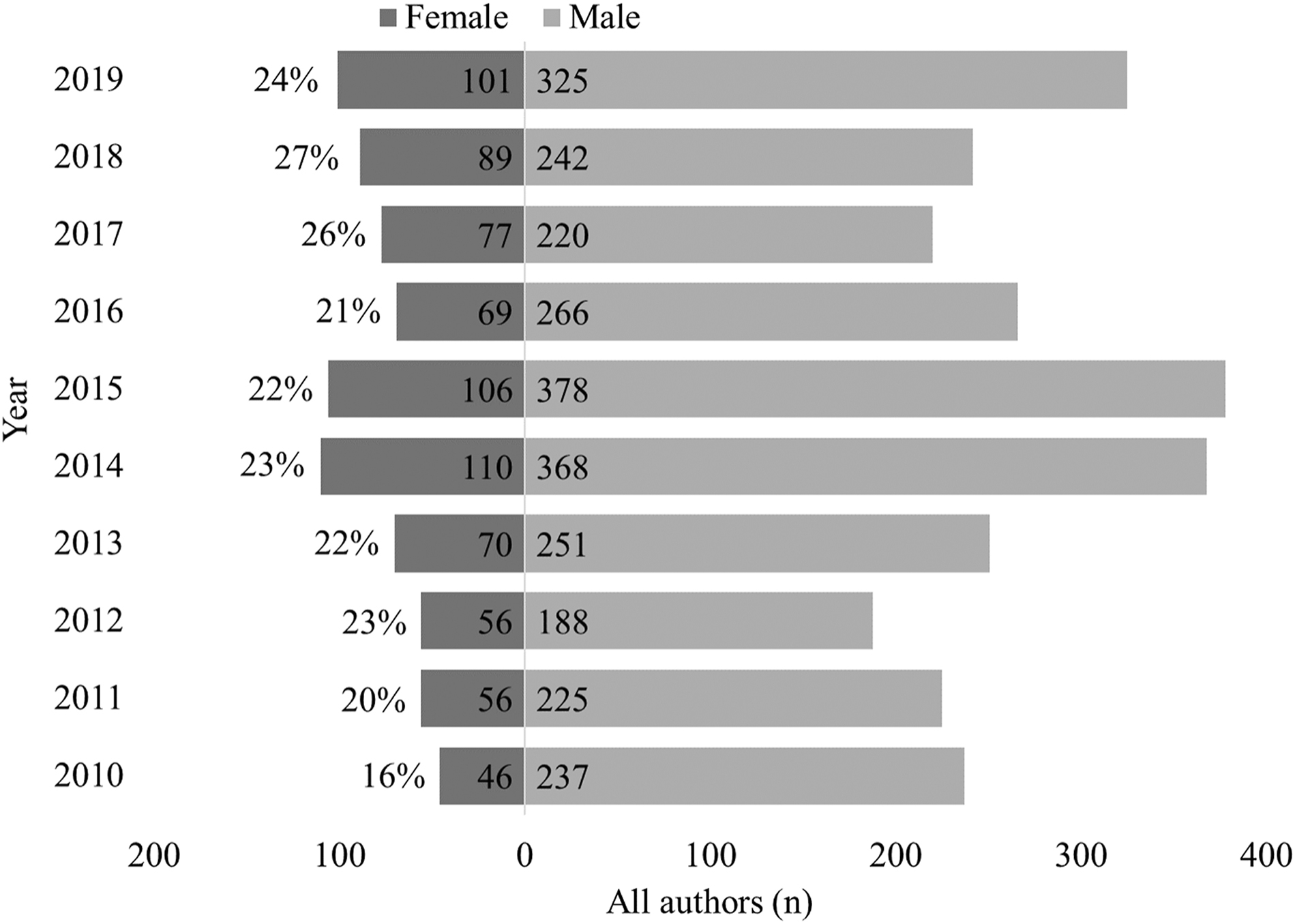
Total number of WEM authors categorized by gender between 2010 and 2019. Absolute counts are within bars. The annual percentage of women represented is located on the left of the female bars. The unknown gender cases are not shown.
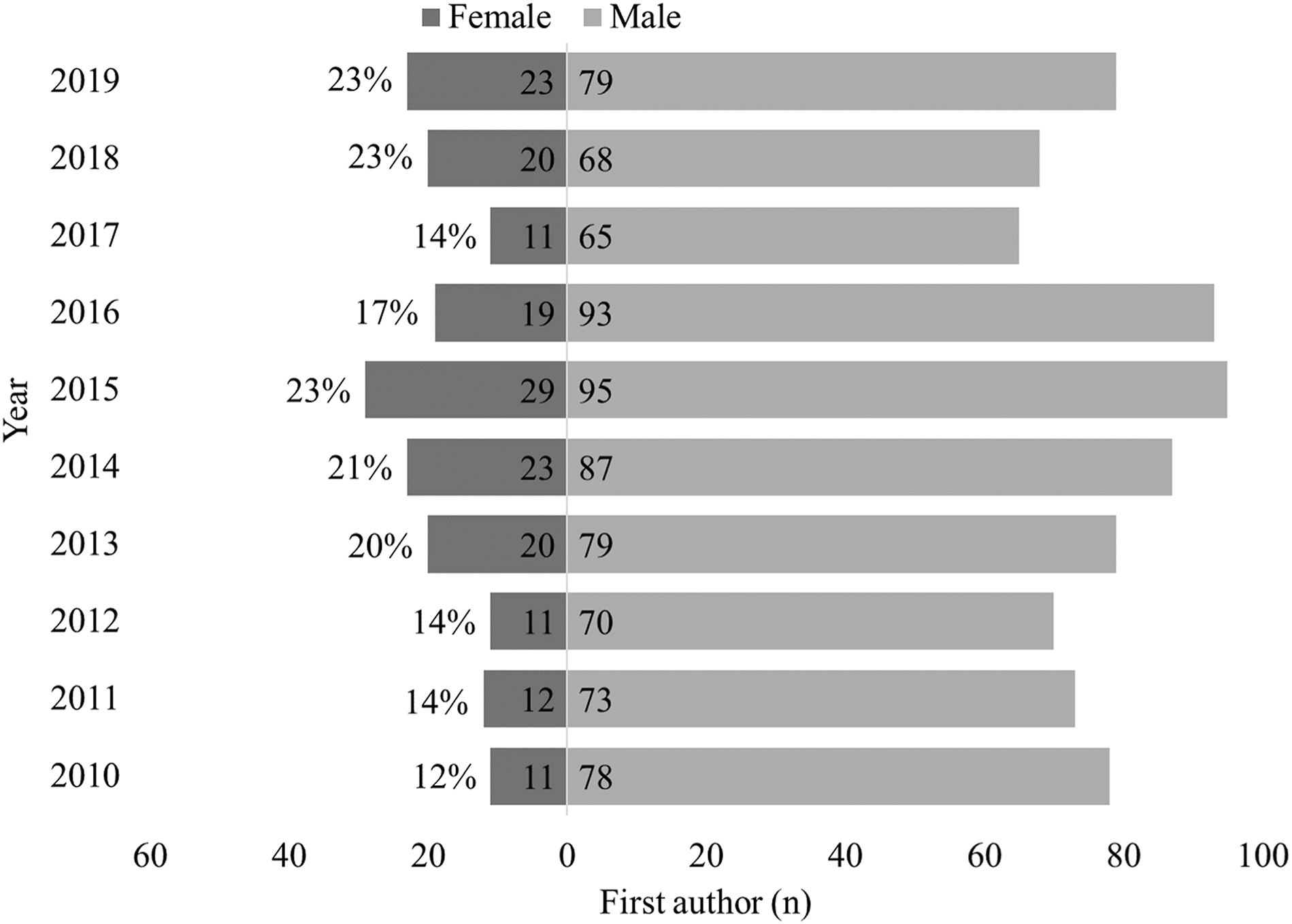
First authors of WEM publications categorized by gender between 2010 and 2019. Absolute counts are within bars. The annual percentage of women represented is located on the left of the female bars. The unknown gender cases are not shown.
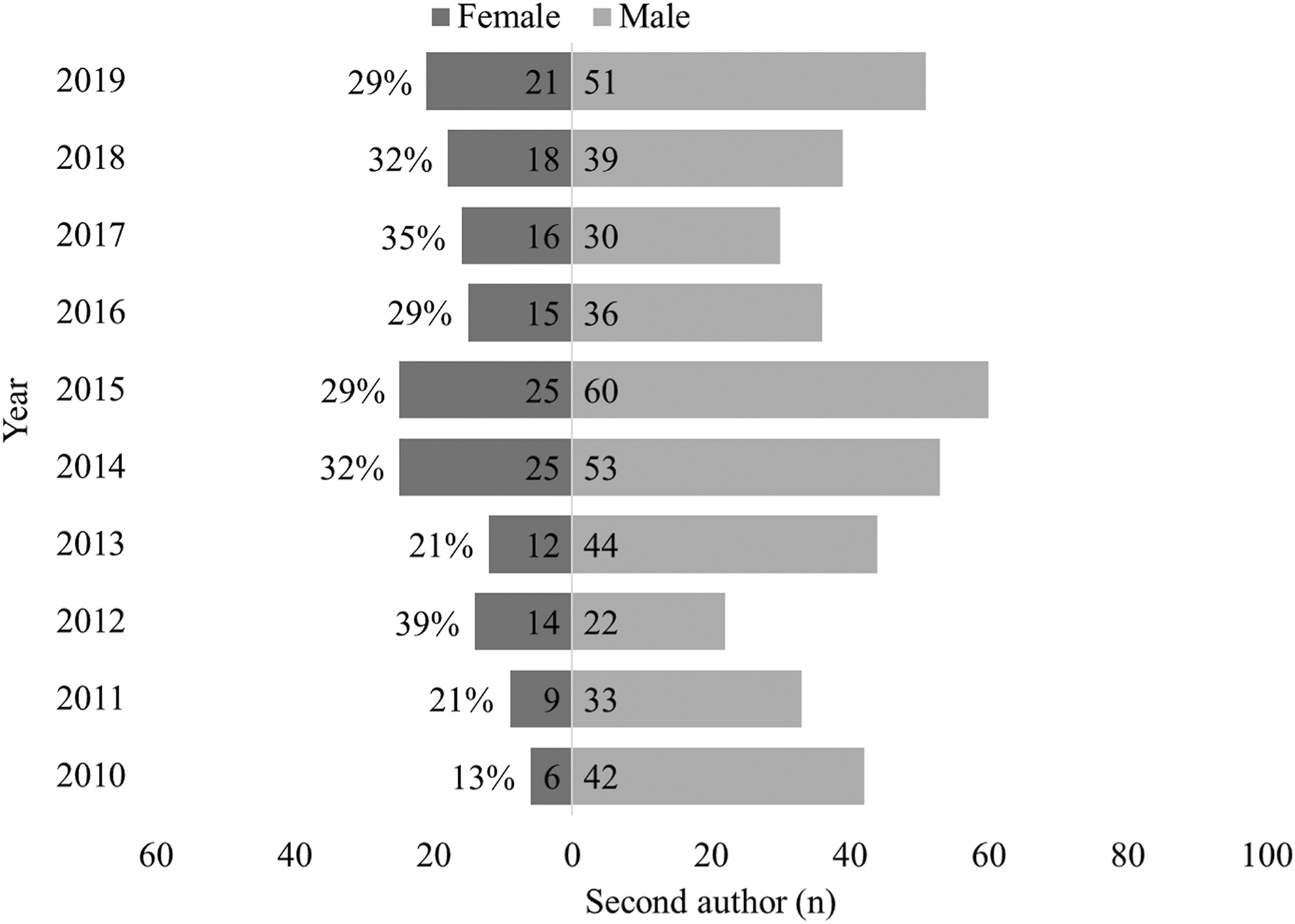
Second authors of WEM publications categorized by gender between 2010 and 2019. Absolute counts are within bars. The annual percentage of women represented is located on the left of the female bars. The unknown gender cases are not shown.
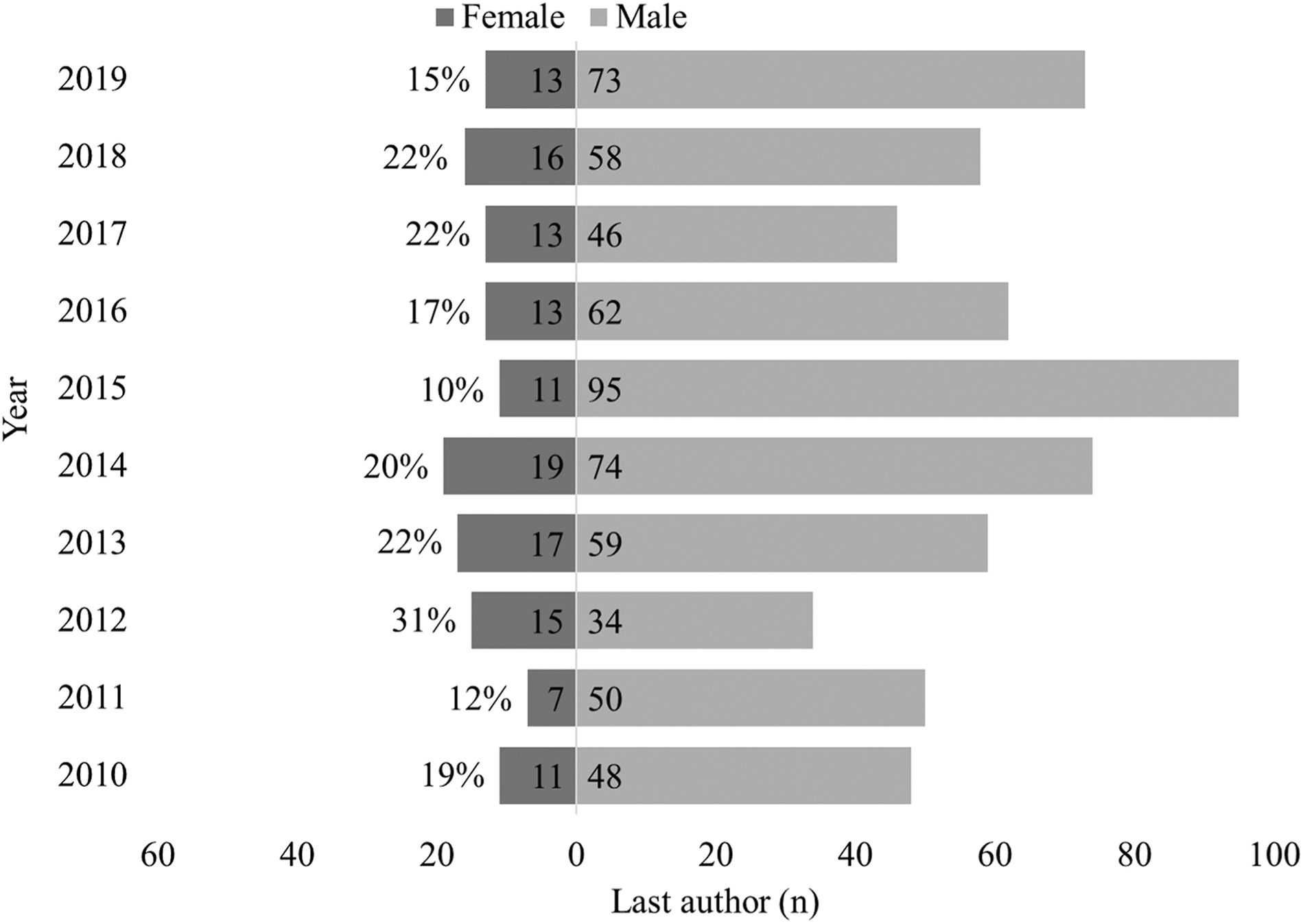
Last authors of WEM publications categorized by gender between 2010 and 2019. Absolute counts are within bars. The annual percentage of women represented is located on the left of the female bars. The unknown gender cases are not shown.
The gender distribution of first authors by publication type is summarized in Table 1. Female first authorship was highest for concepts articles and brief research reports and lowest for book reviews and editorials.
Gender distribution of first authorship by publication type in WEM, 2010–2019
During the study period, the database contained 2469 reviewers. Each of these were classified as female or male, with no unknown classifications. Table 2 summarizes reviewer characteristics. Figure 5 shows gender distribution of reviewers over time. The proportion of female reviewers increased over the 10-y study period (P<0.0001), with the annual range varying from 9 to 22% (Figure 5). The mean rate of invitations per reviewer was lower for women (mean difference=0.3 invitations, P=0.004), but there were no differences in the proportions accepted (P=0.214) or completed (P=0.597). Women took approximately 1.4 d longer to return reviews (P=0.005).
WEM reviewer characteristics (2010–2019)
Data from 2016 (when program began) through 2019.
P<0.05.
Difference is not significant.
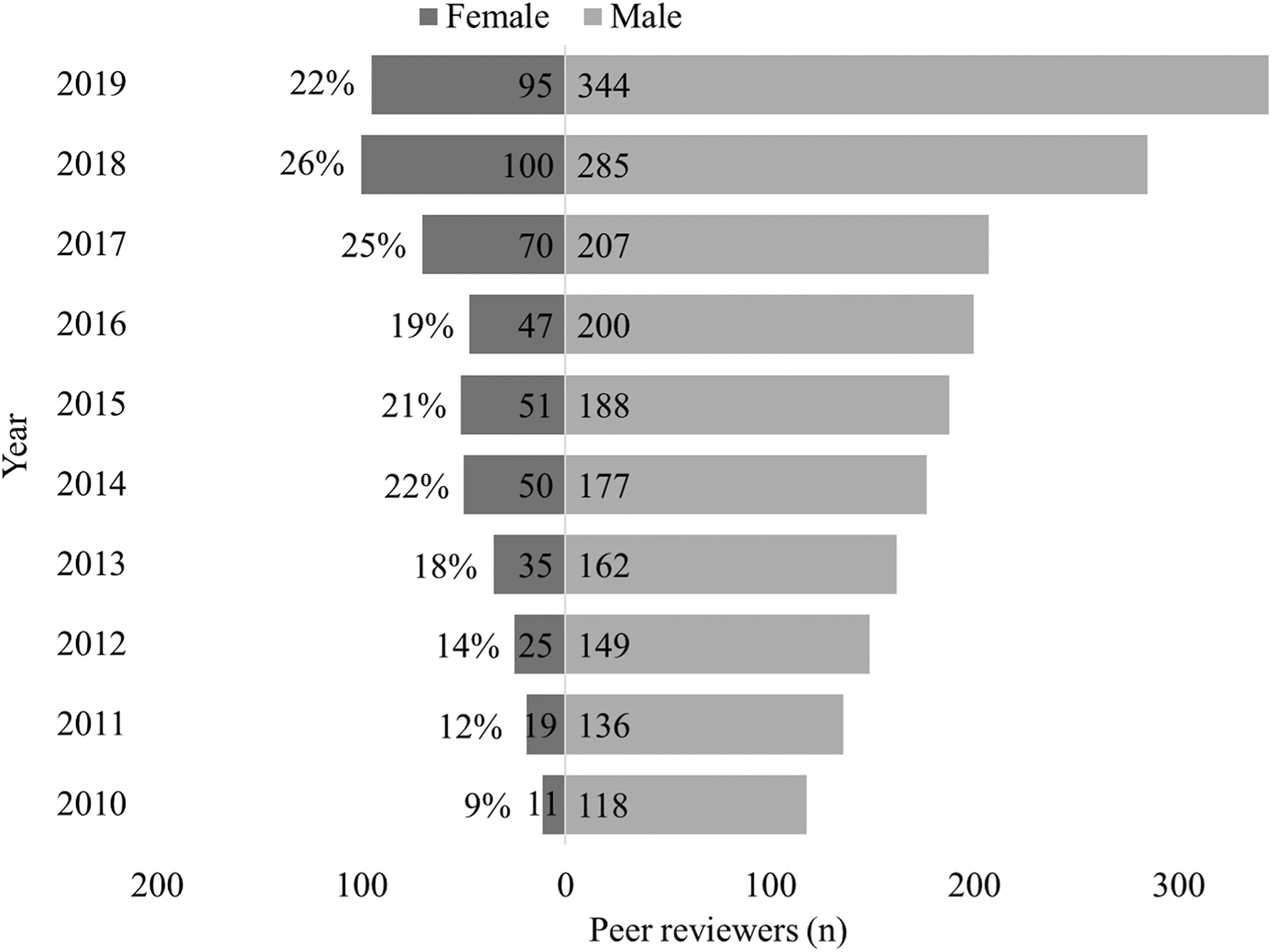
Peer reviewers of WEM categorized by gender between 2010 and 2019. Absolute counts are within bars. The annual percentage of women represented is located on the left of the female bars.
The WEM editorial board had a total of 45 members serving varying terms over the study period, 16% (n=7) of whom were women and 84% (n=38) who were men. The editorial board at the end of 2020 as listed on the masthead had 23 positions, which included 20 members, of which 20% (n=4) were women and 80% (n=16) were men. Three of the men held two separate positions each. There were 5 editors emeritus listed on the journal masthead, all men.
Discussion
The data presented here provide a 10-y snapshot of gender distribution associated with WEM journal activities. Women make up a minority of authors, peer reviewers, and editorial board members. The number of female authors doubled from 2010 to 2019, and was greater than the increase in number of male authors.
The percentage of female authors in 2019 (24%) was slightly lower than the percentage of female WMS members in 2020 (28%). 21 WMS membership is an imperfect benchmark, however, because it is not a prerequisite for publishing in WEM. Data are lacking on the number of women practicing wilderness medicine and/or conducting wilderness medicine research. It is also not clear whether women or men publish wilderness medicine research more or less often in journals other than WEM.
It is encouraging that the categories of articles where women have the highest representation include research and concepts articles, publications that actively advance the field of wilderness medicine. Women are underrepresented as editorial authors. However, invited editorials are relatively rare in WEM, providing only 2% of all first authorships. The vast majority of all submissions received by the journal are unsolicited. Efforts to seek a broad array of voices and increasing the number of invited works could be one way to include more women in the journal.
We found that the category with the fewest female authors was first authors of letters to the editor, which had approximately half the number of female first authors as did the category of original research. The reasons for this are unclear. We did not break down this category by types of letters (eg, research, comment, or response). It may be that women are less likely to submit letters in response to the work of others as is seen in letters to lay press, 22 and they may be more likely to decline to respond to letters than male authors. Because there are small numbers of senior women in wilderness medicine, as evidenced by low numbers of female senior authors, it is possible that women who have senior positions in wilderness medicine may have too many requests and demands on their time to take on lower priority publications such as letters to the editor.
One noteworthy inequity is the low rate of female first authorship in clinical practice guidelines (15%). These guidelines tend to be high-profile documents, and underrepresentation in this type of work can have substantial implications for recognition, professional exposure, and opportunity. Future working groups for these projects should make an effort to include female experts.
Although female reviewers remain in the minority, female representation increased over the study period. There were no other meaningful differences in reviewer metrics. Women received fewer invitations to review, but the mean difference of 0.3 per reviewer is not practically important. Similarly, although women took longer to return reviews, the mean difference of 1.4 d has minimal practical importance, and the average of 10.4 d falls within the required deadline to return reviews. We did not evaluate the content or quality of individual reviews as part of the current work.
The composition of the WEM editorial board showed the greatest disparity, with women holding 17% of the positions over the period studied. Several studies of peer-reviewed journals have shown similar patterns. In a recent study of 410 leading medical journals across specialties, women comprised 21% of all editors-in-chief. 9 A similar review of the editorial board composition for the 60 leading medical journals found that 18% of editorial board members were women. 23 The lowest female representation for medical specialty editorial review boards was found in critical care (7%), and the highest was seen in internal medicine (37%). 23 Emergency and family medicine are the most commonly represented medical specialties in the WMS. Among journals from those fields, women make up 16 to 17% of emergency medicine journal editorial board members and 35% of family medicine journal editorial boards. 24 -26
Although determination of gender parity targets may not be straightforward, other journals have demonstrated that concerted efforts can improve gender balance. The Lancet journals committed to gender parity in 2018 following an internal review that showed an approximate 30% female representation on the editorial boards. The editorial boards of 4 journals in the group—The Lancet Diabetes & Endocrinology, The Lancet HIV, The Lancet Infectious Disease, and The Lancet Oncology—achieved 50% or more female membership as part of the #Lancetwomen project by early 2019. 12
The root causes of the imbalance in participation in academic science are multifaceted, with origins as early as childhood or middle school.27,28 Numerous strategies are needed to promote gender equity. A critical effort should be directed at establishing or strengthening mentorship and training pipelines. 29 The WEM reviewer-in-training program was established to encourage physicians interested in wilderness medicine and scientific publication by providing them with direct mentorship to help them develop their reviewing and writing abilities. Participation in this program approximates journal authorship and reviewer gender patterns, but additional targeted promotions could be used as part of an effort to attract underrepresented groups.
Work in other fields of medicine suggests that low representation of women is not solely due to a lack of qualified women, but rather that it is also due to institutional and noninstitutional barriers for female researchers.2,30 Targeted efforts to remove barriers to gender parity are warranted. For example, journal procedures and materials should be evaluated to minimize the possibility for overt or unconscious bias. Some journals have shifted from the more common single-blind review process (the authors alone are blinded) to a double-blind review (both the authors and reviewers are blinded), and even a triple-blind process (the authors, reviewers, and editors are blinded). However, such changes have had mixed effects.31,32 Other journals have used double-blinding as a strategy to achieve gender ratio parity in submissions and acceptances. 33 Information on the gender distribution of WEM submitters was not available for this study, but we encourage the consideration of strategies to promote equity. Improving the diversity of the reviewer pool may also help to address potential bias.
Limitations
This work has several limitations. It was restricted to the assignment of male and female gender groups; we did not attempt to identify nonbinary identifying individuals owing to the nature of the automated tool we employed. It is also possible that some of the gender classifications were incorrect. The automated tool that we used relied on statistical likelihoods based on self-reporting in scraped social media websites and combined localized data from global sources, rendering some individual names (eg, Jan and Kim) potentially more likely to be misclassified. Prospective efforts should collect this demographic information directly from contributors because self-identification is most likely to reflect individuals’ gender identities. We did not evaluate individual manuscript submissions or reviews, making it impossible to comment on any potential quality differences or handling/disposition biases. We were also unable to confirm the relative contributions of any author, which can vary regardless of the authorship order. We only evaluated the authorship of accepted and published papers, not those that were withdrawn or rejected. Finally, we evaluated gender distribution but recognize that there are other underrepresented groups that may face publication barriers in wilderness medicine that we have not addressed in this study.
Conclusions
Our data are intended to promote discussion and to work toward the goal of gender equity in wilderness medicine. Although women’s representation increased in some areas over the study period, women continue to comprise a minority of WEM authors, peer reviewers, and editorial board members. Although women’s participation in WEM activities was broadly consistent with WMS membership gender distribution, there is marked underrepresentation compared with medicine and society as a whole.
Gender equity could be improved by identifying and eliminating barriers to participation, addressing any potential bias in review processes, implementing strategies to increase female-authored submissions, and increasing mentorship and training. Improvements in gender equity will require effort across all levels of the journal and the WMS in addition to monitoring to measure progress. The result of these efforts can strengthen the field of wilderness medicine and its influence as a medical specialty.
Footnotes
Acknowledgements
Acknowledgments: The authors acknowledge Al M. Best, PhD, for statistical assistance.
Author Contributions: Study concept and design (LK, NWP, SS); data acquisition (AB, NWP, ABB, NEP, LK); data analysis (NWP, LK, SS, NEP, ABB); drafting, critical revision, and approval of the final manuscript (all authors).
Disclosures: Linda E. Keyes is past president of the WMS, Neal W. Pollock was editor-in-chief of WEM at the time of writing, and Alicia Byrne is managing editor of WEM. No authors were involved in the process of peer review or the editorial process of this manuscript.
Financial/Material Support: None.