






Keywords
A 27-y-old right-hand-dominant man presented to the ski clinic shortly after jamming his right thumb into a tree while skiing. He was skiing at about 40 km·h-1 (25 mi·h-1) through trees when his gloved right thumb hit a large tree branch. Deformity was noted upon removal of the glove, along with significant bleeding. Pain was mild at first but increased steadily to moderate pain, throbbing in nature. He had a history of closed dislocations to other finger joints while playing sports and denied baseline hyperflexibility. His medical and social histories were otherwise unremarkable. On physical examination, an open wound was noted at the palmar surface of the interphalangeal joint of the right thumb (Figure 1). Sensation at the distal tip of the thumb was intact.
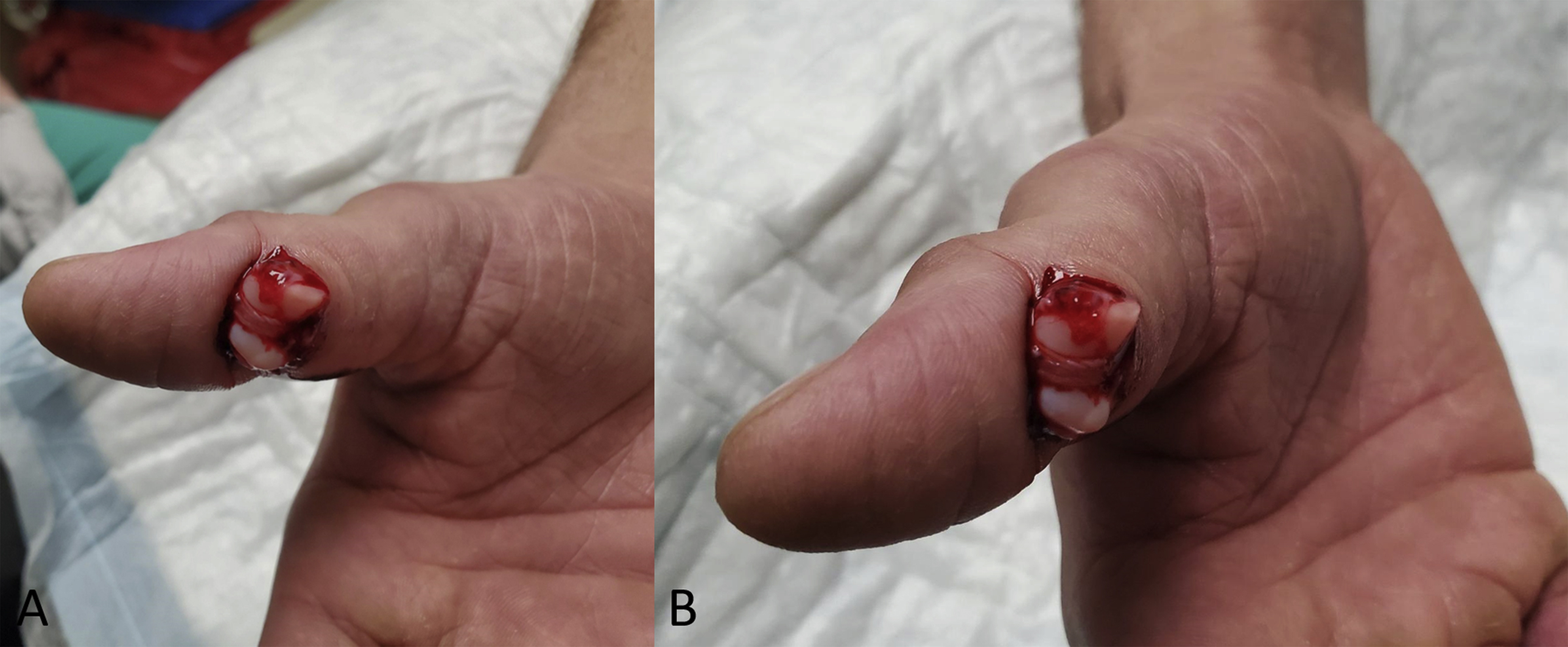
(A, B) Photographs of the right thumb on arrival showing an open wound.
What is the most likely diagnosis?
Diagnosis: open dislocation of the interphalangeal joint of the right thumb
Visual identification of the open dislocation was made upon presentation to the ski clinic (Figure 1). Plain radiography demonstrated dorsal dislocation of the distal phalanx without fracture (Figure 2A and B). Initial attempts at reduction using a digital nerve block were unsuccessful. The patient was given 1 g of cefazolin and was transferred for consultation with hand surgery after cleaning and covering of the wound.
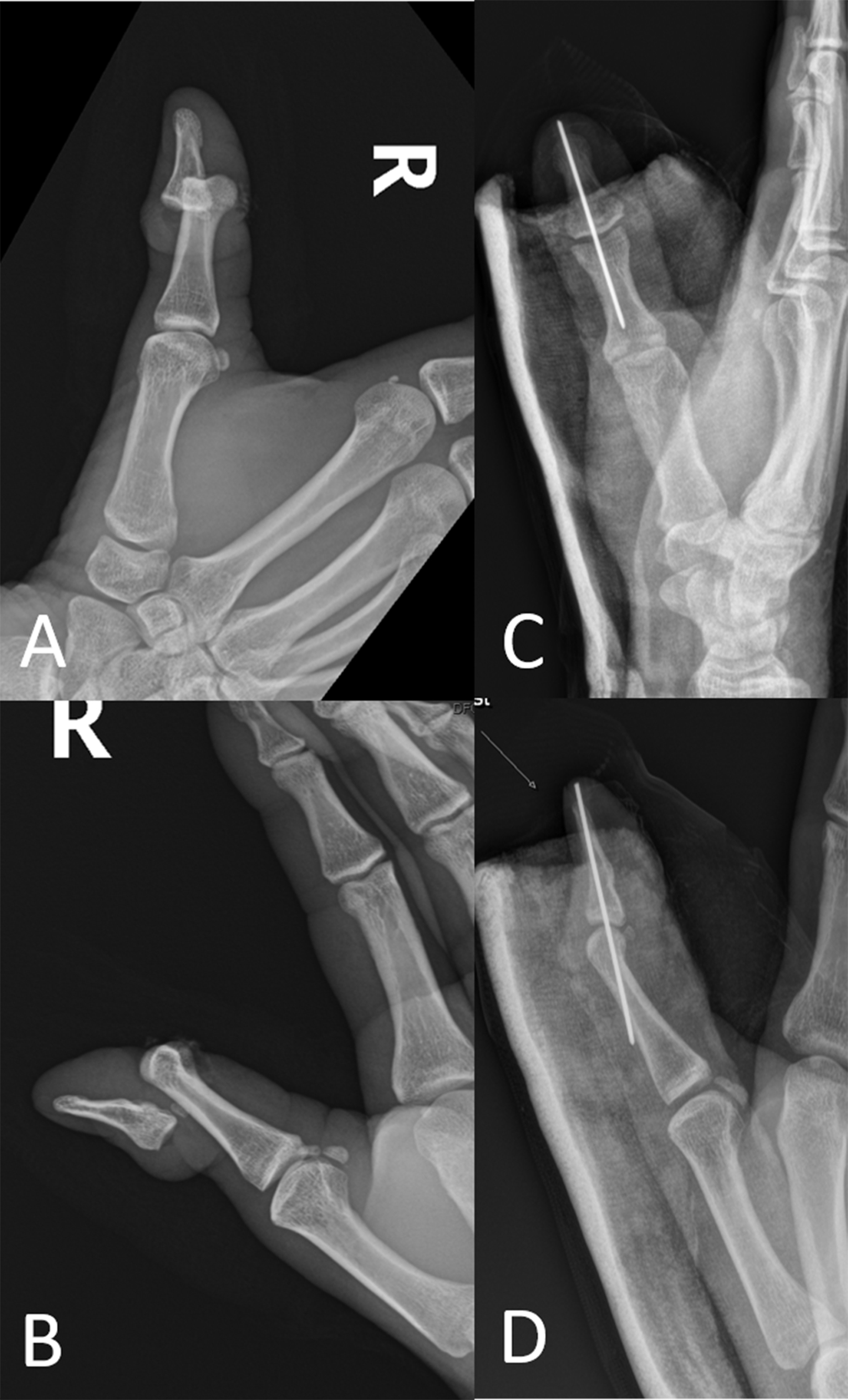
(A, B) Right thumb x-rays, anterioposterior and lateral views before and (C, D) after reduction and fixation.
In the operating room, the laceration was found to extend to the radial digital nerve, which was intact and draped across the condyle of the proximal phalanx. The flexor pollicus longus tendon was subluxed ulnarly around the condyle of the phalanx, blocking attempts at reduction. The tendon was reduced over the condyle, but the joint still could not be reduced. The volar plate had to be removed, which allowed for reduction. Wire fixation was applied to maintain reduction. Post-fixation imaging showed normal alignment of the joint (Figure 2C and D). The patient provided written consent for use of his images and medical care for educational and publication purposes.
Discussion
Open dislocations of digital joints are rare sports injuries. 1 -4 Published case reports identified do not include open wounds accompanying dorsally dislocated thumb interphalangeal joints with an exposed distal end of the proximal phalanx sustained from direct impact to the tip of the thumb. 1 -4 Digit dislocations most often present with intact skin, pain, and obvious deformity. Dorsal displacement is the most common. Closed dislocations can typically be reduced on the field or in the emergency department setting.
It is important for clinicians to keep in mind that reductions that are unsuccessful after initial attempts will likely need surgical consultation. It is likely that, in this case, excessive pressure in the reduction attempt may have caused further injury given the position of the flexor pollicus longus tendon. All open joint dislocations should be referred for urgent surgical consultation.
Footnotes
Acknowledgements
Author Contributions: JU and DZ contributed to the patient’s clinical care. JD, DZ, and MK performed the literature review, drafted, reviewed, and approved the manuscript.
Financial/Material Support: None.
Disclosures: None.