






Abstract
Introduction
BASE (buildings, antennae, span, earth) jumping involves jumping from fixed objects with a parachute. This practice is associated with fatal events. Despite considerable evolution in BASE jump practice over the past years, fatalities have increased. Identifying the main causes of fatal events and recommending processes to reduce fatalities is vital for safe BASE jumping practice.
Methods
In an effort to capture worldwide cases between 2007 and 2017, we identified and classified on a Haddon matrix each fatal event from the BASE jumping fatality list. Although not devoid of limitations, this is the most comprehensive list of BASE jumping fatal events and the main source of information on BASE-related fatalities for BASE jump participants.
Results
The report noted 223 fatalities, 197 of them being cliff jumps. In addition, 137 fatal jumps were wingsuit jumps. Impact and object strike were the main cause of fatal event (96%). Human factors leading to fatality were mostly low pull/no pull (64%) and bad exits (15%). Equipment factors included off-heading openings, twists, and pilot chute entanglement. Environmental factors included strong wind, poor visibility, and water.
Conclusions
BASE jump practice has undergone radical transformations in the last 10 y, especially linked to the mountain environment and the use of wingsuits. These factors were linked to most fatal events. Key recommendations are basic practical measures, such as ground preparation and equipment checks, and deep technical and personal knowledge that involves regular engagement and significant introspection.
Introduction
BASE (buildings, antennae, span, earth) jumping, an extreme sport involving parachuting from fixed structures, is associated with fatal events. 1 A systematic review of fatal BASE jumps between 1981 and 2006 listed 106 cases. 2 Despite considerable development in equipment and practice since 2006, there has been a significant increase in fatalities. 3 However, there are few systematic studies of fatalities.4,5 A study focusing on wingsuit BASE fatalities 4 recorded 180 fatalities (mostly April to October) and found that 98% were males and 97% resulted from cliff strike and ground impact (49 and 47%, respectively) from flight path miscalculations. The study noted that wingsuit BASE fatalities were on the increase. The present study had a twofold purpose. The first and main purpose was to detail causes and preconditions of all BASE jumping discipline fatalities between 2007 and 2017. The second was to use this analysis to provide a set of recommendations to reduce fatalities.
BASE JUMPING SINCE 2006
The last decade has been witness to a significant increase in global BASE participant rates, from approximately 700 in 2002 6 to 2800 in 2017. 5 One popular site, the Lauterbrunnen valley (Switzerland), hosts approximately 30,000 jumps per year. The past decade has also seen significant improvements in practices.
Until the mid-2000s the location of most spots/exits (places with good BASE jump conditions) was known only to a limited number of BASE jumpers. Becoming a BASE jumper was relatively difficult and, in most cases, only possible if a potential participant was able to locate and engage a mentor. From the mid-2000s forums emerged through social networks and video channels and increased BASE visibility, provided information on practice and spots, and facilitated broader access to the BASE community. There are now a number of BASE jump schools providing first jump courses, and the most popular BASE jump sites are supported by significant economic investment offering shuttles, rooms, bars, and places to stay.
There are 4 main categories of BASE jump outfits linked to specific BASE jump practices: 1) normal clothes (also called slick; eg, pants and jacket) for basic BASE jumping, mostly used by novices; 2) the tracksuit (ie, pants and jacket designed for inflation), allowing a modicum of stability and tracking capacity; 3) the monotrack or onesie (1-piece tracksuit), used to increase tracking capacity and speed; and 4) the wingsuit (transforms part of the vertical speed into horizontal speed). The wingsuit is the most emblematic technical evolution of the last decade 7 and requires high-level skills. Adoption of the wingsuit in BASE jumping led to proximity flying, where participants fly in close proximity (often only few meters) to objects (ie, ground, trees, and ridges) at speeds of > 200 km·h-1. 8
In summary, since 2006, BASE jumping has evolved considerably and is characterized by 1) a growing practitioner base; 2) an increased presence on social networks; 3) the creation of a network of services around the most famous spots; 4) significant technical developments, including the widespread use of wingsuits; and 5) evolution of BASE jumping techniques, such as proximity flying.
Methods
Formal ethical approval has been obtained from the faculty ethics committee from Université libre de Bruxelles (Comité d’Éthique Facultaire, affiliated with the Faculté des Sciences Psychologiques et de l’Éducation). Data were collected via the BASE fatality list. 3 This list started in 1981 to document fatal BASE jump incidents around the world. Most cases include eyewitness accounts with information on human, equipment, and environmental factors. This list of fatal events is recognized as the most comprehensive list of BASE jump fatalities and is the most used by BASE jumpers. Nevertheless, it is not devoid of limitations because unreported fatalities may exist and data collected are based on testimonies from eyewitnesses and close relatives, which are prone to recall and classification bias. The absence of data collection by medical personnel and of investigation by researchers into individual cases is also a major limitation.
Data included all fatal events from January 2007 through December 2017, either during the jump or immediately after landing (eg, drowning). Fatalities from incidents during access (eg, hiking, climbing) were not included. An adapted Haddon matrix was used to classify injury as a function of 3 factors: human, equipment, and environment. The Haddon matrix is a widely used method for analyzing classical injury events 9 and sports injuries. 10 Nevertheless, the use of the Haddon matrix on these specific data is difficult and may underestimate the human factors involved. Indeed, a vast majority of material and environmental factors conceal poor human decisions. For example, “bad weather” is of course an environmental factor; however, it is primarily the decision of a BASE jumper to jump in suboptimal weather conditions.
Results
Although 106 fatal events were registered between 1981 and 2006, a total of 223 fatal events occurred between 2007 and 2017: 6 from buildings and similar objects, 13 from antennas, 7 from spans, and 197 from earth. Ninety-three percent of the fatalities were males. Between 2007 and 2017, 58 fatalities involved normal/slick clothes (26%), 23 tracksuits, and 4 monotrack/onesie jumpsuits; 137 fatalities (61%) involved wingsuit jumps (Figure 1). Fatalities increased each year with the exception of 2008, 2012, and 2017 (Figure 1). The deadliest months were August (n = 43), September (n = 32), and July (n = 31). Main causes of the fatal event were identified in 221 of the 223 cases (Table 1). A huge majority (96%) involved impact with relief and object.
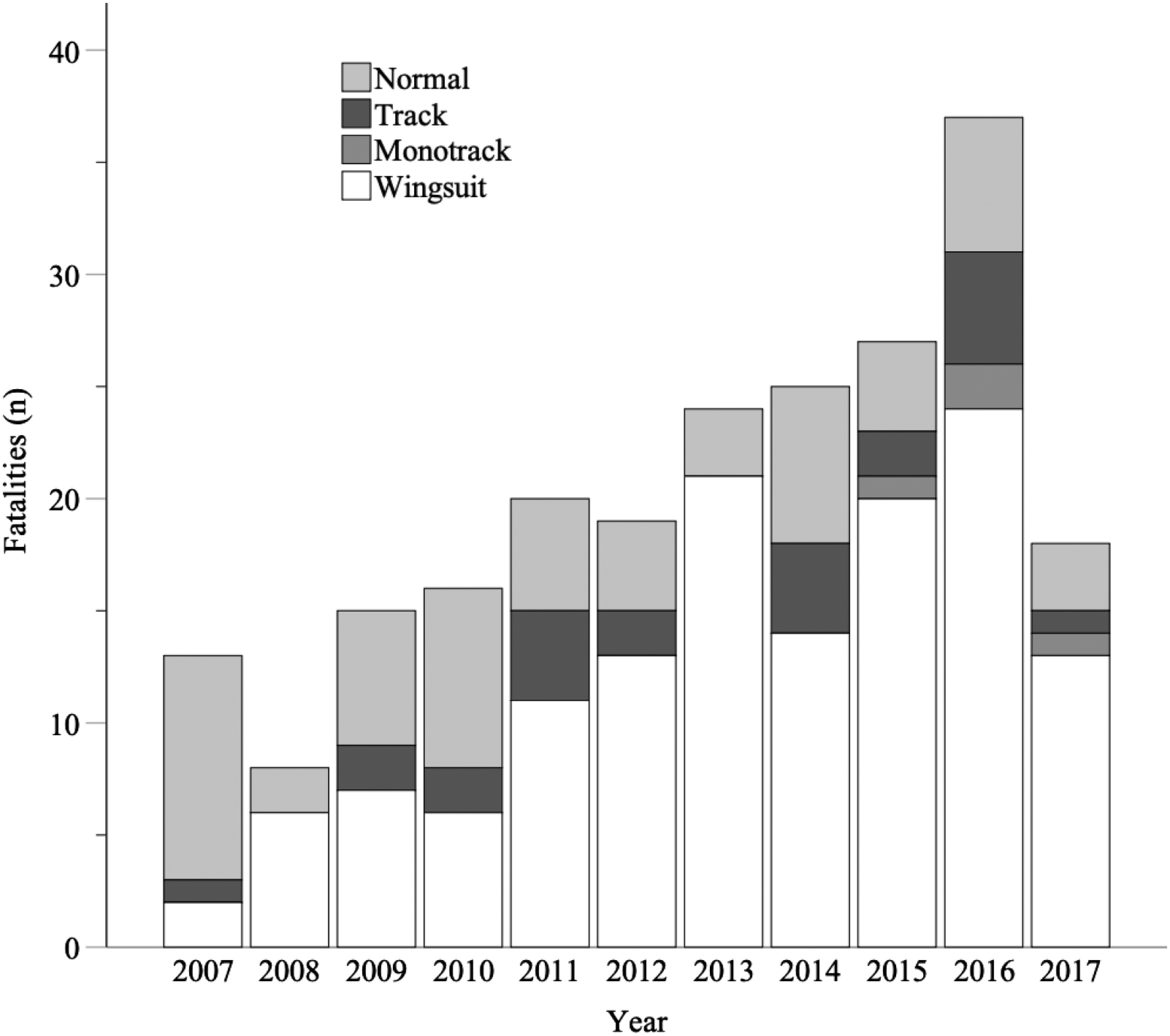
Number of fatalities per year and by type of outfit.
Events by type of outfit and in total between 2007 and 2017
Many object-strikes (eg, cliff) are considered as impacts (eg, ground). This is often due to the lack of information (eg, visual witness) on the jump or flight pattern.
One of the 2 unknown events was a jumper who was discovered dead in his car with severe lower body trauma. His gear was found after several days, but there is no mention of the type of outfit used for the jump.
MAIN CAUSES OF FATAL EVENT
Human factors
Low pull (deploying the parachute at an insufficient height for full deployment) and no pull were by far the most prevalent human factors leading to fatality (n = 142; Table 2). Bad jump exits (eg, weak impulse, slipping, too short start, instability) resulted in 34 fatal events. Low speed causing poor flight performance (and occasionally stall) was registered in 15 cases (only wingsuit jumps). Instability during the jump was reported in 5 cases (2 normal, 1 track suit, and 2 wingsuits). Finally, freefall acrobatics were reported in 6 cases and first jump/first wingsuit jump in 2 cases.
Deployment failure by type of outfit between 2007 and 2017
Equipment factors
Twists and off-heading openings were the main equipment factors, although these are often linked to human error. Twists and off-heading opening are in some cases the result of poor packing, but most (up to 95%) are the direct result of poor body position during parachute deployment. Bridle entanglement and pilot chute in tow were also major equipment factors leading to fatality (Table 3). Inability to deploy the pilot chute after multiple trials was reported in 3 cases.
Equipment factors leading to fatality between 2007 and 2017
Bridle entanglement, bridle wrapped around part of the body, which means that it is impossible to open the container and deploy the parachute; twists, twisted lines linking the canopy to the parachute harness; off-heading opening, opening of the parachute toward the relief.
Environmental factors
Strong wind was reported in 11 cases, night/darkness in 2 cases, clouds/fog in 2 cases. Heat was mentioned in 1 fatality but not explicitly linked to the fatal event. The other environmental factor was water (3 drownings).
Discussion
Between 2007 and 2017, despite radical transformations in BASE jumping practice, there has been an increase in the number of fatalities, particularly in mountain environments. Between 1981 and 2006, there were twice as many fatal jumps from earth as from other objects (ie, building, antenna, and span). In the period of 2007 to 2017, the proportion was 7.6 to 1. This significant increase could be explained by 2 main factors: an increase in mountain jumps and the development of wingsuit BASE jumping. Cliff jumps are now easily accessible due to the multitude of services and prevalence of information about the main spots. Currently, in popular locations such as the Lauterbrunnen valley, it is not unusual to jump 10 times in 1 d. Multiplication of jumps might lead to a multiplication of the risk, especially for technically and physically ill-prepared jumpers.
As recognized by Mei-Dan et al, 4 the use of wingsuits in BASE jumping is a major factor related to fatalities in the mountain environment. From 2008, with the exception of 2010, the majority of fatal events were wingsuit jumps. This pattern is significant because wingsuit BASE jumpers are a minority. Most fatalities in wingsuit BASE jumping result from path miscalculation, which leads to impact, and from no pull or low deployment of the parachute, which reflects the findings of Mei-Dan et al. 4 Wingsuit use has also led to other evolutions in BASE jumping practices, such as proximity flying. Even for expert pilots, this practice multiplies the risk of impact and object strike. For this reason, an extensive period of training from airplane jumps is highly recommended (ie, hundreds of wingsuit skydive jumps). Such skydive training improves flying performance and would reduce the risk of low-speed stall and flying approximations in a less forgiving environment.
Environmental factors linked to fatal events are mostly a result of poor decision-making. Acquisition of specific knowledge in aerology and of the environment in which each specific jump takes place (eg, topography) would reduce fatalities. Most BASE jump fatal events are the result of a combination of several poor decisions rather than just a single issue. Bad jump exits were responsible for a considerable number of fatalities (34); thus, training for effective exits is extremely important. Balloon jumps are not ideal because the basket can move when jumping, which distorts sensations. Practicing wingsuit and tracksuit exits in slick conditions from spots that “forgive” is an important first step. Equally, not jumping from exits after wet or snowy weather is also extremely important, be it in wingsuit, tracksuit, or normal clothes. Fatalities linked to low-pull/no-pull events might be reduced considerably if jumpers (especially trackers and wingsuiters) regularly reminded themselves that deploying their parachute, even a few meters from the ground, is better than attempting to fly over an obstacle they consider too close.
The 3 main equipment factors are off-heading openings, twists, and bridle entanglement. In the first 2 cases, the main cause is poor body position at parachute opening. Poor packing and opening with wind coming from the wrong direction can also explain off-heading openings and twists, but to a much lesser extent. Bridle entanglement issues often relate to body position when pulling the pilot chute. To reduce the chance of an equipment-related incident, it is vitally important for pilots to familiarize themselves with new suits and harnesses before using them in BASE environments. Practicing the opening procedure (ie, throwing the pilot chute properly into the wind) on the ground and from airplanes is highly recommended. Careful parachute packing and prejump equipment checking procedures are crucial for preventing equipment-related issues.
In the last years, significant equipment evolutions (eg, easy-release toggles) have reduced the potential for equipment failures. The equipment is for the most part extremely safe. The capacity to share safety techniques has also evolved with the creation of specific forums, blogs, and BASE schools that provide effective knowledge accumulation and diffusion. However, although equipment is generally well adapted and technical skills are in constant evolution, the human factor requires more focus. For example, excellent equipment might invite behaviors otherwise not recommended for particular environmental conditions or individual skills, capacities, and capabilities.
GENERAL RECOMMENDATIONS
A number of key recommendations can be drawn from the analysis in this article. The first is related to the acquisition of in-depth knowledge of 1) the jump environment, including wind conditions and exits; 2) the material and its properties (eg, glide, speed); and 3) one’s own capacities (eg, hiking, tracking, mental functioning under stress and hunger). Although part of this knowledge can be obtained and updated by regular engagement with forums, blogs, and discussions with other participants, an important part involves significant introspection. Physical training combining stamina and strength, proper nutrition, and hydration and the regular practice of skydiving are other important factors. Finally, and most importantly, humility is an essential quality for safe jumping. In the era of easily accessible jumps, it is important to be realistic about one’s own skills and readiness. Simple actions that can contribute to a long and safe BASE jumping career include 1) realistically assessing jump trends, such as overstalling the wingsuit before landing (which is highly dangerous); 2) being comfortable hiking down when conditions are not optimal; and 3) deploying the parachute before entering the red zone (too low to the ground).
Conclusions
BASE jumping has undergone radical transformations in the last decade. A growing practitioner base, increased visibility on social networks, easier access to the main mountain spots, and the widespread use of wingsuits have dramatically changed the practice. The number of fatal events has increased yearly, and most fatalities have involved wingsuit jumps in mountainous terrain. Although an accurate assessment of fatal events could not be measured precisely given an unknown number of unreported jumps and hundreds of locations, key factors related to recorded fatalities can be identified. Most fatalities in wingsuit BASE jumping resulted from path miscalculation, which led to impact, and no pull or low deployment of the parachute. Furthermore, bad jump exits were responsible for a considerable number of fatalities. On the basis of the data in this study we can say that recommendations to reduce fatality include basic measures, such as ground and airplane preparation, equipment checks, and the development of profound technical knowledge. For improvements in data capture it is important to facilitate open dialogue between the BASE community and researchers and specialists of data collection, if only to help improve BASE safety. This might be an ideal opportunity for the BASE community and the university sector to collaborate.
Author Contributions
All authors contributed equally to the present study.
Financial/Material Support
None.
Disclosures
None.