






Abstract
Skin infections are an important issue among participants in expedition-length adventure races. Prolonged stress, scant sleep, and water exposure mean that competitors are at risk of uncommon manifestations of infections. Ulcerative tinea pedis is an example of this. We present a case with characteristic clinical manifestations, including the “sandpaper symptom.” There is limited literature exploring infectious foot complaints in expedition adventure racers. Beyond this case report, more research is needed to better understand incidence rates, risk factors, diagnostic measures, treatment, and prevention options.
Keywords
Introduction
Expedition adventure racing involves teams of 4 racing nonstop, trekking, biking, rafting, and kayaking with little rest for periods of up to 10 d. Competitors travel off track through inhospitable terrain on minimal sleep under race conditions. Injuries and illness are common.1,2 Existing literature describes blisters as the primary foot issue encountered. 1 Racers do, however, describe other foot complaints beyond blisters, although there is scant, if any, mention of this in current literature.
These different foot issues were seen in many teams at the 2018 edition of Godzone Adventure Race in Fiordland, New Zealand. Although there was a wide range of presentations, many of these cases shared features suggesting acute tinea infection. The following case is typical of this cluster of symptoms.
Case
A 29-y-old man was competing in his seventh expedition-length adventure race. After around 75 h of racing he noted a sandpaper-like feeling around his toes. He attempted to relieve the symptoms by removing his shoes for a period of paddling; however, symptoms continued. Within around 8 h an erythematous rash with areas of skin erosion and serous ooze was evident on removal of shoes and socks. This involved all 5 toes and interdigital web spaces on both feet. Both legs were edematous to mid-shin. At this point, fevers, tachycardia, and mild delirium also developed. The athlete received 625 mg of amoxicillin and clavulanic acid as treatment from his team first aid kit. While still febrile he developed a diffuse rash with small erythematous vesicles, especially on the trunk. Symptoms forced withdrawal from the race approximately 24 h after their onset. Figures 1 and 2 show the appearance of the feet 36 h after withdrawal from the race.
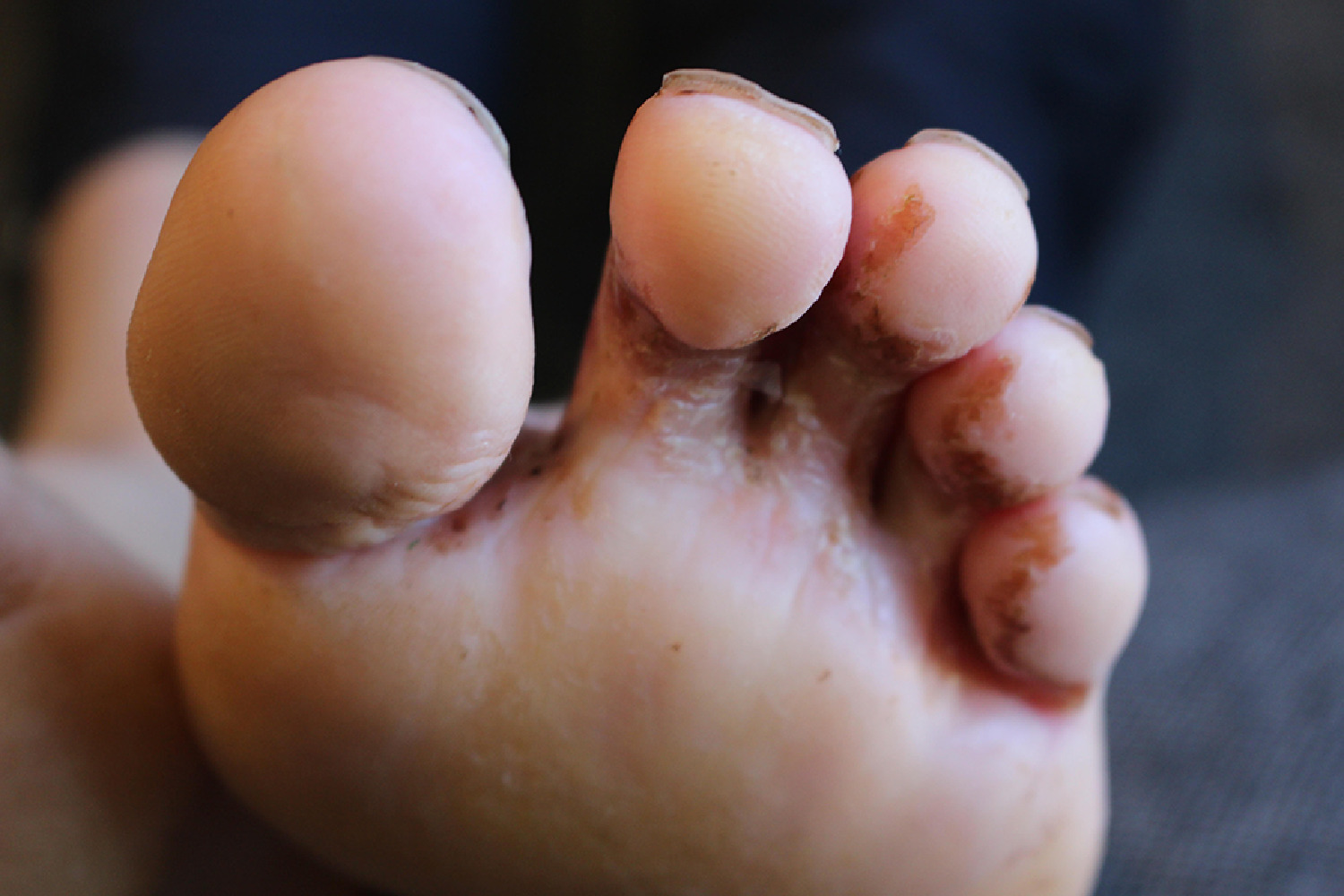
Plantar view of affected foot, 3 d after cessation of activity.
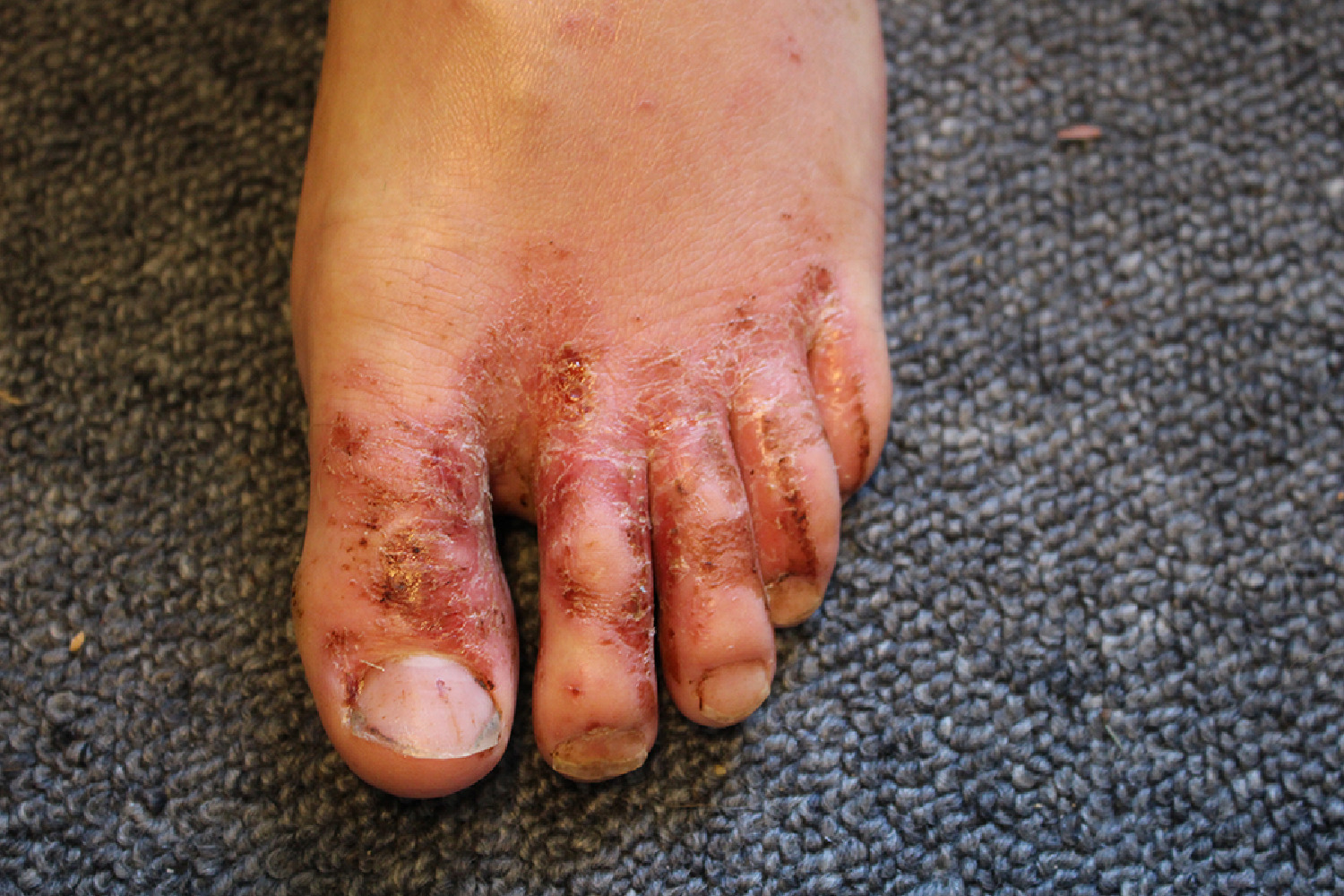
Dorsal view of affected foot, 3 d after cessation of activity.
Initial treatment involved cleaning in an iodine and potassium permanganate solution. In the days after the race, the rash dried before healing over a period of weeks. Over this period, a topical antifungal (miconazole) and povidone iodine were applied regularly. Seven days of amoxicillin and clavulanic acid were also taken orally. A vesicular rash, predominantly on the trunk, occurred intermittently over the following 3 wk, accompanied by low-grade fevers. These episodes stopped at approximately the same time as final resolution of the foot rash.
Discussion
Foot complaints are common in adventure racing. Water immersion, prolonged walking, and the off-road nature of courses all combine to increase the risk of foot issues. The case described displays features similar to foot issues seen by experienced racers in other expedition events around the world over the last decade. Colloquially, this presentation has been referred to as trench foot. However, the macroscopic appearance and progression of symptoms seem more aligned with ulcerative and vesicular forms of acute tinea pedis, rather than an immersion injury or trench foot. The distinction is important to help guide future prevention and treatment.
The diagnosis of immersion injury includes damage to feet because of prolonged immersion in water. This can occur in both cold and warm temperatures. Nonfreezing cold injury typically occurs with water below 15°C and occurs primarily via vascular changes. 3 Warm water immersion injury results from direct effects of water on the integrity of the skin. 4 In the presented case, neither the appearance of the skin rash nor the setting of its occurrence fit with immersion injuries.
Tinea pedis describes dermatophyte infections of the feet. Multiple dermatophyte species are capable of causing symptoms, with Trichophyton rubrum and Trichophyton interdigitale being most common. 5 Occlusive footwear, male sex, immune suppression, concurrent dermatological conditions, and moist environments are relevant risk factors for development of dermatophytic infections. 6 A number of clinical presentations are described for tinea. Interdigital tinea pedis is the most common type in the general population, whereas the cases seen in expedition adventure racing better fit with vesicular and ulcerative forms. This has also been described in other wilderness settings. 7 The vesicular type involves small vesicles associated with underlying erythema. 6 Acute ulcerative tinea includes ulcers and erosions around the base of toes and web spaces. This type is especially vulnerable to secondary bacterial infections, generally with gram-negative species. 5
This vulnerability to secondary bacterial infections brings about a diagnostic conundrum and potential clinical overlap with bacterial toe web infections, another important differential diagnosis to consider in this case. Gram-negative bacteria toe web infection (GNBTWI), as well as infections caused by other bacterial species, can present with a rash distribution similar to that in ulcerative tinea pedis. 8 The distinction between the 2 clinical entities is complicated because interdigital tinea is a significant predisposing factor in the pathophysiology of GNBTWI. 8 In addition, bacterial and fungal pathogens often coexist in interdigital infections. 9 In the case described, the presence of the systemic rash, suggestive of a dermatophytid reaction, strengthens the case for, at the very least, an underlying fungal component as the causative organism.
Athletes experiencing this type of foot issue at Godzone 2018 typically first noted a sandpaper-like feeling on their toes and instep. This “sandpaper symptom” seemed to herald the beginning of the vesicular and ulcerative symptoms, with a 4- to 6-h delay before the appearance of characteristic skin changes. With the skin changes a burning sensation developed. The pain associated with this was severe, with competitors having to slow travel markedly and in some cases withdraw from the race.
Systemic symptoms were also a feature. Fever, tachycardia, malaise, and altered mental status all occurred. These symptoms have multiple possible causes. Bacterial secondary infection, or progression to GNBTWI, could lead to the systemic inflammatory response. The presence of a prolonged distant rash also fits the description of a dermatophytid reaction. This type of autoeczematous reaction has been described in cases of vesiculobullous tinea pedis. 10 It is not possible to confirm the cause of the systemic symptoms because treatment was initiated before diagnostic procedures could be performed. Ideally, these would include bacterial swabs for culture and antibiogram and fungal scrapings for polymerase chain reaction and culture. 11 In this case, empiric treatment included initiation of broad-spectrum oral antibiotics (amoxicillin and clavulanic acid), cessation of physical activity, astringent soaks, and application of a topical antifungal agent (miconazole).
Foot issues were more common and more severe at Godzone 2018 compared with prior editions of the race and with other races internationally. At least 1 in 4 athletes at Godzone 2018 had some degree of foot infection. There are several possible contributing factors to explain this. Existing literature describes injury rates in dry environments: California 1 and Utah, 12 respectively. Fiordland includes terrain that is in general wetter than these race locations. Packrafting was also included for the first time; this discipline can have competitors moving in and out of water often, resulting in wet feet for a prolonged period. Stage length was much longer, with a longer period between transitions and sock changes/foot care. Longer periods without rest seemed to increase risks of more serious foot problems. Teams that took more regular, longer periods of rest seemed to develop fewer, less serious foot issues. The race also included controls against transmission of waterborne pests. Feet were regularly submerged in detergent-containing solution (Surfax, Jasol New Zealand, Auckland, New Zealand). This detergent has a degreasing effect on skin, which may have altered the natural skin barrier and microbial colonization of the feet. Finally, immune suppression is a risk factor for development of tinea pedis. 12 The literature suggests that expedition adventure racers experience a degree of immune dysfunction when it comes to respiratory infections. 13 This immune dysfunction may increase the risk of developing more severe forms of tinea infections.
Future research should include better characterization of the foot issues encountered in expedition adventure racing. Our case is limited by the reliance on clinical features for diagnosis. Future studies should collect microbiological samples to consider a suspected underlying pathogen. With a better understanding of the etiology of foot issues in adventure racing, it will be possible to develop a more evidence-based approach to treatment and prevention of such issues.
Footnotes
Acknowledgments
Thanks to 100% Pure Racing, organizers of Godzone Adventure, for their support in publishing this case. Thanks to Dr A. Crowley, Dr R. John, Dr A. Gray, and Dr M. van den Boom for their perspectives on the topic after Godzone 2018.
Author Contributions: Drafting of manuscript, collecting case information (TR, MJ), literature review (TR); reviewing draft text (MM, LJ, MJ), multiple updates (MM, LJ).
Financial/Material Support: None.
Disclosures: T. Reynolds is a director of Ascent Medical Support Ltd.