






Abstract
Introduction
This study compares a parabolic microphone to unaided hearing in detecting and comprehending hidden callers at ranges of 322 to 2510 m.
Methods
Eight subjects were placed 322 to 2510 m away from a central listening point. The subjects were concealed, and their calling volume was calibrated. In random order, subjects were asked to call the name of a state for 5 minutes. Listeners with parabolic microphones and others with unaided hearing recorded the direction of the call (detection) and name of the state (comprehension).
Results
The parabolic microphone was superior to unaided hearing in both detecting subjects and comprehending their calls, with an effect size (Cohen’s d) of 1.58 for detection and 1.55 for comprehension. For each of the 8 hidden subjects, there were 24 detection attempts with the parabolic microphone and 54 to 60 attempts by unaided listeners. At the longer distances (1529–2510 m), the parabolic microphone was better at detecting callers (83% vs 51%; P<0.00001 by χ2) and comprehension (57% vs 12%; P<0.00001). At the shorter distances (322–1190 m), the parabolic microphone offered advantages in detection (100% vs 83%; P=0.000023) and comprehension (86% vs 51%; P<0.00001), although not as pronounced as at the longer distances.
Conclusions
Use of a 66-cm (26-inch) parabolic microphone significantly improved detection and comprehension of hidden calling subjects at distances between 322 and 2510 m when compared with unaided hearing. This study supports the use of a parabolic microphone in search and rescue to locate responsive subjects in favorable weather and terrain.
Background
During a missing person search in a rural or wilderness environment, the incident commander will typically divide the search territory into distinct areas with boundaries defined by physical objects (eg, a creek or trail) or global positioning system coordinates. 1 Ground search teams will be assigned a specific area and asked to conduct a search that results in a specified success rate (eg, 80% probability of detection) for a defined subject status (ie, responsive or unresponsive).2,3 As areas are searched and searchers debriefed, the search may expand to new areas. Conversely, if signs from the search (such as tracks or a dog alert) or other sources (such as eyewitness accounts) point to a specific area, more and/or different resources may be assigned to that area.
If there is any hope that the subject is responsive, ground search teams are trained to call the subject’s name and listen for a response. 4 Subjects are often heard before they are detected by other means. However, there are no published studies documenting the distances over which calling subjects can be heard. Additionally, devices that improve sound detection have not been studied in search and rescue and are not used in practice.
A parabolic microphone uses a parabolic reflector to collect and focus sound waves into a microphone, much in the same way a parabolic antenna (eg, satellite dish) focuses radio waves. The sound input into the microphone is processed and sent to headphones worn by the user. The extent of sound enhancement is proportional to the square of the diameter of the parabolic microphone. Thus, a 66-cm (26-in) parabolic microphone (the largest standard size) will be approximately 2.6 times as sensitive as a 41-cm (16-in) parabolic microphone. Parabolic microphones are routinely used on the sidelines of televised football games. Sound technicians aim the microphones toward the players, and the collected sound becomes part of the televised broadcast. Additionally, ornithologists use parabolic microphones to record bird calls. 5 We are not aware of any published study that has evaluated parabolic microphone use in search and rescue.
This study compares a 66-cm parabolic microphone (Klover Products, Janesville, WI) to unaided hearing in detecting and comprehending the calls of hidden subjects in favorable conditions and terrain.
Methods
This study was conducted on April 9, 2017 from 1015 to 1602 hours at a private ranch in California by members of the Santa Clara County Sheriff’s Search & Rescue Team. A centralized listening point was set up in a grassy field. Eight subject locations were identified, all at different distances and compass bearings from the listening point. All subject locations were at higher elevations than the listening point, and each had a direct line of sight to the listening point. Each location also allowed the subject to be concealed (eg, hidden behind bushes) so that listeners could only rely on sound to locate the subjects. These subject locations were located around a 253 degree arc from the listening point. Distances, elevations, and compass bearings were determined by global positioning system (Garmin GPSMAP 60CSx; Garmin Inc, Olathe, KS). The distances from the listening point, and the elevations for each, are shown in Table 1. The locations and distances are shown graphically in Figure 1.
Distances, compass bearings, and elevations of the 8 subject locations
The listening post elevation was 195 m.
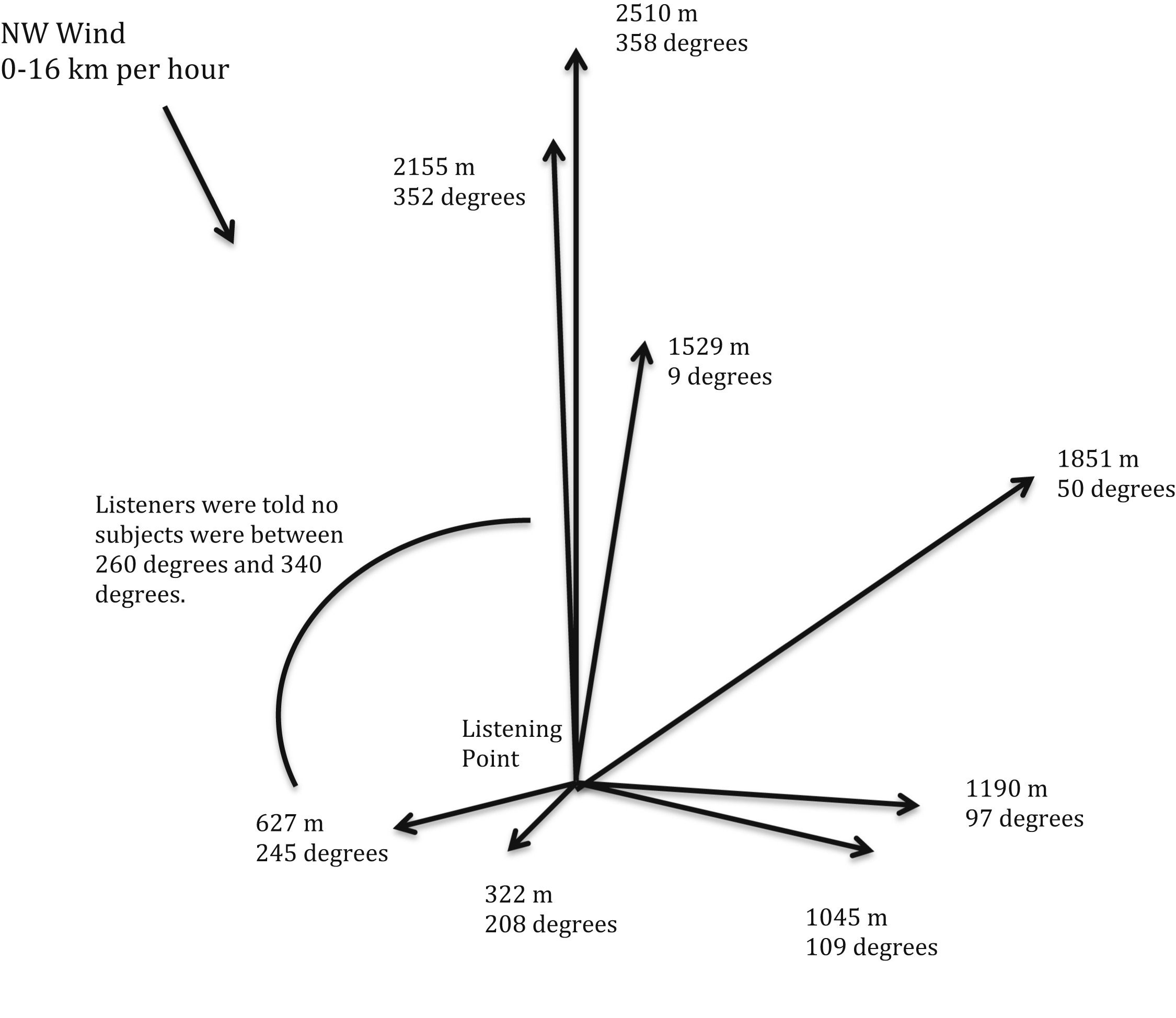
Locations of hidden callers relative to the listening point in this study.
Immediately before deployment, each of the 8 subjects was asked to call 5 m away from a sound meter and was provided feedback (“louder, quieter”) until they were calling at 75±2 dB. They were then asked to call at the same level once deployed. There was no additional calibration during or after the test. A Quest 211A sound meter (serial number 703010V; 3M Corp. Minneapolis, MN) was used for the calibration. Each subject was given a radio and a sheet of paper with 3 call signs (ie, letters the subject would answer to over the radio such as A, L, and W) and state names (eg, Michigan, North Dakota, and Arizona) associated with each call sign. A radio operator located at the listening point would call a given call sign and instruct the subject to start calling the name of the state associated with that call sign. The subject would do so approximately every 3 s for 5 min. At the end of 5 min (tracked by a timekeeper at the listening point), the radio operator would tell the subject to stop calling. If all listeners signaled the timekeeper that they had heard the call and recorded their results, the timekeeper would tell the subject to stop calling before 5 min. This was common with the subjects who were closer to the listener.
The order in which the subjects called was predetermined and random. In a given sequence, the first calling subject might call “Arizona” from 2155 m; the second might call “New Hampshire” from 1190 m. The order of the callers was independent of where each was located (by compass direction). Importantly, no one at the listening point knew the spot from which a given subject was calling, so no one could bias the listeners toward a particular direction. Furthermore, when a second set of subjects replaced the first set halfway through the day, all of the call signs, names of states being called, and the order of calling were changed so that new listeners (who were previously subjects) could not use the information they had gained in calling to bias the results as listeners.
A hill near the listening post was too close to conceal a subject from the listeners. The listeners were informed that there were no subjects located on this hill (between 260 and 340 degrees). Thus, the arc of potential subjects covered 280 degrees around the compass (from 340 degrees around to 260 degrees).
There were 8 cycles through all 8 subjects, meaning there were 64 subject calls during the course of the study. Each time, there were 3 listeners with parabolic microphones, and 2 to 14 unaided listeners. Around the listening point, signs in the field denoted compass bearings in 10-degree increments. The listeners (both with microphones and unaided) were instructed to listen for a caller and then to write down on their report form the name of the state being called and the compass bearing (from the signs around the listening post). To get the compass bearing, the listeners were instructed to go a specific point at the listening point (from which all the compass bearing signs were correctly oriented) and to make his or her best 3-digit estimate of the compass direction of the call. The listeners were instructed to mark an X on the report form if they heard nothing. Listeners were instructed not to mention what they heard or point in a specific direction if they heard something. Each listener wrote down his or her results on a report form.
Microphone operators used 66-cm parabolic microphones. Microphone operators were instructed to take their headphones off when a new subject started calling (to see if they could get a direction of the call) and then to put the headphones on after 15–30 s. If they heard nothing without the headphones, they were instructed to do a slow sweep of the 280 degree arc covering all of the subjects.
The test was halted for several minutes on a number of occasions when airplanes were flying overhead, making significant noise. Weather for the day was sunny with temperatures of 12–18
If a listener successfully identified the direction of a call to within 20 degrees, it was counted as a success in detection (Tables 2 and 3; Figure 2). If a listener correctly identified the name of the state being called, it was counted as a success in comprehension (Tables 4 and 5; Figure 3). A two-tailed χ2 test without correction for multiple samples was performed for each endpoint (detection and comprehension), and the effect size (Cohen’s d index) was calculated for each. χ2 significance was set at P<0.05.
Success in identifying the direction of a calling subject within 20 degrees
NS, not significant.
Success in identifying the direction of a calling subject within 20 degrees (consolidation of Table 2)
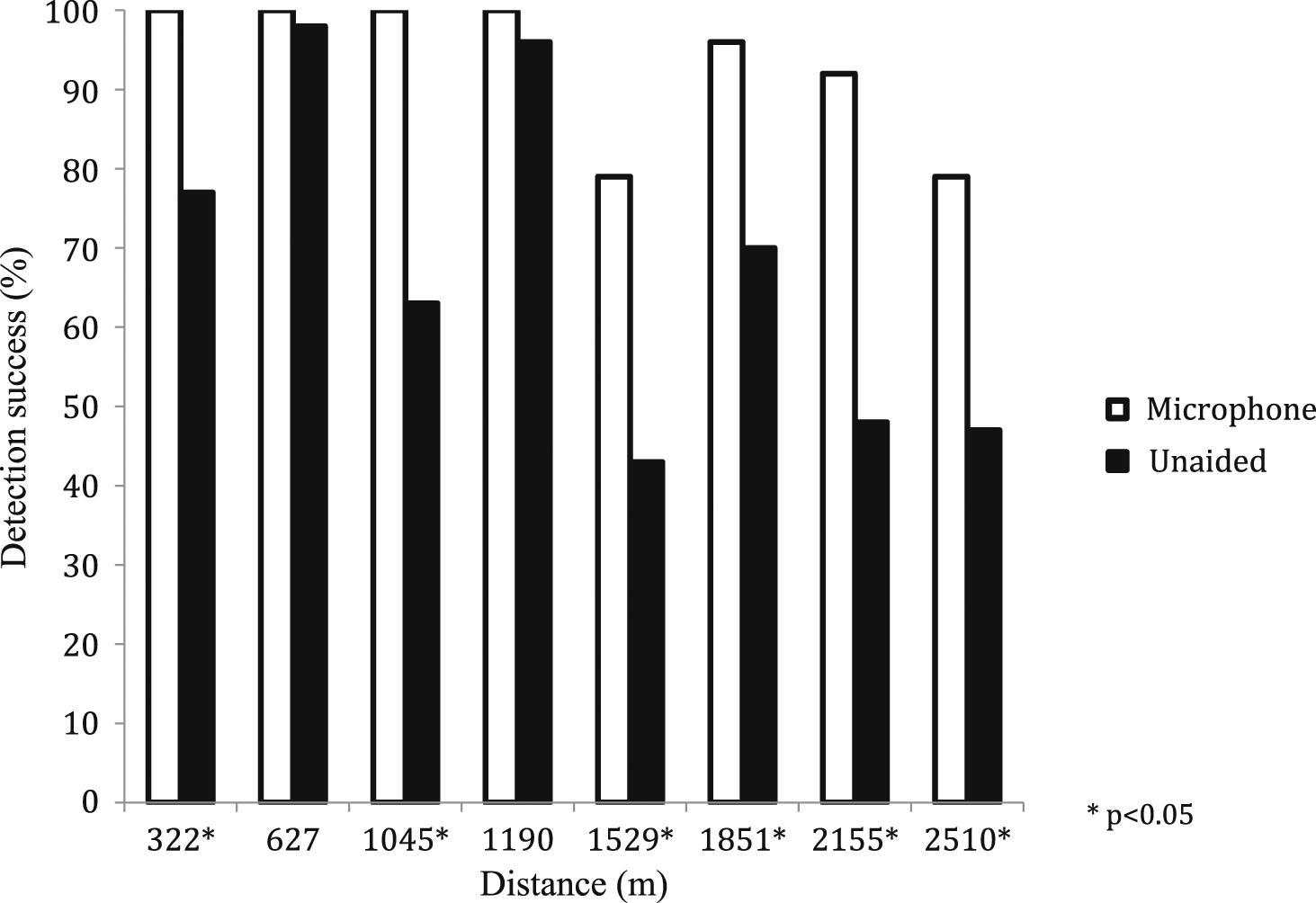
Success in identifying the direction of a calling subject within 20 degrees (ie, detection).
Success in identifying the state name being called (ie, comprehension)
Success in identifying the state name being called (consolidation of Table 4)
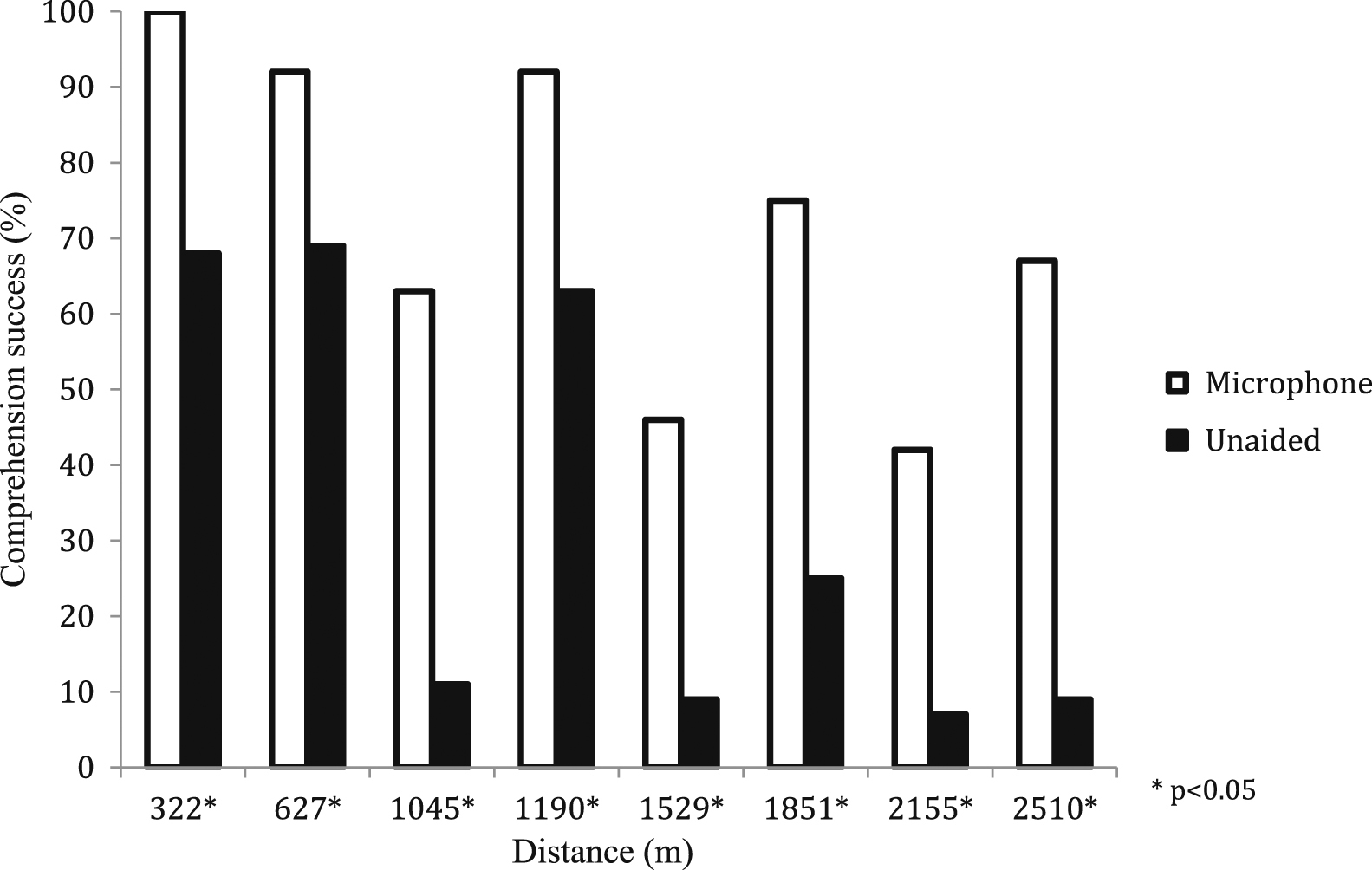
Success in identifying the state name being called ie, comprehension.
Results
The parabolic microphone (n=192) was superior to unaided hearing (n=443) at both detection of hidden callers (P<0.00001 by χ2; effect size of 1.58 by Cohen’s d) and comprehension of their calls (P<0.00001 by χ2; effect size of 1.55 by Cohen’s d), pooling all distances. Additional comparisons of success at each distance were performed for both end points by 2-tailed χ2 test without correction for multiple samples. Based on a substantial drop-off in success for both modalities (microphone and unaided hearing) and both end points (detection and comprehension) beyond 1200 m, results from 322 to 1200 m and 1200 to 2510 m were pooled for analysis.
When the state name was correctly identified with the parabolic microphone, the listener always recorded the direction within 19 degrees of the true direction. The mean direction determination for correctly identified state names by microphone users was 6 degrees off the correct direction, as compared to 7 degrees off for unaided hearing (P=NS).
Discussion
In this study, the 83% detection rate by unaided listeners between 322 and 1190 m was very good, not far below 100% achieved with the parabolic microphone. At the longer distances (1529–2510 m), the detection rate was 86% with the microphone and 52% by unaided hearing (P<0.00001 by 2-tailed χ2 test).
The parabolic microphone aided comprehension both meaningfully and statistically at all distances. Between 322 and 1190 m, comprehension with the microphone was 86% vs 52% for unaided listening (P<0.00001). Between 1529 and 2510 m, comprehension with the microphone was 57% vs only 12% for unaided listening (P<0.00001). These results show the parabolic microphone to be superior in both detecting and comprehending hidden subjects who are calling.
Although detection and comprehension decreased at greater distances, this decrease was not consistent from one distance to the next. For example, both detection and comprehension were better at 1851 m than at 1529 m. Some subjects might have been clearer in pronouncing the state names they called.
In real searches, there are commonly many teams searching adjacent territories. An incomprehensible call in the distance is easily dismissed as a call from another search team. However, if a team can understand what is being called, the team can distinguish between a subject and another team. For this reason, both detection and comprehension are important. This study suggests that unaided listening, in favorable conditions, can detect and comprehend greater than 50% of calling subjects out to 1190 m. This translates into an area of 4.4 km2. Use of the parabolic microphone extends the range of greater than 50% detection and comprehension to 2510 m, corresponding to 19.8 km2, or approximately 4.5 times the area achieved with unaided hearing. At all distances between 322 and 2510 m, the parabolic microphone yields a higher probability of detection and comprehension than unaided hearing.
A parabolic microphone is more likely to be valuable in the following conditions: Minimal wind No rain (because of noise) No aircraft, particularly helicopters (noise) Topography that allows line of sight to most of the area being covered
Although this study was conducted during daylight hours, using the parabolic microphone at night might offer advantages: Wind tends to be lower, helicopters and other search aircraft are probably not operating, and the team can use a powerful flashlight to elicit a response from a subject. Also, if communication with the subject can be established in the dark, a more precise compass bearing can be determined by asking the subject when the flashlight is aimed directly at him or her. It is probably helpful for the microphone team to have a satellite phone because radio communications might not be set up at night.
If full operations (including helicopters) diminish the value of a parabolic microphone during the day in areas being searched, the incident commander might consider assigning the microphone team to a peripheral area that would otherwise go unsearched during that operational period. This can give search management some confidence that unsearched areas do not contain a responsive subject.
To hear a subject, a team must first elicit a response from a subject. The authors recommend use of a megaphone to elicit a response, although this study did not include use of a megaphone. Lost children may be reluctant to respond when strangers call. 6 In such situations, it may help to have a family member call with the megaphone.
The parabolic microphones, electronics, and headphones weigh approximately 3.4 kg (7.5 lb). Bulkiness is more of an issue than weight in taking a unit into the field attached to a backpack: The width of the parabolic microphone would make it difficult to go off trail in thickly wooded terrain. However, the system is easily portable on dirt roads, trails, or areas without dense vegetation.
Limitations
Few real world searches are conducted in conditions and terrain as favorable for clear sound transmission as those experienced in this study. There were no helicopters operating overhead and no nearby traffic. The terrain was mostly grassy fields with small clusters of trees (as shown in Figure 4). All of the subjects were at different altitudes from the listeners, meaning most of the sound traveled well above the ground and above any objects that might attenuate it. The test subjects were also calling continuously for 5 min, which might not happen in a real search. Thus, the results presented here (for both the microphone and unaided listening) are probably more favorable than what might be achieved in more windy conditions, in terrain with more trees, in situations where the subject and listener are at similar elevations, or where the subject may call for a shorter duration or at a lower volume.
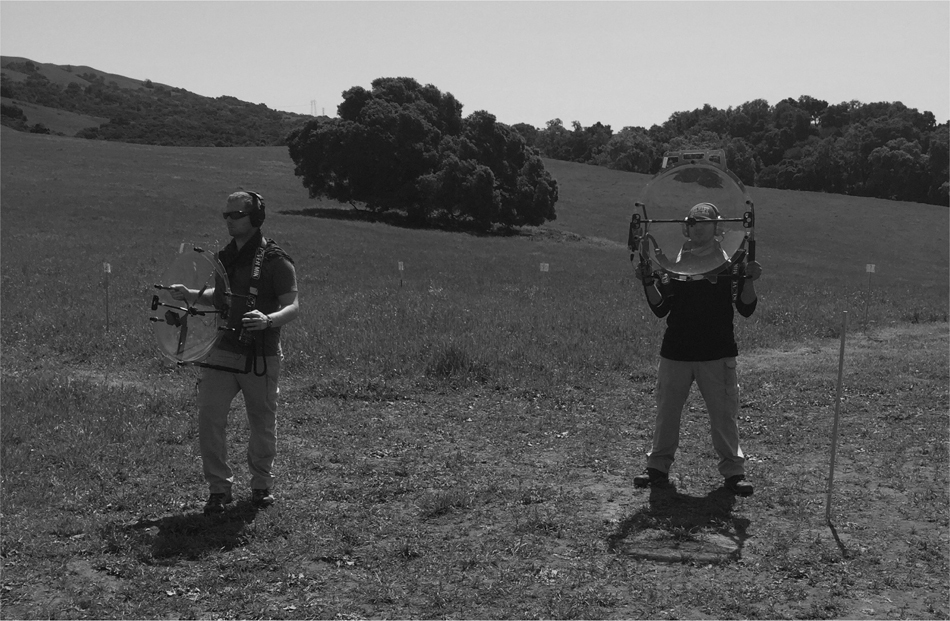
Two parabolic microphone users during the study.
This study did not determine the outer limits of detection and comprehension with the parabolic microphone in favorable conditions and terrain. The chosen location allowed a maximum caller–listener separation of 2510 m. Detection and comprehension with the parabolic microphone were over 50% at 2510 m. In favorable conditions and terrain, the parabolic microphone may allow users to detect and comprehend callers at distances greater than 2510 m.
Future studies
The ability to hear a subject depends on the ability to elicit a response from a subject. This study did not address how to elicit a response. The more powerful commercial megaphones claim a communication distance of 2400 m (1.5 mi), close to the longest distance in the current study. It would be very helpful to know the distance at which a person can hear and comprehend a call with a commercial megaphone.
Most of the sound travel in this study was through open air, given the elevation differences between the callers and the listeners. It would also be interesting to compare the parabolic microphone with unaided hearing over flat ground, both in open terrain and more densely vegetated terrain. Additionally, it would be valuable to determine the added sensitivity of a parabolic microphone in a canyon or similar setting where sound is redirected. Because some people carry whistles into the wilderness, it would be interesting to compare detection with the parabolic microphone to unaided hearing with whistle calls instead of vocal calls.
Finally, it may be possible to develop software that diminishes background noise, such as bird calls, wind, and manmade noise. The development and validation of such software might allow the parabolic microphone to be valuable in a greater range of search and rescue situations.
Conclusions
This study suggests a 66-cm parabolic microphone can significantly increase the range at which a searcher can both detect and comprehend calls from a lost subject in favorable weather conditions and terrain. This study supports the use of a 66-cm parabolic microphone in searching for a subject who might be responsive.
Acknowledgments: The authors thank Jose L. Puglisi, PhD, and Andrew Haskell, MD, for assistance in statistical analysis. The authors thank Klover Products, Janesville, WI, for providing the parabolic microphones used in this study. Klover Products had no role in the design, execution, or analysis of this study.
Author Contributions: Study concept and design (NLB, SKS, JAT); acquisition of data (NLB, SPB, SKS, JAT, PKT, JNT); analysis of data (NLB, SPB); drafting of manuscript (NLB); critical revision of manuscript (NLB, SKS, JAT, JNT); approval of final manuscript (NLB, SPB).
Financial/Material Support: Santa Clara County Search and Rescue Incorporated provided funding to pay for some of the shipping cost of the parabolic microphones used in this study.
Disclosures: None.