






Abstract
Objective
In developing countries, rural communities often face the lack of potable water infrastructure and must rely on untreated sources for drinking, which are often contaminated with waterborne pathogens. The use of home water treatment devices is seen as one means of reducing the risk of exposure to waterborne pathogens. The aim of this study was to evaluate the microbiological and physicochemical performance of a simple in-home point-of-use device based on gravity ultrafiltration through an ultrafilter membrane.
Methods
Twenty-five randomly selected households from 2 rural communities in Culiacán, Mexico, were enrolled. Water samples were collected before and after treatment and during storage for a period of 8 weeks. Heterotrophic bacteria, total coliforms, fecal coliforms, Escherichia coli, and Giardia spp were quantified, as well as various physicochemical parameters.
Results
All of the untreated water samples contained high levels of indicator bacteria, but none were detected in the treated water fulfilling the requirements set by the Mexican Norm (NOM-127-SSA1-1994) and the World Health Organization guidelines for drinking water. However, indicator bacteria (fecal coliforms and E coli) were detected in every sample from water stored 24 hours after treatment.
Conclusion
This study demonstrated that point-of-use filters using gravity-fed ultrafilters are a low-cost, effective water treatment technology for water of poor microbial quality. However, further identification of the sources and mechanisms by which water is contaminated when stored after treatment will help with designing and implementing better strategies for keeping water safe for domestic use.
Keywords
Introduction
An estimated 750 million people worldwide lack access to safe drinking water. 1 Contaminated drinking water, along with poor sanitation and hygiene, contributes annually to 4 billion cases of diarrhea and 1.9 million deaths in developing countries, affecting mostly young children. 2 The lack of access to safe water has been addressed as one of the development goals established in September 2000 as part of the resolution adopted by the General Assembly during the United Nations Millennium Declaration. 3
Potable water infrastructure in developing countries is not accessible to many rural communities in which demand has made it necessary for consumers to collect water from untreated sources, such as wells, springs, boreholes, rainwater, and surface water. This requires communal water storage tanks, encouraging collection and storage for further use at the household level, hence frequently leading to high levels of fecal contamination. 4
In northwest Mexico, almost 100% of the urban population has access to potable water, but some rural communities remain devoid of safe drinking water and sewage infrastructure. Surface water in northwest Mexico is plentiful but often at risk of contamination due in part to inadequate wastewater treatment in rural communities. Efforts made in rural communities to avoid contaminated water include the use of shallow wells. However, such wells are not adequately protected and may be susceptible to contamination. In addition, contamination may occur during collection and storage in the home.5,6
As reviewed elsewhere, 7 –9 improvements in household water quality are associated with substantial reduction in diarrheal diseases. Some of the least expensive interventions applied to minimize microbial contamination include chlorination, flocculation/disinfection powder, solar disinfection, and ceramic or slow sand filtration. Among these intervention methods, filters have been shown to be one of the most effective methods in removal of waterborne pathogens. 7 Point-of-use (POU) technology based on ultrafiltration has demonstrated not only improved drinking water quality but also reduced diarrheal diseases.10,11 The aim of this study was to evaluate the microbiological and physicochemical performance of an in-home POU device based on gravity ultrafiltration (LifeStraw, Vestergaard Co.).
Methods
Study area
This study was conducted in 2 rural communities in Culiacán, Sinaloa, Mexico, from October through December 2011. Culiacán, capital city of the state of Sinaloa, has an urban population reaching almost 1 million inhabitants, and close to 40,000 rural population. Two of the oldest and poorest rural communities in Culiacán are El Rincón de los Monzón (52 inhabitants) and Pueblo Nuevo (55 inhabitants), with geographical coordinates of 25°03’35.18 N 107°39’38.60” W and 27°03’51.80 N 107°39’38.60” W, respectively.
The main source of water for drinking and household purposes is extraction from wells located near the Humaya canal. The water is transported to households in large open containers posing a risk of potential contamination. Both rural communities (El Rincón de los Monzón and Pueblo Nuevo) were chosen according to the following criteria: lack of access to potable water, sewage infrastructure, and sanitation habits. Household members involved in the study gave their consent to participate, and the respective households were defined as “case households.”
The filtration units were installed according to the manufacturer’s instructions in each of the 25 participant households (16 units were installed in El Rincón de los Monzón and 9 in Pueblo Nuevo). After the device was installed, the participants received a brochure and training for the correct use and proper cleaning of the unit in accordance with the manufacturer’s instructions. Participants were also instructed on consumption and storage of the treated water. Data on the approximate quantity of water treated, the periodicity of unit maintenance, the water source employed, and any specific unexpected events were provided by the participants each week before sampling.
The water treatment system
The LifeStraw Family 1.0 is a fully integrated, gravity-fed ultrafilter, low-cost, POU microbial water treatment system intended for routine use in low-income settings. The unit is designed to treat water of unknown microbiological quality with high levels of turbidity and works at low pressure without any power source requirement. The low cost of this device is due to the fact that once the device is acquired there is no need for additional products, reagents, or electricity. The unit has a cost of about USD $90. The LifeStraw Family 1.0 is designed to produce approximately 150 mL/min (9.0 L/h) of water with a lifetime capacity of about 18,000 L, which would provide a 5-person family with treated water for 3 years. Using the foregoing assumptions, this works out to less than USD $6/person/year. The unit cost would be USD $0.005 per liter treated.
The ultrafiltration method can remove particles in the range of 2 to 50 nm or larger depending on the pore size of the membrane used. This pore size is small enough for the removal of viruses and bacteria. The LifeStraw Family 1.0 has an ultrafiltration membrane in a cylindrical plastic cartridge (dimensions: 26 × 3 cm). Water passes through narrow fibers under gravity-induced pressure.
Source water is introduced into the system by pouring 2 L into a feed water bucket with an 80-µm prefilter. The water passes through the cleanable prefilter mounted inside the feed water bucket and then through a halogen chamber that elutes low amounts of active chlorine to help prevent membrane fouling (a small amount of active chlorine slows biofilm formation on the hollow fiber membrane). A 1-m plastic hose connects the halogen chamber with a cartridge that contains the 20-nm pore size hollow fiber membrane in which ultrafiltration takes place (Figure).
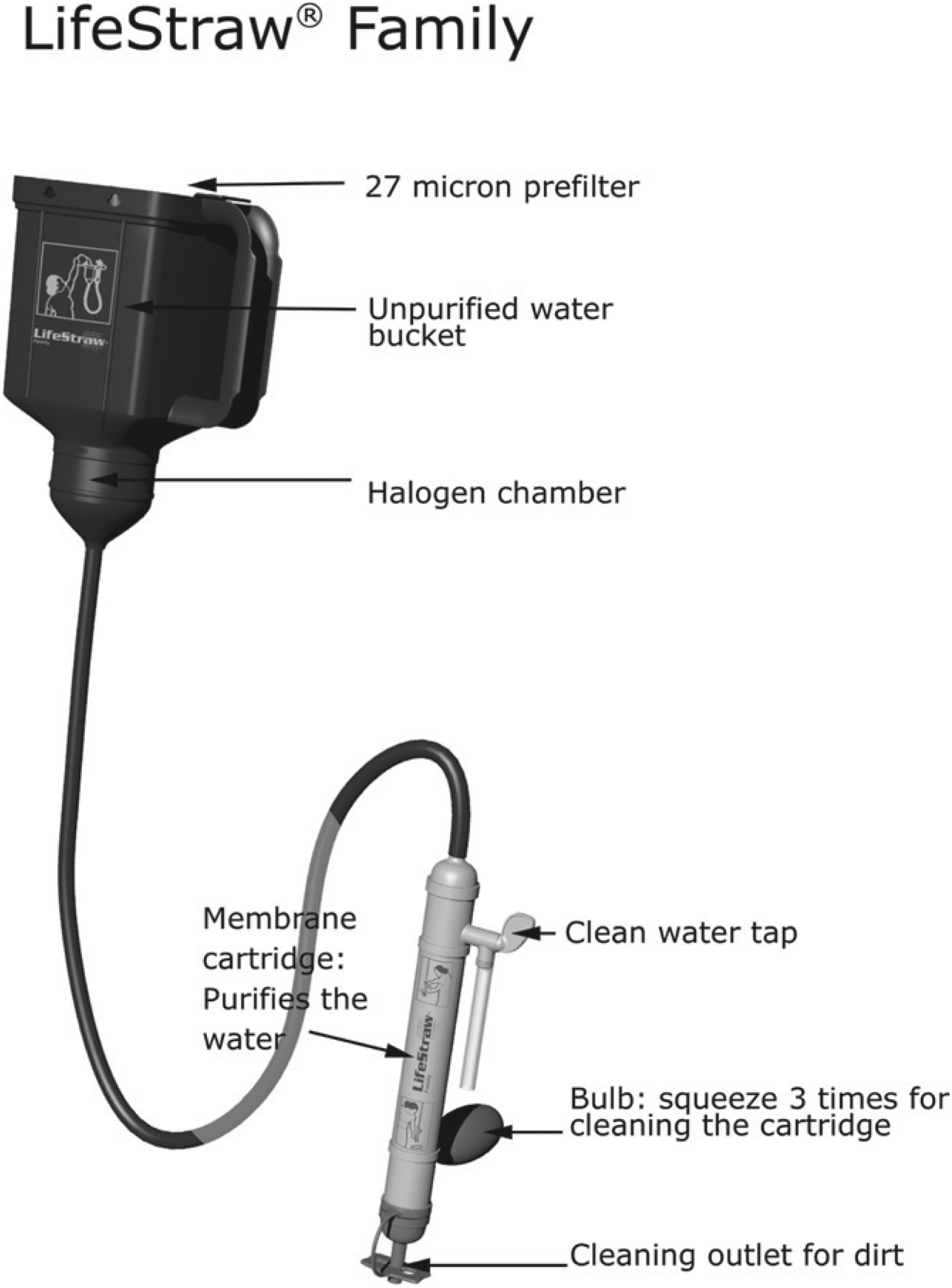
Schematic of device. Taken from Clasen et al. 20
Sample Collection
Water samples were aseptically collected between October and December 2011. Three different water conditions/sites were sampled: 1) Nontreated water (samples were collected directly from untreated wells near the Humaya canal), 2) treated water (samples were taken directly from the POU unit immediately after filtering), and 3) stored water (water was collected after filtering and subsequently stored for in-home use; samples were taken at least 24 hours after storage). For bacterial analysis water samples were taken from the 3 types of water, while for Giardia, samples were taken only from water types 1 and 2. For storage, filtered water was poured directly into a 20-L plastic bottle with a narrow opening and blocked to air with a screw cap. The bottle and cap were periodically washed with filtered water from the POU device. Water samples (1 L) were collected weekly from each site for 8 weeks, placed in sterile 1-L plastic bottles containing 10% sodium thiosulphate to neutralize any residual chlorine, and transported on ice to the National Laboratory for Food Safety Research (Culiacán, Sinaloa, Mexico) for immediate microbiological and physicochemical processing.
Microbial analysis
All bacteriological analyses were carried out according to the Standard Method for the Examination of Water and Wastewater. 12 Escherichia coli and total and fecal coliforms were quantified by the membrane filtration method (0.45 µm, Gelman Science, Ann Arbor, MI) using ECC agar (Chromoagar, Paris, France) and mEndo, respectively. E coli and fecal coliforms were incubated at 45.5°C for 24 hours, while total coliforms were incubated at 37°C for 24 hours. Heterotrophic plate count (HPC) bacteria were enumerated using the spread plate method using R2A agar (Difco, Detroit, MI), and incubated at 37°C for 24 hours. The presence of Giardia spp cysts was assessed following the Sheater flotation technique described by Dryden et al. 13
Physicochemical Analyses
Physicochemical analyses were performed on nontreated and treated water samples according to Standard Methods 14 and the Mexican Norm NOM-127-SSA1-1994. 15 Among the parameters tested were turbidity, color, odor, pH, total dissolved solids, total hardness (C/Ca/CO3), cyanide (CN-), ammonia nitrogen (NH3-N), nitrate (NO3-), nitrite (NO2-), fluoride (F-), residual chlorine, chlorides (Cl-), sulphate (SO4), and iron (Fe).
Data Analysis
Water quality was established according to the World Health Organization (WHO) guidelines for drinking water quality 16 and the Mexican Norm NOM-127-SSA1-1994. 15 An experimental design with 2 factors that were totally randomized, without interactions, and 1 replicate per treatment was performed. Levels of each factor were Time (8 weeks) and Device (with [treated] and without [nontreated]). Analysis of variance was carried out using a Minitab 17.0 (2013, Minitab Inc.). A value of P < .05 was considered as statistically significant.
Results
A total of 384 samples from the case households were analyzed for a period of 8 weeks. Fecal coliforms, total coliforms, and E coli were detected in 100% of the nontreated water samples. The mean concentration ranged from 4.8 × 10² to 3.1 × 10⁵ colony forming units (CFU)/100 mL, 1.5 × 10⁴ to 7.5 × 10⁵ CFU/100 mL and 12 to 2.3 × 10² CFU/100 mL for fecal coliform, total coliform, and E coli, respectively (Table 1). On the other hand, fecal and total coliforms and E coli were absent (<1 CFU/100 mL) in water samples collected immediately after treatment during the 8 weeks of the study, which reflects a reduction of ≥99.9999% of the indicator bacteria in all of the samples treated by the POU units.
Presence of total coliform, fecal coliform, and E. coli in water samples
Data are presented as mean values for all samples taken in the respective week.
POU, point of use.
Colony forming units (CFU)/100 mL.
Point-of-use reduction percentage (%).
The analysis of variance showed no significant differences among bacterial counts during the 8-week trial regardless of the bacterial group being analyzed (total coliform [P = .500], fecal coliform [P = .500], E coli [P = .500], or HPC [P =.664]). On the other hand, the effect of the factor Device (with versus without treatment) was significant for all bacterial groups assayed in this study (P = .0001). The results from water samples tested immediately after treatment showed that the POU unit used in this study was able to remove HPC bacteria during the first 4 weeks of sampling, but levels increased at week 5. Even though these bacterial counts showed important difference among Time 0 and the other levels, the analysis of variance of Time as a main factor showed that this increment was not statistically significant (P = .664).
Stored water after treatment showed contamination with fecal coliform, total coliform, and E coli in all of the samples. The ranges of the indicator bacteria were 1.2 × 10² to 3 × 10³ CFU/100 mL, 1.2 × 10³ to 1.6 × 10⁴ CFU/100 mL, and 1 to 78 CFU/100 mL for fecal coliform, total coliform, and E coli, respectively (Table 1). HPC bacteria exceeded 500 CFU/mL in all of the untreated and stored water samples (Table 2). The POU unit demonstrated efficacy in removing HPC bacteria during the first 3 weeks of the study; however, at week 5 the levels of HPC increased around 1 log. In the present study, Giardia spp was not found in any of the analyzed water samples (data not shown).
Heterotrophic bacteria counts in water samples
Data are presented as mean values for all samples taken in the respective week.
CFU, colony forming units; POU, point of use.
CFU/100 mL.
Point-of-use reduction percentage (%).
A summary of the physical/chemical data for the water samples is shown in Table 3. Most parameters did not show significant differences after treatment, but they did meet the Mexican Norm NOM-127-SSA1-199415 as well as the WHO guidelines for drinking water quality. 16 Turbidity was the only parameter that decreased, diminishing from 2.86 to 0.96 NTU.
Physicochemical water properties
NTU, nephelometric turbidity unit; UPtCo, Platinum-Cobalt units; NA, not applicable.
HACH Chemical Company, Loveland, CO.
Discussion
This study constitutes the first household trial in Northwestern Mexico of an in-home POU device based on gravity ultrafiltration (LifeStraw Family 1.0) demonstrating microbiological of untreated water for drinking purposes.
Previous studies have assessed the effectiveness of the LifeStraw Family 1.0 system from different perspectives. In a controlled trial in a village of the Democratic Republic of Congo, Boisson et al 17 reported that the filter was effective in improving water quality; however, their results provided little evidence on the prevention of new cases of diarrhea. 17 Another study involving 47,000 individuals suggested that diarrheal cases and deaths may be reduced as a result of the inclusion of the LifeStraw Family technology. 18
A study by Clasen et al 19 evaluated the same filtration device in the laboratory for removal of bacteria and viruses. Their results indicated that the POU unit is effective under controlled circumstances in removing a range of microbial indicators of fecal contamination for up to 20,000 L, or roughly 110% of its design capacity, while the average log10 reductions exceeded 6 logs (99.9999%), 4 (99.99%), and 3 logs (99.9%) for bacteria, virus, and protozoan cysts, respectively. 19
Our findings indicate that bacterial reductions were ≥6 logs even in real usage conditions in rural households, where factors such as type of water, dwellerʼs management, and the environment could interfere with the optimal performance of the device.
If we consider that 20% of the households in these communities consume nontreated water, the risk of acquiring waterborne infections is high. In this respect, the POU unit evaluated in this study successfully eliminated indicator bacteria from contaminated water, fulfilling the standards established by the Mexican Norm NOM-127-SSA1-99415 and the WHO guidelines for drinking water quality, 16 which establish zero presence of fecal and total coliforms as well as E coli in 100 mL of water (<1 CFU/100 mL). 14 This suggests that POU devices are effective for the treatment of water with poor microbial quality.
Factors such as poor hygiene habits, presence of pets inside the house (100% of the sampled households owned pets), insects, and dirty floors (mainly soil floors) promote recontamination of water after treatment. 20 As shown in the Results section, the increase in HPC counts observed in water samples obtained immediately after treatment was not statistically significant; this can be explained by the fact that there was only 1 replicate by treatment. One possible reason for the increasing levels of HPC bacteria in the POU unit can be due to biofilm formation in the plastic units, as supported by Lehtola et al. 21 Furthermore, it has been shown that these levels may not represent a significant risk to the consumers, 22 since levels as high as 109 HPC/g have been detected in food samples such as celery, milk, and cabbage with no association to illness. 23
Thus, the presence of heterotrophic bacteria in treated water samples might be due to the transport of these organisms throughout the wind or other vectors. 5 In this way, microbial contaminants may attach to the surface and colonize the hose attached to the water release tap. (Figure). In addition, contamination of stored water might be attributed to the possible use of unclean (not thoroughly washed) containers for the storage of water after treatment or keeping the storage bottle uncapped (stored water exposed to air). LeChevallier et al 6 suggested that poor hygiene and the exposure of the containers to an open environment support the conditions for regrowth of microorganisms in drinking water. 6
Absence of Giardia in water sources could be attributed to the season in which this study took place. Previous studies have reported the seasonal occurrence of protozoa such as Cryptosporidium and Giardia and observed that the maximum prevalence was detected during the period of highest precipitation,24,25 which can favor protozoan dispersion. The present study took place during the fall season when precipitation is very low, which could have negatively influenced the presence of the pathogen.
The device did not have any effects on the physicochemical parameters except turbidity, which was reduced from 2.86 to 0.98 NTU. This was expected because the units involve filtration, but the pores are large enough to allow soluble constituents to pass through the filters. These results coincide with laboratory assessment of the units by Clasen et al. 19 According to the WHO, for small water supplies in communities where water resources are very limited and where there is limited or no treatment, the aim should be to produce water that has turbidity of at least <5 NTU and, if at all possible, <1 NTU.16,26 Residual chlorine was not detected during the physicochemical analyses, as expected by the addition of sodium thiosulfate to the plastic bottles right before collecting samples. Sodium thiosulfate was added to avoid bacterial reductions before sample analyses.
Even though the effectiveness of the POU device for treatment of untreated water was demonstrated in this study, it would be useful to study the units for longer periods in a larger field study to better assess the performance of these units with prolonged usage.
Furthermore, it would be of importance to study the source of and causes for the recontamination of water when stored after POU treatment to provide evidence that will help in designing new and more effective ways of maintaining safe drinking water for longer periods after purification.
Conclusions
The results of this study suggest that POU gravity-fed ultrafilter filters are a promising low-cost, effective water treatment technology that has the potential to fill the service gap where potable water systems are inadequate or inaccessible. This technology can be applicable for any setting where access to safe water sources is not available, including developing countries and in emergency settings after natural disasters. Long-term and large-scale studies are needed to ensure that POU filters can provide consistent, reliable, and low-cost access to safe drinking water. Further identification of the sources of and mechanisms by which water is contaminated when stored after treatment will help with designing and implementing better strategies for keeping water safe for domestic use.
Acknowledgments: The authors acknowledge M. Sc. José Andrés Medrano Félix and M. Sc. Aurora Gastélum for their technical assistance.
Author Contributions: Conceived the project (NCC and CCQ); writing and editing of the manuscript and analysis and interpretation of data (NCC and JRIR); experimental design and statistical analysis of data (JBVT); edited the manuscript (CGG and MS). All authors read and approved the final version of the manuscript.
Financial/Material Support: Authors acknowledge Centro de Investigación en Alimentación y Desarrollo, A.C. for financial support and Vestergaard Co. for donating the devices for drinking water treatment.
Disclosures: None.
Footnotes
Submitted for publication September 2015
Accepted for publication May 2016