






Abstract
Objective
To describe demographic patterns in avalanche fatalities in the United States during the past 6 decades according to geographic location and preavalanche activity.
Methods
The Colorado Avalanche Information Center currently manages the National Avalanche Accident Dataset. This dataset describes deidentified avalanche fatalities beginning in 1951. Covariates included age, sex, month, state of occurrence, and preavalanche activity. Both absolute and proportional avalanche fatalities were calculated by year and by each covariate. A linear regression model was used to trend the proportion of avalanche fatalities stratified by covariate.
Results
There were 925 recorded avalanche fatalities in the United States between 1951 and 2013. There were an average of 15 ± 11 fatalities/y (mean ± SD; range, 0 to 40 fatalities/y). The mean (+/− SD) age was 29 ± 6.6 years (range, 6–67 years), and 86% were men. Total avalanche fatalities have increased linearly (R2 = 0.68). Despite the highest number of total deaths in Colorado (n = 253), the proportion of avalanche fatalities in Colorado decreased (–5% deaths/decade; P = .01). Snowmobilers are now the largest group among fatalities and accounted for 23% of deaths (n = 213). The proportion of snowmobile fatalities has increased (+7% deaths/decade; P < .01), as has the proportion of snowboarder fatalities (+2% deaths/decade; P < .01).
Conclusions
Avalanche fatalities have increased. This is most likely related to an overall rise in backcountry utilization. Fatalities have increased among snowmobilers and snowboarders. Despite a rise in backcountry utilization, avalanche fatalities in Colorado are decreasing. A strategy of focused training and education aimed toward at-risk groups could result in lower avalanche fatalities.
Introduction
In the United States, backcountry winter recreation has become increasingly popular. This trend is evident for both motorized and nonmotorized recreationalists. According to Snowsports Industries America (SIA), the sale of alpine touring boots has doubled since 2012, and sales of backcountry accessories such as avalanche beacons and probes have risen 12%. 1 The SIA also observed a huge growth in splitboard sales, reporting fewer than 500 units sold in 2009, but more than 3000 sold in 2012 (6-fold increase). 1 The Outdoor Industry Association has reported a 40% increase in the number of telemark skiers since 2006. 2 Snowmobiling has also gained in popularity. According to the International Snowmobile Manufacturers Association, there are now more than 1.3 million snowmobiles registered in the United States, a 40% increase from 1990. 3
Snow avalanches are a recognized objective risk when participating in backcountry winter recreation. In 1999, Page et al 4 published a study that described more than 4 decades of avalanche fatalities in the United States. At that time, snowmobilers and snowboarders accounted for less than 10% of victims. Clearly there are more people recreating in the backcountry. Have there also been changes in their activities? Given the increased popularity of snowmobiling and splitboards, this is certainly possible.
The purpose of our study was to describe changes in demographic patterns in avalanche fatalities in the United States during the past 6 decades. Given the increase in backcountry recreationalists, we hypothesized that avalanche fatalities have increased. We also hypothesized that there has been a change in the pattern of these fatalities with respect to geographic location and type of preavalanche activity.
Methods
The Colorado Avalanche Information Center (CAIC) currently manages the National Avalanche Accident Dataset 5 , which was initiated in 1951. This dataset contains deidentified descriptions of avalanche fatalities. This analysis includes entries from 1951 through 2013. Each entry includes the time, location, and number of fatalities for each reported avalanche. Additional information included the age, sex, preaccident activity, and burial status of the victim. The CAIC estimates the current capture rate for reporting avalanche fatalities in the United States to be >95%. However, this capture rate has not been formally validated, and a capture rate before 2000 is speculative. Colorado population data were obtained from the US Census Bureau. 6 Data on snowmobile registrations were made available from the International Snowmobile Manufacturers Association. 7 Winter recreation utilization data for Vail Pass, Colorado, were made available from the US Forest Service (Vail Pass Winter Recreation Season Report, unpublished data used with permission, 2014). Occupancy data for the 10th Mountain Division Hut System were made available from the 10th Mountain Division Hut Association (B. Dodge, unpublished data used with permission, 2014).
Victim age, sex, month, and state of occurrence were analyzed using descriptive statistics. Victims were characterized as either fully buried (avalanche debris covered the head or there was no exposed part of the victim visible to rescuers) or partially buried (the head remained above the snow surface). Fatalities were classified a priori by preavalanche activity based on the preexisting categorizations within the National Avalanche Accident Dataset. For the purpose of this analysis, victims could be classified exclusively as a snowmobiler, a backcountry skier, a backcountry snowboarder, a climber, an in-bounds skier/snowboarder, a side-country skier/snowboarder (victim rode a ski lift to access out-of-bounds terrain), a hiker/snowshoer, or other. Other included a heterogeneous mix of highway workers, house occupants (those killed by an avalanche while in a home), miners, and motorists, which when taken separately were too underpowered to allow for individual analysis.
The absolute number of avalanche fatalities was categorized by state, activity, age, and sex for each year of the study period (the outcome variables). Next, the proportion of avalanche fatalities was calculated for each outcome variable between 1951 and 2013 (for example, number of snowmobile fatalities in 2010 divided by the total number of avalanche fatalities in 2010). Because validated data on winter backcountry utilization are limited, formal avalanche mortality rates for each outcome variable could not be calculated. However, by calculating the proportion of avalanche fatalities by outcome variable for each year and then trending these proportions with time, modeling of a proxy rate was possible. A bivariate linear regression analysis was performed to model percent change per decade (beta coefficient) in the proportion of avalanche fatalities calculated for each outcome variable. Normality of outcome variables was evaluated. Log transformation and nonparametric methodologies were not required before linear regression. To maximize relevance, the regression model included only the 6 states with the most avalanche fatalities (Alaska, Colorado, Montana, Utah, Washington, and Wyoming). Student’s t test was used to compare mean age of snowmobile fatalities compared with nonmotorized victims. A two-tailed probability value <.05 was considered significant. Stata 12.1 (StataCorp, College Station, TX) and JMP Pro 11.1 (SAS, Cary, NC) were used for statistical analysis.
Results
Nine hundred twenty-five avalanche fatalities were reported between 1951 and 2013. There were an average of 15 ± 11 fatalities/y (mean ± SD; range, 0–40 fatalities/y). The mean (+/− SD) age was 29 ± 7 years (range, 6–67 years). Eighty-six percent of fatalities were men (n = 795). Although avalanche fatalities occurred in every month of the calendar year, February had the most fatalities at 205 (22%). The burial status was known in 837 (90%) of the victims. Of the 837 fatalities with a recorded burial status, 785 (93%) were fully buried.
Figure 1 illustrates the increasing number of fatalities in the United States during the study period. Colorado accounted for 27% of avalanche fatalities, the most of any state. Taken together, Alaska, Colorado, Montana, Utah, Washington, and Wyoming accounted for 81% of all avalanche deaths. Despite the highest number of total deaths in Colorado, the proportion of avalanche fatalities in Colorado has decreased with time (–5% deaths/decade; P = .01). Figure 2 demonstrates the absolute number of avalanche fatalities in Colorado as a function of Colorado population. 6 Between 2001 and 2013, the 10th Mountain Division Hut Association in Colorado reported a 15% increase in winter hut bookings. Between 2002 and 2011, the US Forest Service reported a 64% increase in permits for the Vail Pass Backcountry Winter Recreation area. In contrast to Colorado, Table 1 demonstrates a significant increase in the proportion of fatalities in Alaska, Utah, and Wyoming during the study period.
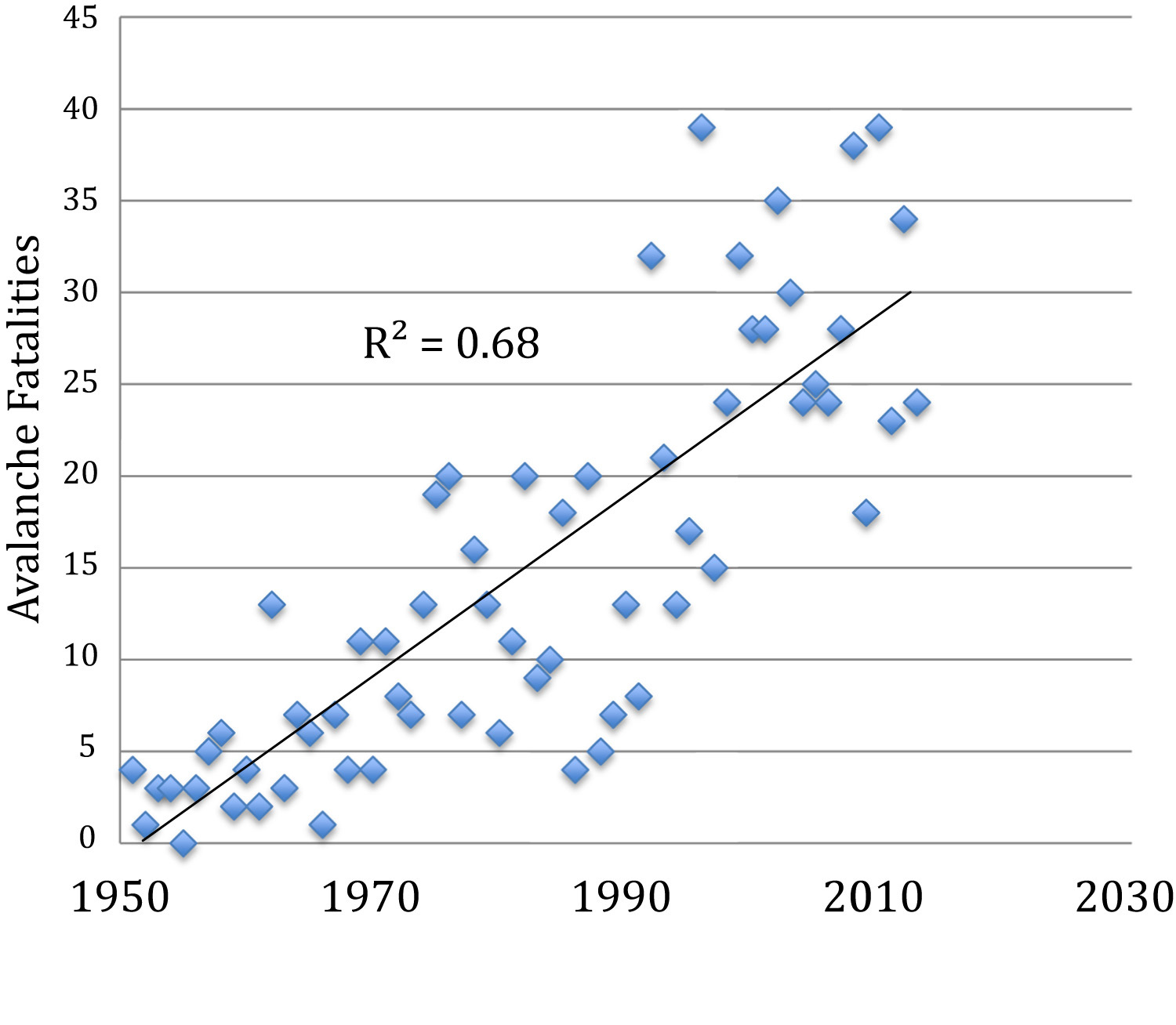
Total avalanche fatalities, 1951–2013.
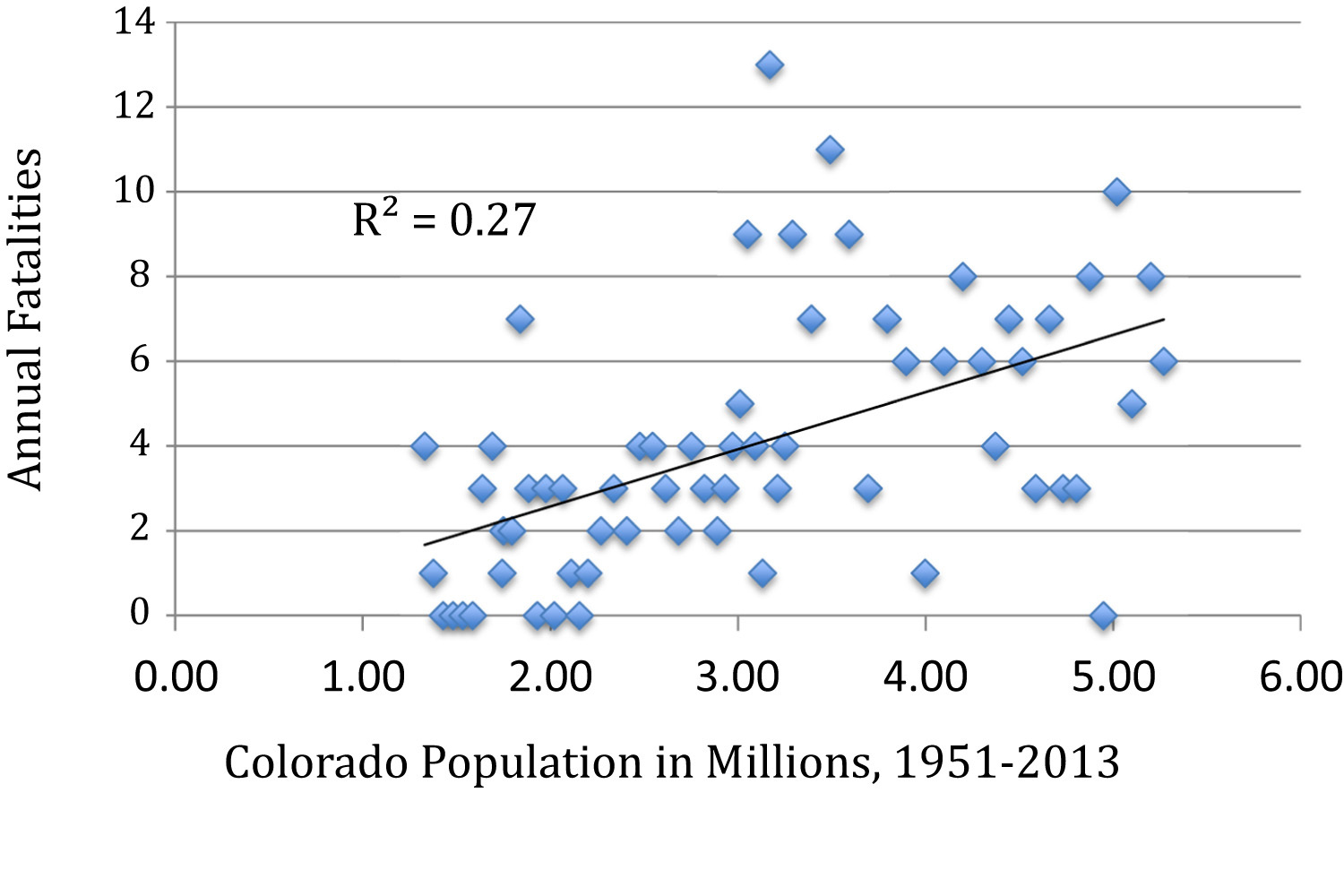
Correlation of Colorado population with Colorado avalanche fatalities.
Avalanche fatalities by state, 1951–2013
N/A, not available.
Table 2 shows avalanche fatalities organized by activity. Snowmobilers were the largest group, accounting for 23% of all deaths (n = 213). Backcountry skiers were the second largest group at 22% (n = 199). Figure 3 demonstrates the increased proportion of snowmobile-related fatalities during the study period (P < .01). Data from the International Snowmobile Manufacturers Association show an overall increase in snowmobile registrations in the 6 states with the highest frequency of avalanche fatalities between 1977 and 2013 (Figure 4). 7 The proportion of backcountry skier deaths did not significantly change between 1951 and 2013 (P = .11). Although backcountry snowboarders accounted for only 5% of avalanche fatalities, the proportion of fatalities in this group increased significantly during the study period (+2% deaths/decade; P < .01). Conversely, the proportion of climbers killed by avalanches decreased significantly (–3% deaths/decade; P = .04).
Avalanche fatalities by activity, 1951–2013
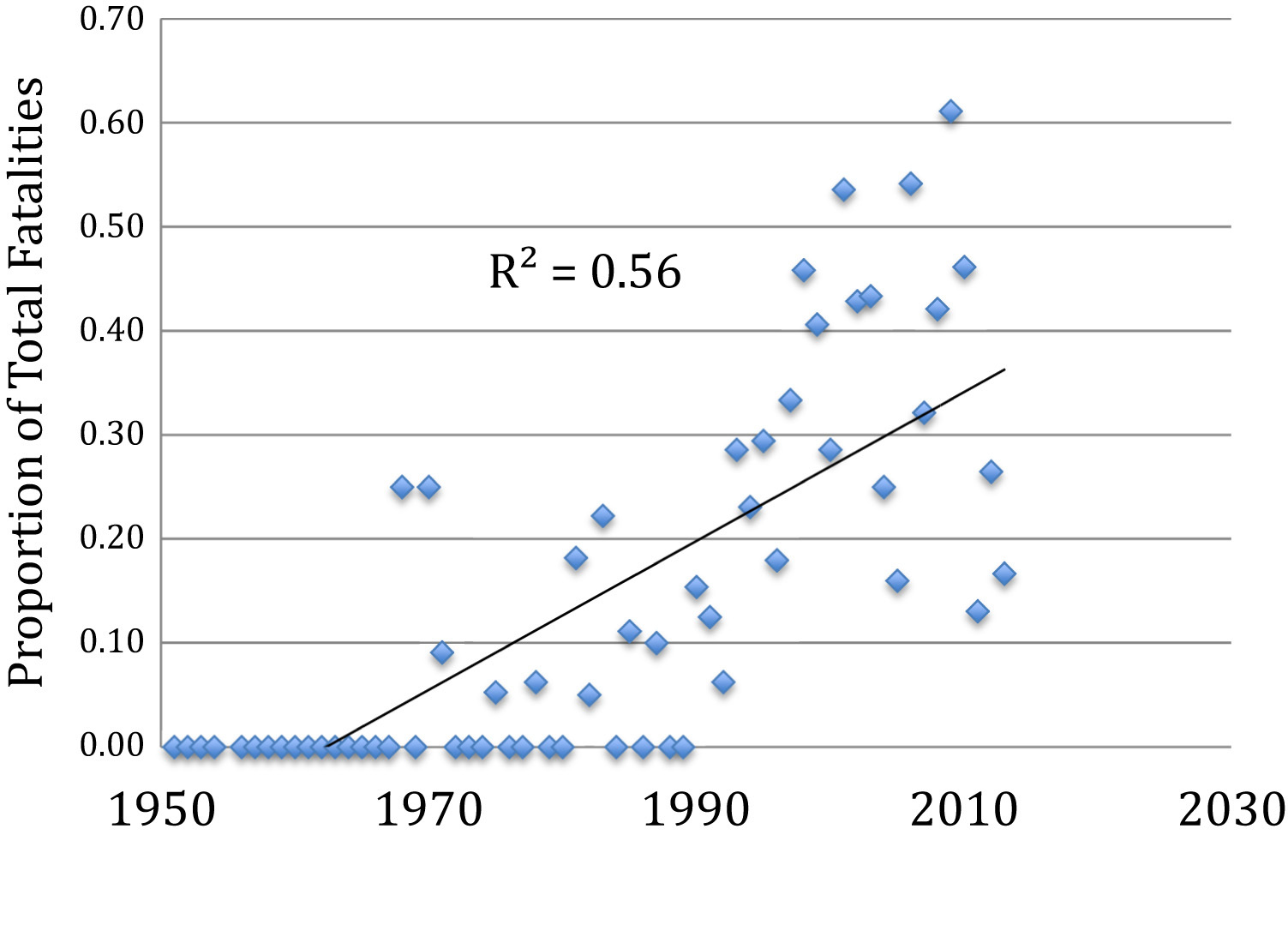
Proportion of snowmobile fatalities, 1951–2013.
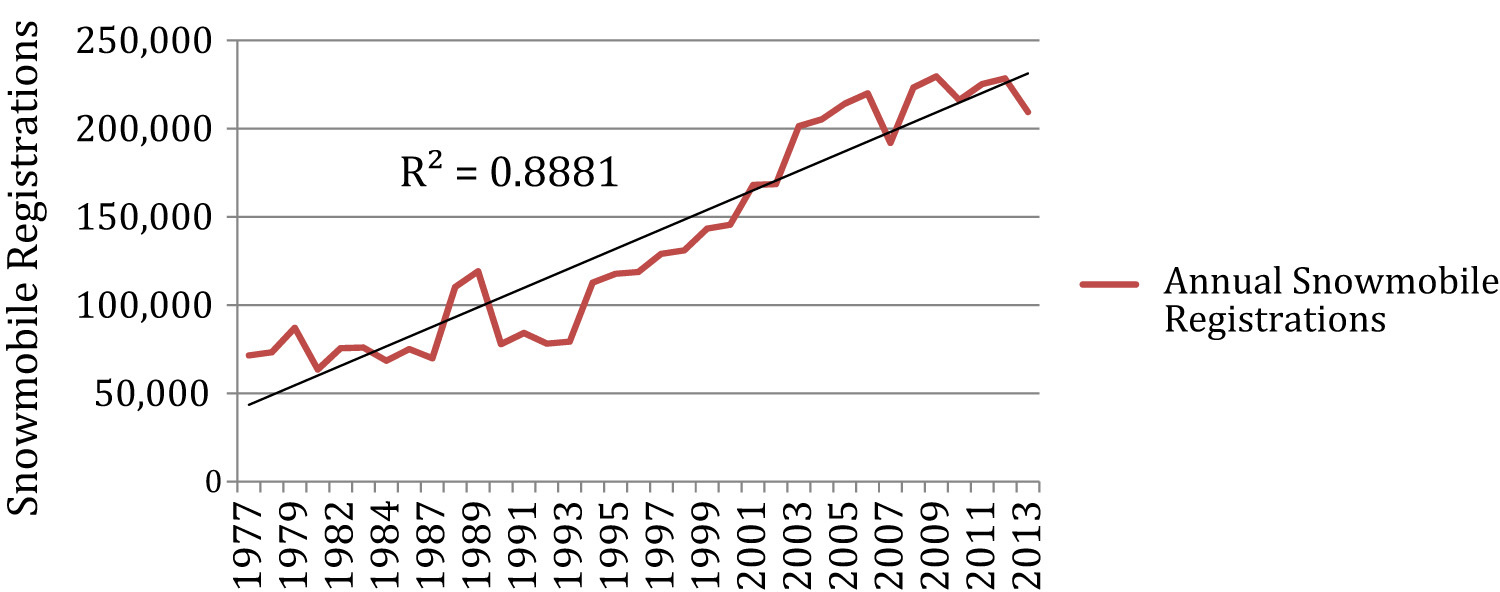
Snowmobile registrations for Colorado, Alaska, Utah, Montana, Washington, and Wyoming. 1977–2013.
The proportion of male to female fatalities did not significantly change between 1951 and 2013 (P = .60). However, the age of avalanche fatality victims increased significantly during the study period (2 years/decade; P < .01). The mean age of snowmobile fatalities was significantly older than that of nonmotorized victims (34 years vs 31 years; P < .01). Taken separately, the constituent subgroups within the other group each numbered less than 2% of total victims.
Discussion
This study has 2 main findings. First, the total number of avalanche fatalities in the United States rose during the study period. The most likely explanation for the continued increase in avalanche fatalities is simply that more winter recreationalists are in the backcountry. Snowsports Industries America estimated that 5 million people used the backcountry in 2014. 1 Accurate estimates of backcountry utilization for preceding years are not available, but multiple outdoor industries reported increased sales of backcountry equipment for the preceding decade. 1 –3 At this time, these data represent the best proxy of backcountry utilization over time and support the notion that overall usage has increased. Although there has been an observed increase in the absolute number of avalanche fatalities, trends regarding the avalanche fatality rate (fatalities per exposure) are more difficult to surmise. It is possible that improved reporting has contributed to the observed increase in avalanche fatalities. Capture rates for the early decades of this study are not available, but it is plausible that reporting systems were less sensitive. However, it seems less likely that increased reporting is the primary cause of this trend.
Our second major finding is that there has been an important shift in both the type of recreationalist killed by avalanches and the geographic location of these fatalities. We speculate that these changes are largely driven by dynamic changes in both the location and activities of backcountry recreationalists.
Snowmobilers now comprise the largest cohort of avalanche fatalities (23% of total victims). Similarly, there was a significant increase in the proportion of snowmobile-related deaths during the study period (Figure 3). Previous studies have reported backcountry skiers as the largest group. 4 This observation represents an important shift in the type of recreationalist killed by avalanches in the United States. Both Canadian investigators and the CAIC have observed a similar trend.8,9
We chose to focus on the proportion of avalanche fatalities rather than the absolute number of fatalities for 2 main reasons. As previously stated, modeling the change in the proportion of fatalities as a function of time by activity or state allowed for the calculation of a relative proxy fatality rate. For instance, if the proportion of the snowmobile fatalities increased, then the proportion of a different activity group must have correspondingly decreased. Second, there was large variability in overall avalanche fatalities from year to year. For example, in 2008 there were 38 total fatalities, of which 18 were snowmobilers. In 2009 there were 18 total fatalities, of which 11 were snowmobilers. In absolute terms, the number of snowmobiler fatalities decreased during this 2-year period. However, the proportion of snowmobiler fatalities increased from 42% to 61%. Accordingly, changes over time in the proportion of deaths by activity or location are more meaningful when compared with absolute fatality data.
The earliest reported snowmobiling-related avalanche death in our study occurred in 1968. We surmise that several factors contributed to the overall increase in snowmobiler fatalities. There are currently 1,397,200 registered snowmobiles in North America. In 1990 there were 1,042,938. 7 Historically, the greatest numbers of snowmobile registrations were clustered in the Midwest, where the lack of mountainous terrain limited avalanche-related fatalities. Snowmobile registrations in the states with the highest numbers of avalanche fatalities have markedly increased (Figure 4). 7 The Gallatin Avalanche Center recently estimated that snowmobilers’ usage exceeded that of nonmotorized backcountry users by nearly 10-fold. 10 These observations support the assumption that snowmobile recreation has increased in mountainous, avalanche terrain.
Snowmobiles are also more powerful today than in decades past. More powerful machines have facilitated the practice of “high-pointing” or “high-marking,” in which a snowmobiler attempts to ride as far up a steep slope as possible without getting stuck or rolling over. Unfortunately, high-marking can be a precipitant for avalanches. It is also a behavioral risk unique to this group. Snowmobilers represent an at-risk group that requires focused avalanche education. The challenges of tailoring avalanche education to snowmobilers were highlighted in a 2011 report by the American Avalanche Association. 11 Snowmobilers exhibit different behavior in the backcountry and are exposed to different risks when compared with their nonmotorized counterparts. Much of the currently available avalanche education remains largely tailored to skiers and snowboarders. Further adaptation of these curricula to snowmobilers to address the inherent differences in safe-travel techniques, snow stability evaluation, and rescue methods could possibly reduce avalanche fatalities in this cohort.
There was an observed increase in the proportion of fatalities among backcountry snowboarders. This is most likely related to increased backcountry utilization among this cohort. The earliest identified death among backcountry snowboarders occurred in 1986, approximately a decade after Burton Snowboards sold its first snowboard. In part because of the popularity of the splitboard, an increased number of snowboarders have improved access to avalanche terrain. Although SIA data show that overall snowboard sales have been flat in recent years, splitboard sales have markedly increased. 1 The SIA now estimates that more snowboarders than skiers are recreating in the backcountry.
In 1999, snowmobilers and snowboarders accounted for fewer than 10% of avalanche fatalities. 4 Snowmobilers and snowboarders now account for 28% of total fatalities. Although more snowmobilers and snowboarders are in the backcountry, other factors may be at play. In 2007, Silverton et al 12 observed that backcountry skiers were more likely to use avalanche rescue equipment and were more likely to have taken an avalanche education class than backcountry snowmobilers. It is certainly possible that differences in avalanche preparedness among winter recreationalists are contributing to increased fatalities relative to other user groups. Valuable insight could be gained from further examination of the level of avalanche training, experience, and preparedness within at-risk groups, with the aim of determining whether specific behavioral patterns or training deficiencies are amenable to focused intervention.
Colorado has a notoriously unstable continental snowpack (B. Kalet, unpublished data used with permission, 2008). Accordingly, it is not surprising that Colorado has observed the most avalanche fatalities in the United States, nearly double that of any other state. Winter backcountry recreation is popular in Colorado, and much of the population has easy access to backcountry terrain. Recent data exploring the spatial clustering of avalanche fatalities in Colorado showed a high frequency of accidents in areas with close proximity to roads and ski areas (the so-called side-country). 13 Indeed, backcountry utilization in Colorado appears to be on the rise. The 10th Mountain Division Hut Association and the Vail Backcountry Recreation Area have both observed signification increases in utilization. Data from the Vail area are particularly relevant because they include large numbers of both motorized and nonmotorized users. Despite increased utilization, the proportion of total avalanche fatalities in Colorado significantly decreased during the study period relative to other states. In 1999, Page et al 4 demonstrated a significant correlation between the Colorado population and Colorado avalanche fatalities over time (r = 0.67). For comparison, the authors replicated this methodology using contemporary avalanche fatality data and found that the Colorado population no longer correlated with avalanche fatalities.
What has changed? It is unlikely the snowpack has become more stable. It is certainly possible that backcountry recreation has become more popular in other states such as Alaska, Utah, and Wyoming. Increased backcountry utilization in these states, leading to increased fatalities, could be driving down the proportion of deaths observed in Colorado. However, this would not explain why the Colorado population no longer correlates with avalanche fatalities.
The Colorado Avalanche Information Center began issuing public avalanche forecasts in 1973. Increasingly up-to-date avalanche information was made available to the Colorado public in the 1980s and has transformed from a basic hotline to smartphone mobile apps. A review of the 2014 CAIC course calendar showed avalanche seminars during every week of the ski season. 14 Improvements in forecasting and education are temporally associated with the downward trend in Colorado avalanche fatalities; this could help explain the reduction in fatalities seen during the study period. However, these data are far from causal. Avalanche training and education presumably reduce the risk of being caught or killed in an avalanche, although this has yet to be proven. Training is clearly not a panacea, as no amount of experience reduces the avalanche risk to zero when traveling in avalanche terrain. An estimated one-third of avalanche victims had some type of avalanche training. 15 Further prospective data studying the impact of forecasting and education on avalanche prevention are needed.
The proportion of avalanche fatalities reported in Alaska, Utah, and Wyoming increased during the study period. All of these states have forecasting agencies but nonetheless observed a rise in their proportion of fatalities. It is unlikely that forecasting is less effective in these locations. It is possible that recreationalists in these states have relatively less avalanche experience when compared with other states, but this seems less plausible and there are no data to support this. It is more likely that increased backcountry utilization is a more powerful driver of avalanche fatalities when compared with the potential risk reduction attributable to forecasting and education. It is also worth noting that early in the study period, avalanche deaths in Colorado dwarfed those of other states. Presumably this is in part owing to the fact that much of the ski industry developed in Colorado after World War II. Other states may have simply caught up as Colorado has regressed to the mean. Nonetheless, it is encouraging that Colorado has seen a reduction in its proportion of fatalities despite an increase in backcountry usage. Future study aimed at identifying the root cause of this trend could be helpful to other states and forecasting agencies.
Eighty-six percent of avalanche victims were men. This is consistent with previously reported studies.4,8 The proportion of male to female avalanche fatalities did not significantly change during the study period. Although this is a negative result, it is interesting to consider what this could imply about the avalanche fatality rates for women. Anecdotally, more women appear to be recreating in the backcountry when compared with earlier decades. If women have been more exposed to avalanches but their proportion of total fatalities has remained constant, fatality rates for women may in fact be decreasing. What this might suggest in terms of risk taking and backcountry decision making is worth further study.
The mean age of the victims reported here is slightly older than the average age of the victims reported by Page et al, 4 but is more in line with more recent data from Canada. 8 It is unclear whether the increased age of avalanche victims reflects a trend that older, more experienced recreationalists have sought the solitude of backcountry terrain, or whether this reflects an overall aging of the population within the snow sports industry. Alternatively, we have anecdotally observed that younger backcountry recreationalists appear to prefer skiing or snowboarding, whereas older users, who may have more disposable income, are more heavily represented within the snowmobiling cohort. The mean age of fatalities among snowmobilers was 3 years older when compared with that of nonmotorized victims. Given the increase in snowmobiling fatalities, activity could be acting as a confounder for the observed age increase among this cohort.
Limitations
This study was limited to avalanche fatalities rather than a study of both fatal and nonfatal avalanche accidents. Unfortunately, robust epidemiological data such as avalanche occurrence per recreation day are not currently available, as nonfatal avalanches often go unreported. This limits the generalizability of these data. This was a retrospective registry, so coding errors were certainly possible; however, it is unlikely this would lead to systematic bias. Also the preavalanche activity grouping of other was considerably heterogeneous. Trends within this grouping could have been missed. However, the subgroups within other were each less than 2% of total fatalities. We therefore believed the sizes of these subgroups were too underpowered to allow us to infer statistically significant trends.
Conclusions
Avalanche fatalities continue to increase. This is most likely related to an overall increase in backcountry utilization. Fatalities have increased among snowmobilers and snowboarders. Despite increased backcountry utilization in Colorado, the number and proportion of avalanche fatalities in this state have decreased. This suggests that a strategy of improved forecasting and focused education tailored to at-risk groups could result in lower avalanche fatalities.
Footnotes
Acknowledgments
The authors would like to thank the Colorado Avalanche Information Center and the International Snowmobile Manufacturers Associations for their valuable contributions to this study. Additionally, we thank the US Forest Service and the 10th Mountain Division Hut System for providing backcountry utilization data.
☆
Disclaimer: None.